Краткое резюме: технически пригодный для переработки и фактически переработанный
Упаковка для еды может быть технически пригодной для переработки, но при этом не перерабатываться на практике. Техническая совместимость — это лишь первый шаг. Реальная переработка также зависит от того, собирается ли упаковка, правильно ли она сортируется, принимается ли переработчиком или бумажной фабрикой и превращается ли во вторичный материал с жизнеспособным рынком сбыта.
- Техническая пригодность к переработке: Материал или конструкция упаковки могут быть переработаны в подходящих условиях.
- Сбор: Местная система сбора бытовых или коммерческих отходов фактически принимает данную упаковку.
- Сортировка: Предприятие по восстановлению материалов может идентифицировать упаковку и отделить её в правильный поток.
- Переработка: Переработчик или бумажная фабрика может обработать собранный материал с приемлемым качеством и выходом.
- Рынок сбыта: Восстановленное волокно или полимер имеют практическое применение и покупателя.
Главный вывод: Пригодность к переработке — это результат работы системы, а не просто свойство материала. Поэтому покупателям упаковки следует оценивать как дизайн продукта, так и инфраструктуру обращения с отходами на целевом рынке.
Бумажный стакан, стакан PET, крышка из полипропилена или крафтовая коробка для еды могут описываться как пригодные для переработки, поскольку их основной материал технически может быть направлен в налаженный процесс переработки. Однако такое утверждение не говорит покупателю, что произойдёт с упаковкой после её использования.
Упаковка всё ещё должна быть принята программой сбора, распознана и отделена при сортировке, переработана соответствующим переработчиком или бумажной фабрикой и превращена во вторичный материал, имеющий жизнеспособное применение. Сбой на любом из этих этапов может помешать фактической переработке упаковки, которая в остальном технически пригодна для переработки.
Это различие приобретает всё большее значение для упаковки для общественного питания. Покупателям, сравнивающим бумажных стаканов, пластиковые стаканы, бумажные миски, коробки для еды на вынос и упаковку из формованного волокна, следует избегать сведения решений об окончании срока службы к простой маркировке материала, такой как “бумага”, “PET” или “PP”. Актуальный вопрос — как полный формат упаковки работает в реальной системе сбора и переработки целевого рынка.
Ключевой вывод: Правильный вопрос — не просто “Пригодна ли эта упаковка для переработки?”, а “На каком рынке, в какой системе сбора, на каком пути сортировки и в каком процессе переработки эта упаковка реально пригодна для переработки?”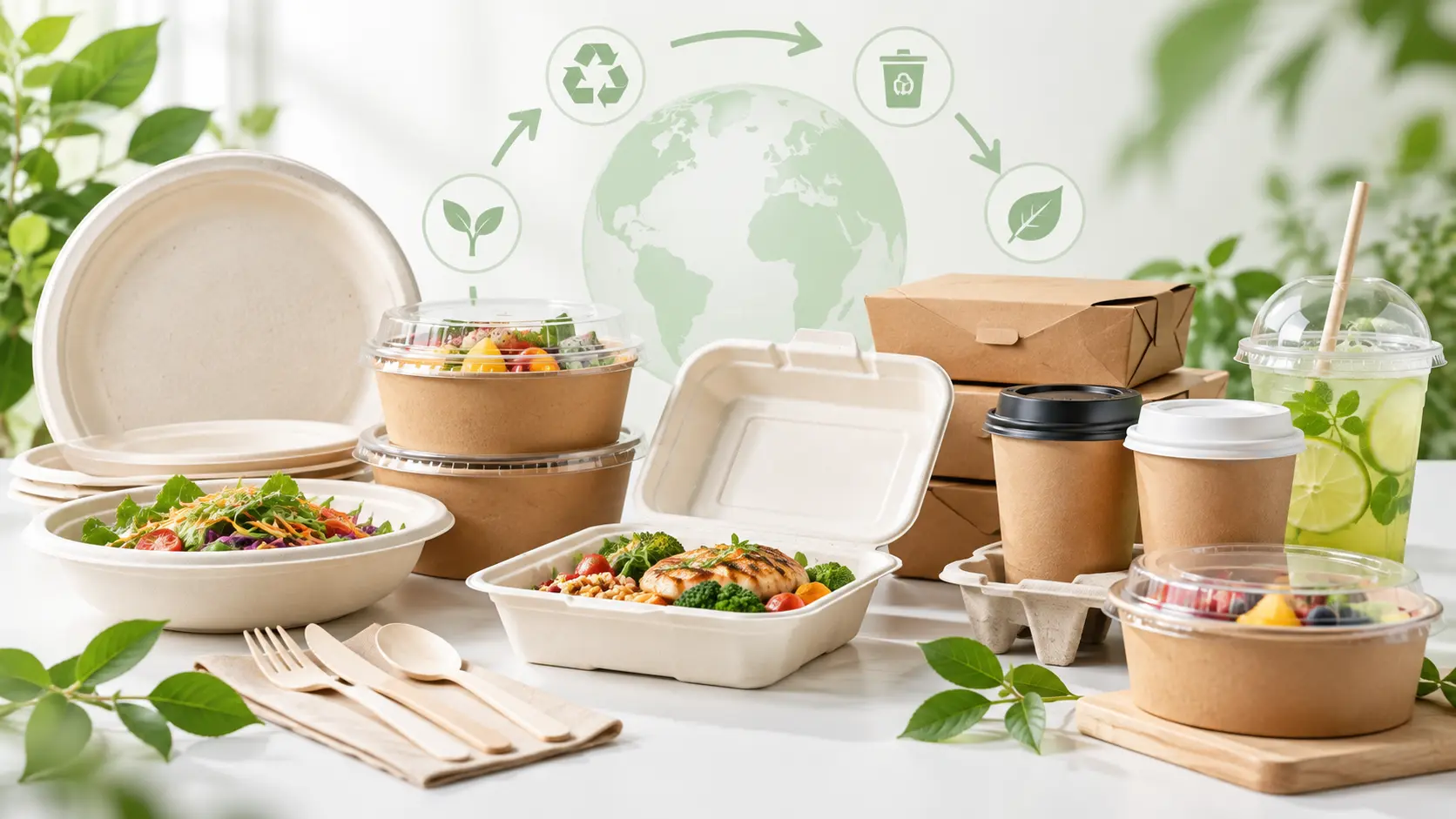
Что на самом деле означает “технически пригодный для переработки”?
Технически пригодный для переработки обычно означает, что материал или упаковка могут быть переработаны в пригодный вторичный материал при наличии подходящего оборудования, технологических условий и качества входного сырья.
Для бумажной упаковки для еды это может включать оценку способности к повторному роспуску, выхода пригодного волокна, отходов сит, барьерных покрытий, химии влагопрочности, клеев и загрязнений. Для упаковки из PET или PP техническая совместимость может, напротив, зависеть от типа полимера, этикеток, пигментов, клеев, застёжек, многослойных структур и чистоты потока восстановленного полимера.
Таким образом, техническая пригодность к переработке важна, но она отвечает лишь на первый вопрос. Она не подтверждает автоматически, что местные власти собирают данный предмет, что предприятие по восстановлению материалов может его извлечь или что переработчик примет его экономически выгодно.
Это различие особенно важно для упаковки из волокна с покрытием. Bioleader® подробнее рассмотрел структуру покрытия, способность к повторному роспуску, восстановление волокна и совместимость с фабриками в нашем руководстве по теме покрытие на водной основе против PLA против бумажных мисок и стаканов с покрытием PE. Цель данной статьи иная: она рассматривает всю систему между дизайном упаковки и фактической переработкой.
От пригодного для переработки материала к фактической переработке: модель пяти этапов
Практичный способ оценки пригодности упаковки для еды к переработке — рассматривать переработку как последовательность пяти этапов. Прохождение одного этапа не гарантирует прохождение следующего.
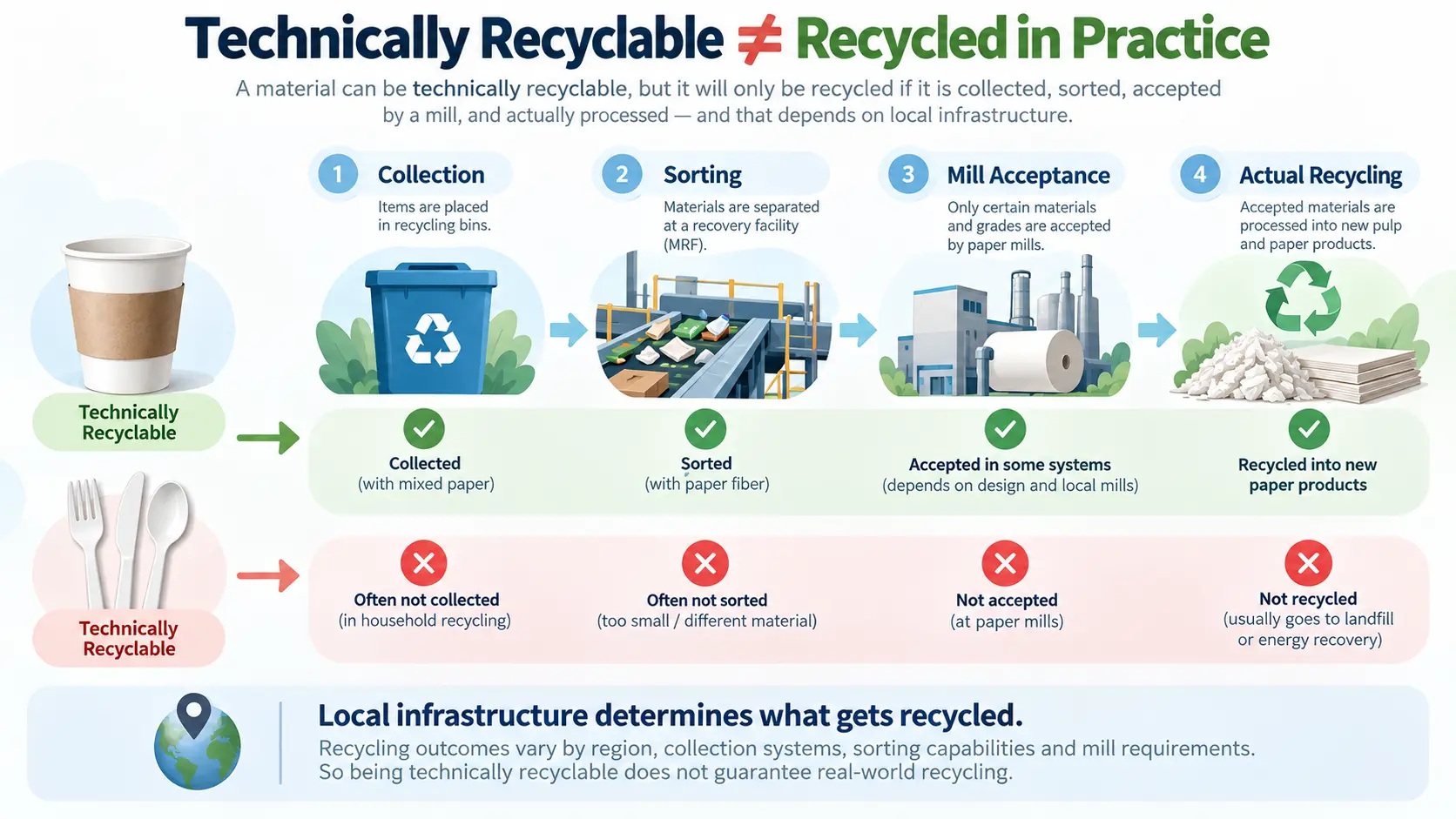
| Этап | Ключевой вопрос | Типичная точка отказа |
|---|---|---|
| 1. Техническая совместимость | Может ли конструкция упаковки технически быть направлена в подходящий процесс переработки? | Несовместимые покрытия, клеи, добавки, многослойные структуры или комбинации полимеров. |
| 2. Доступность сбора | Фактически собирается ли эта упаковка на целевом рынке? | Местная программа сбора бытовых или коммерческих отходов исключает данный формат. |
| 3. Сортировка и восстановление | Может ли упаковка быть идентифицирована и отделена в правильный поток материала? | Малый размер, необычная форма, смешанные компоненты, загрязнение или помехи для сортировки. |
| 4. Приёмка на переработку | Может ли переработчик или бумажная фабрика обработать её эффективно и с приемлемым качеством? | Низкий выход, чрезмерные отходы, загрязнение, низкая чистота полимера или неблагоприятная экономика. |
| 5. Жизнеспособность рынка сбыта | Есть ли полезное и экономически жизнеспособное применение для восстановленного материала? | Недостаточный спрос, низкое качество восстановленного материала или неблагоприятная рыночная экономика. |
Только после рассмотрения этих этапов становится осмысленным обсуждать, вероятно ли упаковка будет recycled in practice.
Gate 1: Is the Packaging Technically Compatible With Recycling?
Technical compatibility begins with the complete packaging structure rather than the headline material alone.
Paper-Based Food Packaging
A paper cup or paper food bowl may contain a high proportion of recoverable fiber, but its recycling performance can also be influenced by coating chemistry, coating weight, wet-strength additives, printing, adhesives, food residue and other components.
A paper mill needs to separate useful fibers from materials that cannot be incorporated into the recovered pulp. For this reason, statements such as “made from paper” are not sufficient evidence that every paper food package will behave identically during recycling.
PET and PP Food Packaging
PET and PP are established recyclable polymers, but polymer recyclability should not be confused with the recyclability of every finished product made from those polymers.
A large mono-material PET bottle, a clear PET cold cup and a small PET lid may enter the waste system differently. The same principle applies to a PP food tub, PP lid and PP fork. Geometry, component size, labels, pigments and the local sorting configuration can change the recovery outcome even when the resin family is the same.
Buyers comparing beverage formats can review Bioleader®’s broader guide to paper, PET, PP and PLA disposable cups for application differences before assessing the appropriate disposal pathway for each material.
Мнение производителя
Material specification should be treated as the beginning of a recyclability assessment, not the conclusion. For B2B purchasing, the full structure should be checked, including the main substrate, coating or lining, lid material, labels, adhesives and any separable components.
Gate 2: Is the Package Actually Collected?
A packaging format cannot reach a recycler if the collection system does not accept it.
This is one of the clearest differences between technical recyclability and recycling in practice. The United States provides a useful paper-cup example. In May 2026, the Foodservice Packaging Institute reported that approximately 20% of the U.S. population lived in communities where both hot and cold paper cups were accepted in residential recycling programs.
The number is important, but it must be interpreted correctly. It represents recycling access, not an actual 20% paper-cup recycling rate. Access means that residents in those communities have a collection pathway available; it does not demonstrate that every accepted cup is correctly disposed of, sorted, processed and converted into new material.
The American Forest & Paper Association has also stated that approximately 40 paper mills in North America can recycle paper cups, while advising consumers to check local recycling rules. Together, these points illustrate a central principle:
Processing capability does not guarantee collection access. A paper cup may be technically processable by suitable mills while still being excluded from recycling programs in many communities.
For international buyers sourcing бумажная упаковка для пищевых продуктов, this means a claim that works in one city, country or commercial waste system should not automatically be copied to another market.
Gate 3: Can the Package Be Correctly Sorted?
Collection does not mean that the package will necessarily reach the correct recycler. After collection, mixed materials commonly have to pass through sorting systems that separate fiber, plastics, metals and other material streams.
Material recovery facilities may use combinations of screens, optical sorting, near-infrared recognition, mechanical separation, air systems, robotic sorting and manual quality control. Actual configurations differ between markets and facilities.
Packaging can become difficult to recover when its physical format or components interfere with those systems. Relevant factors can include:
- A package may be too small to remain in the intended sorting stream.
- A lightweight lid or piece of cutlery may behave differently from a larger container made from the same polymer.
- Integrated components may cause the package to be directed toward the wrong material stream.
- Large decorative metallic areas, certain pigments or other features can interfere with some automated sorting technologies.
- Food residue can reduce sorting efficiency and recovered-material quality.
- A body and lid made from different materials can require different disposal or separation instructions.
The 2026 version of 4evergreen’s Circularity by Design Guideline specifically expanded guidance on sorting disruptors for paper-based packaging. This is an important development because it recognises that recyclability cannot be evaluated only by what happens inside the recycling mill; packaging must first reach the correct recycling stream.
Practical distinction: A polymer can be recyclable while a particular product format remains difficult to recover. A PP container and a PP fork may therefore have different real-world recycling outcomes even though both are made from polypropylene.
Gate 4: Will a Recycler or Paper Mill Actually Process It?
Once a package reaches the correct material stream, another question remains: can the downstream facility process it efficiently enough to justify acceptance?
For paper-based food packaging, mills may consider usable fiber yield, pulping behavior, screen rejects, coating separation, adhesives, wet-strength properties and contamination. For plastic recycling, processors may evaluate polymer purity, contamination, labels, pigments, component compatibility and the quality of the resulting recyclate.
This is why two apparently similar food packages can receive different recycling assessments. A change in barrier chemistry, coating weight, label system or component configuration may alter processing behavior even when the visible product looks almost identical.
The issue is particularly relevant when specifying крафт-бумажными коробками для еды. Kraft paperboard itself may be a valuable fiber source, but grease barriers, polymer linings, adhesives and food contamination still need to be considered when determining the appropriate recycling pathway.
For professional sourcing, supplier statements should therefore be supported by applicable specifications and, where available and relevant, testing such as repulpability, fiber-yield or recyclability assessments.
Gate 5: Is There a Viable End Market for the Recovered Material?
Recycling does not end when a recycler produces recovered fiber, PET flakes or PP recyclate. The recovered material must still have a technically suitable and economically viable downstream application.
The quality of secondary material affects where it can be used and what buyers are willing to pay for it. Contamination, mixed polymers, degraded fiber quality or inconsistent input streams can reduce the number of practical applications available.
This is the economic side of recyclability that is often missing from consumer-facing sustainability claims. A technically possible recycling process is more likely to operate consistently when collection volumes, processing efficiency, recovered-material quality and end-market demand work together.
For B2B packaging buyers, the result is clear: recycling infrastructure includes markets for recovered material, not only recycling bins and processing equipment.
Technically Recyclable, Designed for Recycling and Recycled at Scale Are Different
Several recycling terms are often used as though they describe the same condition. They do not.
| Термин | Практическое значение | Что это автоматически не доказывает |
|---|---|---|
| Technically Recyclable | The packaging can be processed under suitable technical conditions. | That it is locally collected or commonly recycled. |
| Designed for Recycling | The packaging has been designed to reduce interference with relevant collection, sorting and recycling processes. | That sufficient infrastructure or collection access already exists everywhere. |
| Accepted for Recycling | A specified local program permits consumers or businesses to place the item in a defined recycling stream. | That every collected unit reaches a recycler successfully. |
| Recycled in Practice | The packaging is actually collected, recovered, processed and converted into secondary material within a functioning system. | That the same outcome applies in every region. |
| Переработка в промышленных масштабах | A broader system-level condition involving recycling through sufficiently developed infrastructure and material flows. | That material-level technical recyclability alone is sufficient. |
This distinction is becoming increasingly important in European packaging regulation. Regulation (EU) 2025/40, the Packaging and Packaging Waste Regulation, separates design for recycling from the later requirement for packaging to be recycled at scale. The PPWR framework therefore moves recyclability assessment beyond a simple statement about material chemistry and toward the performance of packaging within collection, sorting and recycling systems.
Bioleader® maintains a separate technical guide covering the PPWR Declaration of Conformity for foodservice packaging, while our по глобальным правилам компостируемой упаковки на 2026 год explains why recycling, compostability, legal market access and labeling should be evaluated as separate compliance questions.
Four Real-World Examples Show Why Infrastructure Matters
1. Red Deer, Alberta: The Package Did Not Change, but the Recycling System Did
On October 1, 2026, Red Deer, Alberta expanded its residential recycling program to accept additional consumer packaging, including hot and cold beverage cups, ice-cream containers, plastic food containers, foam takeout packaging and several other formats.
The same announcement also listed plastic dishes and cutlery among items that remained unacceptable.
This is an unusually clear example of why material category alone cannot determine real-world recyclability. Infrastructure and program rules changed, allowing some existing packaging formats to enter the recycling system without requiring the underlying package itself to be redesigned.
Alberta’s broader Extended Producer Responsibility rollout reached its final implementation phase on October 1, 2026, expanding access to single-use-product recycling to approximately 97% of Albertans. Exact accepted materials and collection arrangements still need to be checked at community level.
Case lesson: Real-world recyclability can change when collection infrastructure changes, even when the material and packaging design remain exactly the same.
2. U.S. Paper Cups: Recyclable in Suitable Systems but Not Universally Collected
Paper cups illustrate another type of gap. Suitable North American paper mills can recover fiber from paper cups, and collection access has expanded significantly. Yet residential acceptance still does not cover the entire U.S. population.
The accurate conclusion is therefore not “paper cups cannot be recycled,” nor is it “paper cups are recyclable everywhere.” A more defensible description is:
Paper cups can be technically and commercially recyclable in suitable systems, while collection access and mill acceptance remain market-dependent.
3. California SB 343: A Recycling Claim Is Increasingly an Infrastructure Claim
California’s SB 343 provides another useful example because it links recyclability representations to real-world collection and processing conditions rather than relying only on a resin code or theoretical material capability.
CalRecycle uses statewide characterization work and related criteria to support determinations concerning whether products and packaging are routinely collected and processed for recycling.
The statutory timeline originally pointed to labeling restrictions for products and packaging manufactured after October 4, 2026. However, on July 14, 2026, a federal court issued a preliminary injunction in California League of Food Producers v. Bonta that currently blocks enforcement of SB 343 while the litigation proceeds. Buyers and brands should therefore check the current legal position before relying on the original enforcement timeline.
Compliance lesson: A recycling symbol is increasingly becoming a claim about the surrounding recovery system, not merely a claim about what the package is made from.
4. EU PPWR: Design for Recycling and Recycled at Scale Are Separate Concepts
The EU PPWR provides the clearest regulatory illustration of the same principle. Its recyclability framework considers whether packaging is designed for material recycling and whether waste packaging can be separately collected, sorted into defined streams and recycled into secondary raw materials of sufficient quality.
The regulation therefore distinguishes between designing packaging to work with recycling processes and demonstrating that recycling operates at meaningful scale. For buyers exporting foodservice packaging to Europe, these concepts should be incorporated into long-term material and packaging development rather than treated as interchangeable marketing terms.
How Recycling Reality Differs Across Food Packaging Formats
The following comparison shows why Bioleader® does not recommend applying a single recyclability claim across a multi-material foodservice packaging portfolio.
| Формат упаковки | Technical Consideration | Main Real-World Bottleneck |
|---|---|---|
| PE-Coated Paper Cup | Usable paper fiber may be recoverable in mills equipped to process coated cups. | Collection access, coating structure and mill acceptance. |
| Water-Based Coated Paper Cup | Recycling behavior depends on the specific barrier chemistry, coating weight and finished structure. | Product-specific evidence and local paper-mill compatibility. |
| PET Cold Cup | PET has established mechanical recycling technology. | Cup-format collection, sorting and contamination. |
| PET Крышка | The polymer itself may be technically recyclable. | Small component size and local sorting configuration. |
| PP Lid or Food Container | PP can be mechanically recycled in suitable systems. | Collection, sorting, polymer-stream quality and end-market demand. |
| Пластиковые столовые приборы | The base polymer may be technically recyclable. | Small format, low collection access and sorting losses. |
| Коробка для продуктов из крафт-бумаги | Fiber recovery depends partly on barrier, adhesives and contamination. | Food residue, coating structure and paper-mill acceptance. |
| Контейнер из жома | Molded fiber should not automatically be treated as conventional recyclable paper packaging. | Food contamination, wet-strength chemistry, local fiber-recovery rules and available organics or composting routes. |
The bagasse example deserves particular caution. Bioleader® supplies a broad range of варианты упаковки из багассы сахарного тростника, but molded-fiber products should not simply be placed under a generic “recyclable paper” claim.
Some molded-fiber formats may technically enter fiber-recovery systems under suitable conditions, but food contamination, barrier additives, wet-strength chemistry and local acceptance can change the preferred end-of-life route. In markets with suitable organics collection and composting infrastructure, certified compostability may be more relevant than a recycling claim for certain food-contaminated fiber products.
What Food Packaging Buyers Should Ask Suppliers
A professional packaging procurement process should move beyond asking suppliers for a single yes-or-no recyclability statement.
Buyer Checklist: Verifying Packaging Recyclability
- Confirm the exact material composition. Ask for the main substrate, polymer, fiber and any secondary materials.
- Identify the barrier structure. For paper packaging, confirm whether the barrier is PE, PLA, aqueous coating or another system.
- Check coating weight where relevant. Small structural differences can influence repulpability and reject levels.
- Confirm lid and component materials. The package body and lid may require different recovery pathways.
- Review labels and adhesives. These components can influence plastic or fiber recycling processes.
- Request applicable recyclability or repulpability evidence. Testing should correspond to the actual structure being purchased.
- Ask about fiber yield or screen rejects where relevant. These metrics can provide more technical insight than a generic “recyclable” statement.
- Verify destination-market collection rules. Local acceptance should not be inferred from another country or municipality.
- Check known recycler or mill acceptance. Processing capability is particularly important for coated and composite packaging.
- Define the intended disposal pathway before printing claims. Recycling, industrial composting and general waste are different systems and should not be presented as interchangeable.
Environmental claims should also match available documentation. Bioleader® publishes available сертификатами и протоколами испытаний covering selected packaging materials, food-contact requirements, compostability and related compliance areas. Buyers should verify that any report or certificate applies to the specific product structure, SKU and claim being made.
How Bioleader® Evaluates Packaging Recyclability
A Product-Specific Approach Instead of One Universal Claim
Bioleader® manufactures and supplies paper cups, paper bowls, kraft food boxes, bagasse food containers and other foodservice packaging for international B2B buyers. Because these products use different substrates, coatings and components, recyclability should be evaluated product by product and market by market.
For selected projects, buyers can request available material specifications, coating information, test reports, product samples and compliance documentation before bulk ordering. Where recyclability is a purchasing requirement, the destination market should be identified early so that the packaging structure, labeling and end-of-life claim can be reviewed against the intended collection and processing environment.
This is especially important for multinational restaurant chains, distributors and private-label buyers. A package sold into several countries may require different disposal instructions even when the physical SKU remains unchanged.
Recyclability Should Be Designed Around the Destination Market
The most useful sustainability decision is not necessarily to select the material with the strongest environmental-sounding label. The better approach is to align the packaging format with the waste-management system that is most likely to handle it after use.
For a market with established paper-cup collection and compatible mills, a fiber-recovery pathway may be practical. Where PET containers are widely collected and effectively sorted, PET recycling may have a stronger infrastructure position. Where heavily food-contaminated fiber packaging enters a well-managed organics stream, certified compostability may be more relevant.
None of these pathways should be assumed globally.
This is also why recycling and compostability should not be treated as competing marketing slogans. They are different end-of-life systems with different infrastructure requirements. A packaging buyer should first identify the destination-market waste pathway and then select the material, barrier structure and claim that best fit that system.
Conclusion: Recyclability Is a System Outcome
Technically recyclable is not the same as recycled in practice. Material compatibility is only the first gate. Real recycling depends on collection, sorting, recycler or mill acceptance, recovered-material quality and a viable end market.
For food packaging procurement, this means that resin codes, paper content and generic recycling symbols are not enough to determine the actual end-of-life outcome. Buyers should evaluate the complete packaging structure together with the waste-management infrastructure of the destination market.
Bioleader® supports international foodservice buyers with product specifications, available compliance documentation, samples and material options across paper, molded fiber and other disposable packaging formats. For projects where recycling or compostability claims affect purchasing decisions, the preferred approach is to define the destination country, application, packaging structure and intended disposal pathway before finalizing the specification.
Часто задаваемые вопросы
What does technically recyclable mean?
Technically recyclable means that a material or packaging structure can be processed into usable secondary material under suitable recycling conditions. It does not automatically mean that the package is accepted by local collection programs, successfully sorted or routinely recycled in the destination market.
Why is recyclable packaging not always recycled in practice?
Packaging can fail at several stages after disposal. It may not be accepted by the local collection program, may be lost during sorting, may not meet recycler or paper-mill specifications, or may produce recovered material with limited downstream demand. Actual recycling therefore depends on an entire system rather than material chemistry alone.
Are paper cups actually recycled?
Paper cups can be recycled in mills equipped to recover their fiber, but collection access and mill acceptance vary by market. In 2026, the Foodservice Packaging Institute reported that about 20% of the U.S. population had residential recycling access for both hot and cold paper cups. This figure represents access, not the percentage of cups actually recycled.
Is PET food packaging always recyclable?
No. PET is an established recyclable polymer, but the recycling outcome of a finished PET package depends on its format, size, labels, components, contamination and local collection and sorting system. A PET bottle, PET cup and small PET lid can therefore have different real-world recovery outcomes.
Why is plastic cutlery difficult to recycle?
Plastic cutlery may be made from a technically recyclable polymer, but forks, knives and spoons are relatively small product formats and are not accepted by many municipal recycling programs. Small size and sorting behavior can prevent them from reaching the appropriate polymer recycling stream.
What is the difference between design for recycling and recycled at scale?
Design for recycling concerns whether packaging has been designed to work effectively with relevant collection, sorting and recycling processes. Recycled at scale is a broader system-level condition indicating that recycling occurs through sufficiently developed infrastructure and material flows. The EU PPWR distinguishes between these concepts.
How should packaging buyers verify recyclability claims?
Buyers should verify material composition, barrier structure, coating type, component materials, available recyclability or repulpability testing, local collection rules and known recycler or mill acceptance. The destination market should always be considered before applying recycling labels or environmental claims.
Ссылки
- Европейский союз. Регламент (ЕС) 2025/40 об упаковке и упаковочных отходах. Official Journal of the European Union.
- Институт упаковки для предприятий общественного питания. Recycling Access Reaches 20% of U.S. Population for Paper Cups, Marking Major Progress. May 8, 2026.
- American Forest & Paper Association. Можно ли перерабатывать бумажные стаканы?.
- CalRecycle. SB 343: Accurate Recycling Labels. Includes the July 14, 2026 preliminary-injunction update.
- Правительство Альберты. Расширенная ответственность производителя. Alberta EPR implementation timeline.
- City of Red Deer. More Materials Accepted in Red Deer’s Recycling Program Starting October 1. September 24, 2026.
- 4evergreen. Circularity by Design Guideline, Version 4. 2026.
- 4evergreen. Guidance on the Improved Collection and Sorting of Paper-Based Packaging for Recycling. 2026.