Korte samenvatting: technisch recyclebaar versus in de praktijk gerecycled
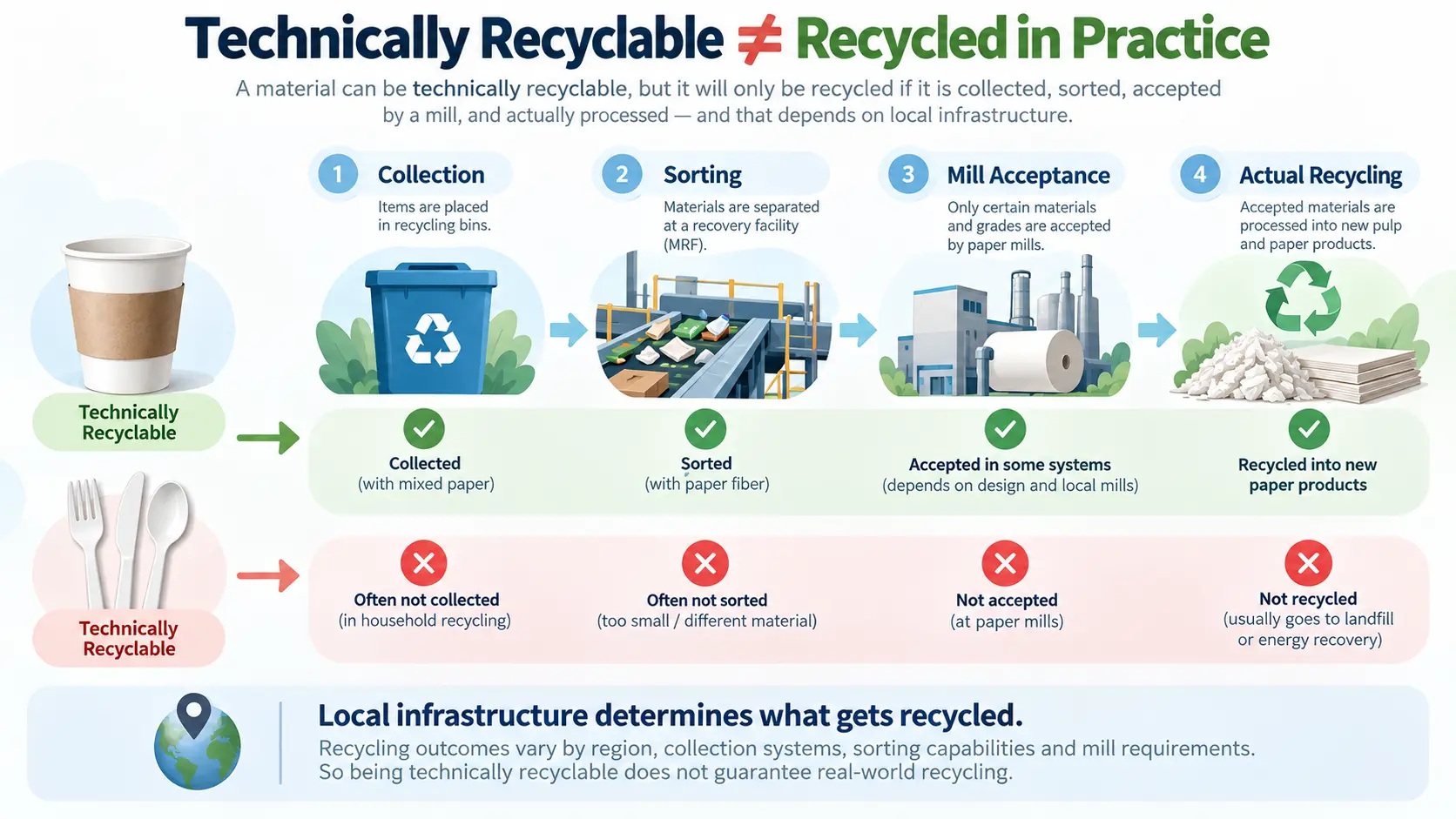
Een voedselverpakking kan technisch recyclebaar zijn zonder in de praktijk te worden gerecycled. Technische compatibiliteit is slechts de eerste stap. Echte recycling hangt er ook van af of de verpakking wordt ingezameld, correct gesorteerd, geaccepteerd door een recycler of papierfabriek en omgezet in een secundair materiaal met een levensvatbare eindmarkt.
- Technische recyclebaarheid: Het materiaal of de verpakkingsstructuur kan onder geschikte recyclingomstandigheden worden verwerkt.
- Inzameling: Het lokale huishoudelijke of commerciële recyclingsysteem accepteert de verpakking daadwerkelijk.
- Sortering: Een materiaalterugwinningsinstallatie kan de verpakking identificeren en in de juiste stroom scheiden.
- Herverwerking: Een recycler of papierfabriek kan het ingezamelde materiaal verwerken tegen acceptabele kwaliteit en opbrengst.
- Eindmarkt: De teruggewonnen vezel of polymeer heeft een praktische toepassing en koper in de keten.
Belangrijkste conclusie: Recyclebaarheid is een systeemuitkomst, niet simpelweg een materiaaleigenschap. Kopers van verpakkingen moeten daarom zowel het productontwerp als de afvalbeheerinfrastructuur van de bestemmingsmarkt beoordelen.
Een papieren beker, PET beker, polypropyleen deksel of kraft voedseldoos kan als recyclebaar worden beschreven omdat het hoofdmateriaal technisch in een gevestigd recyclingproces kan worden ingebracht. Die bewering vertelt een koper echter niet wat er gebeurt nadat de verpakking is gebruikt.
De verpakking moet nog steeds worden geaccepteerd door een inzamelprogramma, worden herkend en gescheiden tijdens de sortering, worden verwerkt door een geschikte recycler of papierfabriek en worden omgezet in teruggewonnen materiaal met een levensvatbare toepassing in de keten. Falen in een van deze fasen kan verhinderen dat een anders technisch recyclebare verpakking in de praktijk wordt gerecycled.
Dit onderscheid wordt steeds belangrijker voor foodserviceverpakkingen. Kopers die papieren bekers, plastic bekers, papieren kommen, afhaaldozen en gevormde vezelverpakkingen vergelijken, moeten beslissingen over het einde van de levensduur niet terugbrengen tot een simpel materiaallabel zoals “papier”, “PET” of “PP.” De relevante vraag is hoe het volledige verpakkingsformaat presteert binnen het werkelijke inzamel- en recyclingsysteem van de beoogde markt.
Belangrijkste conclusie: De juiste vraag is niet simpelweg “Is deze verpakking recyclebaar?” maar “In welke markt, welk inzamelsysteem, welk sorteerproces en welk recyclingproces is deze verpakking realistisch gezien recyclebaar?”
Wat betekent “technisch recyclebaar” eigenlijk?
Technisch recyclebaar betekent doorgaans dat een materiaal of verpakking kan worden verwerkt tot bruikbaar secundair materiaal wanneer geschikte apparatuur, procesomstandigheden en inputkwaliteit beschikbaar zijn.
Voor papieren voedselverpakkingen kan dit betekenen dat herpulpbaarheid, bruikbare vezelopbrengst, zeefafwijzingen, barrièrecoatings, natsterktechemie, lijmen en contaminatie moeten worden beoordeeld. Voor PET of PP verpakkingen kan technische compatibiliteit daarentegen afhangen van polymeeridentiteit, etiketten, pigmenten, lijmen, sluitingen, meerlaagse structuren en de zuiverheid van de teruggewonnen polymeerstroom.
Technische recyclebaarheid is dus belangrijk, maar beantwoordt slechts de eerste vraag. Het bevestigt niet automatisch dat een lokale autoriteit het item inzamelt, dat een materiaalterugwinningsinstallatie het kan terugwinnen of dat een recycler het economisch accepteert.
Dit onderscheid is vooral belangrijk voor gecoate vezelverpakkingen. Bioleader® heeft coatingstructuur, herpulpbaarheid, vezelterugwinning en compatibiliteit met papierfabrieken uitgebreider onderzocht in onze gids over watergedragen coating versus PLA versus PE beklede papieren kommen en bekers. Het doel van dit artikel is anders: het kijkt naar het volledige systeem tussen verpakkingsontwerp en daadwerkelijke recycling.
Van recyclebaar materiaal naar daadwerkelijke recycling: het vijf-poortenmodel
Een praktische manier om de recyclebaarheid van voedselverpakkingen te beoordelen, is recycling te behandelen als een reeks van vijf poorten. Het passeren van één poort garandeert niet dat de volgende wordt gepasseerd.
| Poort | Belangrijkste vraag | Typisch faalpunt |
|---|---|---|
| 1. Technische compatibiliteit | Kan de verpakkingsstructuur technisch in een geschikt recyclingproces worden ingebracht? | Incompatibele coatings, lijmen, additieven, meerlaagse structuren of polymeercombinaties. |
| 2. Toegang tot inzameling | Wordt deze verpakking in de bestemmingsmarkt daadwerkelijk ingezameld? | Het lokale huishoudelijke of commerciële programma sluit het formaat uit. |
| 3. Sortering en terugwinning | Kan de verpakking worden geïdentificeerd en in de juiste materiaalstroom worden gescheiden? | Klein formaat, ongebruikelijke vorm, gemengde componenten, contaminatie of sorteerverstoringen. |
| 4. Acceptatie bij herverwerking | Kan een recycler of papierfabriek het efficiënt en tegen acceptabele kwaliteit verwerken? | Lage opbrengst, overmatige afwijzingen, contaminatie, slechte polymeerzuiverheid of ongunstige economie. |
| 5. Levensvatbaarheid van de eindmarkt | Is er een nuttige en economisch levensvatbare bestemming voor het teruggewonnen materiaal? | Onvoldoende vraag, lage kwaliteit van het teruggewonnen materiaal of ongunstige markteconomie. |
Pas nadat deze poorten zijn overwogen, wordt het zinvol om te bespreken of een verpakking waarschijnlijk in de praktijk gerecycled.
Poort 1: Is de verpakking technisch compatibel met recycling?
Technische compatibiliteit begint bij de volledige verpakkingsstructuur en niet alleen bij het materiaal dat in de kop wordt genoemd.
Voedselverpakkingen van papier
Een papieren beker of papieren voedselkom kan een hoog aandeel terugwinbare vezels bevatten, maar de recyclingprestaties kunnen ook worden beïnvloed door de chemische samenstelling van de coating, het coatinggewicht, natsterkte-additieven, bedrukking, lijmen, voedselresten en andere componenten.
Een papiermolen moet bruikbare vezels scheiden van materialen die niet in de teruggewonnen pulp kunnen worden opgenomen. Daarom zijn uitspraken als “gemaakt van papier” geen voldoende bewijs dat elke papieren voedselverpakking zich tijdens recycling identiek zal gedragen.
PET en PP voedselverpakkingen
PET en PP zijn gevestigde recyclebare polymeren, maar de recyclebaarheid van een polymeer mag niet worden verward met de recyclebaarheid van elk eindproduct dat van die polymeren is gemaakt.
Een grote monomateriaal PET fles, een transparante PET koude beker en een klein PET deksel kunnen anders in het afvalstromensysteem terechtkomen. Hetzelfde principe geldt voor een PP voedselbak, PP deksel en PP vork. Geometrie, componentgrootte, etiketten, pigmenten en de lokale sorteerconfiguratie kunnen de terugwinning beïnvloeden, zelfs wanneer de harsfamilie dezelfde is.
Kopers die drankenformaten vergelijken kunnen de bredere gids van Bioleader® bekijken gids over papieren, PET, PP en PLA wegwerpbekers raadplegen voor toepassingsverschillen voordat zij de juiste afvoerroute voor elk materiaal beoordelen.
Inzicht van de fabrikant
Materiaalspecificatie moet worden beschouwd als het begin van een recyclebaarheidsbeoordeling, niet als de conclusie. Voor B2B inkoop moet de volledige structuur worden gecontroleerd, inclusief het hoofdmateriaal, de coating of bekleding, het dekselmateriaal, etiketten, lijmen en eventuele scheidbare componenten.
Poort 2: Wordt de verpakking daadwerkelijk ingezameld?
Een verpakkingsformaat kan een recycler niet bereiken als het inzamelsysteem het niet accepteert.
Dit is een van de duidelijkste verschillen tussen technische recyclebaarheid en recycling in de praktijk. De Verenigde Staten bieden een nuttig voorbeeld van papieren bekers. In mei 2026, meldde het Foodservice Packaging Institute dat ongeveer 20% van de Amerikaanse bevolking in gemeenschappen woonde waar zowel warme als koude papieren bekers werden geaccepteerd in recyclingprogramma's voor huishoudens.
Het aantal is belangrijk, maar het moet correct worden geïnterpreteerd. Het vertegenwoordigt toegang tot recycling, niet een daadwerkelijk 20% recyclingpercentage voor papieren bekers. Toegang betekent dat inwoners van die gemeenschappen een inzamelroute beschikbaar hebben; het toont niet aan dat elke geaccepteerde beker correct wordt weggegooid, gesorteerd, verwerkt en omgezet in nieuw materiaal.
De American Forest & Paper Association heeft ook verklaard dat ongeveer 40 papiermolens in Noord-Amerika papieren bekers kunnen recyclen, terwijl consumenten wordt geadviseerd de lokale recyclingregels te controleren. Samen illustreren deze punten een centraal principe:
Verwerkingscapaciteit garandeert geen toegang tot inzameling. Een papieren beker kan technisch verwerkbaar zijn door geschikte molens, terwijl deze in veel gemeenschappen toch wordt uitgesloten van recyclingprogramma's.
Voor internationale kopers die papieren voedselverpakking, inkopen, betekent dit dat een claim die in de ene stad, het ene land of het ene commerciële afvalsysteem werkt, niet automatisch naar een andere markt mag worden gekopieerd.
Poort 3: Kan de verpakking correct worden gesorteerd?
Inzameling betekent niet dat de verpakking noodzakelijkerwijs de juiste recycler bereikt. Na inzameling moeten gemengde materialen doorgaans door sorteersystemen gaan die vezels, kunststoffen, metalen en andere materiaalstromen scheiden.
Material recovery facilities kunnen combinaties gebruiken van zeven, optische sortering, nabij-infraroodherkenning, mechanische scheiding, luchtsystemen, robotsortering en handmatige kwaliteitscontrole. De werkelijke configuraties verschillen per markt en per faciliteit.
Verpakkingen kunnen moeilijk terug te winnen zijn wanneer hun fysieke vorm of componenten deze systemen verstoren. Relevante factoren kunnen zijn:
- Een verpakking kan te klein zijn om in de beoogde sorteerstroom te blijven.
- Een lichtgewicht deksel of stuk bestek kan zich anders gedragen dan een grotere container van hetzelfde polymeer.
- Geïntegreerde componenten kunnen ervoor zorgen dat de verpakking naar de verkeerde materiaalstroom wordt geleid.
- Grote decoratieve metaaloppervlakken, bepaalde pigmenten of andere kenmerken kunnen sommige geautomatiseerde sorteertechnologieën verstoren.
- Voedselresten kunnen de sorteerefficiëntie en de kwaliteit van het teruggewonnen materiaal verminderen.
- Een body en deksel van verschillende materialen kunnen verschillende afvoer- of scheidingsinstructies vereisen.
De 2026 versie van 4evergreen's Circularity by Design Guideline breidde de richtlijnen specifiek uit over sorteerverstoorders voor verpakkingen op papierbasis. Dit is een belangrijke ontwikkeling omdat hiermee wordt erkend dat recyclebaarheid niet alleen kan worden beoordeeld op basis van wat er in de recyclingmolen gebeurt; verpakkingen moeten eerst de juiste recyclingstroom bereiken.
Praktisch onderscheid: Een polymeer kan recyclebaar zijn terwijl een bepaald productformaat moeilijk terug te winnen blijft. Een PP container en een PP vork kunnen daarom in de praktijk verschillende recyclingresultaten hebben, ook al zijn beide gemaakt van polypropyleen.
Poort 4: Zal een recycler of papiermolen het daadwerkelijk verwerken?
Zodra een verpakking de juiste materiaalstroom bereikt, blijft er nog een vraag: kan de downstreamfaciliteit het efficiënt genoeg verwerken om acceptatie te rechtvaardigen?
Voor voedselverpakkingen op papierbasis kunnen molens rekening houden met bruikbare vezelopbrengst, pulpinggedrag, zeefresten, scheiding van coatings, lijmen, natsterkte-eigenschappen en verontreiniging. Voor kunststofrecycling kunnen verwerkers polymeerzuiverheid, verontreiniging, etiketten, pigmenten, compatibiliteit van componenten en de kwaliteit van het resulterende recyclaat beoordelen.
Daarom kunnen twee ogenschijnlijk vergelijkbare voedselverpakkingen verschillende recyclingbeoordelingen krijgen. Een verandering in barrièrechemie, coatinggewicht, etiketsysteem of componentconfiguratie kan het verwerkingsgedrag veranderen, zelfs wanneer het zichtbare product bijna identiek lijkt.
De kwestie is bijzonder relevant bij het specificeren van kraftpapieren voedseldozen. Kraftpapier of verpakkingskarton zelf kan een waardevolle vezelbron zijn, maar vetbarrières, polymeerbekledingen, lijmen en voedselverontreiniging moeten nog steeds worden overwogen bij het bepalen van de juiste recyclingroute.
Voor professionele inkoop moeten leveranciersverklaringen daarom worden ondersteund door toepasselijke specificaties en, waar beschikbaar en relevant, tests zoals beoordelingen van herpulpbaarheid, vezelopbrengst of recyclebaarheid.
Poort 5: Is er een levensvatbare eindmarkt voor het teruggewonnen materiaal?
Recycling does not end when a recycler produces recovered fiber, PET flakes or PP recyclate. The recovered material must still have a technically suitable and economically viable downstream application.
The quality of secondary material affects where it can be used and what buyers are willing to pay for it. Contamination, mixed polymers, degraded fiber quality or inconsistent input streams can reduce the number of practical applications available.
This is the economic side of recyclability that is often missing from consumer-facing sustainability claims. A technically possible recycling process is more likely to operate consistently when collection volumes, processing efficiency, recovered-material quality and end-market demand work together.
For B2B packaging buyers, the result is clear: recycling infrastructure includes markets for recovered material, not only recycling bins and processing equipment.
Technically Recyclable, Designed for Recycling and Recycled at Scale Are Different
Several recycling terms are often used as though they describe the same condition. They do not.
| Term | Praktische betekenis | Wat het niet automatisch bewijst |
|---|---|---|
| Technically Recyclable | The packaging can be processed under suitable technical conditions. | That it is locally collected or commonly recycled. |
| Designed for Recycling | The packaging has been designed to reduce interference with relevant collection, sorting and recycling processes. | That sufficient infrastructure or collection access already exists everywhere. |
| Accepted for Recycling | A specified local program permits consumers or businesses to place the item in a defined recycling stream. | That every collected unit reaches a recycler successfully. |
| Recycled in Practice | The packaging is actually collected, recovered, processed and converted into secondary material within a functioning system. | That the same outcome applies in every region. |
| Recycling op schaal | A broader system-level condition involving recycling through sufficiently developed infrastructure and material flows. | That material-level technical recyclability alone is sufficient. |
This distinction is becoming increasingly important in European packaging regulation. Regulation (EU) 2025/40, the Packaging and Packaging Waste Regulation, separates design for recycling from the later requirement for packaging to be recycled at scale. The PPWR framework therefore moves recyclability assessment beyond a simple statement about material chemistry and toward the performance of packaging within collection, sorting and recycling systems.
Bioleader® maintains a separate technical guide covering the PPWR Declaration of Conformity for foodservice packaging, while our 2026 wereldwijde gids voor composteerbare verpakkingsregelgeving explains why recycling, compostability, legal market access and labeling should be evaluated as separate compliance questions.
Four Real-World Examples Show Why Infrastructure Matters
1. Red Deer, Alberta: The Package Did Not Change, but the Recycling System Did
On October 1, 2026, Red Deer, Alberta expanded its residential recycling program to accept additional consumer packaging, including hot and cold beverage cups, ice-cream containers, plastic food containers, foam takeout packaging and several other formats.
The same announcement also listed plastic dishes and cutlery among items that remained unacceptable.
This is an unusually clear example of why material category alone cannot determine real-world recyclability. Infrastructure and program rules changed, allowing some existing packaging formats to enter the recycling system without requiring the underlying package itself to be redesigned.
Alberta’s broader Extended Producer Responsibility rollout reached its final implementation phase on October 1, 2026, expanding access to single-use-product recycling to approximately 97% of Albertans. Exact accepted materials and collection arrangements still need to be checked at community level.
Case lesson: Real-world recyclability can change when collection infrastructure changes, even when the material and packaging design remain exactly the same.
2. U.S. Paper Cups: Recyclable in Suitable Systems but Not Universally Collected
Paper cups illustrate another type of gap. Suitable North American paper mills can recover fiber from paper cups, and collection access has expanded significantly. Yet residential acceptance still does not cover the entire U.S. population.
The accurate conclusion is therefore not “paper cups cannot be recycled,” nor is it “paper cups are recyclable everywhere.” A more defensible description is:
Paper cups can be technically and commercially recyclable in suitable systems, while collection access and mill acceptance remain market-dependent.
3. California SB 343: A Recycling Claim Is Increasingly an Infrastructure Claim
California’s SB 343 provides another useful example because it links recyclability representations to real-world collection and processing conditions rather than relying only on a resin code or theoretical material capability.
CalRecycle uses statewide characterization work and related criteria to support determinations concerning whether products and packaging are routinely collected and processed for recycling.
The statutory timeline originally pointed to labeling restrictions for products and packaging manufactured after October 4, 2026. However, on July 14, 2026, a federal court issued a preliminary injunction in California League of Food Producers v. Bonta that currently blocks enforcement of SB 343 while the litigation proceeds. Buyers and brands should therefore check the current legal position before relying on the original enforcement timeline.
Compliance lesson: A recycling symbol is increasingly becoming a claim about the surrounding recovery system, not merely a claim about what the package is made from.
4. EU PPWR: Design for Recycling and Recycled at Scale Are Separate Concepts
The EU PPWR provides the clearest regulatory illustration of the same principle. Its recyclability framework considers whether packaging is designed for material recycling and whether waste packaging can be separately collected, sorted into defined streams and recycled into secondary raw materials of sufficient quality.
The regulation therefore distinguishes between designing packaging to work with recycling processes and demonstrating that recycling operates at meaningful scale. For buyers exporting foodservice packaging to Europe, these concepts should be incorporated into long-term material and packaging development rather than treated as interchangeable marketing terms.
How Recycling Reality Differs Across Food Packaging Formats
The following comparison shows why Bioleader® does not recommend applying a single recyclability claim across a multi-material foodservice packaging portfolio.
| Verpakkingsformaat | Technical Consideration | Main Real-World Bottleneck |
|---|---|---|
| PE-Coated Paper Cup | Usable paper fiber may be recoverable in mills equipped to process coated cups. | Collection access, coating structure and mill acceptance. |
| Water-Based Coated Paper Cup | Recycling behavior depends on the specific barrier chemistry, coating weight and finished structure. | Product-specific evidence and local paper-mill compatibility. |
| PET Cold Cup | PET has established mechanical recycling technology. | Cup-format collection, sorting and contamination. |
| PET Deksel | The polymer itself may be technically recyclable. | Small component size and local sorting configuration. |
| PP Lid or Food Container | PP can be mechanically recycled in suitable systems. | Collection, sorting, polymer-stream quality and end-market demand. |
| Plastic bestek | The base polymer may be technically recyclable. | Small format, low collection access and sorting losses. |
| Kraft papier voedseldoos | Fiber recovery depends partly on barrier, adhesives and contamination. | Food residue, coating structure and paper-mill acceptance. |
| Bagasse container | Molded fiber should not automatically be treated as conventional recyclable paper packaging. | Food contamination, wet-strength chemistry, local fiber-recovery rules and available organics or composting routes. |
The bagasse example deserves particular caution. Bioleader® supplies a broad range of suikerrietbagasse verpakkingen, but molded-fiber products should not simply be placed under a generic “recyclable paper” claim.
Some molded-fiber formats may technically enter fiber-recovery systems under suitable conditions, but food contamination, barrier additives, wet-strength chemistry and local acceptance can change the preferred end-of-life route. In markets with suitable organics collection and composting infrastructure, certified compostability may be more relevant than a recycling claim for certain food-contaminated fiber products.
What Food Packaging Buyers Should Ask Suppliers
A professional packaging procurement process should move beyond asking suppliers for a single yes-or-no recyclability statement.
Buyer Checklist: Verifying Packaging Recyclability
- Confirm the exact material composition. Ask for the main substrate, polymer, fiber and any secondary materials.
- Identify the barrier structure. For paper packaging, confirm whether the barrier is PE, PLA, aqueous coating or another system.
- Check coating weight where relevant. Small structural differences can influence repulpability and reject levels.
- Confirm lid and component materials. The package body and lid may require different recovery pathways.
- Review labels and adhesives. These components can influence plastic or fiber recycling processes.
- Request applicable recyclability or repulpability evidence. Testing should correspond to the actual structure being purchased.
- Ask about fiber yield or screen rejects where relevant. These metrics can provide more technical insight than a generic “recyclable” statement.
- Verify destination-market collection rules. Local acceptance should not be inferred from another country or municipality.
- Check known recycler or mill acceptance. Processing capability is particularly important for coated and composite packaging.
- Define the intended disposal pathway before printing claims. Recycling, industrial composting and general waste are different systems and should not be presented as interchangeable.
Environmental claims should also match available documentation. Bioleader® publishes available certificaten en testrapporten covering selected packaging materials, food-contact requirements, compostability and related compliance areas. Buyers should verify that any report or certificate applies to the specific product structure, SKU and claim being made.
How Bioleader® Evaluates Packaging Recyclability
A Product-Specific Approach Instead of One Universal Claim
Bioleader® manufactures and supplies paper cups, paper bowls, kraft food boxes, bagasse food containers and other foodservice packaging for international B2B buyers. Because these products use different substrates, coatings and components, recyclability should be evaluated product by product and market by market.
For selected projects, buyers can request available material specifications, coating information, test reports, product samples and compliance documentation before bulk ordering. Where recyclability is a purchasing requirement, the destination market should be identified early so that the packaging structure, labeling and end-of-life claim can be reviewed against the intended collection and processing environment.
This is especially important for multinational restaurant chains, distributors and private-label buyers. A package sold into several countries may require different disposal instructions even when the physical SKU remains unchanged.
Recyclability Should Be Designed Around the Destination Market
The most useful sustainability decision is not necessarily to select the material with the strongest environmental-sounding label. The better approach is to align the packaging format with the waste-management system that is most likely to handle it after use.
For a market with established paper-cup collection and compatible mills, a fiber-recovery pathway may be practical. Where PET containers are widely collected and effectively sorted, PET recycling may have a stronger infrastructure position. Where heavily food-contaminated fiber packaging enters a well-managed organics stream, certified compostability may be more relevant.
None of these pathways should be assumed globally.
This is also why recycling and compostability should not be treated as competing marketing slogans. They are different end-of-life systems with different infrastructure requirements. A packaging buyer should first identify the destination-market waste pathway and then select the material, barrier structure and claim that best fit that system.
Conclusion: Recyclability Is a System Outcome
Technically recyclable is not the same as recycled in practice. Material compatibility is only the first gate. Real recycling depends on collection, sorting, recycler or mill acceptance, recovered-material quality and a viable end market.
For food packaging procurement, this means that resin codes, paper content and generic recycling symbols are not enough to determine the actual end-of-life outcome. Buyers should evaluate the complete packaging structure together with the waste-management infrastructure of the destination market.
Bioleader® supports international foodservice buyers with product specifications, available compliance documentation, samples and material options across paper, molded fiber and other disposable packaging formats. For projects where recycling or compostability claims affect purchasing decisions, the preferred approach is to define the destination country, application, packaging structure and intended disposal pathway before finalizing the specification.
Veelgestelde vragen
What does technically recyclable mean?
Technically recyclable means that a material or packaging structure can be processed into usable secondary material under suitable recycling conditions. It does not automatically mean that the package is accepted by local collection programs, successfully sorted or routinely recycled in the destination market.
Why is recyclable packaging not always recycled in practice?
Packaging can fail at several stages after disposal. It may not be accepted by the local collection program, may be lost during sorting, may not meet recycler or paper-mill specifications, or may produce recovered material with limited downstream demand. Actual recycling therefore depends on an entire system rather than material chemistry alone.
Are paper cups actually recycled?
Paper cups can be recycled in mills equipped to recover their fiber, but collection access and mill acceptance vary by market. In 2026, the Foodservice Packaging Institute reported that about 20% of the U.S. population had residential recycling access for both hot and cold paper cups. This figure represents access, not the percentage of cups actually recycled.
Is PET food packaging always recyclable?
No. PET is an established recyclable polymer, but the recycling outcome of a finished PET package depends on its format, size, labels, components, contamination and local collection and sorting system. A PET bottle, PET cup and small PET lid can therefore have different real-world recovery outcomes.
Why is plastic cutlery difficult to recycle?
Plastic cutlery may be made from a technically recyclable polymer, but forks, knives and spoons are relatively small product formats and are not accepted by many municipal recycling programs. Small size and sorting behavior can prevent them from reaching the appropriate polymer recycling stream.
What is the difference between design for recycling and recycled at scale?
Design for recycling concerns whether packaging has been designed to work effectively with relevant collection, sorting and recycling processes. Recycled at scale is a broader system-level condition indicating that recycling occurs through sufficiently developed infrastructure and material flows. The EU PPWR distinguishes between these concepts.
How should packaging buyers verify recyclability claims?
Buyers should verify material composition, barrier structure, coating type, component materials, available recyclability or repulpability testing, local collection rules and known recycler or mill acceptance. The destination market should always be considered before applying recycling labels or environmental claims.
Referenties
- Europese Unie. Verordening (EU) 2025/40 betreffende verpakking en verpakkingsafval. Official Journal of the European Union.
- Foodservice Packaging Institute. Recycling Access Reaches 20% of U.S. Population for Paper Cups, Marking Major Progress. May 8, 2026.
- American Forest & Paper Association. Kunnen papieren bekers worden gerecycled?.
- CalRecycle. SB 343: Accurate Recycling Labels. Includes the July 14, 2026 preliminary-injunction update.
- Government of Alberta. Uitgebreide producentenverantwoordelijkheid. Alberta EPR implementation timeline.
- City of Red Deer. More Materials Accepted in Red Deer’s Recycling Program Starting October 1. September 24, 2026.
- 4evergreen. Circularity by Design Guideline, Version 4. 2026.
- 4evergreen. Guidance on the Improved Collection and Sorting of Paper-Based Packaging for Recycling. 2026.