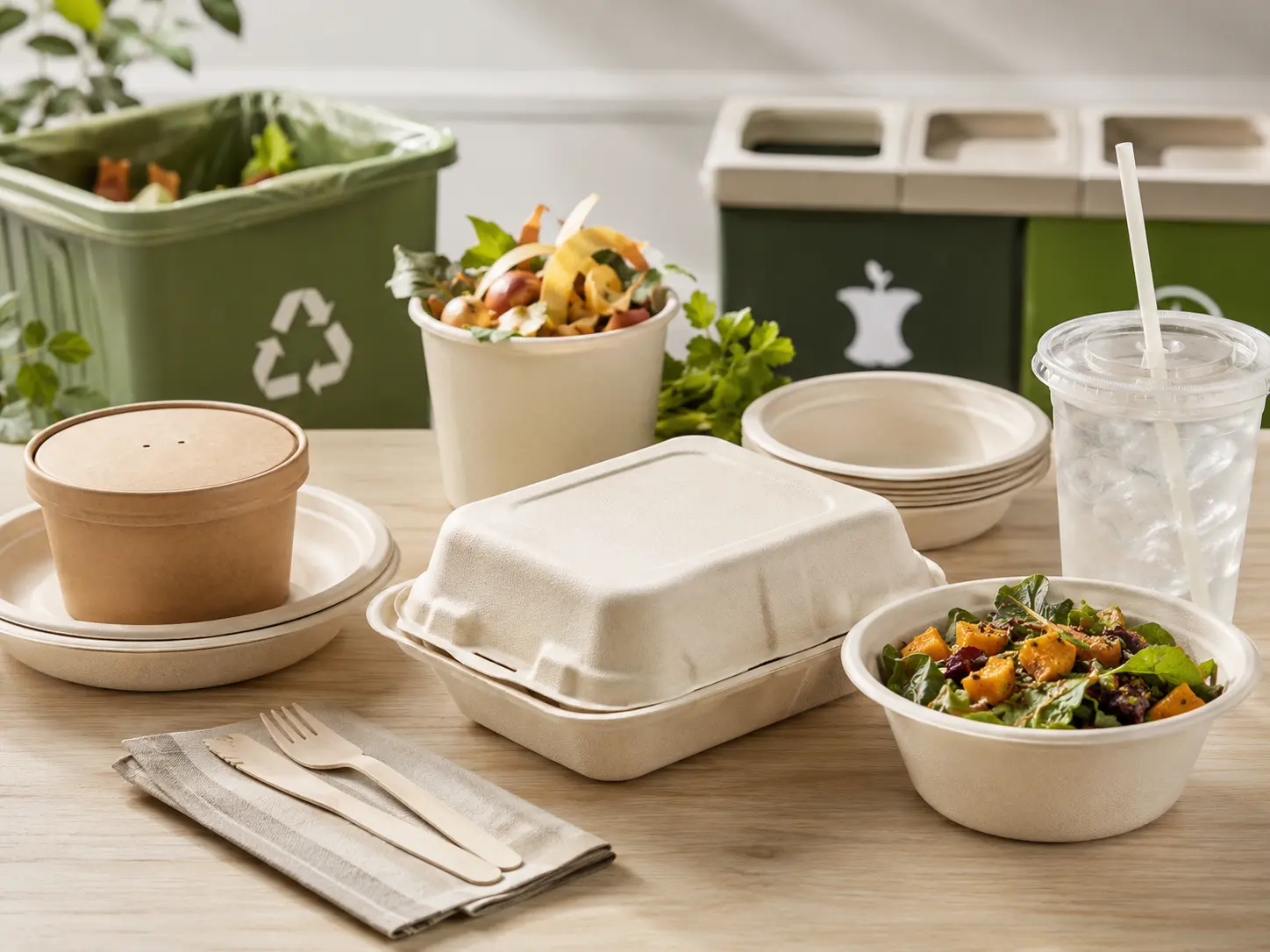









概要: 技術的にリサイクル可能と実際にリサイクルされることの違い
食品包装は、技術的にリサイクル可能であっても、実際にはリサイクルされないことがあります。. 技術的な適合性は最初のステップにすぎません。実際のリサイクルは、その包装が回収され、正しく分別され、リサイクル業者や製紙工場に受け入れられ、そして市場性のある二次材料に変換されるかどうかにもかかっています。.
- 技術的なリサイクル可能性: 材料または包装構造が、適切なリサイクル条件下で処理できること。.
- 回収: 地域の家庭用または事業用リサイクルシステムが、実際にその包装を受け入れていること。.
- 分別: 材料回収施設がその包装を識別し、正しい流れに分離できること。.
- 再処理: リサイクル業者または製紙工場が、許容できる品質と収率で回収材料を処理できること。.
- 最終市場: 回収された繊維またはポリマーに、実用的な下流用途と買い手があること。.
重要なポイント: リサイクル可能性はシステム全体の結果であり、単なる材料の特性ではありません。したがって包装の購入者は、製品設計と、仕向け市場の廃棄物管理インフラの両方を評価すべきです。.
紙カップ、PETカップ、ポリプロピレン製のふた、クラフト紙のフードボックスは、その主要材料が技術的に確立されたリサイクル工程に入れるという理由で、リサイクル可能と表現されることがあります。しかしその表現は、包装が使用された後に何が起こるかを購入者に伝えるものではありません。.
包装は依然として、回収プログラムに受け入れられ、分別の過程で識別・分離され、適切なリサイクル業者または製紙工場で処理され、市場性のある下流用途を持つ回収材料に変換されなければなりません。これらの段階のいずれかで失敗すると、技術的にはリサイクル可能な包装であっても、実際にはリサイクルされない可能性があります。.
この区別はフードサービス向け包装においてますます重要になっています。購入者が比較する際には 紙コップ, 、プラスチックカップ、紙ボウル、テイクアウトボックス、モールドファイバー包装などを、「紙」「PET」「PP」といった単純な材料ラベルに還元して廃棄後の判断をすべきではありません。重要な問いは、その包装形態全体が、対象市場の実際の回収・リサイクルシステムの中でどのように機能するかです。.
重要なポイント: 正しい問いは、単に「この包装はリサイクル可能か?」ではありません。「どの市場、回収システム、分別経路、リサイクル工程において、この包装は現実的にリサイクル可能なのか?」です。“
「技術的にリサイクル可能」とは実際に何を意味するのか?
技術的にリサイクル可能とは 一般的に、適切な設備、工程条件、投入品質が利用可能な場合に、材料または包装を有用な二次材料に処理できることを意味します。.
紙ベースの食品包装の場合、これは再パルプ化性、使用可能な繊維収率、スクリーン除去物、バリアコーティング、湿潤強度薬剤、接着剤、汚染などの評価を伴うことがあります。PETまたはPP包装の場合、技術的な適合性は代わりに、ポリマーの種類、ラベル、顔料、接着剤、閉鎖部、多層構造、回収ポリマー流の純度に依存することがあります。.
したがって技術的なリサイクル可能性は重要ですが、最初の問いに答えるだけです。地方自治体がその物品を回収しているか、材料回収施設がそれを回収できるか、リサイクル業者が経済的に受け入れるかは、自動的に確認するものではありません。.
この区別はコーティングされた繊維包装にとって特に重要です。Bioleader®は、コーティング構造、再パルプ化性、繊維回収、製紙工場との適合性について、以下のガイドでより詳しく検討しています: 水性コーティング vs PLA vs PE ライニング紙ボウルとカップ. 。本記事の目的は異なります。包装設計と実際のリサイクルの間にあるシステム全体を考察します。.
リサイクル可能な材料から実際のリサイクルへ: 5つのゲートモデル
食品包装のリサイクル可能性を評価する実用的な方法は、リサイクルを5つのゲートの連続として捉えることです。1つのゲートを通過しても、次のゲートを通過することは保証されません。.
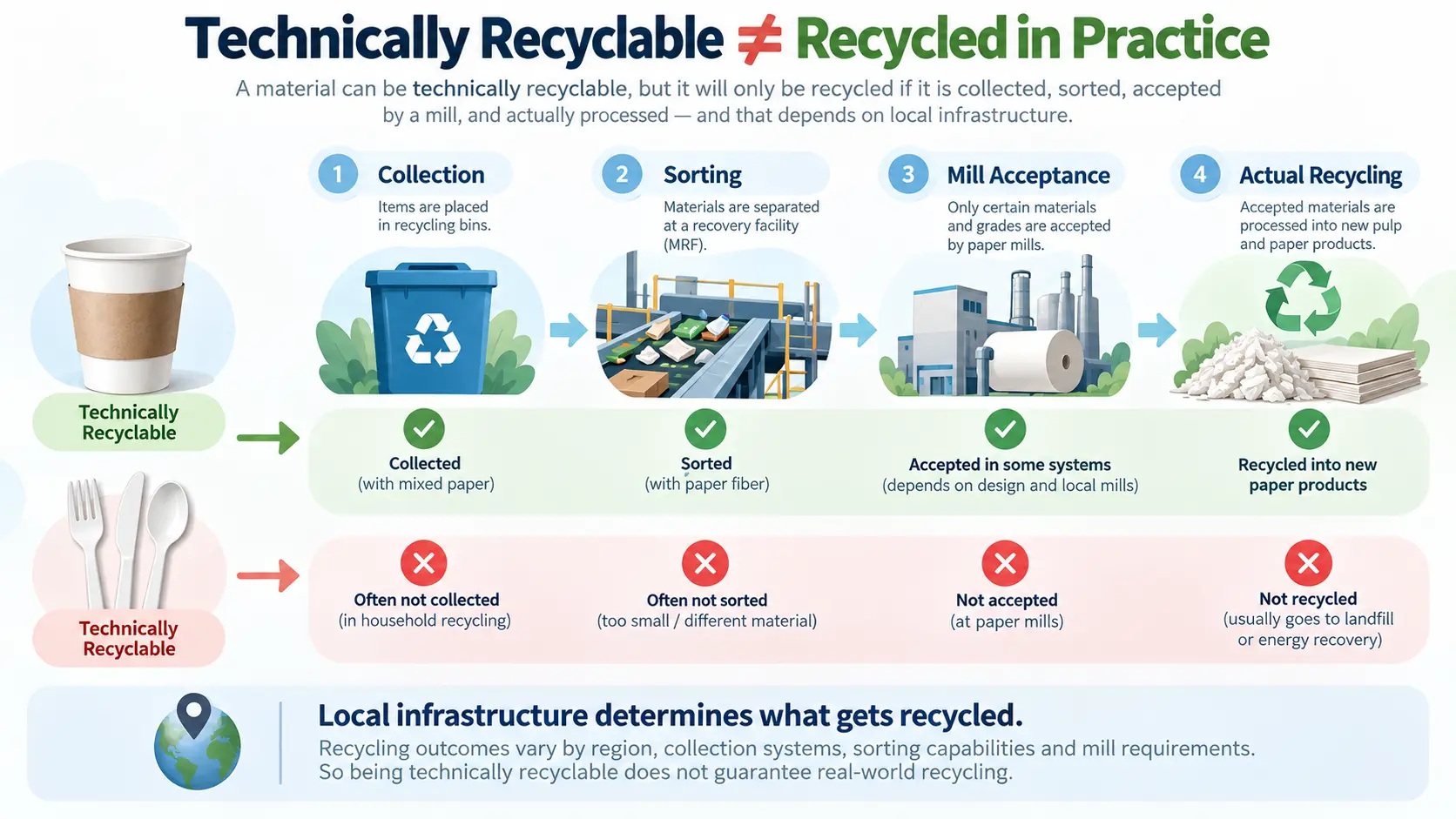
| ゲート | 重要な質問 | 典型的な失敗ポイント |
|---|---|---|
| 1. 技術的適合性 | 包装構造は技術的に適切なリサイクル工程に入れるか? | 不適合なコーティング、接着剤、添加剤、多層構造、ポリマーの組み合わせ。. |
| 2. 回収へのアクセス | 仕向け市場は実際にこの包装を回収しているか? | 地域の家庭用または事業用プログラムがその形態を除外している。. |
| 3. 分別と回収 | 包装を識別し、正しい材料の流れに分離できるか? | 小さなサイズ、特殊な形状、混合部品、汚染、分別を妨げる要因。. |
| 4. 再処理の受け入れ | リサイクル業者または製紙工場が、許容できる品質で効率的に処理できるか? | 低収率、過剰な除去物、汚染、不十分なポリマー純度、不利な経済性。. |
| 5. 最終市場の実現可能性 | 回収材料に有用で経済的に実行可能な行き先があるか? | 需要不足、回収材料の品質低下、不利な市場経済性。. |
これらのゲートを考慮して初めて、包装がリサイクルされる可能性が高いかどうかを議論することが意味を持ちます。 recycled in practice.
Gate 1: Is the Packaging Technically Compatible With Recycling?
Technical compatibility begins with the complete packaging structure rather than the headline material alone.
Paper-Based Food Packaging
A paper cup or paper food bowl may contain a high proportion of recoverable fiber, but its recycling performance can also be influenced by coating chemistry, coating weight, wet-strength additives, printing, adhesives, food residue and other components.
A paper mill needs to separate useful fibers from materials that cannot be incorporated into the recovered pulp. For this reason, statements such as “made from paper” are not sufficient evidence that every paper food package will behave identically during recycling.
PET and PP Food Packaging
PET and PP are established recyclable polymers, but polymer recyclability should not be confused with the recyclability of every finished product made from those polymers.
A large mono-material PET bottle, a clear PET cold cup and a small PET lid may enter the waste system differently. The same principle applies to a PP food tub, PP lid and PP fork. Geometry, component size, labels, pigments and the local sorting configuration can change the recovery outcome even when the resin family is the same.
Buyers comparing beverage formats can review Bioleader®’s broader guide to paper, PET, PP and PLA disposable cups for application differences before assessing the appropriate disposal pathway for each material.
メーカーからの洞察
Material specification should be treated as the beginning of a recyclability assessment, not the conclusion. For B2B purchasing, the full structure should be checked, including the main substrate, coating or lining, lid material, labels, adhesives and any separable components.
Gate 2: Is the Package Actually Collected?
A packaging format cannot reach a recycler if the collection system does not accept it.
This is one of the clearest differences between technical recyclability and recycling in practice. The United States provides a useful paper-cup example. In May 2026, the Foodservice Packaging Institute reported that approximately 20% of the U.S. population lived in communities where both hot and cold paper cups were accepted in residential recycling programs.
The number is important, but it must be interpreted correctly. It represents recycling access, not an actual 20% paper-cup recycling rate. Access means that residents in those communities have a collection pathway available; it does not demonstrate that every accepted cup is correctly disposed of, sorted, processed and converted into new material.
The American Forest & Paper Association has also stated that approximately 40 paper mills in North America can recycle paper cups, while advising consumers to check local recycling rules. Together, these points illustrate a central principle:
Processing capability does not guarantee collection access. A paper cup may be technically processable by suitable mills while still being excluded from recycling programs in many communities.
For international buyers sourcing 紙製食品包装, this means a claim that works in one city, country or commercial waste system should not automatically be copied to another market.
Gate 3: Can the Package Be Correctly Sorted?
Collection does not mean that the package will necessarily reach the correct recycler. After collection, mixed materials commonly have to pass through sorting systems that separate fiber, plastics, metals and other material streams.
Material recovery facilities may use combinations of screens, optical sorting, near-infrared recognition, mechanical separation, air systems, robotic sorting and manual quality control. Actual configurations differ between markets and facilities.
Packaging can become difficult to recover when its physical format or components interfere with those systems. Relevant factors can include:
- A package may be too small to remain in the intended sorting stream.
- A lightweight lid or piece of cutlery may behave differently from a larger container made from the same polymer.
- Integrated components may cause the package to be directed toward the wrong material stream.
- Large decorative metallic areas, certain pigments or other features can interfere with some automated sorting technologies.
- Food residue can reduce sorting efficiency and recovered-material quality.
- A body and lid made from different materials can require different disposal or separation instructions.
The 2026 version of 4evergreen’s Circularity by Design Guideline specifically expanded guidance on sorting disruptors for paper-based packaging. This is an important development because it recognises that recyclability cannot be evaluated only by what happens inside the recycling mill; packaging must first reach the correct recycling stream.
Practical distinction: A polymer can be recyclable while a particular product format remains difficult to recover. A PP container and a PP fork may therefore have different real-world recycling outcomes even though both are made from polypropylene.
Gate 4: Will a Recycler or Paper Mill Actually Process It?
Once a package reaches the correct material stream, another question remains: can the downstream facility process it efficiently enough to justify acceptance?
For paper-based food packaging, mills may consider usable fiber yield, pulping behavior, screen rejects, coating separation, adhesives, wet-strength properties and contamination. For plastic recycling, processors may evaluate polymer purity, contamination, labels, pigments, component compatibility and the quality of the resulting recyclate.
This is why two apparently similar food packages can receive different recycling assessments. A change in barrier chemistry, coating weight, label system or component configuration may alter processing behavior even when the visible product looks almost identical.
The issue is particularly relevant when specifying クラフト紙フードボックス. Kraft paperboard itself may be a valuable fiber source, but grease barriers, polymer linings, adhesives and food contamination still need to be considered when determining the appropriate recycling pathway.
For professional sourcing, supplier statements should therefore be supported by applicable specifications and, where available and relevant, testing such as repulpability, fiber-yield or recyclability assessments.
Gate 5: Is There a Viable End Market for the Recovered Material?
Recycling does not end when a recycler produces recovered fiber, PET flakes or PP recyclate. The recovered material must still have a technically suitable and economically viable downstream application.
The quality of secondary material affects where it can be used and what buyers are willing to pay for it. Contamination, mixed polymers, degraded fiber quality or inconsistent input streams can reduce the number of practical applications available.
This is the economic side of recyclability that is often missing from consumer-facing sustainability claims. A technically possible recycling process is more likely to operate consistently when collection volumes, processing efficiency, recovered-material quality and end-market demand work together.
For B2B packaging buyers, the result is clear: recycling infrastructure includes markets for recovered material, not only recycling bins and processing equipment.
Technically Recyclable, Designed for Recycling and Recycled at Scale Are Different
Several recycling terms are often used as though they describe the same condition. They do not.
| 用語 | 欧州委員会が調和されたラベリング規則を採択する法定期限は、すべての包装が最終ラベルを付ける必要がある日付と同じではありません。 | 自動的に証明されるわけではないこと |
|---|---|---|
| Technically Recyclable | The packaging can be processed under suitable technical conditions. | That it is locally collected or commonly recycled. |
| Designed for Recycling | The packaging has been designed to reduce interference with relevant collection, sorting and recycling processes. | That sufficient infrastructure or collection access already exists everywhere. |
| Accepted for Recycling | A specified local program permits consumers or businesses to place the item in a defined recycling stream. | That every collected unit reaches a recycler successfully. |
| Recycled in Practice | The packaging is actually collected, recovered, processed and converted into secondary material within a functioning system. | That the same outcome applies in every region. |
| リサイクル規模でのリサイクル | A broader system-level condition involving recycling through sufficiently developed infrastructure and material flows. | That material-level technical recyclability alone is sufficient. |
This distinction is becoming increasingly important in European packaging regulation. Regulation (EU) 2025/40, the Packaging and Packaging Waste Regulation, separates design for recycling from the later requirement for packaging to be recycled at scale. The PPWR framework therefore moves recyclability assessment beyond a simple statement about material chemistry and toward the performance of packaging within collection, sorting and recycling systems.
Bioleader® maintains a separate technical guide covering the PPWR Declaration of Conformity for foodservice packaging, while our 2026年世界の堆肥化可能な包装規制ガイド explains why recycling, compostability, legal market access and labeling should be evaluated as separate compliance questions.
Four Real-World Examples Show Why Infrastructure Matters
1. Red Deer, Alberta: The Package Did Not Change, but the Recycling System Did
On October 1, 2026, Red Deer, Alberta expanded its residential recycling program to accept additional consumer packaging, including hot and cold beverage cups, ice-cream containers, plastic food containers, foam takeout packaging and several other formats.
The same announcement also listed plastic dishes and cutlery among items that remained unacceptable.
This is an unusually clear example of why material category alone cannot determine real-world recyclability. Infrastructure and program rules changed, allowing some existing packaging formats to enter the recycling system without requiring the underlying package itself to be redesigned.
Alberta’s broader Extended Producer Responsibility rollout reached its final implementation phase on October 1, 2026, expanding access to single-use-product recycling to approximately 97% of Albertans. Exact accepted materials and collection arrangements still need to be checked at community level.
Case lesson: Real-world recyclability can change when collection infrastructure changes, even when the material and packaging design remain exactly the same.
2. U.S. Paper Cups: Recyclable in Suitable Systems but Not Universally Collected
Paper cups illustrate another type of gap. Suitable North American paper mills can recover fiber from paper cups, and collection access has expanded significantly. Yet residential acceptance still does not cover the entire U.S. population.
The accurate conclusion is therefore not “paper cups cannot be recycled,” nor is it “paper cups are recyclable everywhere.” A more defensible description is:
Paper cups can be technically and commercially recyclable in suitable systems, while collection access and mill acceptance remain market-dependent.
3. California SB 343: A Recycling Claim Is Increasingly an Infrastructure Claim
California’s SB 343 provides another useful example because it links recyclability representations to real-world collection and processing conditions rather than relying only on a resin code or theoretical material capability.
CalRecycle uses statewide characterization work and related criteria to support determinations concerning whether products and packaging are routinely collected and processed for recycling.
The statutory timeline originally pointed to labeling restrictions for products and packaging manufactured after October 4, 2026. However, on July 14, 2026, a federal court issued a preliminary injunction in California League of Food Producers v. Bonta that currently blocks enforcement of SB 343 while the litigation proceeds. Buyers and brands should therefore check the current legal position before relying on the original enforcement timeline.
Compliance lesson: A recycling symbol is increasingly becoming a claim about the surrounding recovery system, not merely a claim about what the package is made from.
4. EU PPWR: Design for Recycling and Recycled at Scale Are Separate Concepts
The EU PPWR provides the clearest regulatory illustration of the same principle. Its recyclability framework considers whether packaging is designed for material recycling and whether waste packaging can be separately collected, sorted into defined streams and recycled into secondary raw materials of sufficient quality.
The regulation therefore distinguishes between designing packaging to work with recycling processes and demonstrating that recycling operates at meaningful scale. For buyers exporting foodservice packaging to Europe, these concepts should be incorporated into long-term material and packaging development rather than treated as interchangeable marketing terms.
How Recycling Reality Differs Across Food Packaging Formats
The following comparison shows why Bioleader® does not recommend applying a single recyclability claim across a multi-material foodservice packaging portfolio.
| 包装形態 | Technical Consideration | Main Real-World Bottleneck |
|---|---|---|
| PE-Coated Paper Cup | Usable paper fiber may be recoverable in mills equipped to process coated cups. | Collection access, coating structure and mill acceptance. |
| Water-Based Coated Paper Cup | Recycling behavior depends on the specific barrier chemistry, coating weight and finished structure. | Product-specific evidence and local paper-mill compatibility. |
| PET Cold Cup | PET has established mechanical recycling technology. | Cup-format collection, sorting and contamination. |
| PET 蓋 | The polymer itself may be technically recyclable. | Small component size and local sorting configuration. |
| PP Lid or Food Container | PP can be mechanically recycled in suitable systems. | Collection, sorting, polymer-stream quality and end-market demand. |
| プラスチック製カトラリー | The base polymer may be technically recyclable. | Small format, low collection access and sorting losses. |
| クラフト紙フードボックス | Fiber recovery depends partly on barrier, adhesives and contamination. | Food residue, coating structure and paper-mill acceptance. |
| バガス容器 | Molded fiber should not automatically be treated as conventional recyclable paper packaging. | Food contamination, wet-strength chemistry, local fiber-recovery rules and available organics or composting routes. |
The bagasse example deserves particular caution. Bioleader® supplies a broad range of サトウキビバガス包装, but molded-fiber products should not simply be placed under a generic “recyclable paper” claim.
Some molded-fiber formats may technically enter fiber-recovery systems under suitable conditions, but food contamination, barrier additives, wet-strength chemistry and local acceptance can change the preferred end-of-life route. In markets with suitable organics collection and composting infrastructure, certified compostability may be more relevant than a recycling claim for certain food-contaminated fiber products.
What Food Packaging Buyers Should Ask Suppliers
A professional packaging procurement process should move beyond asking suppliers for a single yes-or-no recyclability statement.
Buyer Checklist: Verifying Packaging Recyclability
- Confirm the exact material composition. Ask for the main substrate, polymer, fiber and any secondary materials.
- Identify the barrier structure. For paper packaging, confirm whether the barrier is PE, PLA, aqueous coating or another system.
- Check coating weight where relevant. Small structural differences can influence repulpability and reject levels.
- Confirm lid and component materials. The package body and lid may require different recovery pathways.
- Review labels and adhesives. These components can influence plastic or fiber recycling processes.
- Request applicable recyclability or repulpability evidence. Testing should correspond to the actual structure being purchased.
- Ask about fiber yield or screen rejects where relevant. These metrics can provide more technical insight than a generic “recyclable” statement.
- Verify destination-market collection rules. Local acceptance should not be inferred from another country or municipality.
- Check known recycler or mill acceptance. Processing capability is particularly important for coated and composite packaging.
- Define the intended disposal pathway before printing claims. Recycling, industrial composting and general waste are different systems and should not be presented as interchangeable.
Environmental claims should also match available documentation. Bioleader® publishes available 認証書と試験報告書 covering selected packaging materials, food-contact requirements, compostability and related compliance areas. Buyers should verify that any report or certificate applies to the specific product structure, SKU and claim being made.
How Bioleader® Evaluates Packaging Recyclability
A Product-Specific Approach Instead of One Universal Claim
Bioleader® manufactures and supplies paper cups, paper bowls, kraft food boxes, bagasse food containers and other foodservice packaging for international B2B buyers. Because these products use different substrates, coatings and components, recyclability should be evaluated product by product and market by market.
For selected projects, buyers can request available material specifications, coating information, test reports, product samples and compliance documentation before bulk ordering. Where recyclability is a purchasing requirement, the destination market should be identified early so that the packaging structure, labeling and end-of-life claim can be reviewed against the intended collection and processing environment.
This is especially important for multinational restaurant chains, distributors and private-label buyers. A package sold into several countries may require different disposal instructions even when the physical SKU remains unchanged.
Recyclability Should Be Designed Around the Destination Market
The most useful sustainability decision is not necessarily to select the material with the strongest environmental-sounding label. The better approach is to align the packaging format with the waste-management system that is most likely to handle it after use.
For a market with established paper-cup collection and compatible mills, a fiber-recovery pathway may be practical. Where PET containers are widely collected and effectively sorted, PET recycling may have a stronger infrastructure position. Where heavily food-contaminated fiber packaging enters a well-managed organics stream, certified compostability may be more relevant.
None of these pathways should be assumed globally.
This is also why recycling and compostability should not be treated as competing marketing slogans. They are different end-of-life systems with different infrastructure requirements. A packaging buyer should first identify the destination-market waste pathway and then select the material, barrier structure and claim that best fit that system.
Conclusion: Recyclability Is a System Outcome
Technically recyclable is not the same as recycled in practice. Material compatibility is only the first gate. Real recycling depends on collection, sorting, recycler or mill acceptance, recovered-material quality and a viable end market.
For food packaging procurement, this means that resin codes, paper content and generic recycling symbols are not enough to determine the actual end-of-life outcome. Buyers should evaluate the complete packaging structure together with the waste-management infrastructure of the destination market.
Bioleader® supports international foodservice buyers with product specifications, available compliance documentation, samples and material options across paper, molded fiber and other disposable packaging formats. For projects where recycling or compostability claims affect purchasing decisions, the preferred approach is to define the destination country, application, packaging structure and intended disposal pathway before finalizing the specification.
よくある質問
What does technically recyclable mean?
Technically recyclable means that a material or packaging structure can be processed into usable secondary material under suitable recycling conditions. It does not automatically mean that the package is accepted by local collection programs, successfully sorted or routinely recycled in the destination market.
Why is recyclable packaging not always recycled in practice?
Packaging can fail at several stages after disposal. It may not be accepted by the local collection program, may be lost during sorting, may not meet recycler or paper-mill specifications, or may produce recovered material with limited downstream demand. Actual recycling therefore depends on an entire system rather than material chemistry alone.
Are paper cups actually recycled?
Paper cups can be recycled in mills equipped to recover their fiber, but collection access and mill acceptance vary by market. In 2026, the Foodservice Packaging Institute reported that about 20% of the U.S. population had residential recycling access for both hot and cold paper cups. This figure represents access, not the percentage of cups actually recycled.
Is PET food packaging always recyclable?
No. PET is an established recyclable polymer, but the recycling outcome of a finished PET package depends on its format, size, labels, components, contamination and local collection and sorting system. A PET bottle, PET cup and small PET lid can therefore have different real-world recovery outcomes.
Why is plastic cutlery difficult to recycle?
Plastic cutlery may be made from a technically recyclable polymer, but forks, knives and spoons are relatively small product formats and are not accepted by many municipal recycling programs. Small size and sorting behavior can prevent them from reaching the appropriate polymer recycling stream.
What is the difference between design for recycling and recycled at scale?
Design for recycling concerns whether packaging has been designed to work effectively with relevant collection, sorting and recycling processes. Recycled at scale is a broader system-level condition indicating that recycling occurs through sufficiently developed infrastructure and material flows. The EU PPWR distinguishes between these concepts.
How should packaging buyers verify recyclability claims?
Buyers should verify material composition, barrier structure, coating type, component materials, available recyclability or repulpability testing, local collection rules and known recycler or mill acceptance. The destination market should always be considered before applying recycling labels or environmental claims.
参考文献
- 欧州連合。. 包装および包装廃棄物に関する規則(EU) 2025/40. Official Journal of the European Union.
- フードサービス包装協会。. Recycling Access Reaches 20% of U.S. Population for Paper Cups, Marking Major Progress. May 8, 2026.
- American Forest & Paper Association. 紙カップはリサイクルできますか?.
- CalRecycle. SB 343: Accurate Recycling Labels. Includes the July 14, 2026 preliminary-injunction update.
- アルバータ州政府。. 拡大生産者責任. Alberta EPR implementation timeline.
- City of Red Deer. More Materials Accepted in Red Deer’s Recycling Program Starting October 1. September 24, 2026.
- 4evergreen. Circularity by Design Guideline, Version 4. 2026.
- 4evergreen. Guidance on the Improved Collection and Sorting of Paper-Based Packaging for Recycling. 2026.