Introduction: The Ink Dilemma in Food Packaging
Custom printing on food packaging has become a powerful brand asset. Restaurants, cafés, food delivery platforms, and global chains increasingly demand vibrant designs, personalized logos, and sustainable aesthetics to strengthen brand recognition. Yet, this growing appetite for custom food packaging inks raises a difficult dilemma: how to remain compliant with strict global food safety and packaging laws while also meeting creative marketing needs.
The 2025 regulatory environment is particularly demanding. The European Union’s Regulation (EC) No. 1935/2004, the Swiss Ordinance on printing inks, the U.S. FDA’s regulations on food-contact substances, and the ongoing Packaging and Packaging Waste Regulation (PPWR) framework all set stringent standards. Beyond that, consumer watchdogs and NGOs are more active than ever, publishing testing results on packaging inks and holding brands accountable for potential contamination or migration into food.
The issue lies in migration testing—the process of verifying that substances from inks, coatings, or adhesives do not migrate into the food beyond set limits. For importers, distributors, and brands, the risk of failing a migration test can mean lost contracts, legal penalties, and reputational harm. At the same time, suppliers need flexibility: companies want custom colors, new seasonal graphics, and specialized marketing prints.
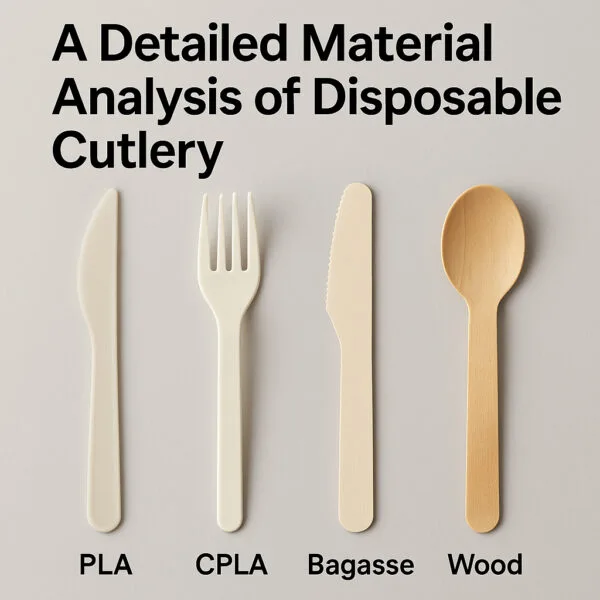
This guide provides a detailed roadmap on how to customize food packaging inks without breaking compliance, including an overview of testing methods, global regulations, safe customization options, buyer documentation needs, and integration with sustainable packaging products such as bagasse food containers, kraft paper bowls, PLA cups, and compostable CPLA cutlery.
Understanding Migration Tests
Food packaging inks must comply with limits on chemical migration to ensure consumer safety. There are several types of tests, each designed to evaluate different risks:
Overall Migration Tests (OMT)
These measure the total amount of non-volatile substances that migrate from packaging into food simulants. The EU generally sets an overall migration limit of 10 mg/dm² of surface area in contact with food.Specific Migration Tests (SMT)
These target specific substances of concern such as heavy metals (lead, cadmium), solvents, or monomers. For example, substances like styrene, benzophenone, and certain amines are closely monitored.MOSH/MOAH Testing
Mineral Oil Saturated Hydrocarbons (MOSH) and Mineral Oil Aromatic Hydrocarbons (MOAH) have been found in recycled board and inks. Their migration into food raises potential carcinogenic risks, leading to tighter restrictions.PFAS-Free Requirements
With rising awareness of per- and polyfluoroalkyl substances (PFAS), migration testing is extending into fluorinated substances. Some states and EU proposals already include mandatory testing or thresholds, often 50 ppm total PFAS.
Testing Methods:
Common laboratory techniques include GC-MS (Gas Chromatography-Mass Spectrometry) for volatile compounds, LC-MS/MS (Liquid Chromatography-Mass Spectrometry) for specific non-volatile chemicals, and total fluorine screening to detect PFAS. The U.S. EPA’s draft Method 1633 is increasingly referenced for PFAS monitoring.
Failing a migration test can lead to recalls, import rejections, and even litigation. A notable case involved food wraps imported into the EU from Asia that failed MOSH/MOAH tests; the importer lost both the shipment and the retailer contract.
📊 Scientific Data on Food Packaging Inks & Migration Tests
| Category | Key Data / Limit | Source / Context |
|---|---|---|
| Overall Migration Limit (OML) | ≤ 10 mg/dm² of food contact surface | EU Regulation (EC) No 1935/2004 |
| Specific Migration Limits (SML) | As low as 0.01 mg/kg food for some amines & monomers | EU Positive List substances |
| MOSH/MOAH Migration | Up to 20 mg/kg food detected in recycled board inks | EFSA studies, 2021 |
| PFAS Threshold | 50 ppm total organic fluorine | U.S. state bans (e.g., CA, WA) |
| PFAS in Fast Food Packaging | 50% of 118 samples contained >20 ppm organic fluorine | Consumer Reports study, 2022 |
| Consumer Concern | 70% of consumers check packaging safety cues | NielsenIQ survey |
| Brand Priorities | 62% of food brands rank ink testing as top 3 compliance priority | Deloitte, 2023 |
| Market Growth of Low Migration Inks | USD 2.4B in 2023 → 4.2B in 2030, CAGR ~7.8% | Market Research Future, 2023 |
Compliance Standards and Global Regulations
Several overlapping global frameworks regulate food packaging inks:
European Union (EU)
Regulation (EC) No. 1935/2004 sets the overarching requirement that materials in contact with food must not transfer substances in quantities that could endanger health, change food composition, or alter taste and odor.
The Swiss Ordinance on Printing Inks (SR 817.023.21) provides a positive list of permitted substances for printing inks. Although national, it has influenced EU discussions.
The PPWR (Packaging and Packaging Waste Regulation) adds new requirements on recyclability and labeling. Ink formulations must also align with sustainable design principles.
United States (FDA)
FDA 21 CFR 176.170 and related sections regulate substances that can be used in food contact packaging. While not as prescriptive as the EU, FDA requires safety evaluation of any new or non-listed substances.
Other Regions
China’s GB standards include migration limits for heavy metals and printing inks.
Canada and Japan also rely on general safety clauses but are moving toward stricter ink guidelines.
Key Trend: By 2025, regulators are converging toward requiring low migration inks and full declaration of compliance (DOC/COC) from suppliers. Importers must align with these rules to avoid non-compliance.
| Region | Regulation | Ink Requirement | Key Notes |
|---|---|---|---|
| EU | Reg. (EC) 1935/2004 | OML ≤ 10 mg/dm²; SML for listed substances | Swiss Ordinance as reference for inks |
| U.S. | FDA 21 CFR 176.170 | General safety clause; pre-market approval for new substances | No positive list |
| China | GB Standards | Limits on heavy metals & solvents | Increasingly aligned with EU |
| Canada | Food & Drugs Act | General safety, case-by-case evaluation | Moving toward EU style rules |
Customization Without Breaking Compliance
Brands want packaging that reflects identity, seasonal themes, and promotional campaigns. Customization is inevitable. However, customization must respect compliance boundaries.
Safe Areas for Customization:
Colors: Use of pigments from approved positive lists, avoiding restricted heavy metals.
Logos & Graphics: Designs can be adjusted freely, provided inks are compliant.
Surface Coverage: Partial vs. full-surface prints may impact migration risk, but compliant inks allow flexibility.
Non-Negotiable Compliance Rules:
Ink Formulation: Cannot use pigments or solvents not authorized under regulations.
Drying & Curing: Incomplete curing increases risk of migration.
Functional Barriers: Laminates or coatings must be proven effective.
Low Migration Ink Technology
Low migration inks are formulated with raw materials that minimize transfer into food. They are commonly used in flexographic and offset printing for food packaging.
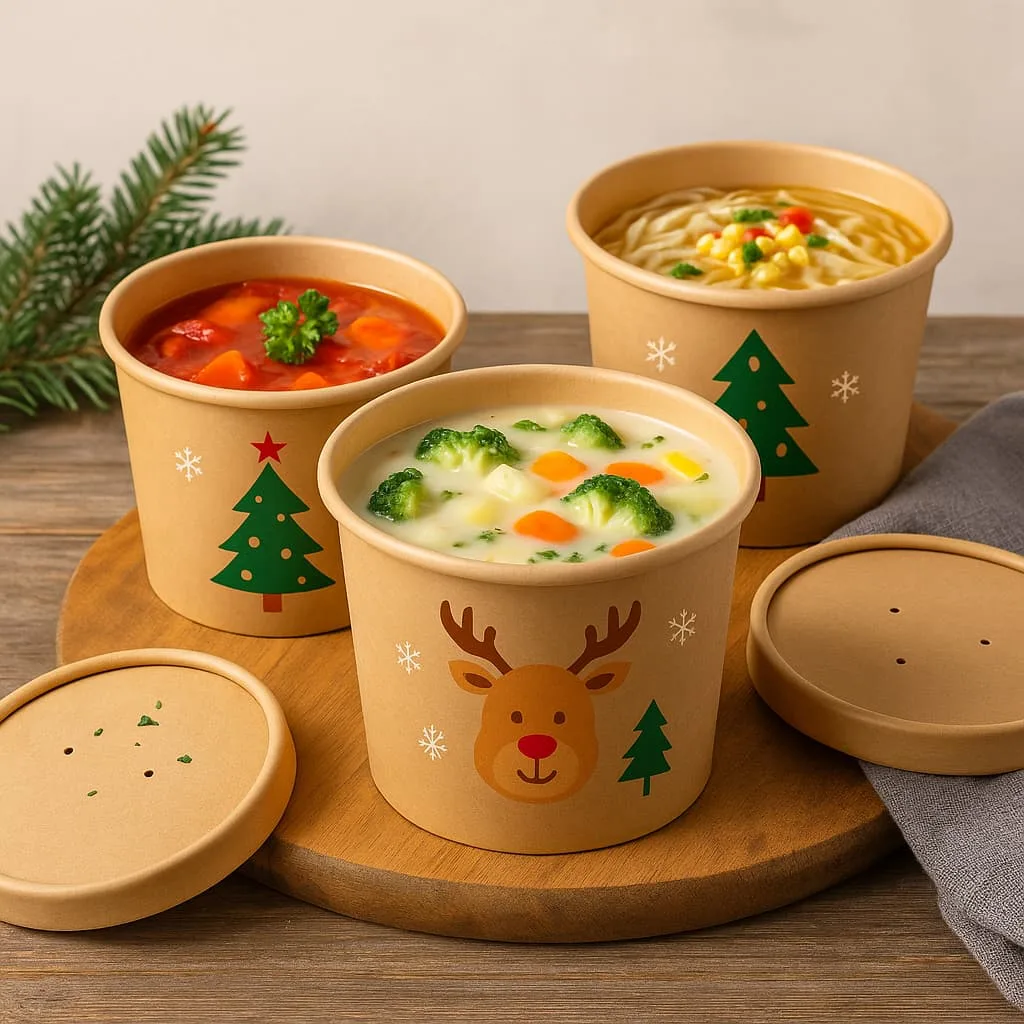
Bioleader® Practices in Custom Ink Printing:
Biodegradable bagasse bowls: Printed with water-based low migration inks, ensuring compliance while maintaining vivid branding.
Kraft paper salad bowls: Use soy-based or water-based inks that are PFAS-free and recyclable.
PLA cups: Printed outer sleeves use safe inks, combined with PFAS-free inner lining.
CPLA cutlery packaging: Monochrome prints using low migration UV inks.
This balanced approach allows customers to enjoy design flexibility while ensuring safety and compliance.
| Customization Aspect | Safe Practices | Compliance Risks |
|---|---|---|
| Colors | Use pigments from positive lists | Heavy metals, azo dyes |
| Logos & Graphics | Simple designs with water-based inks | Full coverage with risky inks |
| Ink Type | Water/soy-based inks | Solvent inks with high VOCs |
| Substrate | Bagasse, kraft, PLA | Plastics with unknown migration |
Testing & Documentation Buyers Need
For importers and buyers, documentation is crucial to prove compliance. The following are essential:
Certificate of Compliance (COC)
A supplier declaration confirming inks and materials comply with relevant regulations.Laboratory Test Reports
Independent lab reports verifying overall and specific migration, MOSH/MOAH, and PFAS absence.Supplier Declarations
Ingredient lists or positive lists confirming raw materials used in inks.Printing Process Records
Information on curing, lamination, and quality control.
Cost & Timing:
Testing typically costs between $500 and $1500 per SKU, with lead times of 7–14 days. While not insignificant, these costs are essential for compliance and can save much larger losses from rejected shipments.
Case Example: A Bioleader® customer in Europe required seasonal custom-printed bagasse containers. By using low migration inks and supplying full COC and lab reports, they successfully passed German and French migration checks, enabling uninterrupted supply.

Expert Insights on Low-Migration Inks
According to Dr. Emily Roberts, a senior toxicologist at a European food safety institute, “Low-migration inks are not a marketing buzzword anymore—they are becoming a mandatory baseline. By 2026, we expect that at least half of EU importers will demand certified migration test reports before accepting any packaging.”
John Miller, a compliance consultant for multinational food brands, adds: “The most common mistake suppliers make is underestimating the documentation load. Importers expect Certificates of Compliance, supplier declarations, and third-party test reports to be available at the first request. If you cannot provide them within a week, you lose the contract.”
These expert views highlight that compliance is not an optional add-on; it is a core requirement for doing business in the U.S. and EU markets.
Market Data & Consumer Perception
Data shows growing consumer concern over packaging inks:
A Nielsen study found 70% of consumers check food labels and packaging for safety cues.
McKinsey reports show that 62% of U.S. shoppers are willing to pay more for safe and sustainable packaging.
Market Research Future estimates that the low migration inks market will grow at a CAGR of 7–9% through 2030, driven by regulatory changes and retailer policies.
Retailers are also enforcing standards:
Walmart requires vendors to avoid inks with certain priority chemicals.
Whole Foods lists mineral oil hydrocarbons as restricted.
Carrefour mandates documentation for custom-printed packaging.
This market shift reinforces the importance of combining customization with compliance.
| Indicator | Value | Source |
|---|---|---|
| Consumers checking packaging safety | 70% | NielsenIQ |
| Consumers willing to pay more for safe packaging | 62% | McKinsey |
| Low migration inks market size 2023 | USD 2.4B | MRF 2023 |
| Market size 2030 forecast | USD 4.2B | MRF 2023 |
Predictions & Trends
Predictions and Trends 2025–2030
Looking ahead, several trends are shaping the future of food packaging inks:
Shift to Water-Based and Bio-Based Inks: Analysts forecast that water-based and soy-based inks will dominate by 2030, accounting for over 55% of global food packaging ink usage.
Integration with PFAS-Free Policies: States banning PFAS are also pushing for inks that comply with low-fluorine thresholds. This means dual compliance: no PFAS and no high-migration substances.
Retailer-Led Standards: Major retailers are setting their own ink safety benchmarks, often stricter than national laws. For example, German supermarkets already require low-migration certification for all private-label packaging.
Digital Printing Expansion: By 2030, digital printing inks for biodegradable food packaging will see a CAGR of 10–12%, as they allow customization with less risk of excessive solvent migration.
For importers and brands, these trends suggest that compliance today is not just about avoiding penalties—it is about future-proofing supply chains.
Eco-Friendly Tableware Integration
Food packaging safety is not only about inks—it is about the entire package. Bioleader® integrates safe printing inks with eco-friendly substrates to deliver compliance and sustainability:
PFAS-free bagasse food containers for takeout: Derived from sugarcane fiber, printed with water-based inks.
PLA cups with PFAS-free lining for beverages: Clear compostable cups with safe ink-printed outer sleeves.
Compostable CPLA cutlery PFAS-free certified: Packaging sleeves printed with low migration UV inks.
PFAS-free kraft paper bowls with lids: Soy-based inks combined with FSC-certified kraft paper.
By offering OEM/ODM services, Bioleader® ensures that every customization request—logos, patterns, seasonal campaigns—remains within safe boundaries.

Common Myths About Food Packaging Inks
| Myth | Fact |
|---|---|
| “All soy-based inks are automatically safe.” | Soy-based inks still require migration testing; not all formulations meet EU or FDA standards. |
| “Only the EU requires migration testing.” | U.S. retailers and states like California increasingly request ink compliance reports. |
| “If packaging is compostable, ink safety doesn’t matter.” | Even compostable packaging must pass migration limits to avoid food contamination. |
| “Migration tests are optional for small runs.” | Regardless of order size, importers and retailers can demand test reports. |
| “Low-migration inks mean lower print quality.” | Advances in ink chemistry now allow low-migration inks with vivid, high-resolution results. |
By addressing these misconceptions, brands can make informed decisions and avoid costly compliance mistakes.
Buyer Considerations Before Choosing Custom Inks
Importers and brands should evaluate the following before proceeding with custom packaging inks:
Supplier Qualification
Ensure suppliers can provide COC and test reports.Testing Strategy
Decide whether to test representative SKUs or each SKU separately.Cost vs. Compliance
Balance design ambitions with ink compliance costs.Material Compatibility
Choose materials that naturally enhance compliance (bagasse and kraft absorb ink differently than PLA).Scalability
Verify that custom designs can be scaled to mass production without altering ink curing and compliance status.
Options: Water-based inks are suitable for kraft and bagasse; soy-based inks add sustainability; UV inks are effective for CPLA cutlery packaging. Each comes with different compliance considerations.
Conclusion: Customization Meets Compliance
In 2025, customization and compliance are not mutually exclusive. Importers, brands, and suppliers can achieve both if they adopt low migration inks, align with regulatory frameworks, and demand full documentation.
For businesses, the opportunity is clear: customization builds brand recognition, while compliance builds consumer trust. Companies that integrate both will not only meet regulations but also gain a competitive advantage in sustainability-conscious markets.
Bioleader® positions itself as a PFAS-free, low-migration, OEM/ODM supplier in China, providing bagasse containers, kraft paper bowls, PLA cups, and CPLA cutlery that meet the highest global standards. Through rigorous testing, complete documentation, and flexible design options, Bioleader® helps brands customize without crossing compliance lines.
📌 FAQ
1. What is a migration test in food packaging inks?
A migration test checks whether substances from inks transfer into food above legal limits. It includes overall migration and specific migration testing.
2. Are soy-based inks always safe for food packaging?
No. Soy-based inks still require laboratory migration testing to confirm compliance with EU and FDA food contact regulations.
3. What documents are needed to prove ink compliance?
Typical documents include a Certificate of Compliance (COC), third-party migration test reports, supplier declarations, and process records.
4. Which packaging materials work best with low migration inks?
Bagasse containers, kraft paper bowls, PLA cups with PFAS-free lining, and CPLA cutlery sleeves are well suited to low migration inks.
5. How much does food packaging ink compliance testing cost?
Testing usually costs between $500 and $1500 per SKU, with results delivered in about 7–14 days depending on the lab.
References
European Food Safety Authority (EFSA), Scientific Opinion on mineral oil hydrocarbons in food.
European Commission, Regulation (EC) No 1935/2004 on materials and articles intended to come into contact with food.
Swiss Federal Food Safety and Veterinary Office, Ordinance on Printing Inks for Food Packaging.
U.S. Food and Drug Administration, 21 CFR 176.170 Indirect food additives.
Consumer Reports, 2022 study on PFAS in fast-food packaging.
NielsenIQ, Global Consumer Packaging Safety Survey, 2023.
McKinsey & Company, Future of Packaging: Shaping the Industry in 2025.
Deloitte, Packaging Compliance and Safety Report, 2023.
Market Research Future, Low Migration Inks Market Forecast 2023–2030.
Food Packaging Inks & Compliance: Key Insights 2025
How can brands customize inks safely?
By selecting low-migration inks and ensuring compliance with EU 1935/2004, Swiss Ordinance, and FDA standards, brands can achieve design flexibility without legal risk. Water-based and soy-based inks are proven safe options for bagasse bowls, kraft paper containers, PLA cups, and CPLA cutlery sleeves.
Why does compliance matter in 2025?
Migration testing failures can cause shipment rejection and reputational loss. With PFAS bans and stricter state-level rules, compliance is now a market-entry requirement, not just a quality add-on.
What options exist for safe customization?
– Water-based inks for kraft and bagasse packaging.
– Soy-based inks for compostable paper bowls.
– UV-curable low migration inks for CPLA cutlery packs.
– Printed PLA cup sleeves using PFAS-free coatings.
Considerations before purchase:
1) Always request Certificates of Compliance and third-party test reports.
2) Confirm ink formulations are on positive lists.
3) Match ink type to packaging material for optimal results.
4) Plan ahead for 2025–2030 regulations to avoid double compliance costs.
Trend outlook:
The low-migration inks market is projected to grow at 7–9% CAGR to 2030, driven by EU rules and PFAS-free mandates. Retailers will increasingly enforce their own ink safety standards, making compliance a competitive differentiator.