GCC countries (Saudi Arabia, UAE, Qatar, Kuwait, Oman, Bahrain) will enforce full or partial bans on single-use plastics between 2025–2026. Regulations prioritize PFAS-free, certified biodegradable materials such as bagasse, cornstarch, PLA and CPLA. Importers increasingly require EN13432/ASTM D6400 compostability certificates, PFAS-free declarations, material traceability, and multilanguage labeling. This article provides a supplier-ready breakdown of rules, approved materials, testing protocols, and B2B recommendations for large-volume GCC buyers.
Introduction: Why GCC Became the Fastest-Growing Market for Compostable Packaging (2025–2026)
The Gulf Cooperation Council (GCC) has become one of the world’s most dynamic regions for foodservice, quick-service restaurants (QSR), and delivery-driven consumption. Saudi Arabia, the UAE, Qatar, Kuwait, Oman, and Bahrain are simultaneously expanding their food delivery ecosystems while accelerating regulatory pressure on single-use plastics. This rare combination—high consumption and strict sustainability compliance—positions GCC as the fastest-growing market for biodegradable food packaging in 2025–2026.
The shift is also driven by structural realities: GCC countries heavily rely on food imports and have limited domestic capacity to produce biodegradable materials, such as bagasse packaging, cornstarch food packaging, and compostable takeout containers. As a result, the region relies heavily on external suppliers, with China emerging as the leading manufacturing hub for sustainable food packaging.

For global buyers and exporters, 2025–2026 marks a critical market-entry window. Multiple GCC states will implement new bans, expand PFAS restrictions, tighten certification requirements, and impose traceability rules. Suppliers who are aligned with GCC’s upcoming biodegradable food packaging rules—especially those offering bagasse and cornstarch solutions—will experience accelerated demand.
This guide analyzes GCC materials standards, certification pathways, country timelines, and operational expectations for manufacturers. It also integrates insights from Bioleader®, a China-based supplier serving the region with PFAS-free bagasse, cornstarch, CPLA, and kraft solutions.
1. Understanding GCC: Why Its Packaging Rules Matter Globally
1.1 The Six GCC Countries & Their Role in Global Import Markets
The GCC bloc—Saudi Arabia, the United Arab Emirates, Qatar, Kuwait, Oman, and Bahrain—represents one of the world’s highest per-capita consumption clusters, with strong dependence on imports for foodservice and packaging.
Key regional drivers include:
High GDP per capita across all six states
Rapid expansion of cloud kitchens, QSR chains, and delivery platforms
High import reliance due to limited agricultural and manufacturing output
Government-backed sustainability policies linked to Vision 2030, Vision 2040, and national climate strategies
GCC demand for eco-friendly food packaging has grown more than 25% annually since 2021, making it the fastest-expanding destination market for manufacturers of bagasse packaging, compostable food containers, and plant-based tableware.
1.2 GCC’s Plastic Pollution Background & Changing Consumer Behavior
Plastic waste has become a significant environmental concern in the region, especially as per-capita takeaway consumption exceeds global averages. Single-use plastics account for a large share of municipal waste in Saudi Arabia, UAE, and Qatar. Combined with the region’s harsh climate, plastic breakdown releases harmful residues that increasingly attract regulatory intervention.
Consumers are also more conscious: eco-friendly dining, plastic-free takeout, and biodegradable packaging are now important purchasing factors for premium F&B operators.
To address this, GCC states are turning to compostable, PFAS-free, and recyclable materials while phasing out oxo-degradable and non-compliant plastics.
2. GCC 2025–2026 Plastic & Packaging Rules: Country-by-Country Breakdown
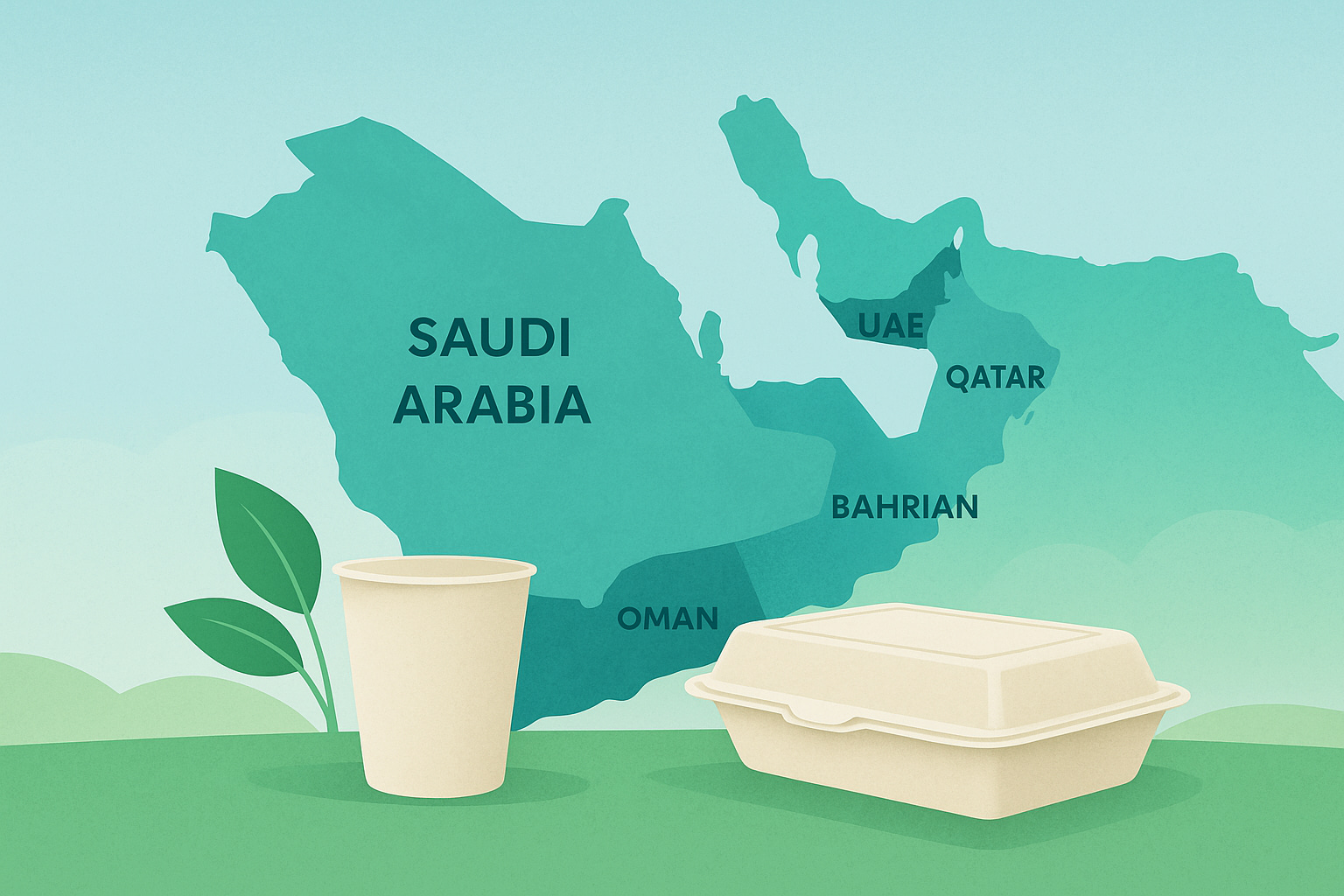
Most global suppliers overlook the regional differences between GCC markets. This section outlines the regulatory direction of each GCC state, providing a clear, structured comparison that is often missing in publicly available resources. The breakdown helps suppliers understand how each market is evolving and what requirements are becoming standard across the region.
2.1 United Arab Emirates (UAE) — 2026 Full Plastic Ban
The UAE has adopted one of the most aggressive regulatory paths in the region.
Key mandates:
Nationwide ban on single-use shopping bags already in force
Full ban on non-recyclable and non-compostable foodservice packaging by 2026
Mandatory shift to compostable or high-grade recyclable materials for food delivery
Local municipalities (Dubai, Abu Dhabi) enforcing PFAS-free requirements for paper-based packaging
Importers must provide:
Certificate of Conformity (CoC)
Material Declaration
PFAS-Free Statement
Compostability certificates (EN13432 or ASTM D6400)
UAE is the most mature market for bagasse clamshells, compostable food trays, CPLA cutlery, and PLA cold cups.
2.2 Saudi Arabia — SASO/OXO Transition & Compostables
Saudi Arabia previously allowed Oxo-degradable plastics but has fully banned them following SASO’s alignment with international sustainability standards.
Current requirements:
Strict prohibition of Oxo-degradable plastics
SASO mandates:
Compostable, recyclable, or certified biodegradable materials
PFAS-free food contact packaging
Clear recycling or compostability labeling
F&B takeaway packaging must be free from restricted substances and tested for material safety
Large-scale distributors increasingly favor bagasse food packaging due to heat resistance for rice, biryani, and curries
Saudi Arabia’s regulatory pathway is pushing the market rapidly toward certified biodegradable materials from credible manufacturers.
2.3 Qatar — Post-World Cup Waste Strategy
After the 2022 FIFA World Cup, Qatar significantly expanded its sustainability framework.
Key points:
Hotels, catering operators, and cloud kitchens are required to adopt certified biodegradable packaging
Import inspections now include:
Material origin verification
COA
MSDS
PFAS-free documentation
Bagasse and cornstarch products are now widely accepted
Strict requirements apply to packaging used for large-scale events, corporate catering, and hospitality chains
Qatar is highly sensitive to sustainability compliance and increasingly rejects low-grade plastics.
2.4 Oman / Kuwait / Bahrain — Gradual Ban Timeline
Though smaller markets, these countries have rapidly accelerated their regulatory timelines.
Government facilities (schools, hospitals, ministries) have already banned single-use plastics
Takeaway packaging will be fully replaced with biodegradable or recyclable materials by 2025–2026
Material identification labeling is mandatory
Importers must provide compostability documentation, safety tests, and PFAS-free proof
These states represent significant growth markets for wholesale biodegradable food packaging suppliers and factories.
3. Which Materials Are Allowed? GCC-Approved Packaging Categories
3.1 Bagasse Packaging — The Most Preferred Material in GCC
Bagasse dominates the hot-food market due to unmatched performance and compliance:
Heat resistance up to 120°C
Suitable for biryani, curry, grilled dishes, and rice plates
Oil-resistant and leak-resistant
100% compostable (home + industrial)
Naturally PFAS-free when using modern production lines
Bagasse packaging is the primary choice recommended by major GCC importers, distributors, and cloud kitchens.

3.2 Cornstarch Packaging — Accepted with Industrial Composting
Cornstarch tableware works well for:
Salads
Fruits
Cold meals
Light snacks
Office catering
Limitations apply:
Not recommended for highly oily or hot foods
Requires industrial composting conditions to fully degrade
Across Saudi Arabia, UAE, and Qatar, cornstarch trays and containers are allowed as long as labeling references their industrial composting characteristics.

3.3 PLA and CPLA Packaging — Widely Used for Drinks & Cutlery
PLA cups are allowed for cold beverages (juice, iced coffee, smoothies)
CPLA cutlery is approved for hot dishes and delivery meals
PLA lids for salads and desserts remain broadly acceptable across GCC
These materials must meet compostability standards and be PFAS-free.
3.4 Materials Prohibited in GCC
This list is extremely important for manufacturers targeting the region:
Oxo-degradable plastics: banned in all GCC markets
Non-compostable single-use plastics: heavily restricted
Paper packaging containing PFAS coatings: targeted in UAE and Qatar
Plastics that lack traceability or compostability documentation
Non-compliant materials will be rejected at customs.
4. GCC Importer Requirements: Documents, Certifications & Testing
4.1 Mandatory Documentation
GCC importers must receive a complete regulatory file. Missing documents may lead to shipment delays or rejection.
Core requirements:
Certificate of Conformity (CoC)
PFAS-Free Declaration
Material Safety Data Sheet (MSDS)
Certificate of Analysis (COA)
Food-contact compliance: FDA or LFGB
Compostability certification: EN13432 or ASTM D6400
These are critical for import and customs clearance.
4.2 Testing Requirements
Key tests often required:
Overall migration test
Heavy metals and chemical safety test
PFAS screening
Biodegradability/performance test (per EN/ASTM standards)
Many importers require third-party testing performed by accredited labs.
4.3 Inspection Requirements for Major Ports
Saudi Arabia and UAE are particularly strict:
Pre-shipment inspection
Label compliance verification
Lot traceability for each product batch
Manufacturers must maintain strong documentation to avoid clearance issues.
5. Performance Requirements for Hot & Cold Foods in GCC Climate
The Middle East’s climate significantly affects packaging performance. With temperatures often exceeding 40°C, food containers must withstand heat, humidity, and longer delivery distances.
5.1 Hot Meals (Rice, Curry, Biryani, Soup)
Bagasse is the dominant material:
Withstands 120°C
Supports oily, spicy, and hot dishes
Maintains shape over long delivery durations
Prevents leaks even in humid environments
Cloud kitchens rely heavily on bagasse for performance stability.
5.2 Warm Meals (Grill, Meat, Shawarma)
Bagasse clamshells
CPLA cutlery for durability
These materials meet regional durability expectations.
5.3 Cold Meals (Salads, Fruits, Desserts)
PLA cups
Kraft-based options for salads
Cold-food packaging represents strong growth due to the rising popularity of healthy meal concepts.
6. 2025–2026 Supplier Checklist: How Manufacturers Must Prepare
6.1 EPR & Regulatory Documentation
Suppliers must maintain:
Complete conformity files
PFAS-free manufacturing statements
Multilingual documentation
Full transparency on materials and processing
Documentation is equally important as product performance in GCC markets.
6.2 Production Requirements
Key manufacturing priorities:
PFAS-free coatings and processes
Dust-free and hygienic packaging environments
Traceability of raw materials
Compliance with international compostability standards
Large buyers increasingly demand cleanroom-style production for premium products.
6.3 OEM/ODM for GCC Market
Manufacturers targeting GCC should provide:
Arabic + English carton printing
Arabic waste sorting icons
Logo embossing for bagasse containers
Private label support for distributors
Mixed SKU production flexibility
This enhances brand presence for importers and QSR chains.
6.4 Supply Chain Adaptation
Operational strategies:
40HQ mixed loading for distributors
Short lead time for repeat orders
Priority recommendation of bagasse for hot foods
Clear carton labeling for customs
GCC buyers typically place large orders, with strong preference for consistent quality and customizable packaging.
7. Case Studies: GCC Importer Success Stories
7.1 UAE Cloud Kitchen Switching to Bagasse → Complaint Rate -78%
A Dubai-based cloud kitchen replaced PP containers with bagasse packaging. Within three months:
Customer complaints fell by 78%
Delivery performance improved due to better heat resistance
The brand gained a “sustainable” label in customer reviews
7.2 Saudi Distributor Moving from OXO → Bagasse + CPLA Full Upgrade
A Riyadh distributor transitioned from oxo-degradable plastics to certified biodegradable materials:
Sales increased 42% due to compliance advantages
Retail partners adopted CPLA cutlery for hot meals
Import clearance times reduced by half
7.3 Qatar Hotel Catering Migrating to PFAS-Free Tableware
A five-star catering service upgraded to PFAS-free paper and bagasse products:
Passed all municipal inspections
Reduced packaging-related guest complaints
Enhanced its ESG and sustainability positioning
8. Bioleader® Advantage for GCC Importers
8.1 Full GCC Compliance (PFAS-Free, EN13432, ASTM, LFGB, FDA, SGS)
Bioleader® offers materials and products aligned with all GCC requirements, including PFAS-free bagasse, compostable cornstarch packaging, CPLA cutlery, and PLA cups. ( for example like Saudi Arabia need INSPECTION REPORT of SASO Technical Regulation for Food Safety for Tools & Equipment Used in the Kitchen)
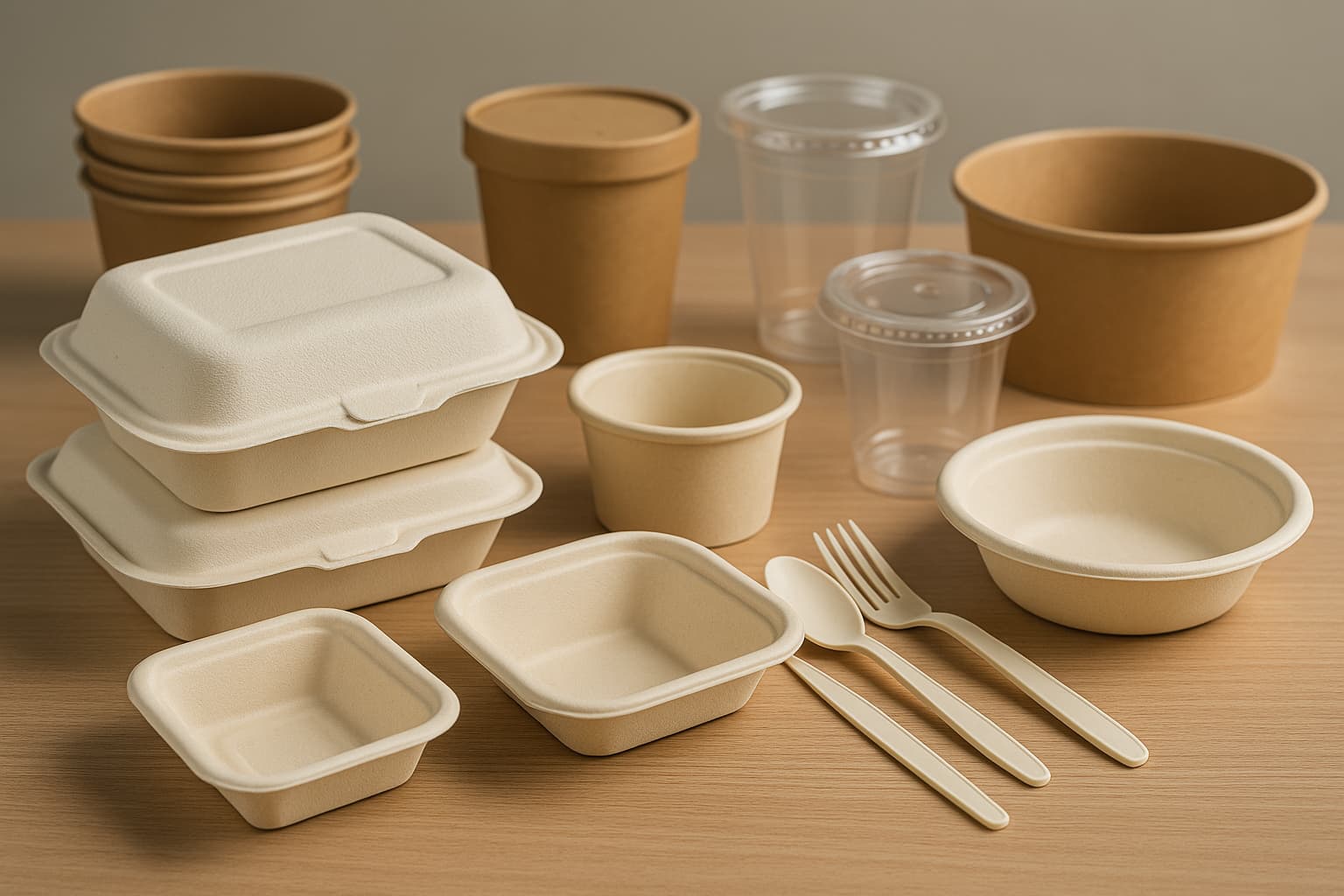
8.2 Large-Scale Production (Bagasse + Cornstarch + CPLA + Kraft)
Modern automated lines support:
High-volume production
Rapid lead times
Stable quality
Diverse SKU coverage
8.3 OEM/ODM for GCC (Arabic + English Printing)
Bioleader® supports:
Arabic printing
Waste sorting icons
Private labels
Logo embossing
Mixed 40HQ loading
8.4 Export Experience to Dubai, Riyadh, Doha
With extensive GCC experience, Bioleader® understands regional compliance, customs processes, and buyer expectations.
Conclusion
From 2025 to 2026, GCC nations will enter an accelerated phase of plastic bans and sustainable packaging mandates. This evolution will dramatically reshape the takeaway, catering, and foodservice sectors across Saudi Arabia, UAE, Qatar, Oman, Kuwait, and Bahrain.
Bagasse remains the optimal choice for hot foods in the region, while cornstarch supports cold and light meals. PLA and CPLA offer scalable solutions for beverages and cutlery. Manufacturers prepared with PFAS-free, compliant, and traceable products will outperform competitors.
For global suppliers and distributors, this is a rare strategic moment: GCC markets require large volumes, have high purchasing power, and depend heavily on external manufacturing. Bioleader® delivers a fully compliant portfolio aligned with GCC’s regulatory trajectory and sustainability goals.
FAQ
1. What biodegradable materials are most accepted in GCC for food packaging?
Bagasse is the most preferred material due to its heat resistance and compostability. Cornstarch, PLA, and CPLA are also accepted across GCC markets, especially for cold meals and cutlery.
2. Do GCC countries require PFAS-free food packaging?
Yes. UAE and Qatar are already implementing PFAS restrictions, and other GCC countries are aligning with similar safety standards. PFAS-free documentation is increasingly mandatory.
3. Are oxo-degradable plastics allowed in Saudi Arabia or UAE?
No. Oxo-degradable plastics are banned across all GCC countries, particularly Saudi Arabia and the UAE, where SASO and municipal rules strictly prohibit them.
4. What certifications do GCC importers usually request from suppliers?
Common requirements include Certificate of Conformity (CoC), compostability certificates (EN13432/ASTM D6400), FDA/LFGB food-contact certifications, MSDS, COA, and PFAS-free declarations.
5. Which biodegradable packaging performs best under GCC’s hot climate conditions?
Bagasse packaging performs best because it withstands up to 120°C, resists oil, and maintains structure in long delivery times. It is ideal for biryani, curry, rice plates, and hot meals.
References
SASO – Saudi Standards, Metrology and Quality Organization, Packaging and Plastic Materials Guidelines.
UAE Ministry of Climate Change and Environment, Single-Use Plastics Policy Report.
Qatar Ministry of Municipality, Waste Management Strategy 2022–2030.
Dubai Municipality Food Safety Department, PFAS-Free Packaging Notice.
European Bioplastics Association, Global Bioplastic Market Data.
Ellen MacArthur Foundation, Global Plastics Treaty Framework.
ASTM International, Compostability Standards D6400 & D6868.
EU EN13432 Standard Committee, Requirements for Compostable Packaging.
Key Insights: GCC Biodegradable Packaging Explained
Why GCC Packaging Regulations Are Structurally Different:
GCC food consumption relies heavily on imports, creating a regulatory environment where packaging rules directly influence supply chains. Because local production of compostable materials is limited, importers must depend on PFAS-free, certified biodegradable packaging from global manufacturers. This is why compliance documentation and material traceability matter more in GCC than in most regions.
What GCC Importers Now Expect From Suppliers:
Importers increasingly require full compliance bundles: EN13432 or ASTM D6400 certificates, PFAS-free declarations, FDA or LFGB tests, MSDS/COA, and carton-level labeling in English and Arabic. For many distributors, the “supplier readiness” of a manufacturer is as important as product quality itself.
How Suppliers Should Prepare for 2025–2026:
The most competitive manufacturers are transitioning to PFAS-free coatings, improving bagasse molding quality, certifying cornstarch and PLA lines, and offering mixed-SKU 40HQ loading. Many GCC buyers prefer factories that can consolidate bagasse, cornstarch, PLA, CPLA and kraft paper packaging into one shipment. Operational flexibility is now a core advantage.
Material Options and Their Strategic Fit:
Bagasse leads in hot meals (biryani, curry, grilled dishes) due to 120°C resistance. Cornstarch is accepted for salads and cold meals but not recommended for oily dishes. PLA excels in cold beverages, while CPLA is preferred for cutlery. Kraft paper is viable when PFAS-free coatings are used. Choosing the correct material directly reduces rejection rates and enhances regulatory compliance.
Considerations Before Entering GCC Markets:
Suppliers must evaluate climate durability, PFAS restrictions, pre-shipment inspection requirements, and label language rules. Inconsistent documentation or unclear compostability claims are the top reasons shipments are delayed or rejected. Factories prepared with stable testing protocols and transparent material data gain priority with GCC importers.
Strategic Outlook for 2025–2026:
The GCC is evolving into one of the world’s largest buyers of biodegradable food packaging. Regulations, consumption power and delivery culture will keep accelerating demand for bagasse containers, cornstarch packaging and compostable cups. Suppliers with PFAS-free capability, certification readiness and high-volume production capacity will dominate regional partnerships.
What This Means:
GCC importers are not only buying products—they are buying compliance, traceability, and stability. Manufacturers who provide complete certification files, PFAS-free materials and multi-SKU container consolidation will become preferred long-term partners.