


Bioplastic Food Containers: Eco-Friendly, Compostable & Disposable Solution by Bioleader®
Bioleader® Cornware food containers are described in the product range as using a cornstarch-based bioplastic compound. Buyers should identify the current formulation or material declaration for the finished article rather than treating cornstarch as a complete recipe. This page connects the material brief to container geometry, closure, food use and supporting documents. Bioplastic, biodegradable and compostable describe different questions in a purchase specification; one word alone does not establish every property of the supplied package.

Specify the Material and the Finished Container
The current collection contains hinged clamshells and separate-lid trays, with single and divided meal layouts. Choose a named article and its required components before comparing material claims. A tray body, its lid and an attached label can require different material descriptions and evidence.
For the general terminology, the compostable plastic tableware guide provides wider context. This page stays focused on a finished food container and its specification.
You might also like
Cornware Container Formats in the Current Collection

Cornstarch 1500Ml Tray With Lid 5-Compt.

Cornstarch 1350Ml Tray With Lid 5-Compt.

Cornstarch 1100Ml Tray With Lid 5-Compt.

Cornstarch Tray With Lid 1000Ml 3-Compt.

Cornstarch Tray With Lid 650mMl 3-Compt.

Cornstarch Tray With Lid 650mMl 2-Compt.

Cornstarch Tray With Lid 1000Ml
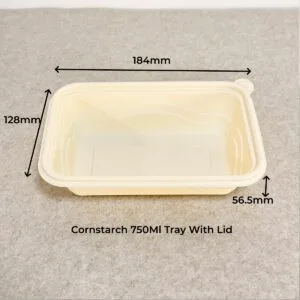
Cornstarch Tray With Lid 750Ml

Cornstarch Tray With Lid 500Ml

Cornstarch Burger Box 6"x6"

Cornstarch Food Container 380ml

Cornstarch Food Container 450ml
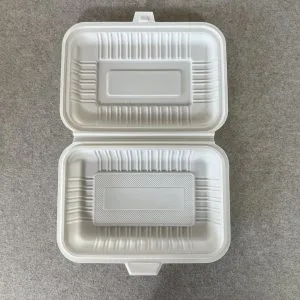
Cornstarch Food Container 600ml
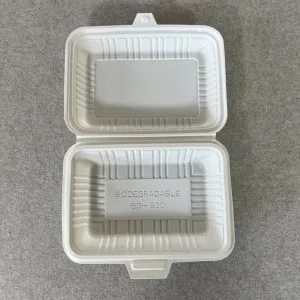
Cornstarch Food Container 800ml

Cornstarch Food Container 1000ml

Cornstarch Lunch Box 1000ml / 8"x8" 1-C

Cornstarch Lunch Box 1000ml / 8"x8" 3-C

Cornstarch Food Box 1200ml / 9"x9" 1-C

Cornstarch Food Box 1200ml / 9"x9" 3-C
What a Bioplastic Container Specification Should Identify
| Specification layer | Record for the selected container | Avoid this assumption |
|---|---|---|
| Material identity | Current material description or declaration for body and lid | Cornstarch alone describes the full polymer formulation |
| Article geometry | Model, dimensions, capacity and compartment layout | Equal capacity means identical shapes or usable food space |
| Closure | Attached hinge or named separate lid; material and fit | Similar footprints establish compatibility |
| Use performance | Food, filling temperature, holding time and product instructions | The material name establishes universal reheating or storage performance |
| Claimed end of life | Product-specific evidence and stated conditions | Biobased wording alone establishes compostability or a disposal route |
A Material Name Does Not Define the Closure
Bioleader’s table lists BLT-500 and BLT-750 at the same 184 × 128mm footprint but different listed heights, 38.5 and 56.5mm. Use these figures to compare geometry, then establish lid compatibility from the matched component records and current drawing for each article. Similarly, a hinged BGH clamshell is a different construction from a BLT tray with a separate lid.
Evidence for Food Use and Claimed End of Life
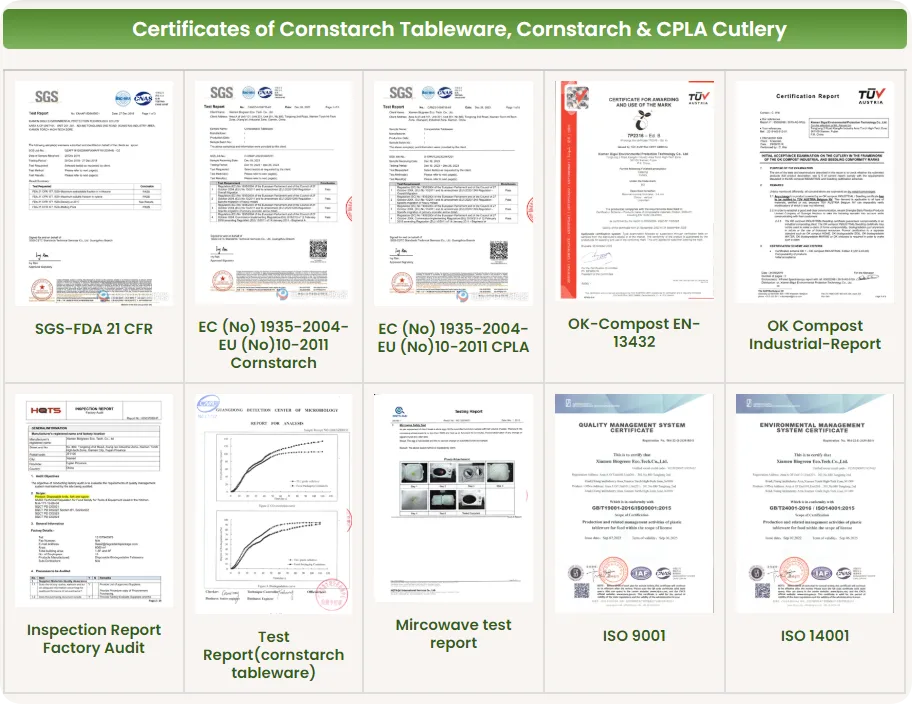
Request the food-contact documents and instructions for the actual body and lid, with the intended food and use conditions stated. If compostability is required, check the applicable finished-product coverage and conditions separately. Do not extend a claim from a raw material, another SKU or a certificate image to the complete package without matching evidence.
The disposable compostable container buying guide covers component coverage and the receiving collection route in a service program.



Compare Named Formats Before Choosing a Material Brief
| Published example | Physical format | Specification discussion |
|---|---|---|
| BGH-803: 1000ml, 200 × 215 × 70mm | Three-compartment hinged clamshell | Identify the body/attached-lid article, hinge and closure requirements |
| BLT-1000-3C: 1000ml, 250 × 188 × 45mm | Three-compartment tray with separate lid | Identify the body and matching lid as the supplied pair |
These published examples show why volume and compartment count do not replace a model specification. Use current samples to assess the portion and handling routine, and retain the article references with the material and document review.

From Your Material Brief to an Approved Container Specification
Give Bioleader your material requirement, intended food use and preferred container format. The team can help identify a suitable current model and clarify its body, matching lid or attached closure before matching the available material description to that finished article. Review the named sample with the same component and material records, so the material brief becomes a container specification the buyer can approve.
Use that reference for the quotation and packing details, then retain the approved model, components, material description and sample record for repeat supply. Review proposed changes against this specification before replenishment. For sample approval and production requirements, use the food-container manufacturer guide; for quantities across several models, use the wholesale container assortment guide.
- Named model and current drawing or dimensional reference.
- Body and lid material descriptions, with requested evidence.
- Food, filling, holding, transport and any proposed reheating conditions.
- Approved samples, packing unit and change-review requirements.
Browse More Products for other product families.
Bioplastic Food-Container Specification FAQ
Does cornstarch identify the complete formulation of a food container?
No. Bioleader’s product description refers to a cornstarch-based bioplastic compound. Obtain the current material description or declaration for the actual supplied body and lid.
Does bioplastic mean a container is automatically compostable?
Do not infer compostability from the name. Check finished-product evidence, coverage and stated conditions for the selected article, and confirm the receiving collection route where relevant.
Why can two 1000ml three-compartment containers need different specifications?
BGH-803 is listed as a hinged clamshell at 200 × 215 × 70mm, while BLT-1000-3C is a tray with a separate lid at 250 × 188 × 45mm. Their construction and component requirements differ.
What changes should trigger a new specification review?
Review changes to the body, lid, formulation, dimensions or intended food use against the approved samples, material descriptions and relevant documents before repeat supply.
Can one material statement establish microwave, freezer and hot-food suitability?
No. Request current product instructions for each intended use and the selected components. Assess the actual food, time, temperature and handling conditions on the approved sample.
Contact Us Now
Address: No.39 Xinglong Road, Xiamen, Fujian, China
Contact: Junso Zhang(Mr.)
Phone & What’sapp: +86-15980856610
Wechat: bioleader
Email: info@bioleaderpack.com