Author: Bioleader Compliance & Material Research Division
Published: February 12, 2026 | Topic: Regulatory Update & Material Kinetics
Executive Summary: What Changed and Why It Matters
On February 5, 2026, China’s National Health Commission (NHC) issued Announcement No. 1, 2026, expanding the permitted use scope of key inorganic substances—calcium sulfate, barium sulfate, and talc—for applications associated with Polylactic Acid (PLA) in food-contact plastic materials and products. The same update also formally adds Polyethylene Furanoate (PEF) as a recognized food-contact resin variety.
For packaging buyers, brand owners, and converters, the business impact is straightforward: the regulation strengthens the legal pathway for performance-enhanced bio-based plastics (notably CPLA) and signals China’s accelerating recognition of next-generation, high-barrier bio-based polymers such as PEF.
- For PLA/CPLA: clearer compliance grounding for higher-heat foodservice applications through engineered crystallization routes.
- For PEF: a policy-backed entry into food-contact packaging where barrier performance and shelf-life are strategic priorities.
- For exports: improved alignment between material science, documentation readiness, and multi-market compliance workflows.
Compliance Reality Check: “Allowed Substances” vs. “Guaranteed Performance”
A common procurement mistake is to treat a positive-list update as a universal performance guarantee. In practice, “allowed for use” confirms that a formulation pathway is legally feasible—yet finished-product performance still depends on part design, processing control, and intended-use conditions.
For professional buyers, compliance should always be managed on two parallel tracks:
- Substance conformity: additives and resins follow permitted scopes under the relevant GB framework and the latest NHC announcement.
- Migration + functional validation: finished products must be validated under realistic conditions (time/temperature, food simulants, oils/sauces, and usage scenarios).
This 2026 update strengthens the legal foundation for engineered PLA systems; responsible manufacturers still need disciplined QC and evidence-based validation to satisfy export markets.
Technical Analysis: The Science Behind High-Performance CPLA
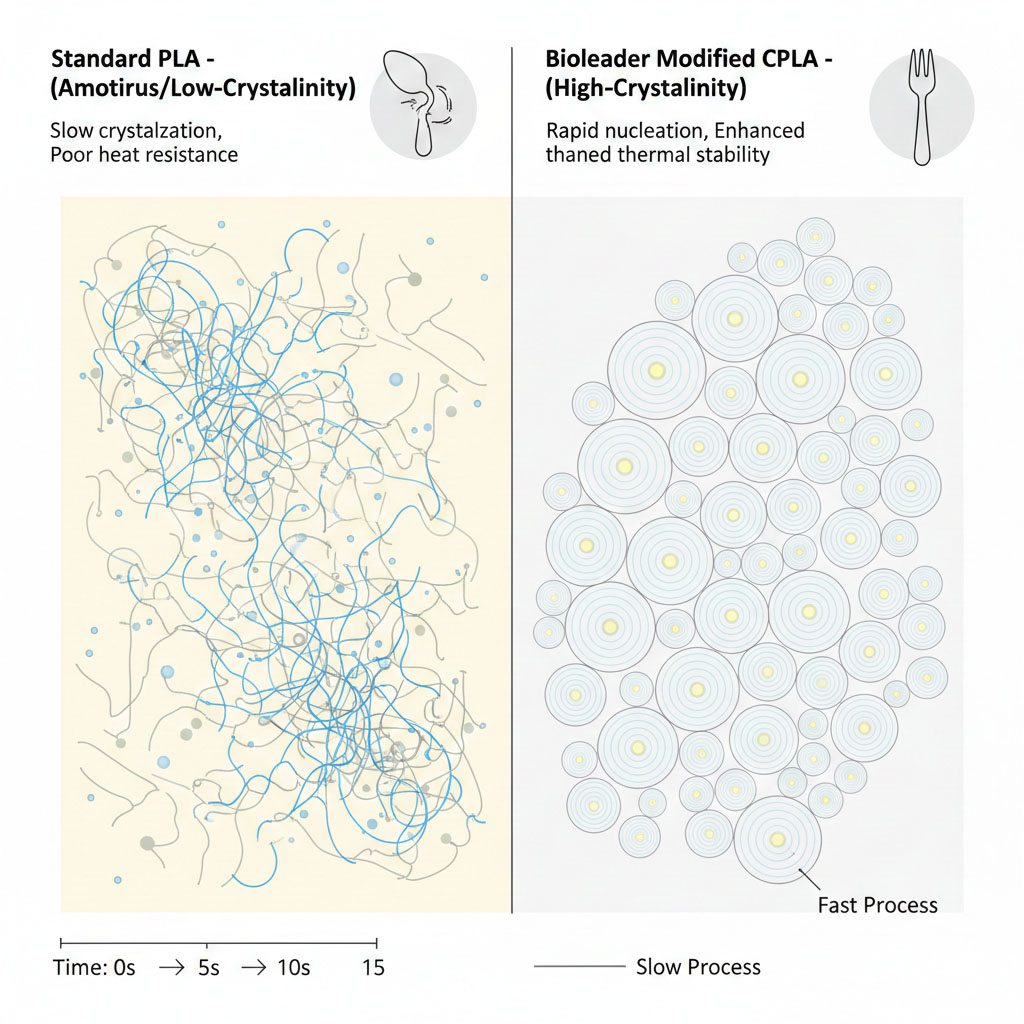
Standard PLA often exhibits limited thermal resistance when used in hot-food applications—especially when crystallinity remains low. That is precisely why Crystallized PLA (CPLA) has become a mainstream engineering route for high-heat disposable cutlery and certain rigid food-contact items.
How Mineral Additives Enable Crystallization
Inorganic particles can function as heterogeneous nucleation sites, accelerating crystallization kinetics and improving structural stability at elevated temperatures.
- Calcium sulfate & talc: frequently applied as nucleating agents to support faster crystallization and improved thermal windows.
- Engineering precision matters: performance depends on particle dispersion, particle size distribution, formulation ratios, and controlled processing (molding parameters and, where applicable, annealing strategy).
Why This Matters Commercially
When executed correctly, engineered crystallization upgrades PLA from a general-purpose bio-polymer to a more robust material platform with improved heat resistance and dimensional stability—critical for buyers who must meet hot-use expectations while maintaining food-contact safety requirements.
Performance Snapshot: Standard PLA vs. Engineered CPLA (Representative Targets)
The following comparison provides a procurement-oriented view of typical material-level targets. Actual performance varies by resin grade, additive system, product geometry, and processing controls.
| Technical Property | Unit | Standard PLA (Typical Low-Crystallinity) | Engineered Modified CPLA (Target Range) | Business Significance |
|---|---|---|---|---|
| Heat Distortion Temperature (HDT) | °C | ~52–55 | ~105–120 | Enables higher-temperature service windows (hot-fill / short reheating) depending on design & process |
| Tensile Strength | MPa | ~45–60 | ~55–70 | Improves rigidity and structural integrity for foodservice applications |
| Crystallinity (DSC-based) | % | <10 | >40–45 | Supports thermal stability and dimensional control |
| Additive Loading (Typical) | % | 0 | Often 1–5 | Lower loading supports consistency and reduces formulation risk exposure |
| Compliance Strategy | — | Basic GB pathway | GB pathway + export documentation readiness | Supports multi-market procurement and retailer audit expectations |
Application Note: HDT and crystallinity are material-level indicators. Finished-product outcomes also depend on wall thickness, geometry, stress points, and real use conditions (microwave power/time, oily foods, sauces). Any “microwave safe” claim must be scenario-defined and validated.

Bioleader Positioning: Compliance Engineering Beyond Minimum Standards
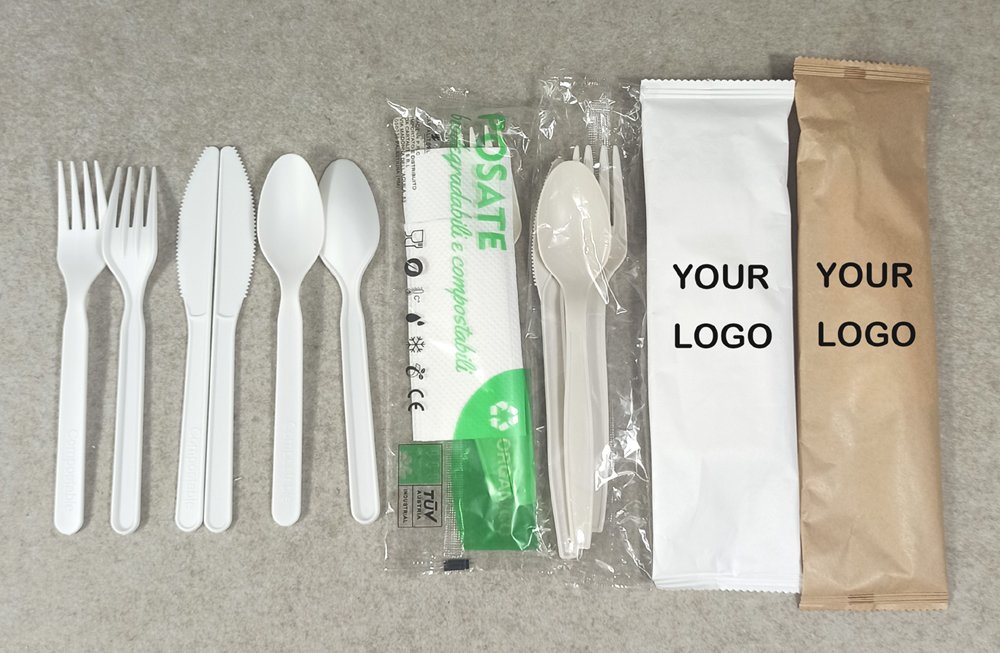
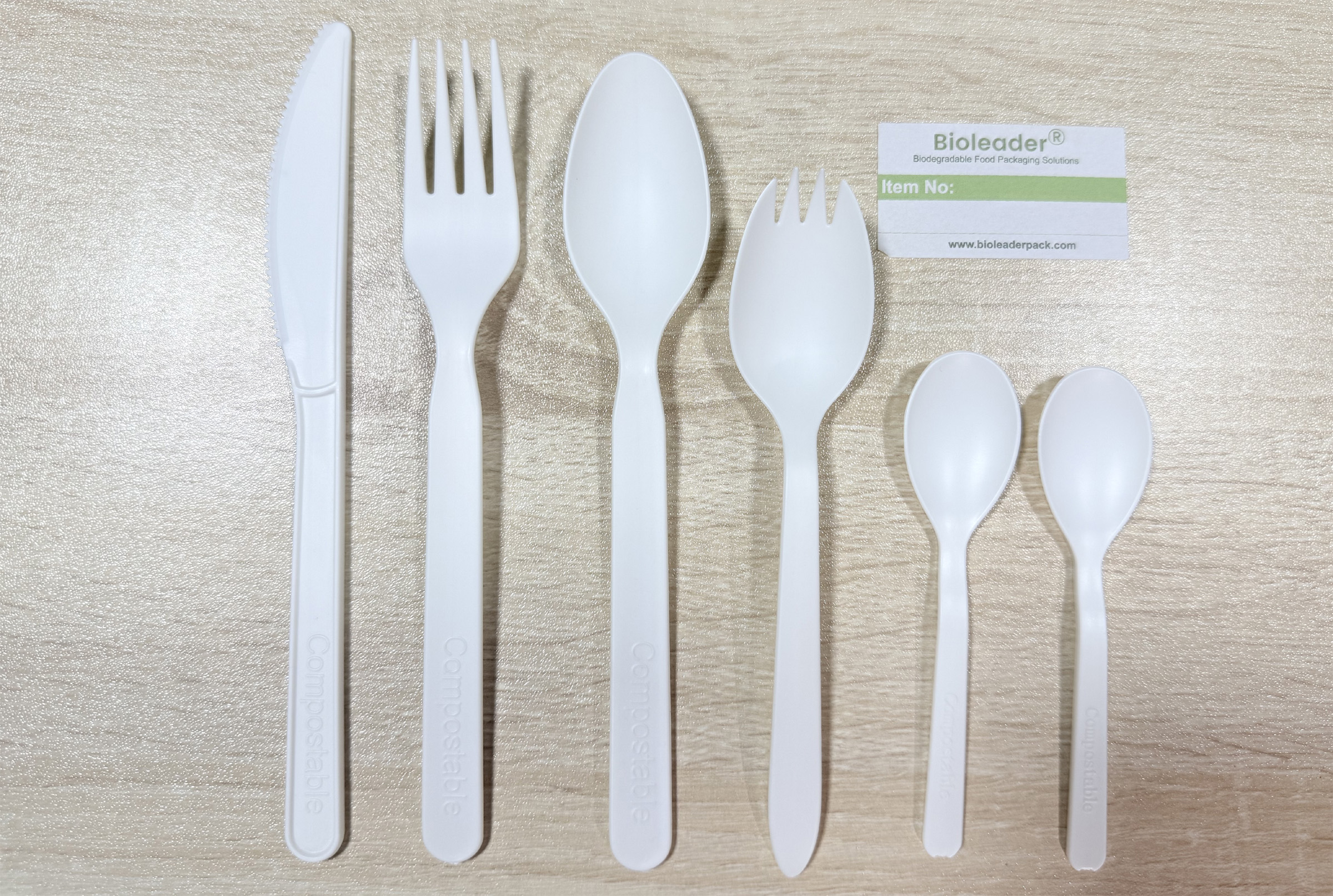
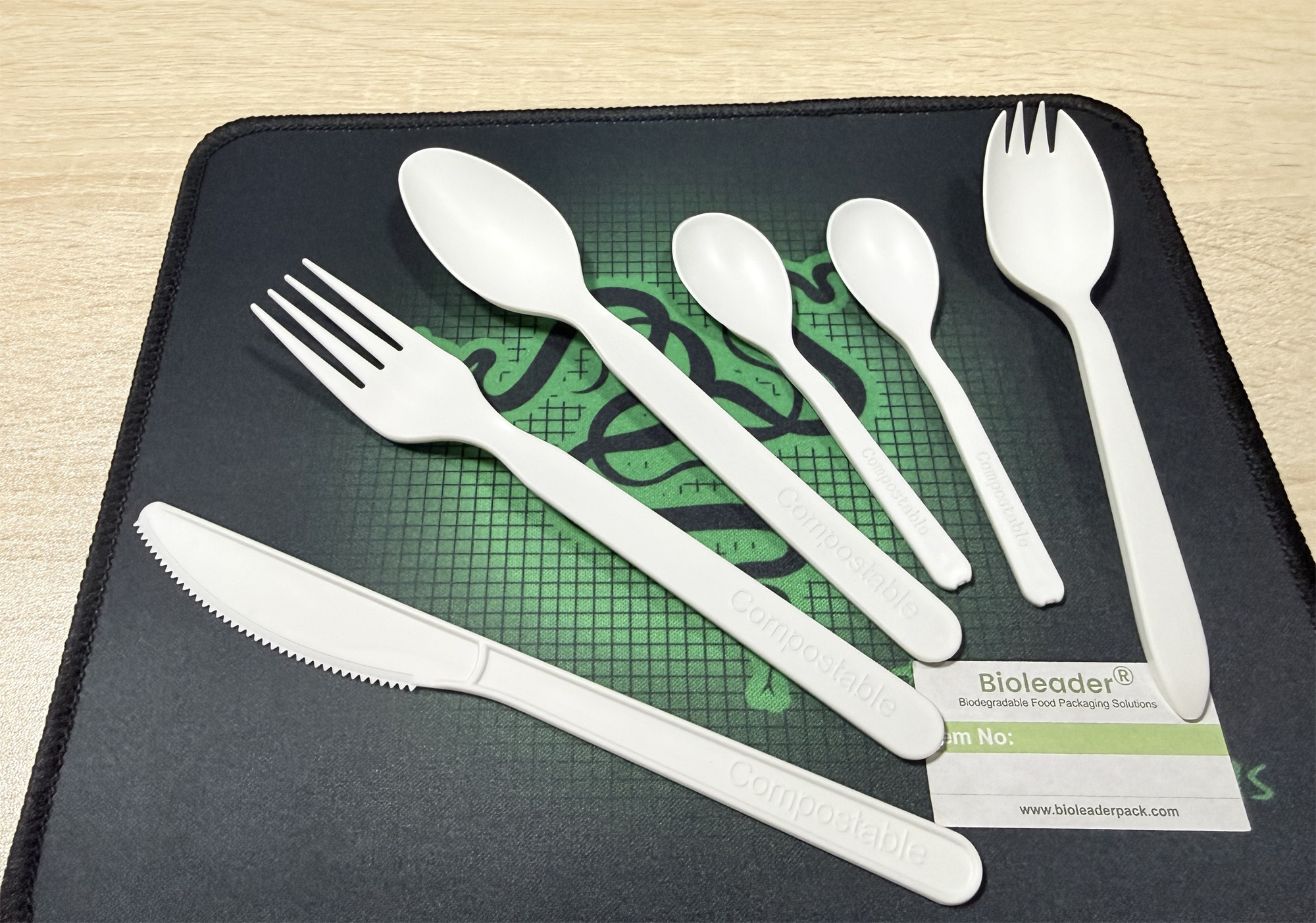
As the regulatory door opens wider, the market differentiator shifts from ‘can supply PLA’ to ‘can supply auditable performance with auditable compliance.’ Bioleader (厦门彼利得) positions its approach around disciplined formulation control and export-market readiness—ensuring that every product, from high-transparency PLA Cups to heat-resistant CPLA Cutlery, meets the most rigorous mechanical and safety benchmarks. By prioritizing precise crystallization and migration control, we provide global brands with the certainty that their sustainable packaging performs as well as it protects.
1) Controlled Micro-Loading Philosophy
Bioleader’s modified CPLA route emphasizes tight ratio control of mineral nucleating agents—using only what is necessary to achieve crystallization benefits while keeping formulation variability low. This supports consistent production outcomes and reduces compliance uncertainty for long-term supply programs.
2) Dual-Market Documentation Mindset (China + EU)
For international buyers, compliance is not a slogan; it is a deliverable. Export workflows typically require both (i) permitted-substance conformity and (ii) migration evidence aligned with intended-use conditions. Bioleader structures internal QC and supplier management to support documentation readiness for buyers operating in multiple jurisdictions, including the EU regulatory environment.
PEF: The High-Barrier Future in Food-Contact Packaging
The formal inclusion of PEF (Polyethylene Furanoate) as a food-contact resin is a strategic policy signal. PEF is widely recognized for its potential in high-barrier packaging, often reported to deliver multi-fold oxygen barrier improvements versus PET, depending on testing conditions (including humidity and methodology).
Where PEF Creates the Most Value
- Packaging requiring enhanced oxygen protection for longer shelf life
- Beverage and sensitive food formats where barrier performance directly impacts product quality
- Bio-based resin strategies aiming to reduce carbon footprint while maintaining performance
Important clarification for buyers: PEF is best viewed as a bio-based, high-barrier polymer platform. It should not be automatically assumed to be a compostable substitute for foodservice disposables. Its role is typically closer to PET replacement strategies in barrier-critical packaging.
Buyer Action Checklist: How to De-Risk PLA/CPLA Sourcing After the 2026 Update

- Request updated compliance statements referencing Announcement No. 1, 2026 and relevant GB conformity pathways.
- Confirm additive identities and typical loading ranges (calcium sulfate, barium sulfate, talc) and supplier traceability.
- Ask for migration evidence aligned with your market requirements (overall/specific migration under defined conditions).
- Define the intended-use scenario precisely: temperature/time, oils/sauces, microwave power/time boundaries.
- Validate finished-product performance, not just resin claims (geometry and processing determine outcomes).
- Align labeling and claims (“hot food,” “microwave reheating,” “compostable”) with test data and local rules.
- Plan for scale: verify lot-to-lot consistency controls and QC checkpoints for recurring orders.
Conclusion: A More Mature, Engineering-Driven Era for China’s Bioplastics
China’s 2026 food-contact update demonstrates a clear direction: regulations are increasingly aligned with material science and industrial feasibility. Expanded clarity for mineral additives in PLA systems strengthens the legal pathway for high-performance CPLA engineering, while the inclusion of PEF accelerates the adoption of bio-based, high-barrier resins for advanced packaging.
For global buyers, the next procurement advantage will come from partners who can deliver stable performance, migration-managed formulations, and export-ready documentation—not merely a catalog of materials.
FAQ
1) Does the 2026 announcement mean all PLA products are now safe for hot food?
No. The update strengthens lawful formulation pathways, but hot-use suitability still depends on crystallinity engineering, product design, processing controls, and validation under intended-use conditions.
2) Why are calcium sulfate, barium sulfate, and talc important for CPLA?
These minerals can act as nucleating agents that accelerate crystallization and help improve thermal stability. The outcome depends on dispersion quality and precise formulation/process control.
3) Can I claim “microwave safe” for CPLA cutlery based on HDT alone?
HDT is a helpful indicator, but “microwave safe” must be scenario-defined (time, power, food type) and verified on finished products. Claims should be supported by validation data.
4) What documents should an EU buyer request besides GB-related statements?
EU buyers typically require positive-list conformity plus overall/specific migration testing under intended-use conditions. Procurement should request declarations, traceability records, and relevant test reports.
5) Is PEF compostable like PLA?
Not necessarily. PEF is primarily positioned as a bio-based, high-barrier resin for shelf-life and barrier-critical packaging. Compostability depends on material design and local standards, and should not be assumed.
6) What is the most practical way to de-risk a PLA/CPLA supplier selection?
Define use conditions clearly, request migration evidence, validate finished-product performance, and confirm formulation traceability and QC controls for consistent scale supply.
References
- National Health Commission (NHC) of the PRC: Announcement No. 1, 2026 on approvals/updates for food-related products (food-contact materials scope).
- GB 9685-2016 and relevant subsequent regulatory updates referenced by competent authorities: Additives for food contact materials and articles.
- Regulatory compliance practice notes: Food-contact conformity workflows (positive list + migration verification) for multi-market procurement.
Copyright Notice:
© 2026 Bioleader®. If you wish to reproduce or reference this content, you must provide the original link and credit the source. Any unauthorized copying will be considered an infringement.