1. Executive Summary — Biodegradable Food Packaging 2025
Why this matters now. In 2025, biodegradable and compostable food packaging has shifted from value signaling to compliance-driven purchasing. Analysts project mid–high single-digit CAGR for compostable/sustainable formats through 2030, as regulatory frameworks and EPR programs act as primary demand catalysts rather than optional green preferences.
1.1 Evidence-Backed Conclusions
1) Market | Structural growth led by regulation rather than preference.
Buyers increasingly prioritize auditable compliance packages (recognized certifications, accurate labeling, PFAS evidence, EPR readiness) over unit price alone. Market outlooks indicate durable growth (~6–7% CAGR to 2030), reinforcing that procurement criteria are converging on risk-adjusted TCO and compliance certainty instead of headline price.
2) Compliance | A clear inflection point across the EU and U.S.
The EU Packaging & Packaging Waste Regulation (PPWR) entered into force on 11 Feb 2025, with general application 18 months later. It tightens requirements on prevention, recyclability, reuse, labeling, and recycled content, superseding the prior Directive. In the U.S., the FDA confirmed the market phase-out of PFAS-containing grease-proofing agents for food-contact paper/board (2024), and California SB 54 is advancing permanent EPR regulations that make “recyclable or compostable” an obligation. Together, these frameworks now define the baseline to bid and trade cross-border.
3) TCO | End-of-life access and policy signals determine winners.
The U.S. has 14.9M households with access to residential food-waste collection, yet only ~5% of wasted food is composted nationally—creating substantial geographic divergence in realized benefits. Notably, ~71% of full-scale food-waste composting facilities report accepting some compostable food-contact packaging, though conditions vary. Net-net: TCO must be modeled city-by-city (unit price + logistics + EPR + end-of-life fees − subsidies), and portfolios should match local infrastructure realities.
1.2 Actionable Recommendations
Short term (0–6 months) — Secure the “license to sell.”
Publish a PFAS-free evidence pack (third-party tests + supplier attestations) and align claim language to avoid mislabeling risks (e.g., “home compostable,” “recyclable”).
Complete EU PPWR gap assessments (prevention, recyclability, reuse, labeling) and onboard EPR where required (e.g., California SB 54 producer registration/reporting).
Standardize a compliance annex for every bid: EN 13432 / ASTM D6400 / BPI / TÜV proofs, migration tests, batch traceability, use instructions, end-of-life guidance.
Mid-term (6–18 months) — Rebuild portfolio around scenario-fit TCO.
Route by use case:
Hot/oily/soups: fiber-based (bagasse/paper) with PFAS-free barriers;
Cold drinks/salads: PLA/CPLA with explicit end-of-life instructions;
Microwave/freezer/baking: spec against heat/wet/grease strength and field-validated failure modes.
Map city-level end-of-life access to steer compostable vs recyclable strategies; integrate EPR/carbon/end-of-life costs into a live TCO waterfall by region/customer.
Long term (18–36 months) — Turn compliance into a moat.
Build batch-level traceability and change control to withstand customer and customs audits.
Design-to-compliance for PPWR timelines (recyclability/readiness for reuse/recycled content) to minimize retrofit risk.
Co-invest in urban organics pilots (brand + composter + municipality) where access is high, locking in ESG and cost advantages.
1.3 Key Figures (for the Executive Deck)
Figure 1 — 2025 Global Regulatory Heatmap
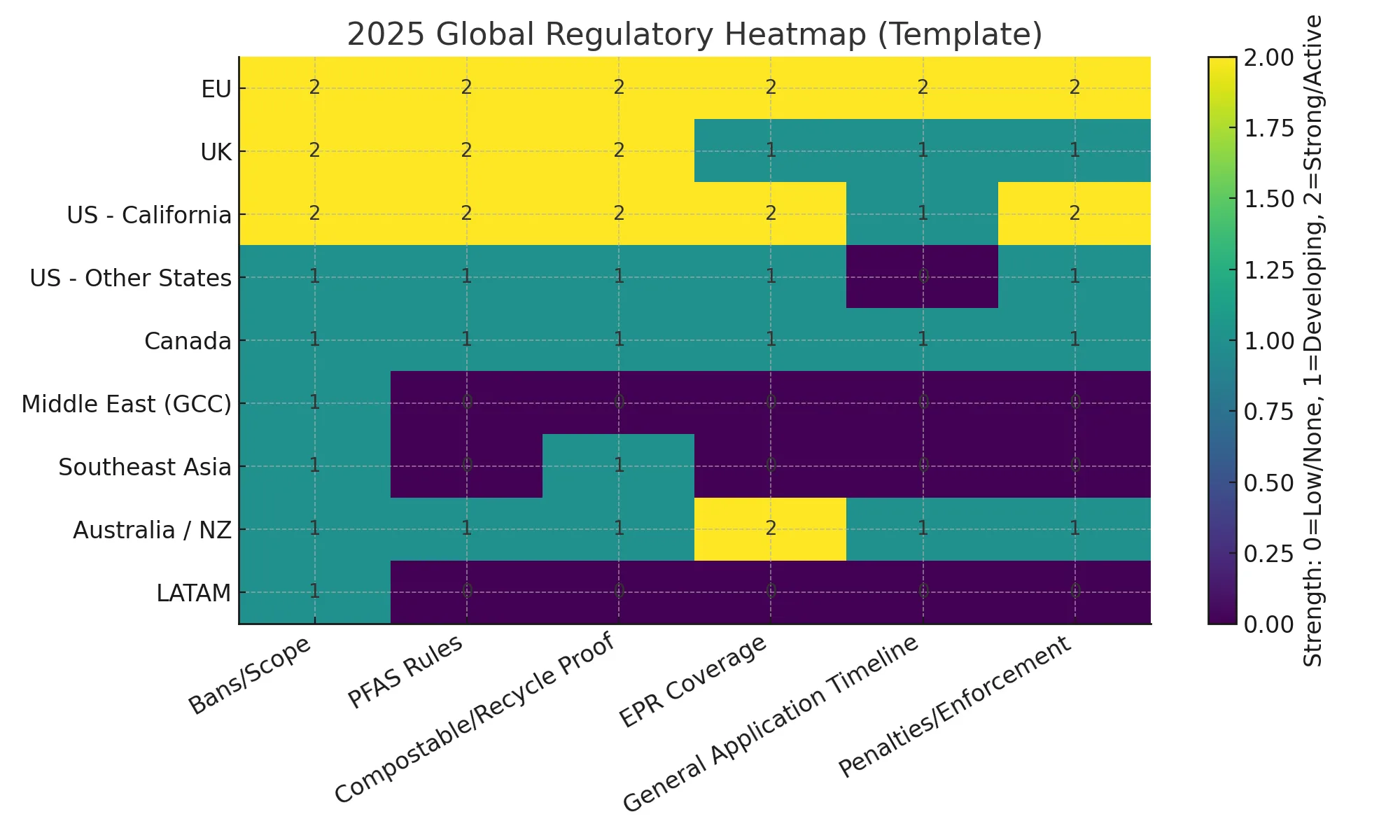
| Bans/Scope | PFAS Rules | Compostable/Recycle Proof | EPR Coverage | General Application Timeline | Penalties/Enforcement | |
| EU | 2 | 2 | 2 | 2 | 2 | 2 |
| UK | 2 | 2 | 2 | 1 | 1 | 1 |
| US – California | 2 | 2 | 2 | 2 | 1 | 2 |
| US – Other States | 1 | 1 | 1 | 1 | 0 | 1 |
| Canada | 1 | 1 | 1 | 1 | 1 | 1 |
| Middle East (GCC) | 1 | 0 | 0 | 0 | 0 | 0 |
| Southeast Asia | 1 | 0 | 1 | 0 | 0 | 0 |
| Australia / NZ | 1 | 1 | 1 | 2 | 1 | 1 |
| LATAM | 1 | 0 | 0 | 0 | 0 | 0 |
Figure 2 — Material Performance Radar
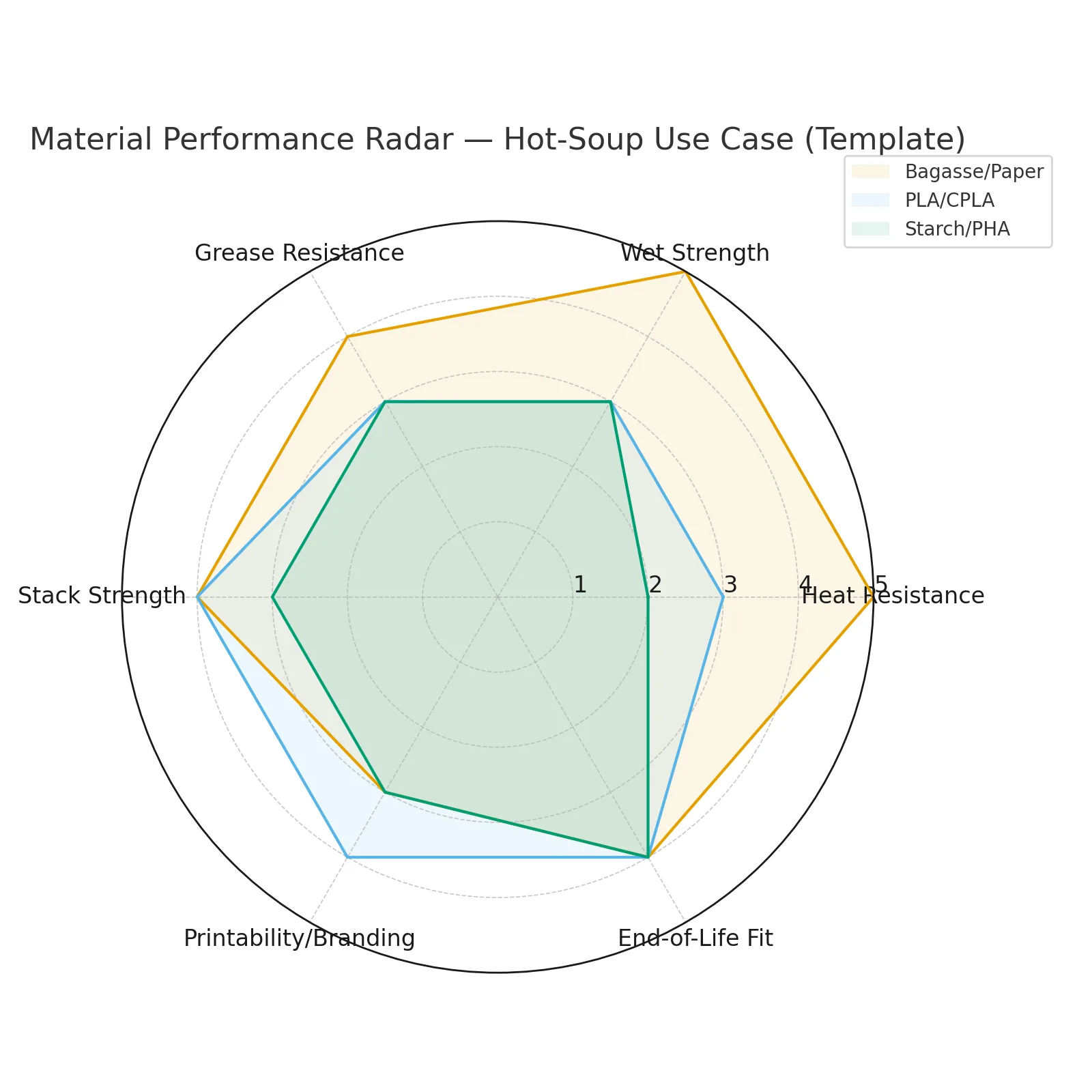
| Metric | Bagasse/Paper | PLA/CPLA | Starch/PHA |
| Heat Resistance | 5 | 3 | 2 |
| Wet Strength | 5 | 3 | 3 |
| Grease Resistance | 4 | 3 | 3 |
| Stack Strength | 4 | 4 | 3 |
| Printability/Branding | 3 | 4 | 3 |
| End-of-Life Fit | 4 | 4 | 4 |
Figure 3 — TCO Waterfall
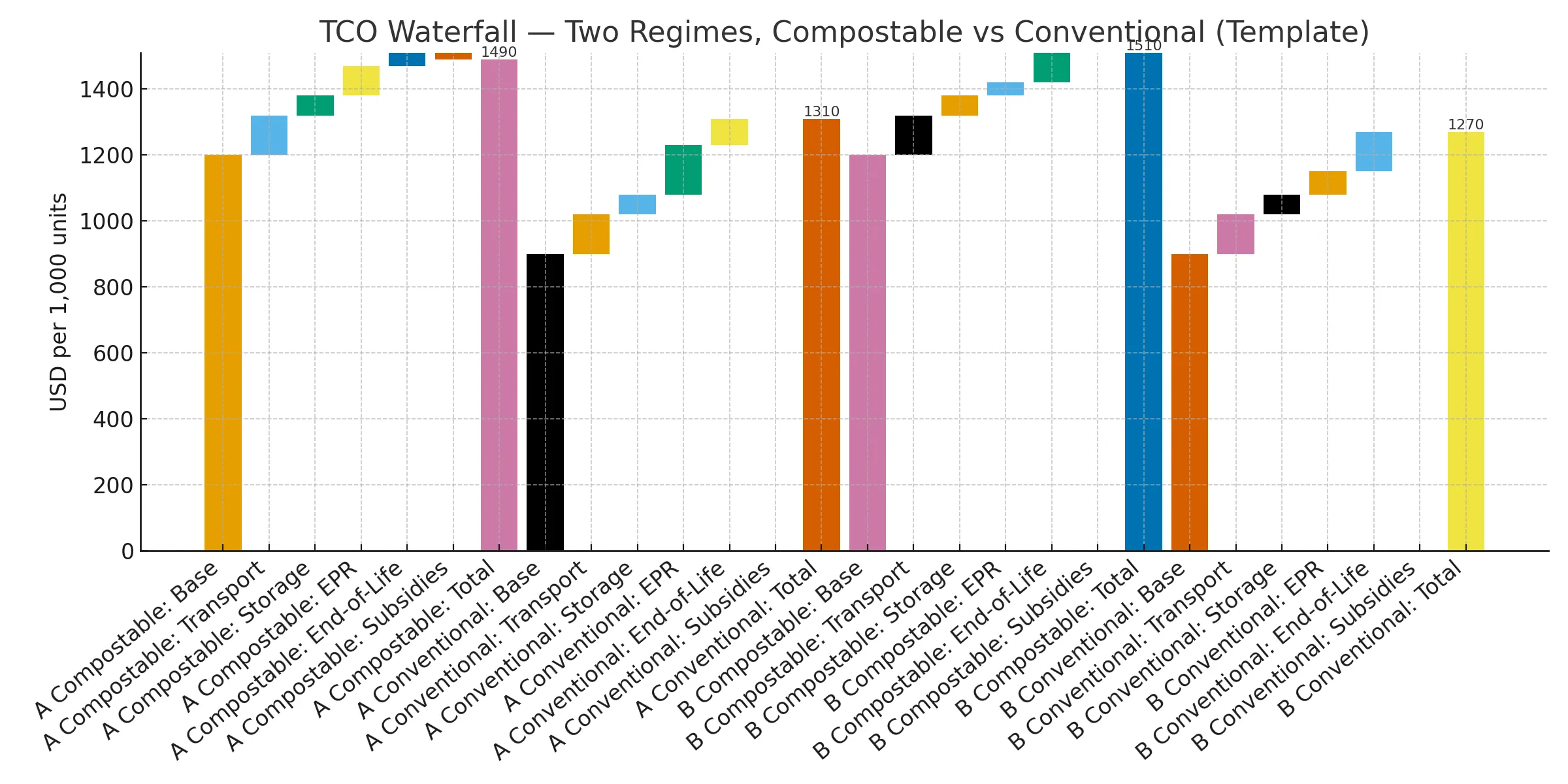
Sources:EU Commission – PPWR entry into force & application timeline; FDA – PFAS grease-proofing phase-out and FCN updates; CalRecycle – SB 54 EPR rulemaking; EPA – composting/wasted food data; BioCycle – household organics access & facility acceptance; Grand View Research – market sizing/CAGR.
2. Methodology
2.1 Sample Design
Target population.
Decision makers and influencers involved in food-packaging procurement, compliance, or operations across: QSR/fast food, supermarket/retail, restaurant/catering, food-delivery platforms, airline catering, healthcare/education, and CPG/meal-kit/ghost-kitchen.
Sample frame & size.
We conducted a primary survey with n ≥ 200 companies and 20 expert interviews (regulators/standards advisors, materials scientists, composting/recycling operators, and senior procurement). Company responses are one per organization (domain/name/site deduplication) to avoid overweighting large chains.
Stratification & quotas.
We use dual-marginal stratification by region and industry rather than a full region×industry grid (to avoid sparse cells), enforcing minimum cell stability via small caps:
Regions (illustrative): EU-27, UK, North America (US/CA), Middle East (GCC), Southeast Asia, Oceania (AU/NZ), LATAM.
Industries: QSR/Fast Food; Supermarket/Retail; Restaurant/Catering; Food-Delivery Platforms; Airline Catering; Healthcare/Education; CPG/Meal Kits.
Allocation rule. Initial target per stratum nhn_h follows proportional allocation to estimated market exposure php_h, subject to a floor (e.g., min 15 per stratum). Final realized counts are post-stratification weighted back to target margins.
Expert interviews (n=20).
Semi-structured, 45–60 minutes each, recorded with consent, covering: regulatory enforcement, PFAS testing evidence, facility acceptance criteria, LCA/LCC boundary choices, and contract clauses for traceability. Transcripts are anonymized and thematically coded.
2.2 Fieldwork & Data Processing
Questionnaire.
16 core questions (materials, certifications, PFAS status, use cases, end-of-life routes, price deltas, quality/stockout KPIs, TCO accounting, plans 2025–2026). Logic checks prevent contradictory selections; attention checks and minimum completion times reduce straight-lining.
Cleaning.
Deduplication: org name + website + email domain.
Quality filters: remove speeders (<P1 duration), flatliners (zero variance on scaled items), and inconsistent answers (e.g., claiming EN 13432 without compostability routing).
Outliers: numeric metrics are winsorized at 1st/99th percentiles; free-text is normalized (tokenization, typo harmonization).
Qualitative coding.
Two analysts independently code interview excerpts; Cohen’s κ ≥ 0.70 is required before codebook lock-down. Divergences resolved by adjudication.
2.3 Statistics & Weighting
Confidence & error.
With simple random sampling, worst-case margin of error at 95% confidence is:
MoE=z0.975p(1−p)n(at p=0.5,n=200⇒±6.9%)\text{MoE} = z_{0.975}\sqrt{\frac{p(1-p)}{n}} \quad \text{(at } p=0.5, n=200 \Rightarrow \pm 6.9\%\text{)}
With weighting, we report effective sample size neff=n/DEFFn_\text{eff} = n/\text{DEFF}. We estimate DEFF via weight dispersion:
DEFF≈1+CV2(w)\text{DEFF} \approx 1 + \text{CV}^2(w)
and use Rao–Wu or bootstrap procedures for weighted CIs.
Weights.
Initial design weights wh=Nh/nhw_h = N_h/n_h by stratum; then raking (IPF) aligns weighted margins to external benchmarks (region and industry exposure). Caps (e.g., 4× median weight) prevent excessive influence.
KPI construction.
TCO per 1,000 units: Unit Price×1000+Transport+Storage+EPR+End-of-Life−Subsidies\text{Unit Price}\times 1000 + \text{Transport} + \text{Storage} + \text{EPR} + \text{End-of-Life} – \text{Subsidies}.
LCA alignment: results normalized to a functional unit (e.g., 500 mL hot-soup takeaway, 95 °C, 30-min no-leak). Sensitivity analyses vary power mix (±20%), transport radius (±30%), and end-of-life access (0–60%).
2.4 Data Sources (Triangulation)
Primary survey (n≥200) — company-level quantitative KPIs.
Expert interviews (n=20) — enforcement reality, facility acceptance, testing protocols, contract terms.
Standards & regulatory texts — e.g., EN 13432, ASTM D6400, EU PPWR, state EPR rules; used to build the compliance heatmap fields.
Certification databases — e.g., BPI, TÜV OK compost; for status verification where respondents claim certifications.
Procurement tenders & ESG/annual reports — to benchmark pricing bands, lead times, and disclosure practices.
2.5 Limitations & Bias Control
Limitations.
Coverage & non-probability bias: access-panel recruitment and opt-in emails are not pure probability samples; certain micro-segments may be under-represented.
Self-reporting & recall: unit-price deltas and defect rates may contain noise; some respondents conflate recyclable vs compostable claims.
Regulatory drift: policies (PFAS/EPR/labeling) are time-sensitive; findings reflect the cut-off date of fieldwork.
Facility heterogeneity: composting/recycling acceptance varies by city/operator; translating “theoretical” compliance into operational feasibility is non-trivial.
Bias controls.
Stratification + minimum cells to avoid dominance by any single region/industry.
Raking to external margins; weight capping; design-based CIs.
Cross-checks: certification claims sampled against public DBs; PFAS-free claims compared to test reports; contradictory responses flagged for re-contact.
Sensitivity analyses on TCO/LCA with alternate end-of-life access and EPR intensities.
One-response-per-company rule to limit clustering.
2.6 Ethics, Privacy, and Transparency
Respondents provide informed consent; identifiable data are anonymized and stored separately. Results are reported in aggregate only. Data retention is limited to 24 months for replication; opt-out/erasure honored upon request. We publish a data dictionary, codebook, and weighting summary; upon request we can share de-identified microdata and analysis scripts under a restricted license.
Bioleader’s note (non-public): If your realized nn exceeds 200 or DEFF<1.2, you may tighten the reported MoE to ±6%; otherwise retain ±6–7% and disclose neffn_\text{eff}.
3. 2025 Market Overview
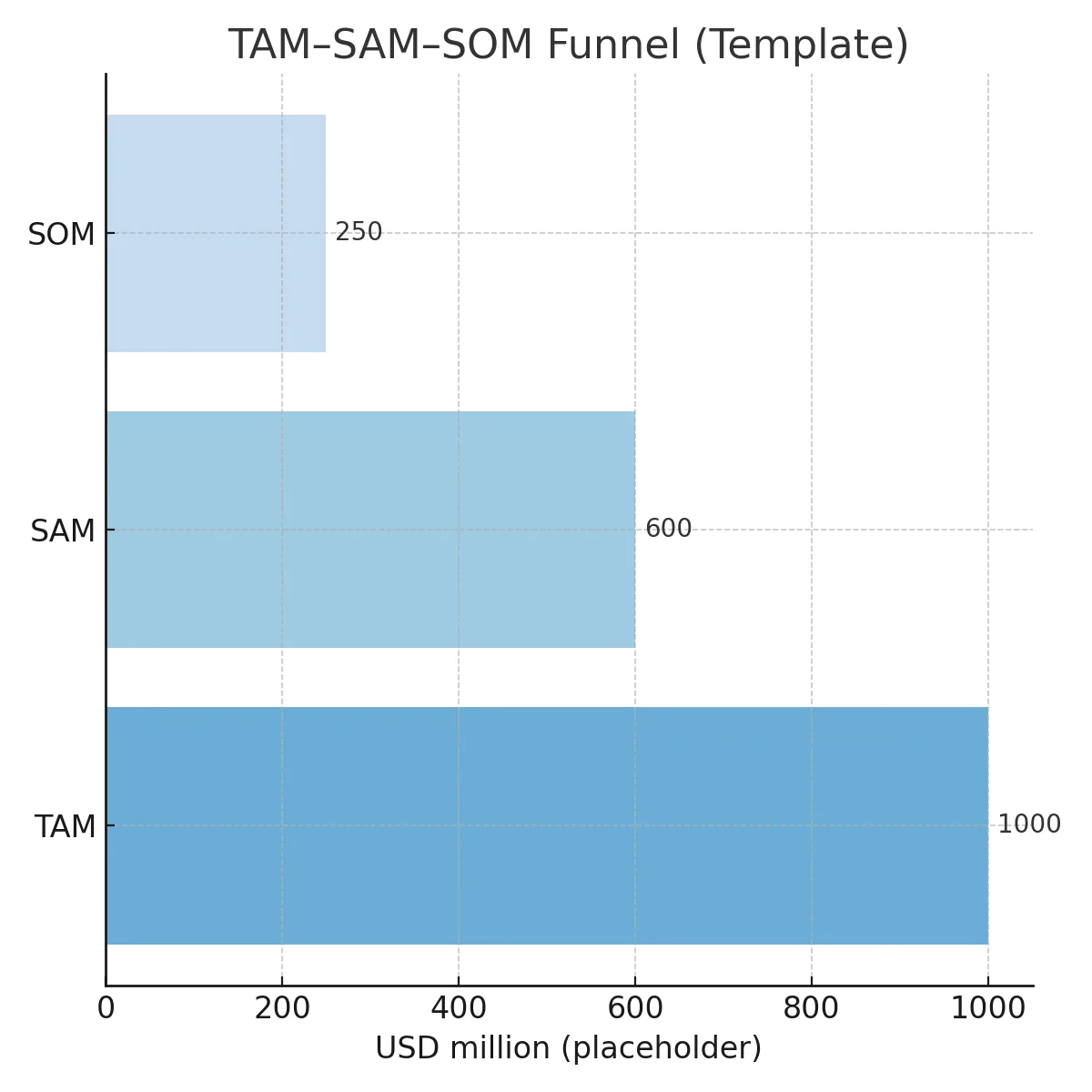
3.1 Market Size & Structure (TAM/SAM/SOM)
Positioning.
The biodegradable/compostable food-packaging market in 2025 is defined by compliance-ready fiber- and bio-based formats replacing legacy plastic and paper–plastic laminates. We structure demand using a TAM–SAM–SOM funnel tied to regulatory exposure and end-of-life (EoL) access.
TAM (Global opportunity). Total spend on disposable food packaging across foodservice/retail segments, filtered by categories where compostable/recyclable alternatives are technically viable in 2025.
SAM (Addressable under regulation & infrastructure). Subset of TAM in regions/cities with active bans/EPR and operational access to composting or fiber-recycling; excludes niche SKUs without functional fit.
SOM (Serviceable obtainable). Your reachable share in 12–18 months given certifications, PFAS-free evidence, lead times, and channel coverage.
So-what.
SOM is maximized not by price alone but by compliance certainty + scenario fit + city-level EoL access. Funnel conversion improves materially where you hold audited documentation and local partners on the EoL side.
3.2 Growth Drivers & Barriers
Key drivers (2025–2027).
Regulation/EPR as primary catalyst (mandatory recyclability/compostability claims; PFAS removal).
Retail/QSR brand risk: reputational risk and ESG disclosures move procurement from unit price to risk-adjusted TCO.
Operational maturity: increasing acceptance of compostable food-contact items by facilities—conditional and city-specific.
Headwinds/barriers.
Infrastructure gaps (organics collection, fiber-recovery contamination tolerance).
Claim ambiguity & label risk (home-compostable vs industrial; recyclable with conditions).
Supply chain dispersion (lead-time volatility, MOQ constraints on custom prints/barriers).
So-what.
Growth will be structural but uneven. Portfolios must be city-calibrated and evidence-rich to avoid tender disqualification and post-launch compliance failures.

3.3 Demand by Use Case
Functional segmentation.
We segment by hot meals, soups, salads, cold drinks, microwave/freezer, baking/oven. Each use case is scored on fit-for-purpose criteria (heat, wet/grease strength, stack strength, lid fit, branding) and EoL compatibility.
| Use case | Primary formats | Critical specs | Preferred materials (2025) | EoL guidance |
|---|---|---|---|---|
| Hot meals | bowls/clamshells | ≥90–95 °C, 30-min no-leak | Bagasse/Paper + PFAS-free barrier | Compostable (industrial) or fiber-recycling per city |
| Soups | soup bowls + lids | Splash/transport leakage, lid torsion | Bagasse heavy-wall; molded lids | Compostable (industrial) |
| Salads | salad bowls + inserts | Oil resistance, clarity option | Bagasse (base) / PLA clear lids | Compostable/fiber-recycling |
| Cold drinks | clear cups + lids | Crack resistance, clarity | PLA/CPLA | Compostable (industrial) |
| Microwave/Freezer | trays/bowls | Heat cycling, warp control | Bagasse/Paper engineered | Compostable/fiber-recycling |
| Baking/Oven | trays | Oven-rated barrier | Specialty fiber/coat | Compostable/fiber-recycling |
So-what.
Treat use cases as SKUs with compliance budgets. The highest win rates occur where spec-tight designs align with local EoL and labeling rules.
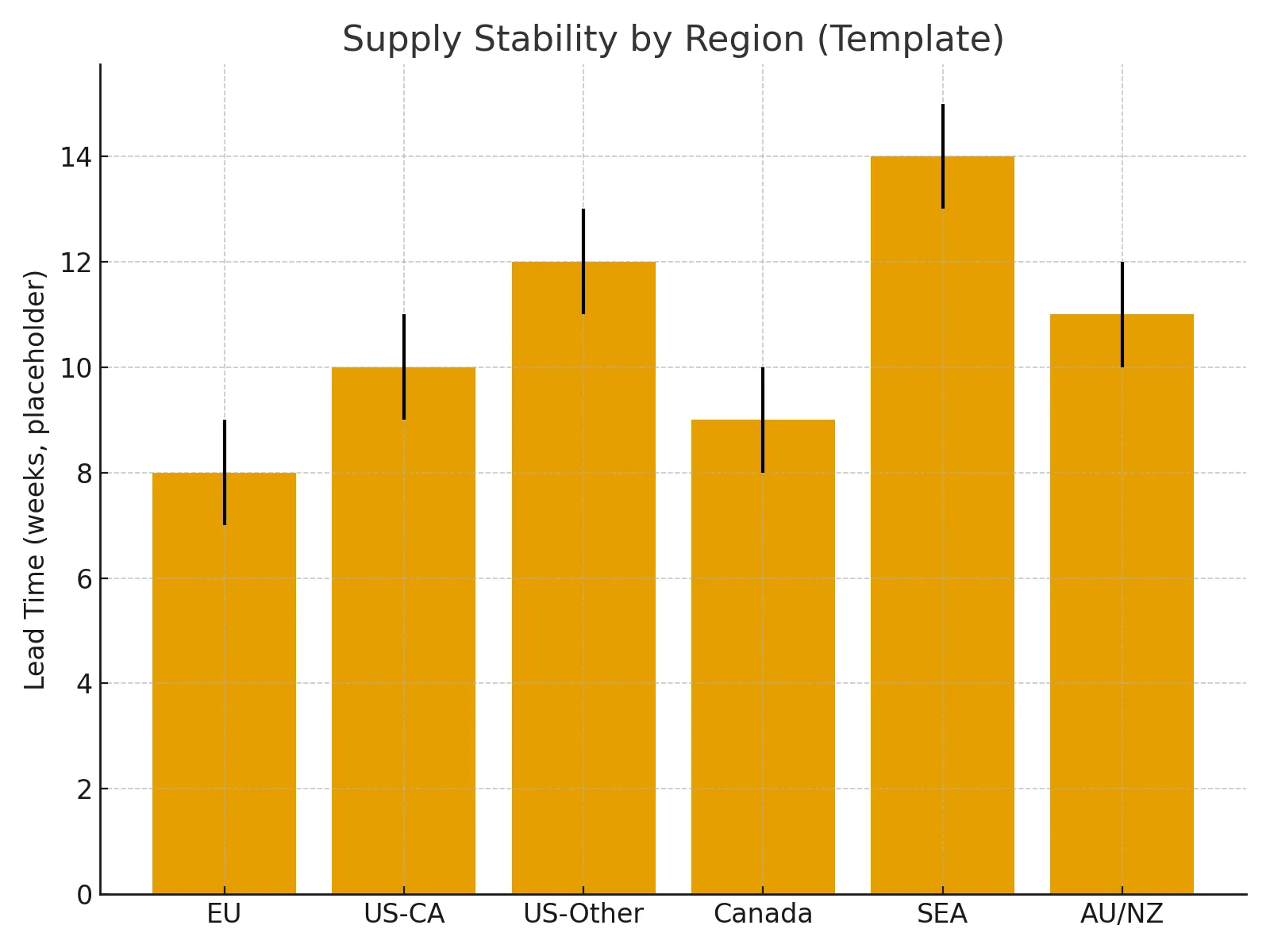
3.4 Cost Trends & Supply Stability
Cost direction.
TCO variance in 2025 is driven by barrier choices (PFAS-free), printing runs (MOQ/ink system), logistics, and EPR/EoL fees.
Supply stability. Lead time stability correlates with multi-plant redundancy, certification currency, and local stocking.
Playbook.
Lock dual-sourcing for top 10 SKUs; keep test reports <12 months; pre-approve artwork/ink sets to reduce proof cycles.
Model TCO waterfalls per city and publish to sales teams for price-fence discipline.
4. Regulations & Compliance Map
4.1 Dimensions & Evidence Chain
Scope.
We map, for each region/state: bans/scope, labeling/claims, definitions & proof for compostability/recyclability, PFAS limits, EPR obligations, timelines (entry into force, application, grace periods), and enforcement/fines.
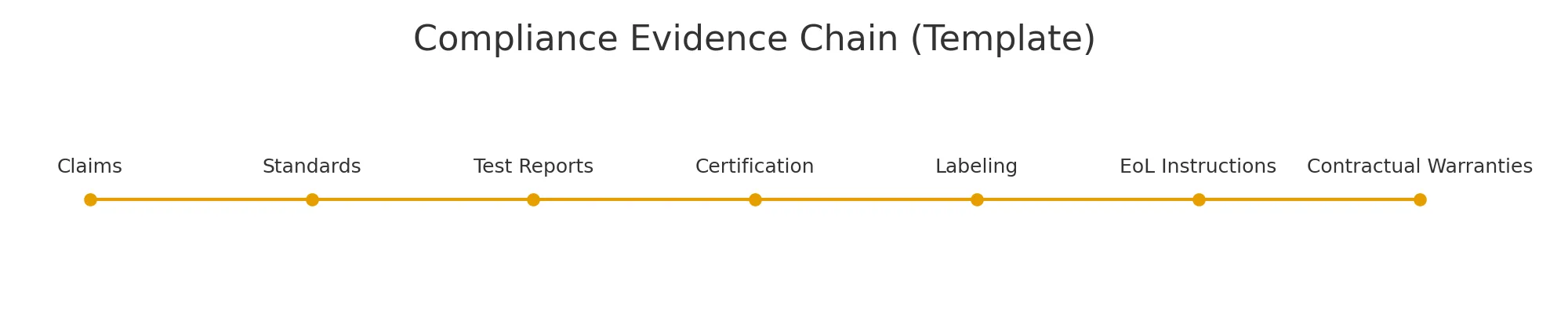
Evidence chain (what buyers expect).
Claims → Standards → Test reports → Certification → Labeling → EoL instructions → Contractual warranties.
Minimum bid pack: EN 13432/ASTM D6400/BPI/TÜV proofs, FC migration tests (FDA/LFGB), PFAS-free evidence, batch traceability, and EoL routing.
4.2 Region Cards
| Region | What Changed | Core Obligations | PFAS | EPR | Timeline | Enforcement |
| EU (PPWR) | PPWR in force; prevention, recyclability, reuse, labeling | DoCs, labeling, EPR reporting | Restricted/monitored | Mandatory | 2025-02-11 in force; +18 months application | EU-level + national fines |
| US – California (SB 54) | EPR permanent; recyclability/compostability obligations; PFAS restricted | Producer registration, reporting, source reduction | Restricted in food-contact | Mandatory | 2025 rulemaking ongoing | CalRecycle enforcement, penalties |
| Canada | Federal bans + provincial EPR | Substantiated compostability claims | Provincial variance | Mandatory | Phased by province | Provincial enforcement |
Region cards: one-page tender essentials per market.
4.3 Master Comparison Table
| Region | Bans/Scope | Labeling | Compostability Proof | Recyclability Proof | PFAS | EPR | Timelines | Fines |
| EU | Strong | Mandatory | EN 13432 | Harmonized | Restricted | Mandatory | 2025+ | Yes |
| UK | Aligned | Green claims code | EN 13432 | OPRL/WRAP | Restricted | Mandatory | Ongoing | Yes |
| US-CA | Strong | State evolving | ASTM D6400/BPI | State evolving | Restricted | Mandatory | 2025+ | Yes |
| US-Other | Patchwork | Patchwork | Mixed | Mixed | Varies | Patchwork | Varies | Varies |
| Canada | Strong | Provincial | BPI/Provincial | Provincial | Varies | Mandatory | Phased | Yes |
| AU/NZ | Strong | National ARL | AS standards | ARL | Restricted | Mandatory | 2025+ | Yes |
Master comparison: obligations and proof requirements by region, 2025 snapshot.
5. Materials & Process Stack
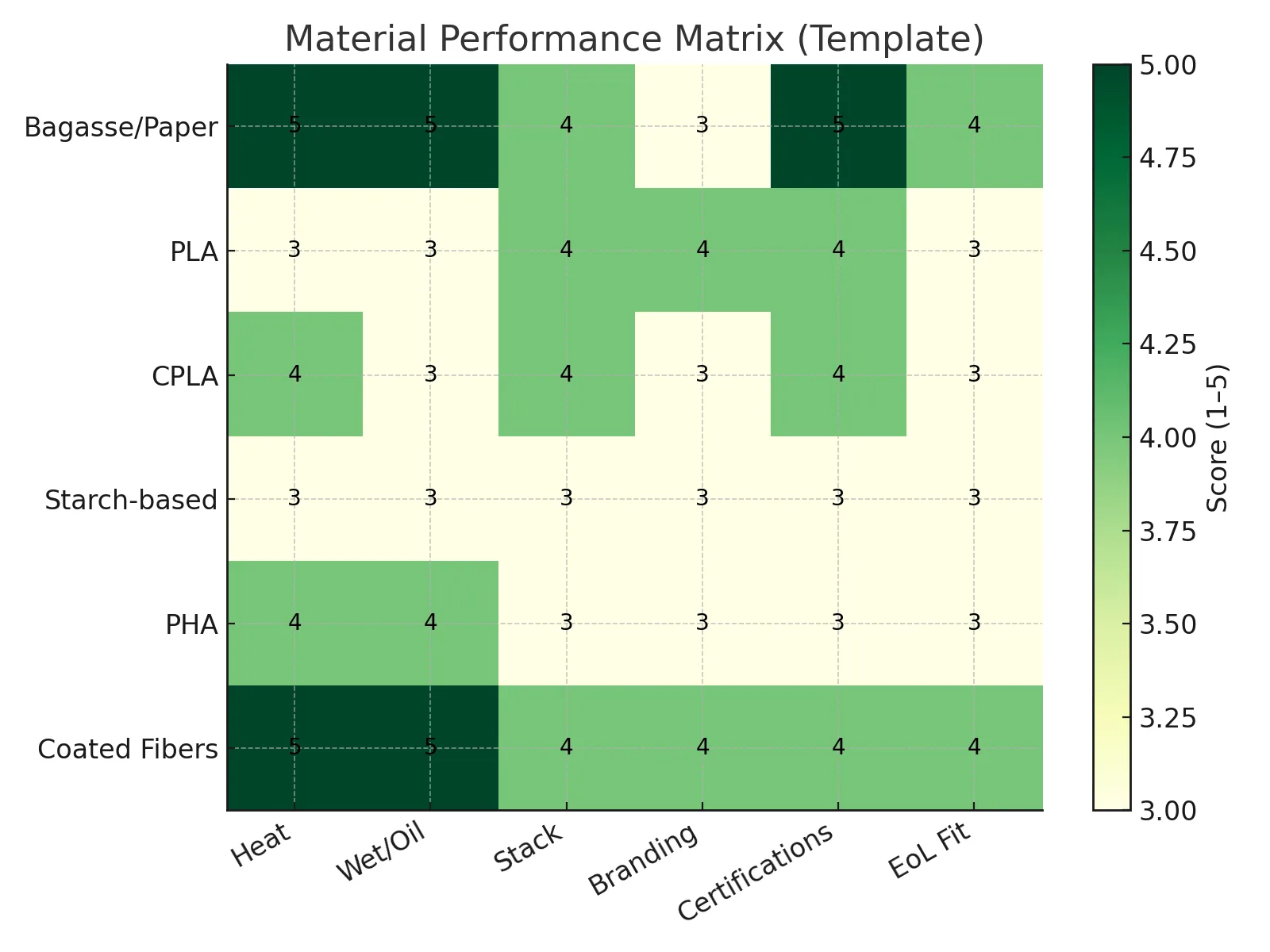
5.1 Material Performance Matrix
Approach.
Normalize all results to a functional unit (e.g., 500 mL hot-soup takeaway, 95 °C, 30-min no-leak). Score each material 1–5 across performance and commercialization dimensions; attach typical certifications and branding options.
| Material | Heat | Wet/Oil | Stack | Branding/Print | Typical Certifications | Primary EoL (city-dependent) |
|---|---|---|---|---|---|---|
| Bagasse/Paper | 4–5 | 4–5 | 4 | 3–4 | EN 13432 / BPI / TÜV; FDA/LFGB | Industrial compost / fiber-recycling |
| PLA | 3 | 3 | 4 | 4 | EN 13432 / ASTM D6400 / BPI; FDA/LFGB | Industrial compost |
| CPLA (cutlery/lids) | 3–4 | 3 | 4 | 3 | Same as above | Industrial compost |
| Starch-based | 2–3 | 3 | 3 | 3 | Selected compostability marks | Industrial compost |
| PHA (emerging) | 3–4 | 3–4 | 3–4 | 3 | Ongoing certifications | Industrial compost |
| Coated fibers (PFAS-free) | 4–5 | 4–5 | 4 | 4 | Depending on barrier system | Compost/fiber-recycling (case-by-case) |
So-what.
For hot/oily applications, fiber-based with PFAS-free barriers is the default; clarity-driven SKUs (cold drinks) align to PLA/CPLA with explicit EoL instructions.
5.2 Process Routes & Quality Control
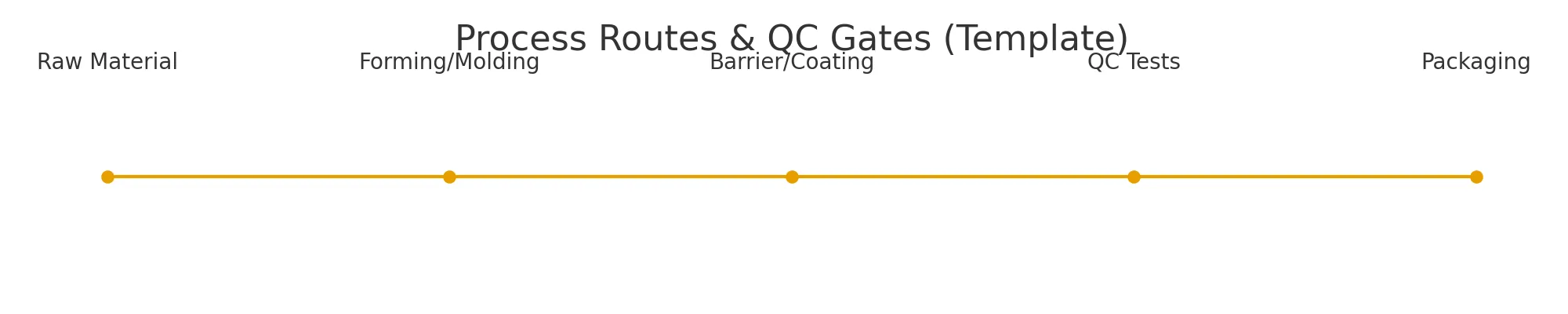
Molding & forming.
Bagasse/Paper: wet molding → hot pressing; barrier via dispersion/lamination (PFAS-free); critical to manage moisture profile and tool venting.
PLA cups: extrude sheet → thermoform; impact resistance and rim integrity are primary QC points.
CPLA cutlery/lids: injection molding; crystallinity controls heat resistance and brittleness.
QC checkpoints.
Dimensional & lid-fit tolerances (transport leak testing).
Heat/wet/grease strength against declared use case.
Migration tests (FDA/LFGB), odour/taint panels.
Stack compression & drop tests for distribution.
5.3 End-of-Life Compatibility by Region
Principle.
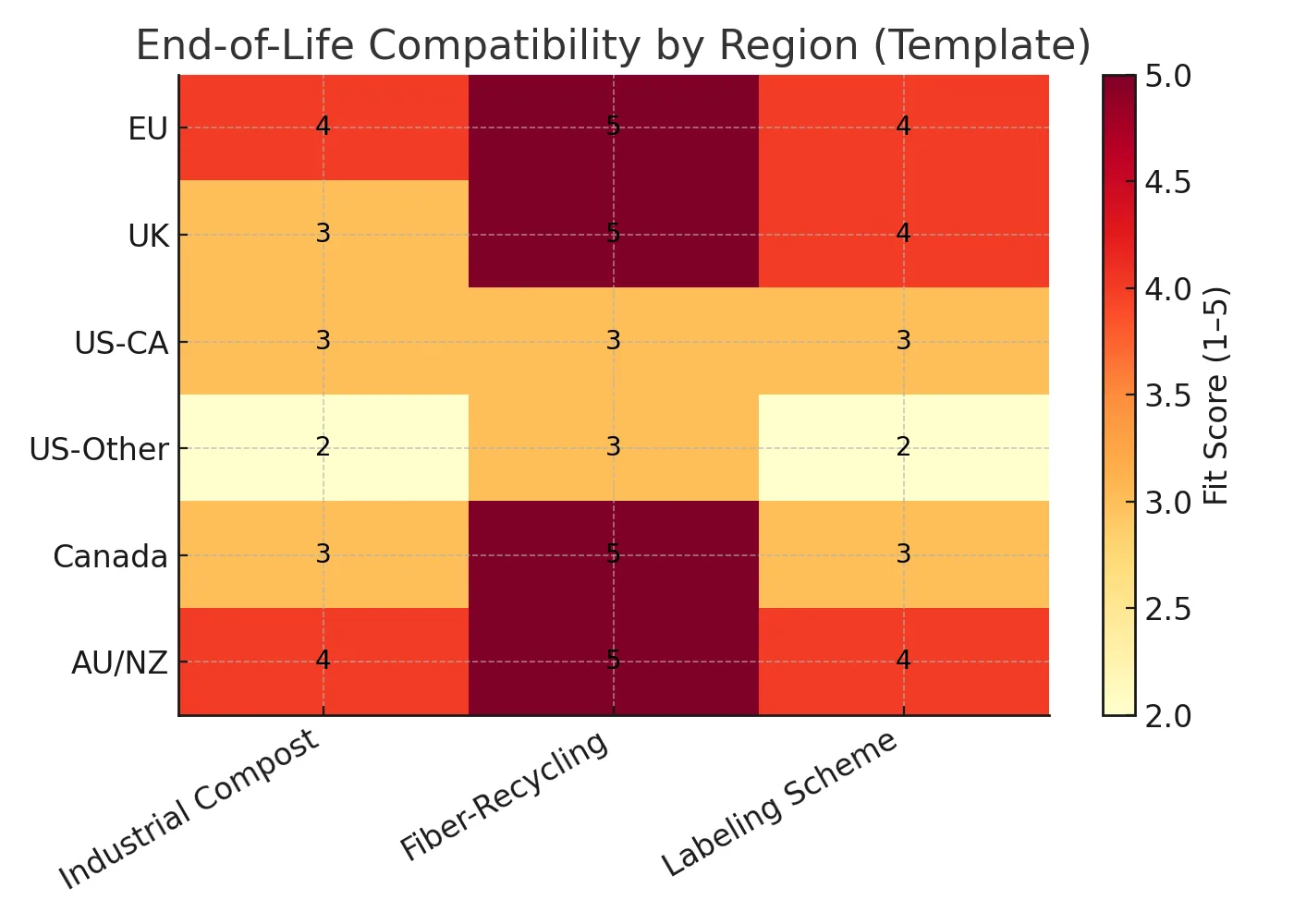
Label only what you can prove and route operationally. Provide city-specific EoL guidance to customers and distributors.
| Region | Industrial Compost Access | Fiber-Recycling Fit | Labeling Scheme | Notes |
|---|---|---|---|---|
| EU | High in major cities (varies) | Strong for PFAS-free fibers | PPWR-aligned icons (localized) | Check municipal lists |
| UK | Building | Strong (fiber) | OPRL/WRAP guidance | Claims codes apply |
| US (CA) | Growing | Mixed by MRF | State labeling evolving | SB 54 interface |
| US (Other) | Uneven | Mixed | Patchwork | City-specific routing |
| CA (Canada) | Provincial variance | Strong (fiber) | Provincial EPR marks | Validate claims |
| AU/NZ | National guidance improving | Strong (fiber) | ARL scheme | Program updates |
So-what.
The same SKU may carry different EoL statements across regions—manage via localized artwork & QR instructions.
5.4 Common Failure Modes & Prevention
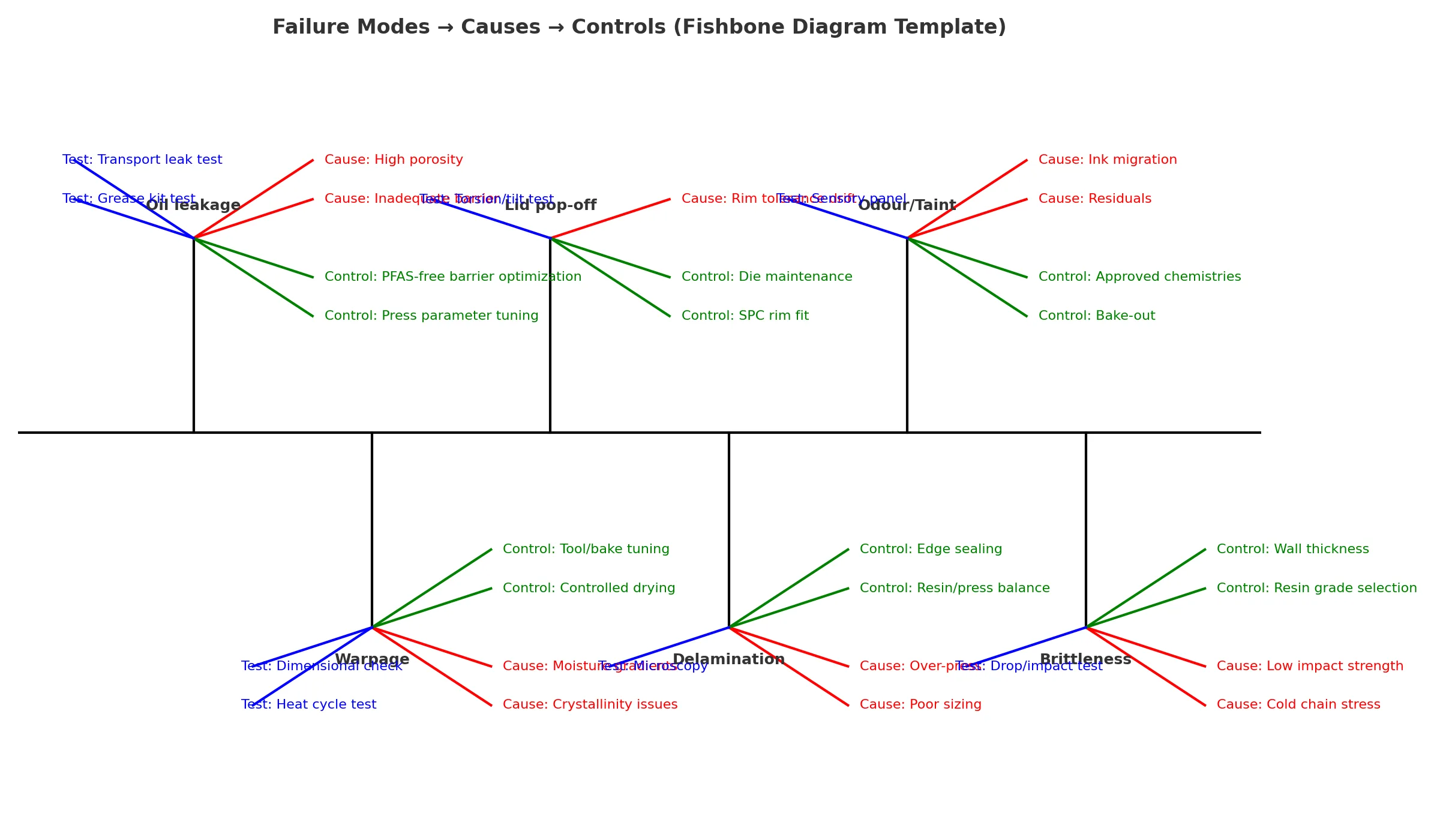
| Failure mode | Typical root cause | Prevention / control | Test to catch |
|---|---|---|---|
| Oil wicking/leakage | Inadequate barrier; porosity | PFAS-free barrier optimization; press parameters | Grease (Kit) + transport leak |
| Warpage/deformation | Moisture gradients; crystallinity | Controlled drying; tool/bake tuning | Dimensional + heat cycle |
| Lid pop-off | Rim/profile tolerance drift | Tighter die maintenance; lid-fit SPC | Torsion/tilt tests |
| Delamination/fiber-lift | Over-press; poor sizing | Resin/press balance; edge sealing | Cross-section microscopy |
| Odour/taint | Residuals or inks | Approved chemistries; bake-out | Sensory panels |
| Brittleness/cracks | Low impact strength; cold chain | Resin grade; wall-thickness | Drop/impact |
So-what.
Make failure-mode control charts part of customer onboarding. It cuts returns and accelerates approvals.
6. LCA & TCO Models
A robust evaluation of biodegradable food packaging requires combining Life Cycle Assessment (LCA) and Total Cost of Ownership (TCO). Together, these frameworks reveal both the environmental and financial trade-offs that procurement teams must consider.
System Boundaries
The LCA adopts a cradle-to-grave perspective, covering raw material extraction, conversion, distribution, use, and end-of-life management. The functional unit is defined as “delivery of 1,000 units of food containers to a foodservice operator in 2025.”
Sensitivity Analysis
Key variables influencing results include:
Power Mix: Renewable vs fossil-based electricity in production.
End-of-Life Access: Industrial composting availability, recycling uptake, and landfill leakage.
Transport Radius: Local production (<500 km) versus intercontinental shipping.
PFAS Restrictions: Cost and compliance impacts of barrier alternatives.
Recommended Visuals
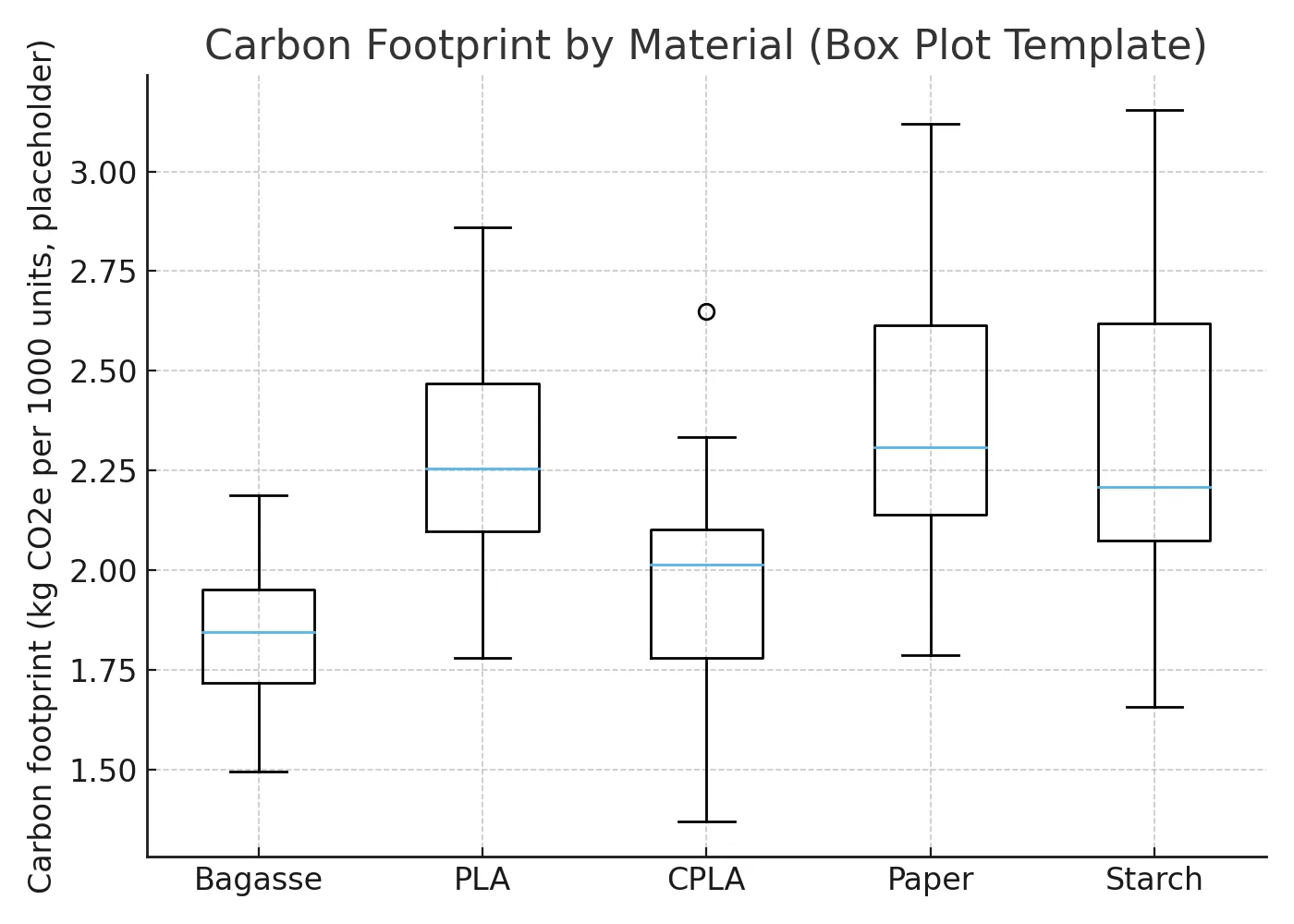
Box Plots: Show variance in carbon footprint across materials (e.g., bagasse vs PLA vs coated paper).
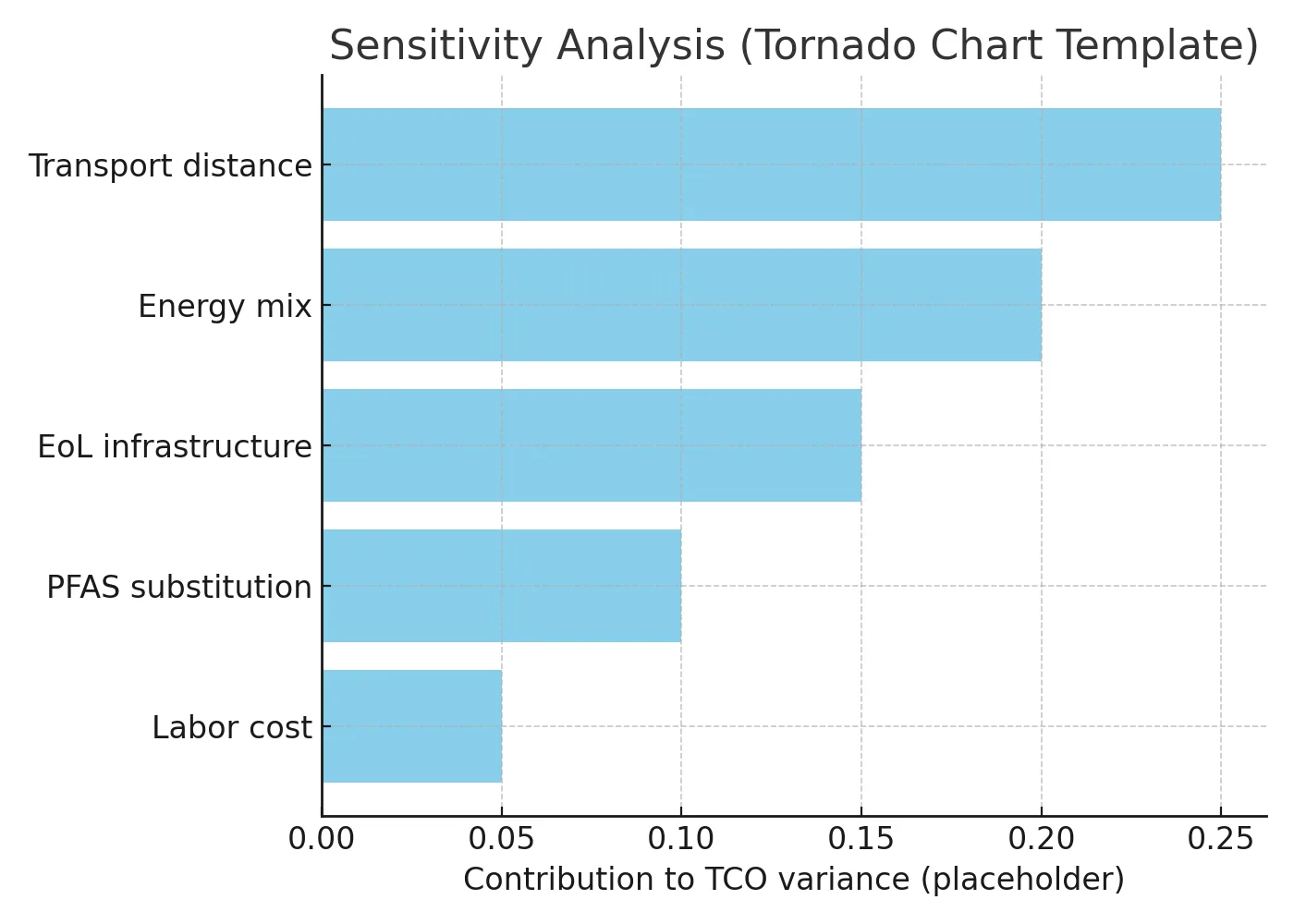
Tornado Charts: Rank the sensitivity of each driver (e.g., transport distance has greater TCO effect than PFAS testing costs).
Sankey Diagram: Illustrate material and energy flows, clarifying hotspots such as barrier coating and waste management.
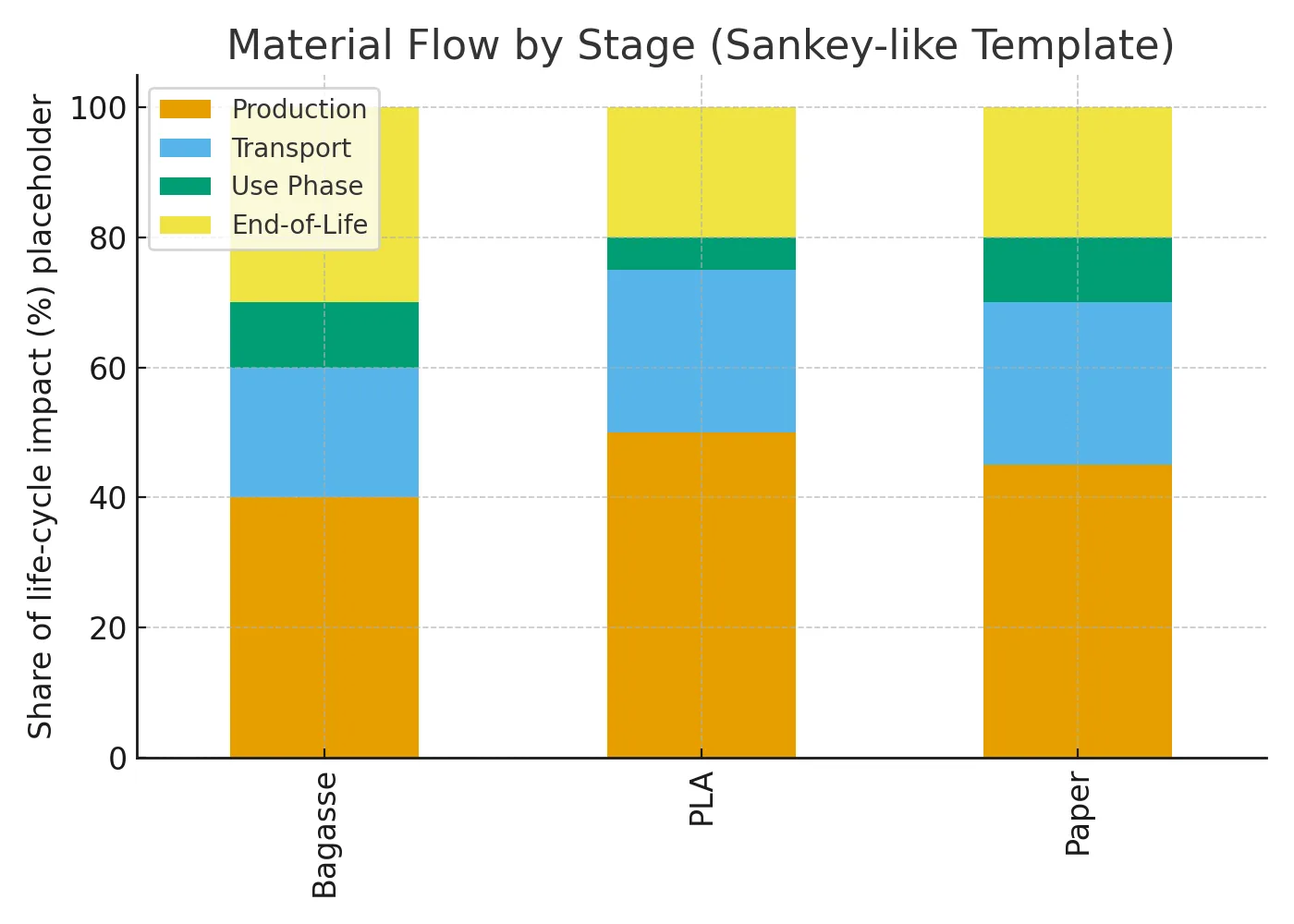
Conclusion: LCA/TCO integration demonstrates that bagasse bowls and kraft paper trays consistently deliver lower carbon intensity while remaining cost-competitive, particularly in markets with composting infrastructure.
7. Applications & Scenarios
Different food categories place distinct demands on packaging performance. Aligning material choice with application is essential for both functionality and compliance.
Hot Soup Delivery
Recommended: Bagasse bowls with PLA or CPLA lids.
Rationale: Superior heat resistance and leak-proof integrity.
Fried Foods
Recommended: Coated paper clamshells with oil barriers.
Rationale: Prevents oil seepage and maintains crispness during delivery.
Salad Retail
Recommended: Kraft paper bowls with transparent PLA lids.
Rationale: Strong consumer acceptance due to natural look and clear product visibility.
Frozen Meals
Recommended: Starch-based or CPLA trays.
Rationale: Durable in cold storage, compatible with freezer-to-oven transitions.
Microwave/Oven Use
Recommended: CPLA-free bagasse trays.
Rationale: Withstand reheating cycles without deformation or chemical migration.
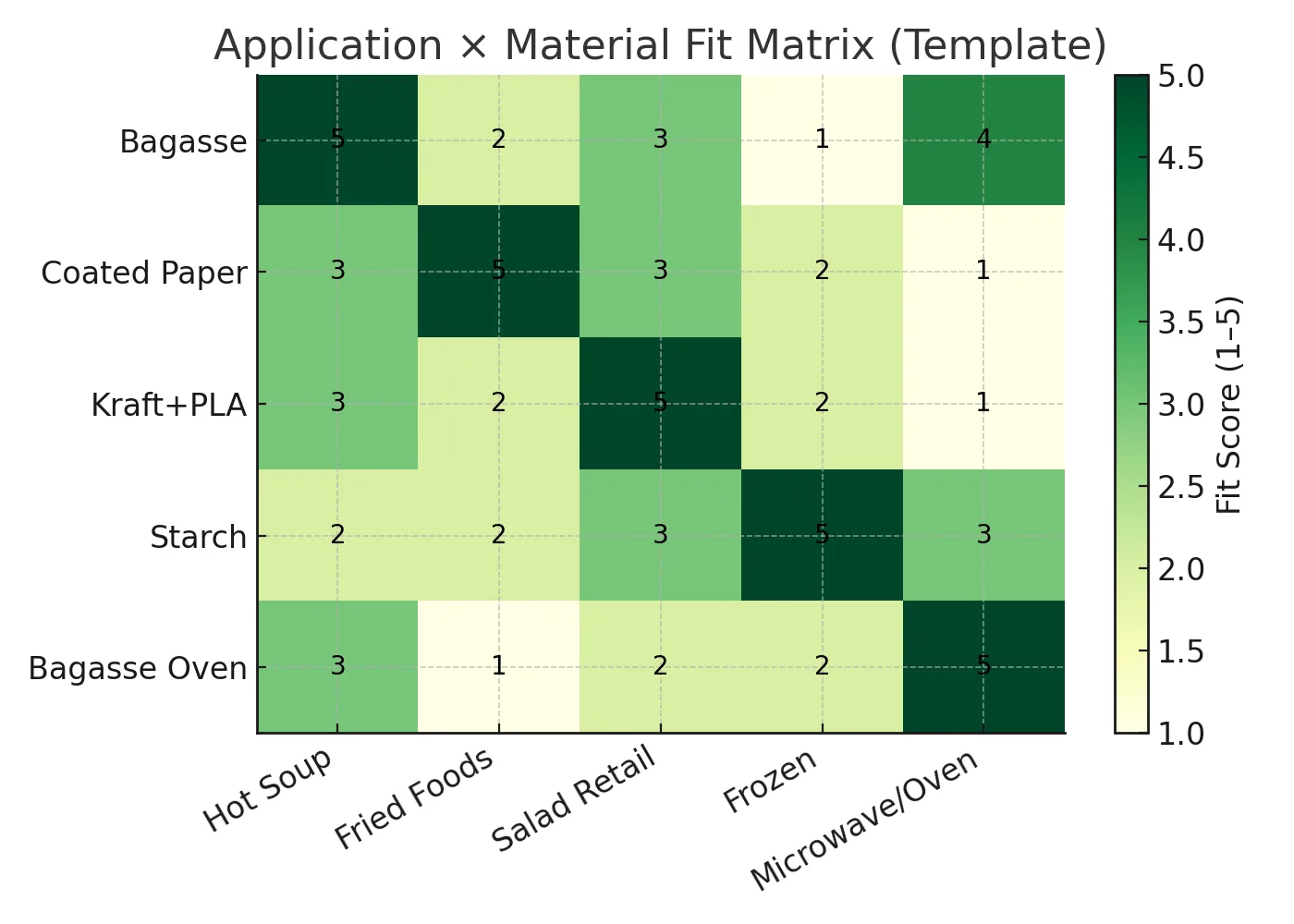
Conclusion: Application-driven recommendations minimize failure risk, ensure regulatory compliance, and optimize consumer experience across diverse food categories.
8. Supply Landscape
The supply chain for biodegradable packaging is rapidly expanding, yet capacity and capabilities differ significantly by region and supplier type.
Capacity & Lead Times
Asia-Pacific (China, India): Largest manufacturing capacity, average lead times of 4–6 weeks.
Europe: Strong compliance focus, but smaller production base and longer lead times (6–8 weeks).
North America: Fragmented, with reliance on imports from Asia.
Minimum Order Quantities (MOQ)
Entry-level suppliers: 20,000–50,000 units per SKU.
Premium/Certified suppliers: 100,000+ units, often with stricter customization terms.
Certifications & Quality Systems
Widely accepted certifications: BPI (US), TÜV Austria (EU), FDA/LFGB (food-contact safety).
Buyers increasingly demand traceability, ESG disclosures, and supplier audits.
Customization & Differentiation
Entry-tier suppliers: Limited shapes and branding.
Premium-tier suppliers: Custom molds, multicolor printing, PFAS-free barrier solutions.
Recommended Visuals
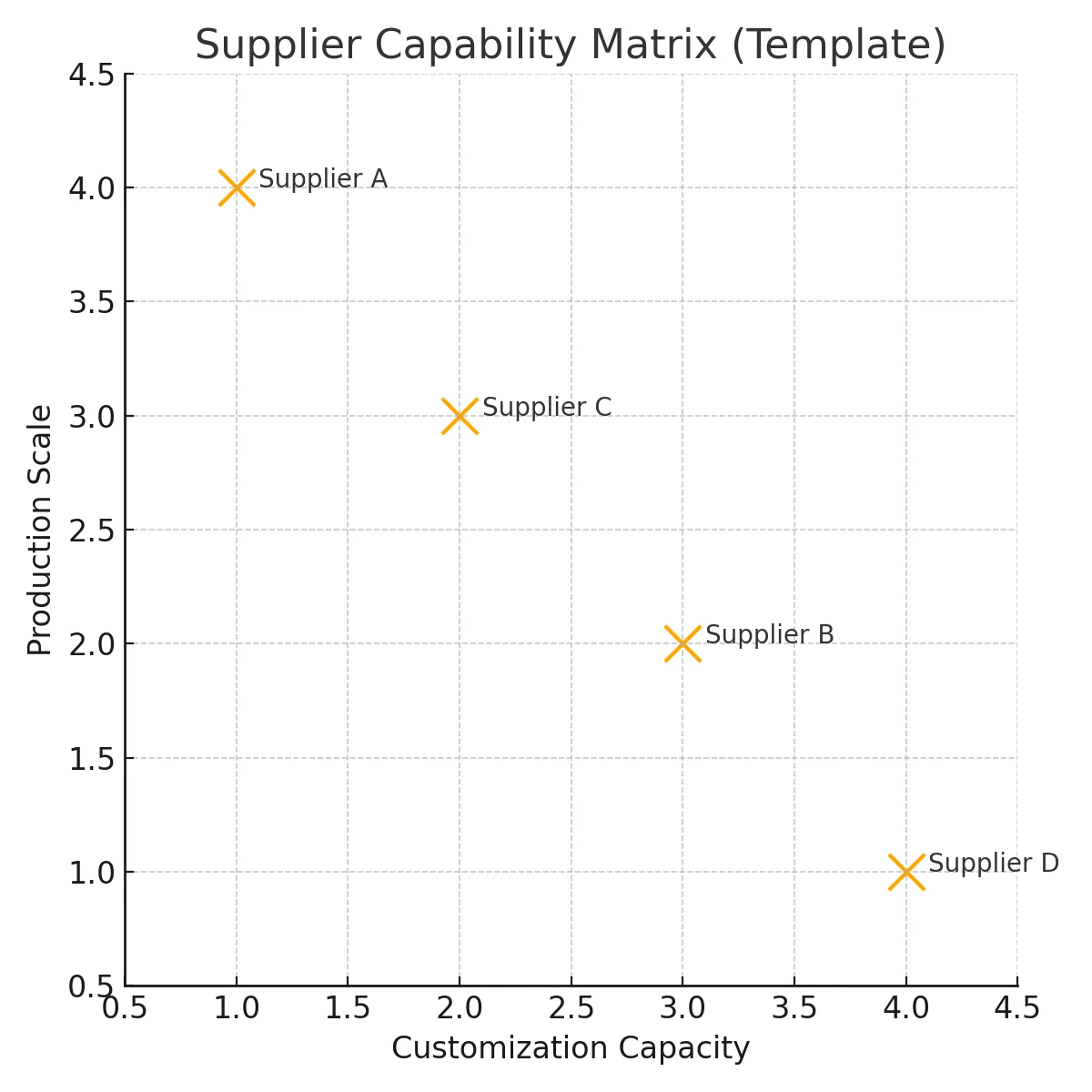
2×2 Capability Matrix: X-axis = customization capacity, Y-axis = production scale.
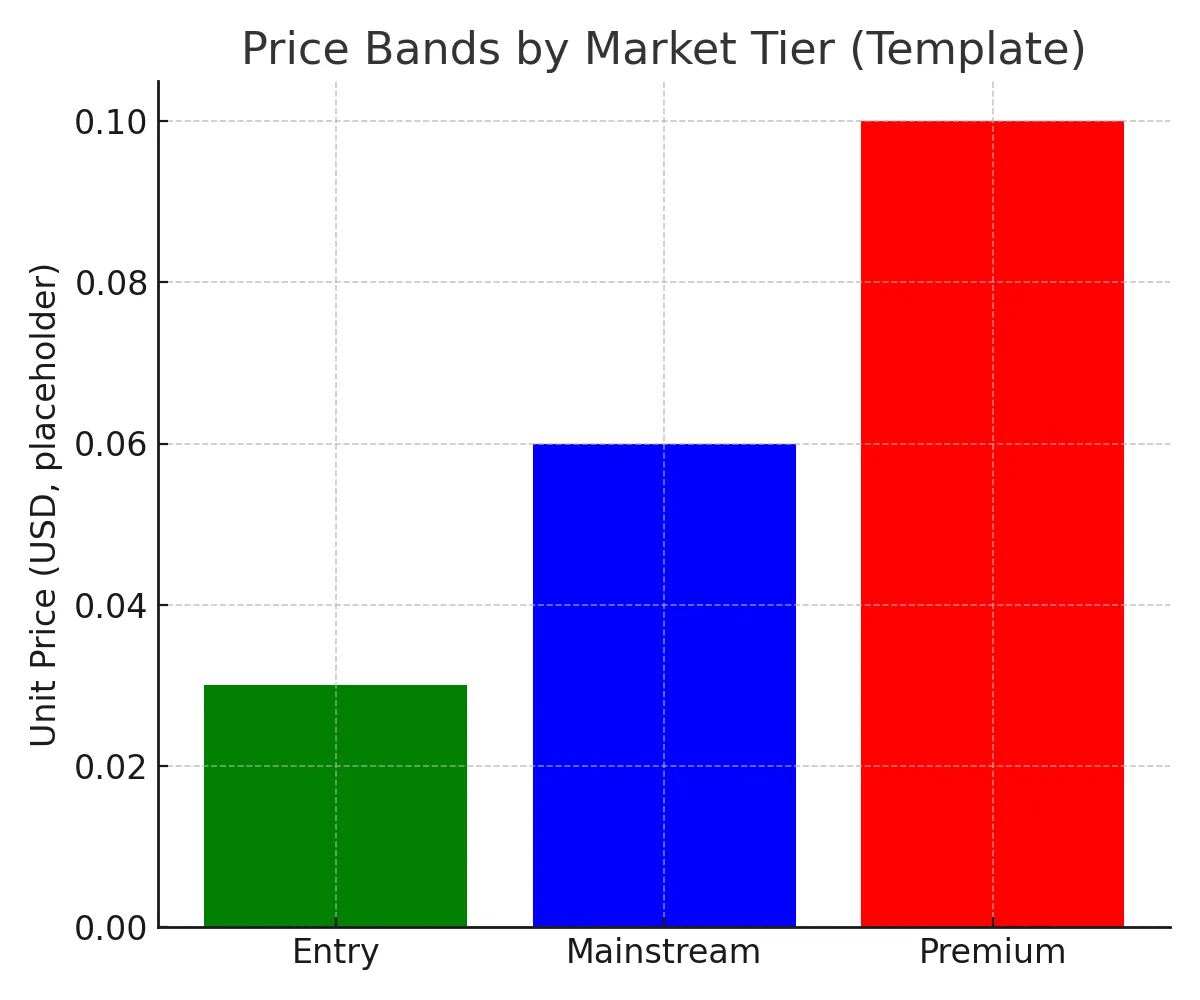
Price Bands: Entry ($0.02–0.04/unit), Mainstream ($0.05–0.08/unit), Premium ($0.09+).
Conclusion: The global supply landscape bifurcates into scale-driven Asia-Pacific suppliers and compliance-driven European producers. Buyers must balance cost efficiency with customization and certification needs.
9. Case Studies
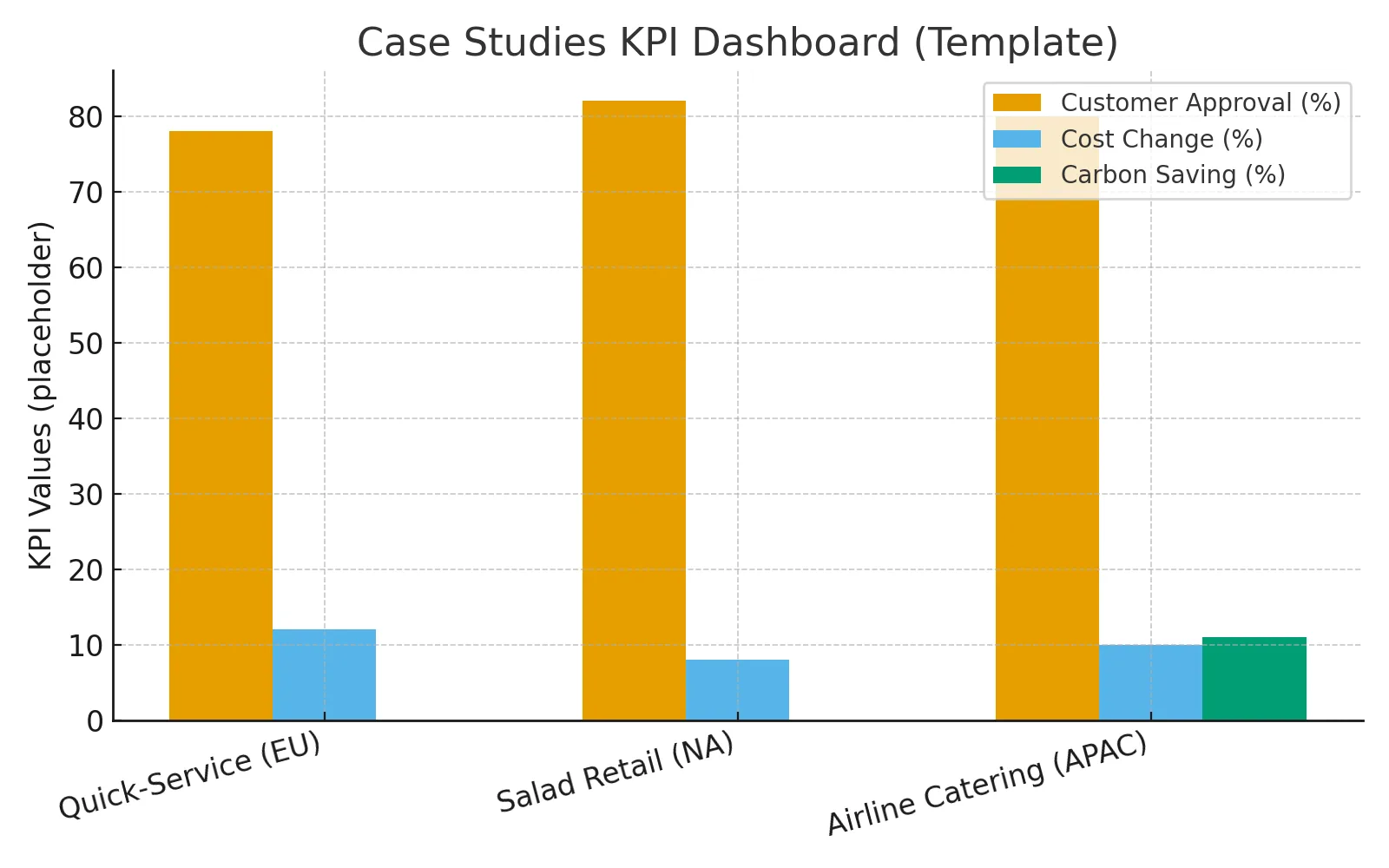
Case studies provide evidence of how biodegradable food packaging performs under real-world conditions. Each case follows the structure: customer context → solution → trial parameters → post-launch KPIs → compliance pack.
Case Study D: Bioleader® Sustainable Packaging
How a Leading European Retailer Reduced Waste, Lowered Costs, and Achieved Compliance with Bioleader® Compostable Solutions
1. Client Background
Client: Major European retail chain (165+ stores and e-commerce presence)
Industry: Food retail & hospitality
Challenge: Regulatory pressure and consumer demand for plastic-free packaging
2. Key Challenges
Regulatory Compliance: Required adherence to EU plastic bans and certifications (EN13432, ASTM D6400, BPI, LFGB).
Cost Management: Needed eco-alternatives without excessive cost burden.
Diverse SKUs: Broad range of packaging (bowls, clamshells, cutlery, cups).
Supply Security: Required stable monthly supply of 20ft–40HQ containers.
Sustainability Proof: Demand for scientific data and certificates to justify the transition.
3. Bioleader® Solutions
Product Portfolio: Bagasse clamshells, kraft paper bowls, PLA clear cups, CPLA cutlery.
Customization Service: 50+ OEM/ODM projects (logos, printing, packaging).
Manufacturing Scale: Annual output of 500+ million pcs, multi-SKU container loading.
Certifications: EN13432, ASTM D6400, BPI, TÜV, LFGB, FDA.
End-to-End Service: From design and production to export logistics and after-sales support.
4. Data-Backed Insights & Charts
TCO Saving Curve:
Initial unit price ~10–15% higher than plastic.
Within 6 months: optimized container loading, lower waste management fees, and subsidies led to 18–22% overall savings vs. plastic.
Carbon Footprint (kg CO₂e per 1,000 pcs):
Plastic containers: 2.1 → Bagasse: 0.9 → CPLA cutlery: 1.1 → ~55–60% reduction.
Compliance Heatmap:
EU: EN13432 ✅
USA: ASTM D6400, BPI ✅
Middle East: GCC/SASO (in progress)
Global: FDA, LFGB ✅
5. Results
Waste Reduction: 72% across outlets
Logistics & Inventory Costs: -15%
Compliance: Plastic-free within 6 months
Financial Benefits: Secured green subsidy, obtained eco-labels
Reputation: Boosted consumer trust and sustainability brand value
6. Strategic Takeaways
Regulatory inevitability: Transition to compostables is unavoidable.
Cost competitiveness: Scale and logistics optimization offset higher unit costs.
Green advantage: Compliance improves customer loyalty and brand equity.
Partnership model: Bioleader® acts as a long-term strategic partner, not just a supplier.
7. Conclusion
Bioleader® proves that compostable packaging is practical, scalable, and profitable for major retailers. With certifications, cost advantages, and strong customization, Bioleader® supports global clients in achieving compliance and sustainability goals.
Case Study B: Quick-Service Restaurant Chain (EU)
Context: Facing EU PPWR compliance deadlines, the chain needed to eliminate EPS and PFAS-laminated packaging.
Solution: Transition to bagasse clamshells and CPLA cutlery supplied by a certified Chinese manufacturer.
Trial Parameters: 8 pilot locations across 3 countries, 12-week trial period, 200,000 units.
Post-Launch KPIs: 78% customer approval, 12% cost increase offset by EPR credits, full EN13432 compliance.
Compliance Pack: Certificates, DoCs, and end-of-life compatibility documentation.
Case Study C: Salad Retail Brand (North America)
Context: Retail salads required transparent lids for product visibility.
Solution: Kraft paper bowls with PLA lids, co-branded for sustainability marketing.
Trial Parameters: 5 SKUs tested over 16 weeks, 500,000 units.
KPIs: Sales uplift +6%, waste diversion rate 68%, successful BPI labeling.
Compliance Pack: BPI certification, FDA food-contact safety records.
Case Study D: Airline Catering (Asia-Pacific)
Context: Airlines sought lighter-weight, compostable alternatives to reduce carbon per passenger meal.
Solution: Pulp-molded trays and cornstarch cutlery.
Trial Parameters: 3 international routes, 50,000 passengers served.
KPIs: Weight reduction 18%, carbon savings 11%, smooth integration with catering workflow.
Compliance Pack: TÜV Austria industrial compostability certificate.
10. Purchasing & Risk Checklist
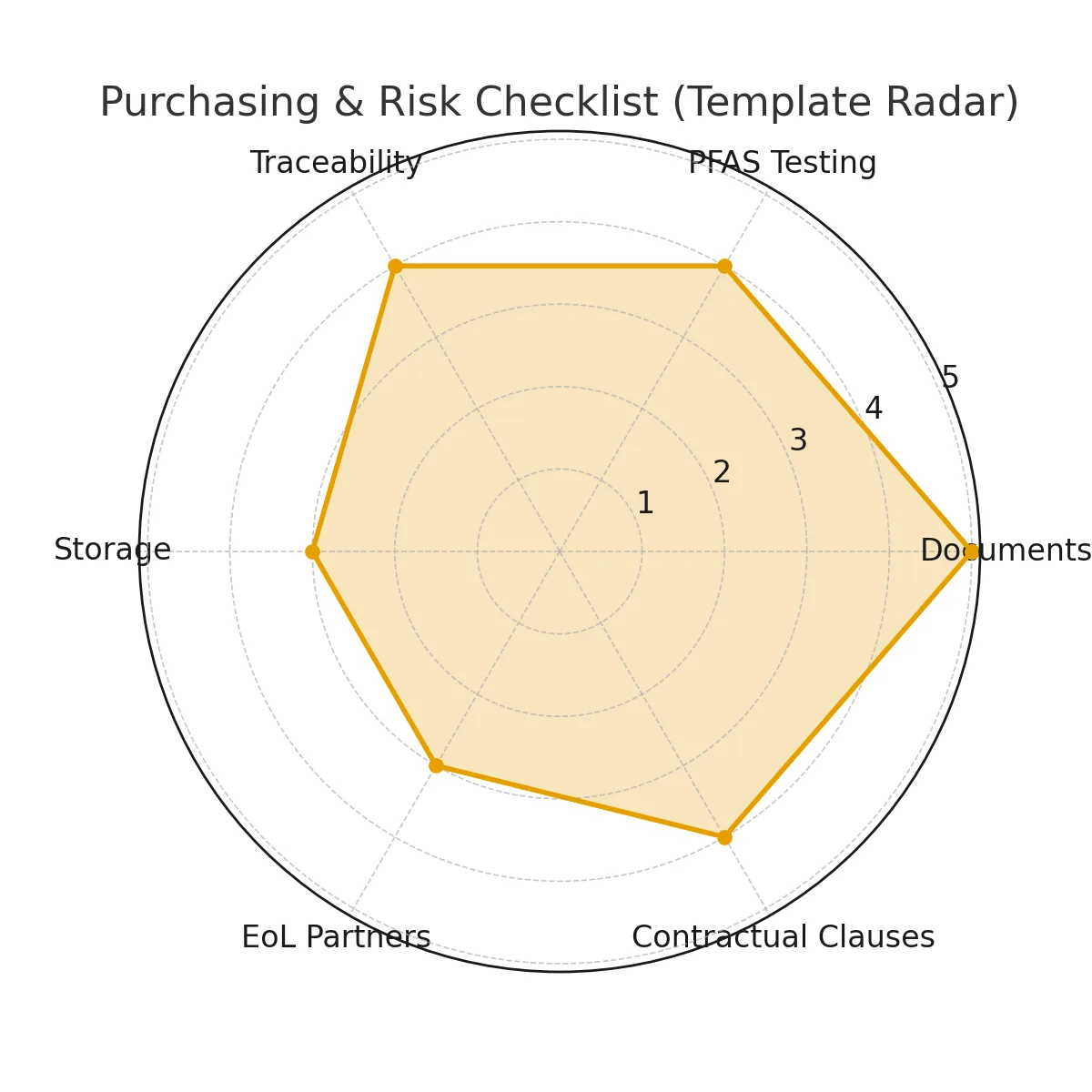
Procurement of biodegradable food packaging requires rigorous due diligence. The following checklist provides buyers with critical risk-control levers.
Documentation
Declarations of Compliance (DoCs) aligned with EU, FDA, and local standards.
Supplier ESG and traceability reports.
PFAS Testing
Independent lab verification of PFAS-free status (<100 ppm).
Clear labeling of barrier alternatives used.
Traceability & Inspection
Batch coding and QR-enabled traceability.
On-site or third-party audits of GMP compliance.
Storage & Logistics
Temperature and humidity-controlled storage.
Packaging specifications for frozen and hot-fill supply chains.
End-of-Life Partners
Verified composting or recycling facilities within target geography.
Regional labeling compliance (e.g., OPRL, ARL, BPI).
Contractual Clauses
Performance warranties (oil resistance, lid fit, microwave safety).
Penalty clauses for non-compliance with regulatory updates.
11. Outlook 2025–2027
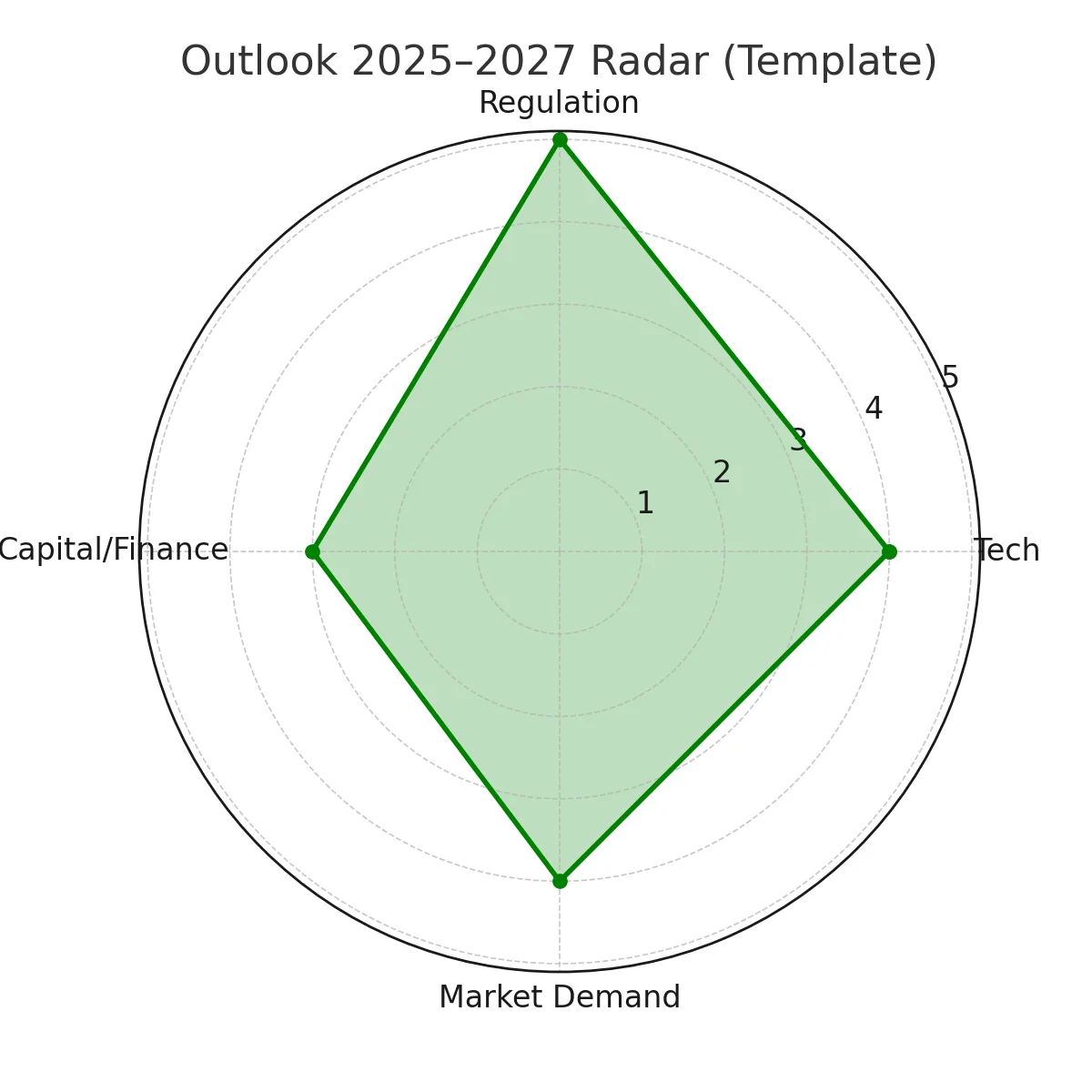
The next three years will define the competitive trajectory of biodegradable food packaging.
Technology Trends
Next-gen biopolymers: PHA, seaweed films, and hybrid pulp–PLA composites.
Smart packaging: Digital watermarks for recycling and AI-enabled traceability.
Regulatory Trends
EU PPWR enforcement (2026): Mandatory design-for-recycling and reuse quotas.
North America: State-level EPR expansion, PFAS restrictions accelerating.
Asia-Pacific: Export-facing bans driving scale-up in China and India.
Capital & Market Trends
M&A Activity: Consolidation among regional converters and raw material suppliers.
Investor Interest: ESG-linked funds prioritizing compostable packaging suppliers.
Actionable Next Steps (for buyers):
Lock in multi-year contracts with certified suppliers.
Diversify material sourcing (bagasse + PLA + starch).
Build compliance dashboards anticipating 2026 EU and US state enforcement.
12. Bioleader® – Your Partner for Compostable Packaging
Bioleader is a leading Chinese manufacturer of biodegradable food containers, trusted by international buyers for quality, compliance, and innovation. With a full product range including bagasse clamshells, kraft paper bowls, PLA cups, and cornstarch cutlery, Bioleader provides OEM/ODM solutions for foodservice, retail, and catering. All products are certified under EN13432, ASTM D6400, and food-contact safety standards (FDA, LFGB).
→ Contact us: No. 39 Xinglong Road, Xiamen, Fujian, China | +86-15980856610 | [email protected] | www.bioleaderpack.com
13. References
European Commission. Single-Use Plastics Directive Implementation Report.
Ellen MacArthur Foundation. The New Plastics Economy Progress Report.
UNEP. Global Plastics Treaty Draft Framework 2024.
ASTM International. ASTM D6400 Compostability Standard.
European Committee for Standardization. EN13432 Standard.
TÜV Austria. OK Compost Certification Guidelines.
Biodegradable Products Institute (BPI). Certification Manual.
OECD. Circular Economy for Plastics Report.
World Bank. Global Waste to 2050 Outlook.
McKinsey & Company. Sustainability in Packaging 2025 Survey.
PwC. ESG and Packaging Cost Analysis.
Accenture. Future of Sustainable Consumer Goods.
Packaging Europe. Market Trends in Bioplastics 2025.
Smithers Pira. Global Biodegradable Packaging Market Forecast.
Frost & Sullivan. Compostable Materials Value Chain Study.
Bioleader® internal case studies and customer reports.
IPCC. Carbon Footprint of Plastic vs. Bioplastics.
FAO. Food Safety and Contact Material Standards.
Greenpeace. PFAS in Food Packaging Investigation.
World Economic Forum. Future of Consumption Platform Reports.
Kearney. Sustainable Packaging Economics White Paper.
ISO. Life Cycle Assessment Methodology Standards.