Introduction
The green revolution is sweeping through the food packaging world, with “eco-friendly” solutions gaining mainstream popularity across continents. Yet, as sustainable packaging becomes more visible, so do misconceptions and marketing myths. From confusion about biodegradability to assumptions about cost and performance, many brands and consumers struggle to separate fact from fiction.
Why is myth-busting so important? In a competitive landscape shaped by regulations, shifting consumer expectations, and global supply chain challenges, making informed, science-based packaging decisions can drive both environmental and business value. This article breaks down the top 10 myths about eco food packaging, providing evidence-based answers, real-world case studies, and actionable insights—plus expert guidance and practical checklists from leading manufacturer Bioleader®.
Myths 1–5—Are You Sure It’s Really Eco?
Myth #1: Biodegradable Means Compostable
Fact: Not all biodegradable materials are compostable—and the difference matters.
A material labeled “biodegradable” only needs to break down naturally, but may leave behind microplastics or take years to disappear in landfill. “Compostable” means a product can be broken down by microbes under specific composting conditions (e.g., heat, humidity, oxygen), resulting in nutrient-rich soil with no toxic residue.
Quick Guide:
Biodegradable: Breaks down eventually, conditions vary, may leave residue.
Compostable: Fully breaks down under set conditions, leaving no toxins.
Industry Tip: Always look for certifications like EN13432 (Europe) or ASTM D6400 (US) to confirm compostability.
Myth #2: Paper Packaging Is Always 100% Eco-Friendly
Fact: Not all paper packaging is equally sustainable.
Bleaching, the use of virgin fiber, and chemical coatings (such as PE or PFAS) can compromise both the recyclability and the true eco-friendliness of paper-based packaging.
Uncoated paper: Compostable and recyclable, but not always grease- or moisture-resistant.
Coated/laminated paper: May resist water and grease, but often requires industrial processes to separate layers, reducing compostability and recyclability.
Expert Insight:
If a paper product is shiny, water-resistant, or unusually stiff, check if it has a plastic or chemical lining.
Myth #3: Plant-Based Plastics Break Down Anywhere
Fact: Most plant-based plastics (like PLA) require industrial composting facilities.
PLA (polylactic acid) looks and feels like plastic but is made from renewable plant sources. However, it needs high temperatures (above 60°C), specific microbes, and controlled conditions to decompose. In a regular landfill or your backyard compost, it can persist for years.
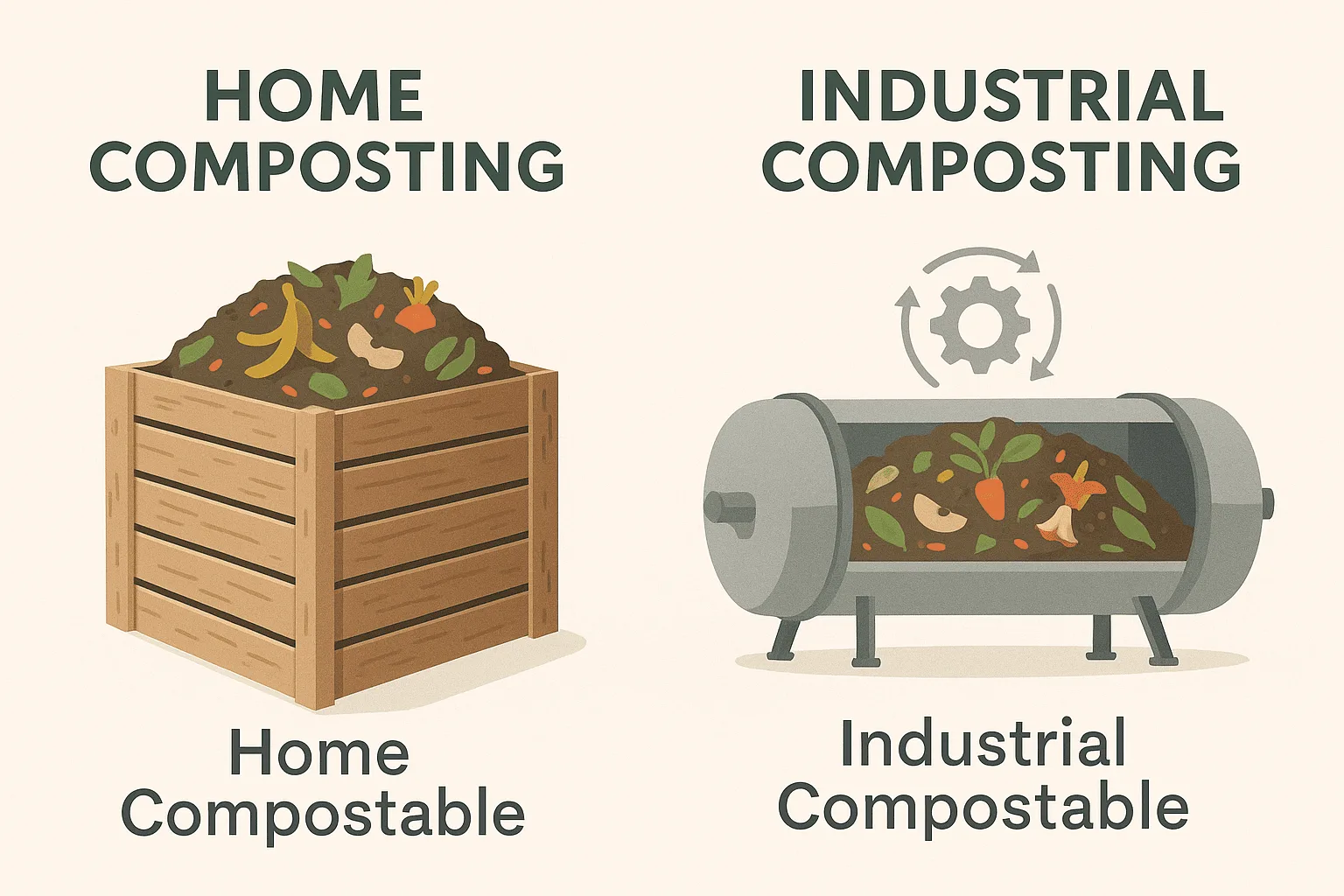
Home compostable: Bagasse, some molded fiber, certified paper.
Industrial compostable: Most PLA, some cornstarch blends.
Buyer’s Note:
Before marketing packaging as “compostable,” verify if your region offers access to appropriate composting infrastructure.
Myth #4: All ‘Green’ Packaging Is Free of Harmful Chemicals
Fact: Eco-friendly does not always mean toxin-free.
Some “biodegradable” products may still use coatings, adhesives, or additives containing PFAS (“forever chemicals”) or BPA, which have raised significant health and environmental concerns.
Regulatory Trend:
The EU and parts of the US are now banning PFAS in food-contact packaging, and “BPA-free” is becoming a consumer must-have.
How to Check:
Ask for supplier disclosures and review independent test results for food contact safety and chemical migration.

Myth #5: ‘Recyclable’ and ‘Recycled’ Mean the Same Thing
Fact:
Recyclable: Theoretically can be recycled, but may not be accepted by local programs.
Recycled: Made from previously used materials, closing the loop.
The Real Challenge:
Contamination, lack of infrastructure, and confusion about local recycling rules mean that even “recyclable” packaging often ends up in landfill.
Best Practice:
Look for packaging with post-consumer recycled content, and help customers understand local recycling best practices.
Myths 6–10—Eco Packaging in the Real World
Myth #6: Eco Packaging Is Always More Expensive
Fact: Cost is dropping fast—and the total value goes beyond price per unit.
While some early eco materials were 20–50% more expensive, global scaling, material innovations, and competitive pressure have narrowed the gap. In many categories (e.g., bagasse plates, cornstarch clamshells), the price difference is now 5–10%, or even at cost parity for high-volume buyers.
Business Perspective:
Eco packaging can reduce regulatory risk, boost brand loyalty, and even drive higher sales—often more than offsetting marginal price differences.
Bioleader® Case:
By investing in advanced automation and direct-from-source procurement, Bioleader® delivers compostable bowls and cutlery at competitive prices for global fast-food and catering brands.
Myth #7: Only Big Companies Can Afford Eco-Friendly Solutions
Fact: SMEs and startups are driving the green packaging wave.
Minimum order quantities are falling, supplier networks are globalizing, and digital design tools allow for affordable customization—even for small runs.
Flexible MOQs: Many suppliers now offer pilot orders starting from 5,000–10,000 pieces.
Online platforms: Sourcing biodegradable packaging is easier than ever via B2B marketplaces.
Bioleader® View:
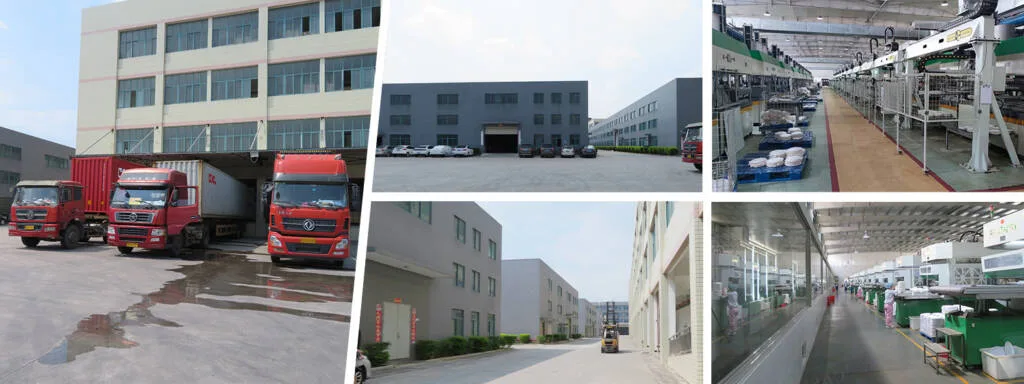
“We believe sustainable packaging should be accessible for every business, regardless of size. Our OEM/ODM services and design support empower small brands to go green and grow,” says Junso Zhang, founder of Bioleader®.
Myth #8: Eco Packaging Is Weaker or Less Practical
Fact: Performance now matches or exceeds conventional options in many cases.
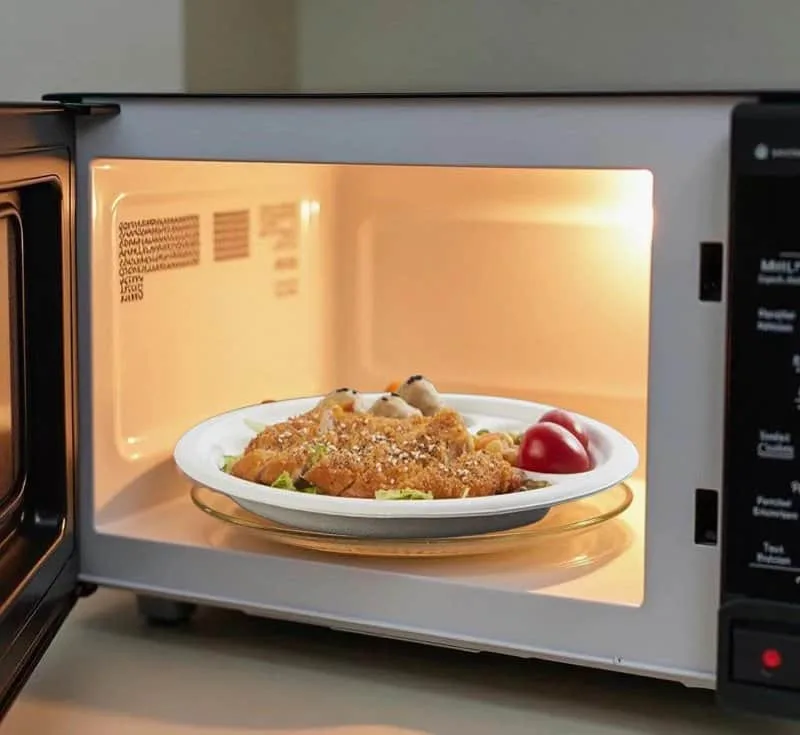
Modern bagasse trays are microwavable, heat-resistant to 120°C, and even freezer-safe. Compostable cutlery made from CPLA (crystallized PLA) is strong enough for steak. Biodegradable paper bowls with lids outperform foam and plastic for soups, salads, and takeout.
Real-World Data:
Third-party tests show bagasse containers maintain structure with hot, greasy foods for over 60 minutes.Consumer Experience:
Recent surveys indicate 85% of users rate modern eco packaging as “equal to or better” than traditional options for food safety and convenience.
Myth #9: Switching to Eco Packaging Has Little Impact on the Planet
Fact:
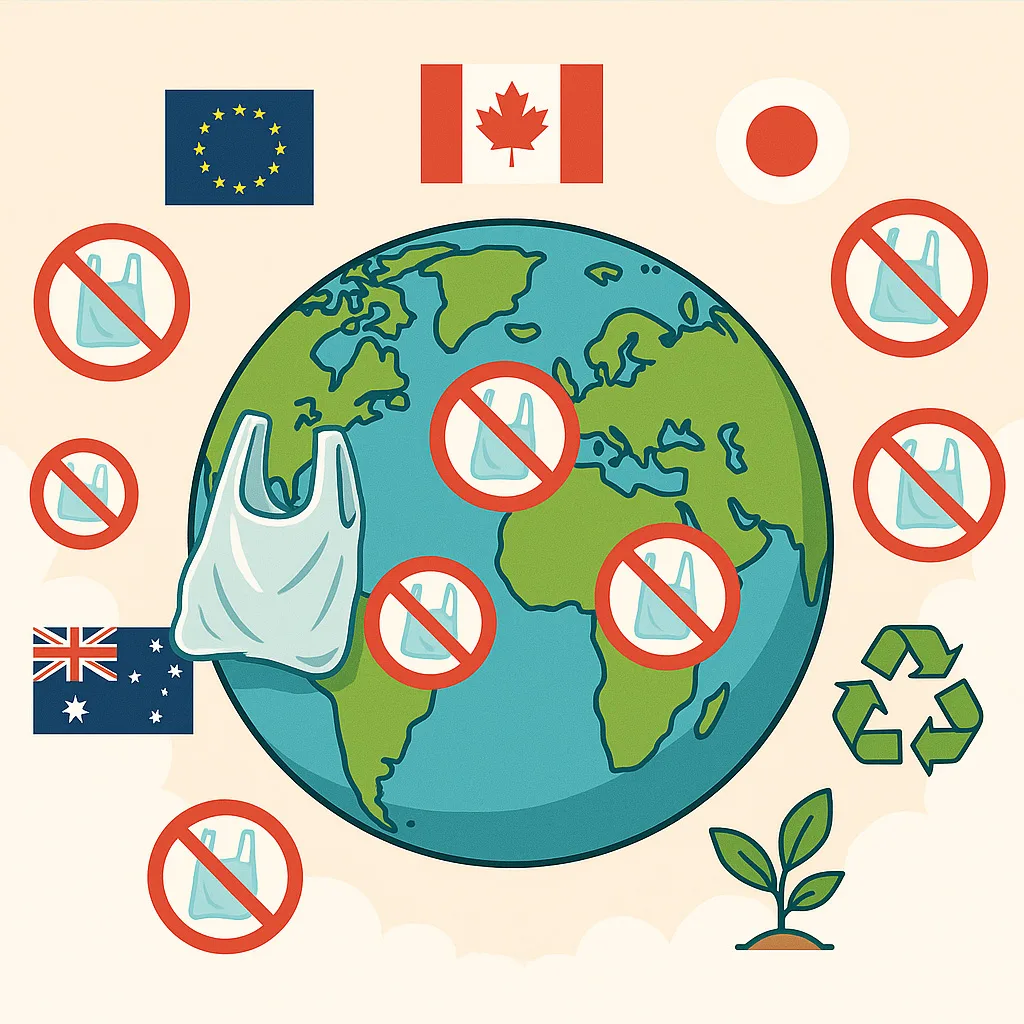
Life-cycle assessments (LCAs) consistently show major environmental benefits from sustainable packaging, including:
Reduced landfill waste and ocean plastic pollution
Lower carbon and water footprints
Enhanced compost quality for agriculture
Case in Point:
A leading global QSR chain saw a 47% reduction in packaging-related landfill waste after switching to bagasse and cornstarch products—saving thousands of tons of plastic per year.
Myth #10: All Eco Packaging Looks the Same
Fact:
Branding, customization, and design have gone “eco-chic.”
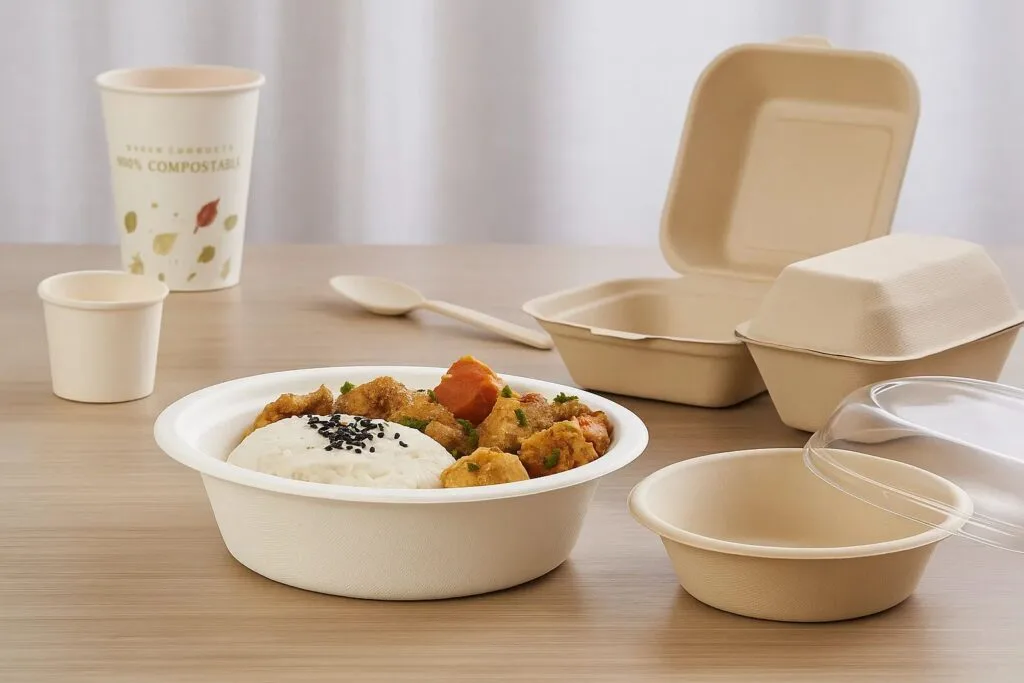
Modern digital printing, embossing, and laser engraving allow brands to create distinctive, high-impact packaging—while maintaining compostability or recyclability.
Options Include:
Full-color branding on bagasse clamshells
Custom shapes and embossed logos on paper bowls with lids
On-pack QR codes linking to environmental impact stories
Bioleader® Innovation:
Bioleader® partners with clients to create award-winning custom designs that turn every meal into a marketing moment—without sacrificing sustainability.
Scientific Reality Check—What Really Works?
Certifications and What They Mean
| Certification | Scope | Region | Notes |
|---|---|---|---|
| EN13432 | Compostability | Europe | Industrial compost, full breakdown |
| ASTM D6400 | Compostability | US/International | Similar to EN13432 |
| OK Compost Home | Home Compostability | Europe | Lower temp, less strict, home-garden |
| BPI | Compostable Products | US | Widely recognized by composters |
| FSC, PEFC | Responsible Sourcing | Global | For paper/fiber content |
Scientific Testing: Performance and Safety
Barrier Properties: Modern eco materials provide strong resistance to moisture, grease, and heat—especially for paper bowls with lids used in soup and takeaway sectors.
Decomposition Rates:
Bagasse: 60–120 days (industrial/home compost)
PLA: 120–180 days (industrial compost)
Coated papers: Varies based on coating type
Health & Safety:
Certified products are tested for heavy metals, migration of harmful chemicals, and microbiological safety to ensure food contact compliance.
Product Comparisons & Buyer’s Guide
Material Comparison Table
| Material | Compostability | Home/Ind. Compost | Durability | Barrier | Cost Trend | Best Use |
|---|---|---|---|---|---|---|
| Bagasse | Yes | Both | High | High | ↓ | Trays, boxes, hot foods |
| PLA | Yes (industrial) | Industrial only | Med-High | Med | ↓ | Cold cups, cutlery |
| Cornstarch | Yes (mostly ind.) | Ind./Some home | Medium | Med | → | Bento, boxes, cutlery |
| CPLA | Yes (industrial) | Industrial only | High | Med | → | Compostable cutlery |
| Paper | Varies | Both, depends | Med | Low | → | Wrappers, napkins |
How to Read Labels & Certifications
Look for:
Clear compostable/biodegradable iconography
Certification numbers (EN13432, ASTM D6400, BPI)
Manufacturer traceability
Be cautious:
Vague claims (“green,” “eco-safe”)
Lack of third-party testing

Tips for Businesses: Sourcing & Due Diligence
Request full material breakdowns and certification documents.
Visit production sites virtually or in person, if possible.
Seek samples and conduct product-specific tests (hot, cold, greasy foods).
Consider long-term supplier partnerships for cost and quality control.
Prioritize manufacturers with a proven ESG (Environmental, Social, Governance) track record.
Breaking the Cycle—How Consumers and Brands Can Make a Difference
For Consumers
Avoid greenwashing: Scrutinize packaging claims and look for genuine certifications.
Participate in composting or recycling programs: Dispose of used packaging responsibly.
Support transparent brands: Choose restaurants and retailers that publish environmental data and are open about sourcing.
For Brands
Educate customers: Use on-pack messaging, QR codes, and website FAQs.
Invest in storytelling: Share your packaging journey and impact stats across social channels.
Lead by example: Participate in industry alliances and share best practices.
Bioleader® Case Study: Leading by Innovation
Bioleader®, a top Chinese biodegradable tableware manufacturer, sets an industry standard for innovation, reliability, and sustainability.
Achievements:
Supplies major international QSRs and emerging eco brands with bagasse, PLA, and cornstarch products.
In-house R&D for next-generation compostable cutlery, clamshells, and customized paper bowls with lids.
EN13432, BPI, OK Compost, and FDA-certified product lines.
Invests in closed-loop recycling programs, digital traceability, and customer co-creation workshops.
Launched a client education program to help global partners understand “real eco” versus greenwashing.
Founder’s View:
“Our goal at Bioleader® is to make genuine sustainable packaging easy to understand, access, and trust—no myths, just science and results.”
FAQ
1. Is all compostable packaging suitable for home composting?
No, only packaging with home-compostable certifications (like OK Compost Home) is suitable for backyard composting. Most PLA and some cornstarch items require industrial facilities.
2. Can I microwave food in biodegradable containers?
Most bagasse, fiber, and CPLA packaging are microwave safe for short periods. Always check manufacturer guidelines.
3. How do I know if my food packaging contains PFAS or BPA?
Check product documentation and certification. Reputable manufacturers like Bioleader® will provide PFAS/BPA-free guarantees and test results.
4. Does compostable packaging break down in landfill?
Decomposition is slower in landfill due to lack of oxygen and microbial activity. Compostable packaging is most effective when disposed of in composting streams.
5. What’s the most eco-friendly disposable tableware for takeout?
Look for bagasse, molded fiber, or certified compostable cornstarch/PLA products, sourced from trusted suppliers.
Future Outlook: What’s Next for Eco Food Packaging?
The pace of innovation is accelerating. Key future trends include:
Smart Packaging: QR codes, RFID, and “track-and-trace” for full material transparency.
Edible & Functional Packaging: Seaweed wraps, edible spoons, and flavor-enhancing coatings.
Policy Leadership: More regions will ban PFAS and non-compostable single-use plastics, leveling the global playing field.
Collaborative Standards: Industry alliances will drive harmonization and raise the bar on both product performance and transparency.
Expert Prediction:
In five years, eco-packaging will not just be a “green” option but the global standard for foodservice. Brands that invest now will lead both the market and the movement.
Conclusion
Busting myths about “eco” food packaging isn’t just a marketing exercise—it’s vital for real environmental progress, regulatory compliance, and sustained business success. Brands, suppliers, and consumers each have a role in demanding truth, transparency, and science-backed solutions.
As global demand grows, leaders like Bioleader® prove that scalable, certified, high-performance packaging can deliver environmental and economic wins.
Choose knowledge, not hype—because the planet can’t afford anything less.
Appendices
Glossary of Eco-Packaging Terms
Biodegradable: Breaks down via natural processes, timing varies.
Compostable: Fully degrades into harmless, nutrient-rich matter under set conditions.
FSC/PEFC: Certification for responsibly sourced forest materials.
PFAS/BPA: Synthetic chemicals of concern, often banned in food packaging.
References
Ellen MacArthur Foundation.
“New Plastics Economy: Catalysing Action.”
https://www.ellenmacarthurfoundation.org/publications/new-plastics-economy-catalysing-actionEuropean Commission.
“Single-use plastics.”
https://environment.ec.europa.eu/topics/plastics/single-use-plastics_enU.S. Plastics Pact.
“Roadmap to 2025.”
https://usplasticspact.org/roadmap/Statista Research Department.
“Sustainable packaging – statistics & facts.”
https://www.statista.com/topics/4212/sustainable-packaging/Biodegradable Products Institute (BPI).
“Certification for Compostable Products.”
https://bpiworld.org/Wikipedia.
“Biodegradable plastic.”
https://en.wikipedia.org/wiki/Biodegradable_plasticFood Packaging Forum (Dr. Jane Muncke, Editor).
“Food contact chemicals in food packaging.”
https://www.foodpackagingforum.org/food-packaging-health/food-contact-chemicalsBioleader®.
“About Bioleader: Leading Manufacturer of Biodegradable Food Packaging.”
https://www.bioleaderpack.com/about-us/International Organization for Standardization (ISO).
“ISO 17088: Specifications for compostable plastics.”
https://www.iso.org/standard/72736.htmlJillian Mock.
“Are Compostable Plastics the Answer?” Scientific American
https://www.scientificamerican.com/article/are-compostable-plastics-the-answer/