Beyond Greenwashing: Building a Credible Sustainable Packaging Brand
In a crowded “green” market where more than half of claims are vague or misleading, true credibility hinges on verifiable sustainability. Bioleader® emphasizes certifications like EN 13432 and robust lifecycle assessments—not just marketing—to ensure packaging is genuinely compostable, safely verified, and capable of meeting stringent regulations and consumer trust in 2025.
In today’s oversaturated “green” market, sustainability claims have become ubiquitous—but their truthfulness often remains questionable. As packaging companies flood the market with buzzwords like “eco-friendly,” “biodegradable,” and “natural,” skepticism among regulators, buyers, and consumers is growing steadily. According to a 2024 European Commission report, over 53% of green claims are vague, misleading, or outright unfounded.
In 2025, credibility is no longer optional—it is the currency of survival in the sustainable packaging industry. Brands that rely solely on marketing rhetoric without solid proof face regulatory crackdowns, market rejection, and loss of buyer trust.
Bioleader®, as a leading manufacturer of compostable packaging solutions—including bagasse, kraft paper, and PLA tableware—understands that sustainability claims today must be substantiated by verifiable data, third-party certifications, and compliance with evolving global regulations.
1. Regulatory Pressure Is Reshaping the Packaging Industry
✳️ Global Regulatory Shifts in 2025
The packaging industry is experiencing profound change driven by tightening regulations around the world. These new rules aim to eliminate greenwashing and enforce transparency and accountability:
EU Green Claims Directive (Expected 2025 Finalization, COM/2023/166 final)
This directive mandates that environmental claims must be supported by rigorous scientific evidence, such as Life Cycle Assessments (LCA) or recognized third-party certifications. Terms like “biodegradable,” “climate-neutral,” or “eco” can no longer be used loosely without verification.California Senate Bill 343 (SB-343)
California prohibits deceptive environmental labeling and requires compostable packaging to meet standards such as ASTM D6400 or TUV OK Compost. Violations carry penalties and product delisting risks.China’s 2025 Plastic Reduction Guidelines
These guidelines emphasize mandatory labeling and traceability, especially targeting packaging in e-commerce and food delivery sectors, where green claims must be verifiable and transparent.
📊 Market Impact of Regulatory Crackdowns
The increasing scrutiny means that manufacturers who fail to provide proof risk fines, legal actions, and removal from retail shelves. Environmental claims are no longer mere marketing tools—they are compliance checkpoints and critical competitive differentiators.
2. Greenwashing Red Flags: What Buyers Are Rejecting
The purchasing landscape is rapidly evolving. B2B buyers and international importers are highly sensitive to signs of greenwashing. Common red flags that buyers increasingly reject include:
Generic buzzwords such as “eco-friendly,” “green,” or “natural” without any definition, certification, or scientific backing.
Misleading visuals like leaves, earthy colors, or recycling symbols that imply sustainability but lack factual proof.
No evidence of recognized compostability or biodegradability certifications such as EN13432, ASTM D6400, or ISO 17088.
Lack of supply chain transparency—buyers want to know raw material origins, ethical labor practices, and carbon footprints.
In contrast, brands that lead with transparency, data, and verifiable certifications stand out and win contracts.
3. The 4 Pillars of Credible Sustainable Branding
Building a truly credible sustainable packaging brand requires commitment to four foundational pillars:
✅ 1. Certification-Backed Products
Environmental claims must be backed by verifiable certifications recognized internationally:
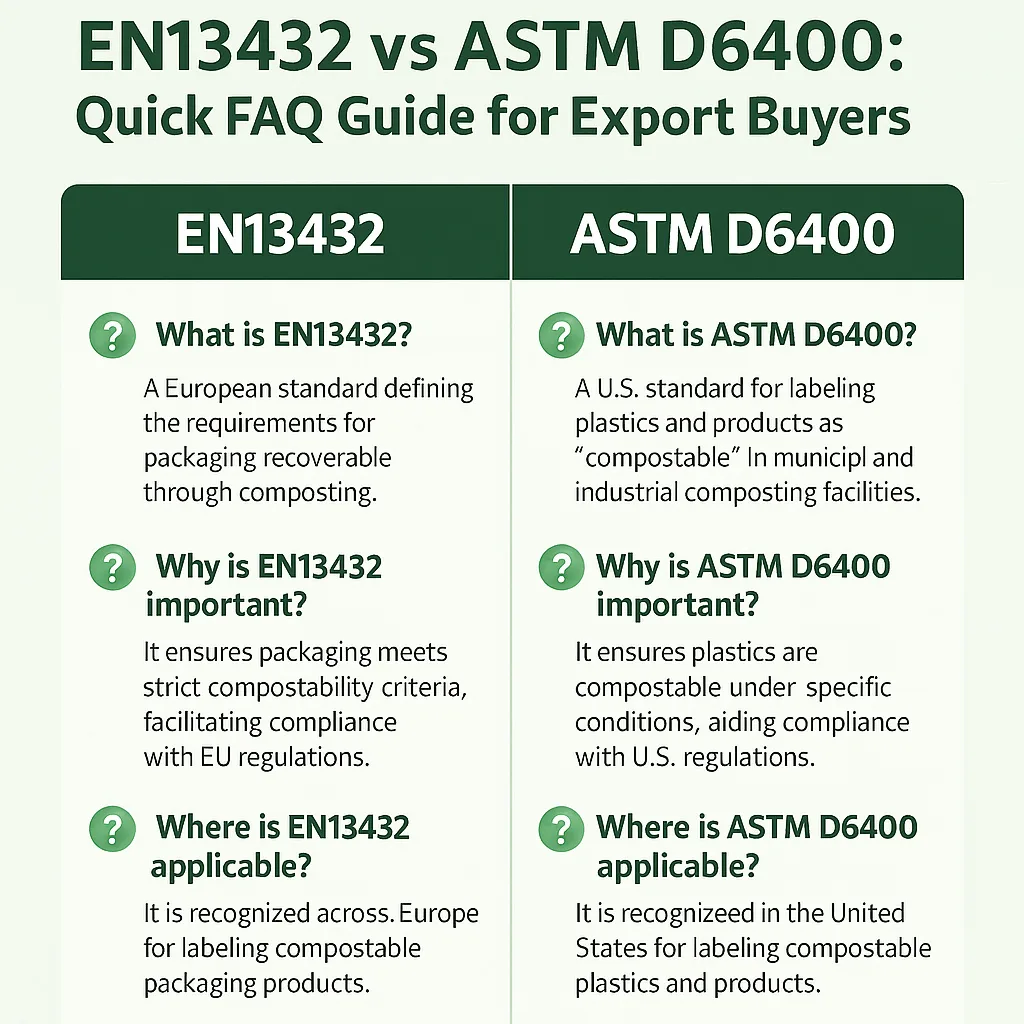
EN13432 (EU standard for industrial compostability)
ASTM D6400 (US compostability standard)
OK Compost Home / TUV (home compostability certifications)
BPI Certification (North America)
Bioleader®’s key products—such as bagasse clamshell boxes and kraft paper salad bowls—comply fully with EN13432 and have passed rigorous third-party food contact safety testing. These certifications are essential proof points for export buyers requiring compliance documentation for their local markets.
✅ 2. Life Cycle Assessment (LCA)
An LCA is a comprehensive scientific method assessing a product’s environmental impact throughout its entire life—from raw material extraction to disposal or recycling. This includes energy use, water consumption, carbon emissions, and waste generation.
According to McKinsey (2024), brands that publish LCAs experience a 22% increase in buyer trust and gain a competitive edge in sustainability-conscious markets.
Bioleader® is actively investing in LCA studies across its main product lines, ensuring full transparency and data compliance with EU Green Claims and similar frameworks globally.
✅ 3. Transparent Supply Chain
Modern packaging buyers demand detailed knowledge of their supplier’s supply chains, including:
Sustainable and legal sourcing of raw materials
Ethical labor standards and fair working conditions
Full carbon footprint accounting (Scopes 1, 2, and 3 emissions)
Technologies such as blockchain-enabled traceability and QR-code batch tracking enable transparency at scale. Bioleader® leverages these tools to offer clients full supply chain visibility, enhancing confidence and simplifying audits.
✅ 4. ESG and Public Accountability
Environmental, Social, and Governance (ESG) frameworks have become central to business viability and reputation. Brands with robust ESG programs attract premium partnerships and investment.
Bioleader®’s ESG commitments include:
Achieving carbon-neutral operations by 2027
Transitioning to renewable energy in manufacturing processes
Publishing annual ESG impact and sustainability reports
Facilitating third-party factory audits and supplier disclosures
This public accountability differentiates Bioleader® as a sustainability leader.
4. Case Studies: What Credibility Looks Like in Practice
📦 Case 1: EU Retailer Rejects “Compostable” Trays without EN13432
A 2024 audit in Germany revealed that over 40% of products labeled “compostable trays” lacked valid EN13432 certification. Retailers strictly removed uncertified items from shelves, prioritizing products with full documentation.
Bioleader®’s bagasse trays passed the audit thanks to thorough LCA disclosures and third-party certification, securing a competitive advantage for distributors and retail partners.

🍱 Case 2: APAC Food Brand Switches to Certified PLA Tableware
A fast-casual chain in Singapore transitioned away from uncertified disposable bowls after intensified government audits on environmental claims. Bioleader® provided EN13432-certified cornstarch and bagasse tableware, helping the brand regain compliance and consumer trust while aligning with local food safety regulations.

5. What Export Buyers Are Looking For in 2025
Export buyers across Europe, North America, Japan, and Australia now enforce stringent supplier vetting, requiring:
| Buyer Requirement | Must-Have in 2025 |
|---|---|
| Legal Compostability | EN13432 / ASTM D6400 / OK Compost certification |
| Full Product Traceability | QR-code or batch-level traceability documentation |
| Third-Party Lab Testing | Food contact safety and biodegradability testing |
| LCA or Carbon Disclosure | Transparent reporting of Scope 1–3 emissions |
| Brand Accountability | Annual ESG reports, factory audit disclosures |
Only suppliers meeting these criteria stand a chance in international tenders and long-term contracts.
6. How Bioleader® Builds Brand Credibility
Bioleader® is a leading manufacturer specializing in innovative compostable packaging solutions, offering a comprehensive product portfolio designed to meet diverse food service needs. Our core product lines include:
Sugarcane Bagasse Tableware: Bagasse Clamshell Boxes, Food Containers, Trays with Lids, Plates, Bowls, Trays, and customizable packaging services tailored to client requirements.
Paper Food Packaging: Paper Cups, Soup Bowls, Salad Bowls, Food Boxes, and Takeout Paper Bags — all made with certified sustainable materials.
Cornstarch Tableware: Clamshell Boxes, Bowls & Cups, and Plates, providing biodegradable alternatives for single-use foodware.
Biodegradable Cutlery and PLA Cups: Fully compostable cutlery and PLA cups designed for various food and beverage applications.

Bioleader®’s credibility rests on a foundation of proof, process, and performance:
Proof: All products come with downloadable certifications, including EN13432 industrial compostability and rigorous food contact safety reports. New product launches feature detailed carbon footprint metrics, ensuring transparent environmental impact disclosure.
Process: Each export shipment is accompanied by batch-specific compliance packets. Bioleader® partners with European collaborators for joint Life Cycle Assessments (LCA), maintaining scientific rigor and meeting evolving global standards.
Performance: Committed to carbon neutrality by 2027, Bioleader® integrates renewable energy in manufacturing and publishes annual ESG impact reports. Comprehensive supplier and factory disclosures foster trust and accountability.
This comprehensive approach ensures that Bioleader®’s packaging is not just sustainable in name, but verifiably sustainable in practice—delivering measurable environmental and commercial value to brands, retailers, and end consumers worldwide.

7. Expert Perspectives: What Industry Leaders Say About Verified Sustainability
In a marketplace defined by compliance and digital accountability, expert voices are shaping procurement standards and policy direction. Here’s what leading figures across law, supply chain, and sustainable packaging have to say about the shift from greenwashing to verified sustainability:
🎙️ Dr. Anna Keller – Environmental Law Specialist, EU Regulatory Affairs
“The Green Claims Directive isn’t just a marketing regulation—it’s a market correction. If a company claims biodegradability or climate neutrality, it must prove it through independent verification. By 2025, failure to comply won’t just be illegal—it will be commercially suicidal.”
Commentary: Dr. Keller’s insight highlights that sustainability has moved from voluntary CSR language into the territory of legal liability. For exporters to the EU, this underscores the urgent need to align claims with EN13432, ISO 14021, and full LCA transparency.
🎙️ Daniel Wong – Sustainable Procurement Consultant, Singapore Green Label
“We no longer ask suppliers if their packaging is ‘green.’ We ask: Who certified it? Can you show me the LCA? Where’s the QR code for batch tracking? Buyers are no longer fooled by leaves on boxes.”
Commentary: From a procurement perspective, Daniel underscores the shift in buyer expectations: sustainability must now be quantified, tracked, and verifiable. His emphasis on QR-based traceability aligns with Bioleader®’s digital batch compliance system.
🎙️ Isabelle Ruiz – Director, Global Packaging Council
“Many brands still treat ESG as a PR requirement. But in global packaging, ESG is becoming the license to operate. Retailers and multinationals will soon mandate third-party-verified carbon data before onboarding any new packaging vendor.”
Commentary: Isabelle’s forecast reflects a strategic industry shift: ESG metrics are no longer “optional nice-to-haves” but fundamental to international supply partnerships—especially in sectors like food, cosmetics, and retail. This reinforces the strategic value of Bioleader®’s annual ESG reporting and carbon neutrality goals.
Conclusion: From Greenwashing to Genuine Impact
Sustainability is no longer a marketing checkbox—it’s a regulatory expectation, a procurement requirement, and a brand-defining pillar. As governments roll out stricter compostable packaging laws and retailers demand verified environmental claims, food and packaging brands must move beyond greenwashing and into a new era of credible, measurable action.
To build a truly sustainable packaging brand in 2026 and beyond, companies must:
✅ Ditch vague language like “eco-friendly” or “biodegradable” without certification
✅ Adopt globally recognized standards like EN13432, ASTM D6400, and BPI certification
✅ Ensure full supply chain transparency, from raw material to end-of-life compostability
✅ Invest in material testing, lifecycle data, and local compliance mapping
✅ Educate buyers and stakeholders to close the gap between perception and performance
“In the next five years, the most trusted food brands will be those who can prove sustainability—not just claim it.”
— Dr. Lena Zhou, Environmental Packaging Advisor, HKUST
Consumers and buyers are no longer just eco-conscious—they’re eco-skeptical. To stand out, your packaging must not only look sustainable but be scientifically backed, legally compliant, and fully transparent.
The age of greenwashing is over. The age of green credibility has just begun.
FAQ
1. What does certified compostable packaging mean?
Certified compostable packaging meets specific standards like EN13432 or ASTM D6400, ensuring it breaks down safely within industrial or home composting systems without leaving harmful residues.
2. How can manufacturers avoid greenwashing in packaging claims?
Manufacturers avoid greenwashing by using verifiable certifications, conducting life cycle assessments (LCA), providing transparent supply chain data, and complying with global regulations such as the EU Green Claims Directive.
3. Why is EN13432 certification important for export packaging?
EN13432 is the EU’s recognized standard for compostable packaging. It is required for exporting to many international markets, assuring buyers that products meet strict biodegradability, toxicity, and disintegration criteria.
4. What are the differences between biodegradable and compostable packaging?
Biodegradable packaging breaks down over time but lacks a guaranteed timeframe or safe residue. Compostable packaging breaks down fully into natural elements within a defined time under specific composting conditions.
5. How do life cycle assessments (LCA) improve sustainable packaging credibility?
LCAs evaluate environmental impacts from raw materials to disposal, providing scientific proof of sustainability claims. Publishing LCA data increases buyer trust and supports compliance with tightening environmental regulations.
📚 References
European Commission (2024) – Green Claims Directive Report
https://ec.europa.euCalifornia Senate Bill 343 (SB-343) – Truth in Environmental Advertising
https://leginfo.legislature.ca.govMcKinsey Sustainability Report (2024) – The Business Case for LCA Transparency
https://www.mckinsey.comGreen Alliance UK (2023) – The Greenwash Files
https://green-alliance.org.ukGlobal Composting Alliance – Certification Guidelines for Bioplastics
https://compostingcouncil.orgBioleader® Internal Compliance Reports (2025) – Certification, Traceability & ESG Data Sheets
How to Shift from Greenwashing to Credible Sustainable Packaging
In today’s era of skepticism, sustainability branding must be grounded in verifiable action—not buzzwords. Buyers now reject vague claims like “eco-friendly” unless backed by third-party standards and scientific proof. Bioleader® anchors its credibility through four pillars: recognized certifications (EN 13432, BPI), independent lifecycle assessments, transparent material traceability, and strict factory-level quality controls.
How credibility builds trust: Third-party certification reassures regulators and buyers of real compostability. Published LCAs demonstrate environmental performance, helping brands substantiate claims with data. And transparent supply chain systems enable traceability, reinforcing accountability and trust.
Why it matters now: With growing regulatory pressures and consumer scrutiny, authenticity in sustainability is a survival metric. Brands that invest in proof—not rhetoric—position themselves for enduring reputation, compliance, and long-term market leadership.