









Quick Summary: The EU anti-greenwashing rules introduced by Directive (EU) 2024/825 will apply from 27 September 2026. The deadline for Member States to transpose the Directive was 27 March 2026.
Generic environmental claims such as “eco-friendly,” “green,” “biodegradable,” and “biobased” are high-risk when they are not clearly qualified and supported on the same medium.
In June 2026, the European Commission published implementation Q&A, while the Consumer Protection Cooperation Network issued a common understanding on the treatment of old stock carrying environmental claims or sustainability labels.
The separate Green Claims Directive is not the same legislation. It remains a pending and delayed proposal and should not be presented as EU law already in force.
For packaging buyers, the key question is no longer, “Does this product look sustainable?” The practical question is, “Can the supplier match every environmental statement to the correct product, component, standard, document, and destination market?”
For years, many suppliers have used broad sustainability language. Terms such as “green,” “eco,” “compostable,” “biodegradable,” and “plastic-free” have often appeared without clearly defining the product scope, disposal conditions, component exclusions, or certification coverage.
That approach is becoming increasingly risky.
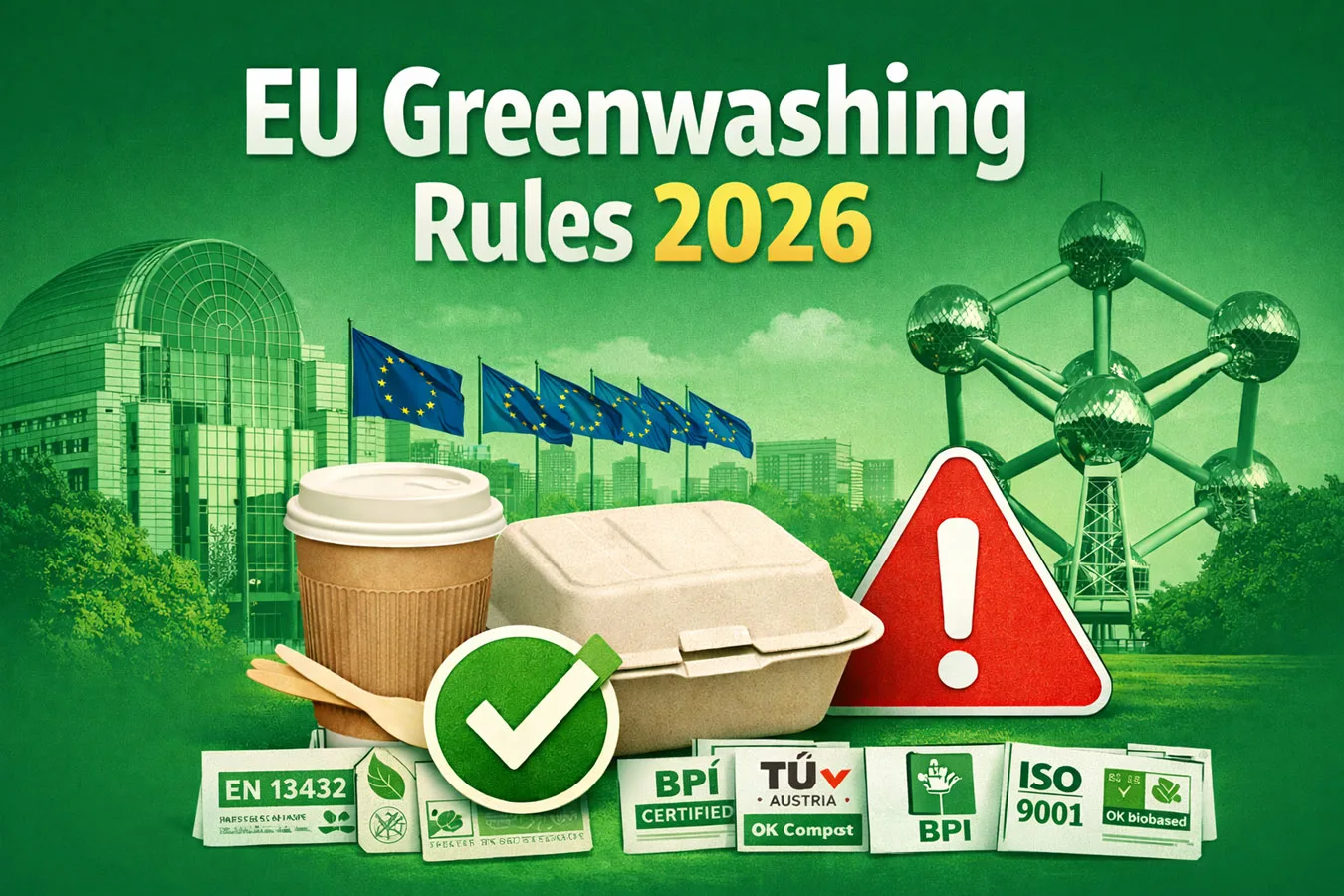
From 27 September 2026, European consumer-facing environmental communication will be subject to tighter controls under Directive (EU) 2024/825. Importers, distributors, retailers, foodservice brands, and packaging suppliers should therefore review product pages, labels, icons, printed packaging, sustainability badges, and promotional wording before the application date.
For global sourcing teams, this changes supplier selection. For manufacturers with product-specific documentation and controlled claim wording, it also creates a commercial advantage.
Bioleader® is positioned to support this type of review through a compliance structure that separates food-contact documentation, compostability standards, quality-management systems, material information, and supporting test reports. Its certificate framework also explains that documentation requirements vary by material, product type, individual SKU, and destination market.
This distinction is important. A bagasse clamshell, PLA cold cup, paper bowl, cornstarch plate, PET lid, and CPLA fork should not all be marketed using the same environmental wording.
Why the EU’s 2026 Greenwashing Crackdown Matters to Food Packaging
The September 2026 application date is not simply a media headline. It is a practical packaging, marketing, and procurement deadline.
Directive (EU) 2024/825 was adopted in 2024. Member States had until 27 March 2026 to transpose the rules into national law, and the requirements will apply from 27 September 2026.
The Directive primarily changes the EU framework for business-to-consumer commercial practices. This means that the direct focus is consumer-facing communication. However, B2B packaging suppliers are still affected because their product descriptions, certificates, artwork, claims, and technical documents may be used by importers, distributors, retailers, restaurants, and food brands in communication to consumers.
For food packaging, almost every commercial surface can become a claim surface:
- Cup and bowl printing
- Retail packs and master cartons
- Product labels and stickers
- Restaurant menus and takeaway applications
- Product pages and online marketplaces
- Catalogs, brochures, and sales presentations
- Sustainability icons and certification marks
- Distributor and private-label product listings
Once packaging wording enters consumer-facing communication, it is no longer only promotional language. It can become part of a compliance review.
2026 Update: Commission Q&A and Old Stock Guidance
On 30 June 2026, the European Commission published questions and answers to support consistent implementation of Directive (EU) 2024/825. The update gives businesses additional guidance on generic environmental claims, sustainability labels, offset-based climate claims, visual communication, and the transition to the new requirements.
The Consumer Protection Cooperation authorities also agreed on a common understanding concerning “old stock.” This includes products or packaging carrying environmental claims or sustainability labels that were manufactured, ordered, distributed, or placed on retail shelves before 27 September 2026.
The old-stock approach does not create a blanket exemption. Businesses are expected to take timely, good-faith steps to adapt consumer-facing practices. Authorities may apply a proportionate or phased enforcement approach where genuine transitional difficulties exist, especially during the early period of application.
Buyer note: Importers should not assume that existing packaging artwork can be used indefinitely because it was printed before September 2026. Old cartons, labels, sleeves, website copy, and distributor listings should be reviewed as part of the transition plan.
Why Europe Is Moving Toward Evidence-Based Claims
The policy shift responds to a longstanding credibility problem in environmental marketing. European Commission materials report that:
- 53% of green claims provide vague, misleading, or unfounded information.
- 40% of claims have no supporting evidence.
- The EU market contains approximately 230 sustainability labels with widely varying levels of transparency and verification.
For global procurement teams, the message is clear: the strongest supplier is not the company with the greenest slogan. It is the supplier with the clearest product scope, most relevant document set, and most controlled claim wording.
Which Packaging Claims Are Now High Risk in Europe
Generic Environmental Claims Are a Red-Flag Area
The European Commission’s implementation guidance specifically identifies generic environmental claims such as:
- Environmentally friendly
- Eco-friendly
- Green
- Climate friendly
- Biodegradable
- Biobased
These claims become problematic when they suggest excellent environmental performance but are not clearly and prominently qualified on the same medium.
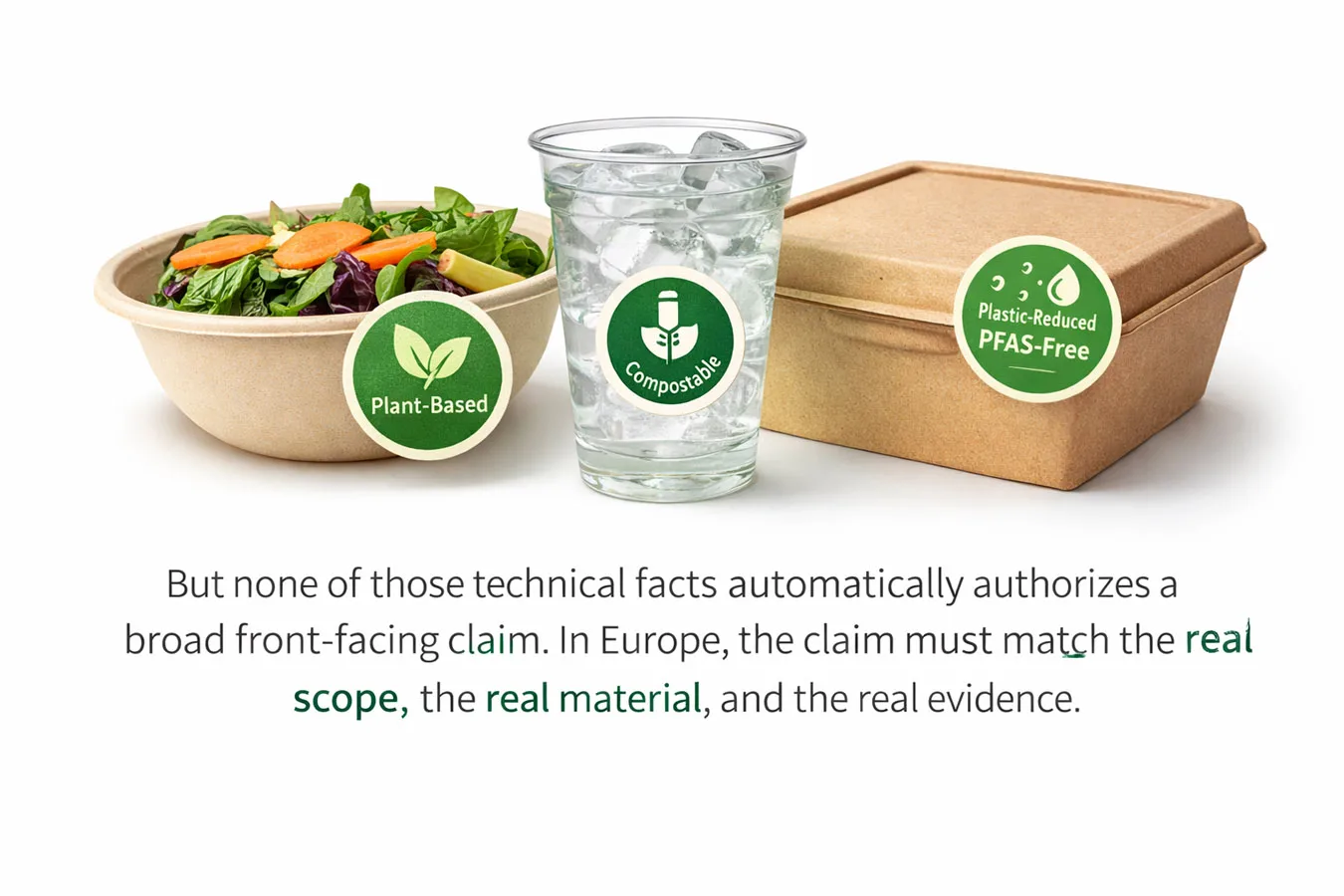
A molded fiber bowl may be made from renewable plant fiber. A PLA cup may be eligible for industrial compostability certification. A paper container may use a reduced-plastic coating or be supported by PFAS-related documentation.
However, none of these technical facts automatically authorizes a broad claim such as “good for the planet” or “completely eco-friendly.” The wording must match the actual material, finished product, certification scope, intended application, and available evidence.
Unverified Sustainability Labels Are Also Under Pressure
The EU rules do not focus only on words. They also address sustainability labels.
Where a sustainability label is not established by a public authority, it generally needs to be based on a qualifying certification scheme with transparent requirements, independent third-party monitoring, and fair access for operators that meet the conditions.
This is highly relevant to packaging artwork. Many suppliers still use:
- Self-designed green badges
- Leaf-shaped sustainability seals
- Unlicensed compostability symbols
- Recycling-style arrows with no defined meaning
- Eco logos created by the manufacturer itself
These graphics may imply independent verification even when none exists. Buyers should confirm the owner, rules, verification process, and permitted use of every sustainability mark before approving artwork.
Carbon-Neutral Wording Is No Longer Casual Language
Claims such as “carbon neutral,” “climate neutral,” or similar product-level statements require particular caution.
Directive (EU) 2024/825 restricts claims that a product has a neutral, reduced, or positive greenhouse-gas impact where the claimed result is based on offsetting greenhouse-gas emissions outside the product’s value chain.
For food packaging suppliers, it is safer to communicate specific, supportable facts such as:
- Defined material composition
- Verified recycled or biobased content
- Product-specific compostability scope
- Measured manufacturing changes
- Documented reductions within a defined system boundary
- Food-contact and chemical-compliance information
These statements are more defensible than broad climate slogans that do not explain the methodology, boundary, baseline, or role of offsets.
Visual Design Can Imply Environmental Claims
Environmental claims are not limited to written sentences. Images, symbols, brand names, product names, labels, colors, and overall presentation can also imply environmental performance.
Green backgrounds, leaves, forests, circular arrows, soil imagery, and compost-style icons may influence how consumers interpret the packaging. These visual elements are not automatically prohibited, but they should not create an environmental impression broader than the evidence.
European claim review should therefore be part of packaging development rather than a final legal check after artwork has already been printed.
What Global Buyers Should Check Before Accepting a “Sustainable Packaging” Claim
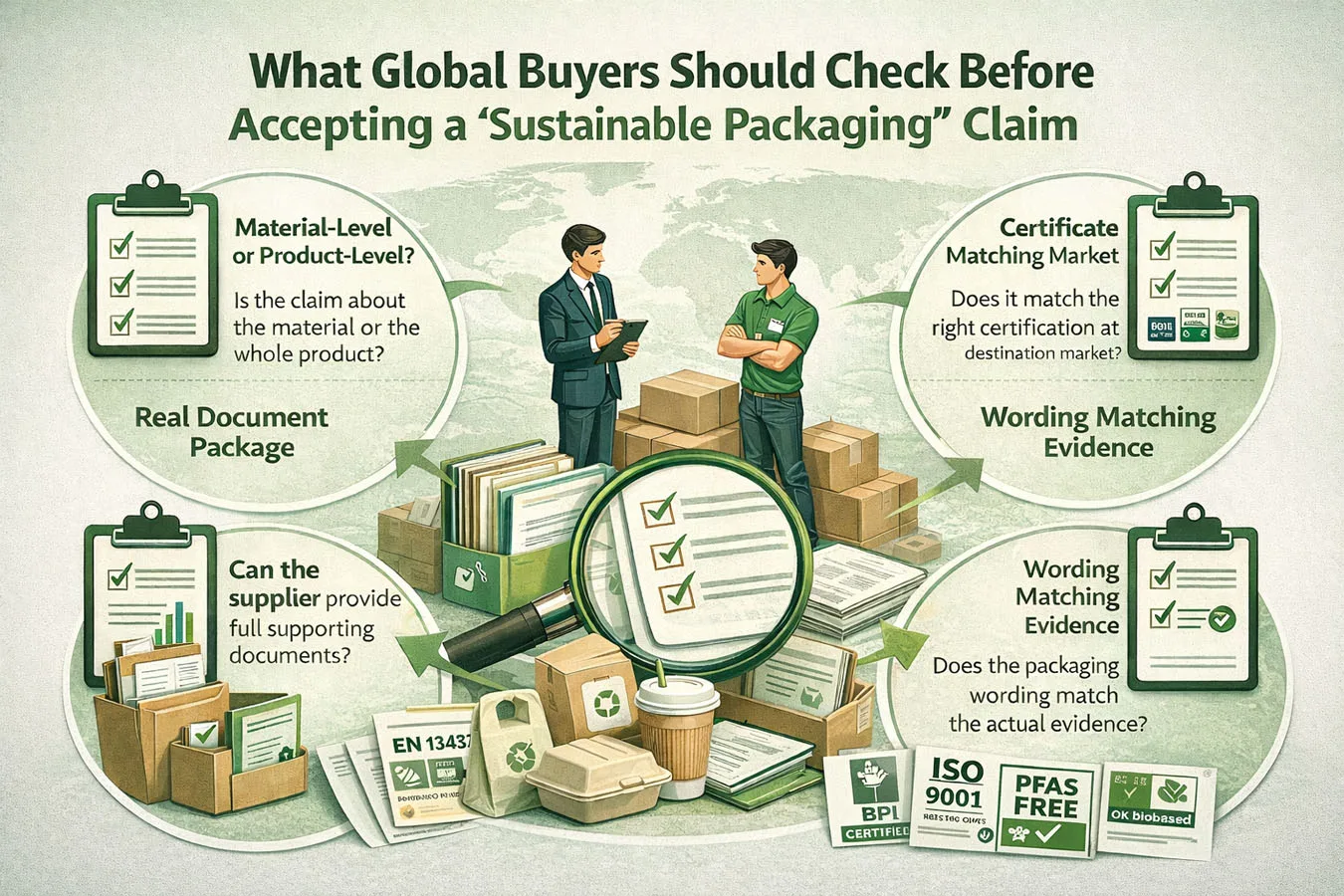
Check Whether the Claim Is Material-Level or Product-Level
This is the first verification step.
A raw material may have one environmental characteristic, while the finished food packaging product may contain additional coatings, pigments, inks, labels, adhesives, barriers, lids, sleeves, or windows.
Packaging buyers should ask:
- Does the claim apply only to the base fiber or polymer?
- Does it cover the complete finished SKU?
- Is the lid included?
- Are printing inks and adhesive systems covered?
- Does the certificate apply to the same thickness and formulation?
- Is the claim limited to one production site or product family?
These are practical supplier-audit questions, not academic distinctions.
Check Whether the Certification Matches the Destination Market
A certificate is not useful in the abstract. It must match the product, claim, destination market, and intended disposal route.
Bioleader®’s certificate page explains that certification and document requirements vary by material, product type, and destination market. This is important because one certificate deck should not be treated as universal approval for every export project.
A European buyer, North American distributor, Australian importer, and Japanese foodservice brand may request different combinations of:
- Food-contact documentation
- Compostability certification
- Material declarations
- PFAS-related documentation
- Quality-management evidence
- Product performance data
- Destination-specific declarations
A supplier that maps documents by product and market is easier to audit than one that sends the same generic presentation for every item.
Check Whether the Supplier Can Provide a Real Document Package
A serious compliance review should not stop at a page of certification logos.
Depending on product type and market, a buyer-ready package may include:
- Material specification or technical data sheet
- Finished-product food-contact report or declaration
- Compostability certificate or supporting test documentation
- Certificate number and covered product scope
- PFAS, PFOA, PFOS, or fluorine-related documents where applicable
- Declaration of Conformity where required
- Quality-management certificates
- Product application and temperature guidance
- Component information for lids, coatings, inks, and labels
Bioleader® publicly groups documentation into separate areas covering food-contact compliance, compostability, quality management, and supporting technical information. This structure is more useful than treating every document as evidence of one broad environmental claim.
Check Whether the Packaging Wording Matches the Evidence
A supplier may hold legitimate reports while still using wording that is broader than the evidence.
Examples include:
- An industrial compostability certificate used to support a home-compostable claim.
- A raw-material certificate used as proof for every finished SKU.
- A bagasse container described as fully compostable even when supplied with a PET lid.
- A food-contact report presented as evidence of biodegradability.
- A PFAS-free report presented as proof that a product is chemical-free.
- A recyclable material claim used without considering local collection systems.
Supplier audit in 2026 must therefore include review of technical evidence and customer-facing copy.
How Bioleader® Supports a Claim-Ready Compliance System
Bioleader® Starts with Scope, Not Slogans
One of the most useful principles on Bioleader®’s certificate page is that documentation requirements vary by material, product type, and destination market.
This is the correct starting point for EU claim review. A sugarcane bagasse clamshell, paper bowl, PLA cold cup, CPLA fork, cornstarch plate, and PET lid should not be presented under one simplified environmental statement.
A stronger workflow is:
- Identify the exact product and components.
- Define the intended application and destination market.
- Identify the proposed environmental claim.
- Match the claim to the relevant product documents.
- Add limitations or qualifications where needed.
- Approve final packaging and website wording.
This approach reduces the risk of applying one certificate or one claim to unrelated product categories.
Bioleader® Separates Food-Contact Compliance from Sustainability Messaging
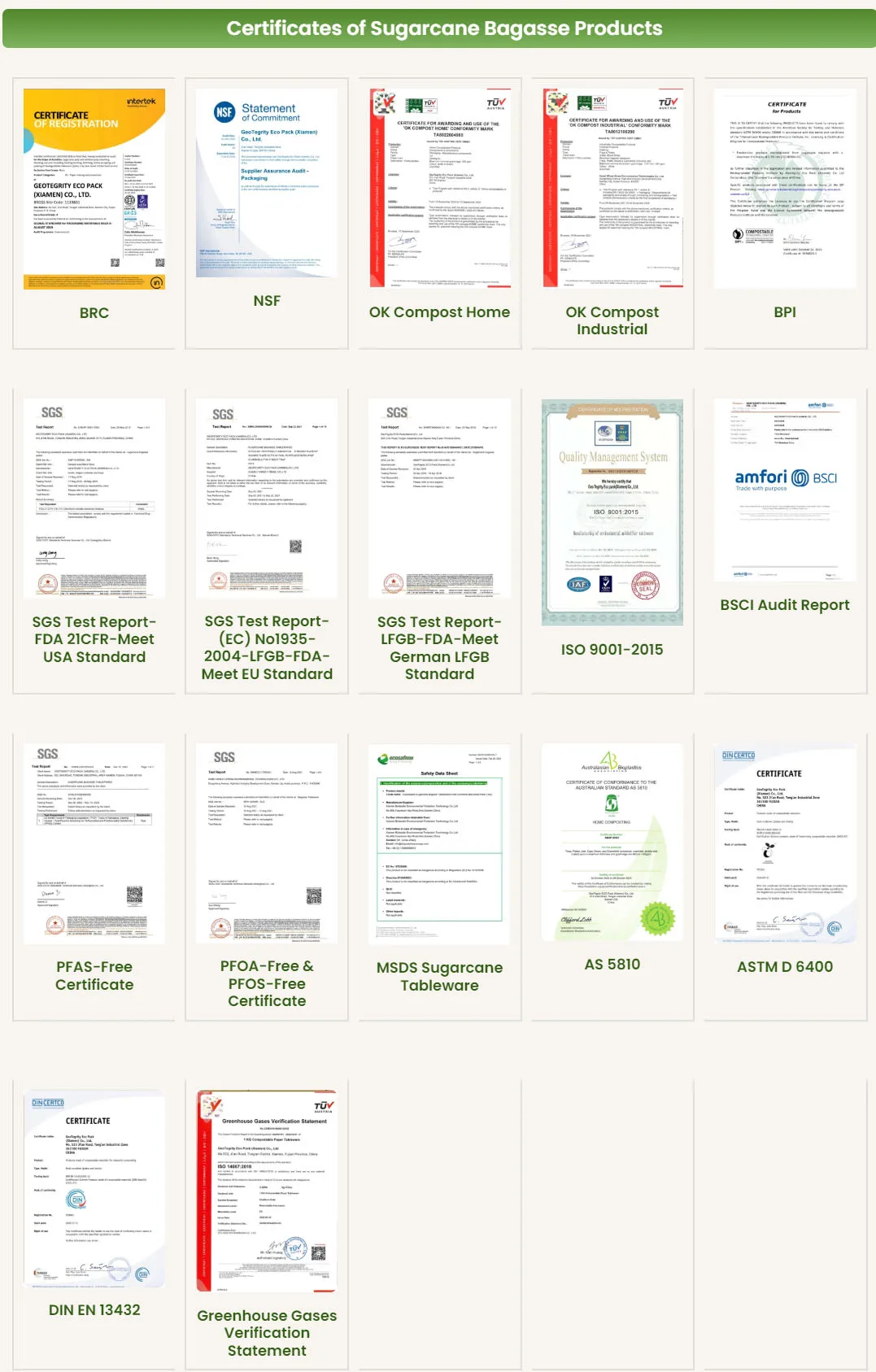
This separation is important because food-contact safety and environmental performance are related but distinct questions.
Depending on the product and destination market, food packaging buyers may need to review references such as:
- FDA 21 CFR requirements
- Regulation (EC) No 1935/2004
- Regulation (EU) No 10/2011 where applicable
- LFGB testing
- Declaration of Conformity
- Migration testing and use-condition limitations
A product does not become food-contact compliant merely because it is compostable, plant-based, paper-based, or described as eco-friendly.
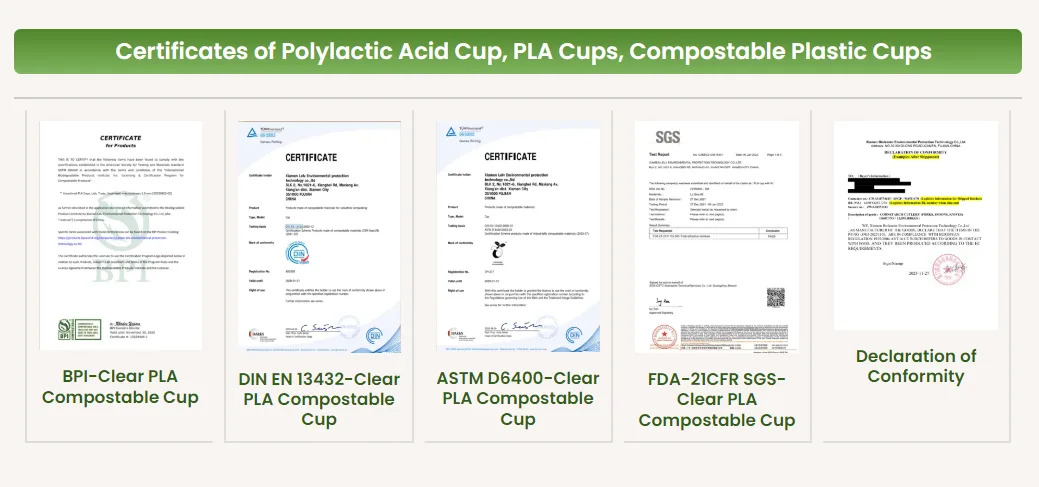
Bioleader® Organizes Compostability Claims Around Recognized Frameworks
Bioleader®’s public compliance information references recognized frameworks including OK compost HOME, BPI, DIN EN 13432, ASTM D6400, and AS 5810.
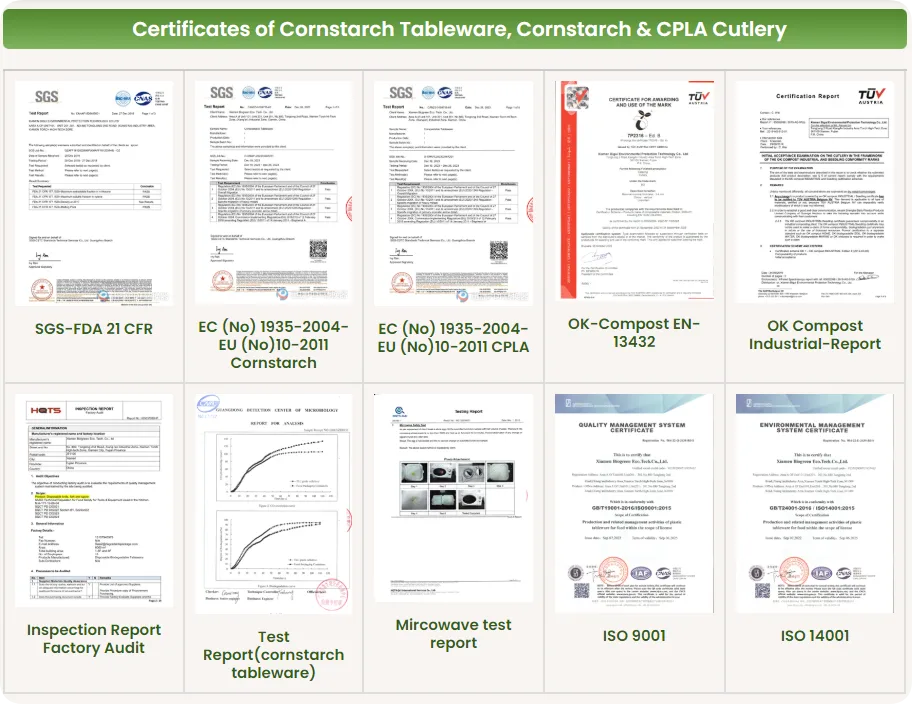
These references are useful only when they are connected to the correct product scope. Buyers should confirm:
- The certificate holder
- The applicable product or product family
- The item code or model mapping
- The material formulation
- The thickness range
- The certification environment
- The validity status
- Whether the certification mark may be used on private-label artwork
Industrial compostability, home compostability, biodegradability, food-contact compliance, and local facility acceptance should always be reviewed separately.
Bioleader® Supports Buyer Review with Management-System Evidence
Environmental claims are more credible when the supplier also demonstrates process discipline and controlled documentation.
Bioleader® publicly references management and quality systems including ISO 9001, BRCGS, BSCI, and QS. The exact scope and relevance of each document should still be checked against the manufacturing facility, product, and buyer requirement.
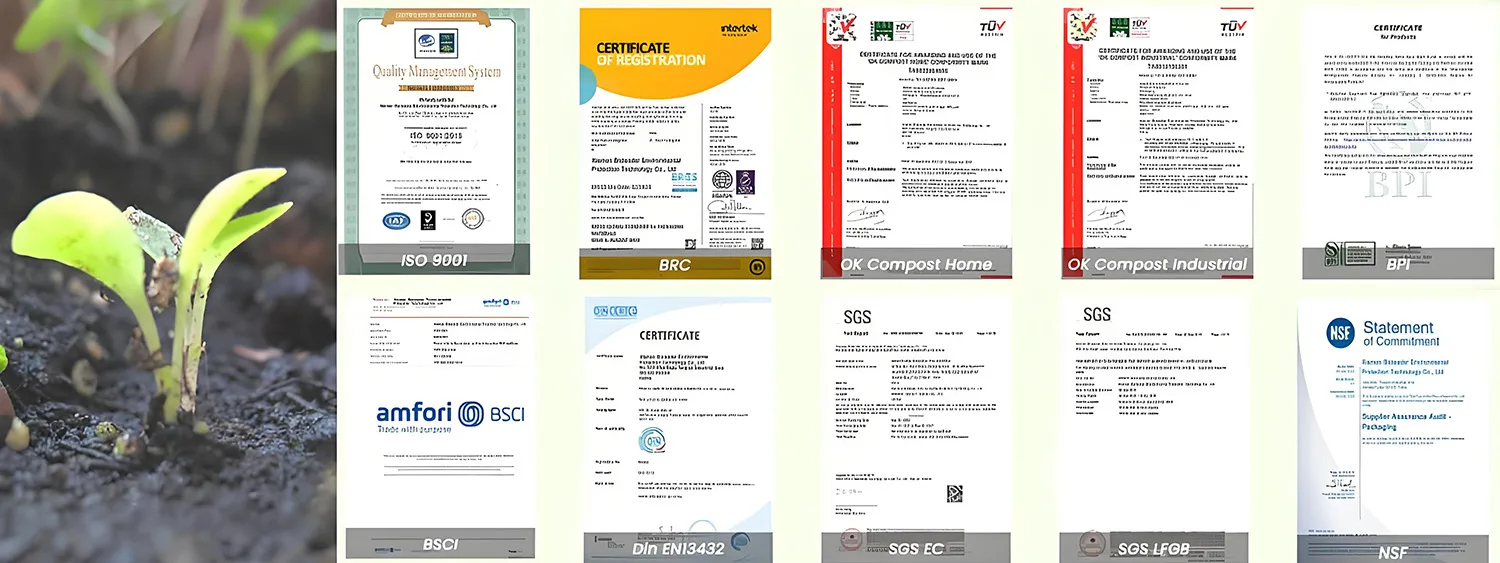
Management-system evidence does not prove that every product is compostable or environmentally superior. Its value lies in supporting quality control, audit readiness, traceability, document management, and production consistency.
Supporting Documents Strengthen Transparency
Bioleader®’s public compliance information also references supporting documents such as PFAS/PFOA/PFOS-related test reports and technical data sheets.
These documents can help procurement teams move from initial interest to product approval, but their scope should remain clear.
For example:
- A PFAS report does not prove compostability.
- A compostability certificate does not prove food-contact compliance.
- A TDS does not replace independent certification.
- A raw-material declaration does not automatically cover the complete printed product.
- A quality certificate does not prove the environmental performance of every SKU.
The strongest supplier package uses different documents to answer different compliance questions.
Controlled Wording Is Stronger Than Broad Marketing
For European communication, it is safer to state that a product is supported by specified documents or certification within a defined scope than to make one broad promise across an entire catalog.
For example:
“Product-specific compostability and food-contact documentation is available for selected items, subject to material, SKU, construction, certification scope, and destination-market requirements.”
This wording is less dramatic than claiming that all products are universally eco-friendly, but it is more suitable for professional procurement and regulatory review.
A Practical Supplier Audit Model to Avoid Greenwashing Risk
Step 1: Define the Exact Claim Before Discussing Artwork
A buyer should first ask:
What exactly are we trying to say about this packaging?
The answer should identify whether the claim concerns:
- Compostability
- Biodegradability
- Biobased content
- Recycled content
- Recyclability
- Plastic-free composition
- PFAS-free status
- Food-contact compliance
- Carbon or lifecycle performance
The buyer should also identify whether the statement applies to the complete product, one component, one material, or one lifecycle stage.
Step 2: Match the Claim to the Correct Document Set
Once the claim is defined, the supplier should map it to the correct evidence.
| Proposed Claim | Relevant Evidence | Evidence That Is Not Enough by Itself |
|---|---|---|
| Industrially compostable | Applicable finished-product certificate or clearly mapped product-family certification. | Raw-material brochure or biodegradable statement. |
| Home compostable | Product-specific home-compostability certification. | Industrial compostability certificate. |
| PFAS-free | Defined supplier declaration and appropriate product testing where applicable. | Compostability or food-contact certificate. |
| Food-contact compliant | Applicable declaration, migration test, or food-contact report. | Environmental certification. |
| Recyclable | Material design plus destination-market collection, sorting, and recycling context. | Resin identification alone. |
| Biobased | Defined material composition or verified biobased content. | Plant imagery or compostability logo. |
Step 3: Review Scope, Market, and Validity
A certificate without scope control is weak evidence.
Buyers should check:
- Certificate holder
- Certificate number
- Issuing body
- Product or material covered
- Applicable thickness or weight
- Color and additive restrictions
- Printing and coating coverage
- Manufacturing site
- Validity or registry status
- Destination-market relevance
Step 4: Review Packaging Wording and Product-Page Copy
Even a technically valid project can become risky if specific evidence is converted into an unlimited environmental promise.
The final review should cover:
- Product title
- H1 and product summary
- Carton and retail-pack wording
- Icons and certification marks
- Image captions and alt text
- Printed cup or bowl copy
- Distributor and marketplace listings
- FAQ and sustainability statements
The same claim scope should remain consistent across every channel.
Step 5: Keep a Buyer-Ready Claim File
A buyer-ready claim file should include:
- The exact approved wording
- The covered product codes
- Excluded components
- The supporting certificates and reports
- Market and disposal conditions
- Permitted use of certification marks
- Artwork approval records
- Document review dates
- Change-control requirements
This file-based approach reduces the risk of sales teams, distributors, or private-label buyers expanding a claim beyond the evidence.
A Practical Example: How Bioleader® Can Support an EU Claim Review
Consider an EU buyer sourcing bagasse food containers and planning to use a compostability-related statement.
A weak supplier response would be to send one certificate image and a brochure saying that the entire product range is eco-friendly.
A stronger review process would be:
- Confirm the exact bagasse container item code.
- Identify whether the order includes a bagasse lid, PET lid, PP lid, or no lid.
- Confirm natural or white color and the product formulation.
- Identify the intended EU market and sales channel.
- Review available food-contact documentation.
- Review the applicable compostability certificate or product mapping.
- Check PFAS-related documents where required.
- Confirm whether labels, printing, and accessories are covered.
- Agree on approved packaging wording before production.
This process creates three commercial advantages:
- It lowers the risk of overclaiming.
- It makes supplier and customer audits more efficient.
- It gives importers a clearer compliance file for internal approval.
For more detailed product-level checks, buyers can also review how to verify truly compostable food packaging.
Why This Gives Bioleader® an Advantage in Europe
The EU’s anti-greenwashing direction increases the risk for suppliers that depend on vague environmental language. At the same time, it can reward suppliers with better document organization and product-specific claim control.
Bioleader®’s public compliance structure follows a useful model:
- Compliance documents grouped by function
- Product categories separated by material
- Food-contact and environmental documents treated separately
- Supporting reports available according to product and market
- Claims connected to scope rather than applied universally
For importers, distributors, and food brands, this can provide practical value:
- Faster initial supplier review
- Cleaner product and document mapping
- Better support for internal procurement approval
- More accurate product-page and packaging wording
- Lower risk of unsupported environmental claims
- More efficient preparation for retail or customer audits
The advantage does not come from claiming that every product has every certification. It comes from helping buyers identify which documents and claims apply to the selected product and destination market.
Final Takeaway
In Europe after 27 September 2026, the strongest packaging supplier will not necessarily be the company with the most visible green messaging.
It will be the supplier with the most defensible claim file.
That means connecting:
- The exact product
- The material and components
- The proposed environmental claim
- The applicable standard
- The supporting document
- The destination market
- The final consumer-facing wording
The EU policy shift raises the standard for packaging communication. It exposes weak sustainability marketing, limits unsupported labels, and gives an advantage to manufacturers that can connect product, scope, document, and wording in one controlled system.
Bioleader®’s public compliance framework moves in that direction by separating document types and emphasizing that requirements depend on material, product type, and destination market.
That is the right direction for EU packaging procurement.
It is also the right direction for suppliers that want to compete on evidence rather than promises.
FAQ
1. What are the EU Greenwashing Rules 2026 for packaging buyers?
The main adopted changes come from Directive (EU) 2024/825. From 27 September 2026, consumer-facing generic environmental claims and sustainability labels will face tighter controls. Packaging buyers should verify that claims are specific, clearly qualified, supported by relevant evidence, and limited to the correct product and component scope.
2. When do the new EU anti-greenwashing rules start to apply?
EU Member States had until 27 March 2026 to transpose Directive (EU) 2024/825. The rules will apply from 27 September 2026. Packaging artwork, product-page copy, labels, icons, and distributor listings should therefore be reviewed before the application date.
3. Are terms like “eco-friendly” or “biodegradable” still safe to use in Europe?
Not automatically. These may be treated as high-risk generic environmental claims when their meaning is not clearly and prominently specified on the same medium. Suppliers should explain the exact environmental attribute, the product or component covered, the supporting evidence, and any disposal limitations.
4. What should buyers check before accepting a sustainable packaging claim?
Buyers should determine whether the claim applies to the material, finished product, complete set, or one component. They should also verify certificate scope, destination-market relevance, document validity, finished-product construction, permitted logo use, and whether public wording matches the available evidence.
5. What documents should a food packaging supplier provide?
Depending on the product and market, a supplier may need to provide material specifications, food-contact documents, relevant compostability support, PFAS-related documentation, technical data sheets, quality-management evidence, product-performance guidance, and clear certificate-to-product mapping. Not every document applies to every SKU.
6. Is the Green Claims Directive already fully in force in the EU?
No. The adopted rules applying from September 2026 come from Directive (EU) 2024/825. The separate Green Claims Directive remains a pending and delayed legislative proposal. It should not be described as EU law already in force.
7. How does Bioleader® help buyers reduce greenwashing risk?
Bioleader® supports product-specific review based on material, product type, selected components, destination market, and intended claim. Depending on the item, buyers can review available food-contact, compostability, PFAS-related, quality-management, and technical documents before approving packaging wording or artwork.
Official References
- European Union — Directive (EU) 2024/825 on Empowering Consumers for the Green Transition
- European Commission — Sustainable Consumption and Directive Implementation Q&A
- European Commission — Common Understanding on Old Stock Situations
- European Commission — Green Claims Proposal
- European Parliament — Legislative Status of the Green Claims Proposal