

Quick Summary
Choosing the right eco-friendly takeaway containers should begin with the meal, not with a generic “green” material label. Hot soup, oily curry, fried food, chilled salad and iced drinks create different requirements for temperature, moisture, oil resistance, ventilation, lid fit and delivery time.
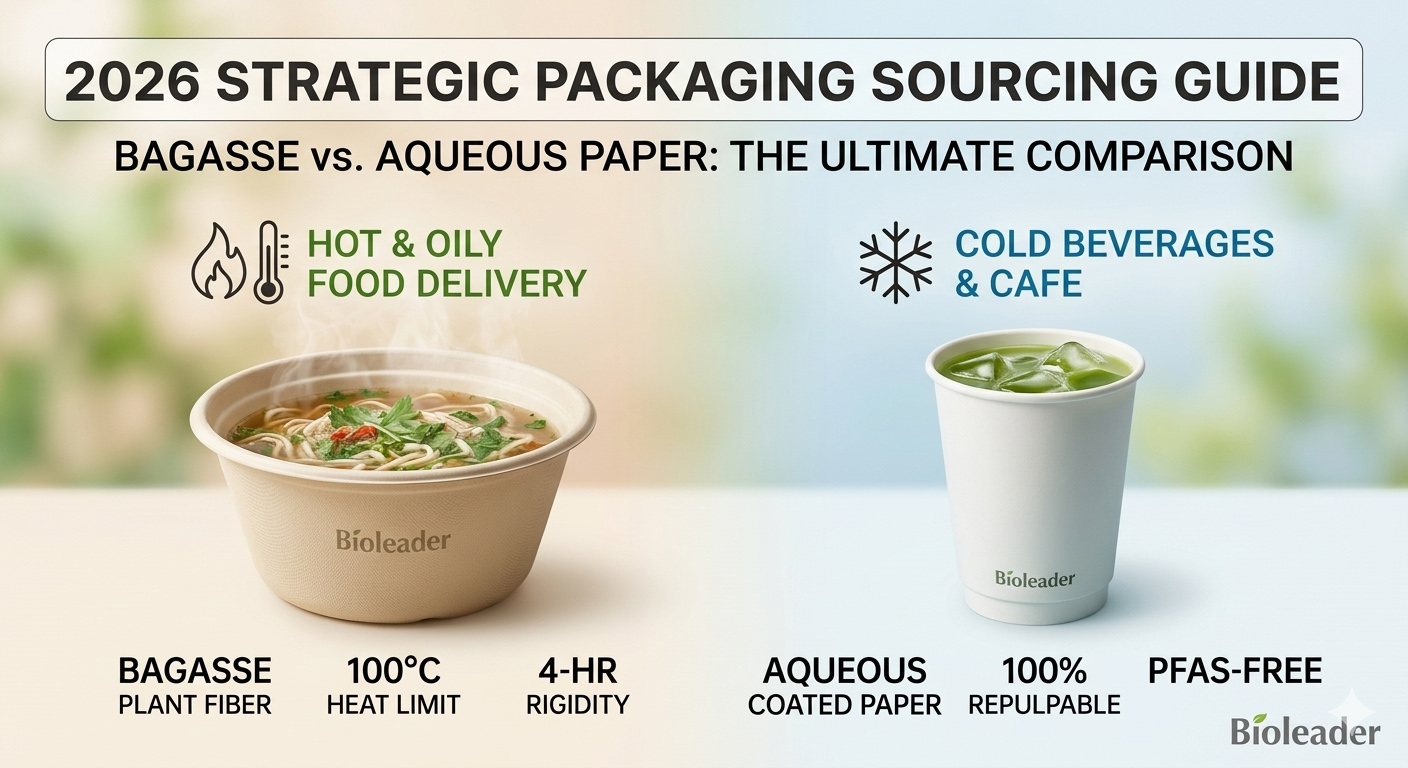
- Hot meals: sugarcane bagasse and application-tested paper food containers are common starting points.
- Soup and noodles: prioritize rim stability, lid compatibility, leakage testing and sufficient headspace.
- Salads and chilled meals: condensation, coating structure, presentation and lid clarity become more important.
- Fried foods: ventilation and moisture release may matter as much as grease resistance.
- Cold beverages: clear PLA cups are primarily designed for cold applications and require suitable storage and a realistic end-of-life pathway.
- B2B procurement: evaluate the complete container-and-lid system, available compliance documents, carton packing, MOQ and destination-market requirements before bulk production.
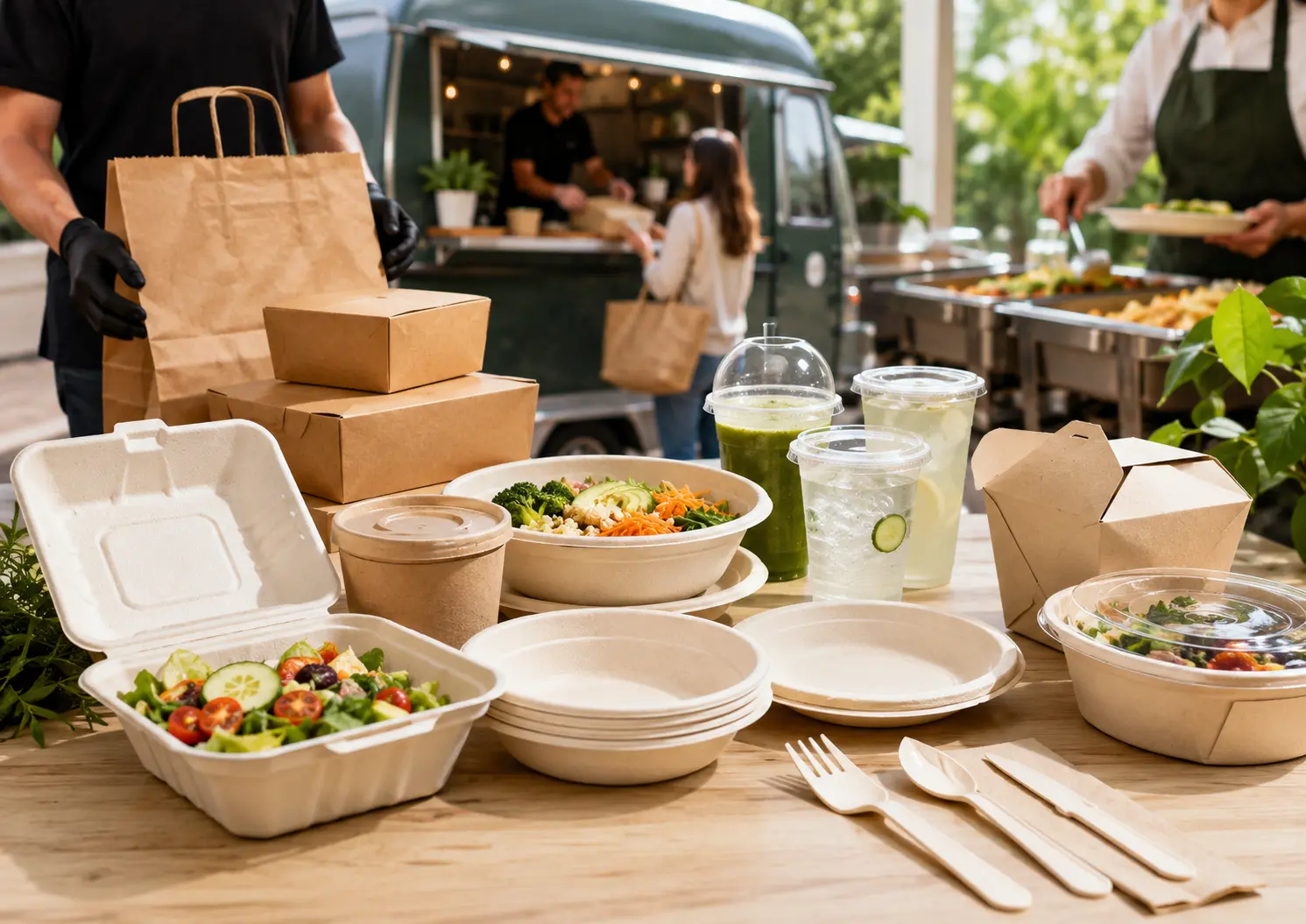
This guide compares bagasse, paper and kraft packaging, cornstarch-based tableware, PLA and CPLA, then shows how restaurants, foodservice brands and wholesale buyers can select takeaway packaging by meal type and operating scenario.
Choosing takeaway packaging is no longer only a question of replacing conventional plastic. For restaurants, delivery kitchens, distributors, caterers and foodservice brands, the container influences food protection, delivery performance, warehouse efficiency, waste handling and customer experience.
Consumer research confirms that environmental packaging matters, but price and product performance still influence purchasing decisions. A 2025 peer-reviewed study involving 270 consumers found that 55.18% preferred environmentally friendly packaging when environmental performance was considered separately, while 22.59% selected the survey response indicating willingness to pay more than 10% for a product in environmentally friendly packaging.[1]
This is an important distinction for foodservice procurement. Sustainability can influence preference, but a package that leaks, collapses, traps excessive steam or fails during delivery can increase food waste, replacement cost and customer complaints.

Why Eco-Friendly Takeaway Containers Matter in 2026
Sustainability Is Now a Procurement and Performance Issue
Environmental packaging claims increasingly influence how buyers and consumers assess food packaging, but sustainability cannot be separated from food safety, cost and operational performance.
The European Commission’s 2024 Eurobarometer findings reported that 72% of Europeans take the chemical safety of products into account when making purchases. After respondents were given information about PFAS, 81% expressed concern about possible health effects and 84% expressed concern about environmental effects.[2]
These results do not mean that every consumer will pay more for compostable packaging or that one material is automatically preferred. They do show why chemical composition, accurate environmental claims and transparent documentation are becoming more relevant to procurement and brand trust.
Buyer takeaway: Environmental positioning can influence purchasing decisions, but food safety, packaging performance, price and credible supporting evidence still determine whether a packaging program works in practice.
Food Delivery Creates a Significant Packaging Footprint
The scale of takeaway packaging also matters. A peer-reviewed study of online food delivery in South Korea estimated that approximately 72.93 thousand tonnes of plastic packaging were consumed by online food delivery services in 2020. Polypropylene (PP) and polyethylene terephthalate (PET) together accounted for 81.48% of the plastic packaging identified in the study.[3]
The study also found that the production stage was responsible for a substantial share of environmental impacts and evaluated alternatives including reusable systems, recycled materials and increased recycling rates. This illustrates why sustainable takeaway packaging cannot be evaluated only by what happens after disposal.
A separate 2025 life-cycle assessment of takeaway food packaging found that the environmental comparison between single-use and reusable systems depends significantly on user behavior, production assumptions, return cycles, transport and other operating conditions.[4]
Interpretation note: These studies should not be used to claim that one material is universally better. They show why packaging weight, production, reuse behavior, food protection, transport and end-of-life infrastructure should be considered together.
Packaging Quality Influences the Delivery Experience
Delivery adds vibration, stacking, liquid movement, steam and longer holding times. Packaging therefore becomes part of the delivered service rather than simply a disposable container.
A peer-reviewed study using data from the Meituan on-demand service platform found that poor packaging performance can contribute to consumer complaints and influence how customers attribute service failures between merchants and delivery platforms.[5]
For restaurant and procurement teams, the practical lesson is clear: environmental positioning should not replace physical testing. Lid security, liquid movement, steam, temperature, portion weight, stacking and expected journey time should be evaluated with the actual food.
Regulatory Pressure Is Becoming More Specific
Packaging regulation is also moving beyond broad “plastic reduction” language toward more specific rules concerning material composition, substances of concern, recyclability, labeling and waste management.
In the European Union, Regulation (EU) 2025/40 on packaging and packaging waste applies from 12 August 2026. Article 5(5) establishes concentration limits for PFAS in food-contact packaging. From that date, relevant food-contact packaging cannot be placed on the EU market where PFAS concentrations are equal to or above:
- 25 ppb for any individual PFAS measured using targeted PFAS analysis, with polymeric PFAS excluded from that quantification;
- 250 ppb for the sum of PFAS measured as the sum of targeted PFAS analysis, where applicable with prior degradation of precursors and with polymeric PFAS excluded from that quantification; or
- 50 ppm for PFAS including polymeric PFAS, subject to the additional total-fluorine provisions in Article 5(5).[6]
Japan takes a different regulatory approach. Under its Plastic Resource Circulation framework, 12 specified single-use plastic products are covered by measures to rationalize use. Foodservice-related items include forks, spoons, table knives, stirrers and beverage straws, and covered business categories include restaurants and takeaway or delivery foodservice operators.[7]
Japan’s broader Resource Circulation Strategy for Plastics also sets a milestone of a cumulative 25% reduction in single-use plastics by 2030.[8]
Compliance note: Regulations differ by product and destination market. Compostability certification does not automatically exempt a PLA- or CPLA-based product from single-use-plastic restrictions, while a PFAS report does not replace food-contact, material-composition or compostability documentation.
What Makes a Takeaway Container “Eco-Friendly”?
Compostable vs. Biodegradable vs. Recyclable
Biodegradable, compostable, recyclable, bio-based and plastic-free describe different properties. Treating them as interchangeable is one of the most common causes of inaccurate environmental claims.
- Biodegradable: describes biological degradation under particular environmental conditions. Without a defined environment and timeframe, the term does not provide a complete disposal instruction.
- Compostable: refers to products designed to satisfy defined composting requirements under an applicable standard and specified composting environment.
- Industrial compostable: generally refers to controlled municipal or commercial composting conditions.
- Home compostable: requires separate product-specific evidence and should not be inferred from industrial compostability.
- Recyclable: depends not only on the material but also on local collection, sorting, contamination levels and processing infrastructure.
- Bio-based: describes the origin of some or all feedstock and does not automatically determine whether a finished product is compostable, recyclable or plastic-free.
- Plastic-free: should apply to the complete packaging structure, not only its visible substrate.
The Biodegradable Products Institute (BPI) distinguishes “compostable” from the much broader term “biodegradable” and notes that not everything marketed as biodegradable is compostable because the relevant timeframe and environment must be specified.[9]
The U.S. Environmental Protection Agency also emphasizes that certified commercially compostable foodservice ware should be procured in conjunction with real collection and commercial composting capacity. EPA guidance recommends confirming that a local composting program exists, accepts the selected products and has appropriate collection or hauling arrangements.[10]
Material Safety and Chemical Compliance
Food-contact suitability and environmental claims are separate questions. A package may be compostable or made from renewable feedstock but still require appropriate food-contact testing and product-specific documentation for its intended use.
What Buyers Should Verify
- Actual substrate and resin composition.
- Food-contact documentation applicable to the selected product.
- Intended food type, temperature and contact duration.
- Coatings, inks, adhesives and lid materials where relevant.
- PFAS-related declarations or test reports where required.
- Industrial or home compostability claims and certification scope.
- Destination-market restrictions and labeling requirements.
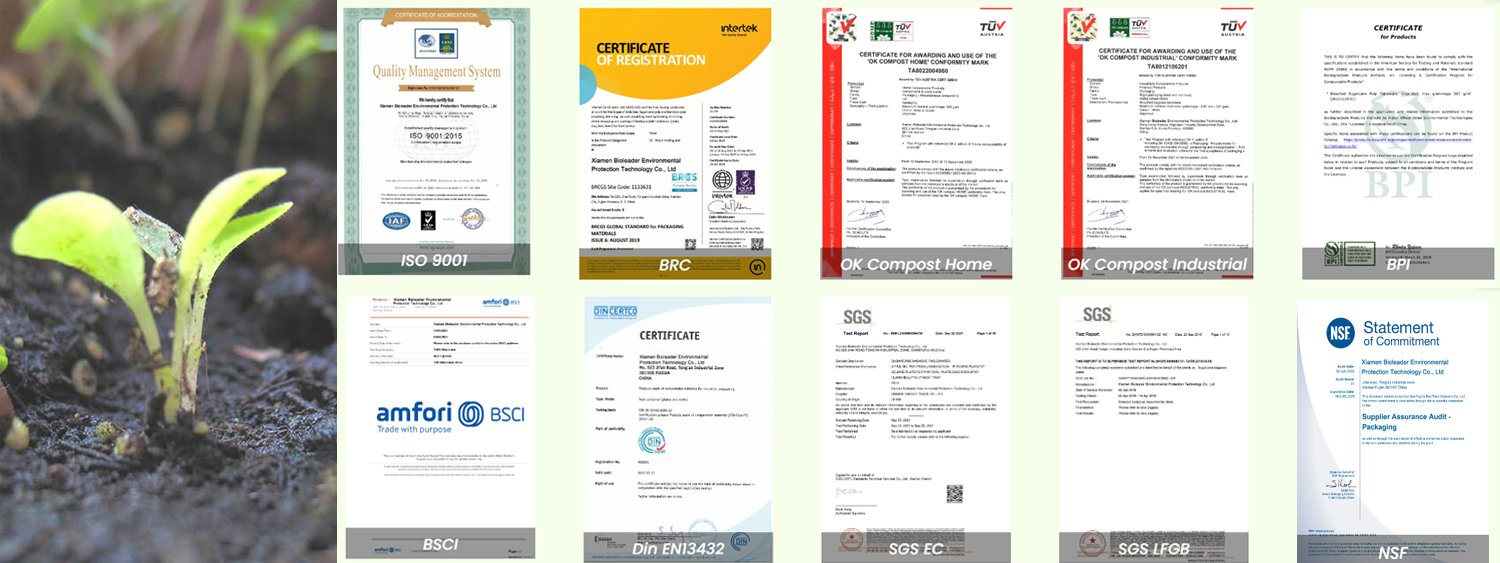
Bioleader® buyers can review available documentation through the Certificates & Test Reports section and request product-specific documents for the selected SKU.
Identifying Real Sustainability vs. Greenwashing
A natural brown color, leaf symbol or “eco” label is not evidence by itself. Procurement teams should separate marketing appearance from verifiable product information.
- What is the complete product made from?
- Which temperature, oil, moisture and delivery conditions is it designed to handle?
- Which reports or certifications apply to the actual SKU?
- What is the realistic end-of-life pathway in the destination market?
- Can the supplier provide consistent dimensions, lid compatibility, carton information and repeat-production control?
For this reason, buyers evaluating eco-friendly food packaging for foodservice should compare the complete packaging structure rather than judging sustainability from material appearance alone.
Understanding Material Options for Eco-Friendly Takeaway Use
Bagasse: A Versatile Molded-Fiber Option
Sugarcane bagasse is a renewable plant-fiber material widely used for clamshells, bowls, plates, trays and takeaway food containers. Its molded structure makes it useful for many hot and cold meal applications.
- Available in a broad range of clamshell, bowl, plate and tray formats.
- Commonly selected for hot meals, rice dishes, noodles, fried foods and oily takeaway applications.
- Can be paired with molded-fiber, paper, PET, PP or other application-specific lids depending on the selected product.
- Oil, water and heat performance varies by fiber formulation, barrier system, product weight and structural design.
- Microwave and freezer claims should be confirmed against the specification or test documentation of the selected SKU.
Buyers should not assume that every molded-fiber product has identical PFAS status or barrier performance. For category-level sourcing, review Bioleader®’s sugarcane bagasse tableware range and bagasse clamshell boxes for wholesale takeaway packaging.
Manufacturer Insight
Based on Bioleader®’s experience serving foodservice packaging buyers, hot and oily food packaging should be evaluated with the actual meal rather than by material name alone. Filling temperature, food composition, holding time, lid structure and delivery movement can all change the result. Buyers should test the selected SKU under intended-use conditions before confirming bulk production.
Cornstarch-Based Tableware: Formulation Matters
Cornstarch-based tableware is available in plates, bowls, cups and compartment food containers, but “cornstarch” should not automatically be interpreted as pure starch, plastic-free material or home-compostable material.
- Commercial resin formulations vary by product and supplier.
- Structural rigidity can make selected formulations useful for compartment meals and catering.
- Heat and microwave performance should be confirmed from the selected product specification.
- Compostability claims should match the actual resin system and available certification.
- Destination-market restrictions should be checked where the formulation contains a plastic or bioplastic resin system.
Current product formats can be compared through Bioleader®’s cornstarch tableware wholesale category.
Kraft and Paper Food Containers
Paper and kraft food packaging is widely used for salads, soup, noodles, rice meals, bakery products and branded takeaway programs. However, the visible paper substrate is only one part of the complete package.
Depending on the product, paper packaging may contain PE, PLA, a water-based coating, PP components, aluminum foil or another functional barrier. As a result:
- Paper does not automatically mean plastic-free.
- Paper does not automatically mean recyclable.
- Paper does not automatically mean compostable.
- Hot-food performance depends on paperboard grade, coating, seam construction and intended food.
- Lid material can significantly change the complete packaging structure and end-of-life route.
- Microwave suitability should be confirmed for the complete base-and-lid system.
Foodservice buyers can compare bowls, cups and boxes through Bioleader®’s paper food packaging solutions.
PLA Cups and Lids
Standard clear PLA cups are primarily intended for cold beverage applications such as iced coffee, juice, smoothies, bubble tea and chilled desserts.
- High clarity for beverage and dessert presentation.
- Suitable for cold-drink applications when stored and transported appropriately.
- Industrial compostability may apply when supported by the selected product certification.
- Storage and transport temperature require attention.
- Standard clear PLA cups should not be presented as hot-drink or microwave packaging unless a product-specific specification or report explicitly supports that use.
For cold beverage sourcing, review Bioleader®’s compostable PLA cold cups for iced drinks.
CPLA Cutlery
CPLA is commonly used for disposable cutlery where greater rigidity and heat resistance are needed than with standard PLA. Actual heat performance remains product-specific and should be confirmed from the selected specification or test report.
CPLA also remains a plastic-based material. Compostability certification does not automatically create an exemption from destination-market single-use-plastic restrictions, particularly for disposable cutlery.
Fork, spoon, knife and wrapped-set formats can be reviewed through Bioleader®’s compostable CPLA and cornstarch cutlery range.
Data-Dense Material Comparison for Takeaway Buyers
| Material System | Typical Takeaway Use | Temperature / Use Positioning | EU PFAS Check | Compostability / End-of-Life Evidence | Buyer Should Verify |
|---|---|---|---|---|---|
| Bagasse / Molded Fiber | Hot meals, clamshells, bowls, plates, trays, compartment containers | Commonly used for hot and cold food; exact limits depend on product design and testing | For EU food-contact packaging, Article 5(5) PFAS limits apply where relevant: 25 ppb / 250 ppb / 50 ppm thresholds | Do not assume a universal degradation period; verify the certification or evidence applicable to the actual finished product | PFAS evidence, food-contact report, oil/water resistance, microwave claim, lid fit, food test |
| Paper / Kraft | Soup bowls, salad bowls, food boxes, cups, noodle containers | Depends on paperboard, coating, seam structure and lid | Complete food-contact packaging structure must be considered, not only the paper substrate | PE-, PLA- and water-based-coated structures can have different end-of-life pathways; verify the complete construction | Coating type, paper weight, food-contact evidence, lid material, microwave suitability, disposal claim |
| PLA | Cold cups, iced drinks, desserts and selected cold-food lids | Primarily cold-use; do not apply a universal hot-use temperature without SKU-specific evidence | Where PLA is part of EU food-contact packaging, relevant PPWR requirements still apply | Verify applicable industrial compostability certification; local commercial compost acceptance is separate | ASTM D6400 / BPI or other applicable certification, storage conditions, lid compatibility, local composting infrastructure |
| Cornstarch-Based Resin | Plates, bowls, compartment boxes and selected takeaway containers | Highly formulation-dependent; microwave and heat performance must be product-specific | Verify complete formulation and product evidence rather than assuming compliance from the word “cornstarch” | Not automatically plastic-free, home compostable or industrial compostable | Resin composition, certification, temperature specification, microwave claim, destination regulation |
| CPLA Cutlery | Forks, spoons, knives and wrapped cutlery sets | Generally higher heat resistance than standard PLA, subject to product specification | PPWR Article 5(5) addresses food-contact packaging; cutlery also needs review under applicable product and single-use-plastic rules | Industrial compostability may apply where product certification supports the claim | Temperature specification, compostability certification, destination-market cutlery restrictions, wrapping structure |
Important: There is no scientifically responsible universal “180-day degradation time” or one temperature limit that can be assigned to every product in an entire material family. Certification scope, formulation, product geometry, test method and composting environment must be checked before publishing a fixed number.
Choosing the Right Container by Meal Type
Selecting the correct eco-friendly disposable takeout container depends heavily on food category, filling temperature, oil and water content, acidity, holding time, portion weight and delivery conditions.
| Meal Type | Practical Packaging Options | Main Risks | Buyer Should Verify |
|---|---|---|---|
| Salads & chilled meals | Paper salad bowls, bagasse bowls, suitable clear lids | Condensation, lid fogging, moisture exposure | Cold storage, coating, lid fit, display clarity |
| Soup & noodles | Paper soup bowls, selected bagasse bowls, application-matched lids | Leakage, steam, lid separation | Filling temperature, holding time, rim fit, headspace |
| Rice bowls & hot entrées | Bagasse bowls, suitable paper containers, selected cornstarch-based formats | Oil, soaking, bottom deformation | Barrier performance, wall strength, stacking |
| Curry & oily dishes | Bagasse containers, application-tested paper, selected compartment boxes | Oil penetration, sauce movement, cross-compartment leakage | Barrier system, closure strength, delivery vibration |
| Fried foods | Bagasse clamshells, ventilated paper boxes | Steam, condensation, loss of crispness | Ventilation, grease resistance, hinge strength |
| Cold beverages | PLA cold cups or another clear-cup system suited to the destination waste stream | Heat exposure, cup/lid mismatch | Storage conditions, rim dimensions, lid fit, disposal infrastructure |
For Salads & Cold Meals
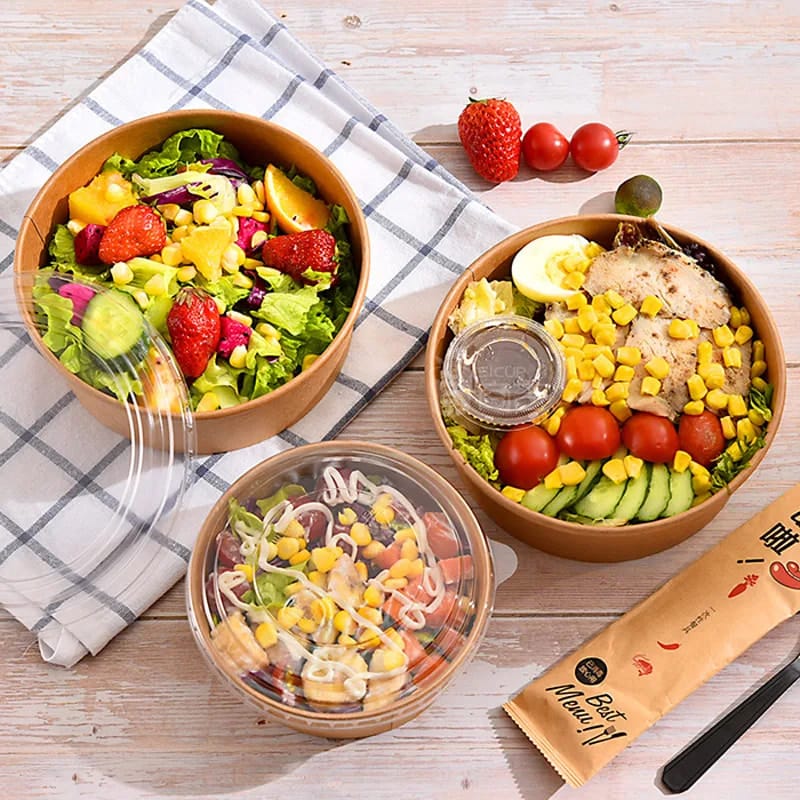
Cold meals require freshness retention, condensation management, stable stacking and attractive product presentation.
- Kraft paper salad bowls with suitable lids for branded cold-food programs.
- Bagasse bowls where a molded-fiber appearance and rigid structure are preferred.
- Clear lid systems where refrigerated display and product visibility are important.
Buyers should verify the bowl coating, chilled-storage behavior and lid material rather than assuming every kraft bowl has the same recyclability or compostability profile.
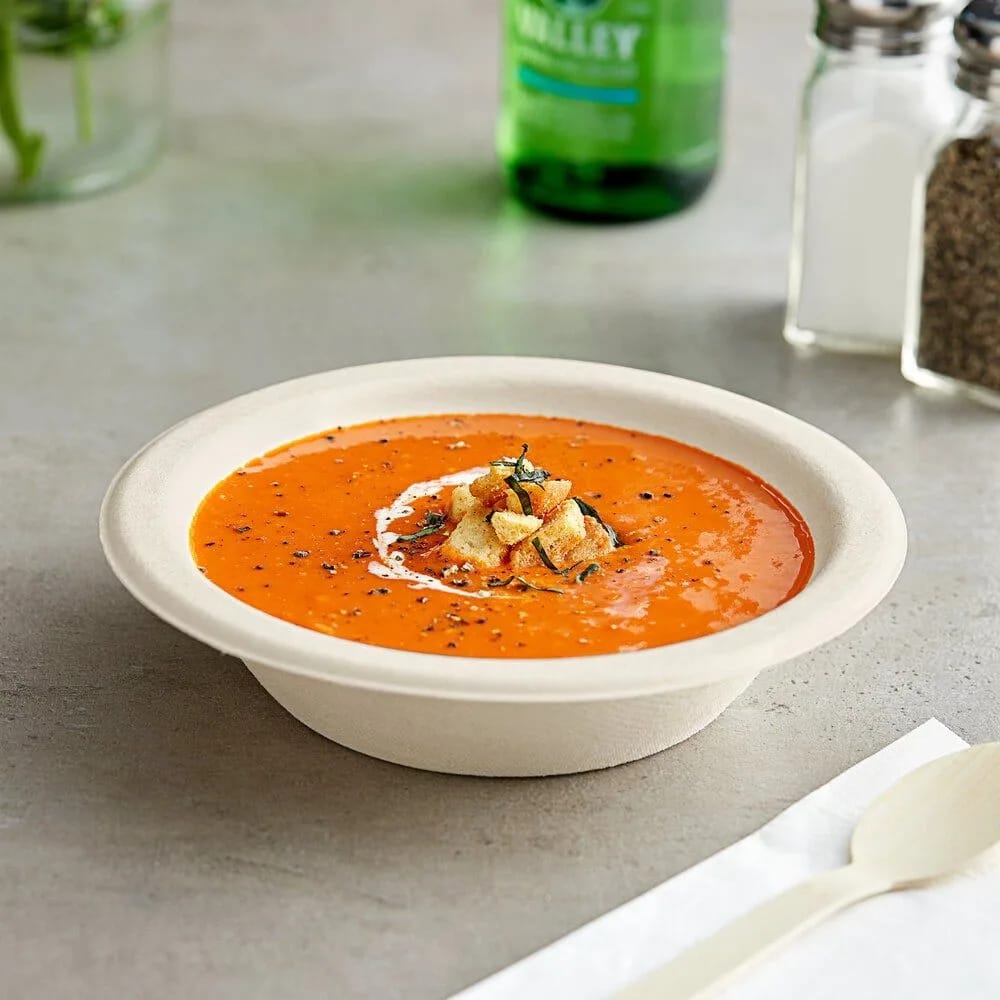
For Soups, Noodles & Broth-Based Dishes
Soup and noodle packaging faces one of the most demanding takeaway combinations: hot liquid, steam, movement and extended holding time.
- Bagasse soup bowls with suitable lids.
- Application-tested paper soup bowls with a barrier matched to the intended food.
- Stable rims and compatible lids designed to withstand liquid movement during delivery.
Critical checks include filling temperature, actual delivery time, rim deformation, lid separation, leakage and condensation. Research on food-delivery complaints also supports the importance of packaging quality as part of the overall service experience.[5]
For Rice Bowls, Burritos & Hot Entrées
Rice meals, burritos and mixed hot entrées require structural strength, heat stability and resistance to sauces and moisture.
- Bagasse bowls for many hot-meal applications.
- Cornstarch-based compartment boxes where the selected formulation is suitable for the intended food.
- Paper bowls and food boxes with an application-appropriate barrier structure.
Instead of assuming that one material “performs best,” buyers should test portion weight, sauce content, filling temperature and delivery stacking. Bioleader® also provides application guidance on choosing biodegradable hot-meal and steak takeaway boxes.

For Curries, Stir-Fries & Oily Foods
Curries, stir-fries and saucy dishes challenge packaging through oil exposure, steam, liquid movement and delivery vibration.
- Bagasse clamshells or containers with suitable oil and water resistance.
- Application-tested paper food containers with compatible lids.
- Selected compartment containers where sauces need to remain separated.
Procurement teams should evaluate cavity depth, barrier performance, closure design, compartment height and whether liquid crosses between sections when the filled package is tilted or shaken.

For Fried Foods: Fries, Chicken & Snacks
Fried food requires grease resistance, but ventilation is equally important. A completely sealed package can trap steam and soften fried food before it reaches the customer.
- Bagasse clamshells with suitable ventilation.
- Paper food boxes designed to allow moisture release.
- Stable hinges and closures for delivery handling.
Buyer testing should compare crispness, grease resistance, condensation and hinge performance after the normal holding and delivery period rather than judging the empty package alone.

Meal-selection rule: Match the food first, then the material. Temperature, liquid movement, oil, steam, delivery time and closure design usually determine whether a takeaway package succeeds.
Choosing the Right Container by Eating Scenario

The same meal can require different packaging when the operating model changes. Dine-in, delivery, catering, supermarket display and street-food operations expose containers to different holding times, storage conditions and handling risks.
| Service Scenario | Additional Packaging Priority | Typical Buyer Question |
|---|---|---|
| Home & office meal prep | Refrigeration, reheating and storage | Is the selected SKU suitable for the intended temperature cycle? |
| Restaurant dine-in + takeaway | SKU simplification and quick packing | Can one container serve several menu items without compromising performance? |
| Fast-casual & salad chains | Presentation, chilled display and stackability | Does the lid remain clear and secure after cold storage? |
| Takeout & delivery | Vibration, closure and stacking | Will the lid remain secured during a realistic delivery journey? |
| Street food & festivals | Compact storage and rapid handling | Can staff store, open and close the package quickly? |
| Institutional catering | High volume and standardized specifications | Can carton packing, lid systems and repeat supply be standardized? |
Home Meals & Office Meal Prep
Meal-prep packaging may pass through refrigeration, transport and reheating. Buyers should verify the actual product specification before describing a container as microwave-safe, freezer-safe or suitable for repeated temperature cycling.
Restaurants & Dine-In Operations
Restaurants can often simplify operations by reducing unnecessary packaging SKUs. One bowl rim shared across several capacities or one tested container format suitable for several menu items can reduce storage complexity and staff training requirements.
Fast-Casual & Salad Chains
These businesses commonly prioritize chilled display, presentation, lid clarity, branding and stackability. Paper salad bowls and molded-fiber bowls can both work, but coating and lid structure should be evaluated as part of the complete package.
Takeout & Delivery Platforms
Delivery introduces multi-dimensional packaging challenges: vibration, temperature change, oil movement, stacking and extended holding time.
Buyers can compare delivery-focused formats through Bioleader®’s biodegradable food containers with lids solution page and wholesale bagasse clamshell container category.
Street Food & Food Stalls
Street vendors generally need compact cartons, fast opening, simple closure and efficient counter storage. Lightweight packaging is useful only if it still has sufficient strength for the food and intended serving period.
Key Product Features to Evaluate Before Buying
Heat Resistance
A universal temperature number should not be assigned to an entire material family. Actual performance depends on formulation, thickness, geometry, barrier treatment, lid structure and intended-use testing.
| Material System | Practical Temperature Positioning | Buyer Verification |
|---|---|---|
| Bagasse | Widely used for hot and cold meals | Verify selected SKU, food type, holding time, oil/water exposure and microwave claim if required |
| Cornstarch-based tableware | Performance varies substantially by resin formulation | Confirm actual resin system and product-specific temperature specification |
| Paper / kraft | Depends strongly on board, coating, seam and lid structure | Confirm complete construction and intended hot/cold application |
| PLA clear cups | Primarily positioned for cold-use packaging | Confirm storage conditions and cup/lid specification |
| CPLA cutlery | Generally higher heat resistance than standard PLA | Use product-specific temperature data rather than a universal material limit |
Leak and Oil Resistance
Key performance variables include:
- fiber or board structure;
- barrier chemistry or coating;
- bottom and side seams;
- rim geometry;
- lid-lock design;
- wall thickness and product weight;
- food temperature and contact duration.
Experienced disposable takeout packaging suppliers for fast-food operations should be able to provide specifications and samples so buyers can conduct application-specific tests.
Structural Strength & Stackability
Stackability is particularly important for:
- large delivery orders;
- shared office lunches;
- cloud kitchens;
- catering events;
- institutional meal programs.
Filled containers should be tested under realistic vertical pressure and movement rather than assessed only while empty.
Lid Compatibility
Depending on the container, available lid materials may include molded fiber, paper, PP, PET, PLA or other structures.
Buyers should check:
- rim diameter and dimensional tolerance;
- snap-fit strength;
- temperature compatibility;
- venting requirements;
- stacking behavior;
- carton quantities of bases and lids.
A matching nominal diameter does not guarantee that bases and lids from different molds or suppliers will fit correctly.
Branding Opportunities
Depending on the product, customization can include printed paper surfaces, labels, sleeves, molded logos or other OEM/private-label solutions. Ink, coating, migration and direct-food-contact exposure should be reviewed where applicable.
Storage Efficiency & Supply Chain Stability
High-volume buyers should also evaluate:
- pieces per carton;
- carton dimensions;
- nesting efficiency;
- pallet or container loading;
- warehouse conditions;
- production planning;
- base-to-lid quantity balance.
For wholesale sourcing, Bioleader®’s biodegradable takeaway container solutions for foodservice buyers provide a practical starting point before final SKU selection.
Environmental & Compliance Checklist
Certifications and Documents Serve Different Purposes
| Standard / Document | What It Helps Verify | What It Does Not Automatically Prove |
|---|---|---|
| EN 13432-related certification or testing | Compostability requirements for packaging within the applicable certification scope | Food-contact compliance or acceptance by every composting facility |
| ASTM D6400 | Requirements for plastics and plastic-containing products designed for aerobic municipal or industrial composting | Food-contact safety or home compostability |
| BPI Commercial Compostability Certification | Third-party assessment using ASTM D6400 as the base standard, with other applicable ASTM standards depending on the product | Acceptance by every commercial composting facility |
| Home compost certification | Home-compostability requirements within the applicable certification scheme | Automatic equivalence to industrial compostability or every national scheme |
| Food-contact declaration / report | Suitability under specified food-contact conditions | Compostability |
| PFAS declaration / report | PFAS-related evidence for the product or sample covered by that document | Other food-contact, compostability or performance requirements |
| ISO / BRC / quality-system evidence | Manufacturing and quality-management controls within the relevant scope | Product compostability or food-contact compliance by themselves |
The current ASTM D6400-26 specification covers plastics and products made from plastics that are designed to be aerobically composted in municipal or industrial facilities. BPI states that ASTM D6400 is the base standard used for all items assessed through its commercial compostability certification process.[11][12]
EU PPWR and PFAS in Food-Contact Packaging
Under Regulation (EU) 2025/40, food-contact packaging placed on the EU market from 12 August 2026 must comply with the applicable PFAS requirements in Article 5(5).
| PPWR PFAS Threshold | Limit | Important Scope Note |
|---|---|---|
| Individual targeted PFAS | 25 ppb | Polymeric PFAS excluded from this targeted quantification |
| Sum of targeted PFAS | 250 ppb | Where applicable with prior degradation of precursors; polymeric PFAS excluded from this targeted quantification |
| PFAS including polymeric PFAS | 50 ppm | Article 5(5) also contains requirements where total fluorine exceeds 50 mg/kg |
Importers and brands should evaluate the complete PPWR requirements rather than treating PFAS thresholds as the only compliance obligation. Bioleader® buyers can also review the EU PPWR compliance white paper and importer checklist.
Japan Plastic Resource Circulation Requirements
Japan’s framework identifies 12 specified single-use plastic products. Foodservice-related items include forks, spoons, table knives, stirrers and drinking straws. Restaurants and takeaway or delivery foodservice operations are among the covered business categories for these products.[7]
Reduction measures can include charging for products, confirming whether customers need them, providing incentives for refusal, changing product design or switching to alternative materials. The law should therefore not be summarized as a simple requirement for restaurants to use compostable packaging.
Understanding Composting Requirements
- Industrial compostable: requires defined controlled composting conditions and appropriate local infrastructure.
- Home compostable: requires separate supporting evidence and should not be assumed from industrial certification.
- Biodegradable: should not be used as a vague substitute for a verified compostability claim.
EPA guidance also makes clear that certified commercially compostable foodservice ware is most useful when an appropriate commercial composting program is locally available, accepts the specific product types and has collection services in place.[10]
Buyer note: Certification should match the selected product, supplier and formulation. Local collection acceptance should be confirmed separately because even certified compostable products may not be accepted by every commercial composting facility.
Cost & Operational Considerations for F&B Operators
Eco-friendly takeaway packaging should be evaluated as part of the operating system rather than only by price per piece.
Material Cost vs. Performance
There is no reliable universal statement that one eco-friendly material always costs a fixed percentage more or creates a fixed percentage of operational savings. Actual cost depends on:
- material and formulation;
- product weight and dimensions;
- coating or barrier structure;
- lid type;
- printing requirements;
- MOQ;
- carton packing;
- freight and duties;
- destination-market requirements.
The 2025 consumer survey also shows why price cannot be ignored. While 55.18% preferred environmentally friendly packaging when that issue was evaluated separately, 32.22% said price was more important. Meanwhile, 22.59% selected the response indicating willingness to pay more than 10% for environmentally friendly packaging.[1]
Commercial implication: Sustainable packaging still has to meet a workable price point. Buyers should compare total landed and operating cost after specifications are fixed rather than relying on generic “eco packaging premium” percentages.
SKU Optimization for Multi-Menu Restaurants
Many restaurants can reduce procurement complexity by standardizing packaging where technically appropriate:
- one or two bowl rim systems across several capacities;
- a common salad bowl family for chilled foods;
- one or two compartment formats for combo meals;
- shared lid sizes where the base dimensions are verified;
- a limited cutlery program.
The goal is not to force every meal into one package. It is to reduce unnecessary SKU duplication while maintaining food performance.
Storage, Freight & Carton Planning
Carton volume can materially affect the economics of an imported packaging program. Procurement teams should compare pieces per carton, carton dimensions, CBM, warehouse space, loading efficiency and base-to-lid quantities before evaluating total landed cost.
Avoiding Hidden Delivery Costs
Typical hidden costs include:
- leakage causing remakes or refunds;
- lid mismatches between production lots or suppliers;
- extra bags or double packing used to compensate for weak containers;
- slow packing because too many lid systems are in use;
- food waste caused by structural failure;
- excess storage space caused by inefficient cartons.
Good packaging therefore does not need to be the cheapest package. It needs to protect the meal reliably at an acceptable total operating cost.
Practical Application Examples: Matching Containers to Real Meal Risks
The following examples illustrate procurement scenarios. They are not presented as Bioleader® customer case results or guaranteed performance claims. Final results depend on the selected product, food, temperature and operating conditions.
Example 1: Salad Chain and Refrigerated Display
Challenge: condensation, chilled storage, attractive presentation and reliable lid fit.
Possible direction: kraft paper salad bowls with suitable clear lids or selected bagasse bowls.
Verification: store filled samples under the normal refrigerated conditions and check lid fogging, wall softening, dressing contact and stacking performance.
Example 2: Noodle Shop and Hot Soup Delivery
Challenge: hot liquid, steam, rim deformation, movement and delivery holding time.
Possible direction: application-tested paper soup bowls or selected bagasse bowls with a compatible lid.
Verification: fill the container with the actual soup at normal service temperature, close the lid, hold it for the expected journey and test for leakage after realistic movement.
Example 3: Multi-Compartment Rice or Curry Meal
Challenge: sauces crossing compartments, oily foods and stacking during transport.
Possible direction: compartment bagasse containers or a suitable cornstarch-based 3-compartment food container where the formulation and intended use are confirmed.
Verification: test the most liquid and oily menu items, tilt the filled package, simulate delivery vibration and confirm that the lid does not press food across the partitions.
Recommended Product Mix for All-Meal Takeaway Operations
A practical multi-menu packaging program usually combines several materials rather than forcing one material across every food application.
| Application | Suggested Starting Point | Key Verification |
|---|---|---|
| Cold meals | Kraft salad bowls or bagasse bowls | Coating, chilled storage and lid fit |
| Hot meals | Bagasse bowls, bagasse clamshells and suitable paper containers | Temperature, oil, moisture and holding time |
| Compartment meals | Bagasse or selected cornstarch-based compartment formats | Partition performance and formulation |
| Fried foods | Vented bagasse clamshells or paper food boxes | Steam release and grease resistance |
| Sauces & add-ons | Small bagasse or other application-specific cups | Leakage and lid security |
| Cold beverages | Compostable PLA cold cups | Cold-use conditions, storage and industrial composting pathway |
Bioleader®’s main food packaging product portfolio allows distributors and foodservice buyers to compare bagasse, paper, cornstarch-based tableware, PLA cups and compostable cutlery within one sourcing program.

How to Build a Long-Term Sustainable Packaging Strategy
Reduce Unnecessary SKU Complexity
Start by mapping every menu item against filling temperature, moisture, oil, holding time, lid requirements and delivery conditions. Combine SKUs only where one container has been physically verified for several meals.
Standardize Lid Systems Where Possible
Shared rim dimensions can reduce inventory complexity, but the base and lid should still be tested together. Nominal diameter alone does not guarantee compatibility between different factories, molds or product structures.
Plan Around Real Waste Infrastructure
EPA guidance emphasizes that certified commercially compostable foodservice ware should be selected only where a local commercial composting program is available, accepts the product type and has suitable collection or hauling services.[10]
Track Regulations by Destination Market
European buyers should review PPWR requirements, PFAS restrictions, applicable food-contact rules and relevant single-use-plastic restrictions before finalizing material, product structure and artwork.
Japanese buyers should distinguish plastic-reduction obligations from compostability claims and confirm whether the selected disposable item is one of the products covered by the Plastic Resource Circulation framework.
Partner With Suppliers That Can Provide Product-Specific Evidence
Bioleader® Procurement Support
Based on Bioleader®’s experience serving foodservice packaging buyers, material selection should begin with the actual food temperature, holding time, oil and moisture exposure, barrier requirement, lid structure and destination market.
Bioleader®’s multi-category portfolio allows buyers to compare sugarcane bagasse tableware, paper food packaging, PLA cold cups, cornstarch-based tableware and compostable cutlery within one sourcing program.
Depending on the selected item and project, buyers can request:
- product specifications;
- available food-contact reports or declarations;
- available compostability documentation where applicable;
- PFAS-related documentation for the selected product where available;
- container and lid samples;
- carton packing information;
- custom printing and OEM/private-label options;
- multi-SKU export planning.
For broader supplier and material evaluation, buyers can also review Bioleader®’s Sustainable Food Packaging Authority Report.
Conclusion: A Smarter Way to Choose Eco-Friendly Takeaway Containers
- food temperature;
- oil and moisture content;
- delivery and holding time;
- container and lid compatibility;
- storage and transport conditions;
- food-contact and environmental documentation;
- local recycling or composting infrastructure;
- MOQ, carton packing and total landed cost.
Peer-reviewed research also reinforces that takeaway packaging environmental performance depends on how packaging is produced, used, transported and managed after use—not simply on whether the product is described as paper, plant-based, biodegradable or compostable.[3][4]
For distributors, restaurant groups, catering companies and takeaway packaging buyers, Bioleader® offers sourcing options across bagasse, paper, PLA, cornstarch-based tableware and compostable cutlery. Buyers evaluating a new takeaway packaging system can request product specifications, available reports and samples before confirming bulk production.
Frequently Asked Questions
What is the best takeaway container for hot food?
There is no single best material for every hot meal. Bagasse containers and properly specified paper food containers are common options, but buyers should match the product to food temperature, oil content, moisture, holding time and lid requirements. Product-specific testing is recommended before bulk ordering.
What container is best for soup and noodles?
Soup packaging requires a stable rim, compatible lid, sufficient headspace and resistance to hot liquid and movement. Application-tested paper soup bowls and selected bagasse bowls may be suitable. The complete base-and-lid system should be tested with the actual soup and expected delivery time.
What packaging works well for curry and oily food?
Bagasse food containers, suitable coated paper containers and selected compartment formats can be considered. Buyers should test oil resistance, sauce movement, closure security and structural strength under realistic holding and delivery conditions.
Are bagasse containers microwave-safe?
Some bagasse food containers may be suitable for microwave use, but this should be confirmed for the selected SKU and any lid or accessory. Microwave performance should not be assumed for every molded-fiber product solely because it is made from sugarcane bagasse.
Are cornstarch containers plastic-free and compostable?
Not automatically. “Cornstarch” may describe part of the feedstock or formulation, but commercial products can contain other polymers or additives. Buyers should verify the resin system, applicable compostability certification and product specification before describing the product as plastic-free or compostable.
Can PLA cups be used for hot drinks?
Standard clear PLA cups are primarily intended for cold beverages such as iced coffee, juice, smoothies and bubble tea. Hot-drink or microwave claims should not be made unless supported by the specification of the selected product.
What are the EU PPWR PFAS limits for food-contact packaging?
From 12 August 2026, Regulation (EU) 2025/40 sets PFAS concentration thresholds for relevant food-contact packaging at 25 ppb for an individual targeted PFAS, 250 ppb for the sum of targeted PFAS and 50 ppm for PFAS including polymeric PFAS, subject to the detailed analytical and total-fluorine provisions in Article 5(5).
What should buyers check before ordering takeaway containers in bulk?
Buyers should confirm the exact size, usable capacity, food temperature, oil and moisture exposure, lid type, holding time, carton packing, MOQ, printing requirements and destination market. Physical samples should be tested with the actual food before bulk production.
Which compliance documents should food packaging importers request?
The required documents depend on material, product and destination. They may include food-contact reports or declarations, compostability documentation, PFAS-related evidence, material declarations and product specifications. Buyers should verify that each document corresponds to the actual SKU being purchased.
References and Evidence Sources
- Caner, C., Pascall, M. A., Aday, M. S., & Bicki, D. (2025). Consumer Survey on the Environmental Impact of Food Packaging and How It Influences Purchasing Decisions. International Journal of Food Science, 2025, 9458195. DOI: 10.1155/ijfo/9458195. Wiley.
- European Commission (2024). Europeans continue to feel directly affected by environmental issues and policy. Eurobarometer environmental survey findings. European Commission.
- Jang, Y., Kim, K. N., & Woo, J. R. (2023). Post-consumer plastic packaging waste from online food delivery services in South Korea. Waste Management, 156, 177–186. DOI: 10.1016/j.wasman.2022.11.036. PubMed.
- Caspers, J., & Finkbeiner, M. (2025). Littering and consumer behaviour in life cycle assessment—A case study of takeaway packaging for food. Journal of Cleaner Production, 520, 146115. DOI: 10.1016/j.jclepro.2025.146115. ScienceDirect.
- Yan, N., Xu, X., Tong, T., & Huang, L. (2021). Examining consumer complaints from an on-demand service platform. International Journal of Production Economics, 237, 108153. DOI: 10.1016/j.ijpe.2021.108153. ScienceDirect.
- European Union. Regulation (EU) 2025/40 on packaging and packaging waste, Article 5(5). Applicable PFAS limits for food-contact packaging from 12 August 2026. EUR-Lex.
- Ministry of the Environment, Government of Japan. Rationalization of Use of Specified Plastic-Using Products under the Plastic Resource Circulation Act. Japan Ministry of the Environment.
- Ministry of the Environment, Government of Japan. Resource Circulation Strategy for Plastics. The strategy includes a milestone for a cumulative 25% reduction in single-use plastics by 2030. Japan Ministry of the Environment.
- Biodegradable Products Institute. Biodegradable vs Compostable. BPI.
- U.S. Environmental Protection Agency. Identifying Sustainable Food Service and Food Service Ware. U.S. EPA.
- ASTM International. ASTM D6400-26: Standard Specification for Labeling of Plastics Designed to be Aerobically Composted in Municipal or Industrial Facilities. DOI: 10.1520/D6400-26. ASTM International.
- Biodegradable Products Institute. Commercial Compostability Certification. BPI states that ASTM D6400 is the base standard used for assessment in its commercial compostability certification process. BPI.