









Quick Summary: A credible sustainable packaging brand is not built by adding more green words to product pages. It is built through a controlled system that defines every environmental claim, limits each claim to the correct product and market, matches the claim with appropriate evidence, and keeps sales, marketing, procurement, quality, and compliance teams aligned. Certification, testing, lifecycle data, traceability, and transparent limitations all play different roles. No single document proves every sustainability statement.
For food packaging manufacturers, importers, distributors, restaurant groups, and private-label brands, the central question is no longer simply:
“Is this packaging sustainable?”
The more useful questions are:
- Which part of the product does the environmental claim describe?
- Does the claim apply to the raw material, finished product, lid, coating, print, or complete packaging system?
- Which document supports the claim?
- Does that document cover the exact SKU, thickness, formulation, and destination market?
- What limitations must be disclosed to prevent buyers or consumers from misunderstanding the claim?
Bioleader® manufactures foodservice packaging across sugarcane bagasse, kraft paper packaging, paper cups and bowls, PLA cups, CPLA cutlery, and cornstarch-based tableware. Because these materials have different performance characteristics and end-of-life pathways, they should not all be promoted using the same sustainability language.
Scope of this guide: This article focuses on brand-level claim governance and communication. For detailed product certification checks, see how to verify truly compostable food packaging. For EU-specific legal requirements, see the guide to EU greenwashing rules for food packaging.
1. Why Sustainable Packaging Credibility Is Now a Brand System
Environmental credibility is often treated as a marketing task. A company obtains a certificate, adds several green icons, creates a sustainability page, and assumes that the brand is protected.
That approach is incomplete.
A packaging claim may appear in many places:
- Product names and category titles
- Product descriptions and specification sheets
- Printed cups, bowls, sleeves, labels, and cartons
- Sales presentations and quotation documents
- Distributor listings and marketplace pages
- Restaurant menus and sustainability reports
- Social media posts and advertising campaigns
- Tender documents and supplier declarations
If different departments use different wording, the brand can create contradictions even when the underlying product is legitimate. Marketing may say “fully biodegradable,” sales may say “home compostable,” the certificate may cover only industrial composting, and the product specification may include a separate lid that is not covered by the same claim.
Credibility therefore depends on an operating system that controls:
- Claim scope: what exactly is being claimed.
- Evidence scope: what the certificate, report, or calculation actually covers.
- Communication scope: where and how the claim may be used.
- Change control: what happens when the material, coating, supplier, thickness, print, or market changes.
Core principle: No environmental claim should be broader than the evidence supporting it.
2. What Greenwashing Looks Like at Brand Level
Greenwashing is not limited to deliberately false statements. It can also result from vague wording, missing qualifications, outdated documents, inconsistent product information, or evidence that applies to a different product than the one being sold.
Global buyers evaluating biodegradable and compostable packaging commonly identify the following warning signs.
| Brand-Level Red Flag | Why It Creates Risk | Better Practice |
|---|---|---|
| “Eco-friendly” with no explanation | The wording may imply broad environmental superiority without defining the actual benefit. | Name the specific attribute, such as sugarcane fiber content, certified industrial compostability, or reduced plastic content. |
| One certificate used for an entire catalog | The certificate may cover only selected materials, formulations, thicknesses, or product families. | Map each certificate to the covered SKU or clearly defined product group. |
| Raw-material certification presented as finished-product certification | Coatings, inks, adhesives, fillers, lids, and manufacturing conditions may affect the finished product. | State whether evidence applies to the resin, fiber, component, or complete finished item. |
| Industrial compostability presented as home compostability | The two claims involve different conditions, standards, and disposal environments. | Identify the exact composting environment and applicable certification scope. |
| Plant-based presented as plastic-free | A product may contain plant-derived polymer while still being chemically classified as plastic. | Use precise material composition statements instead of relying on imagery or assumptions. |
| Biodegradable presented without environment or conditions | Biodegradation depends on temperature, moisture, microorganisms, oxygen, and disposal conditions. | Specify the environment, standard, certification, and limitations where applicable. |
| Outdated reports or unrelated model numbers | The current product may no longer match the tested formulation or certificate scope. | Maintain document validity, model mapping, version control, and change records. |
| Environmental icons with no defined meaning | Leaves, trees, arrows, and green colors can imply benefits that are not explained. | Place a clear qualification beside the icon or remove it. |
Brand credibility improves when environmental communication moves from general impressions to specific, understandable, and verifiable product attributes.
3. The Four Pillars of a Credible Sustainable Packaging Brand
1. Clearly Scoped Claims
Every claim should answer five questions:
- What: What environmental attribute is being described?
- Where: Does the claim apply to the product, packaging, component, or company?
- Which: Which SKU, material, size, weight, formulation, or production version is covered?
- Under what conditions: Does the claim depend on industrial composting, home composting, recycling access, or another disposal system?
- For which market: Is the wording suitable for the EU, United States, Australia, Japan, or another destination?
For example, “made from sugarcane fiber” is a material statement. “Certified industrially compostable” is an end-of-life statement. “PFAS-free” is a chemical-composition claim. “Food-contact compliant” is a safety and regulatory claim. These statements are related, but they are not interchangeable.
2. Evidence Matched to the Claim
Different claims require different forms of proof. A food-contact test report does not prove compostability. A compostability certificate does not prove microwave performance. A raw-material declaration does not automatically prove the finished printed package has the same characteristics.
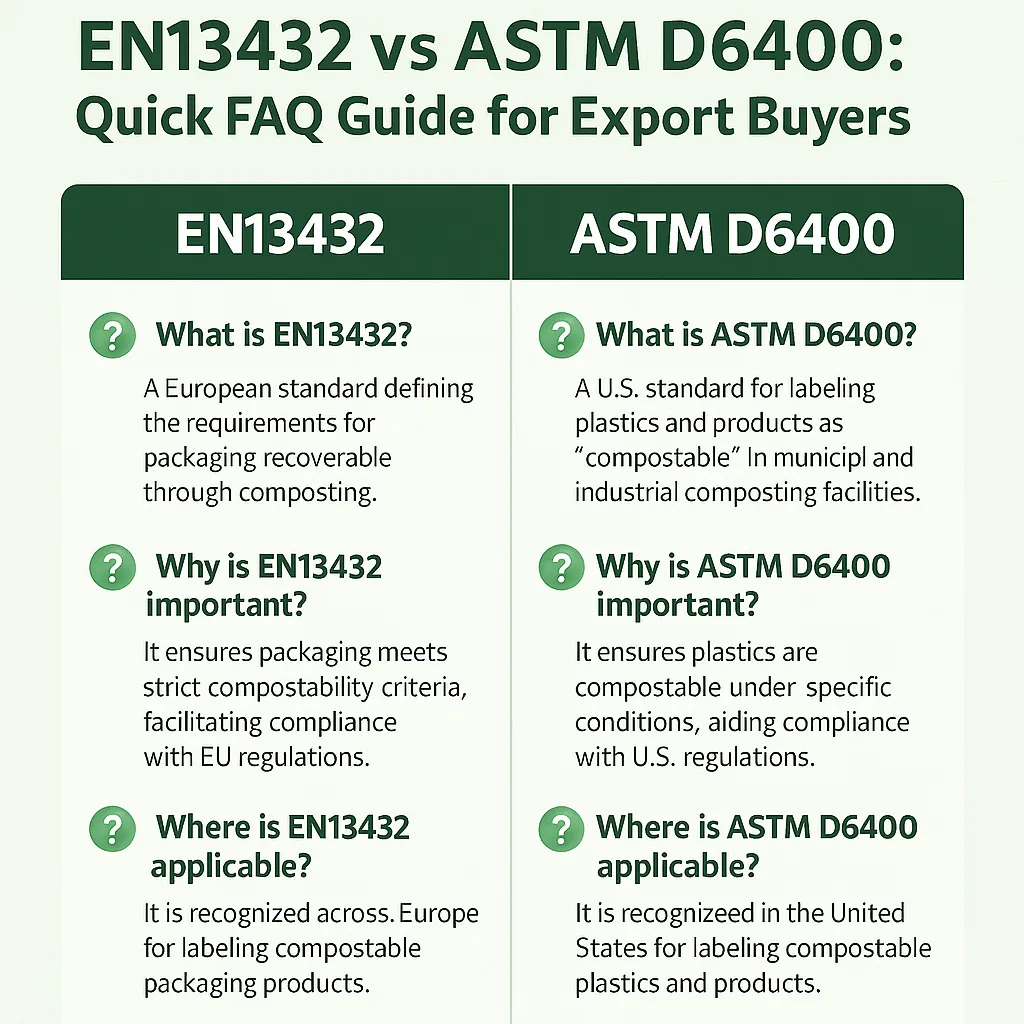
Packaging brands should build a claim-to-evidence map rather than treating one certificate as universal proof. For a detailed comparison of regional compostability standards, review the EN 13432 vs. ASTM D6400 guide for export buyers.
3. Internal Claim Governance
A credible claim should pass through defined internal ownership. Marketing should not create environmental wording without technical review, and quality teams should not approve wording without understanding how consumers or buyers may interpret it.
A practical governance model includes:
- Product team: confirms material, construction, components, and intended use.
- Quality team: confirms reports, testing scope, specifications, and change control.
- Compliance team: checks destination-market requirements and claim limitations.
- Marketing team: converts technical evidence into clear, non-misleading language.
- Sales team: uses approved statements in quotations, presentations, and buyer communication.
- Management: approves high-risk comparative, carbon, company-wide, or future-performance claims.
4. Consistent Buyer-Facing Communication
The same claim should mean the same thing across the website, catalog, carton, specification sheet, quotation, social media post, and distributor listing.
If a product is described as industrially compostable on the technical data sheet, it should not become “home compostable” in a sales message or “biodegrades anywhere” on a marketplace listing.
Consistency does not mean repeating the same slogan. It means keeping the same scope, evidence, limitations, and product identity wherever the claim appears.
4. Build a Claim Architecture Before Building Marketing Campaigns
A claim architecture defines which environmental statements may be used at each level of the business. This prevents a company-wide sustainability message from being incorrectly applied to every product.
| Claim Level | Typical Examples | Evidence Needed | Main Risk |
|---|---|---|---|
| Company Level | Corporate emissions reduction, renewable-energy use, responsible sourcing, waste-reduction program. | Defined organizational boundary, methodology, reporting period, measured data, and governance records. | A limited factory initiative may be presented as a company-wide achievement. |
| Product-Line Level | Sugarcane fiber tableware, PLA cold-drink cups, paper bowls with a specified lining. | Material specifications, product-family scope, supplier declarations, and applicable certifications. | Different formulations or components may exist within the same category. |
| SKU Level | A specific 9-inch plate, 750 ml bowl, 12 oz cup, or CPLA fork. | SKU-specific specification, model mapping, finished-product reports, and current certificate coverage. | The evidence may apply to a similar model rather than the item being sold. |
| Component Level | Cup body, lid, coating, adhesive, ink, sleeve, label, or carton. | Component composition and supplier evidence. | A compliant main body may be combined with a component having a different end-of-life pathway. |
| Application Level | Hot food, cold drinks, microwave reheating, freezer storage, oily meals, takeaway delivery. | Performance testing and clearly defined use conditions. | Environmental evidence may be mistaken for performance evidence. |
| End-of-Life Level | Industrially compostable, home compostable, recyclable, reusable, or general waste. | Applicable standard, certificate scope, local infrastructure review, and disposal qualification. | The intended pathway may not be available in the market where the product is sold. |
Important distinction: A lifecycle assessment may support a defined environmental-footprint or comparative claim, but it does not automatically prove compostability, recyclability, food-contact safety, PFAS-free status, or product performance. Each claim requires evidence suited to that claim.
5. Use an Evidence Hierarchy Instead of a Logo Collection
Credible sustainable packaging brands do not measure proof by counting logos. They evaluate evidence according to its scope, relevance, independence, validity, and connection to the actual product.
| Evidence Type | What It Can Support | What It Does Not Automatically Prove |
|---|---|---|
| Product Specification or TDS | Material, dimensions, weight, structure, temperature guidance, and intended use. | Independent certification or market acceptance. |
| Supplier Declaration | Material composition, intentionally added substances, sourcing information, or manufacturing statement. | Independent laboratory verification unless supported by testing. |
| Food-Contact Test Report | Compliance with the stated food-contact test scope and conditions. | Compostability, recyclability, biodegradation, or general environmental superiority. |
| Third-Party Compostability Certificate | Compliance within the standard, product, thickness, and certification scope stated on the certificate. | Home compostability, universal facility acceptance, marine biodegradation, or food-contact safety. |
| PFAS or Fluorine Test Report | Results under the stated test method, detection limit, sample, and laboratory conditions. | Compostability, plastic-free composition, or total product safety. |
| Lifecycle Assessment | Environmental impacts within the defined system boundary, functional unit, assumptions, and methodology. | Every environmental attribute or an unlimited “eco-friendly” claim. |
| Factory Audit or Quality Certificate | Management-system, process, hygiene, quality, or social-compliance controls within the audit scope. | Environmental performance of every finished product. |
| Internal Performance Test | Application behavior such as leakage, stacking, heat response, or oil resistance under defined conditions. | Third-party certification or legal compliance outside the test scope. |
The strongest claim file usually combines several relevant documents rather than relying on one document to answer every question.
6. Create a Cross-Functional Environmental Claim Approval Workflow
A repeatable approval process reduces the risk of unsupported wording appearing on packaging, websites, brochures, or distributor listings.
- Define the proposed claim. Record the exact wording rather than approving a general idea such as “make it sound greener.”
- Identify the claim level. Determine whether the statement applies to the company, product line, SKU, component, application, or disposal pathway.
- Collect the evidence. Gather specifications, declarations, reports, certificates, calculations, and usage instructions.
- Check product matching. Confirm model number, formulation, weight, thickness, coating, ink, lid, and production version.
- Review destination-market use. Assess whether the wording is suitable for the target country and sales channel.
- Add necessary qualifications. State industrial composting conditions, limited recycling availability, percentage content, component exclusions, or other restrictions where required.
- Approve the final wording. Store the wording, evidence, owner, approval date, market, and permitted media in a central claim register.
- Control future changes. Re-review the claim when the product, supplier, formulation, certificate, packaging artwork, or regulation changes.
Practical rule: Approve exact sentences, not broad marketing concepts. “Certified industrially compostable according to the listed product certificate” is controllable. “Good for the planet” is not.

An Illustrative Claim-Control Example
Consider a molded fiber sandwich tray supplied with a separate transparent lid. A statement such as “the whole package is plastic-free and compostable” may be inaccurate if the lid is made from PET or another polymer with a different disposal pathway.
A better product description separates the components:
- The tray material and its applicable certification or composition.
- The lid material and its intended recycling or disposal pathway.
- The food-contact and performance scope of the complete system.
- Any local limitations on composting or recycling acceptance.
This approach may appear less dramatic than one broad green slogan, but it creates more confidence among professional buyers because the statement can be checked.
7. Turn Technical Evidence into Buyer-Ready Communication
Technical documents are essential, but buyers should not need to interpret a laboratory report before understanding a product claim. Credible brands translate technical evidence into clear communication without expanding the meaning of the evidence.
A practical buyer-facing document package may include:
- A concise product specification sheet.
- A claim summary identifying which statements apply to the product.
- Relevant certificate numbers and covered models.
- Food-contact reports or declarations where applicable.
- PFAS-related documentation for molded fiber or grease-resistant products where required.
- Material and component descriptions.
- Use limitations for temperature, microwave, freezer, oil, moisture, or delivery applications.
- End-of-life guidance appropriate to the destination market.
- Packaging, MOQ, private-label, and logistics information.
This package should answer the buyer’s main questions without claiming that every document applies to every SKU.
Recommended Claim Register Fields
| Field | Information to Record |
|---|---|
| Approved Claim | The exact sentence that may be used. |
| Covered Products | SKU, product family, material, thickness, and formulation. |
| Excluded Components | Lid, label, ink, adhesive, coating, sleeve, or other components not covered. |
| Supporting Evidence | Certificate, report, specification, declaration, LCA, or calculation. |
| Permitted Markets | Countries, regions, customer groups, or sales channels. |
| Required Qualification | Industrial composting only, local acceptance varies, percentage content, or other limitation. |
| Approved Media | Website, carton, cup print, catalog, tender, social media, or sales presentation. |
| Owner and Approval Date | Responsible department, approver, review date, and next review date. |
| Change Trigger | Material change, supplier change, certificate expiry, new market, or artwork revision. |
8. Govern Sustainability Claims Across Different Packaging Materials
A multi-material packaging brand should not use one sustainability message across every product line. Bagasse, paper, PLA, CPLA, cornstarch-based materials, PET, and PP have different strengths, limitations, and disposal pathways.
| Material or Product Type | Credible Communication Focus | Claims Requiring Care |
|---|---|---|
| Sugarcane Bagasse | Renewable plant fiber, molded fiber construction, hot-food applications, selected compostability and PFAS-related documentation. | Do not assume every bagasse item is home compostable, PFAS-free, or covered by the same certificate. |
| Paper Cups and Bowls | Paper source, lining type, food application, printing, recyclability or compostability conditions where supported. | “Paper” does not automatically mean plastic-free, recyclable, or compostable. |
| PLA Cups | Clear cold-drink applications, plant-derived polymer content, and applicable industrial compostability support. | PLA is generally not suitable for high-temperature hot drinks and should not be described as home compostable without specific evidence. |
| CPLA Cutlery | Heat-modified PLA formulation, foodservice use, and product-specific compostability scope. | Do not apply PLA cup performance or certification automatically to CPLA cutlery. |
| Cornstarch-Based Tableware | Material formulation, rigidity, food-use performance, and applicable test or certification documents. | “Cornstarch” does not necessarily mean the product consists only of starch or is home compostable. |
| PET Cups and Lids | High clarity, cold drinks, smoothies, juice, iced coffee, desserts, salads, and recycling guidance where local systems accept PET. | PET is not biodegradable or compostable and should not be grouped with compostable PLA. |
| PP Food Packaging | Heat resistance, microwave suitability where tested, durability, and recyclability according to local systems. | Recyclable material does not guarantee local collection or recycling. |
For a broader explanation of material differences, see the comparison of bioplastics and traditional plastics.

Portfolio governance note: A brand may sell several genuinely useful sustainable packaging options while still needing different environmental wording for each product. Credibility comes from accurate differentiation, not from forcing the entire catalog under one universal claim.
9. What Export Buyers Expect from a Credible Packaging Brand
Export buyers do not all request the same documents, and no single compliance package is suitable for every destination. However, professional procurement teams increasingly expect suppliers to respond clearly and consistently.
| Buyer Expectation | Credible Supplier Response |
|---|---|
| Clear product identity | Item code, material, dimensions, weight, color, lid, coating, and intended application. |
| Claim definition | A precise explanation of compostable, biodegradable, recyclable, PFAS-free, BPA-free, or plastic-free wording. |
| Document mapping | Confirmation of which report or certificate applies to which item. |
| Honest limitations | Clear disclosure where local infrastructure, temperature, food type, or component choice affects the claim. |
| Change control | Notification when material, formulation, supplier, coating, printing, or certificate scope changes. |
| Application support | Guidance on hot food, cold drinks, oil resistance, leakage, microwave use, freezer use, and delivery performance. |
| Commercial readiness | MOQ, lead time, OEM options, packing, carton information, loading quantity, and shipment terms. |
Changing plastic restrictions, producer-responsibility rules, claim controls, and destination-market requirements are making this documentation more important. For the broader procurement context, see how global plastic restrictions are changing food packaging procurement.
10. How Bioleader® Supports Claim-Ready Packaging Programs
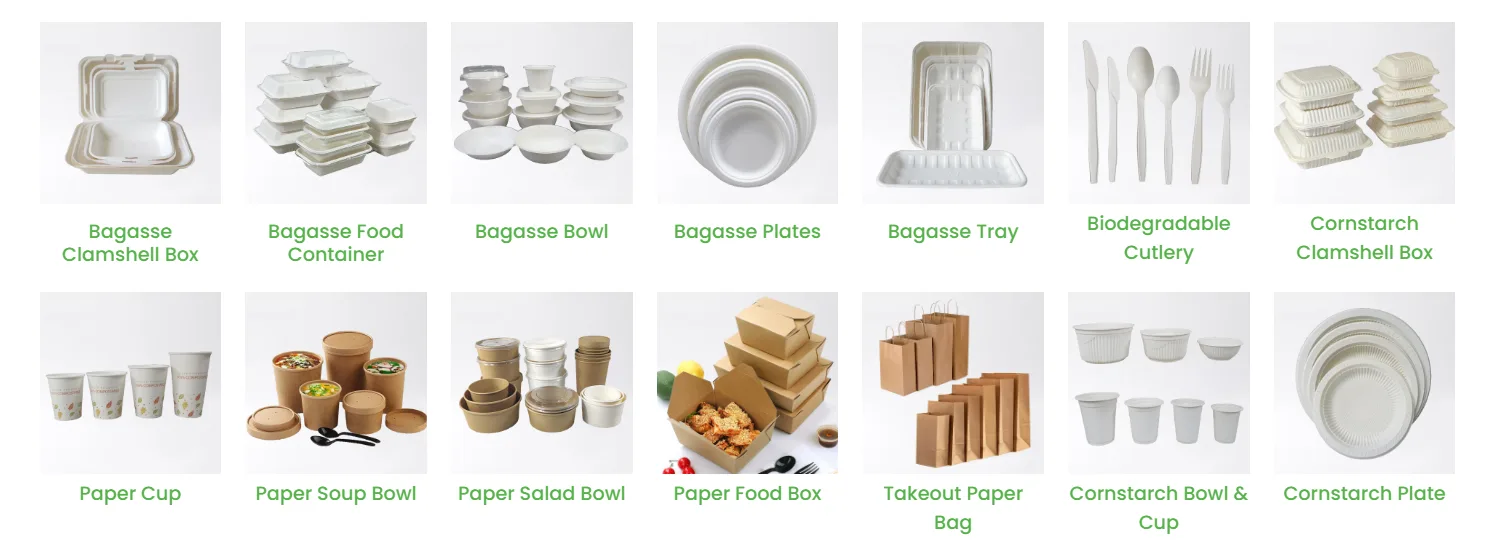
Bioleader® supplies biodegradable, compostable, paper-based, and conventional recyclable packaging options for international foodservice buyers. The product portfolio includes:
- Sugarcane Bagasse Tableware: clamshell boxes, plates, bowls, trays, food containers, and selected PFAS-free molded fiber options.
- Paper Food Packaging: paper cups, soup bowls, salad bowls, food boxes, takeaway packaging, and different lining or coating options.
- Cornstarch Tableware: plates, bowls, clamshells, cups, and rigid disposable foodware based on product-specific formulations.
- Biodegradable and Compostable Cutlery: CPLA and cornstarch-based forks, spoons, knives, and wrapped cutlery options.
- Compostable PLA Cups: clear cold-drink cups for iced coffee, juice, smoothies, bubble tea, desserts, and other cold applications.
For B2B projects, the useful approach is product-specific rather than claim-first. Depending on the material, SKU, destination market, and requested application, Bioleader® can help buyers review available:
- Product specifications and material descriptions
- Food-contact compliance documents
- Compostability certificates or supporting reports for selected product lines
- PFAS-related declarations or test reports where applicable
- Performance information and sample testing
- OEM printing and private-label requirements
- Carton packing, MOQ, lead time, and container-loading details
Document availability and scope vary by product. Buyers should confirm the exact item code and required market before relying on any environmental, compostability, chemical, or food-contact claim.
Bioleader® approach: Start with the product, application, and destination market. Then match the relevant claim, documentation, testing, and communication wording. Do not begin with a broad green slogan and search for evidence afterward.
11. A 90-Day Roadmap for Building Sustainable Packaging Credibility
Days 1–30: Audit Existing Claims
- Collect website, catalog, carton, label, presentation, and marketplace claims.
- Identify generic terms such as eco-friendly, green, natural, biodegradable, compostable, recyclable, plastic-free, and carbon neutral.
- Map each statement to the relevant product and component.
- Flag statements with no available evidence or unclear scope.
- Remove fabricated testimonials, unverifiable expert quotes, and unsupported numerical claims.
Days 31–60: Build the Evidence and Approval System
- Create the central claim register.
- Assign owners from product, quality, compliance, marketing, and sales.
- Map certificates and reports to covered SKUs.
- Define approved wording and required qualifications.
- Create rules for artwork, product-page, quotation, and distributor approval.
- Set document review dates and change triggers.
Days 61–90: Publish and Train
- Update priority product pages and catalogs.
- Correct packaging artwork before the next printing cycle.
- Provide sales teams with approved short explanations.
- Prepare buyer-facing document packages by product category.
- Train distributors not to expand or alter environmental claims.
- Review new claims before launching campaigns or entering new markets.
Sustainable Packaging Credibility Checklist
- Is the claim specific rather than generic?
- Does it identify the product or component covered?
- Is the supporting evidence current and relevant?
- Does the report or certificate match the exact SKU or defined product family?
- Are industrial and home compostability clearly distinguished?
- Are material, food-contact, chemical, and end-of-life claims kept separate?
- Are local collection and disposal limitations explained?
- Is the same approved wording used across all channels?
- Is there an owner responsible for reviewing changes?
- Can the sales team explain the claim without overstating it?
Frequently Asked Questions
What makes a sustainable packaging brand credible?
A credible sustainable packaging brand uses specific claims, matches each claim with relevant evidence, identifies the products and components covered, explains important limitations, and applies the same approved wording across websites, catalogs, cartons, quotations, and distributor listings.
Is a compostability certificate enough to prove a product is sustainable?
No. A compostability certificate supports a defined compostability claim within its stated scope. It does not automatically prove food-contact safety, recyclability, PFAS-free status, lower carbon impact, responsible sourcing, or suitability for every local disposal system.
How can packaging manufacturers avoid greenwashing?
Manufacturers should avoid vague claims, define the exact environmental attribute, verify that evidence covers the finished product, qualify disposal conditions, control wording across departments, and review claims whenever the material, supplier, formulation, packaging component, or destination market changes.
What is the difference between biodegradable and compostable packaging?
Biodegradable describes a material’s ability to break down through biological activity, but the term alone does not define the environment, timeframe, or test conditions. Compostable packaging is evaluated under defined composting conditions and should be supported by an applicable standard or certification. A more detailed explanation is available in the guide to whether biodegradable and compostable are the same.
Does an LCA prove that packaging is compostable?
No. A lifecycle assessment evaluates selected environmental impacts within a defined system boundary and methodology. It may support carbon-footprint or comparative environmental claims, but compostability requires separate product-specific evidence under the applicable compostability standard or certification scheme.
Should every product in one packaging category use the same environmental claim?
No. Products in the same category may use different materials, coatings, inks, lids, weights, formulations, or manufacturing processes. Claims should be mapped to the exact SKU or clearly defined product family rather than automatically applied to the entire category.
What documents should export buyers request from a sustainable packaging supplier?
Buyers should request product specifications, material information, food-contact documents, relevant compostability support, PFAS-related documentation where applicable, performance guidance, certificate-to-SKU mapping, packing details, and clear explanations of claim limitations for the destination market.
Can a product be plant-based but not compostable?
Yes. Plant-based describes feedstock origin, while compostable describes end-of-life behavior under defined conditions. A product can contain renewable or plant-derived material without meeting a recognized compostability standard.
Conclusion: Credibility Comes from Control, Not More Claims
A truly credible sustainable packaging brand does not try to describe every product as green, natural, plastic-free, biodegradable, recyclable, and compostable at the same time.
Instead, it creates a disciplined system:
- Define the exact claim.
- Identify the product and component covered.
- Match the claim with relevant evidence.
- Explain the conditions and limitations.
- Approve wording across technical, compliance, marketing, and sales teams.
- Update claims whenever the product or market changes.
This approach protects the brand while also improving buyer confidence. Professional importers and foodservice businesses do not need the largest number of green icons. They need packaging information that is clear, product-specific, internally consistent, and supported by documents they can review.
For Bioleader® and its global buyers, credible sustainability means connecting material selection, product performance, compliance documentation, claim scope, and commercial communication. The strongest environmental statement is not the broadest one. It is the one that can be accurately explained and reliably supported.
Official References
- European Union — Directive (EU) 2024/825 on Empowering Consumers for the Green Transition
- European Commission — Sustainable Consumption and Consumer Protection Against Greenwashing
- European Commission — Green Claims Proposal and Environmental Claim Verification
- U.S. Federal Trade Commission — Environmental Claims: Summary of the Green Guides