A buyer’s guide to 12–50oz options, materials, and real-world operations
Quick Summary
One-Minute Sizing Flow
- Meal or side? Side → 12–16oz; Meal → go next step.
- How “loaded” is the build? Typical greens + 4 toppings → 24–25oz; grains/protein + premium toppings → 32oz.
- Dine-in, retail, or delivery? Delivery & tall toppings → consider dome lid and/or 32oz.
- Brand/eco goal? Visual merchandising → kraft+rPET; plastic-reduction → bagasse+CPLA/bagasse lid.
TL;DR (clear opinions)
The most versatile single-serve size for salad programs is 24–25oz.
If your signature bowls are protein- or grain-forward, standardize on 32oz.
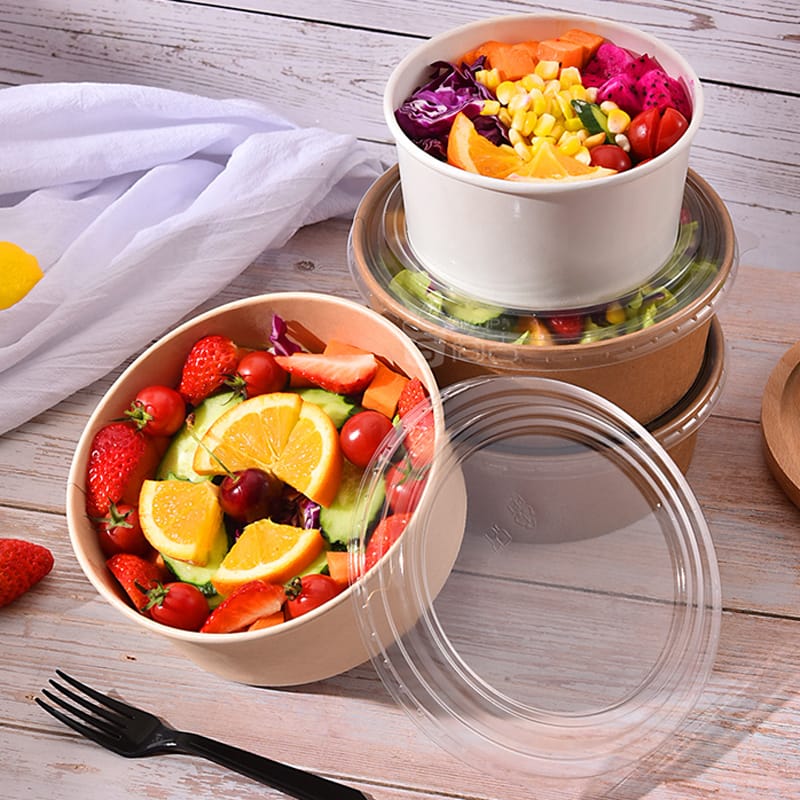
Keep 12–16oz for sides, kids’ portions, and combo meals.
Retain a 42–50oz format for sharing, family trays, and catering SKUs.
This two-core-sizes + one side model (25oz + 32oz + 12–16oz) typically maximizes menu coverage while minimizing inventory complexity.
Paper Salad Bowl Size Table (oz ⇄ ml) with Use Cases
| Label (oz) | Approx. mL | Typical Use Case | Operations Notes / Lid Ideas |
|---|---|---|---|
| 12oz | 355ml | Side salad, fruit, kid’s | Flat/dome clear lid; great for combos |
| 16oz | 473ml | Light lunch/greens | Pairs well with 2–3 toppings |
| 24oz | 710ml | Standard single-serve | “Just right” for most fast-casual |
| 25oz | 739ml | Best-seller single-serve | Common EU/UK default; broad lid availability |
| 28oz | 828ml | Premium toppings, grains | Headroom without jumping to 32oz |
| 32oz | 946ml | Loaded/protein/grain bowls | US chains’ favorite for hearty builds |
| 36oz | 1065ml | Big poke/pasta salads | Consider dome lid for height |
| 42oz | 1242ml | Family/share bowl | Rigid lid for transport stability |
| 44oz | 1301ml | Party platter/deli counter | Use anti-shift inserts if available |
| 50oz | 1479ml | Catering/party salads | Verify stack height & case weights |
Capacity in ounces is typically brimful. Plan to use ~80–90% as your practical fill to prevent lid lift and dressing seepage.
Capacity vs. Real Fill (why your 25oz “feels” smaller in service)
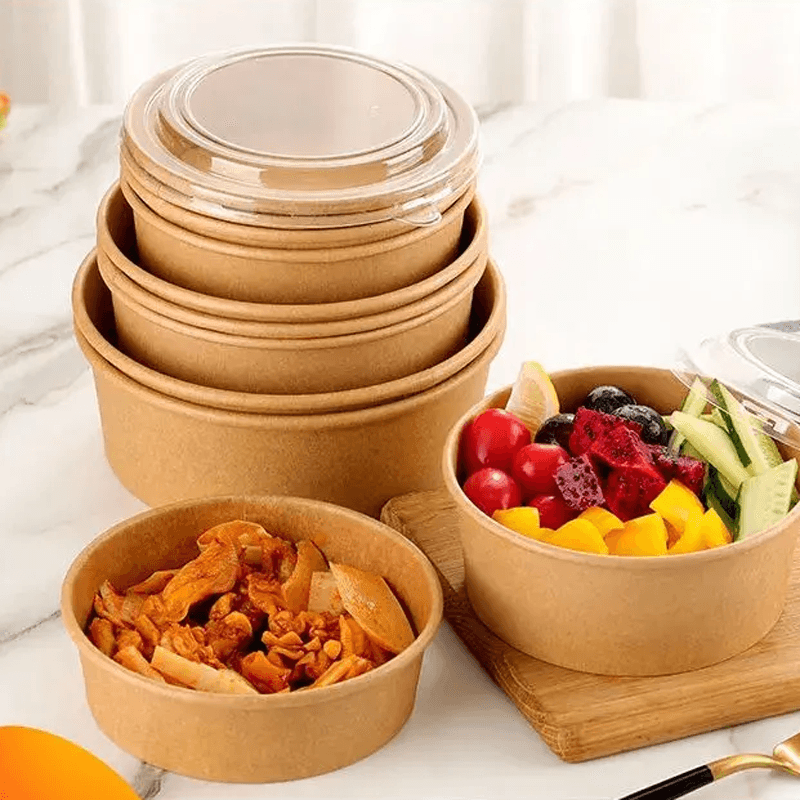
Brimful capacity (printed on the bowl) is a lab measure with water.
Usable capacity depends on ingredient geometry (leafy greens compress, cubed proteins don’t), lid headspace, and dressing strategy (on, tossed, or side cup).
Rule of thumb: For a standard greens base (120–180g), plus 4–6 toppings and protein, a 25oz bowl at ~85% fill looks abundant without compressing delicate leaves. Protein+grain builds often require 32oz.
“Good,” “Best,” and “Standard”—Terminology Calibration
Good size for a salad bowl: The volume that holds your average build with headroom = usually 24–25oz.
Best size: The size that minimizes overflow, returns, and lid failures for your specific menu. For many modern menus, that’s 25oz; for “loaded” brands, it’s 32oz.
Standard size bowl: In single-use paper bowls, industry “standard single-serve” typically means 24–25oz; 32oz is the common “large.”
Materials Deep Dive (choose by brand positioning and ops)
Kraft Paper Bowls (PLA or water-based lining)
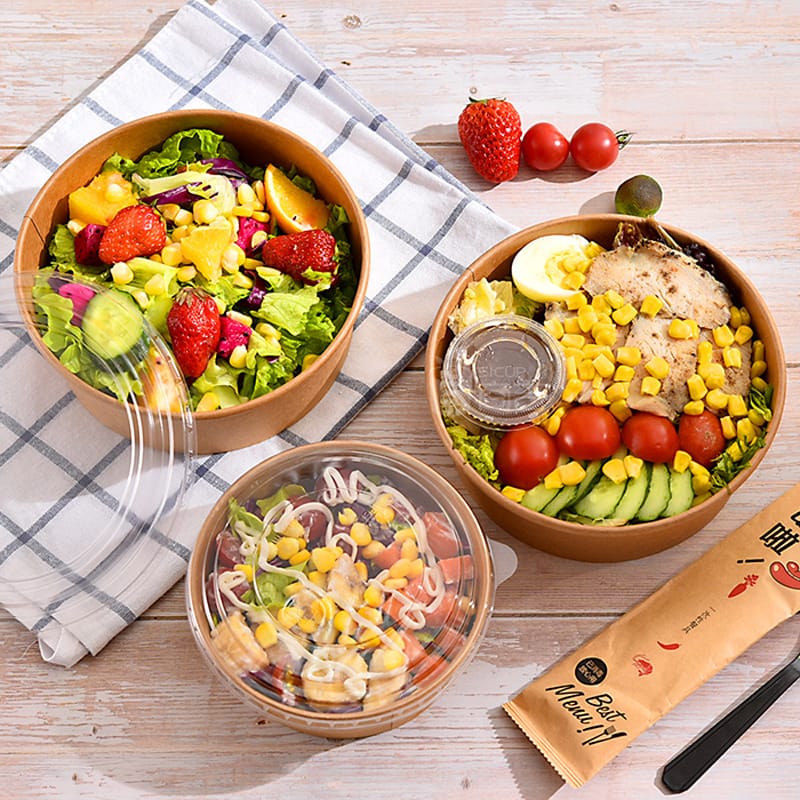
Strengths: Premium natural look, excellent printability, broad lid ecosystems, strong retail shelf appeal.
Consider: Lining choice (PLA or water-based) vs. local compliance; verify oil/heat tolerance for warm toppings; manage condensation in delivery.
Bagasse (Sugarcane Fiber) Bowls


Strengths: Plastic-free body, robust with hot/oily foods, sturdy hand feel, favorable sustainability messaging.
Consider: Pair with CPLA or bagasse lids where clear visibility is not critical; ideal for plastic-reduction mandates and corporate sustainability goals.
Lid Ecosystem—Feature Matrix
| Lid Type | Visibility | Compostable Option | Heat/Condensation Handling | Stack & Seal | Best For |
|---|---|---|---|---|---|
| rPET Flat | High | rPET content (recycled) | Good for cold/ambient | Excellent stack | Retail display, deli |
| rPET Dome | Very high (toppings headroom) | rPET content | Great headspace; watch frosting in chillers | Very good | Premium visuals, tall toppings |
| CPLA Dome | Opaque/translucent | Yes (CPLA) | Better heat tolerance | Good | Plastic-reduction goals, warm builds |
| Bagasse Lid | Opaque | Yes (plastic-free) | Good heat & oil synergy | Good | Plastic-free sets; delivery where visibility is secondary |
Diameter & Height Cheatsheet (typical market patterns)
≈150–165mm Ø → 24–25oz (710–739ml) single-serve
≈165–170mm Ø → 28–32oz (828–946ml) generous single-serve
≈180–185mm Ø → 36–50oz (1065–1479ml) share/catering
Heights generally 50–70mm; dome lids add visual headspace for toppings and protect leafy structure.
Procurement tip: Standardize on one diameter family so lids are interchangeable across 2–3 bowl volumes.
Menu Archetypes → Recommended Size & Setup
Classic greens + 4 toppings (no grains): 25oz, flat rPET lid for display or CPLA for eco sets.
Protein-forward (chicken/tofu + grains + 5–6 toppings): 32oz, dome lid preferred.
Poke/pasta salads (dense ingredients): 28–32oz; check lid height for cubed fish and mix-ins.
Kids/side/fruit: 12–16oz.
Family/catering: 42–50oz with rigid lid; add anti-shift inserts if transporting long distances.
QA & Ops Checklist (reduce defects and returns)
Lid Fit & Shake Test: Fill to 85%, lid on, shake 10×—no leaks, no lift.
Drop Test: 75–100cm drop in secondary bag—seal must hold.
Condensation Check: Chill 45–60 minutes → verify label adhesion and clarity for rPET lids.
Stack Height Audit: Ensure stacked columns don’t stress lids in delivery crates.
Label Real Estate: Confirm label placement doesn’t block venting or smudge on condensation.
SKU Rationalization: Two bodies (25oz & 32oz) + one lid family → fastest line speed and lowest training burden.
Compliance & Sustainability (procurement guardrails)
Food Contact: Request EU Food Contact/LFGB and FDA statements where applicable.
Compostability: For programs claiming compostability, ask for EN13432/BPI certificates (where relevant).
Quality Systems: Prefer suppliers with ISO and BRC/IFS certifications for audit readiness.
Messaging: If your ESG includes plastic-reduction, prioritize bagasse bodies and CPLA/bagasse lids; if recycled content is key, highlight rPET lids.
Logistics & Cost Levers (what finance teams care about)
Case/Sleeve Efficiency: Align case counts with weekly sales velocity to reduce open-case clutter.
Universal Lids: A single lid across 25oz & 32oz can eliminate one full SKU line.
Palletization: Pallets improve stability but may reduce container loading; validate the trade-off (handling vs. freight efficiency).
Artwork & MOQs: Kraft supports short-run digital or larger flexo orders; bagasse suits clean deboss/ink accents.
FAQ—Answering Your Exact Questions
What size paper bowl for salad?
For a main-course salad, choose 24–25oz; for grain- and protein-heavy builds, go 32oz. Keep 12–16oz for sides and kids’ portions.
What is the best size for a paper salad bowl?
For most fast-casual menus, 25oz is the best all-rounder. Brands known for “big salads” should adopt 32oz as standard.
What is a good size for a salad bowl?
Good means it fits your average build with headroom and travels well: usually 24–25oz. Chef-style or “loaded” bowls benefit from 32oz.
How big is a 12oz paper bowl?
Roughly 355ml—ideal for side salads, fruit mixes, or snack portions.
How many ounces is a standard size bowl?
In single-use paper formats, the standard single-serve is 24–25oz. Many chains position 32oz as the large.
Most common bowl size
25oz (≈739ml) dominates single-serve programs; 32oz (≈946ml) is common for premium or hearty builds.
Size of a regular bowl
“Regular” typically refers to 24–25oz in QSR/fast-casual contexts; check regional norms and your competitors’ labeling.
Materials Decision—Make the call
Display-led retail & merchandising: Kraft bowl + rPET flat/dome lid
Plastic-reduction & eco signaling: Bagasse bowl + CPLA/bagasse lid
Delivery-first operations: Prioritize lid lock and headspace; often 32oz + dome lid performs best.
Example Dual-Size Lineup (simple, scalable)
25oz kraft bowl + clear rPET flat lid → everyday single-serve
32oz bagasse bowl + CPLA dome lid → loaded builds & delivery
This pairing covers ≈95% of menu permutations with two bodies and one lid family in many programs.