EPS Alternative Packaging Basics For Purchasing Teams | Bioleader®
Actionable coverage of EPS Alternative Packaging: eco-friendly, biodegradable, compostable materials, performance data, and compliance under EN13432 & ASTM D6400. Includes BPI/TÜV references and Food-Contact Tested guidance for safe deployment. Buyer-focused: manufacturer insights, bulk/wholesale buying playbooks, OEM/ODM customization tips, full size range selection.
EPS Alternative Packaging — Quick Summary
Items displayed (articles): 12
Last updated: 2026-01-08
Includes test data, compliance guides, buyer FAQs, and real-world use cases.
FAQ of Bioleader's Eco-friendly Disposable Tableware
What is BPI compostable cutlery made from?
BPI compostable cutlery is typically made from plant-based materials such as cornstarch, PLA, or other renewable bioplastics that fully biodegrade under commercial composting conditions.
Can biodegradable plastic cutlery be composted at home?
Some biodegradable plastic forks and spoons can be composted at home, but most require the higher temperatures and controlled conditions found in industrial composting facilities for complete breakdown.
Why should businesses switch to bio plastic cutlery?
Switching to bio plastic cutlery helps reduce plastic waste, supports sustainability initiatives, meets consumer demand for eco-friendly products, and enhances brand reputation — EPS Alternative Packaging.
Structural Weaknesses
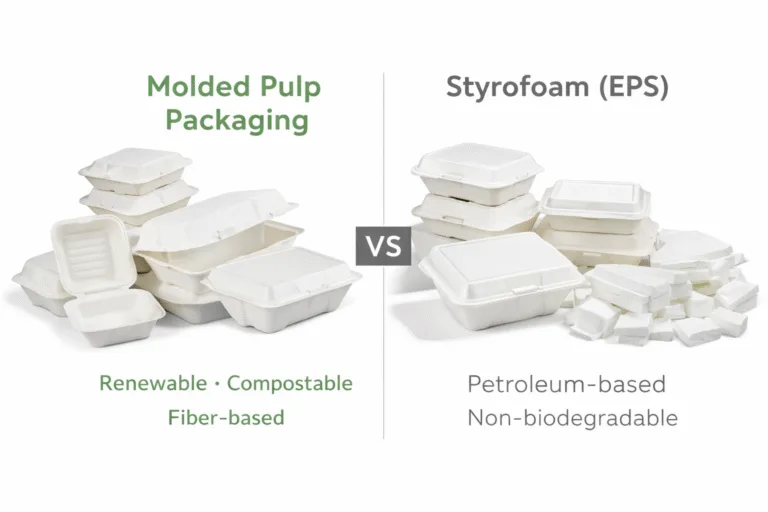
Despite its performance benefits, EPS presents systemic challenges: Non-biodegradable Difficult and uneconomical to recycle High environmental persistence Increasingly restricted by law Globally, less than 10% of EPS is effectively recycled, and in many regions the rate is closer to 1–2%, making it one of the least circular packaging materials in use today. Molded Pulp vs. Styrofoam: Material-Level Differences — EPS Alternative Packaging.
Key Functional Characteristics
Naturally biodegradable Compostable under industrial (and often home) conditions Oil- and grease-resistant with water-based coatings Microwave- and freezer-safe (depending on formulation) From a manufacturing perspective, molded pulp has matured significantly in the past decade, enabling consistent thickness, standardized dimensions, and food-contact compliance at scale , EPS Alternative Packaging. What Is Styrofoam (EPS)? Styrofoam, commonly referred to as EPS, is a petroleum-derived plastic foam made by expanding polystyrene beads with steam and a blowing agent. Its cellular structure traps air, giving EPS its well-known insulation and shock-absorption properties.