










Paper and cardboard are widely used in packaging, shipping, and food service, but their environmental impact depends on more than the material name alone. Real decomposition behavior is shaped by three variables: substrate, barrier layer, and disposal environment. This guide explains how paper and cardboard typically break down in soil-like conditions and landfill, while also helping buyers evaluate paper-based packaging more accurately.
Executive Summary
- Paper does not decompose at one universal speed.
- Uncoated fiber usually breaks down faster than coated or plastic-lined paperboard.
- Landfill is generally the slowest end-of-life path for paper-based materials.
- For food packaging, the barrier layer matters as much as the paper itself.
- For buyers, the right question is not just “Is it paper?” but “How is it built, and where will it go after use?”
Scope note: In this article, “in the ground” refers to moist, microbially active soil-like conditions rather than dry, compacted, or oxygen-limited burial conditions. Actual results vary by climate, product thickness, coating chemistry, and local waste systems.
Quick Decomposition Timeline: Fiber Packaging vs Persistent Barriers
This fast-scan comparison helps explain why substrate + barrier + environment is a better decision model than broad “paper” claims.
Uncoated Paper
Typical soil-like breakdown:
Often within weeks under moist, aerated conditions
Why:
Exposed fiber with no persistent plastic barrier
Corrugated Cardboard
Typical soil-like breakdown:
Often several months, sometimes longer
Why:
Thicker fiber structure slows breakdown
Wax-Coated Board
Typical soil-like breakdown:
Usually slower than uncoated fiber
Why:
Barrier layer delays moisture access
PE-Lined Paper
Typical soil-like breakdown:
Much slower than plain fiber; may persist for years
Why:
Plastic barrier limits water and microbial access
Bioleader Aqueous-Coated Fiber
Positioning:
Designed to reduce reliance on conventional PE lining while preserving functional packaging performance
Buyer value:
A more future-ready fiber-based option for brands seeking a less persistent barrier strategy
Note: This is a directional educational comparison. Actual results depend on basis weight, coating formulation, storage, food contact conditions, and the final disposal route.

What Types of Paper and Cardboard?
Different types of paper and cardboard vary in composition and biodegradability. Broad claims such as “paper always decomposes quickly” are often too simplistic for real packaging use. In practice, fiber structure, barrier layers, inks, adhesives, and food contamination all affect what happens after disposal.
1. Plain Paper
Uncoated and untreated paper, such as office paper or newspaper, usually breaks down relatively quickly in moist natural environments because the cellulose fibers are directly exposed.
2. Corrugated Cardboard
Corrugated cardboard is made from multiple layers for strength and is widely used in shipping and transport. It generally decomposes more slowly than plain paper because it is thicker and denser.
3. Wax-Coated Cardboard
Wax-coated paperboard is used in some moisture-sensitive packaging applications. The coating can slow water penetration and reduce microbial access, which usually delays breakdown.
4. PE-Lined Paper
PE-lined paper is water-resistant and useful during service, but the polyethylene layer also makes end-of-life handling more difficult. Compared with plain fiber paper, it generally decomposes more slowly and is often harder to process in standard recycling systems.
Bioleader Alternative: Aqueous Coating as a More Fiber-Compatible Option
Traditional PE lining helps solve moisture resistance during use, but it also introduces a persistent plastic barrier. For brands looking to reduce that barrier problem, Bioleader’s aqueous coating approach offers a more fiber-oriented direction for paper-based food packaging.
Instead of asking only whether a package is “paper,” buyers should also ask whether the barrier system supports their market’s sustainability goals, disposal pathway, and packaging claims.
5. Recycled Cardboard
Recycled cardboard is made from recovered fiber and can still break down effectively, but its real behavior depends on fiber quality, printing load, additives, and whether any wet-strength or barrier chemistry has been applied.
Technical Note: “Paper-Based” Does Not Mean the Same End-of-Life
For packaging buyers, three layers matter: fiber substrate, barrier chemistry, and actual disposal pathway. Two products may both look like paper, but one may be uncoated fiber while another contains PE, wax, PLA, or another treatment layer. Their decomposition speed, recyclability, and compost fit can therefore be very different.
How Long Does It Take to Decompose in the Ground?
In soil-like environments, decomposition time depends on material type and local conditions such as moisture, aeration, temperature, and microbial activity. The ranges below are best treated as practical estimates, not universal guarantees.
| Type | Typical Breakdown Range in the Ground | Main Variables |
|---|---|---|
| Plain Paper | Often within weeks under moist, aerated conditions | Thickness, ink load, low moisture, poor aeration |
| Corrugated Cardboard | Often several months, sometimes longer | Board thickness, wet strength, climate |
| Wax-Coated Cardboard | Usually slower than uncoated board; may exceed one year | Wax type, thickness, humidity, soil activity |
| PE-Lined Paper | Much slower than uncoated paper; may persist for years | Plastic layer weight, product thickness, burial conditions |
| Recycled Cardboard | Often a few months under favorable conditions | Fiber quality, additives, coatings, moisture |
In general, plain fiber breaks down faster because microbes can access the cellulose more directly. Barrier layers and heavier structures slow moisture entry and delay fiber collapse, which is why packaging claims should always be read in the context of construction and environment.
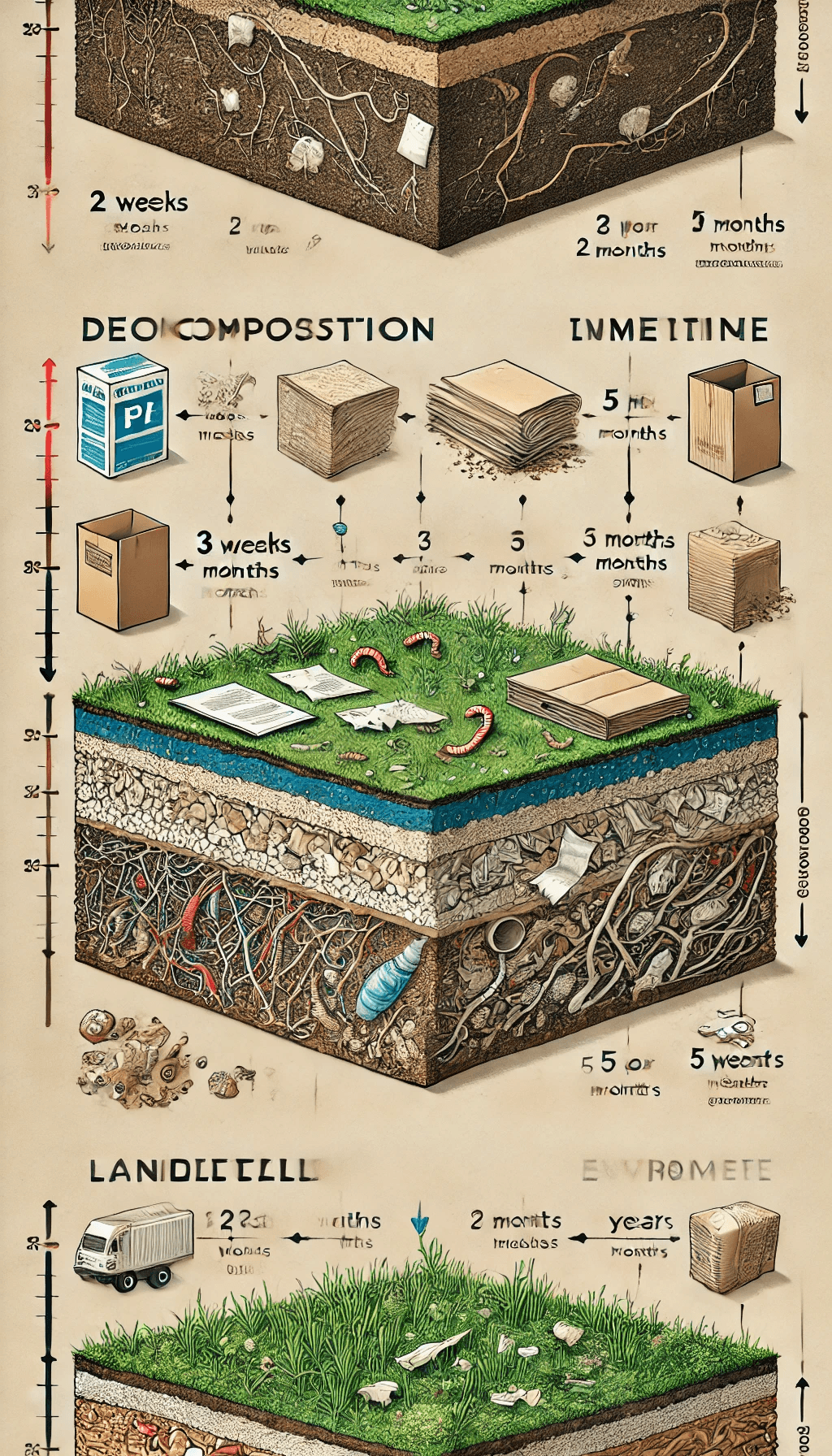
Real Decomposition Test Video
A short time-lapse comparing PE-lined paper and fiber-based aqueous-coated packaging makes the decomposition process much more convincing.
Example of natural fiber decomposition in controlled soil conditions.
Expert Tip
If a supplier gives one exact decomposition number without stating the material structure and disposal conditions, that claim should be treated cautiously. A useful technical answer always connects material type with environment.
How Long Does It Take to Decompose in the Landfill?
In landfill, decomposition is usually much slower because oxygen is limited, materials are compacted, and the environment is not managed like an active composting system. That is why landfill should never be treated as equivalent to compost.
| Type | Typical Behavior in Landfill Conditions | Why It Slows Down |
|---|---|---|
| Plain Paper | Can persist from months to years depending on landfill conditions | Low oxygen, compaction, uneven moisture |
| Corrugated Cardboard | Usually slower than in compost or open soil | Thickness plus restricted airflow |
| Wax-Coated Cardboard | Often persists significantly longer than uncoated board | Moisture barrier reduces fiber access |
| PE-Lined Paper | Often long-lasting; persistence may extend for many years | Plastic layer limits breakdown and separation |
| Recycled Cardboard | Still slower than in compost-like systems | Landfill conditions remain the limiting factor |
Landfill conditions are highly variable, which is why one simple “landfill timeline” can be misleading. For procurement and sustainability planning, the more useful question is whether the packaging will actually go to compost, recycling, or landfill in the destination market.
Eco-Impact Example for Commercial Buyers
Many foodservice brands want to translate a packaging switch into ESG language. One practical method is to estimate how much persistent barrier plastic can be reduced when moving away from PE-lined formats.
Illustrative formula:
Annual units × plastic barrier weight per unit = annual barrier plastic avoided
Example: if a cup contains 0.3 g of PE barrier, then switching 1,000,000 cups to a PE-free fiber-based alternative would avoid about 300 kg of barrier plastic in that packaging system.
This should always be recalculated using your actual cup size, coating weight, and annual volume.
Under Which Conditions Does It Decompose?
Paper and cardboard need the right conditions for efficient breakdown. The better the environment matches the material, the faster the decomposition tends to be.
1. Moisture
Moisture supports microbial activity and helps soften the fiber structure.
2. Oxygen
Aerobic environments usually support faster breakdown than compacted, oxygen-poor ones.
3. Temperature
Warmer temperatures generally accelerate microbial activity, while cold and dry conditions slow the process.
4. Material Coating
Wax, PE, and other barrier layers can reduce water penetration and delay microbial access to the fibers.
5. Thickness and Density
Thicker materials such as corrugated cardboard usually take longer to disintegrate than thinner paper.
6. Printing, Adhesives, and Additives
Heavy ink coverage, adhesives, and functional additives can change how quickly a material absorbs moisture and starts to break apart.
Common Misconceptions
- “Paper always decomposes quickly.” Not necessarily. Coatings, thickness, and local conditions can change the result dramatically.
- “Biodegradable means fast landfill breakdown.” Not necessarily. Landfill is usually the slowest route.
- “Recyclable on paper means accepted everywhere.” Not necessarily. Local infrastructure and contamination still decide acceptance.
Can Paper and Cardboard Be Recycled?
Most paper and cardboard are recyclable in principle, but recovery still depends on cleanliness, material construction, and local infrastructure.
- More commonly recyclable: plain paper, clean corrugated cardboard, and many standard paperboard formats when they are clean and dry.
- More challenging or often not accepted in standard systems: wax-coated paperboard, many PE-lined formats, and heavily contaminated foodservice packaging.
Food residue, liquid contamination, and mixed-material structures can reduce the chance of successful recycling. In practice, buyers should always check local collection rules instead of assuming all fiber-based packaging is accepted.

Practical Procurement Pitfall
One of the most common sourcing mistakes is treating recyclable, biodegradable, and compostable as interchangeable. They are different claims. A stronger purchasing decision checks the coating type, the certification scope, and the actual waste system in the target market.
How to Dispose of Paper and Cardboard?
Proper disposal helps improve the environmental outcome of fiber packaging.
1. Recycling
- Sort clean, dry paper and cardboard into recycling bins where accepted.
- Remove contaminants such as food residue, plastic tape, or mixed-material attachments when possible.
- Flatten cardboard boxes to improve handling and collection efficiency.
2. Composting
- Shred plain paper or cardboard to improve mixing and surface exposure.
- Use caution with glossy, heavily printed, wax-coated, or plastic-lined formats.
- Verify whether the product is suitable for home compost, industrial compost, or neither.
3. Landfill (Last Resort)
- Use landfill only when better recovery options are unavailable.
- Keep in mind that landfill is generally the slowest and least desirable end-of-life route for paper-based materials.
Can Paper Food Containers Decompose or Be Recycled?
Paper food containers, such as coffee cups or takeout boxes, vary widely in recyclability and decomposition performance because they are often multi-layer systems rather than plain paper.
- May decompose more readily: uncoated or lightly treated fiber containers without persistent plastic barriers.
- May require special handling: PLA-lined items often depend on industrial composting systems rather than backyard conditions.
- Often more difficult in standard recycling: PE-lined and wax-coated containers are commonly excluded because of mixed materials, though local rules vary.
For commercial buyers, the most useful evaluation questions are simple:
- What is the barrier layer: PE, PLA, aqueous, wax, or another treatment?
- What end-of-life route is realistic in the target market: recycling, industrial composting, home composting, or landfill?
- What supporting evidence exists: material description, certification, recyclability guidance, or supplier technical documentation?
How to Choose the Right Packaging for Business Use
- Check the coating. PE, wax, PLA, and newer fiber-compatible barrier systems behave very differently after use.
- Check the market fit. A material may be technically compostable, but still fail commercially if local collection infrastructure is missing.
- Check the evidence. Ask for certification scope, substrate details, and disposal guidance that matches the real application.
This reduces the risk of overclaiming sustainability and helps businesses choose packaging that performs not only during use, but also at end-of-life.
Need a More Practical Material Recommendation?
If your current packaging still relies on PE-lined paper or mixed-material structures, Bioleader can help evaluate a more future-ready option based on application, barrier need, end market, and end-of-life fit.
FAQ
1. How long does it take for paper to decompose in soil?
Plain, uncoated paper may begin breaking down within weeks in moist, aerated soil or compost-like conditions. Actual timing still depends on thickness, coatings, moisture, and microbial activity.
2. Does cardboard decompose faster in landfill or compost?
Cardboard generally decomposes faster in compost-like conditions than in landfill, where limited oxygen and compaction slow the process.
3. What factors affect paper and cardboard decomposition?
The main factors include material type, thickness, coatings, printing, temperature, oxygen, moisture, and microbial exposure.
4. Can glossy or coated paper biodegrade naturally?
Some coated papers may still break down over time, but they usually do so more slowly than plain fiber paper. Plastic-lined or heavily treated papers should not be assumed to behave like uncoated paper.
5. Is shredded paper better for composting?
Yes. Shredding usually improves surface exposure and mixing, which can help plain paper and untreated cardboard break down more efficiently in compost systems.
6. Why do some paper cups behave more like plastic at end-of-life?
Because many paper cups are actually paper-plus-barrier structures. If the cup includes PE or another persistent barrier, the paper fiber and the coating will not break down at the same speed.
7. Will eco-friendly packaging start degrading during warehouse storage?
Not under normal dry storage conditions. Fiber-based or compostable packaging is designed to remain stable during standard warehousing and transport. Decomposition generally begins only when the material enters the right combination of moisture, microbes, heat, and environmental exposure.
8. Can compostable or recyclable logos be printed on custom packaging?
Yes, custom printing can include disposal guidance or sustainability claims, but those marks should match the exact material structure and certification scope of the product.
9. Do Bioleader products have BPI or OK Compost certifications?
Certification availability depends on the specific product line, material system, and target market. The right approach is to verify the exact certificate, its scope, and the matching SKU before making any commercial or on-pack claim.
Conclusion
The decomposition time of paper and cardboard varies by material structure and environmental conditions. Recycling and composting remain the preferred recovery routes, while coated and mixed-material structures present greater challenges. The most useful takeaway is simple: choose the right fiber structure, verify the barrier layer, and match the packaging to the disposal system that actually exists in your market.
Bottom line: paper can be a strong sustainability material, but only when its construction and end-of-life pathway are clearly understood.
Article focus: Paper decomposition, cardboard decomposition, packaging end-of-life, PE-lined paper vs fiber-based alternatives, B2B material selection.
Last reviewed: March 2026
Intended readers: Sustainability-focused buyers, food packaging distributors, importers, brand owners, and environmentally conscious readers.
Reviewed By
Reviewed by Bioleader Packaging Research & Application Team
This content has been reviewed for commercial packaging relevance, material logic, and end-of-life terminology. The review process focuses on three technical dimensions: substrate, barrier layer, and disposal environment.
Editorial note: decomposition timelines in this article are presented as practical ranges or directional guidance, not as universal guarantees for every climate, substrate thickness, or waste system.
Reference Source:
“Top ways to ensure your content performs well in Google’s AI experiences on Search” – Google Search Central.
“Introduction to Structured Data Markup in Google Search” – Google Search Central.
“How Long Does It Take Garbage to Decompose?” – Richland Center Parks & Recreation Department.
“How Long Does Cardboard Take to Decompose?” – Planet Paper Box Group Inc.
“How Long Does Cardboard Take To Decompose?” – Collect and Recycle.
“How Long Does It Take for Common Materials to Decompose?” – RTS.
“How long it takes everyday items to decompose” – Forge Recycling.
“Are All Boxes Recyclable?” – American Forest and Paper Association.
“Takeout Container (Wax or Plastic-Lined Paperboard)” – Napa Recycling.
How to increase the recyclability of paper packaging” – Food Packaging Forum.
“Achieving Recyclable Food Packaging” – Oliver Inc.
“Take Out Food Container || Recycling” – City of Fort Collins.
“Are Takeout Containers Recyclable?” – Republic Services.
“Biodegradation” – Wikipedia.
Copyright Notice:
© 2026 Bioleader®. If you wish to reproduce or reference this content, you must provide the original link and credit the source. Any unauthorized copying will be considered an infringement.



One Response
This post really surprised me—didn’t realize cardboard could take years in a landfill, even though it decomposes faster in the ground!