

Quick Summary: Wet Molded Fiber vs Dry Molded Fiber
Wet molded fiber and dry molded fiber use cellulose fibers to make three-dimensional packaging, but the fibers enter the forming stage in fundamentally different conditions. Wet molding forms products from a water-based pulp slurry using vacuum forming, dewatering and hot pressing. Dry-forming systems mechanically separate pulp fibers, airlay them into a dry web, and form that web using heat and pressure.
For food-packaging buyers, the right choice depends on fiber source, product geometry, barrier performance, tooling, production scale, compliance requirements and existing manufacturing infrastructure—not simply on which process uses less water.
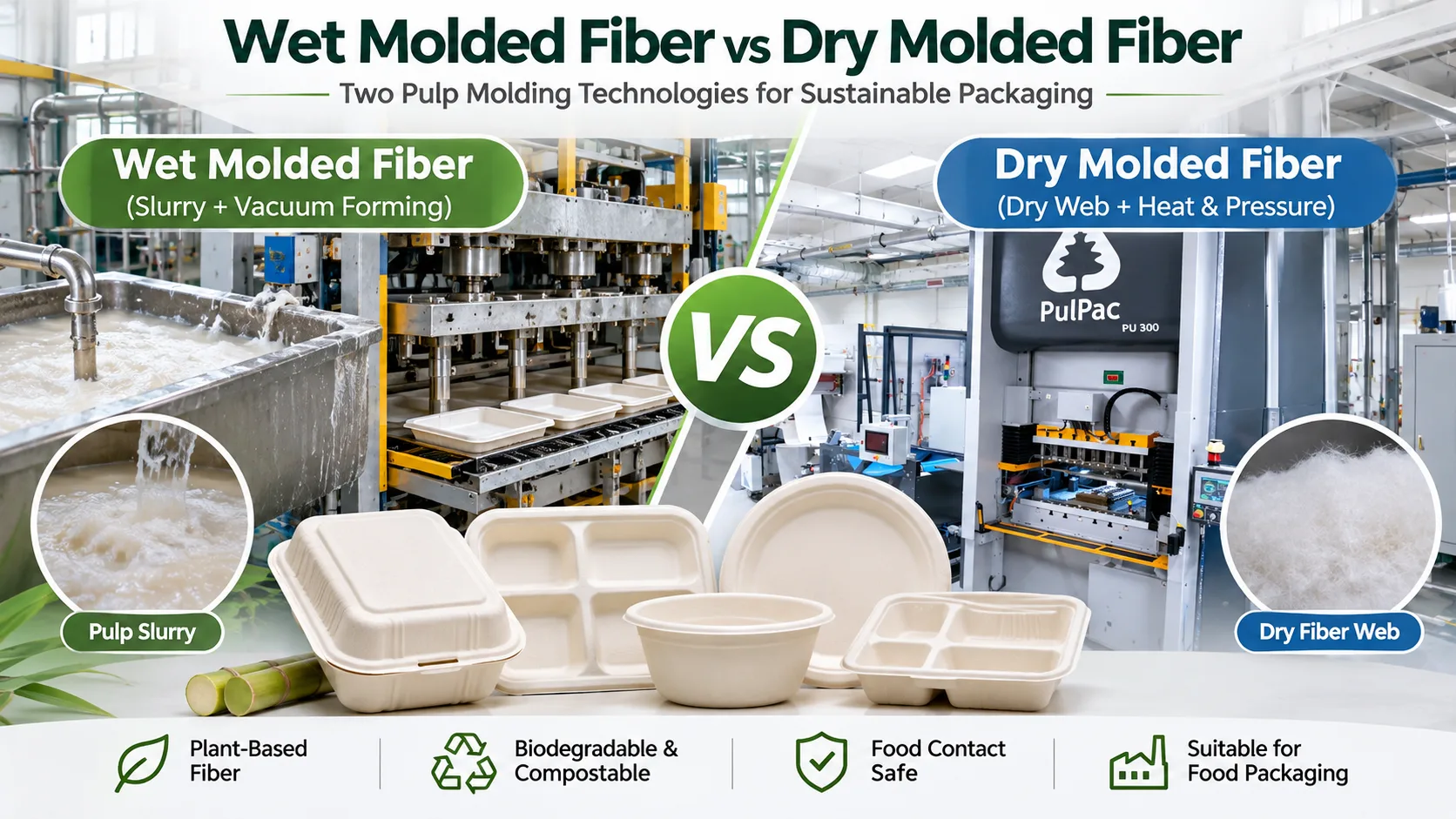
Key takeaway: Wet molding starts with fiber suspended in water. Dry forming starts with separated fibers arranged into a dry web. The product requirement should determine which process makes commercial sense.
Wet Molded Fiber vs Dry Molded Fiber: The Difference in 30 Seconds
| Technical Factor | Wet Molded Fiber | Dry Molded Fiber |
|---|---|---|
| Fiber before forming | Fiber dispersed in a water-based pulp slurry | Mechanically separated fiber arranged into an airlaid dry web |
| Forming principle | Vacuum deposition, dewatering and thermal pressing | Dry-web forming under heat and mechanical pressure |
| Process-water requirement | Water is essential for slurry preparation and fiber deposition | Avoids conventional slurry forming and most associated water-removal operations |
| Established fiber sources | Wood pulp, bagasse, bamboo, wheat straw and other suitable plant fibers | Commercial cellulose pulp; exact feedstock must be validated for milling, airlaying and web-forming performance |
| Typical food-packaging applications | Plates, bowls, clamshells, deep containers and compartment trays | Lids, cutlery, shallow trays and emerging specialty formats |
| Barrier performance | Can use wet-end sizing, surface treatment or other barrier systems | Barrier can be integrated through pulp, tissue or in-line application depending on the system |
| Technology maturity | Long-established global molded-pulp manufacturing route | Newer industrial platform now moving from development into commercial-scale production |
| Technology access | Equipment and tooling available from many machinery and mold suppliers | PulPac’s Dry Molded Fiber platform uses a licensed technology model with approved machinery partners |
| Food-contact / PFAS / compostability | Must be evaluated on the finished product and complete material system. The forming process alone does not prove compliance. | |
This difference is especially relevant for buyers comparing conventional sugarcane bagasse tableware with newer dry-forming platforms. Similar-looking fiber packaging can be produced through very different routes, with different implications for raw material, tooling, barrier design and commercial scale-up.
First, Dry Molded Fiber Is Not the Same as Dry-Press Molded Pulp
This terminology is often confused in packaging discussions.
Traditional molded pulp may be described as wet-pressed or dry-pressed depending on how the wet preform is subsequently dried and compressed. Both routes can still begin with fibers suspended in a water-based pulp slurry.
Modern dry-forming technologies such as PulPac’s Dry Molded Fiber process are different. Commercial pulp is mechanically milled and defibrated, fibers are airlaid into a web, and that web is subsequently molded using heat and pressure.
Technical distinction: “Dry-press molded pulp” can still be a wet-slurry process. Dry Molded Fiber changes the fiber-forming route itself before the final press.
How Wet Molded Fiber Works
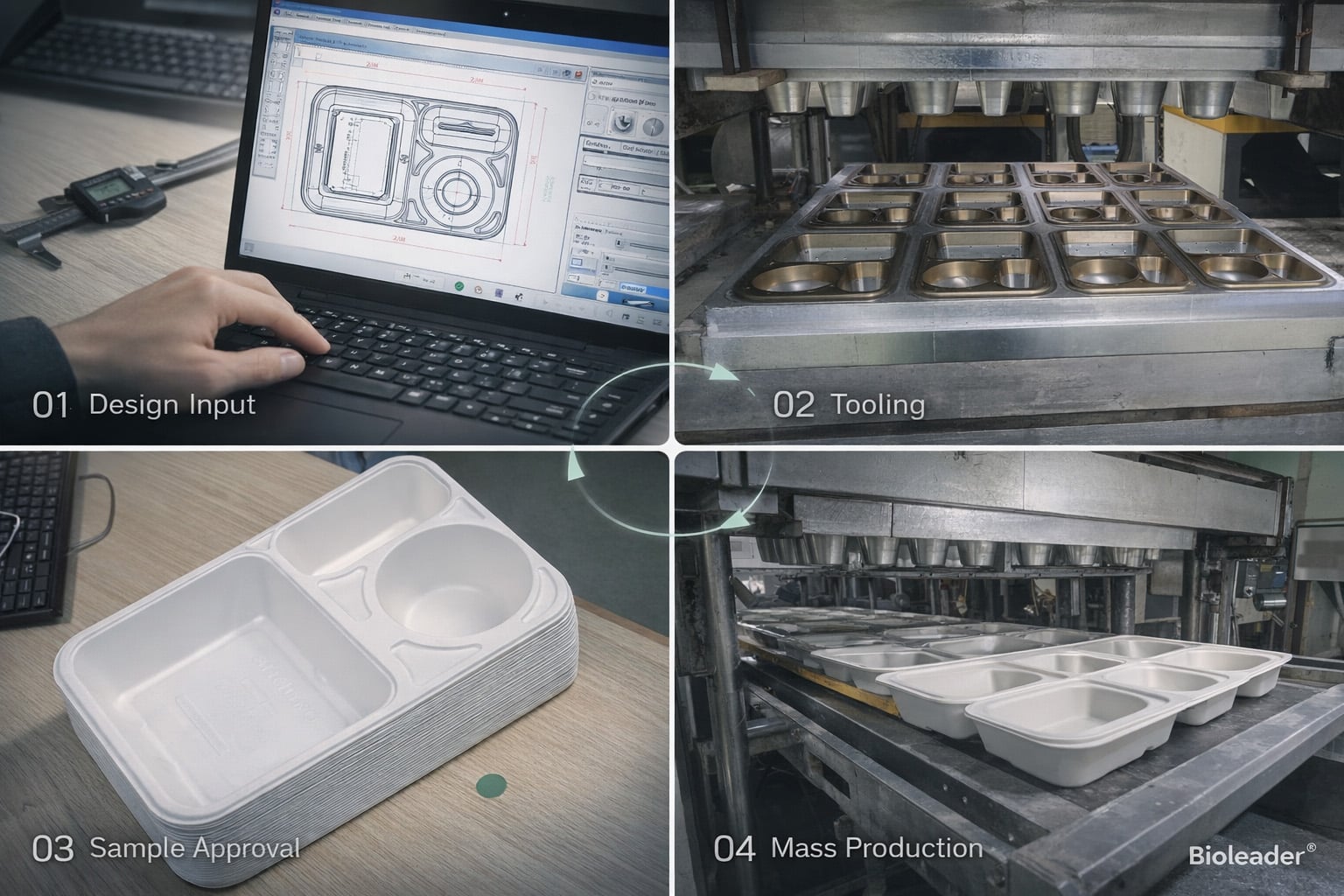
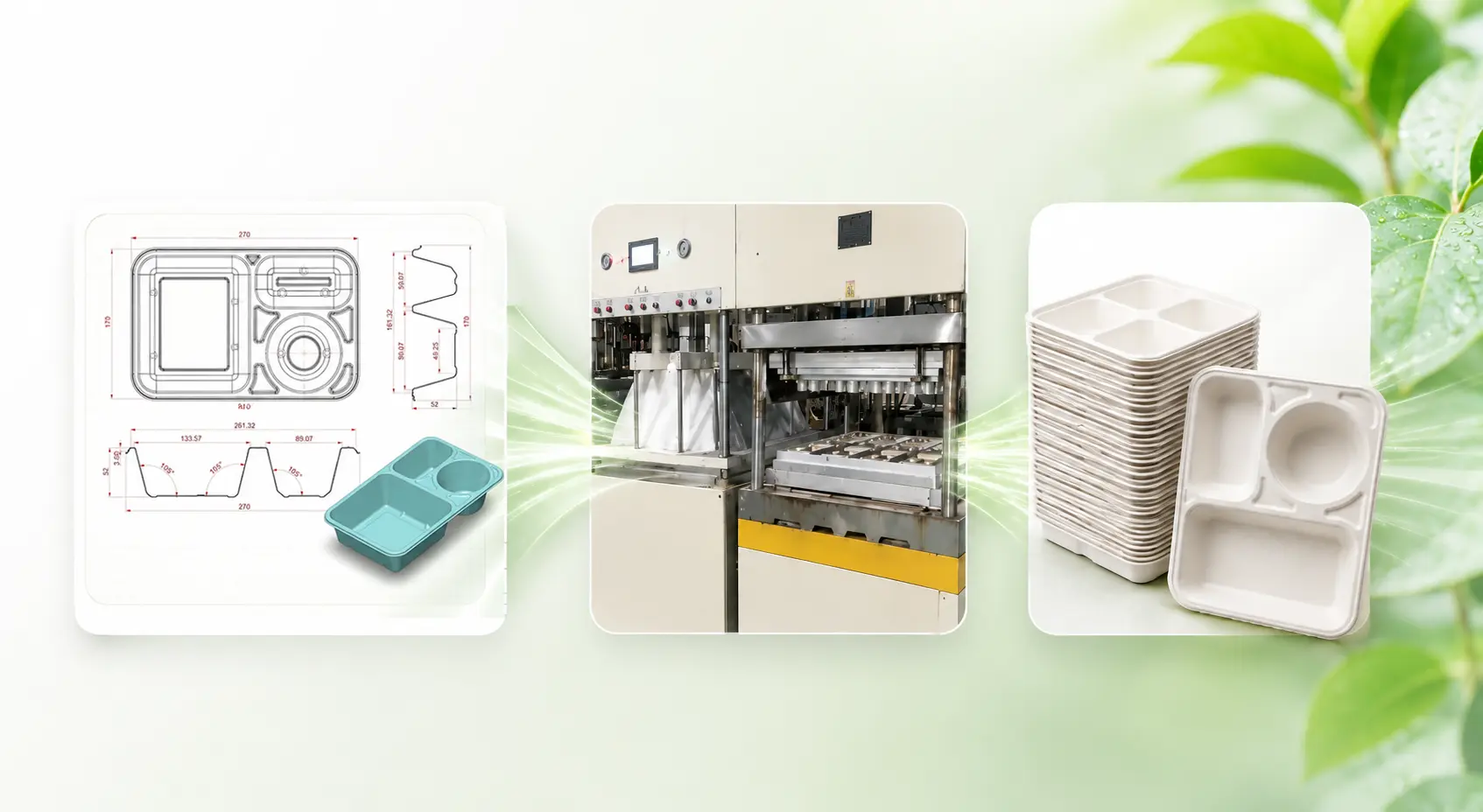
Wet molding is the established manufacturing route behind much of today’s molded-pulp food packaging. Fiber is dispersed in water to produce a controlled slurry. Vacuum draws the fibers onto a porous forming mold while removing part of the water. The wet preform is then pressed and dried before trimming, inspection and packing.
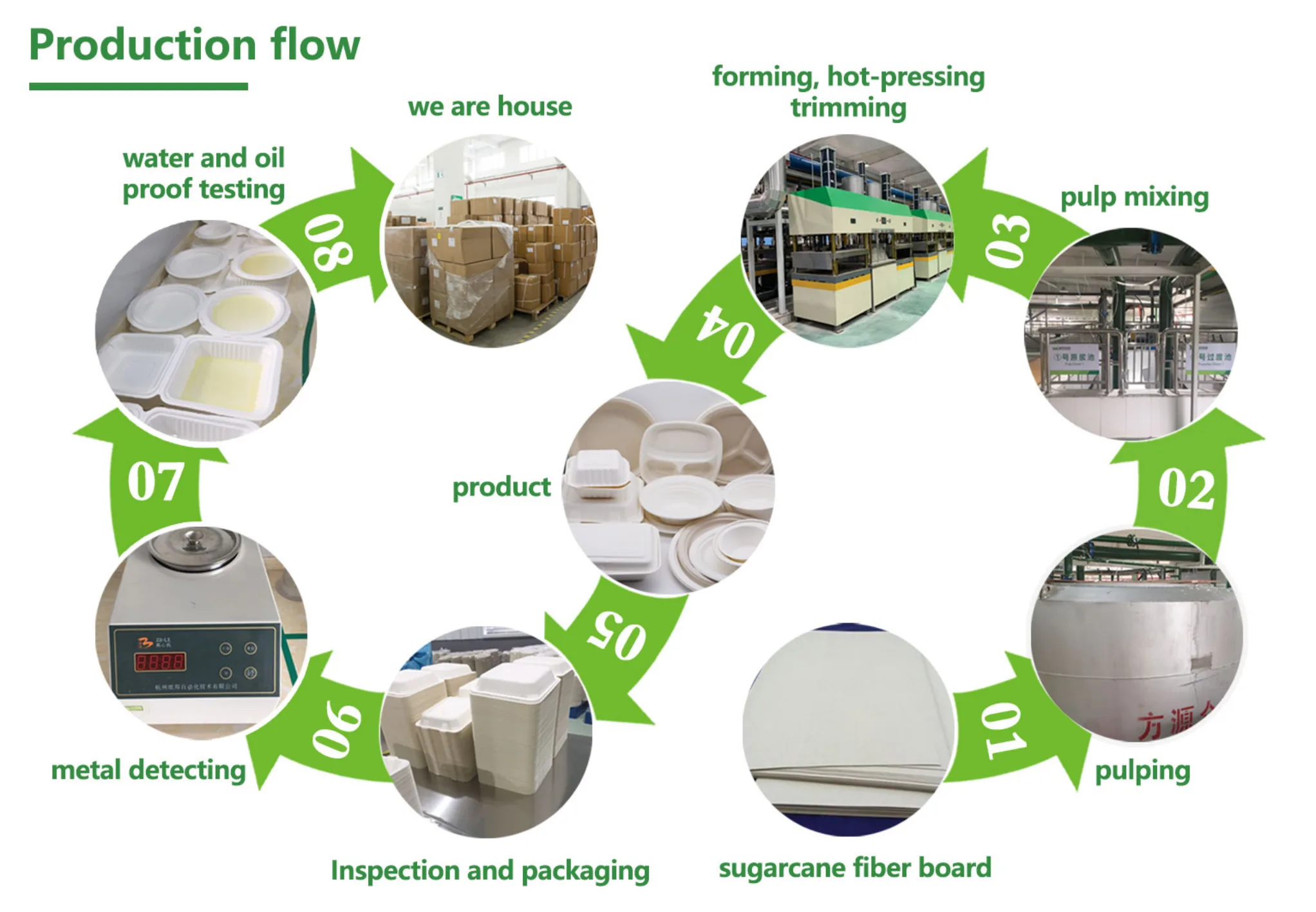
A simplified production sequence is:
Fiber preparation → pulping → pulp slurry → vacuum forming → dewatering → hot pressing and drying → trimming → inspection.
Bioleader® uses this manufacturing route for products including bagasse clamshell boxes, bagasse bowls, plates and molded fiber trays.
Manufacturer Insight
The molding method alone does not determine the quality of a bagasse container. Fiber furnish, slurry consistency, fiber distribution, mold geometry, pressing conditions, trimming accuracy and barrier chemistry all affect rigidity, lid fit, surface quality and resistance to hot or oily food.
For a more detailed process explanation, see Bioleader®’s guide to how molded pulp packaging is manufactured.
How Dry Molded Fiber Works
Dry forming removes the conventional slurry-forming stage. PulPac describes its process as starting with commercially available pulp that is mechanically milled and defibrated. The separated fibers are airlaid into a fluffy web, barriers are added where required, and the web is then molded into a three-dimensional product under heat and pressure.
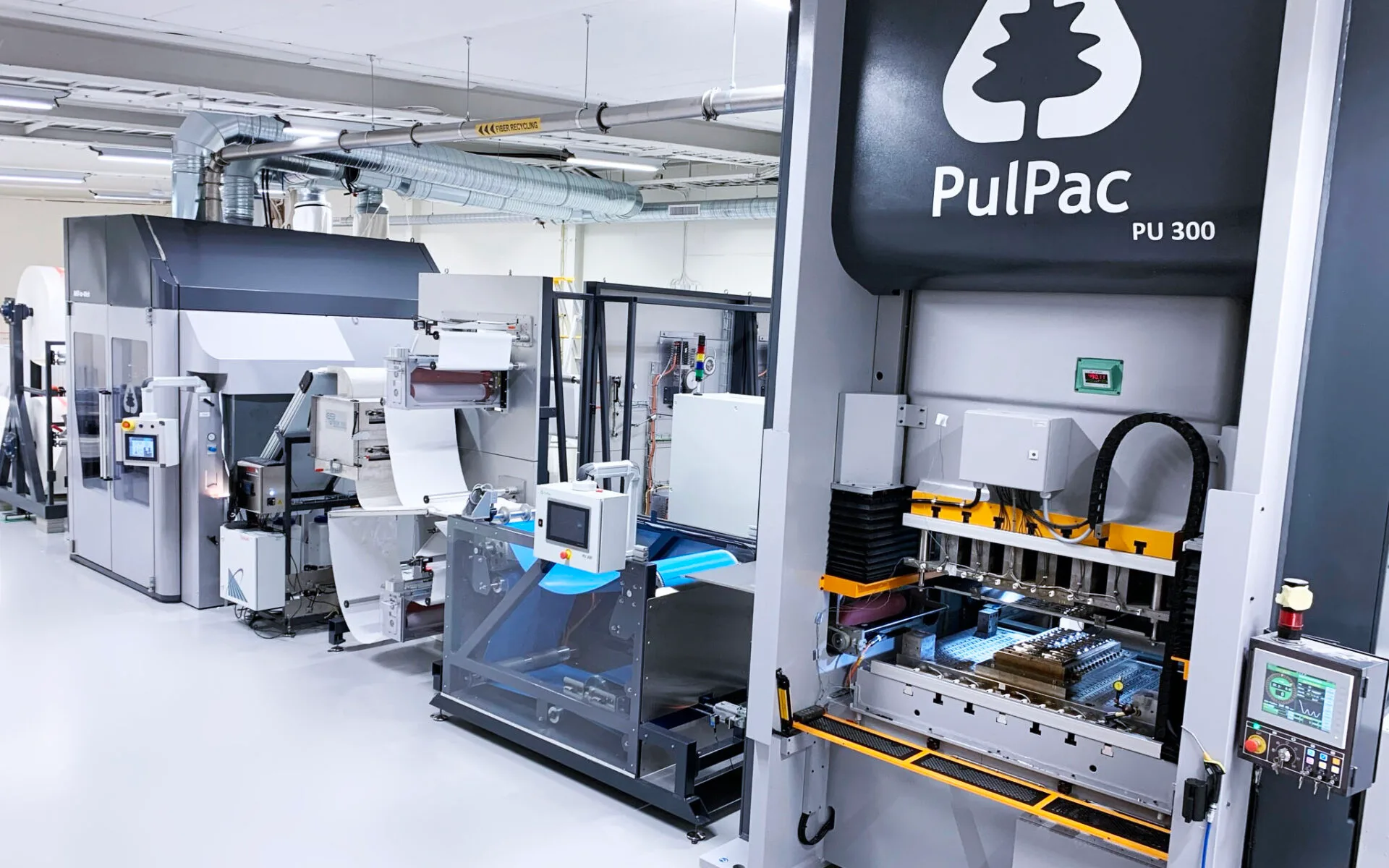
The simplified route is:
Commercial pulp → milling and defibration → airlaid fiber web → barrier if required → heat and pressure → trimming and fiber recycling.
PulPac currently publishes standardized Dry Molded Fiber applications including coffee lids, cutlery and trays. Its Modula platform reports cycle times down to approximately 3.5 seconds for selected standardized applications, although these figures are specific to PulPac equipment, tooling and product designs and should not be treated as universal dry-molding performance.
Raw Material Matters: Bagasse Is More Than Just “Fiber”
One important distinction is often missed when Wet Molded Fiber and Dry Molded Fiber are compared only by process.
Fiber source also affects the business case.
Peer-reviewed research on molded-pulp food packaging shows that agricultural fibers including sugarcane bagasse, bamboo and wheat straw are already established alternatives to virgin wood pulp. Wet-slurry processing is particularly mature for these fiber systems because the fibers can be dispersed, blended and refined before molding.
This is important for foodservice brands specifically looking to use agricultural residues. Bioleader®’s bagasse tableware range converts sugar-industry fiber residue into plates, bowls, clamshells and food containers through established wet-molding infrastructure.
Dry Molded Fiber should not, however, be described as requiring only long-fiber wood pulp. PulPac specifies commercially available or generic pulp, while dry-forming research also continues to evaluate different pulp and natural-fiber systems. The critical question is whether a selected fiber can be milled, airlaid into a sufficiently uniform web and then molded consistently.
Buyer implication: If a packaging program specifically prioritizes commercially proven sugarcane bagasse content, wet molding currently has a highly established supply chain. A dry-forming project should validate the exact feedstock and web-forming behavior instead of assuming that every cellulose source performs identically.
Water and Energy: How Large Is the Difference?
Water reduction is one of the strongest technical arguments for dry forming.
ANDRITZ currently reports that its Dry Molded Fiber solutions can use about 95% less water than conventional wet molding. The company also identifies energy savings from shorter production times and the removal of conventional drying sections.
This is a meaningful process-level advantage, but it should be interpreted correctly.
95% less process water does not mean 95% lower total environmental impact. Final carbon footprint still depends on pulp production, electricity and heat source, product weight, barrier materials, scrap rate, equipment utilization, logistics and end-of-life conditions.
For that reason, a dry-molded package should not automatically be described as lower-carbon than every wet-molded alternative without a product-specific lifecycle assessment.
Barrier Engineering: “Dry” Does Not Mean Waterproof
Neither manufacturing route automatically produces grease-proof or water-resistant packaging.
In wet molding, sizing or barrier chemistry can be introduced into the pulp system or applied to the formed surface depending on the product specification. For food packaging, the exact chemistry and finished-product performance must be validated against the intended temperature, oil exposure and holding time.
PulPac states that its Modula system can introduce barrier functionality through the pulp, through tissue, or through an in-line spraying system. The barrier is selected according to the required resistance to water, oil, grease or other substances.
Grease resistance comes from the complete fiber-and-barrier system—not from whether the product is described as wet molded or dry molded.
This distinction is increasingly important during PFAS-free sourcing. Buyers evaluating molded fiber for demanding hot-food applications can also review Bioleader®’s 2025–2026 Global PFAS-Free Tableware Performance White Paper.
Commercial Scale: The Manufacturing Business Models Are Different
The commercial difference between the two technologies is more nuanced than simply saying one process is cheaper.
Wet Molded Fiber
Conventional wet molding is a mature industrial technology with a broad global base of machine builders, mold suppliers and existing factories. For established products such as plates, bowls, clamshells and bagasse trays, existing tooling and production infrastructure can reduce development complexity.
Dry Molded Fiber
PulPac operates through a patented technology and licensing model. PulPac states that a license agreement is required before ordering a production machine, with machinery supplied through approved turnkey partners. Its published implementation guidance indicates that product validation, licensing, machine ordering and commercial start-up commonly require approximately six to twelve months.
This does not mean Dry Molded Fiber is inherently uneconomic. PulPac’s published data for standardized lids and cutlery show very high potential throughput. It does mean that buyers should compare the complete implementation model rather than only the cost of the fiber itself.
| Commercial Question | Wet Molded Fiber | Dry Molded Fiber |
|---|---|---|
| Existing industrial base | Broad and mature | Growing commercial ecosystem |
| Machine access | Multiple independent machinery suppliers | PulPac platform uses licensed technology and approved machinery partners |
| Existing food-container tooling | Extensive for bowls, plates, trays and clamshells | Rapidly expanding but application-dependent |
| Best economic comparison | Compare tooling, annual volume, material usage, cycle time, barrier system, labor, energy and target unit cost for the actual product. | |
Which Process Makes More Sense for Food Packaging?
| Packaging Requirement | Practical Starting Point | Reason |
|---|---|---|
| Bagasse dinner plate | Wet molded fiber | Highly mature product and tooling ecosystem |
| Deep takeaway bowl | Wet molded fiber | Established deep-form geometry and commercial availability |
| Hinged clamshell | Wet molded fiber | Proven mass-production route with many existing sizes |
| Multi-compartment meal tray | Wet molded fiber | Mature mold design, nesting and foodservice supply chain |
| High-volume fiber coffee lid | Dry forming deserves evaluation | One of the most developed standardized dry-forming applications |
| Fiber cutlery | Dry forming deserves evaluation | High-speed standardized applications have already been demonstrated |
| Lightweight shallow tray | Compare both | Geometry, volume, tooling and material utilization may support either route |
| Hot oily takeaway food | Test finished product | Barrier chemistry and holding conditions matter more than process name |
| Custom agricultural-fiber food container | Wet molding is currently the more established starting point | Existing commercial experience with bagasse and other agricultural fibers |
What Buyers Should Test Before Choosing Wet or Dry Molded Fiber
- Fiber source: bagasse, bamboo, wood pulp or another cellulose furnish.
- Geometry: shallow, deep, hinged, compartmented or highly detailed.
- Food temperature: actual filling, serving and holding temperature.
- Oil and moisture: sauce, steam, grease exposure and required holding time.
- Barrier system: internal sizing, surface treatment, tissue or other functional layer.
- Lid fit: rim geometry, snap fit, sealing and dimensional stability.
- Production volume: annual demand and expected machine utilization.
- Tooling: existing mold availability versus new product development.
- Compliance: food-contact documentation, PFAS requirements, compostability and recycling claims.
Sample Evaluation Should Reproduce the Real Application
Test the actual food, serving temperature, oil or sauce exposure, holding time, stacking pressure, transport conditions, lid fit, nesting, microwave or reheating requirements, trimming quality and dimensional consistency.
A lower-water manufacturing process does not compensate for packaging that softens, leaks, loses lid fit or cannot provide the required food-contact documentation.
For custom product development, Bioleader® evaluates dimensions, forming depth, compartments, rim structure, nesting, lid fit and product strength before production tooling is finalized. See the Custom Molded Pulp & Bagasse Packaging engineering page for the full wet-molded development route.
Tooling precision and fiber distribution are also major quality variables. Bioleader® explains these factors in its technical guide to engineering high-quality molded pulp trays.
Where Bioleader® Fits in This Comparison
Bioleader®’s direct manufacturing experience in this comparison is primarily in wet-molded sugarcane bagasse and molded-pulp food packaging. Current production covers clamshell boxes, plates, bowls, food containers, trays, compartment formats and custom molded-fiber projects.
The Dry Molded Fiber information in this article is presented as an independent technology comparison using PulPac, ANDRITZ and published research. The PulPac equipment shown above is a technical reference and is not represented as a Bioleader® production line.
For established bagasse food packaging, Bioleader® can support product selection, custom molding, tooling development, sample testing, PFAS-free options, food-contact documentation, bulk wholesale and export-ready production.
Final Buyer Conclusion
Wet Molded Fiber remains the more established route for sugarcane bagasse plates, bowls, clamshells, deep food containers and compartment trays. It benefits from mature tooling, existing production infrastructure and broad experience with agricultural-fiber food packaging.
Dry Molded Fiber introduces a materially different forming architecture. Its dry web process can dramatically reduce process-water handling and eliminate conventional drying stages, while enabling high-speed production for suitable applications such as lids, cutlery and selected trays.
The correct decision should therefore begin with the package—not the technology. Define the fiber source, geometry, food conditions, barrier performance, tooling, annual volume and compliance requirements first. Then select the forming route capable of delivering the required performance consistently at commercial scale.
Planning a new molded-fiber food packaging project? Send Bioleader® your target dimensions, food application, temperature, barrier requirements and expected order volume at info@bioleaderpack.com for an initial technical feasibility and tooling review.
Frequently Asked Questions
What is the main difference between wet molded fiber and dry molded fiber?
Wet molded fiber forms products from fibers dispersed in a water-based pulp slurry and then removes water through vacuum, pressing and drying. Dry molded fiber mechanically separates pulp fibers, airlays them into a dry web and forms that web under heat and pressure. The key difference therefore occurs before final molding.
Is Dry Molded Fiber the same as dry-press molded pulp?
No. Dry-press molded pulp may still begin with conventional wet slurry forming. “Dry press” can describe a later pressing or drying operation. Dry Molded Fiber uses a different fiber-preparation route in which pulp is mechanically separated and formed into an airlaid web before heat-and-pressure molding.
Can sugarcane bagasse be used for molded fiber food packaging?
Yes. Sugarcane bagasse is already widely used in molded-pulp food packaging, including plates, bowls, trays and clamshell containers. Wet molding has a mature commercial track record with bagasse and other agricultural fibers. Any alternative dry-forming feedstock should be validated for fiber separation, web formation and final product performance.
How much water can Dry Molded Fiber save?
ANDRITZ reports approximately 95% lower water consumption for its Dry Molded Fiber solutions compared with wet molding. This is a process-level technology-provider benchmark rather than a universal lifecycle figure. Total environmental impact still depends on fiber production, energy, product weight, barriers, logistics and end-of-life conditions.
Is dry molded fiber automatically more sustainable?
No. Lower process-water demand and reduced drying requirements can provide meaningful advantages, but sustainability must be evaluated across the complete product lifecycle. Fiber origin, electricity source, material weight, barrier chemistry, waste, transportation and disposal or recycling routes all influence the final result.
Is dry molded fiber automatically PFAS-free or grease-resistant?
No. Grease and water resistance depend on the complete barrier system. PulPac states that barriers can be introduced through pulp, tissue or in-line spraying. PFAS-free status must be verified from the actual finished-product formulation and appropriate testing or supplier documentation.
Will dry molded fiber replace wet-molded bagasse packaging?
There is no technical reason to assume universal replacement. Wet molding remains highly mature for deep food containers, bowls, plates, clamshells and multi-compartment trays. Dry forming adds another manufacturing platform and may be especially attractive where high-speed production, lightweighting or a redesigned fiber format supports the business case.
References
- PulPac. Dry Molded Fiber – Process and Technology Overview.
- ANDRITZ. Dry Molded Fiber Technology and Industrial Solutions.
- Moulded pulp fibers for disposable food packaging: A state-of-the-art review. Food Packaging and Shelf Life, 2022.
- Molded fiber and pulp products as green and sustainable alternatives to plastics: A mini review. Journal of Bioresources and Bioproducts.