1. Quick Answer: How Should Foodservice Packaging Be Declared?
For EU PPWR purposes under Verordnung (EU) 2025/40, disposable foodservice products should not be declared by simply treating the product, inner bag and corrugated carton as one packaging material. Each item should first be assessed according to what it is, what function it performs and how the commercial unit is actually supplied to the buyer or end user. Buyers that need the broader manufacturer, importer and documentation framework can also review Bioleader®’s EU PPWR 2026-Leitfaden für Verpackungen für den Außer-Haus-Verzehr.
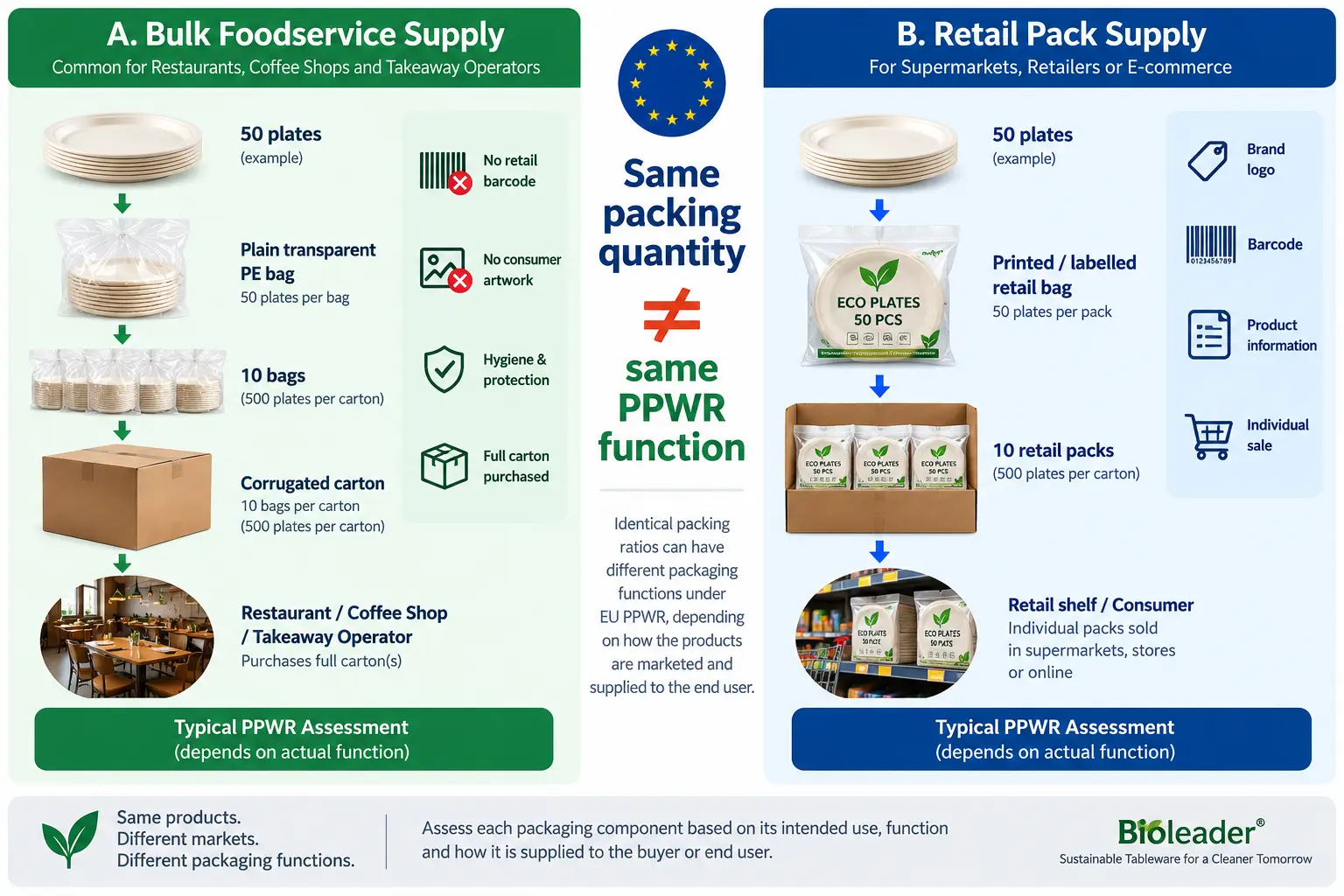
A typical bulk foodservice shipment may contain 50 or 100 paper cups, paper bowls, bagasse plates, food containers or pieces of cutlery inside a plain PE, PP or compostable inner bag, with multiple bags packed into one corrugated carton. In many B2B foodservice orders, the restaurant, coffee shop, takeaway operator or distributor purchases the complete carton rather than individual inner packs.
In this common bulk-supply model, the plain inner bag is normally used for hygiene, moisture protection, dust protection, product separation and handling. It may have no barcode, retail artwork or consumer-facing label and may never be sold separately. However, the absence of printing does not mean that the bag falls outside PPWR. An item used by an economic operator to contain, protect, handle, deliver or present products can still perform a packaging function.
- Do not automatically count the foodservice article itself as packaging. Disposable cups, bowls, plates, containers and cutlery need to be assessed according to their intended use. For example, a cup designed and intended to be filled with a beverage at the point of sale can qualify as service packaging, while the same type of empty cup sold as a standalone household product can be treated differently.
- Do not automatically classify a plain inner bag as sales packaging. If the bag exists mainly as a hygiene and protection layer inside a full-carton B2B unit and is not normally sold separately, its function differs from a consumer-facing retail pack.
- Do not automatically classify every corrugated carton as transport packaging. If the complete carton is conceived and supplied as the normal commercial unit purchased by a restaurant or other end user, its PPWR function should be assessed accordingly. A master carton used only to move multiple retail sales units presents a different case.
- Record packaging materials separately. PE or PP film, compostable polymer bags, paper sleeves, labels, tape and corrugated fiberboard should not be merged into a single generic description such as “eco-friendly packaging.”
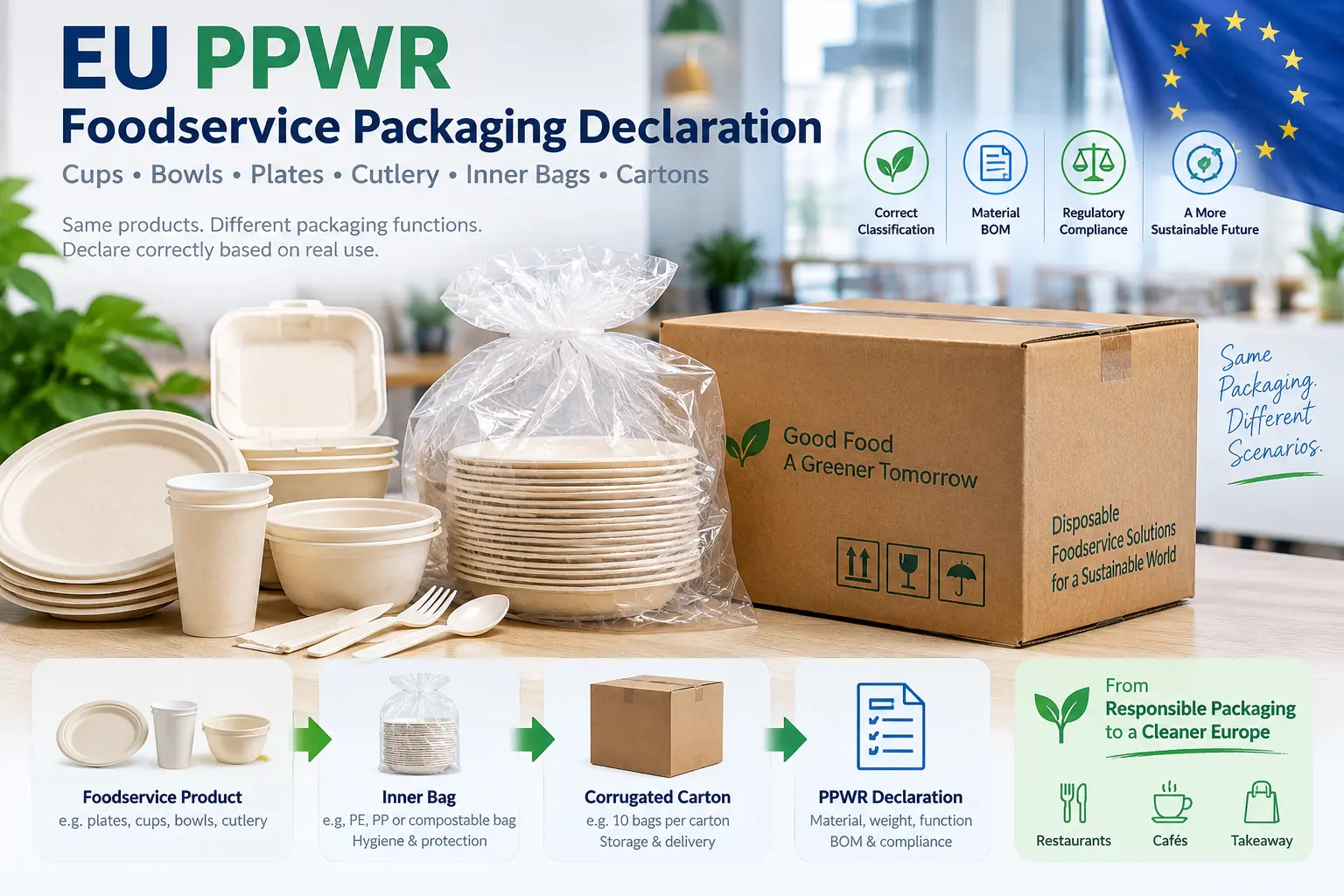
Wichtigste Erkenntnis: PPWR classification depends on the actual function and intended use of each component, not simply on whether it is called an inner bag, retail pack or shipping carton. The same physical packing format can require a different assessment when the commercial sales model changes.
2. Why the Same Packaging Format Can Have Different PPWR Functions
One of the most important PPWR issues for foodservice packaging buyers is that packaging format and packaging function are not the same thing. Two suppliers may both describe a shipment as “50 pcs per bag, 10 bags per carton,” yet those bags and cartons may play different roles depending on how the products are marketed, sold and used downstream.
Regulation (EU) 2025/40 distinguishes packaging functions such as sales packaging, grouped packaging and transport packaging. Sales packaging is conceived to form a sales unit of products and packaging for the end user. Grouped packaging brings together a number of sales units for sale, restocking, stock keeping or distribution. Transport packaging facilitates the handling and transport of one or more sales units or grouped units and helps prevent damage during transport.
This functional approach is particularly important for disposable foodservice supplies because Bioleader® products commonly move through two different commercial models. Der European Commission’s 2026 PPWR guidance also stresses that an item’s status must be assessed against the Article 3 packaging definition and its actual function, rather than from an illustrative example alone.
Scenario A: Bulk Full-Carton Supply to Foodservice Operators
This is the more common model for Bioleader® B2B orders. A restaurant, coffee shop, catering company, takeaway operator or foodservice distributor may purchase complete cartons containing multiple plain inner bags.
| Example Component | Typical Configuration | Main Practical Function | PPWR Assessment Point |
|---|---|---|---|
| Zuckerrohr-Bagasse-Teller | 50 pcs per inner bag | Foodservice-Produkt | Determine whether the article itself performs a packaging or service-packaging function in its intended downstream use. |
| Plain PE inner bag | 50 plates per bag | Hygiene, moisture protection, dust protection and separation | It is still packaging when it performs a containment or protection function, but it should not automatically be treated as a retail sales pack merely because it contains a fixed quantity. |
| Corrugated carton | 10 bags / 500 plates | Commercial supply, handling, storage and transport | Assess whether the carton is conceived as the sales unit supplied to the end user or primarily as packaging used to group or transport other sales units. |
In this situation, a transparent inner bag with no logo or barcode may never reach the market as an independently sold pack. Its primary purpose can simply be to keep the products clean, dry and protected until they are used by the foodservice operator. The complete carton may be the quantity normally ordered and received by the customer.
Scenario B: Individual Retail Packs Inside a Master Carton
A different assessment is required when the same 50-piece quantity is prepared as an individual retail unit. For example, 50 bagasse plates may be packed in a printed or labelled bag carrying a brand name, barcode, product description and consumer information, with 10 such packs placed inside a master carton.
| Example Component | Typical Configuration | Main Practical Function | PPWR Assessment Point |
|---|---|---|---|
| Retail inner pack | 50 pcs per printed or labelled bag | Individual sale, protection and presentation | If the product and bag are conceived as the unit supplied to the end user, the pack has a clear sales-packaging function. |
| Master carton | 10 retail packs per carton | Grouping, warehousing, distribution and transport | The carton should be assessed according to whether it groups sales units, facilitates transport, or performs both commercial and logistics functions within the supply chain. |
Wichtig: Printing, branding or a barcode can provide evidence that an inner pack is intended for individual retail sale, but these features are not the legal test by themselves. A plain transparent 50-piece bag may still be the sales unit if that is how it is conceived and supplied to the end user. Conversely, a printed bag used only as an internal distribution pack should not be classified solely from its appearance.
Manufacturer Insight: Start With the Sales Model, Not the Packaging Name
For Bioleader® bulk foodservice exports, plain inner bags are commonly used as protective and hygienic packaging, while the complete corrugated carton is often the normal B2B purchasing quantity for restaurants, coffee shops, takeaway operators and distributors. Retail-ready packs are also available for projects that require individual bag or box sales. Buyers therefore should tell the supplier how each pack will be sold downstream before finalising the PPWR packaging classification and packaging-material declaration.
Practical Rule: Do not classify packaging from appearance alone. First identify the actual sales unit, then determine which components protect that unit, which components group multiple sales units and which components are primarily used for handling and transport.
3. Scenario A: Full-Carton Supply to Restaurants, Coffee Shops and Takeaway Operators
For many disposable foodservice products, the most common B2B supply model is not an individually merchandised retail pack. Restaurants, coffee shops, takeaway operators, catering companies and other foodservice users often purchase complete cartons containing multiple plain inner bags.
A typical configuration may look like this:
Typical Bulk Foodservice Packing Example
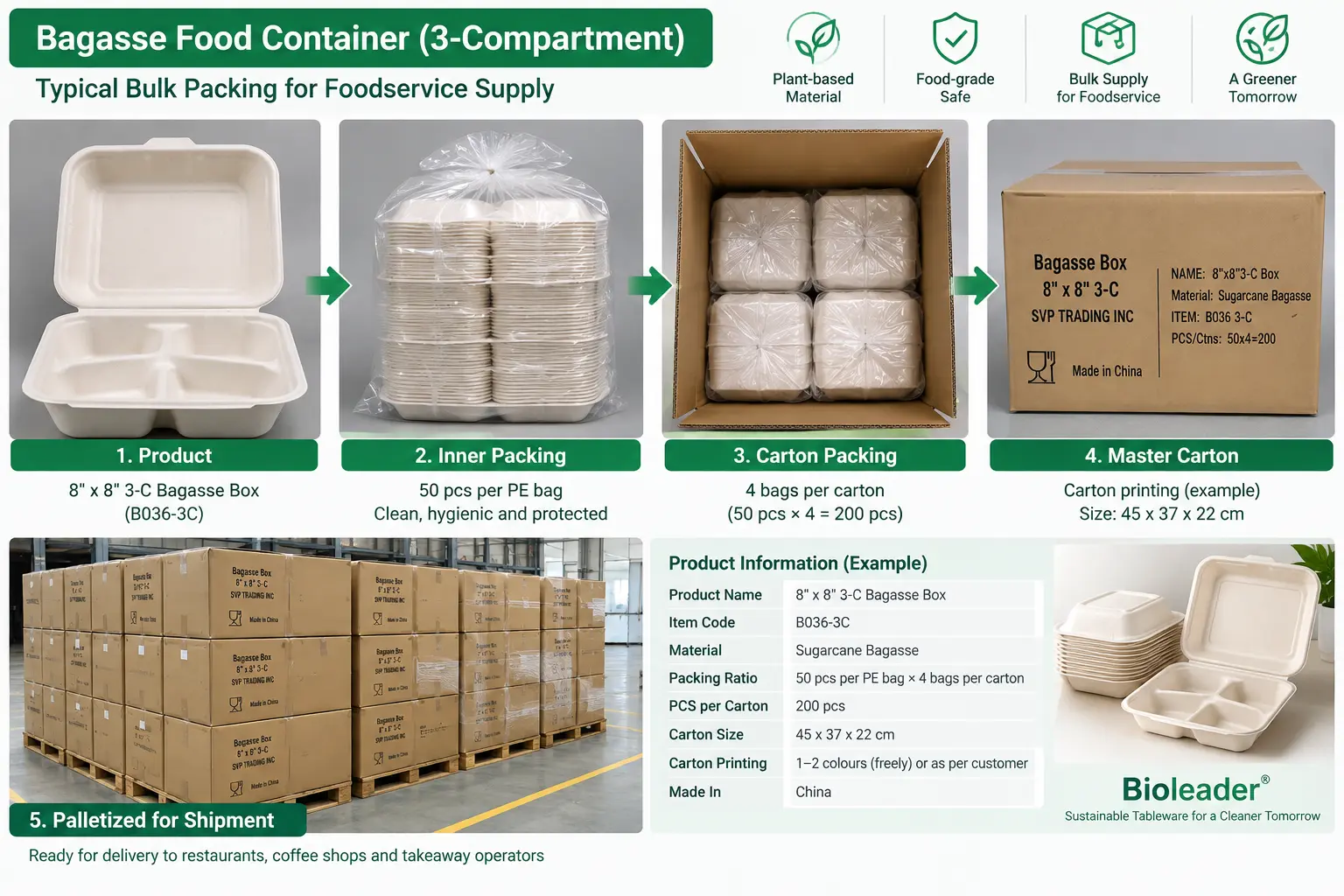
- Product: 8-inch × 8-inch 3-compartment sugarcane bagasse food container
- Inner packing: 50 containers per plain PE bag
- Outer packing: 4 bags per corrugated carton
- Total quantity: 200 containers per carton
- Typical buyer: Restaurant, takeaway operator, catering company or foodservice distributor
- Typical purchasing unit: One or more complete cartons rather than individual 50-piece bags
In this model, the inner bag normally has a practical protection function. It keeps the products clean, reduces exposure to dust and moisture, separates manageable quantities inside the carton and helps maintain hygiene during storage and handling. The bag may be completely transparent and may carry no consumer-facing artwork, barcode or retail label.
The corrugated carton performs a broader commercial and logistics role. It may protect the products during export transportation, make the goods easier to stack and handle, and also represent the normal quantity ordered by the foodservice customer. This is why the complete packaging system should be assessed according to how each layer is actually intended to function, rather than assigning a category based only on its physical position.
| Layer | Typical Bioleader® Bulk Format | Hauptfunktion | What the Buyer Should Assess |
|---|---|---|---|
| Foodservice article | Plate, cup, bowl, container or cutlery | Foodservice use | Determine whether the article itself is a product or performs a service-packaging function in its intended downstream use. |
| Plain inner bag | 50–100 pcs per PE, PP or other film bag | Hygiene, protection, containment and quantity separation | Confirm whether the bag is merely an internal packaging layer or is also intended to form an independently supplied sales unit. |
| Corrugated carton | 10–20 inner bags per carton | Protection, storage, handling, delivery and commercial supply | Determine whether the carton constitutes the normal sales unit, groups other sales units, or primarily facilitates handling and transport. |
This distinction matters because a full-carton foodservice order is commercially different from a retail-ready multipack. If a restaurant normally orders 500 plates as one complete carton and the 50-piece inner bags are never offered independently, the packaging functions should not automatically be assessed in the same way as a supermarket configuration in which every 50-piece pack is individually sold.
Manufacturer Insight: Bulk Cartons Are Common in Foodservice Supply
For Bioleader® export orders, full-carton supply is common across Zuckerrohr-Bagasse Lebensmittelbehälter, bagasse plates, paper cups, paper bowls and disposable cutlery. Plain inner bags are frequently selected for hygiene and protection rather than retail presentation. Retail-ready printed or labelled packs can also be produced, but they represent a different commercial configuration and should be documented separately when assessing PPWR packaging functions.
Wichtigste Erkenntnis: In a bulk foodservice shipment, start with the real purchasing unit. If the customer normally buys and uses complete cartons, do not assume that every inner bag is an independent retail sales pack simply because it contains a fixed number of products.
4. Are Plain PE or PP Inner Bags Packaging Under PPWR?
Yes. A plain PE or PP inner bag can still be packaging under the EU PPWR even when it has no printing, branding, barcode or retail label. PPWR defines packaging by its intended functions, including containment, protection, handling, delivery and presentation. Retail appearance is therefore not a prerequisite for an item to perform a packaging function.
This is directly relevant to disposable foodservice products. A transparent PE bag containing 50 bagasse plates may exist only to keep the plates clean, reduce moisture exposure, protect them from contamination and abrasion, and make the quantity easier to handle inside a larger carton. Those are genuine packaging functions even though the bag is not designed for supermarket display.
Important terminology: In this article, the phrase “protective inner packaging” is used as a practical supply-chain description. It is not a separate statutory packaging category created by PPWR. For formal classification, the actual function of the bag still needs to be assessed against the applicable PPWR definitions, including sales packaging, grouped packaging and transport packaging.
A Plain Inner Bag Is Not Automatically a Retail Sales Pack
The opposite mistake is also common. Because an inner bag contains a fixed quantity such as 50 or 100 pieces, buyers may assume that it must automatically be sales packaging. That conclusion is too simple.
If the buyer normally purchases complete cartons, the inner bag is not separately priced or marketed, and the bag exists primarily to protect and separate products inside the carton, its commercial role is different from an individually marketed retail pack.
Compare the following two examples:
| Merkmal | Plain Hygiene Inner Bag | Retail-Ready Inner Pack |
|---|---|---|
| Menge | 50 plates per bag | 50 plates per bag |
| Material | PE film | PE film |
| Druck | Usually none | Branding and product information may be printed |
| Barcode | Usually none | Often included |
| Normally sold separately | Nein | Ja |
| Main practical purpose | Hygiene, protection and separation | Sale, presentation and protection |
| PPWR approach | Assess its actual role within the full-carton packaging system | More clearly performs a sales-packaging function when conceived as the unit supplied to the end user |
What If the Plain Bag Is Actually Sold Separately?
Printing is not the deciding factor. A plain transparent bag can still form a sales unit if the supplier or distributor actually conceives and supplies that 50-piece pack as the unit sold to the end user.
For example, a wholesaler might receive master cartons containing 20 transparent bags of 50 forks each and then sell those individual 50-piece bags directly to restaurants. Even without printing, the commercial function of that inner bag may therefore differ from an identical-looking bag that is never separated from a full-carton sale.
Practical Rule: “No logo” does not mean “not packaging,” and “50 pcs per bag” does not automatically mean “sales packaging.” Determine how the pack is conceived, supplied and used in the real commercial chain.
5. What Is the Role of the Corrugated Carton in Bulk Foodservice Supply?
A corrugated carton is one of the most common packaging components in exported foodservice products, but it should not automatically be labelled as transport packaging simply because it is an export carton.
Under PPWR, transport packaging is packaging conceived to facilitate the handling and transport of one or more sales units or grouped sales units and to help prevent damage during handling and transport. Grouped packaging, by contrast, groups a certain number of sales units for sale, stock keeping, restocking or distribution. Sales packaging is conceived to constitute the sales unit of products and packaging supplied to the end user.
The correct assessment therefore depends on what is inside the carton and how the carton itself is used commercially.
Case 1: The Full Carton Is the Normal Commercial Unit
Consider a restaurant that orders one carton containing 500 bagasse plates:
- 50 plates per plain PE bag
- 10 plain PE bags per corrugated carton
- 500 plates per carton
- The restaurant orders and receives complete cartons
- The inner bags are not normally offered as separate retail units
In this situation, the carton does more than simply surround individually merchandised retail packs. It is also the normal commercial quantity supplied to the foodservice operator. The buyer should therefore assess whether the carton itself forms part of the sales-unit configuration rather than automatically recording it as transport packaging.
Case 2: The Carton Contains Multiple Retail Sales Units
Now consider a different configuration:
- 50 plates per printed retail bag
- Each bag carries branding, barcode and product information
- 10 retail bags per corrugated master carton
- The distributor opens the carton and sells the 50-piece packs individually
Here, the individual bags are much more clearly conceived as sales units. The master carton can then perform a grouped-packaging or transport-packaging role depending on whether its primary purpose is grouping those sales units for distribution, facilitating transport, or both within the supply chain.
Case 3: The Carton Is Used Primarily for Shipping and Handling
Some cartons are clearly added primarily to protect already defined sales or grouped units during warehousing, container loading and transportation. Where the carton is conceived mainly to facilitate handling and transport and to prevent product damage, the transport-packaging definition becomes more directly relevant.
| Commercial Situation | What Is Inside the Carton? | Primary Question | Likely PPWR Assessment Direction |
|---|---|---|---|
| Restaurant buys complete carton | Plain protective inner bags | Is the carton itself conceived as the unit supplied to the end user? | Assess the sales-unit function before calling it transport packaging. |
| Retailer buys master carton | Multiple individually sold retail packs | Does the carton group a number of existing sales units? | Grouped packaging may be relevant. |
| Additional shipping carton protects existing sales or grouped units | Already defined sales or grouped units | Is its primary purpose handling, transport and damage prevention? | Transport packaging may be relevant. |
Questions to Ask Before Classifying the Carton
- What quantity does the restaurant, coffee shop, distributor or retailer normally order?
- Are the inner bags independently marketed or sold?
- Does the customer normally receive the complete carton as the commercial unit?
- Does the carton group several already defined sales units?
- Is an additional carton or shipping layer added only for transport?
- Can the carton be removed without changing the characteristics of the products or sales units inside?
Manufacturer Insight: “Master Carton” Is a Logistics Name, Not a PPWR Classification
Export manufacturers commonly use terms such as “outer carton,” “master carton” or “export carton” on packing lists and quotations. These terms describe the physical packing format but do not by themselves establish whether the carton is sales packaging, grouped packaging or transport packaging under PPWR. For compliance documentation, the downstream commercial function should be confirmed separately.
Wichtigste Erkenntnis: A corrugated carton should be classified from its real function in the supply chain. A carton purchased as the normal full-carton unit by a foodservice operator is not automatically equivalent to a shipping carton used only to move multiple retail sales packs.
6. Scenario B: Retail Packs Sold Individually
Not all disposable foodservice products are supplied only by full carton. Some buyers require verkaufsfertige Packungen that can be sold individually to households, small restaurants, convenience stores, supermarkets, e-commerce customers or other end users.
A typical retail configuration may still use the same basic packing ratio as a bulk foodservice order, but the commercial function is different:
Typical Retail-Pack Example
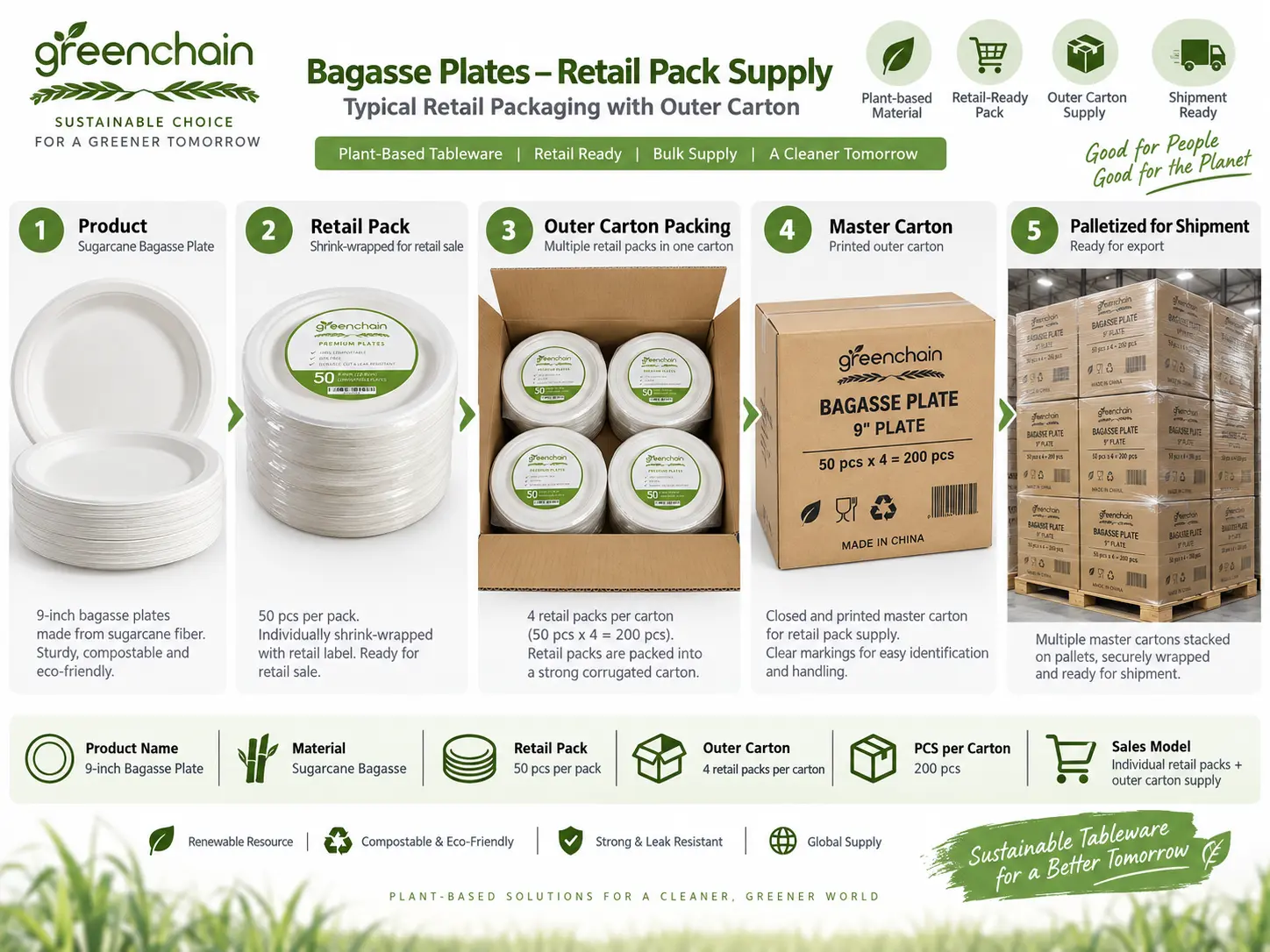
- Product: Teller aus Zuckerrohr-Bagasse
- Retail pack: 50 plates per PE, PP or compostable bag
- Retail information: Brand, product name, quantity, barcode, disposal information or other market-required information
- Master carton: 10 retail packs per corrugated carton
- Total quantity: 500 plates per master carton
- Downstream model: Individual 50-piece packs are sold separately to end users
In this scenario, the 50-piece bag is no longer merely an internal hygiene layer inside a bulk carton. If the product and bag are conceived together as the unit supplied to the end user at the point of sale, the bag performs a clear sales-packaging function under PPWR.
The outer corrugated carton then has a different role. Because it contains multiple already defined sales units, it may perform a grouped-packaging function, a transport-packaging function, or a combination of practical distribution and transport functions that must be assessed according to the actual supply chain.
| Packaging Layer | Retail Supply Example | Hauptfunktion | PPWR Assessment |
|---|---|---|---|
| Foodservice article | 50 empty bagasse plates | Disposable tableware product | Assess the article itself separately from the packaging around it. |
| Individual retail bag | 50 pcs per branded or labelled bag | Containment, protection, presentation and individual sale | If conceived as the product-and-packaging unit supplied to the end user, it performs a sales-packaging function. |
| Master carton | 10 retail packs per carton | Grouping, stock keeping, distribution and transport | Assess whether its primary function is to group sales units, facilitate transport, or both at different stages of the supply chain. |
Retail Packaging Does Not Require a Completely Different Product
The foodservice article itself may be identical in both bulk and retail projects. The same 9-inch bagasse plate, paper cup or disposable fork can be supplied in a plain hygiene pack for a restaurant project or in a printed retail pack for supermarket sale. What changes is the packaging configuration and downstream commercial function.
This is important for importers and private-label buyers because changing from a bulk carton program to a retail program can change the packaging information that needs to be documented. Material composition, unit weight, labels, printing, pack quantity and the role of the master carton should therefore be reviewed when the commercial format changes.
Manufacturer Insight: Retail Projects Should Be Identified Before Final Packaging Approval
Bioleader® commonly supplies full-carton B2B foodservice packaging, but retail-ready configurations can also be developed for distributors, supermarkets and private-label programs. Buyers should specify whether the inner pack will be sold independently before confirming artwork, labels, bag material, pack quantity and carton structure. This allows the packaging BOM and compliance documentation to reflect the actual market configuration rather than a generic factory packing method.
Wichtigste Erkenntnis: When an inner pack is conceived as the unit sold to the end user, it should be assessed as a sales-packaging unit even if the same product is also available in a completely different full-carton B2B configuration.
7. Scenario C: Plain Inner Bags That Are Still Sold as Individual Packs
A particularly important middle case occurs when the inner bag looks like ordinary bulk packaging but is nevertheless sold individually.
For example, a wholesaler may import a master carton containing 20 transparent PE bags of 100 disposable forks. The bags have no custom printing, no branding and no retail artwork. However, the wholesaler opens the master carton and sells each 100-piece bag separately to restaurants, small retailers or other end users.
In that situation, the absence of printing does not prevent the plain bag from forming the commercial sales unit.
Plain Bag, Individual Sale Example
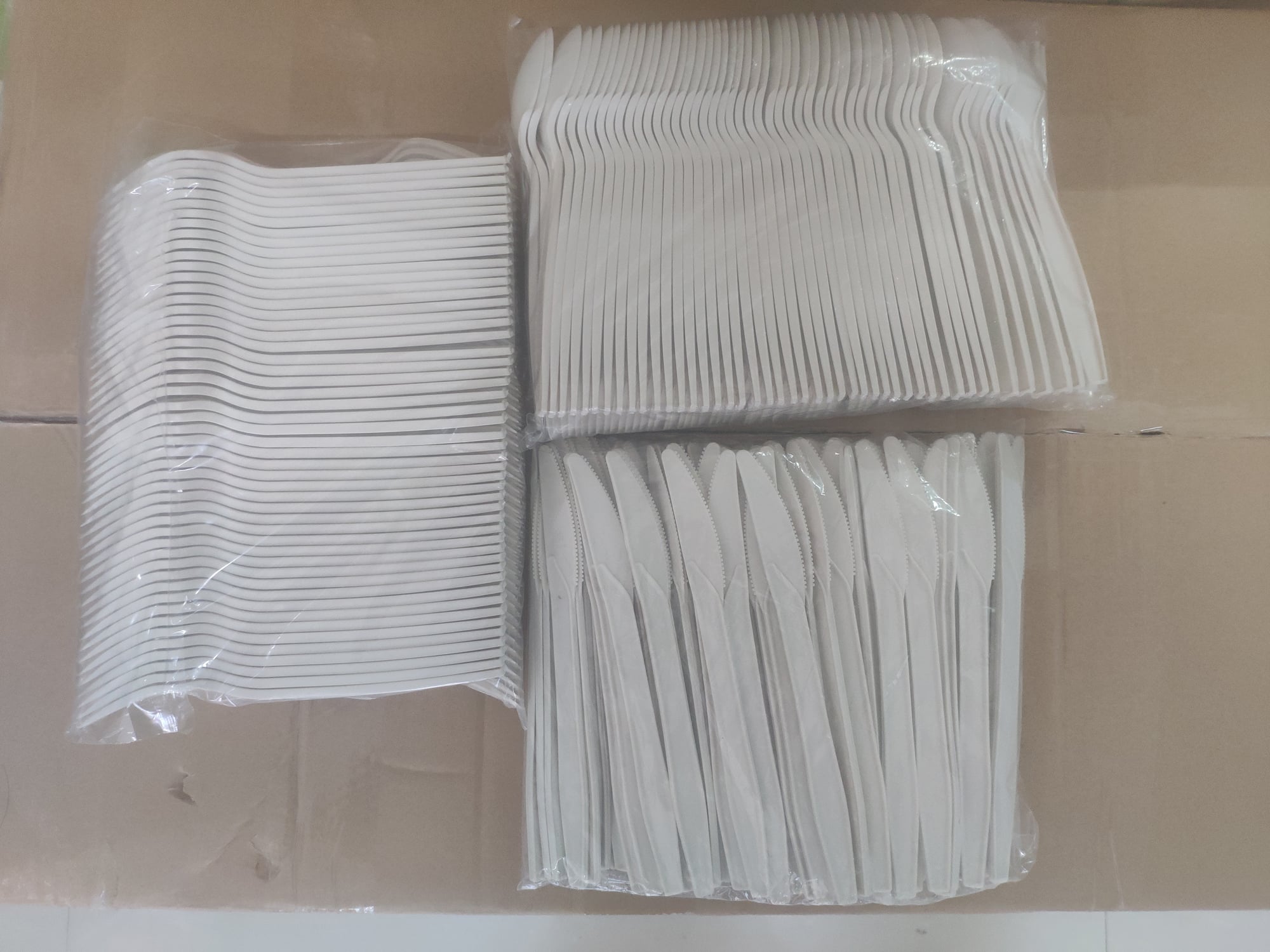
- Product: 100 disposable forks
- Bag: Plain transparent PE bag
- Druck: Keiner
- Barcode: Keiner
- Master carton: 10 bags
- Actual sales model: Each 100-piece bag is supplied separately to an end user
The correct assessment should therefore begin with the commercial reality: what unit is actually conceived and supplied as the sales unit? If the 100-piece pack is the unit normally offered to the end user, its packaging role may be that of sales packaging even though its appearance is almost identical to a plain hygiene bag used inside a full-carton order.
| Frage | Bulk Hygiene Bag | Plain Bag Sold Individually |
|---|---|---|
| Printed? | Nein | Nein |
| Contains a fixed quantity? | Ja | Ja |
| Normally sold separately? | Nein | Ja |
| Main commercial role | Internal hygiene and protection | Individual supply to the end user |
| PPWR implication | Assess within the full-carton packaging system | The bag may constitute the sales-packaging unit despite having no retail artwork |
Do not use appearance as the classification test. Two transparent PE bags can look identical but perform different PPWR functions. One may remain an internal protective layer inside a full-carton B2B order, while the other may be the actual sales unit supplied independently to the end user.
Practical Rule: The actual sales model is more important than whether the bag looks like retail packaging. A plain pack can still be sales packaging when that pack is conceived and supplied as the individual sales unit.
8. Does Printing, Labelling or a Barcode Change the Packaging Function?
Quick Answer: It is evidence of retail use, but not the only deciding factor.
Printing, a brand logo, barcode, product description, quantity declaration or consumer-facing label can strongly indicate that a bag or box has been designed for individual retail sale. However, PPWR classification does not depend on any single graphic or labelling feature.
The more important question is whether the packaging was conceived to constitute the sales unit supplied to the end user. A printed bag can be used as a sales pack, but printing by itself does not create the legal function. Likewise, a completely plain transparent bag can still be the sales unit if it is actually designed and supplied that way.
What Printing and Labels Can Tell You
| Packaging Feature | What It May Indicate | Does It Decide the PPWR Function by Itself? |
|---|---|---|
| Brand logo | Consumer or private-label presentation | Nein |
| EAN / UPC barcode | Pack may be intended for individual inventory and sale | Nein |
| Product name and piece count | Pack may function as a defined commercial unit | Nein |
| Consumer instructions | Pack is likely intended to reach the end user | Nein |
| No printing at all | Could be a hygiene pack or a low-cost sales pack | Nein |
For this reason, a PPWR assessment should not rely on a packaging photograph alone. The buyer or supplier should also confirm how the unit is ordered, invoiced, stocked, distributed and supplied downstream. For the separate question of harmonised labels, symbols and implementation timing, see Bioleader®’s guide to EU PPWR packaging labeling requirements.
Questions That Matter More Than the Artwork
- Is the inner pack assigned its own commercial SKU?
- Can the inner pack be ordered or sold separately?
- Is the complete carton the normal purchasing unit?
- Does a distributor open the carton and resell individual packs?
- Is the barcode used for individual retail scanning or only internal logistics?
- Does the inner pack reach the final user in the same form?
- Is the outer carton only used for grouping and transport, or is it itself the normal sales unit?
Manufacturer Insight: Custom Printing Is a Packaging Change, Not Just a Graphic Change
When a Bioleader® customer changes a plain bulk pack into a branded retail pack, the project should be reviewed as a packaging-system change rather than only an artwork update. The supplier should confirm the bag or box material, pack quantity, printing or label structure, individual pack weight, carton configuration and intended sales channel so that the packaging documentation reflects the final SKU placed on the market.
9. What If the Inner Bag Is Compostable?
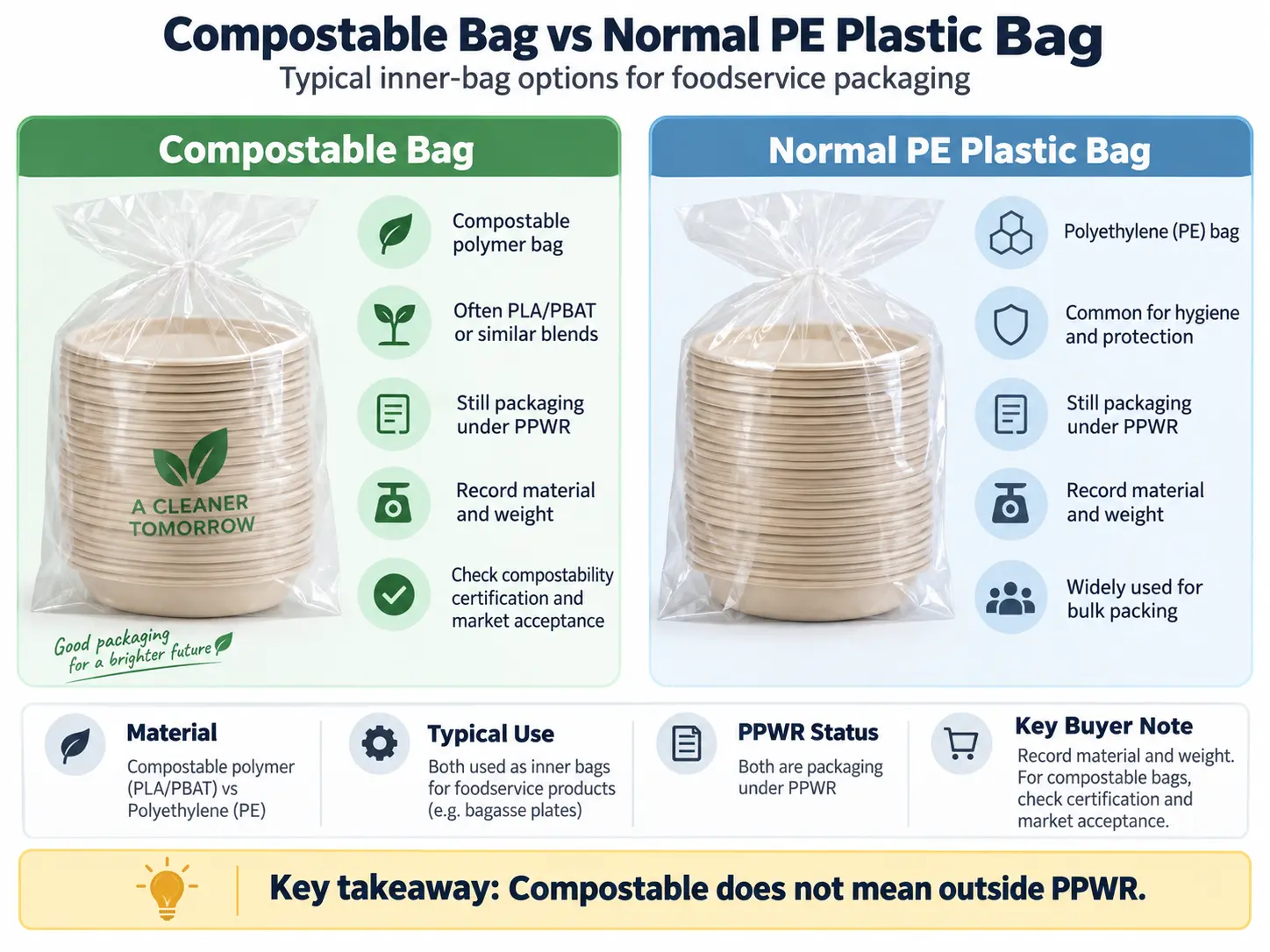
Replacing a conventional PE or PP inner bag with a compostable bag can change the material specification and end-of-life pathway, but it does not automatically change the bag’s packaging function under PPWR.
If a compostable bag is used to contain 50 plates for hygiene and protection, it is still packaging. If that same compostable bag is conceived as an individually sold retail pack, it can still perform a sales-packaging function. The functional assessment therefore remains the same: determine how the bag contains, protects, groups, delivers or presents the products and how the unit is supplied downstream.
Compostable Does Not Mean “Outside the Plastic Rules”
This distinction is particularly important for bags made from materials such as PLA, PBAT or blends containing starch and compostable polymers. Under PPWR, a plastic is defined by its polymer-based structure, and biobased plastics remain plastics irrespective of whether they are biodegradable or non-biodegradable. The European Commission likewise distinguishes biobasierte, biologisch abbaubare und kompostierbare Kunststoffe as different concepts rather than interchangeable claims. A compostability claim therefore should not be used as a substitute for an accurate material declaration.
| Inner Bag Description | Recommended Material Record | What Should Not Be Used as the Only Description |
|---|---|---|
| Conventional transparent bag | PE or PP, as applicable | Plastic bag |
| PLA/PBAT compostable bag | Actual polymer composition or supplier-declared material specification | Biodegradable material |
| Starch-based compostable polymer bag | Actual starch/polymer formulation category supported by technical documentation | Plant-based bag |
| Certified compostable bag | Material composition plus applicable compostability evidence and certificate scope | Eco-friendly bag |
Wichtig: A compostable inner bag should not automatically be treated as exempt from normal PPWR requirements simply because it carries an industrial-compostability certification. PPWR Article 9 creates specific compostability rules for defined packaging formats and allows certain additional national requirements under specified conditions. Buyers should therefore verify whether the particular bag format falls within an EU-level compostability requirement, a Member State rule, or the general PPWR requirements applicable to its packaging category. For a broader market-by-market certification context, see Bioleader®’s Leitfaden zu globalen Vorschriften für kompostierbare Verpackungen 2026.
Industrial Compostability and Home Compostability Are Not the Same
PPWR distinguishes compostable packaging from home-compostable packaging. Industrial compostability relies on controlled treatment conditions, while home composting takes place under much less controlled conditions. An industrial compostability certificate therefore should not automatically be presented as evidence that the same packaging will fully biodegrade in home composting.
Should a Buyer Replace PE With a Compostable Bag?
Not necessarily. The packaging decision should consider the destination market, collection system, composting infrastructure, certification requirements, product-protection performance, storage conditions, cost and the risk of contaminating other waste streams. PPWR itself recognises that compostable plastic packaging can create confusion or cross-contamination when it enters an unsuitable waste stream.
Before Specifying a Compostable Inner Bag
- Confirm the exact bag material rather than accepting only the word “biodegradable.”
- Confirm whether the bag is industrially compostable, home compostable or neither.
- Check the scope and validity of any compostability certification.
- Confirm whether the destination Member State requires, permits or restricts compostable packaging for the relevant format.
- Verify whether local organic-waste collection facilities actually accept that packaging.
- Compare moisture protection, sealing performance and storage stability with the conventional PE or PP alternative.
- Record the weight of the compostable bag separately in the packaging BOM.
Manufacturer Insight: Choose the Inner Bag for the Market, Not Only for the Sustainability Claim
Bioleader® can support different inner-packing configurations depending on the product and project requirements, including conventional protective film and compostable-bag options where technically and commercially suitable. For EU projects, buyers should select the bag only after considering the destination market’s waste system, documentation requirements and actual sales model. Changing the bag material does not remove the need to document its function, composition and weight.
Wichtigste Erkenntnis: A compostable inner bag is still packaging. Compostability changes the material and possible end-of-life route; it does not erase the bag from PPWR assessment or automatically change a bulk hygiene pack into a retail sales pack.
10. How to Record Packaging Materials and Weights
Once the packaging function has been identified, the next step is to build a packaging Bill of Materials (BOM) for each SKU. This is more useful than a general statement such as “packed in PE bags and cartons” because PPWR and EPR reporting increasingly depend on knowing what packaging is placed on the market, what material it contains and how much it weighs. The BOM should also connect to the technical file for the exact SKU; Bioleader®’s PPWR Declaration of Conformity guide for foodservice packaging explains how SKU data and supporting evidence can be mapped into a compliance workflow.
Under the PPWR producer-reporting framework, packaging quantities are reported by weight and by applicable packaging category. Annex II and Annex IX of Regulation (EU) 2025/40 provide the relevant material-category and producer-reporting framework. For a foodservice importer, this means that plastic film, paper or cardboard, biodegradable plastic and other packaging materials should not be combined into one undifferentiated packaging weight.
Practical Rule: Build the packaging BOM from the individual packaging components, not from the gross carton weight. Record the weight of each bag, carton, lid, sleeve, label or other relevant component separately and multiply it by the quantity used in the commercial configuration.
Recommended Packaging BOM Fields
| Feld | What to Record | Warum es wichtig ist |
|---|---|---|
| SKU / Item Code | Exact product reference | Prevents packaging data from being applied to the wrong product specification. |
| Intended Use | Bulk foodservice, point-of-sale filling, retail sale or other use | Helps determine whether the foodservice article itself falls within the PPWR packaging definition. |
| Packaging Component | Product or service packaging, inner bag, retail pack, lid, carton, tape, label or sleeve | Separates the different layers of the packaging system. |
| Packaging Function | Sales, grouped, transport or other applicable function | Supports PPWR classification. |
| Material | PE, PP, paper/cardboard, moulded fibre, PLA/PBAT blend or other actual material | Supports material-category reporting and compliance review. |
| Weight per Component | Actual verified weight in grams | Provides the basis for packaging-weight calculations. |
| Quantity per Pack | Number of components used in each inner or retail pack | Allows calculation at pack level. |
| Quantity per Carton | Number of bags, packs, lids or other components in each carton | Allows calculation at carton level. |
| Total Weight per Carton | Component weight multiplied by component quantity | Provides a practical basis for shipment and EPR calculations. |
| Specification Version | Date or revision number | Prevents outdated packaging data from being reused after a material or packing change. |
Use Actual Component Weight, Not an Estimate From Gross Weight
The preferred method is to weigh each packaging component separately. For example, weigh one empty PE bag, one empty corrugated carton and the relevant labels or other components. Where production tolerances exist, the supplier can document the nominal or verified average weight and the applicable specification tolerance.
Simply subtracting product net weight from the shipping carton gross weight is less reliable because the result can include packing variation, moisture, pallets, protective sheets or other materials that are not part of the same packaging level.
Wichtig: Do not automatically exclude the foodservice article itself from the packaging BOM. A disposable cup, plate or food container designed and intended to be filled at the point of sale may itself qualify as service packaging. Disposable cutlery, by contrast, is specifically listed as a non-packaging item and should not be counted as packaging merely because it is disposable.
Simple Weight Calculation
If one PE inner bag weighs 5 g and a carton contains 10 bags, the PE packaging contribution is 50 g per carton. If the corrugated carton weighs 650 g, the carton contributes another 650 g. These material weights should remain separate rather than being reported as a single 700 g packaging figure without material identification.
For larger shipments, the same verified BOM can be multiplied by the number of cartons placed on the relevant market. This gives importers a repeatable calculation method instead of rebuilding packaging data shipment by shipment.
11. PPWR Packaging BOM Example for Bagasse Plates
Einweggeschirr aus Zuckerrohr-Bagasse illustrates why PPWR reporting needs both material data and intended-use information, and bagasse plates provide a clear SKU-level example. A disposable plate designed and intended to be filled with food at the point of sale can fall within the definition of service packaging. If the same plate is sold empty for a different final use and is not intended to be filled at the point of sale, its status can be different.
Illustrative example only: The weights below are simplified examples used to demonstrate the calculation method. They are not Bioleader® standard specifications, quotations or guaranteed product weights.
Example Configuration
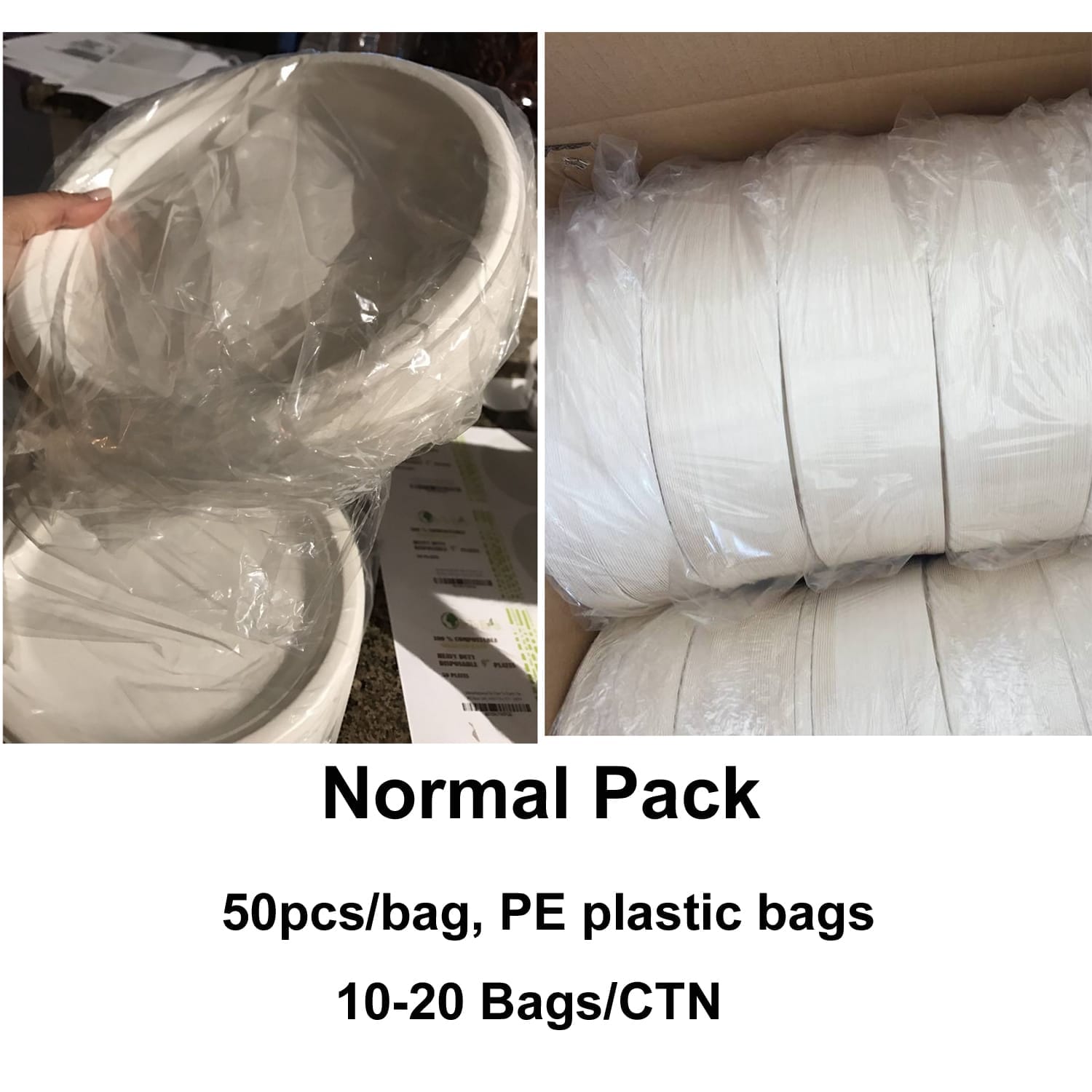
- 500 bagasse plates per carton
- 50 plates per plain PE inner bag
- 10 PE bags per carton
- Illustrative plate weight: 18 g
- Illustrative PE bag weight: 5 g
- Illustrative corrugated carton weight: 650 g
- Illustrative carton tape and label weight: 15 g
| Komponente | Material | Menge | Illustrative Unit Weight | Total Weight per Carton | PPWR Treatment |
|---|---|---|---|---|---|
| Bagasse-Teller | Moulded sugarcane fibre | 500 pcs | 18 g | 9,000 g | Include as packaging where the plates are designed and intended to be filled at the point of sale. Confirm the applicable reporting material category for the destination market. |
| Plain inner bag | PE flexible film | 10 bags | 5 g | 50 g | Packaging; record separately as flexible plastic packaging. |
| Corrugated carton | Corrugated paper/cardboard | 1 carton | 650 g | 650 g | Packaging; assess sales, grouped or transport function according to the actual commercial model. |
| Tape / label | As specified | Per carton | 15 g total | 15 g | Record the relevant packaging components according to their actual materials. |
If the bagasse plates qualify as service packaging in this example, the total packaging system represented in the carton is approximately 9.715 kg, but that number should not be reported as one material. The moulded fibre article, PE film, corrugated cardboard and other components should remain identifiable in the underlying BOM.
If the plates themselves do keine qualify as packaging in the actual downstream use, their 9,000 g product weight should not simply be added to packaging tonnage. The packaging surrounding the product would then need to be assessed separately.
Wichtigste Erkenntnis: For bagasse plates, first determine whether the plate itself is service packaging. Only after that classification is clear should the importer calculate the packaging weight placed on the relevant EU market.
12. PPWR Packaging BOM Example for Paper Cups or Bowls
Bioleader®s Papier Lebensmittelverpackung Angebot umfasst Papierbechern, soup containers and salad bowls that are common examples of foodservice articles that can themselves be packaging. Where they are designed and intended to be filled with beverages or food at the point of sale, they normally perform a service-packaging function.
The material description also matters. A paper cup with PE or another polymer lining should not simply be recorded as “paper” without documenting the actual construction. PPWR Annex II specifically recognises paper/cardboard composite packaging, including laminated paper cups.
Illustrative example only: The dimensions, weights and packing ratios below are used only to show the BOM method and are not Bioleader® fixed specifications.
Example Paper Cup Configuration
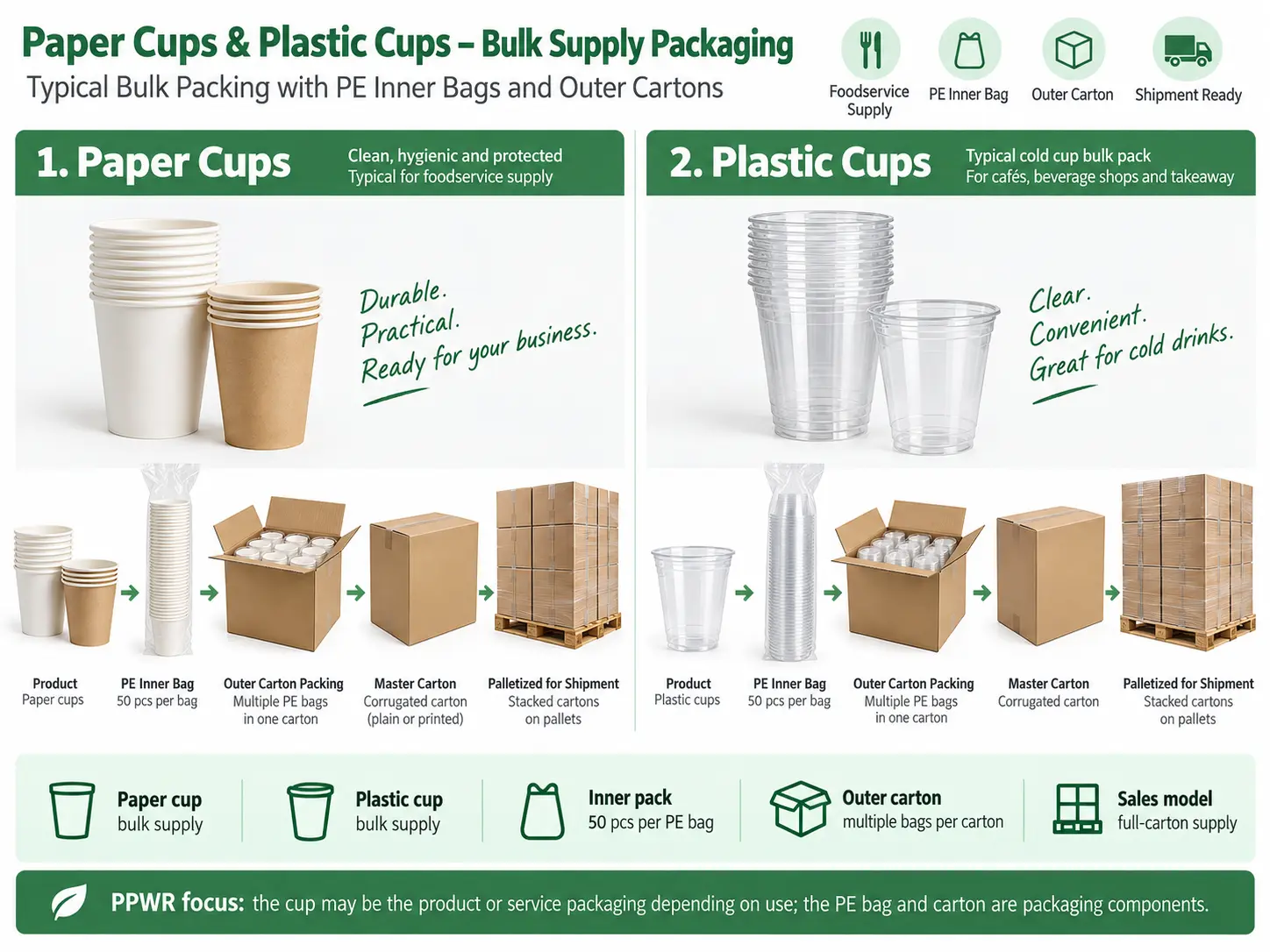
- 1,000 cups per carton
- 50 cups per PE inner bag
- 20 bags per carton
- Illustrative cup weight: 10 g
- Illustrative PE bag weight: 6 g
- Illustrative corrugated carton weight: 750 g
- Illustrative tape and label weight: 15 g
| Komponente | Material / Structure | Menge | Illustrative Unit Weight | Total Weight per Carton | Reporting Note |
|---|---|---|---|---|---|
| Papierbecher | Paperboard with applicable barrier or polymer lining | 1,000 pcs | 10 g | 10,000 g | Where intended for point-of-sale filling, record as service packaging and document the actual material structure. |
| PE inner bag | PE flexible film | 20 bags | 6 g | 120 g | Record separately as flexible plastic packaging. |
| Corrugated carton | Paper/cardboard | 1 carton | 750 g | 750 g | Record separately and determine its packaging function from the sales and distribution model. |
| Tape / label | According to actual specification | Per carton | 15 g total | 15 g | Include relevant packaging components in the BOM. |
In this example, the total physical packaging system would weigh approximately 10.885 kg per carton where the cups themselves qualify as service packaging. The underlying reporting record should still distinguish the paper-based cup structure, flexible plastic inner bags, corrugated carton and any other relevant components.
What If a Lid Is Supplied?
If the cup or bowl is sold with a separate PP, PET, PLA, paper or other lid, the lid should be added as a separate BOM component. Buyers should not assume that the material classification of the cup automatically covers the lid.
Zum Beispiel kann ein Papierschale oder Papierschale für Salat with a PP lid creates at least two different material records: the predominantly paper/cardboard bowl structure and the rigid PP lid. The inner bag and corrugated carton then add further packaging layers. The same component-level BOM logic also applies to transparente PLA Becher when they are supplied with separate lids, sleeves, bags or cartons.
Wichtigste Erkenntnis: “1,000 paper cups per carton” is not sufficient PPWR data. Buyers need the cup structure, cup weight, inner-bag material and weight, carton weight and any lid or accessory packaging that forms part of the final commercial configuration.
13. PPWR Packaging BOM Example for Cutlery
Bioleader®s biologisch abbaubarem und kompostierbarem Besteck provides a useful contrast with cups and plates because disposable cutlery itself is listed as a non-packaging item under PPWR. A fork, knife or spoon should therefore not be counted as packaging merely because it is disposable or supplied to a restaurant.
The packaging around the cutlery still needs to be assessed.
Illustrative example only: The weights below demonstrate the packaging calculation method and are not Bioleader® fixed product specifications.
Example Cutlery Configuration
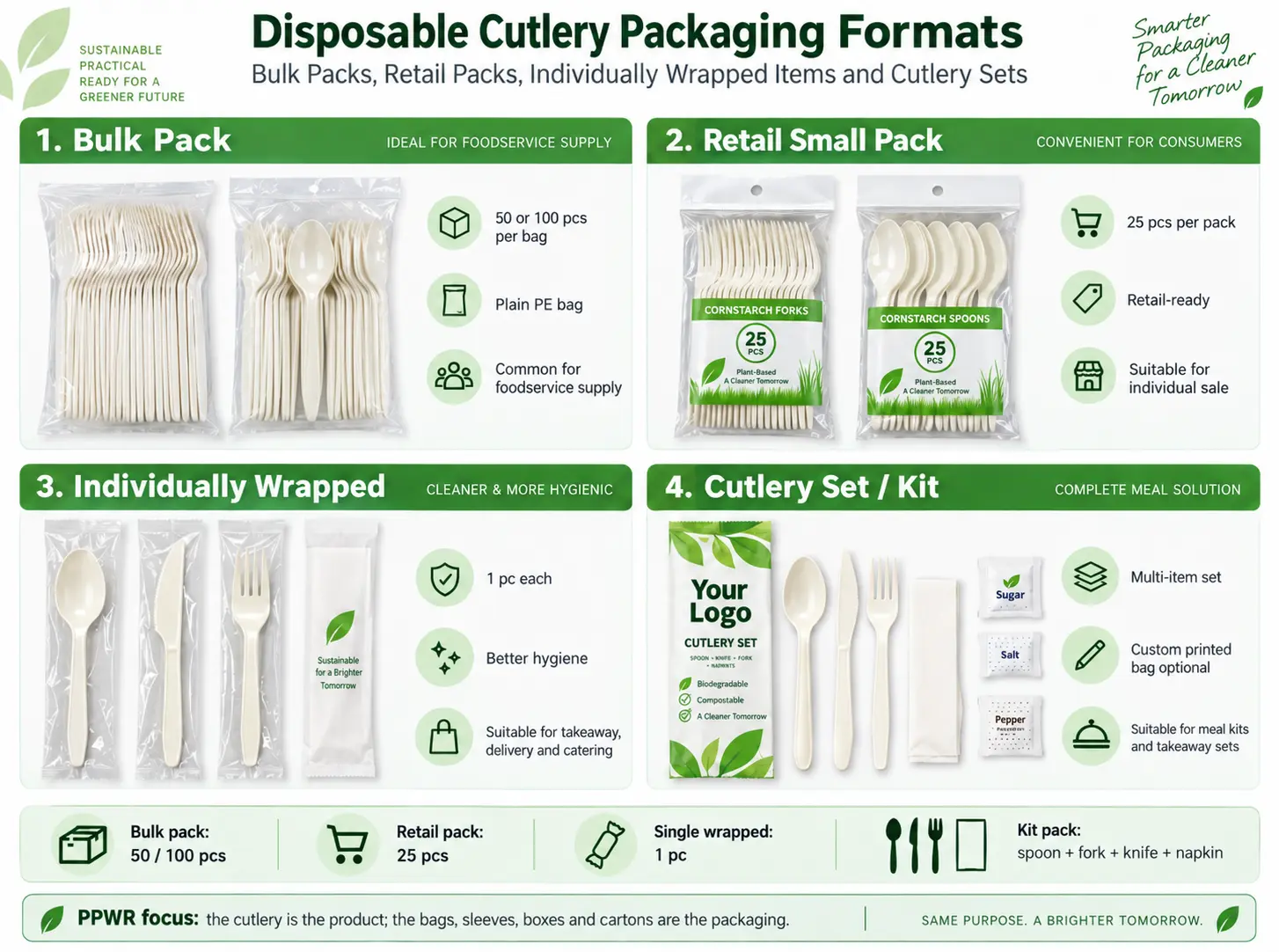
- 1,000 forks per carton
- 50 forks per plain PE bag
- 20 PE bags per carton
- Illustrative PE bag weight: 4 g
- Illustrative corrugated carton weight: 700 g
- Illustrative tape and label weight: 15 g
| Komponente | Material | Menge | Illustrative Unit Weight | Packaging Weight per Carton | PPWR Treatment |
|---|---|---|---|---|---|
| Disposable forks | CPLA Besteck, Maisstärke-Besteck, wood or other specified material | 1,000 pcs | Produktspezifikation | Not included as packaging weight | Disposable cutlery itself is listed as non-packaging. |
| Plain PE bags | PE flexible film | 20 bags | 4 g | 80 g | Packaging; classify its commercial function according to how the packs are supplied. |
| Corrugated carton | Paper/cardboard | 1 carton | 700 g | 700 g | Packaging; assess sales, grouped or transport function. |
| Tape / label | According to specification | Per carton | 15 g total | 15 g | Record relevant packaging components separately. |
In this simplified example, the packaging surrounding 1,000 forks contributes approximately 795 g of packaging per carton. The weight of the forks themselves is product weight and should not be incorrectly added to the packaging tonnage.
If the forks are individually wrapped, packed as retail sets, supplied with napkins or placed into printed paper sleeves, those additional components should be added to the packaging BOM according to their actual material and weight. Buyers comparing materials, pack formats and sourcing options can also review Bioleader®’s kompostierbare Bestecklösungen overview.
Wichtigste Erkenntnis: Do not apply the same PPWR calculation to every foodservice product. A cup or plate intended for point-of-sale filling may itself be packaging, while disposable cutlery is not. The bags, wrappers and cartons around the cutlery remain packaging and must still be recorded.
14. PPWR Compliance vs National EPR Reporting
PPWR compliance and EPR reporting are related, but they are not the same task. This distinction is important for Chinese manufacturers, EU importers, distributors and private-label buyers because a technically compliant packaging specification does not by itself complete the producer’s registration, reporting or fee obligations in every Member State. The European Commission’s 2026 guidance distinguishes the PPWR roles of the manufacturer and the producer, while the Commission’s packaging-waste overview provides the wider EU policy context.
| Frage | PPWR Product / Packaging Compliance | EPR Registration and Reporting |
|---|---|---|
| Main question | Does the packaging placed on the EU market meet the applicable PPWR requirements? | Who is the responsible producer and how much packaging is made available for the first time in a particular Member State? |
| Typical evidence | Technical documentation, material information, testing, conformity assessment and applicable Declaration of Conformity documentation | Producer registration, packaging quantities, packaging categories, reporting period and EPR fulfilment arrangements |
| Measurement focus | Compliance of the packaging specification | Quantities of relevant packaging placed on the national market, generally reported by weight and applicable category |
| Geographic level | EU regulatory framework | Registration and fulfilment operate through the relevant Member State systems |
| Who may be responsible? | Depends on the manufacturer’s, importer’s, distributor’s or brand owner’s legal role under PPWR | The party qualifying as the producer for EPR purposes in the relevant Member State, which may depend on establishment, import, branding and sales model |
PPWR Article 44 and Annex IX require the relevant producer to register and report according to the Regulation and the applicable Member State framework, including the reporting period and quantities by weight of applicable packaging categories. For a wider comparison of EPR systems and supplier preparation, Bioleader® also maintains a guide to global EPR packaging rules.
This means that there is no sound basis for a supplier to tell every EU customer that one generic “PPWR certificate” automatically completes EPR obligations across Europe. The responsible company still needs to determine its legal role and use the applicable national registration, producer responsibility organisation or reporting procedure for each market concerned.
Wichtig: The Chinese exporter should provide accurate packaging composition and weight data, but it should not automatically assume that it is the party responsible for the buyer’s national EPR registration. The legal producer can vary depending on how the goods are branded, imported and made available on the market.
Why the Packaging BOM Helps With EPR
A good packaging BOM creates the factual data layer needed by the responsible EU operator. If an importer brings 100 cartons of a SKU into a Member State, the importer can multiply the verified component weights by the number of cartons and then map those quantities into the applicable national reporting categories.
For example, if each carton contains 50 g of PE inner-bag film and 650 g of corrugated cardboard, 100 cartons contain approximately 5 kg of PE film and 65 kg of corrugated cardboard before considering any other packaging components or any foodservice article that itself qualifies as packaging.
Wichtigste Erkenntnis: PPWR answers whether and how packaging must comply. EPR reporting answers who must register and report the packaging placed on a particular national market, in what quantity and under which applicable reporting category.
15. What Information Should Suppliers Give EU Buyers?
For ordinary foodservice products, EU buyers usually do not need an unnecessarily complicated document from the factory. They need accurate, SKU-specific and traceable packaging information that can be connected to the final commercial configuration. Where testing or certification evidence is relevant, buyers can review Bioleader®’s Zertifikate und Testberichte as a starting point, while confirming that every document applies to the exact ordered SKU and packaging configuration.
A practical supplier data sheet should normally include the following information where applicable:
| Information | Beispiel | Why the Buyer Needs It |
|---|---|---|
| Product / SKU | 9-inch bagasse plate | Links the packaging BOM to the exact product. |
| Verwendungszweck | Foodservice plate intended for filling at point of sale | Helps determine whether the article itself is service packaging. |
| Packing ratio | 50 pcs/bag × 10 bags/carton | Defines the complete commercial configuration. |
| Inner-bag material | PE film | Allows correct material identification. |
| Inner-bag weight | Verified grams per bag | Allows packaging-weight calculation. |
| Retail status | Plain hygiene pack / individually sold retail pack | Supports assessment of the bag’s packaging function. |
| Carton material | Corrugated paperboard | Supports material reporting. |
| Empty carton weight | Verified grams per carton | Provides packaging tare weight. |
| Additional components | Lid, sleeve, label, tape or wrapper | Prevents small but recurring packaging components from being omitted. |
| Product material structure | Bagasse fibre, paperboard + PE, paperboard + PLA, PP lid, PET lid | Important where the product itself qualifies as packaging. |
| Relevant compliance evidence | Food-contact, PFAS, compostability or other applicable documents | Supports the buyer’s technical compliance file. |
| Revision date | YYYY-MM-DD | Shows which packaging configuration the data applies to. |
Manufacturer Insight: One Packaging BOM Should Match One Final SKU Configuration
Bioleader® buyers may use the same foodservice article in several commercial formats: full-carton bulk packing, plain individual packs, printed retail packs or alternative compostable inner bags. These configurations should not share one generic packaging declaration if the materials, weights or sales functions are different. The final packaging BOM should match the actual SKU supplied.
Buyers should also notify the supplier when changing the inner-bag material, carton size, lid, printed retail pack, label structure or pack quantity. Such changes can affect both the packaging BOM and the compliance evidence associated with the final configuration.
16. Buyer Checklist
PPWR Packaging Checklist for Cups, Bowls, Plates and Cutlery
- Confirm the intended use: Determine whether the cup, bowl, plate or container is intended to be filled at the point of sale or sold empty for another use.
- Separate product from packaging: Do not assume every disposable foodservice article is packaging. Disposable cutlery itself is not packaging under the PPWR examples.
- Identify the actual sales unit: Confirm whether the buyer normally purchases a complete carton or individual inner packs.
- Identify the inner-bag function: Determine whether it is primarily a hygiene/protection layer, an independently sold pack or both.
- Do not classify from printing alone: A plain pack can be a sales unit, while a printed pack is not automatically classified solely by its artwork.
- Check the carton function: Determine whether it forms the commercial sales unit, groups existing sales units or primarily facilitates transport.
- Record every material separately: Keep PE, PP, biodegradable plastic, paper/cardboard and other materials identifiable in the packaging BOM.
- Measure actual component weights: Use verified bag, carton, lid, sleeve and label weights instead of relying only on shipment gross weight.
- Add lids and accessories: PP, PET, PLA or paper lids should be recorded separately where supplied.
- Do not describe compostable bags only as “biodegradable”: Record the actual material composition and applicable certification scope.
- Keep retail and bulk configurations separate: A 50-piece plain hygiene pack and a 50-piece retail pack may look similar but perform different commercial functions.
- Maintain revision control: Update the BOM when materials, suppliers, weights, printing, labels or packing ratios change.
- Confirm the responsible EPR producer: Determine who places the packaging on the relevant Member State market for the first time under the applicable PPWR definitions.
- Check the destination country’s reporting process: EU PPWR provides the regulatory framework, but national producer registration and EPR fulfilment still need to be handled for the relevant Member State.
Bioleader® Packaging Data Support for EU Buyers
For bulk foodservice projects, Bioleader® can support buyers by confirming product packing ratios, inner-packing materials, carton configurations and available product-specific compliance documentation. Where PPWR or EPR data is required, the packaging specification should be based on the final ordered SKU rather than a generic catalogue configuration.
For custom retail packing, buyers should confirm the sales channel, pack quantity, printing or labelling requirements and destination market before final packaging approval. This allows the packaging structure and supporting documentation to be aligned before mass production. For a broader procurement review covering PFAS-free, fibre-based and compostable takeaway packaging, see the Bioleader® PPWR checklist for foodservice packaging buyers.
Final Procurement Recommendation
For ordinary foodservice exports, PPWR reporting does not need to begin with a complicated compliance system. Start with a reliable component-level packaging BOM: identify what is packaging, determine the function of each layer, document the actual material, verify the unit weight and calculate the quantity placed on the relevant market. Once those facts are correct, the EU buyer can map the data into the applicable PPWR and national EPR requirements with much lower risk of double counting or material misclassification.
17. Frequently Asked Questions
Gelten einfache Innenbeutel aus PE oder PP als Verpackung im Sinne der EU-PPWR?
Ja. Ein schlichter PE- oder PP-Beutel kann Verpackung sein, auch wenn er kein Logo, keinen Barcode oder keinen Einzelhandelsaufdruck hat. Wenn er dazu dient, Produkte zu enthalten, zu schützen, zu handhaben oder zu liefern, erfüllt er eine Verpackungsfunktion. Ein schlichter Innenbeutel sollte jedoch nicht automatisch als Einzelhandelsverkaufsverpackung eingestuft werden. Seine spezifische PPWR-Funktion hängt davon ab, wie die Verpackung in der tatsächlichen Handelskette konzipiert und geliefert wird.
Wenn ein Restaurant den kompletten Karton kauft, ist der Wellpappkarton dann automatisch Verkaufsverpackung?
No. Full-carton purchasing is an important commercial fact, but it does not by itself settle the legal classification. The carton should be assessed according to its intended function. It may form part of the sales-unit configuration, group other sales units or primarily facilitate handling and transport. Buyers should therefore document how the carton is normally supplied and what function it performs rather than classifying it only from its appearance.
Sind Zuckerrohr-Bagasse-Teller selbst Verpackungen im Sinne der PPWR?
Das können sie sein. PPWR umfasst Einwegteller, die dazu bestimmt und vorgesehen sind, am Verkaufsort befüllt zu werden, im Rahmen der Verpackungsdefinition. Ein Zuckerrohr-Bagasse-Teller, der an ein Restaurant zum Servieren von Speisen geliefert wird, kann daher eine Serviceverpackungsfunktion haben. Ein Einwegteller, der leer für einen anderen Endverwendungszweck verkauft wird, kann anders behandelt werden. Die beabsichtigte nachgelagerte Verwendung sollte dokumentiert werden, bevor sein Gewicht in die Verpackungsberichterstattung einbezogen wird.
Are paper cups and paper bowls packaging under PPWR?
Where cups or bowls are designed and intended to be filled with beverages or food at the point of sale, they can qualify as service packaging. Their own weight and material structure may therefore be relevant to PPWR reporting. Buyers should also record separate lids, inner bags and cartons rather than treating the entire shipment as one paper-packaging material.
Is disposable cutlery counted as packaging?
No. Disposable cutlery is specifically listed as a non-packaging item in the PPWR indicative examples. The fork, knife or spoon itself should therefore not be added to packaging tonnage merely because it is disposable. However, PE bags, individual wrappers, paper sleeves, retail boxes and corrugated cartons used around the cutlery are packaging and should be documented separately.
Does using a compostable inner bag remove the need for plastic packaging reporting?
No. A compostable bag remains packaging, and biodegradable or biobased polymer packaging does not disappear from PPWR assessment simply because it is compostable. The buyer should record its actual material composition, weight and certification status. PPWR Annex II also recognises biodegradable plastics as a packaging material category, so “compostable” should not be used as a substitute for material identification.
How should an EU importer calculate packaging weight for EPR reporting?
The importer should start with a verified packaging BOM for each final SKU. Record the weight and quantity of every relevant component, such as service packaging, inner bags, lids, retail packs and cartons. Multiply those component weights by the number of units or cartons placed on the relevant national market, then map the totals into the applicable packaging categories required by that Member State’s reporting system.
References and Official Sources
This article is intended as a practical B2B packaging and procurement guide. PPWR classification and EPR responsibility should be confirmed against the final SKU, actual sales model and destination Member State requirements. The following official EU sources support the regulatory framework discussed above:
- Regulation (EU) 2025/40 on Packaging and Packaging Waste (PPWR) — EUR-Lex. Official legal text covering the packaging definition, sales/grouped/transport packaging, compostable packaging, manufacturer and producer obligations, Annex I examples, Annex II material categories and Annex IX registration/reporting information.
- European Commission Notice C/2026/3084 — Guidance document for Regulation (EU) 2025/40. Commission interpretation guidance covering packaging-status assessment, the empty-cup versus service-packaging example, manufacturer and producer roles, and practical PPWR implementation questions.
- European Commission — New EU rules on packaging enter into application. Official 2026 implementation update confirming that PPWR generally applies from 12 August 2026 and describing the staged application of key measures.
- European Commission — Packaging Waste. Official overview of the PPWR framework, packaging-waste objectives, design requirements and waste-management policy.
- European Commission — Biobased, Biodegradable and Compostable Plastics. Official policy guidance explaining the differences between biobased, biodegradable and compostable plastics and the importance of appropriate end-of-life systems.