

Paper bowl logo printing artwork: what to send before production
Before you lay out a logo, confirm the bowl model and ask us for its current dieline. The artwork has to fit the flat sidewall blank, leave room for the seam and rim, and print clearly on the chosen paperboard. Even a clean vector file may need a new layout when the bowl size changes.
Bioleader® supports logo printing on kraft and white paper bowls, including selected soup, salad, rectangular and compartment formats. Our custom printed paper bowls with lids page shows the available formats and print options. Start with the logo, model code and colour target. Use the factory drawing to prepare the production layout.
| Send this | Why the factory needs it | A common avoidable problem |
|---|---|---|
| Bowl model, capacity and reference photo | Identifies the actual sidewall shape and printable area | Designing a 1,000 ml bowl with a 750 ml template |
| Editable vector logo: AI, PDF, EPS or CDR | Allows clean scaling, colour separation and positioning | Sending only a screenshot from a website |
| Pantone or agreed CMYK reference | Defines the target brand colour | Expecting a screen RGB colour to match kraft paper exactly |
| Factory-issued dieline, with version | Identifies trim, seam, bleed and restricted zones | Reusing a generic cup or another factory’s layout |
| Fonts outlined or supplied lawfully; images embedded or linked | Prevents missing characters or pictures | A supplier opens the file and sees substitute fonts |
| Approval contact and file revision | Makes it clear which design is authorised | Production starts from an obsolete proof |
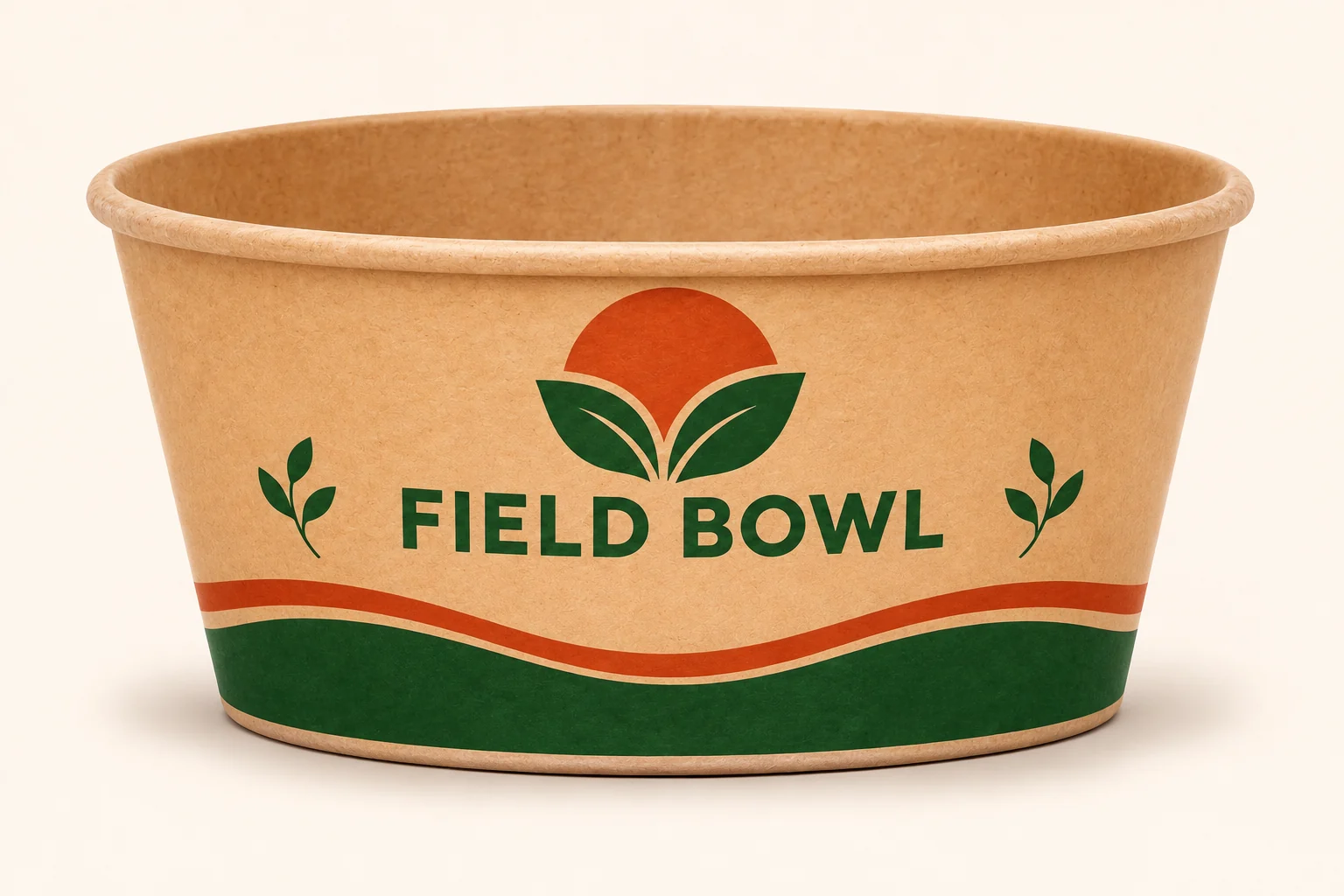
A workable file is not the same as an approved print job
If you have a clean logo and a bowl specification, send both. In our OEM workflow, we can start with an AI, PDF or CDR file or a clear logo reference. We supply or confirm the drawing for the selected bowl and send the revised layout for approval. Before we release the file for production, we check the format, dieline, print method and approved proof.
1. Lock the paper bowl model before drawing the logo layout
Our PE-SSK16, PE-SSK26 and PE-SSK32 round salad bowls share the listed 148 mm rim family, with PP flat, PET dome and paper lid options. Their listed heights are 46, 60 and 78 mm. The 1,000 ml bowl is 32 mm taller than the 500 ml bowl, so check logo placement on each SKU’s own blank even when the lid family stays the same.
Bioleader® publishes these reference round-bowl specifications on its paper salad bowl product page:
| Bioleader® model | Nominal capacity | Listed size, top × bottom × height | What changes for the artwork |
|---|---|---|---|
| PE-SSK16 | 500 ml | 148 × 131 × 46 mm | Shorter wall; text and icons may have less vertical room |
| PE-SSK26 | 750 ml | 148 × 129 × 60 mm | Different height and lower diameter; use its own blank |
| PE-SSK32 | 1,000 ml | 148 × 129 × 78 mm | Taller wall; a shared logo needs position and proportion review |
The dimensions above describe finished containers, not flat printing dielines. They do not provide a printable width, seam allowance or bleed dimension. Those must come from the drawing for the chosen model. The more detailed Bioleader® paper bowl manufacturing and model specifications page explains how sidewall forming, bottom sealing and rim finishing affect the finished article. Its round PE-SSK26 and rectangular PE-RK750 are both 750 ml. The listed dimensions are 148 × 129 × 60 mm and 173 × 121 × 57 mm respectively. Use the confirmed drawing for each shape when positioning the same logo.
Before we approve a layout: confirm the model, paperboard, coating, matching lid and print method. Then work on the approved dieline for that combination. If you change the bowl or board, ask us to review the layout again before signing off.

2. AI, vector PDF, EPS, CDR, PNG or JPG: what is usable?
AI means Adobe Illustrator artwork, not an AI-generated picture. In prepress, the important distinction is usually whether the file contains editable vector paths and usable colour information, not simply whether its filename ends in .ai or .pdf.
| Format received | Usually appropriate for | What must still be checked |
|---|---|---|
| AI (.ai) | Preferred editable source for vector logos and dieline work | Fonts, linked pictures, strokes, colour mode and file version |
| Vector PDF (.pdf) | Sharing a layout for print review or production preparation | Whether paths and text remain usable, not flattened low-resolution artwork |
| EPS (.eps) | Vector logos from established brand systems | Colours, embedded elements and compatibility |
| CDR (.cdr) | Source artwork from CorelDRAW workflows | Conversion, fonts and separation compatibility |
| PNG / JPG | First inquiry, visual concept or photographic reference | Pixel dimensions, edge quality and whether the logo can be rebuilt as vector |
A PDF can contain a vector logo, or it can be a JPEG saved inside a PDF wrapper. The extension alone proves little. Ask your designer to zoom in on the smallest text and linework: if edges become jagged and editable paths are absent, the graphic may need rebuilding. Adobe’s own file-packaging guidance also explains why linked assets and fonts matter when sending Illustrator work to another production team.
A practical handoff for designers
Provide one editable master file and one locked reference PDF showing exactly how the layout should look. Outline fonts in a production copy, while preserving the editable master for future revisions. Include or correctly link placed graphics, name the colour references and identify the design revision. If the file contains licensing-restricted fonts, do not distribute font files without permission; outlining text or supplying appropriately licensed files avoids that problem.
If a transparent PNG is the only file you have, send the highest-resolution copy with your inquiry. We can assess whether to rebuild the logo as vector artwork for the agreed colour and print specification.
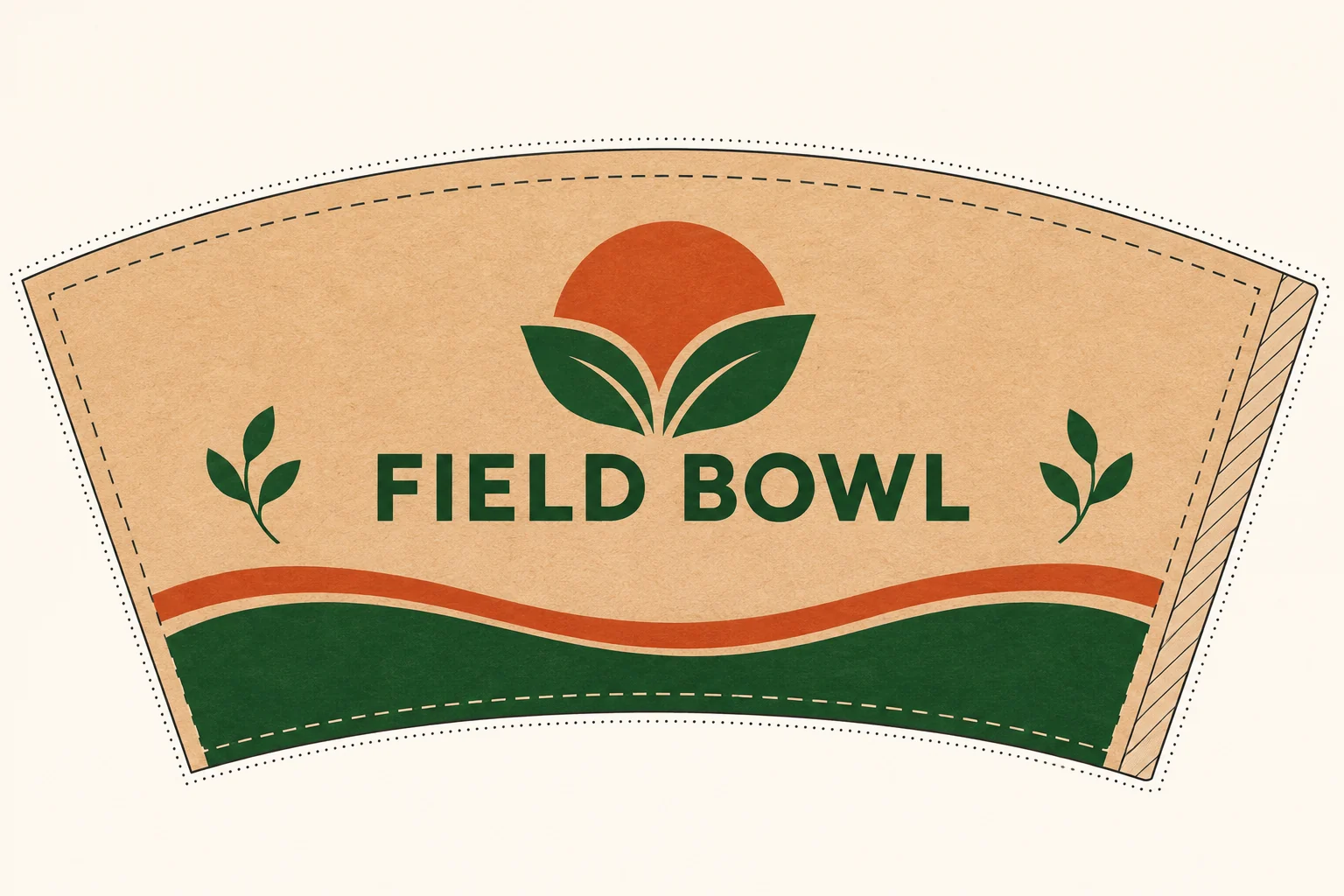
3. Read the factory dieline before placing the logo
Paper-bowl sidewalls are formed from shaped blanks rather than finished as flat rectangular posters. The artwork may be prepared on an unfolded curved or tapered blank, depending on the design and production method. The forming process introduces boundaries that are not obvious in a beauty mockup.
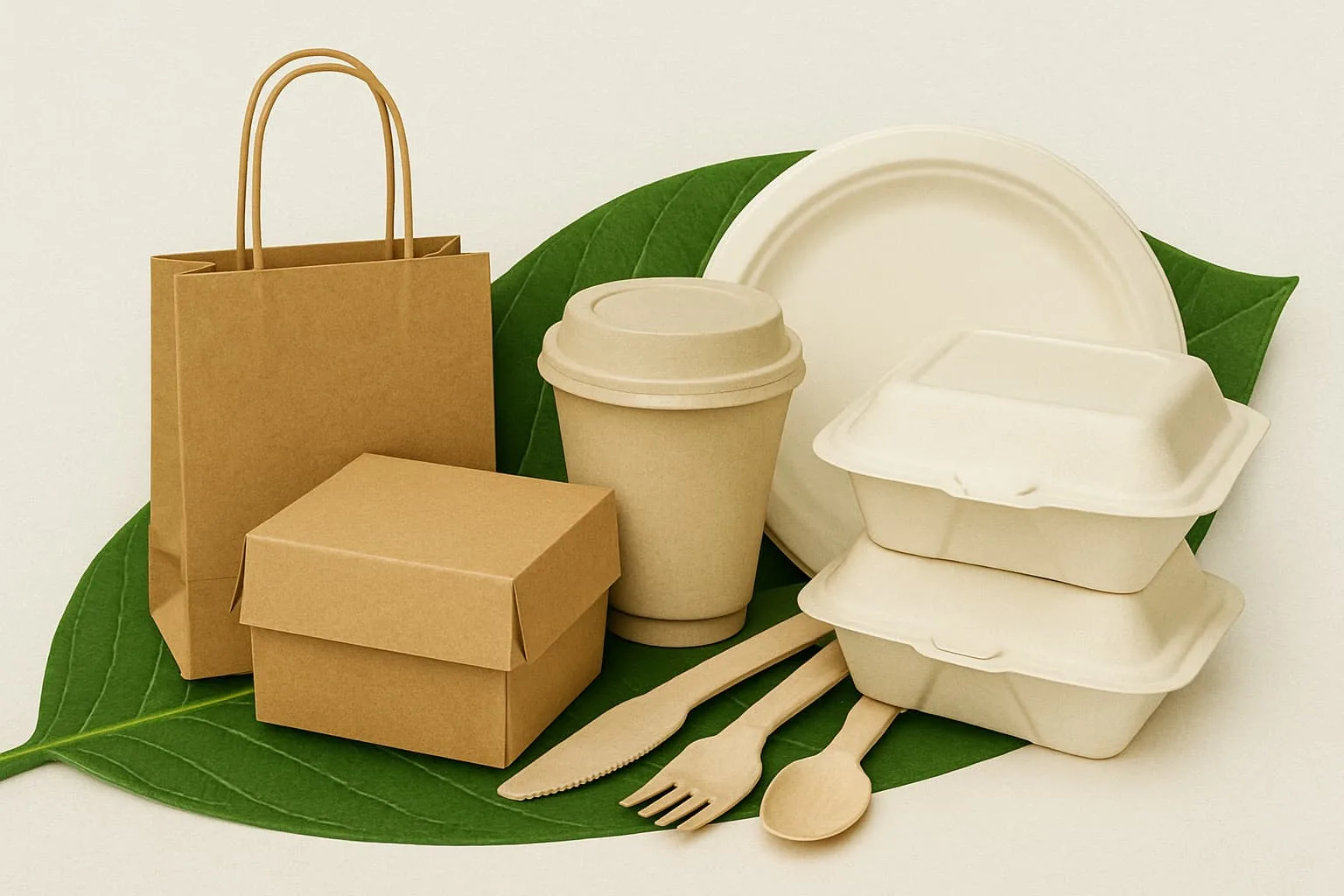
The factory’s approved dieline controls the dimensions. The product and equipment photographs in this guide show Bioleader®’s published packaging range and production context; none is an approved cutting template. Request the actual print-ready drawing for the model you intend to order.
The five zones a buyer should recognise
| Dieline zone | What it means | Artwork decision |
|---|---|---|
| Cut / trim boundary | Where the blank is cut to shape | Do not place essential copy on the cut edge |
| Bleed allowance | Background artwork that extends beyond the cut edge where required | Extend colours or patterns as specified; do not assume a universal 3 mm |
| Safe content area | Area reserved for visible logos, legal copy and key text | Keep small lettering and QR codes away from critical forming zones |
| Side-seam overlap | Area used to join the sidewall | Avoid critical logos or barcodes that may become hidden or disturbed |
| Rim / bottom forming allowance | Regions affected by curling or bottom assembly | Confirm whether fine print or full coverage is feasible there |
A frequent design mistake is to move the logo to the visual centre of a flat drawing without checking where that centre lands on the assembled bowl. The correct placement should be reviewed on the final formed shape, including which side faces the customer when the lid is attached.

4. Pantone and CMYK on kraft versus white paperboard
A Pantone reference describes the intended brand colour; CMYK values describe a process-colour build. Neither one guarantees that printed ink on brown kraft paper will look identical to a display, a white office sheet or another supplier’s coating. Paper colour, ink coverage, print route, surface texture and finish can alter the appearance.
| Brand need | Paper/colour consideration | Approval check |
|---|---|---|
| One strong, solid-colour logo | A spot colour may be simpler to control | Confirm Pantone target and actual stock |
| Four-colour illustration or gradients | CMYK suitability depends on the printing route | Review an achievable print proof, not only a screen image |
| Small pale elements on kraft | Background brown can reduce contrast | Compare an approved physical sample if appearance matters |
| Same branding on kraft and white bowls | One digital file may reproduce differently | Approve each substrate or an agreed acceptable variation |
| Matching bowl body and printed paper lid | Different surfaces and layouts can shift appearance | Confirm the colour match tolerance and printability separately |
For a brand colour that must match across bowls, lids and cups, record the Pantone reference, paperboard, print method and approved sample together. Approve the colour on kraft and white separately when both boards are in the order. Bioleader® discusses this trade-off in its kraft versus white paper bowl comparison.
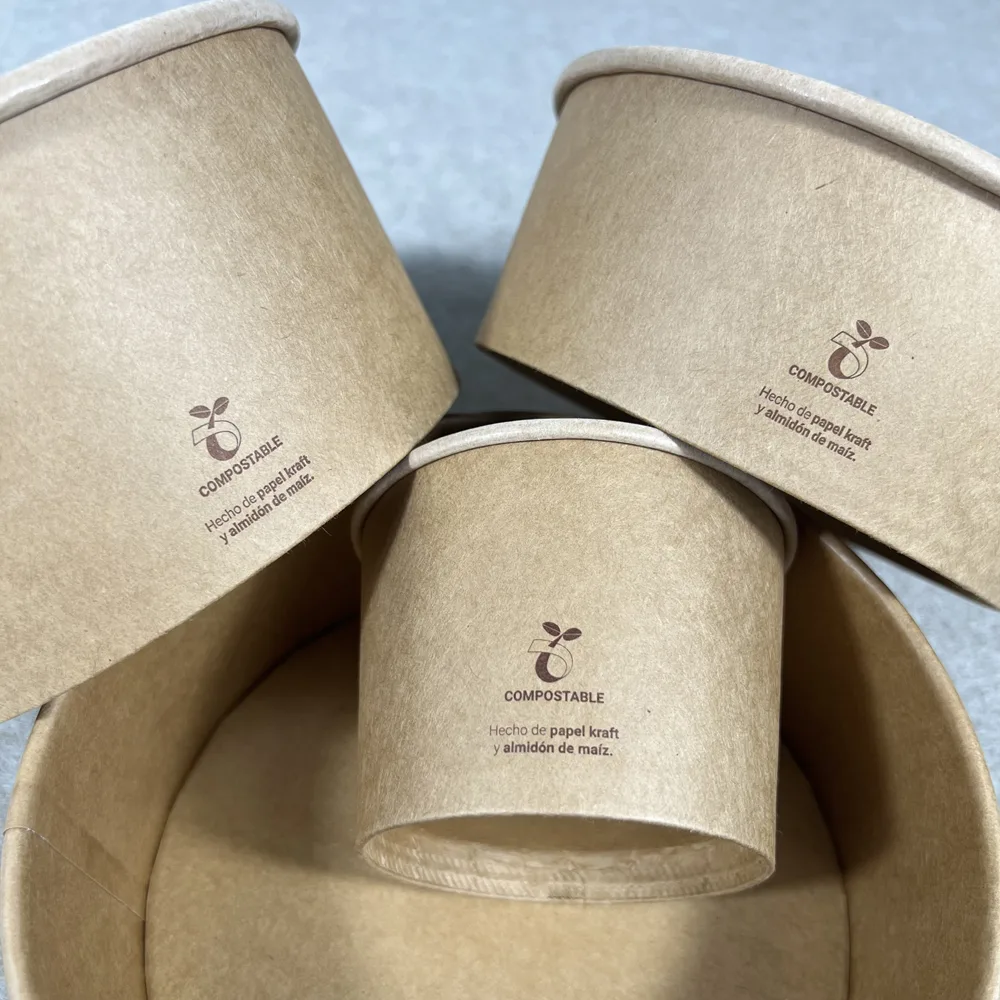
What about flexo versus offset?
The print route determines how we separate the colours. We normally use flexo for our aqueous-coated cup and bowl paper. PE- or PLA-coated bowl projects may suit more than one route, depending on the board and artwork. Confirm spot or process colour output for your SKU before exporting the final file. Our flexo versus offset printing guide explains the production differences. For setup fees, price reductions on larger orders and minimum quantities, use the separate custom printed paper bowls cost and MOQ guide.
5. Six artwork problems worth fixing before a production proof
Before we make plates, we check that the artwork matches the approved drawing and that the file version, colour targets and print limits are clear. These six checks also help the next run use the same approved artwork.
| Problem seen in the file | Why it matters after forming | Action before approval |
|---|---|---|
| Low-resolution logo or screenshot | Letter edges can print soft or broken | Ask for original vectors or approve a vector rebuild |
| Artwork on an outdated dieline | Print location may not match the ordered bowl | Rebuild on the current SKU-specific drawing |
| Text too close to seam or rim | The text may become hidden, curved or harder to read | Move essential information into the confirmed safe zone |
| RGB-only colours, no brand reference | On-screen colour is not a reliable production target | Provide Pantone/CMYK targets and agree a proof reference |
| Missing fonts or linked artwork | Layout may reflow when another computer opens it | Outline fonts in the print copy and package graphics |
| Different logo versions under the same filename | The wrong artwork may be reproduced on a reorder | Record a revision number and one explicitly approved final PDF |
Bioleader® prepress perspective: before sign-off, the factory and buyer need to agree which logo revision belongs to which finished bowl model. Artwork that crosses a seam or sits close to a rim needs an explicit placement review on the approved dieline. Registration, ink rub resistance, odour and batch consistency are subsequent production-quality questions covered in our custom printed paper bowls quality-control guide.
6. Digital proof, print proof and physical bowl sample are not interchangeable
Three approvals may be involved, depending on the project. They answer different questions and may not all be required for every order. A realistic print sample is valuable when colours, small graphics or forming geometry carry commercial risk.
| Approval stage | What it can demonstrate | What it cannot prove |
|---|---|---|
| Digital layout PDF | Placement, spelling, orientation, artwork revision | Actual ink shade, surface feel, formed-bowl appearance |
| Printed colour / material proof | Colour behaviour on a specified substrate and route, if production-representative | Every property of the finished formed container |
| Finished printed bowl sample | Appearance after forming, readable text, seam treatment and lid presentation | Compliance for every untested material/market combination |
For buyers using several capacities, request a digital proof for every approved dieline, even when the same brand system is used. If the project requires a physical sample, ask whether it is made with the intended production method, board and coating. A visual sample made by another technique may be useful for judging layout but should not be treated as a final colour standard.

7. Printed food packaging: artwork approval is not a food-contact certificate
It is possible to approve an attractive logo while leaving the important food-contact questions unanswered. For EU food-contact materials, Regulation (EC) No 1935/2004 sets the general safety framework. Regulation (EC) No 2023/2006 addresses good manufacturing practice, including printing inks on the non-food-contact side and risks such as set-off during stacking or transfer through the substrate. The EuPIA guideline, amended in April 2026, provides additional industry guidance on printing inks used with food-contact materials.
The correct document set depends on the final printed construction: paperboard, coating, ink system, printing location, food type, contact conditions and destination. An AI/PDF artwork approval is not a declaration of compliance, and “water-based ink” alone does not establish universal food-contact suitability.
We also avoid calling every PLA-lined or water-based-coated bowl compostable without finished-product evidence. For a buyer who needs a particular claim, Bioleader® reviews the relevant material and food-contact documents against the order. The underlying production choices are described on our paper bowl factory and quality-control page.
8. Bioleader®’s artwork review: a practical handoff from buyer to factory
We confirm the bowl size and board before preparing the artwork. Once we receive the logo, we supply or confirm the blank drawing and revise the layout with the buyer. We arrange samples where the order calls for them and schedule production after approval.
- Confirm the SKU. Share a model code or actual specifications, board colour, coating and matched lid. A drawing from a previous supplier is a reference, not an automatically approved template.
- Send the best available logo source. AI/vector PDF/EPS/CDR is preferred. If only a PNG exists, tell us it is a concept and request a feasibility review.
- Request the correct blank dieline. Confirm the current revision for that bowl, including permitted coverage and no-print areas.
- Agree the printing direction. Specify Pantone or CMYK targets, number of colours and the intended finished appearance on kraft or white paper.
- Check the proof on the assembled shape. Confirm logo position, readability, seam overlap, lid orientation and any QR code or mandatory text.
- Approve and record one version. Keep the final signed-off PDF, editable source revision, model code and the approved proof or sample details with the order.

What to put in your artwork email
A useful subject line is: Paper bowl artwork review — PE-SSK26 750 ml — Brand / Revision 02. In the message, include the quantity per size and design, whether this is a new project or reorder, and the requested destination market. You can also provide the actual application (hot soup, chilled salad, oily food), since the lining and product choice must be confirmed alongside the print plan.
For dimensions and compatible formats, see Bioleader®’s kraft paper bowl wholesale and manufacturing solutions. For the available options on soup packaging, compare our paper soup bowl product category.
9. Paper bowl logo printing artwork submission checklist
Before submitting a final design, check these items with your designer and procurement team:
- ☐ Bowl model, capacity, material and coating confirmed.
- ☐ Matching lid type and print scope confirmed, including whether the lid is to be printed.
- ☐ Factory dieline received for each bowl size and model.
- ☐ Vector master file and reference PDF provided; linked images accounted for.
- ☐ Fonts outlined in the production copy; legal text proofread.
- ☐ Brand-colour target defined for the chosen kraft or white board.
- ☐ Bleed, seam, rim and bottom allowances taken from the factory drawing, not guessed.
- ☐ Logo orientation checked on the formed bowl, not only on the flat blank.
- ☐ File revision, approval contact, quantity per design and order destination recorded.
- ☐ Any necessary physical sample or food-contact documentation reviewed separately.
Frequently asked questions about paper bowl artwork
What file format should I send for paper bowl logo printing?
Send an editable vector file where possible: Adobe Illustrator AI, vector PDF, EPS or a compatible CDR file. Include a reference PDF that shows the intended appearance, plus any Pantone or agreed CMYK colour references. Bioleader® can review a clear PNG or JPG during the initial inquiry, but a raster image may need to be recreated before it is suitable for manufacturing. The exact file requirements are confirmed for the chosen print method and bowl model.
Can I print a logo on paper bowls using a PNG or JPG file?
A PNG or JPG is useful as a visual reference, especially when a buyer has not yet received the original artwork from the brand designer. It may not be suitable for final printing if it is low resolution, has blurred edges or cannot be separated into the required colours. Send the highest-quality source available and ask whether vector rebuilding is needed. Do not assume saving the image as a PDF changes its underlying quality.
Does Bioleader® provide paper bowl dieline templates?
Yes. Once we confirm the SKU, material and production route, ask us for the current blank dieline. Build your final file to the cut boundary, seam and forming allowances on that drawing. Confirm the drawing revision again if the size or board changes.
Can I use the same logo artwork for different paper bowl sizes?
You can reuse the same brand logo, but not necessarily the same printable layout. The published PE-SSK16, PE-SSK26 and PE-SSK32 specifications share a 148 mm nominal top diameter. Their heights are 46, 60 and 78 mm, and the 500 ml bowl has a different base diameter. Each model needs its own confirmed dieline and placement check. The logo may need to be scaled or repositioned; print setup and minimum quantities are reviewed for each SKU and design in the quotation.
Should I specify Pantone or CMYK colours for kraft paper bowls?
Provide the colour references used in your brand manual, and tell the factory which elements need the closest match. Pantone is useful for communicating a target spot colour; CMYK describes a process-colour build. Brown kraft paper can change perceived brightness and contrast compared with white paper, so the chosen print method and material matter. Where colour is critical, agree a production-representative physical reference rather than relying only on a monitor image.
How much bleed and safe area should a paper bowl dieline include?
There is no single correct bleed or safe-zone measurement for every paper bowl. The required allowance depends on the approved cutting pattern, side seam, rim curl, bottom construction and print process. Use the actual dimensions shown on the factory-issued dieline. Keep essential text, QR codes and logos away from restricted zones; extend background graphics into the specified bleed where required. A general commercial printing rule is not a substitute for a bowl-specific drawing.
Do I need to approve a physical printed sample before bulk production?
Not every printed paper bowl order requires a physical sample. A digital proof may be enough for a straightforward repeat design, provided the approved material and process are unchanged and the order conditions support that approach. A physical printed and formed bowl is more valuable for a new size, tight brand-colour tolerance, fine text, complex coverage or lid presentation. Agree the sample type, cost and approval criteria with Bioleader® before production is scheduled.
Prepare artwork for the bowl you will actually order
A strong logo cannot compensate for an incorrect dieline. Confirm the bowl and lining, request the current blank drawing, supply the best available vector artwork, then approve a proof that reflects the finished container. For a coordinated OEM programme, Bioleader® can review the branding, bowl-and-lid specification and export requirements together.
Send your model, logo file, preferred print colours and quantity per design through the custom printed paper bowls and OEM enquiry page. For upfront fees and MOQ by design, use our companion paper bowl printing costs and plate fees guide.
References and technical sources
- Bioleader® — Customized Paper Bowls with Lids. Published artwork intake and customized bowl workflow.
- Bioleader® — Round Paper Salad Bowl Models. PE-SSK16, PE-SSK26 and PE-SSK32 sizes and formats.
- Adobe — PDF Marks, Bleeds and Colour Output. Production PDF and bleed terminology.
- Adobe — Package Illustrator Files with Linked Images and Fonts. Design-file handoff.
- Regulation (EC) No 1935/2004. EU food-contact framework.
- Regulation (EC) No 2023/2006. GMP and printed-food-contact-material safeguards.
- EuPIA — Guideline on Printing Inks Applied to Food Contact Materials (2026). Industry risk-assessment guidance.