As awareness of environmental concerns grows, more businesses and consumers are seeking alternatives to traditional plastic cutlery. Compostable forks have emerged as a sustainable choice, designed to minimize waste and reduce the long-lasting environmental impact of conventional plastics. These eco-friendly utensils break down under composting conditions, returning valuable nutrients to the soil without leaving harmful residues.
In this article, we’ll explore what compostable forks are, the materials they’re made from, and how they compare. By examining the features and production processes of different compostable fork types—CPLA, cornstarch, wood, bamboo, and bagasse—readers can gain a clear understanding of their sustainability and practicality.
Quick Summary: What Are Compostable Forks Made Of?
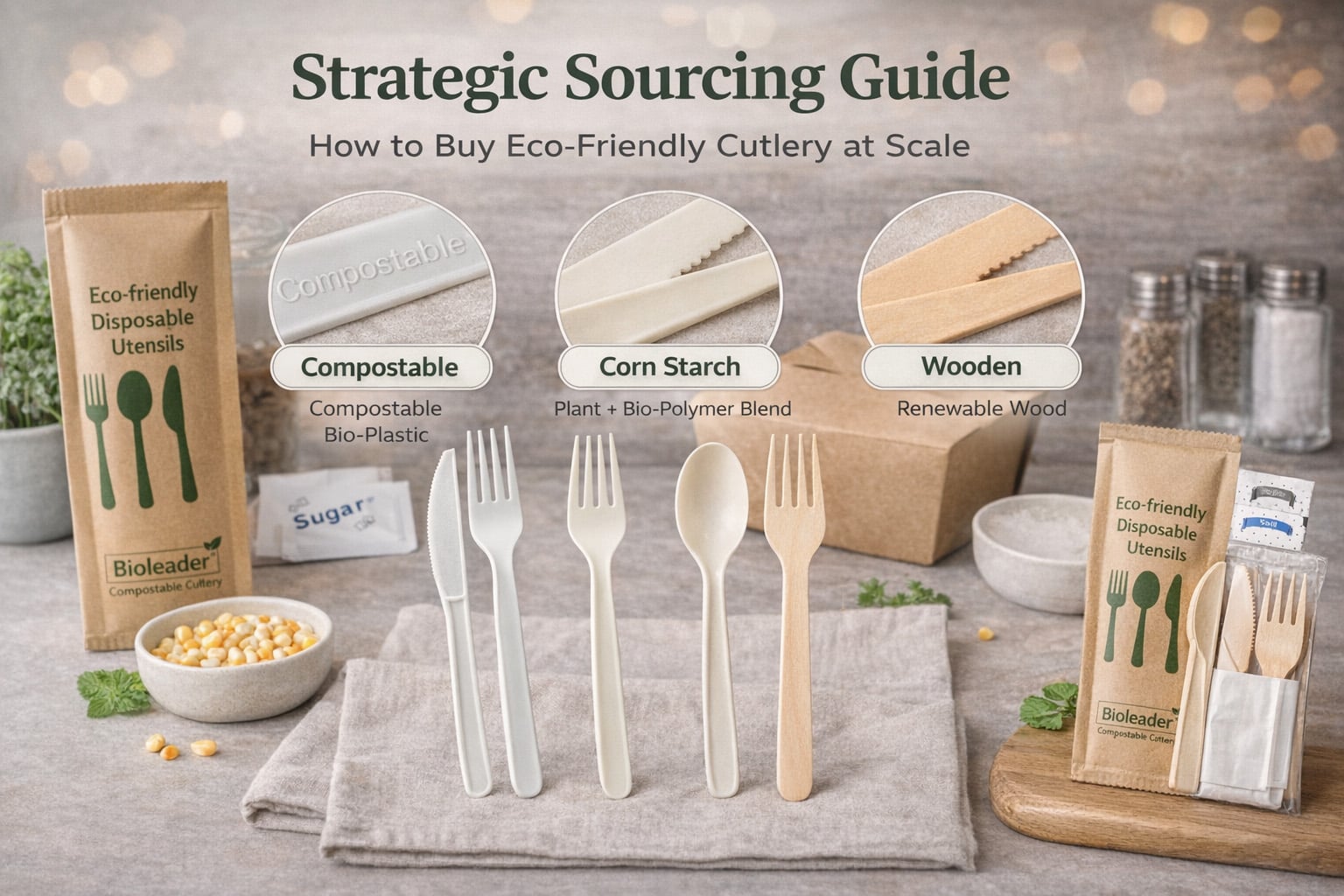
Compostable forks are commonly made from CPLA, cornstarch-based materials, wood, bamboo, or sugarcane bagasse fiber. Each material has different heat resistance, strength, cost, user experience, and composting requirements.
Best material match: CPLA forks are suitable for hot meals and stronger foodservice performance; cornstarch forks are cost-effective for takeaway and general dining; wood and bamboo forks offer a natural look; bagasse fiber forks use upcycled sugarcane pulp but are usually less rigid than CPLA.
Buyer note: “compostable” does not automatically mean home compostable. Always check certification, food-contact safety, heat tolerance, local composting acceptance, and supplier documentation before making disposal or sustainability claims.
What Is a Compostable Fork?
A compostable fork is a utensil created from biodegradable, plant-based materials that break down into natural elements within a controlled composting environment. Unlike traditional plastic forks, which can take hundreds of years to degrade, compostable forks decompose into organic matter, helping to reduce landfill waste and environmental pollution.
Compostable forks are typically made from renewable resources like cornstarch, CPLA (crystallized polylactic acid), wood, bamboo, or bagasse (a byproduct of sugarcane processing). These materials are chosen for their ability to be processed into sturdy, functional cutlery that can withstand hot and cold foods while remaining environmentally friendly.
From a practical foodservice perspective, compostable forks should be evaluated not only by raw material, but also by finished-product performance. Strength, fork tine design, heat resistance, food-contact safety, packaging method, shelf life, and composting pathway all affect whether a fork is suitable for restaurants, cafés, events, schools, catering, takeout, or retail food packaging.
Key Features of Compostable Forks
- Biodegradable and Renewable: Made from plant-based or natural materials, compostable forks are designed to break down under suitable composting conditions and reduce reliance on fossil-based plastic.
- Environmentally Friendly: Compostable forks can reduce plastic waste and support more circular foodservice systems when collected and processed correctly.
- Durable and Heat-Resistant: Despite their plant-based origins, many compostable forks are sturdy enough for various types of meals, including hot and heavy dishes.
- Compostable Conditions: While they decompose more quickly in industrial composting facilities, some natural fiber types may also degrade in home compost setups given proper conditions.
- Food-Contact Safety: Finished compostable forks should be supported by supplier documentation, food-contact testing, and material declarations where required by the target market.
What Are Compostable Forks Made Of?
1. CPLA Fork
Material Composition
CPLA, or crystallized polylactic acid, is a modified version of PLA (polylactic acid) that undergoes a crystallization process to improve its strength and heat resistance. PLA is derived from renewable resources like corn starch or sugarcane, making CPLA an eco-friendly alternative to conventional plastic.
Production Process
CPLA forks start with natural starches that are fermented and polymerized into lactic acid. The resulting PLA is crystallized to increase its heat tolerance and molded into fork shapes. This process ensures that CPLA forks can withstand higher temperatures, making them suitable for hot foods.
Features and Characteristics
- Heat Resistant: CPLA is often safe for use with foods up to around 185°F (85°C), depending on formulation and supplier specification.
- Durable: Though biodegradable, CPLA forks are sturdy and perform well for both light and heavy meals.
- Smooth Finish: The crystallization process gives CPLA utensils a smooth texture, improving user experience.
- Composting Pathway: CPLA usually requires industrial composting conditions rather than ordinary backyard composting.
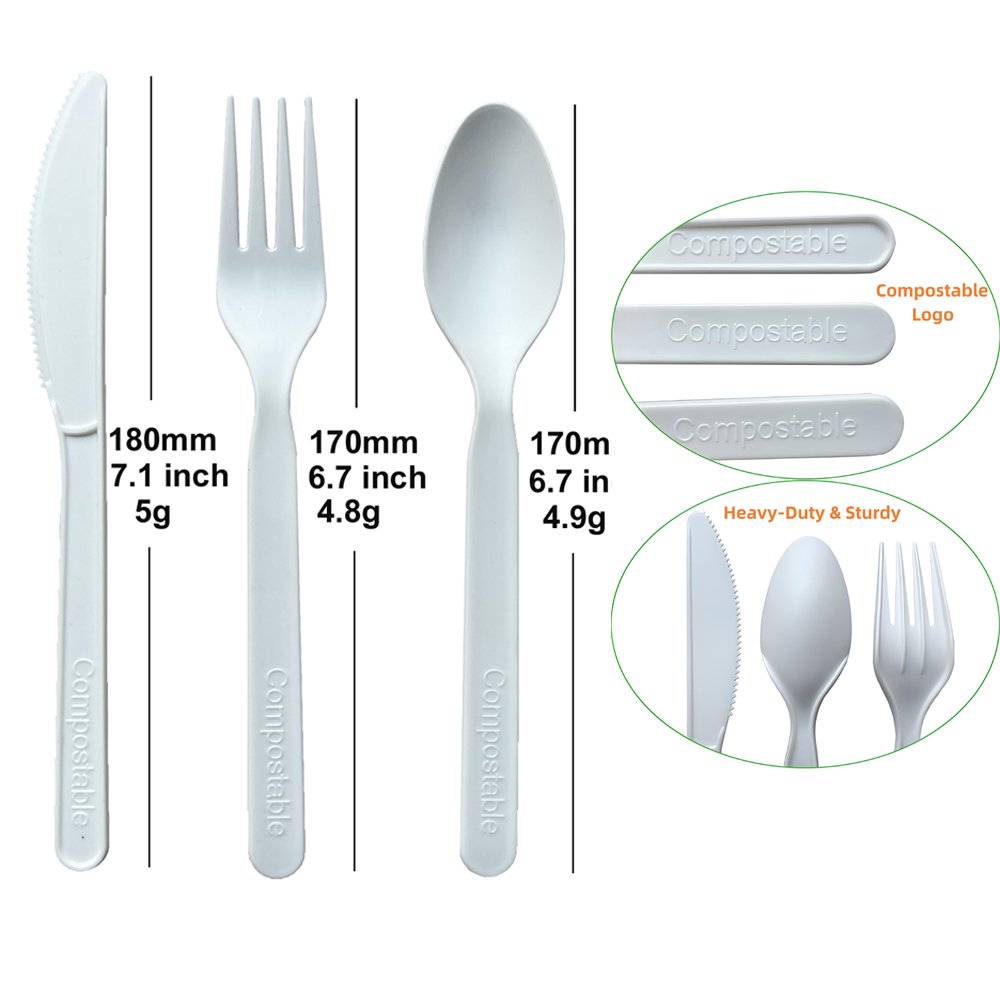
Recommended Product: Bioleader® CPLA Forks
For buyers needing stronger heat resistance, smooth texture, and stable performance for hot meals, Bioleader® CPLA forks are suitable for restaurants, catering, takeaway meals, food trucks, cafeterias, and event dining.
 |  |
2. Cornstarch Fork
Material Composition
Cornstarch forks are made primarily from corn-based polymers. Cornstarch is converted into a resin that can be shaped into utensils. This material is biodegradable and derived from a renewable resource.
In commercial production, “cornstarch fork” can refer to a starch-based blend rather than pure food-grade corn starch. The final formula may include other biodegradable or compostable components to improve strength, molding behavior, heat resistance, and shelf stability. For this reason, buyers should always check the supplier’s material declaration and compostability certification.
Production Process
The process involves extracting starch from corn kernels, fermenting it into lactic acid, and then processing it into PLA or a similar bio-based resin. The resin is then heated and injected into molds to form forks.
Features and Characteristics
- Eco-Friendly Source: Cornstarch is a plentiful and renewable raw material.
- Good for Cold and Warm Foods: These forks are well-suited for room temperature or slightly warm dishes, though they may warp under high heat.
- Economic and Sustainable: Cornstarch-based forks are often more cost-effective than other bioplastics.
- Best Use: General takeaway meals, cold dishes, salads, desserts, office meals, and standard foodservice use.
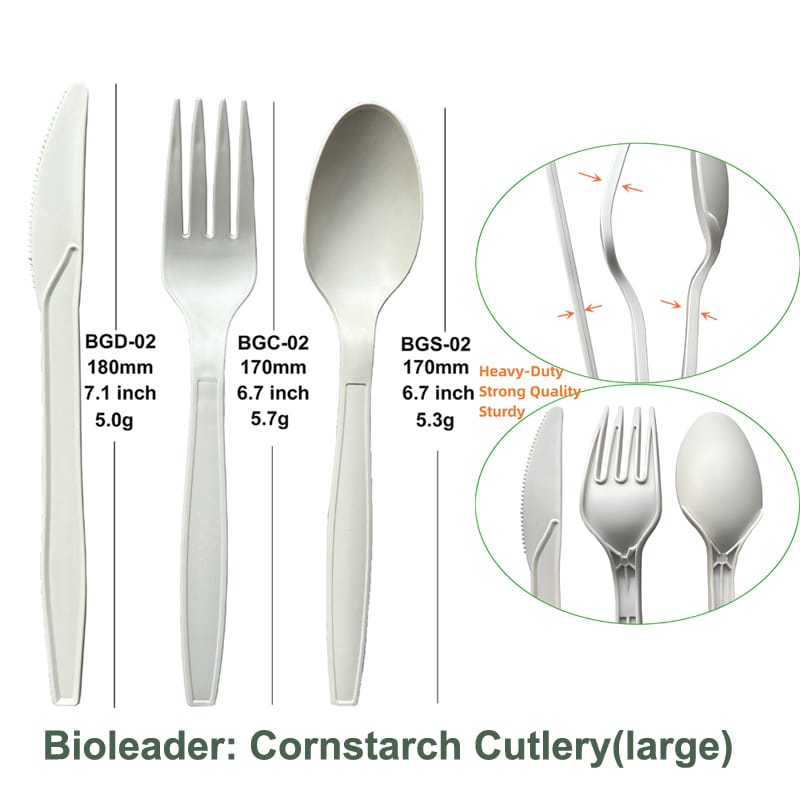
Recommended Product: Bioleader® Cornstarch Forks
For buyers who need cost-effective compostable cutlery for regular takeaway service, Bioleader® cornstarch forks provide a practical balance between price, performance, and sustainability positioning.
 |  |
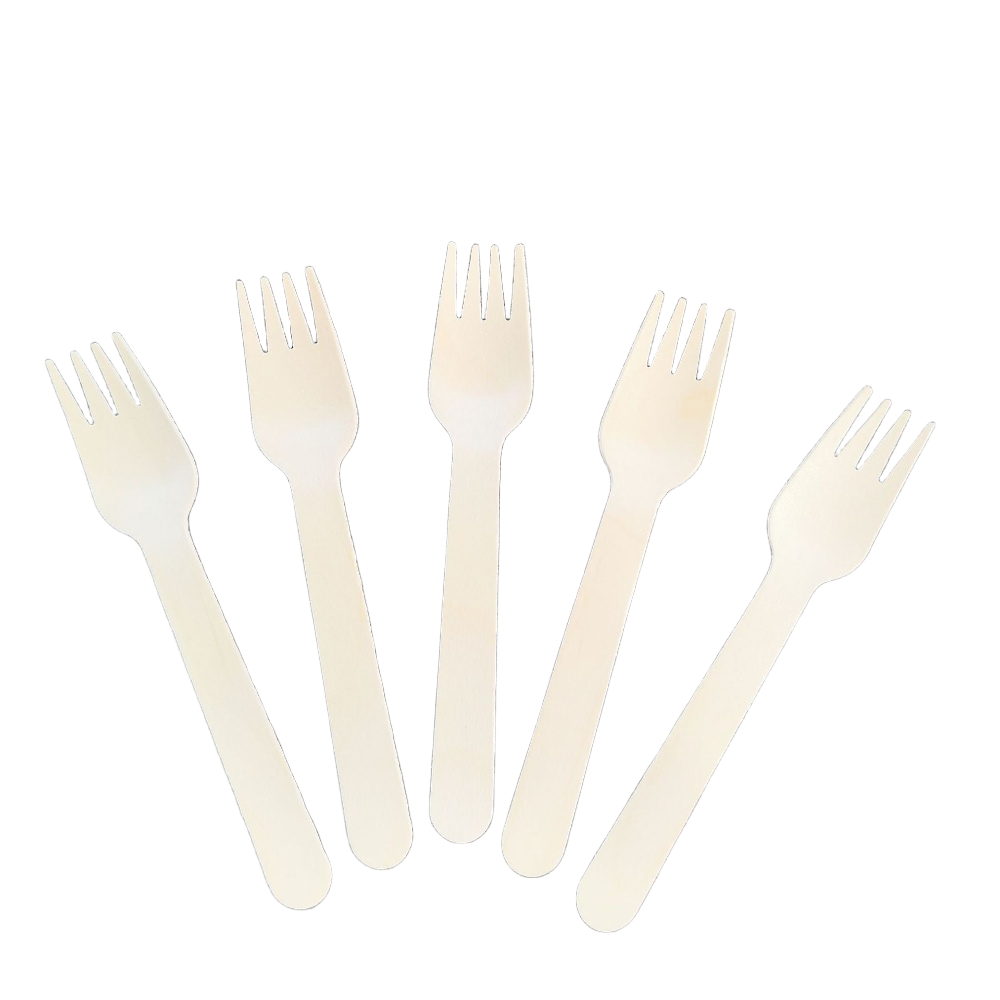
3. Wood & Bamboo Fork
Material Composition
Wood cutlery is crafted from natural, fast-growing plants. Bamboo, in particular, regenerates quickly, making it a highly renewable material. Both materials are untreated, ensuring no harmful chemicals are introduced during decomposition.
For foodservice procurement, wood and bamboo forks are often selected for their natural look, stiffness, and home-compost-friendly image. However, buyers should confirm whether the product is untreated, whether any surface coating is used, and whether the supplier can provide food-contact safety documentation.
Production Process
Wood and bamboo are harvested, cut, and shaped into forks through sanding, carving, and finishing. This process requires minimal energy and involves no harmful additives.
Features and Characteristics
- 100% Natural: Free from synthetic polymers or additives when untreated.
- Compostable Without Industrial Processing: These forks decompose naturally without requiring industrial compost facilities, depending on thickness and local composting conditions.
- Strong and Lightweight: Despite their natural origin, wood and bamboo forks are durable and can handle most types of food.
- Texture Note: Some users prefer the natural appearance, while others may notice a drier mouthfeel compared with CPLA or cornstarch cutlery.
Product Selection Note: Natural Forks vs Bioleader® Compostable Cutlery
Wood and bamboo forks are suitable for buyers who prioritize a natural material look. For brands needing smoother texture, standardized bulk supply, custom wrapped cutlery kits, and higher foodservice consistency, Bioleader® CPLA and cornstarch cutlery are stronger commercial alternatives.
 |  |
4. Bagasse (Paper Pulp) Fork
Material Composition
Bagasse is the fibrous byproduct of sugarcane processing. Once the sugar juice is extracted, the remaining fibers can be processed into pulp and molded into forks. This material is biodegradable and repurposes agricultural waste.
Bagasse is widely used in molded fiber plates, bowls, trays, clamshell boxes, and food containers. For forks, bagasse pulp can support a natural-fiber concept, but stiffness and edge strength may be lower than CPLA or cornstarch cutlery. Therefore, bagasse cutlery is best evaluated by actual product design, density, thickness, food type, and intended dining scenario.
Production Process
Bagasse pulp is mixed with water and molded under heat and pressure to form the shape of a fork. The resulting product is then dried and packaged. This low-energy process repurposes a byproduct that would otherwise be discarded or burned.
Features and Characteristics
- Upcycled Material: Bagasse makes use of waste material, reducing overall environmental impact.
- Compostable and Renewable: The fibers break down quickly in composting environments, depending on product thickness and local conditions.
- Slightly Textured Surface: The natural fibers give the fork a unique texture, which some users find appealing.
- Best Application: Bagasse is especially strong for plates, bowls, trays, and clamshells; for fork applications, buyers should test strength before bulk purchasing.
Recommended Related Solution: Bioleader® Sugarcane Bagasse Tableware
Bagasse performs especially well in molded fiber plates, bowls, trays, and clamshell food containers. For buyers building a full compostable meal kit, Bioleader® can combine bagasse tableware with CPLA or cornstarch forks for a stronger overall packaging solution.
 |  |
Compare the Different Materials of Compostable Forks
When comparing CPLA, cornstarch, wood, bamboo, and bagasse forks, each material has unique strengths and weaknesses. For instance, CPLA offers high heat resistance and durability but may require industrial composting. Cornstarch forks are cost-effective and derived from abundant resources, though they might warp under high heat. Wood and bamboo forks excel in natural aesthetics and home compostability, but their production process can be more labor-intensive. Bagasse, as a repurposed material, provides a highly sustainable option but may not be as durable as other choices.
Overall, choosing the right compostable fork depends on intended use, composting conditions, and personal or business sustainability goals.
Technical note for buyers: the values below should be treated as a practical selection guide rather than a universal guarantee. Actual performance depends on finished-product formulation, thickness, mold design, certification, storage condition, food temperature, and composting infrastructure.
| Material | Heat Resistance | Durability | Cost | Compostability Claim | Typical Degradation Time | Composting Conditions |
|---|---|---|---|---|---|---|
| CPLA | High | High | Moderate | Compostable when certified | Often 90–180 days in industrial composting, depending on certification and conditions | Industrial composting preferred |
| Cornstarch | Moderate | Medium | Low to moderate | Compostable or biodegradable depending on formulation | Varies by blend and composting environment | Usually industrial composting; home compost only if specifically certified |
| Wood | High | Medium | Moderate | Compostable when untreated | Several months depending on thickness and moisture | Home composting possible for untreated products |
| Bamboo | High | High | Moderate | Compostable when untreated | Several months depending on structure and composting conditions | Home composting possible for untreated products |
| Bagasse | Low to moderate | Low to medium for forks; stronger for plates and containers | Low to moderate | Compostable when finished product is suitable and accepted | Varies by thickness, coating, and composting environment | Home or industrial depending on product design and certification |
Buyer Decision Matrix: Which Compostable Fork Material Should You Choose?
| Application | Recommended Material | Reason | Best Bioleader® Link |
|---|---|---|---|
| Hot meals, rice dishes, pasta, catering | CPLA | Higher heat resistance and stronger user experience | CPLA fork and spoon |
| Standard takeaway, salad, desserts, office meals | Cornstarch | Cost-effective and suitable for general foodservice | Cornstarch spoon and fork |
| Natural-looking event cutlery | Wood or bamboo | Natural look and home-compost-friendly image | Compostable cutlery alternatives |
| Full compostable meal kits | Bagasse tableware + CPLA/cornstarch cutlery | Better overall performance than relying on bagasse fork alone | Sugarcane bagasse tableware |
Compostable Cutlery Is Eco-Friendly and Sustainable
As the world moves towards more sustainable practices, compostable cutlery stands out as an eco-friendly alternative to traditional plastics. These utensils, derived from renewable resources, break down naturally and contribute to a circular economy by returning valuable nutrients to the soil.
The future of compostable forks lies in improved materials, better composting infrastructure, and increased consumer awareness. Advancements in material science may lead to forks that degrade even faster, handle higher temperatures, and perform as well as or better than conventional plastic. With continued innovation and widespread adoption, compostable cutlery can play a significant role in reducing global plastic waste.
Responsible disposal remains essential. Compostable forks deliver their environmental benefit only when they are collected and processed in the right composting system. If they are sent to landfill, incineration, or general waste streams, their sustainability advantage may be reduced. Buyers should align product selection with local composting infrastructure and labeling requirements.
Recommend Bioleader Compostable Cutlery: Cornstarch Forks and CPLA Forks
Bioleader’s compostable forks are designed to offer a sustainable alternative without compromising on quality. Their cornstarch forks are crafted from renewable corn-based materials, making them lightweight, cost-effective, and highly suitable for warm or cold dishes. These forks decompose naturally, reducing waste and environmental impact.
The CPLA forks, made from crystallized PLA, provide the additional benefit of heat resistance, allowing them to handle hot meals while maintaining their compostable nature. With both cornstarch and CPLA options, Bioleader provides consumers and businesses an eco-friendly solution for everyday dining needs.
Need Compostable Forks for Foodservice or Export?
Bioleader® supplies CPLA forks, cornstarch forks, compostable spoons, knives, wrapped cutlery kits, and matching eco-friendly tableware for restaurants, catering, takeaway, foodservice distributors, supermarkets, and private-label packaging buyers.
Choose CPLA for stronger heat resistance, cornstarch for cost-effective general use, and bagasse tableware for complete compostable meal packaging solutions.
- CPLA fork and spoon
- Cornstarch spoon and fork
- Wrapped cutlery kits
- Compostable meal solutions
- Bulk export and OEM support
Conclusion
Compostable forks represent a significant step forward in reducing plastic waste and promoting sustainable practices. By understanding their materials and production processes, consumers and businesses alike can make more informed decisions. As we continue to embrace compostable cutlery, we pave the way for a cleaner, greener future.
For B2B buyers, the best compostable fork is not defined by material name alone. It should be selected according to food temperature, meal type, user experience, certification, disposal route, cost structure, and the supplier’s ability to provide stable quality, documentation, and bulk delivery.

Key Takeaways: Compostable Fork Materials
- CPLA forks are best for hot meals and stronger foodservice performance, but usually require industrial composting.
- Cornstarch forks are cost-effective for general takeaway, office meals, salads, and standard dining applications.
- Wood and bamboo forks offer a natural look and may suit home composting when untreated, but user mouthfeel and sourcing should be considered.
- Bagasse fiber is highly valuable for plates, bowls, trays, and clamshells; for forks, buyers should test stiffness and practical use before bulk orders.
- Compostable cutlery claims should be supported by certification, local facility acceptance, food-contact safety, and clear disposal guidance.
FAQ
1. What materials are compostable forks made from?
Compostable forks are typically made from plant-based or natural materials such as cornstarch, PLA, CPLA, bamboo, wood, or sugarcane fiber bagasse. Each material has different strength, heat resistance, cost, and composting requirements.
2. Are compostable forks really biodegradable?
Certified compostable forks are designed to break down into natural elements under specified composting conditions. However, the actual degradation depends on the material, certification, composting temperature, moisture, oxygen, and facility acceptance.
3. How long do compostable forks take to decompose?
In industrial composting facilities, many certified compostable forks are designed to decompose within the required certification timeframe, often around 90 to 180 days. Home composting may take longer and is not suitable for all materials.
4. Can compostable forks be used with hot foods?
CPLA and bamboo or wood-based forks are generally more suitable for hot foods. Cornstarch forks may soften under high heat, while bagasse fiber forks should be tested for stiffness and performance. Always check supplier specifications.
5. Are compostable forks safe for the environment?
Compostable forks can reduce plastic pollution when properly collected and composted. Their environmental benefit depends on renewable material sourcing, production method, certification, composting infrastructure, and whether they avoid landfill or contamination.
6. What’s the difference between compostable and biodegradable forks?
Biodegradable means a material may break down over time, but it does not guarantee the speed, conditions, or residue quality. Compostable forks must meet defined composting standards and are designed to break down into compost under specified conditions.
7. Where can I dispose of compostable forks?
Most CPLA and many cornstarch compostable forks should be placed in commercial composting bins where available. Wood, bamboo, or selected natural fiber forks may be suitable for home composting if untreated and accepted by the local system.
8. Which compostable fork material is best for restaurants?
For restaurants and catering, CPLA is usually the strongest choice for hot meals, while cornstarch is a practical cost-effective option for general takeaway use. Buyers should test real menu items before selecting a material for bulk orders.
Reference Source List
- ASTM International – ASTM D6400 Standard Specification for Labeling of Plastics Designed to be Aerobically Composted in Municipal or Industrial Facilities.
- European Committee for Standardization – EN 13432 Packaging recoverable through composting and biodegradation.
- Biodegradable Products Institute – Certified Compostable Products and Packaging verification guidance.
- TÜV Austria – OK Compost Industrial and OK Compost Home certification programs.
- DIN CERTCO – Compostability certification for products and materials.
- European Bioplastics – Industrial composting, PLA, and certified bioplastics guidance.
- Bioleader® – Compostable cutlery, CPLA forks, cornstarch forks, bagasse tableware, product specifications, and export documentation support.