Plastic Bans and Compostable Food Packaging in Africa: Quick Summary
Africa is not a single regulatory market for disposable food packaging. Plastic bans, Styrofoam restrictions, EPR rules, food-contact expectations and compostable packaging claims vary by country, city and product category. For importers, the key is not to ask whether a product is “eco-friendly” in general, but to verify whether the product, documents and claims match the destination market before buying.
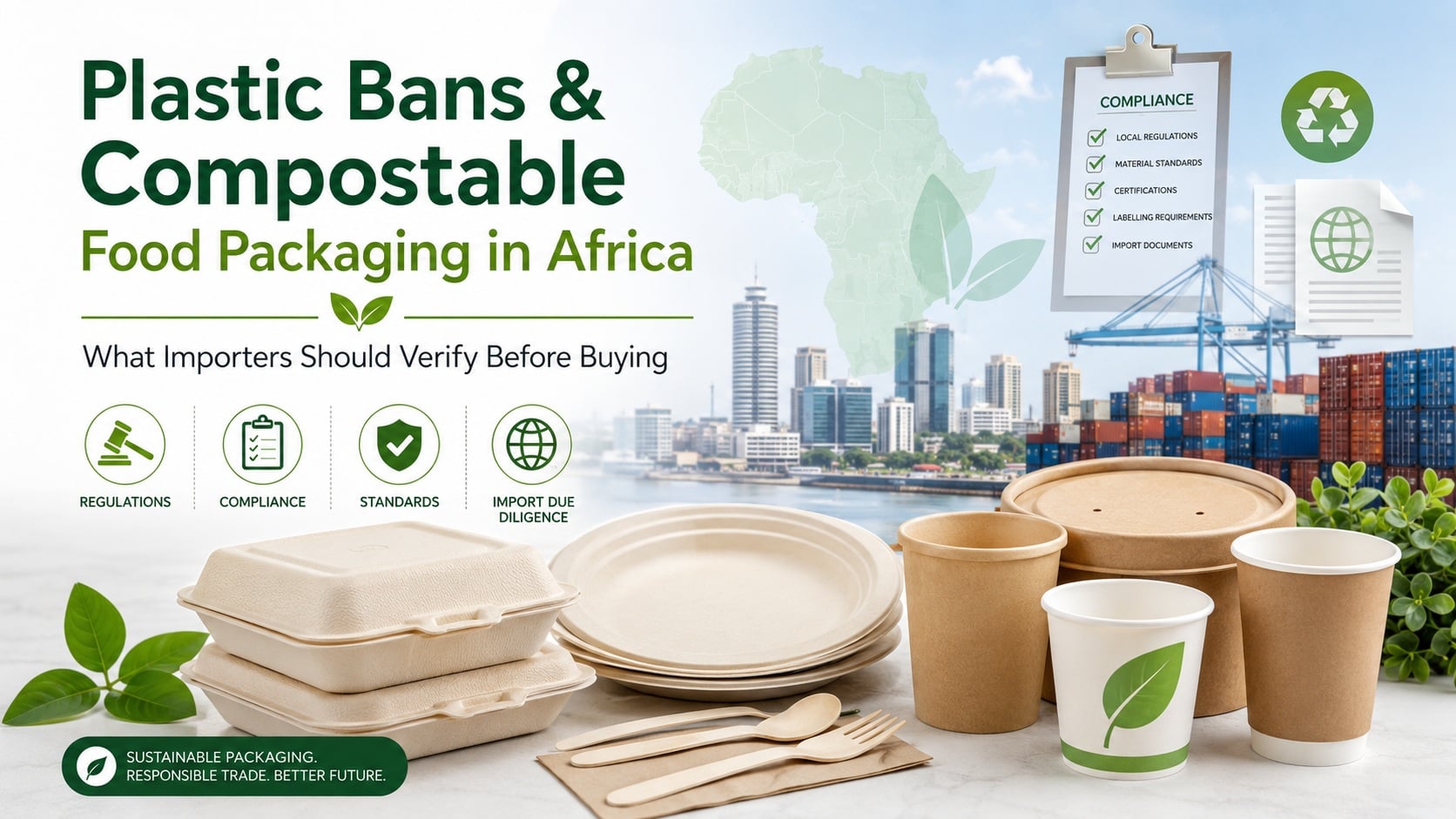
For African packaging buyers, the safest procurement strategy is to treat regulation as a due diligence process. Importers should check plastic bag bans, foam packaging restrictions, single-use plastic rules, EPR obligations, food-contact documents, PFAS-free statements, product specifications and shipment paperwork before confirming bulk orders.
- Do not assume one African country’s plastic policy applies across the continent.
- Check whether the rule targets plastic bags, Styrofoam, disposable cutlery, cups, plates, food containers or packaging waste responsibility.
- Request product-specific documents instead of relying on broad compostable or biodegradable claims.
- Use suppliers that can support material selection, food-contact documentation, carton data, commercial invoice, packing list and export coordination.
Africa Is Not One Regulatory Market
The most important rule for African packaging importers is simple: Africa should not be treated as one uniform compliance zone. A product that is acceptable for one customer in South Africa may require different checks in Kenya, Rwanda, Tanzania, Nigeria, Ghana or a tourism-focused market. Even within one country, enforcement may differ between ports, municipalities, hotels, protected areas, public procurement projects and private foodservice buyers.
This matters because many buyers use broad wording such as “biodegradable packaging for Africa” or “compostable food containers for African markets.” These terms may help with marketing, but they are not enough for import compliance or customer approval. A serious buyer must define the destination country, product type, material, food application, intended claim and supporting documentation before production.
Bioleader®’s view is that packaging regulation should be handled as a procurement risk-control process, not as a slogan. Importers should first understand what is restricted, then select materials that fit both real foodservice use and the destination market’s compliance expectations.
Which Policies Are Affecting Food Packaging Buyers?
Several types of policies are now shaping disposable food packaging decisions in African markets. They do not all target the same products, and they do not all create the same business opportunity. Understanding the difference helps importers avoid wrong assumptions.
| Policy type | What it usually targets | Why it matters for foodservice packaging | Buyer action |
|---|---|---|---|
| Plastic bag bans | Retail carry bags, shopping bags, carrier bags or certain plastic wrapping formats. | These policies create public awareness and may influence wider packaging choices, but they do not automatically ban all food containers. | Check whether the rule applies only to bags or also affects foodservice packaging. |
| Styrofoam and EPS restrictions | Foam takeaway boxes, polystyrene cups, plates, trays and other EPS food packaging. | These rules directly create demand for bagasse clamshells, molded fiber meal boxes and paper-based alternatives. | Prepare foam replacement SKUs and verify if EPS import, sale or use is restricted. |
| Single-use plastic restrictions | Plastic cutlery, straws, plates, cups, bottles, sachets, bags or selected disposable items. | These rules may affect foodservice sets, takeaway accessories and beverage packaging. | Confirm the exact product list and whether compostable plastic is treated differently. |
| Extended Producer Responsibility | Packaging producers, importers, brand owners and compliance schemes. | EPR changes the responsibility for packaging after use and may affect importers and distributors, not only manufacturers. | Ask local importers whether registration, reporting, fees or PRO membership applies. |
| Food-contact and sustainability claims | Materials touching food and marketing claims such as compostable, biodegradable, PFAS-free or plastic-free. | Unsupported claims can create customs, customer or brand-compliance risk. | Request product specifications, food-contact documents and claim-specific statements before shipment. |
Country-by-Country Due Diligence: What Importers Should Verify
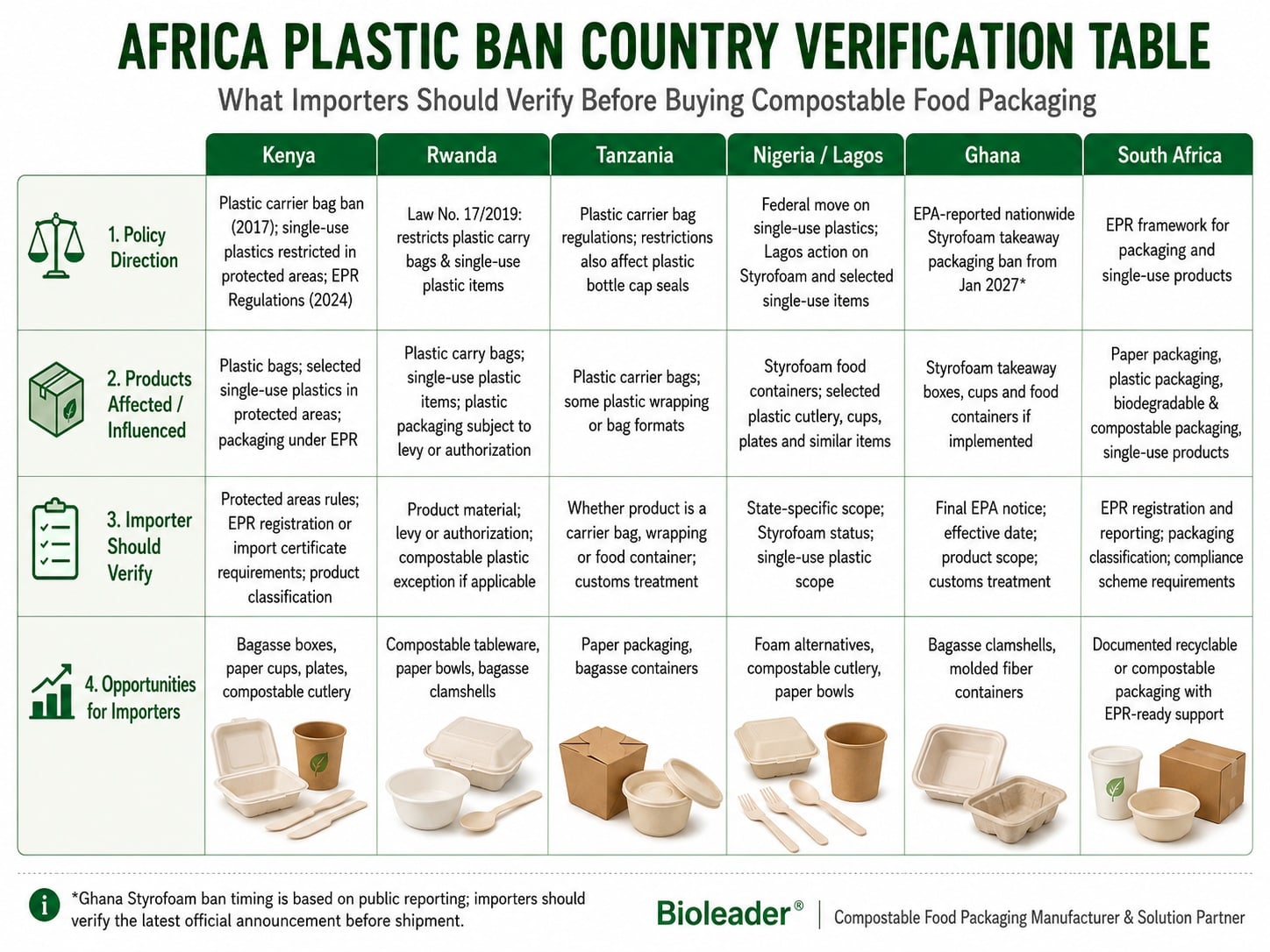
The following table is designed as a buyer verification framework, not as final legal advice. Importers should verify the latest official regulations, gazette notices, customs requirements and local enforcement practice before shipment. This is especially important for large orders, government supply, supermarket channels, hotels, tourism operators and industrial catering contracts.
| Market | Policy direction to verify | Packaging products affected or influenced | What importers should check before buying |
|---|---|---|---|
| Kenya | Kenya has a strong plastic-control policy history, including the 2017 plastic carrier bag ban, restrictions on single-use plastics in protected areas, and newer EPR regulations. | Plastic bags, selected single-use plastic items in protected areas, packaging products under EPR, and foodservice items used by tourism, hotels and public sites. | Check whether the product falls under plastic bag restrictions, protected-area single-use plastic rules or EPR import requirements. For foodservice buyers, prepare alternative products such as bagasse plates, clamshells, paper cups and compostable cutlery with clear documents. |
| Rwanda | Rwanda has one of the strictest approaches to plastic carry bags and single-use plastic items, with legal restrictions on manufacturing, importation, use and sale. | Plastic carry bags, single-use plastic items, and goods packaged in plastic material where levy or exceptional authorization may apply. | Verify whether the product or packaging includes plastic components, whether any compostable plastic claim is recognized, and whether exceptional authorization is required. Avoid broad “biodegradable” claims without local confirmation. |
| Tanzania | Tanzania’s plastic carrier bag regulations prohibit import, export, manufacture, sale, supply, storage and use of plastic carrier bags in Mainland Tanzania. | Plastic carrier bags and related plastic wrapping or bag formats. The rule does not automatically mean every food container is prohibited. | Confirm whether the imported item is a carrier bag, plastic wrapping, food container, cup, bowl or cutlery. Buyers should separate bag compliance from foodservice packaging compliance and verify with customs or local advisors. |
| Nigeria / Lagos | Nigeria has moved toward stronger single-use plastic control, while Lagos has taken visible action against Styrofoam and selected single-use plastics. | Styrofoam takeaway boxes, single-use plastic foodservice items, disposable cutlery, cups, plates, sachets and similar plastic products depending on enforcement stage. | For Lagos-focused buyers, verify the latest enforcement scope before importing foam or plastic foodservice items. Bagasse clamshells, molded fiber meal boxes, paper bowls and compostable cutlery may be practical alternatives, but local approval and customer acceptance should still be checked. |
| Ghana | Public industry reporting indicates Ghana is preparing a nationwide Styrofoam takeaway packaging ban from 2027, but buyers should confirm the final official scope before shipment. | Styrofoam takeaway packs, polystyrene cups and selected EPS foodservice packaging if the reported ban is implemented as described. | Verify the final EPA notice, effective date, product scope and customs treatment. Importers should prepare foam replacement categories such as bagasse food containers, clamshells, paper bowls and molded fiber trays. |
| South Africa | South Africa has a developed EPR framework covering paper and packaging, plastic packaging, biodegradable and compostable packaging, single-use products and single-use compostable products. | Packaging placed on the South African market, including paper packaging, plastic packaging, compostable packaging and certain single-use products. | Check whether the importer, brand owner or producer must register, report or join an EPR scheme. For Bioleader® buyers, documentation and product classification should be aligned with the local importer’s EPR obligations. |
What This Means for Product Selection
Plastic bans and EPR rules do not automatically mean that every buyer should choose the same compostable product. A country that bans plastic bags may still allow many food containers. A city that restricts Styrofoam may create immediate demand for molded fiber clamshells. A market with EPR rules may require better documentation, local registration and packaging classification rather than a simple product substitution.
For hot meals, rice dishes, grilled food, fried snacks and takeaway lunch boxes, bagasse clamshell boxes and bagasse food containers are usually the most practical foam replacement categories. These products should be tested for oil resistance, lid closure, heat exposure, stacking and delivery movement.
For soups, salads, meal prep, supermarket ready meals and café service, kraft paper bowls, paper soup containers and paper salad bowls are often more suitable than molded fiber boxes. The key checks are coating type, lid fit, heat holding time, leak resistance and shelf presentation.
For drinks and meal-kit accessories, paper cups, PLA cold cups, compostable cutlery, CPLA cutlery and cornstarch tableware can support a more complete sustainable foodservice packaging program. PLA cups should be positioned carefully for cold beverage applications unless a specific hot-use product is verified.
What Importers Should Verify Before Buying
For African importers, the most useful compliance question is not “Is this product biodegradable?” A better question is: “Can this product, its material, its claim and its documents survive buyer review, customs review and real foodservice use in my destination market?”
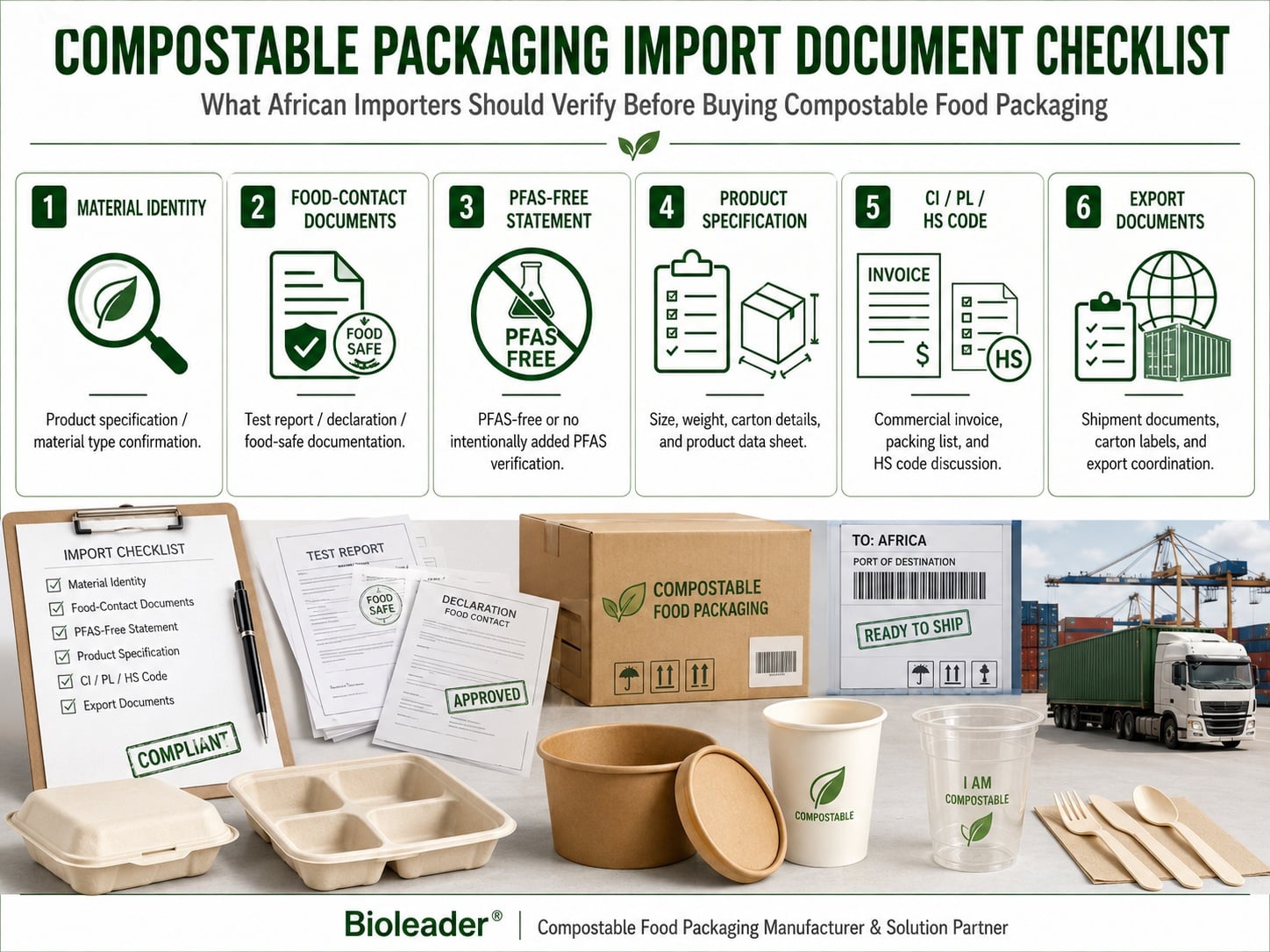
| Verification area | What to request from supplier | Why it matters |
|---|---|---|
| Material identity | Material description, product specification sheet and product family confirmation. | Prevents confusion between bagasse, paper, PLA, CPLA, cornstarch, PP, PET or EPS products. |
| Food-contact suitability | Food-contact documents where relevant, test reports or supplier declarations by product category. | Foodservice buyers, supermarkets and institutional customers often require proof beyond marketing language. |
| Compostability claim | Compostability certificate or product-specific statement where applicable. | Compostability depends on material, product design and local composting conditions; unsupported claims create risk. |
| PFAS-related claim | PFAS-free statement, no intentionally added PFAS declaration or relevant test report where required. | PFAS-related expectations are increasing in global food packaging procurement and should be handled with product-level clarity. |
| Regulatory fit | Destination-country policy check, importer confirmation or local advisor review. | Plastic bans and EPR rules differ across markets and may apply to importers, distributors or brand owners. |
| Shipment documents | Commercial invoice, packing list, carton data, product descriptions, HS code discussion and shipping documents. | Document consistency reduces bank review, customs clearance and buyer-accounting friction. |
Why Food-Contact Documents Matter as Much as Plastic Ban Compliance
Many buyers focus only on plastic bans, but food-contact compliance can be equally important. A product may be positioned as sustainable, but if it touches food, buyers still need to know whether it is suitable for the intended application. Hot soup, oily meals, cold drinks and dry snacks create different material requirements.
For example, a bagasse clamshell used for hot rice and oily chicken should be checked differently from a paper salad bowl with a clear lid. A PLA cold cup should not be treated like a hot beverage cup. Compostable cutlery used in hot foodservice should be reviewed for heat resistance and stiffness. Each product family needs its own specification and application check.
For importers selling to hotels, supermarkets, mining camps, schools, public-sector caterers or international restaurant brands, documentation becomes part of the sales process. A buyer who can show product specifications, material details, food-contact documents and responsible claims will have a stronger position than a buyer who only sells “eco packaging” by price.
Bioleader® Documentation Support for African Buyers
Bioleader® supports African importers by helping connect product selection with documentation and export preparation. The company’s product range includes sugarcane bagasse tableware, bagasse food containers, bagasse clamshell boxes, bagasse plates, bagasse bowls, bagasse trays, kraft paper bowls, paper soup containers, paper salad bowls, paper cups, PLA cups, compostable cutlery, CPLA cutlery and cornstarch tableware.
For regulation-sensitive markets, Bioleader® can help buyers prepare product specifications, food-contact documents where applicable, PFAS-free or no-intentionally-added-PFAS statements where available, carton specifications, packing method, commercial invoice, packing list and export shipment information. These documents do not replace local legal advice, but they give importers a stronger basis for customs clearance, buyer review and customer communication.
The best result comes when buyers share the destination country, product use, food type, target customer, claim requirements and expected quantity before quotation. With this information, Bioleader® can recommend a more suitable material and documentation path instead of offering only a generic price list.
How to Convert Regulation into a Procurement Checklist
Regulation should not make importers passive. It should make the procurement process more disciplined. Before buying compostable or biodegradable food packaging for an African market, importers can use the following workflow.
- Identify the destination country, city and customer channel, such as supermarket, hotel, takeaway chain, distributor, mining camp or event supplier.
- Check whether the local policy targets plastic bags, Styrofoam, single-use plastic products, EPR obligations or food-contact packaging.
- Define the actual food application, including hot meal, oily food, soup, salad, cold drink, dessert or meal kit.
- Select the material category, such as bagasse, kraft paper, PLA, CPLA, cornstarch or a mixed product solution.
- Request product samples and test them with real food, delivery movement, stacking and storage conditions.
- Collect product specifications, food-contact documents, compostability or PFAS-related statements where required.
- Align commercial invoice, packing list, carton data, HS code discussion and product descriptions before shipment.
- Ask the local importer to verify whether EPR registration, product fees, local labels or customer-specific approvals are required.
Common Mistakes to Avoid
- Assuming that all African countries have the same plastic ban or compostable packaging rules.
- Using “biodegradable” as a general claim without product-specific documentation.
- Importing PLA cups for hot drinks without confirming temperature suitability.
- Replacing Styrofoam food boxes with a material that has not been tested with oily or saucy food.
- Ignoring EPR obligations when selling into more regulated markets such as South Africa or Kenya.
- Using one certificate or test report to support unrelated product families.
- Failing to align invoice description, packing list, carton data and product claims before shipment.
- Buying too many SKUs before confirming which products are actually affected by local policy and customer demand.
Internal Link: Market Demand and Product Strategy
Regulation is only one part of the Africa packaging opportunity. Buyers also need to understand which products are likely to sell repeatedly in restaurants, takeaway, catering, supermarkets and mining camps. For a broader demand-side view, read Bioleader®’s guide on disposable tableware demand in Africa.
Bioleader® Solutions for Regulation-Aware African Imports
Bioleader® supplies compostable and biodegradable foodservice packaging for global B2B buyers who need practical material selection, export-ready documentation and bulk supply support. For African markets, the most relevant product categories include bagasse clamshells, bagasse food containers, bagasse plates, bagasse bowls, kraft paper bowls, paper soup containers, paper salad bowls, paper cups, PLA cups, compostable cutlery, CPLA cutlery and cornstarch tableware.
For importers, Bioleader® can support a regulation-aware sourcing process by helping compare materials, confirm food application, review samples, prepare carton data and align export documents. For distributors and foodservice brands, Bioleader® can help build product programs that reduce reliance on Styrofoam and low-quality plastics while staying realistic about cost, application and destination-market verification.
The recommended next step is to share the destination country, target product category, customer channel, food application, estimated quantity and required documents. Bioleader® can then help narrow the product options before quotation and reduce the risk of importing the wrong packaging.
FAQ
Are plastic bans the same across African countries?
No. Plastic bans and packaging rules differ by country, city and product type. Some rules target plastic bags, some focus on Styrofoam, some address single-use plastics, and others create EPR obligations for packaging producers or importers.
What should African importers verify before buying compostable food packaging?
Importers should verify destination-country rules, product material, food-contact suitability, compostability claims, PFAS-related statements, carton specifications, MOQ, commercial invoice, packing list and shipping documents before placing bulk orders.
Are bagasse food containers a good alternative to Styrofoam in Africa?
Yes, bagasse food containers are often a practical alternative for hot meals, rice dishes, takeaway lunch boxes and catering. Buyers should still test oil resistance, moisture tolerance, lid closure, stacking strength and carton protection before import.
Do compostable products automatically comply with African plastic bans?
No. Compostable products do not automatically comply with every African policy. Buyers must check the specific country, product category, material definition and documentation requirements before making claims or importing large quantities.
Why does EPR matter for food packaging importers?
EPR can make importers, producers or brand owners responsible for packaging after use. In markets with EPR rules, buyers may need to understand registration, reporting, fees, producer responsibility organizations or local compliance schemes.
How does Bioleader® help with regulation-aware sourcing?
Bioleader® helps buyers compare bagasse, paper, PLA, CPLA and cornstarch products, prepare specifications, support food-contact documents where applicable, provide PFAS-related statements where available, confirm carton data and coordinate export documents.
Conclusion: Regulation Is Due Diligence, Not Marketing Language
Plastic bans and compostable food packaging rules in Africa are becoming more important, but they should be treated carefully. The right question is not whether a product sounds green. The right question is whether the product, material, documentation, claim and destination-market requirement are aligned before buying.
For African importers, the safest path is to verify country rules, select packaging by real foodservice use, request product-specific documents and work with suppliers that understand export coordination. Regulation is not only a risk. It is also an opportunity for serious buyers to build stronger product lines and move ahead of low-quality plastic and Styrofoam packaging.
Bioleader® supports this transition with compostable and biodegradable foodservice packaging solutions for restaurants, distributors, hotels, supermarkets, catering companies and industrial foodservice buyers across African markets.
References
The following sources were reviewed to support the regulatory discussion in this article. Packaging regulations may change, and importers should always verify the latest official requirements with local authorities, customs brokers or legal advisors before shipment.
- National Environment Management Authority of Kenya, “Plastic Bags”. Kenya NEMA information page on the plastic carrier bag ban that came into effect on 28 August 2017.
- UNEP, “Kenya bans single-use plastics in protected areas”. UNEP report on Kenya’s restriction of plastic water bottles, cups, disposable plates, cutlery and straws in national parks, beaches, forests and conservation areas.
- Kenya NEMA, “Sustainable Waste Management (Extended Producer Responsibility) Regulations, 2024”. Official regulatory document covering EPR requirements for stipulated products and packaging in Kenya.
- RwandaLII, “Law No. 17/2019 relating to the prohibition of manufacturing, importation, use and sale of plastic carry bags and single-use plastic items”. Rwanda legal text covering restrictions on plastic carry bags and single-use plastic items.
- UNEP LEAP, “Rwanda Law No. 17/2019”. UNEP legal summary of Rwanda’s prohibition on plastic carry bags and single-use plastic items, including reference to compostable plastic item exemptions.
- United Republic of Tanzania, “Environmental Management (Prohibition of Plastic Carrier Bags and Plastic Bottle Cap Seals) Regulations, 2022”. Current Tanzania regulation covering plastic carrier bags and plastic bottle cap seals in Mainland Tanzania.
- Food Packaging Forum, “Immediate ban on foamware announced by Lagos State, Nigeria”. Industry summary of Lagos State and Abia State actions against single-use polystyrene foam packaging.
- Reuters, “Nigeria to ban single-use plastics next year”. Reuters report on Nigeria’s federal single-use plastics policy direction and Lagos-related packaging restrictions.
- Government of South Africa, “Extended Producer Responsibility Regulations Amendment, 2021”. Official document covering EPR identified products including paper and paper packaging, plastic packaging, biodegradable and compostable packaging, single-use products and single-use compostable products.