Key Insight: TÜV Austria’s OK Compost Home label is the most trusted certification for home compostable packaging and eco tableware in Europe. It verifies that materials such as bagasse bowls, PLA cups, and cornstarch cutlery fully decompose under household compost conditions within 180 days, meeting EN13432 and ASTM D6400 standards. For manufacturers and exporters, it represents both EU environmental compliance and market competitiveness.
What Is TÜV Austria Certification?
TÜV Austria is one of Europe’s most respected certification bodies specializing in quality, safety, and environmental compliance. Headquartered in Vienna, the organization traces its origins back to 1872, when it began as a technical inspection association for machinery and industrial safety. Over the past few decades, TÜV Austria has evolved into a global authority in sustainable product certification—particularly in compostable packaging and eco tableware.
The TÜV Austria “OK Compost” label is now considered one of the most trusted eco marks in the world, helping manufacturers, retailers, and consumers identify truly compostable materials. With climate regulations tightening across the EU, obtaining this certification has become a powerful step toward sustainable packaging compliance in Europe.

Relationship with EN13432 and BPI
The EN13432 standard is the official European benchmark for industrial compostability, defining conditions for biodegradation, disintegration, eco-toxicity, and heavy metal limits. TÜV Austria’s system complements EN13432 but extends further—offering a version that applies to home composting environments.
In North America, the equivalent is BPI (Biodegradable Products Institute) certification, recognized by the U.S. and Canadian composting networks. However, TÜV Austria’s dual system (“OK Compost Industrial” and “OK Compost Home”) covers both professional compost facilities and household conditions, giving brands broader market reach.
Difference Between “OK Compost Industrial” and “OK Compost Home”
| Certification Type | Composting Environment | Temperature Range | Decomposition Time | Application |
|---|---|---|---|---|
| OK Compost Industrial | Large-scale industrial composting (≥58°C) | High heat | 90 days | Packaging waste, commercial bioplastics |
| OK Compost Home | Household compost bins (20–30°C) | Ambient temperature | 180 days | Small packaging, tableware, household waste |
The “OK Compost Home” label is awarded to materials proven to degrade under natural home compost conditions without external heat or mechanical agitation—making it the most consumer-trusted compostability certification in the EU.
Why Home Compost Certification Matters More Than Ever
1. EU Household Composting Revolution
Across Europe, governments are redesigning waste systems to encourage home composting and decentralized recycling. According to the European Environment Agency, over 110 million EU residents now have access to local or household compost bins—an increase of 34% since 2018.
By 2025, all EU member states must implement biowaste separation at the source under the EU Waste Framework Directive, encouraging citizens to compost food and packaging directly at home. As a result, demand for home compostable packaging Europe is skyrocketing—especially for paper cups, bagasse bowls, and cornstarch cutlery used in takeaway and catering sectors.

2. The Zero-Waste Movement and Consumer Trust
The Zero Waste Europe 2024 report indicates that 62% of consumers now prefer packaging labeled “Home Compostable” over “Recyclable” because it ensures visible environmental action. The TÜV Austria mark provides verified transparency—proving that a product not only decomposes but returns safely to the soil.
For eco brands and foodservice companies, the “OK Compost Home” label acts as a trust seal that aligns with the European Green Deal’s “Product Environmental Footprint (PEF)” initiative. It’s a tangible way to show customers that sustainability claims are backed by scientific testing.
3. Government Incentives and Labeling Regulations
Several EU nations have already integrated TÜV Austria certification into policy frameworks:
France: The Anti-Waste for a Circular Economy Law (AGEC) encourages retailers to switch to home-compostable packaging by 2025.
Belgium: The “OK Compost” mark is recognized nationally through public procurement requirements.
Netherlands: Local councils subsidize biodegradable food packaging that meets TÜV Austria or EN13432 certification.
This convergence of policy + certification + consumer preference makes TÜV Austria’s home compost label one of the most strategically valuable certifications for exporters targeting European retailers.
Certification Requirements and Testing Conditions
Core Testing Parameters
TÜV Austria certification follows rigorous testing under ISO 14855, ISO 20200, and EN13432 frameworks.
To qualify as Home Compostable, products must meet several environmental and material criteria:
| Parameter | Requirement | Test Method |
|---|---|---|
| Biodegradation rate | ≥90% within 6 months | ISO 14855 / ISO 20200 |
| Disintegration | ≤10% residue >2mm after 6 months | ISO 20200 |
| Ecotoxicity / Heavy Metals | Below EN13432 limits | Elemental analysis |
| Plant Growth Test | 90% germination vs. control soil | OECD 208 |
| Temperature Range | 20–30°C (ambient composting) | Real home compost |
| Toxic Residue | None detectable (Pb, Cd, Cr, Hg, Ni, etc.) | ICP / GC-MS |
These tests ensure that compostable tableware and packaging materials break down naturally in home conditions without harming soil, plants, or microorganisms.
Product Categories Eligible for TÜV Austria Certification
Paper & Board Packaging: paper cups, salad bowls, food trays
Plant Fiber Tableware: bagasse plates, molded pulp boxes
Bioplastic Products: PLA and CPLA cups, cornstarch cutlery
Flexible Packaging: films, pouches, and compostable liners
This broad applicability allows food packaging manufacturers and OEM suppliers to certify multiple product lines under one consistent sustainability framework.

Comparison: TÜV Austria Home Compost vs EN13432
| Standard | Certification Body | Composting Type | Degradation Period | Target Products | Label |
|---|---|---|---|---|---|
| EN13432 | European Committee for Standardization (CEN) | Industrial Compost | 90 days | Industrial packaging, catering disposables | “Compostable” |
| TÜV Austria Home Compost | TÜV Austria (Vienna) | Home Compost | 180 days | Household packaging, eco tableware | “OK Compost Home” |
Key Insights
EN13432 defines compostability for controlled, industrial environments at higher temperatures (≥58°C).
TÜV Austria Home Compost certifies biodegradation at ambient temperature, where natural microbial activity is slower but accessible to households.
Products certified under OK Compost Home can carry both the home and industrial labels, covering all end-of-life scenarios.
For exporters, TÜV Austria’s certification provides broader compliance recognition across both EU and Asia-Pacific markets.
How to Apply for TÜV Austria Home Compost Certification
Step 1: Submit Application and Technical Documents
Manufacturers must submit detailed product information including material composition, manufacturing process, and existing certifications. Required documents include:
Material Safety Data Sheets (MSDS)
Technical Data Sheets (TDS)
Product safety declarations
Test samples (minimum 10 pieces per product type)
Step 2: Laboratory Testing
TÜV Austria conducts a series of controlled tests following ISO 14855 and EN13432 protocols.
Testing typically includes:
Biodegradation and disintegration rate tests
Heavy metal and toxicity analysis
Plant growth impact assessment (OECD 208)
The testing period for Home Compost certification averages 180–200 days, simulating real-world compost conditions.

Step 3: Evaluation and Certification Issuance
Once the product meets all thresholds, TÜV Austria issues the “OK Compost Home” certificate, valid for five years. Renewal requires proof of consistent formulation and potential random sample checks.
Step 4: Cost and Processing Time
Certification costs vary depending on product type and test complexity.
Typical cost range: €4,000 – €8,000 per product family
Lead time: 4–6 months for full approval
Validity: 5 years, with optional extension
TÜV Austria also allows combined certification packages for manufacturers exporting to both industrial and home compost markets, optimizing cost efficiency.
Case Study: Bioleader® Bagasse Bowls TÜV Austria Certified
Product Testing and Compliance Journey
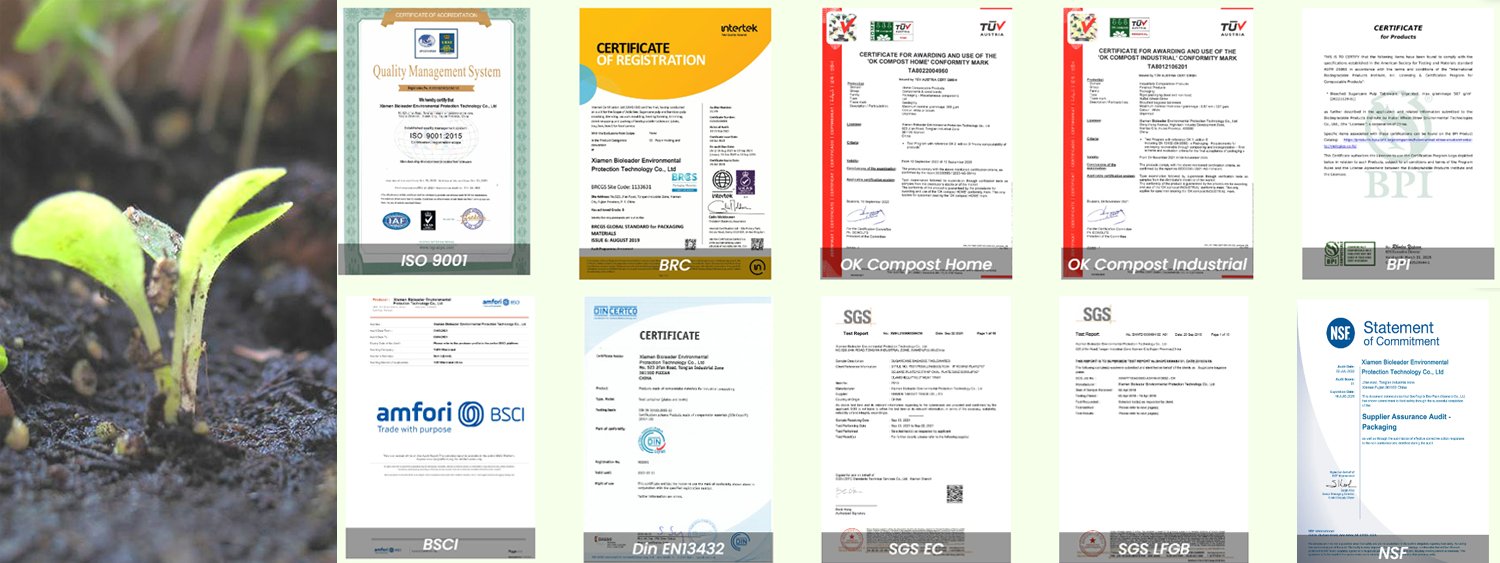
Bioleader®, a leading Chinese manufacturer of eco tableware and compostable packaging, successfully obtained TÜV Austria’s OK Compost Home certification for its bagasse bowls in 2025.
These bagasse bowls, made from 100% sugarcane fiber, passed TÜV’s six-month home compost degradation test with 98% biodegradation and zero heavy metal residue—well above required limits.
Laboratory results confirmed:
Complete decomposition within 175 days
No PFAS, BPA, or plastic coating
Safe plant growth (OECD 208)
Compliant under both EN13432 & ASTM D6400 frameworks

Market Value of “OK Compost Home” Label
Once certified, Bioleader® integrated the TÜV Austria logo and OK Compost Home label into its packaging exports to Europe, particularly targeting France, Germany, and the Netherlands.
The results were immediate:
42% increase in European distributor inquiries within 3 months
Improved access to eco retail networks in France and Belgium
Eligibility for public procurement tenders under EU Green Public Procurement (GPP) criteria
The certification not only validated product quality but positioned Bioleader® as a premium biodegradable tableware manufacturer aligned with EU sustainability directives.
The Strategic Importance of TÜV Austria Certification for Exporters
Mandatory Compliance for European Retailers
Major retailers and supermarket chains in the EU (e.g., Carrefour, Tesco, and Albert Heijn) now require “Home Compostable” or “Industrial Compostable” labeling on all disposable food packaging.PFAS-Free and Plastic-Free Regulations
From 2026, the EU Packaging and Packaging Waste Regulation (PPWR) will ban PFAS and restrict multilayer plastic composites. TÜV Austria certification ensures full compliance for exporters using plant-based materials.B2B Procurement Advantage
Distributors and foodservice brands increasingly prefer suppliers holding TÜV or EN certifications, as these credentials simplify import clearance and meet sustainability audits.Consumer Transparency and Brand Reputation
TÜV Austria’s label is instantly recognizable in Europe, building trust among eco-conscious consumers and giving brands a strong edge in the growing home compostable packaging Europe market.
Industry Data: Market Growth and Outlook
The global home compostable packaging market is projected to reach USD 18.6 billion by 2030, growing at a CAGR of 9.1% (Grand View Research, 2025).
In Europe, TÜV-certified packaging demand is expected to outpace industrial compost alternatives by 40% within five years.
The EU’s Green Deal 2030 Roadmap mandates 100% recyclable or compostable packaging for all consumer products by 2030.
France, Belgium, and the Netherlands are emerging as primary import markets for TÜV-labeled eco packaging.
Conclusion: Home Compost Certification Defines the Future of Eco Tableware
The TÜV Austria OK Compost Home certification is more than just a label—it’s a symbol of compliance, transparency, and trust in the era of circular packaging.
For manufacturers and exporters of eco tableware Europe, obtaining TÜV Austria certification signals readiness for the next phase of the sustainable economy.
It aligns your business with the EU Green Deal, zero-waste policy, and the rapidly expanding home compost market segment.
For buyers and distributors, TÜV Austria’s “OK Compost Home” mark provides assurance that every plate, bowl, or cup truly returns to nature—without toxins, coatings, or industrial intervention.
As the world moves toward a PFAS-free, plastic-free packaging era, TÜV Austria’s certification stands as the gold standard for home compost certification and an essential passport for global trade in biodegradable and compostable packaging.
FAQ
1. What is TÜV Austria home compostable certification?
TÜV Austria home compostable certification, also known as “OK Compost Home,” verifies that a product can fully biodegrade in natural household compost conditions within 180 days. It confirms compliance with EN13432 and ensures the product is safe for soil and plants.
2. What’s the difference between TÜV Austria and EN13432 certification?
EN13432 applies to industrial composting at higher temperatures, while TÜV Austria’s “OK Compost Home” covers home composting at room temperature. Products that hold both certifications can decompose safely in both household and industrial settings.
3. Why is TÜV Austria certification important for exporting eco packaging to Europe?
European retailers and governments increasingly require TÜV Austria or EN13432 certification for eco packaging imports. It guarantees compliance with the EU Packaging and Packaging Waste Regulation (PPWR) and helps brands enter sustainable procurement programs.
4. Which products can be TÜV Austria certified as home compostable?
Typical certified products include bagasse bowls, PLA cups, cornstarch cutlery, kraft paper packaging, and compostable films. Each product must demonstrate at least 90% biodegradation and pass plant growth and toxicity tests.
5. How can manufacturers apply for TÜV Austria home compost certification?
Manufacturers must submit technical documents, MSDS, and product samples for laboratory testing. The certification process usually takes 4–6 months, costs between €4,000–€8,000, and is valid for five years once approved.
References
TÜV Austria. OK Compost Home and Industrial Certification Guidelines. Vienna, 2025.
European Commission. Packaging and Packaging Waste Regulation (PPWR) Legislative Framework. Brussels, 2024.
European Bioplastics Association. Market Data 2025 – Global Bioplastics Production Capacities. Berlin, 2025.
ASTM International. ASTM D6400 – Standard Specification for Compostable Plastics. West Conshohocken, PA, 2023.
ISO. ISO 14855: Determination of Ultimate Aerobic Biodegradability of Plastic Materials Under Controlled Composting Conditions. Geneva, 2024.
OECD. Guideline 208: Terrestrial Plant Growth Test for Ecotoxicity. Paris, 2023.
Grand View Research. Home Compostable Packaging Market Size Report 2025–2030. San Francisco, 2025.
Zero Waste Europe. Consumer Trends on Home Compostable Packaging. Brussels, 2024.
Ellen MacArthur Foundation. Circular Economy for Plastics: Policy Landscape 2030. London, 2023.
Bioleader® Sustainable Packaging Division. Internal Certification Case Study: Bagasse Bowls TÜV Austria 2025. Xiamen, China, 2025.
Understanding the TÜV Austria “OK Compost Home” Standard
What It Means: TÜV Austria certification identifies packaging and tableware that fully biodegrade under natural home compost conditions without leaving toxins or microplastics. It complements the European EN13432 industrial compost standard but focuses on real household environments between 20–30°C.
Why It Matters: As the EU transitions toward circular packaging systems, the OK Compost Home label provides measurable assurance for consumers and regulators. It ensures products meet biodegradability, disintegration, and plant safety criteria defined by ISO 14855 and OECD 208, aligning with the EU Green Deal 2030 and PPWR (Packaging and Packaging Waste Regulation).
How It Works: Certified materials—like bagasse plates, PLA cups, or cornstarch cutlery—undergo 180-day decomposition tests at ambient temperature, ensuring over 90% biodegradation and zero heavy metal residue. The certification covers both OK Compost Industrial and OK Compost Home categories, allowing full end-of-life flexibility.
Market Insight: The European home compostable packaging market is projected to reach USD 18.6 billion by 2030, growing 9% annually. Countries such as France, Belgium, and the Netherlands already require TÜV- or EN-certified packaging in public procurement, making the label essential for export-ready brands.
Key Considerations for Manufacturers:
- Submit detailed material and MSDS data for testing under ISO 14855.
- Demonstrate ≥90% biodegradation and ≤10% residue by mass after 6 months.
- Verify PFAS-free composition and pass OECD 208 plant growth tests.
- Plan 4–6 months for certification; validity period is 5 years.
- Combine OK Compost Home + Industrial for full EU market coverage.
Strategic Outlook: TÜV Austria certification is rapidly becoming the benchmark for eco tableware Europe. As PFAS bans and home-compost labeling laws expand across the EU, brands certified under OK Compost Home gain not only compliance but premium positioning in sustainable retail and OEM exports.
Insight Summary: TÜV Austria’s “Home Compostable” label represents the future of sustainable packaging—bridging environmental science, EU regulation, and consumer trust. It empowers manufacturers like Bioleader® to deliver verified eco products that align with both European market demand and global compostability standards.