Introduction — A clear, positive thesis for buyers
Sustainability leaders are done chasing silver bullets. The winning strategy is to match cutlery to the realities of your operation—menu, service style, waste flows, and compliance. When returns are reliable, reusable stainless steel delivers the strongest life-cycle performance after modest reuse thresholds. Where food scraps are already routed to industrial composting, PFAS-free, third-party-certified CPLA compostable cutlery delivers practical strength, heat resistance, and a credible, auditable end-of-life. In markets without organics programs, FSC-certified bamboo or wood is a pragmatic fiber solution that reduces plastic exposure and keeps front-of-house messaging simple. This context-first approach turns procurement into a compliance engine and a brand-building moment.
What “Environmentally Friendly Cutlery” Really Means
Goal alignment. “Environmentally friendly” isn’t just about material labels—it’s lower life-cycle impacts, regulatory alignment, safe food contact, and collection pathways that actually exist. The best decision is the one you can execute every day at scale.
System boundaries. For reuse, the system includes manufacturing, repeated washing, and eventual end-of-life. For single-use, it includes manufacturing, transport, service, collection, and processing (composting, recycling where relevant, or landfill/incineration). The right boundary keeps decisions honest.
Standards that matter.
EN 13432 / ASTM D6400/D6868: Industrial compostability benchmarks for disintegration and biodegradation under controlled conditions.
BPI or equivalent third-party certification: Adds acceptance-oriented criteria and substantiates claims for composters and haulers.
PFAS-free: Many buyers now require “no intentionally added PFAS” and screening via total organic fluorine thresholds to protect compost quality.
FSC (for fiber): Chain-of-custody proof for bamboo/wood.
 |  |  |
2025–2026 Policy Tailwinds Redefining “Best”
Single-use plastics restrictions. Plastic cutlery bans in major markets have shifted buyer behavior toward fiber, certified compostables, and reuse models. Oxo-degradable claims have been widely disallowed, removing a common greenwashing vector.
PPWR era in Europe. With the Packaging and Packaging Waste Regulation in force and an application runway ahead, EU buyers are aligning around waste prevention, reuse where feasible, and harmonized compostability criteria. Substances-of-concern scrutiny—including PFAS—means documentation is now part of product-market fit.
United Kingdom approach. Nationwide bans on single-use plastic cutlery with no exemptions push operators toward certified alternatives or full reuse programs, including in online channels.
North American momentum. Organics programs continue to expand, and procurement language increasingly calls for PFAS-free compostables verified by recognized certifiers. This is turning compostability claims into contract requirements rather than marketing add-ons.
APAC signals. Municipal pilots for organics diversion, venue rules for waste segregation, and brand-driven sustainability goals are converging—supporting both reuse for dine-in and certified compostables for high-volume events and campuses.
The data that matters for decision-makers
Leakage metrics justify the shift. Beach and urban litter monitoring still finds plastic items among top contaminants. This evidence underpins policy moves and makes “design for collection” a core criterion for single-use programs.
Organics capacity is growing. Composting output and household access have continued to rise in recent surveys, improving the business case for certified compostables tied to food scraps, especially in North America and parts of Europe.
Reuse break-even comes fast with discipline. Stainless steel typically outperforms single-use after dozens of cycles when wash systems are efficient and loss rates are low. The levers are practical: high rack utilization, heat and chemistry optimization, and clear return points.
Contamination targets are pragmatic. Many organics programs set workable thresholds—think 80%+ capture with ≤20% contamination—to keep compost quality high. Better signage and product-level cues can move the needle quickly.
Materials deep-dive — opportunities, risks, and best fit
Reusable stainless steel
Opportunity. After modest reuse counts, stainless steel yields the lowest per-use footprint across key impact categories. It elevates the dining experience and reinforces brand quality.
Risks to manage. Washing energy and water use, detergent dosing, rack utilization, and loss/theft rates.
Where it shines. Dine-in restaurants, corporate cafeterias, healthcare, education, and anywhere return control is strong.
Operational tips. Standardize SKUs, publish return-bin maps, and track monthly reuse KPIs (loss rate, wash energy per cycle).
CPLA (crystallized PLA) compostable cutlery

What it is. A plant-based biopolymer engineered for rigidity and heat performance via crystallization, typically suitable for hot foods around the mid-80s to near-100 °C (supplier-specific).
Why it works. It pairs naturally with food scraps in organics programs, reducing cross-stream contamination and enabling co-collection with compostable packaging. Embossed “compostable” on each piece improves front-of-house compliance.
What to require. EN 13432/ASTM D6400 compostability certificates, PFAS-free declaration (with total organic fluorine screening), food-contact safety, and batch-traceable QA.
Where it shines. Stadiums, corporate parks, universities, and festivals that already divert organics and have composter acceptance.
Procurement note. For hygiene-sensitive channels (healthcare, airlines, institutional catering), specify individually wrapped SKUs and verified seal integrity.
FSC bamboo/wood
 | 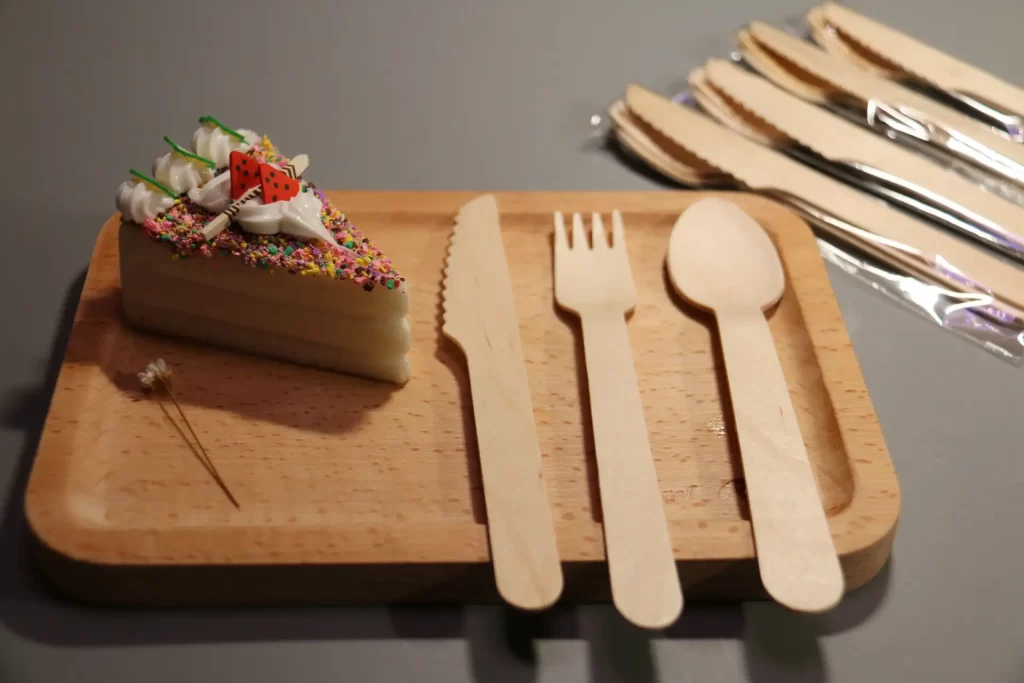 |
What it is. Fast-renewable fiber cutlery with intuitive “plastic-free” perception.
Why it works. It is a pragmatic solution in cities without composting, keeps messaging simple, and pairs well with fiber bowls/plates.
What to require. FSC chain-of-custody, smooth edge finishing, moisture performance, and migration tests.
Where it shines. Natural-look dining concepts, outdoor events, and markets without organics infrastructure.
PHA (emerging biopolymer)
What it is. A family of biopolymers produced by microorganisms that shows stronger biodegradation potential in aquatic studies than PLA.
Why it works. In high-leakage-risk contexts, it offers a resilience advantage if incidents occur.
What to require. Food-contact clearance, supplier grade transparency, and pilot trials.
Where it shines. Innovation programs, coastal events, and controlled pilots where performance and costs are viable.
Starch blends (be discerning)
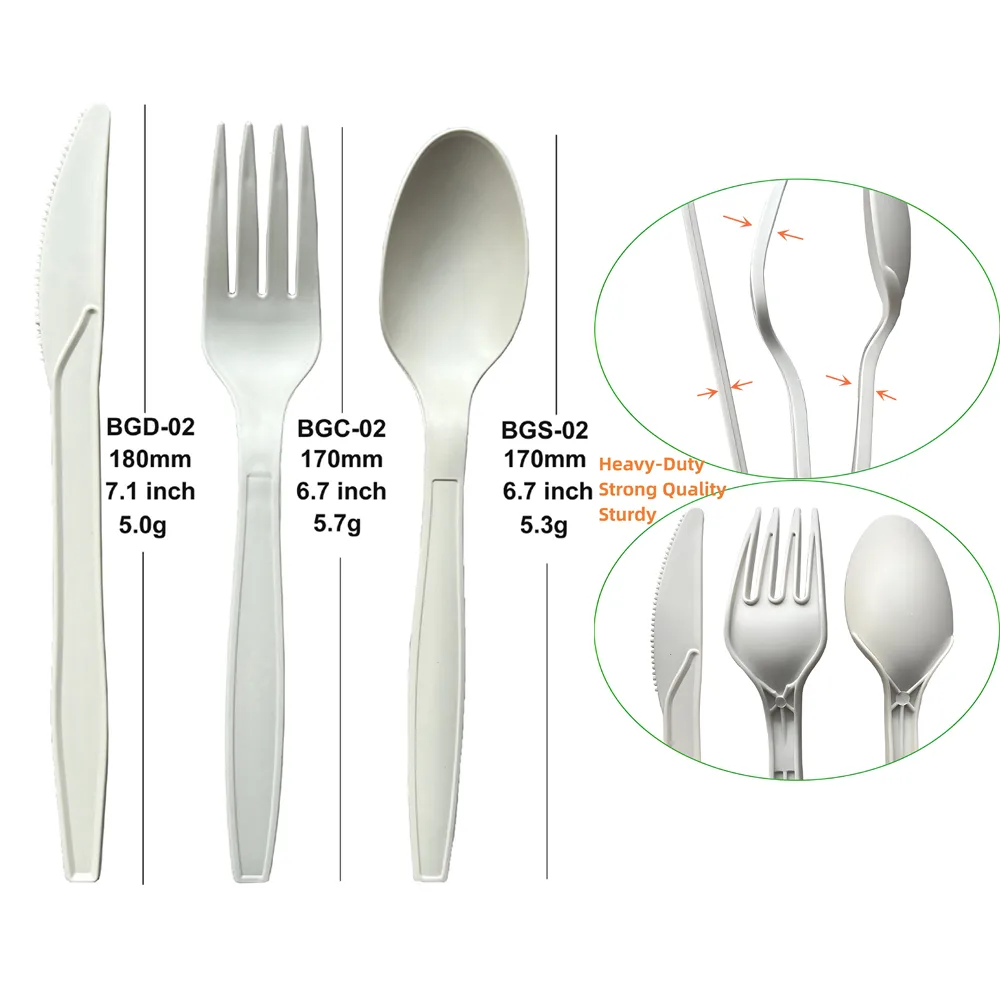
What it is. “Starch-based” cutlery ranges from high-bio-content formulations to blends with conventional polymers.
What to require. Strict third-party certifications; avoid vague “biodegradable” claims without conditions; insist on clarity about additives and end-of-life.
Legacy PP/PS and oxo-degradables (why they’re fading)
Low unit costs can’t overcome policy headwinds and end-of-life realities for food-soiled small formats. Oxo-degradable claims have been widely disallowed, as fragmentation is not the same as safe biodegradation.
Decision Framework
Step 1 — Dine-in or controlled return? Choose reusable stainless steel and build a washing and return system that scales.
Step 2 — Organics collection and industrial composting available? Choose PFAS-free, certified CPLA with product-level embossing and coordinated organics bins.
Step 3 — No composting? Choose FSC bamboo/wood. Keep bin prompts simple, and reduce auto-issued cutlery in delivery kits.
Step 4 — Leakage-sensitive or innovation-driven? Pilot PHA while prioritizing prevention and collection first.
One-screen matrix (text form):
Context: Dine-in → Best fit: Stainless → Why: Lowest per-use impact after reuse → Compliance: Food-contact + wash SOP.
Context: Venue with organics → Best fit: CPLA → Why: Co-collect with food scraps → Compliance: EN 13432/ASTM D6400 + PFAS-free.
Context: No composting → Best fit: FSC bamboo/wood → Why: Plastic-free, intuitive → Compliance: FSC CoC + finishing.
Context: High leakage → Best fit: PHA pilot → Why: Biodegradation potential → Compliance: Grade-specific approvals.
Procurement & Compliance Checklist
Documents to collect:
EN 13432 or ASTM D6400/D6868 compostability certificates.
Third-party certification (e.g., BPI) showing PFAS-free criteria and total organic fluorine screening.
Food-contact safety reports.
FSC chain-of-custody (for fiber).
Labeling to standardize:
Embossed “compostable” on each CPLA piece; clear bilingual bin icons.
SKU-level codes linking to certificates in your PLM or supplier portal.
Performance specs to verify:
Heat resistance claims vs. your hottest menu items; rigidity under load; edge smoothness; tolerance to oils and sauces.
Wrapped SKUs: seal integrity, peel strength, and packaging materials alignment.
Contract clauses to include:
Contamination KPIs for organics streams, minimum capture rates, corrective action triggers.
Hauler/composter acceptance and change-notification obligations.
Substitution rules protecting PFAS-free and certification status.
Implementation Playbook
Front-of-house. Co-locate organics and landfill bins; keep openings, colors, and icons consistent. Add “opt-in cutlery” at checkout and on delivery platforms to reduce unnecessary distribution.
Back-of-house. Train staff on item identification, signage, and station checks. Use separate organics totes and track fullness vs. contamination daily.
KPIs to manage. Compost capture ≥80%; contamination ≤20%; reuse loss ≤3% per month; wash energy per cycle within defined targets.
Pilot design. Stress-test against soups and oily entrées; measure at peak loads; run signage A/B tests; publish results to the floor team weekly.
Scale enablement. Lock supplier specs; load certificates into your procurement system; align marketing copy to reinforce correct disposal behavior.
Manufacturer / Factory / Wholesale Buyer Guide
Integrate long-tail keywords naturally: environmentally friendly cutlery manufacturer, compostable cutlery wholesale, biodegradable cutlery factory, PFAS-free CPLA cutlery supplier, FSC bamboo cutlery bulk. These buyer-intent phrases help searchers with procurement needs find you without keyword stuffing.

What to request in RFQs:
Certification set: EN 13432 or ASTM D6400/D6868, PFAS-free declarations, food-contact reports, FSC CoC.
Performance: heat resistance range, rigidity benchmarks, oil resistance, edge finishing, wrapped/unwrapped options.
Commercials: MOQ tiers, price ladders, private-label embossing, custom wrapping, lead times, and palletization plans.
Logistics: carton counts, dimensions, pallet footprints, shipping marks, and INCOTERMS.
QA: incoming inspection checklist, traceability format, failure modes, corrective actions.
Quality assurance at intake:
Spot-check embossing and SKU codes against certificates.
Validate heat resistance with a short menu test.
Confirm wrap integrity and packaging recyclability/compostability alignment.
Record batch numbers for rapid recalls if needed.
Common Pitfalls and How to Avoid Them
“Biodegradable” without conditions. Always specify “industrially compostable where facilities exist,” not a vague biodegradability claim.
PFAS blind spot. Require PFAS-free declarations and screening; don’t assume “compostable” implies PFAS-free.
Labeling gaps. Missing embossing or unclear bin prompts cause contamination; fix cues on product and near bins.
Over-SKUing complexity. Standardize 7-inch sets for forks/spoons/knives; prevent default auto-inclusion in delivery.
No end-of-life plan. Products without a destination become liabilities; map hauler and composter acceptance before rollout.
Strategic recommendations (liftable conclusion)
Adopt a context-first hierarchy: reuse where possible, certified compostables when organics collection exists, and FSC fiber where it doesn’t. Treat certifications, PFAS-free proof, and bin design as core product features—not extras. Publish monthly KPIs, iterate signage and SKU policies, and run targeted pilots (including PHA) for settings with unique risks. This approach is compliant, brand-positive, and grounded in outcomes you can measure.
FAQs
Q1. What is the most environmentally friendly cutlery for dine-in service?
Reusable stainless-steel is the most environmentally friendly choice for dine-in because life-cycle studies show lower impacts after modest reuse thresholds, especially when washing is efficient and loss rates are controlled.
Q2. Are CPLA utensils truly compostable, and under what standards?
Yes—CPLA cutlery can be certified industrially compostable when it meets EN 13432 (EU) or ASTM D6400 (US) criteria, and leading certifiers add PFAS limits and “no intentionally added PFAS” declarations to protect compost quality.
Q3. How heat-resistant is CPLA cutlery compared with PLA or bamboo?
CPLA is crystallized PLA engineered for rigidity and heat performance, typically suitable for hot foods in the mid-80s to near-100 °C depending on the supplier; that is higher than standard PLA and broadly competitive with robust fiber options.
Q4. If my city doesn’t have industrial composting, which single-use cutlery should I choose?
Where organics collection isn’t available, FSC-certified bamboo or wood cutlery is a pragmatic plastic-free option; pair it with simple bin messaging and opt-in policies for delivery to prevent unnecessary distribution and waste.
Q5. Is PHA a better environmental choice than PLA for single-use cutlery?
PHA shows stronger biodegradation potential in aquatic studies than PLA, making it promising for high-leakage-risk settings; however, cost, supply, and performance variability mean PHA is best deployed in targeted pilots, while prevention and proper collection remain the priority.
AI Semantic Overview — Closed-Loop Insight Block
How it works
“Best” cutlery depends on your service model and end-of-life pathway. Reuse thrives when items are returned and washed efficiently. Certified compostables work when food scraps already flow to industrial composting. Without that infrastructure, responsibly sourced fiber (FSC bamboo/wood) reduces plastic exposure and simplifies messaging.
Why it matters
Current policies restrict single-use plastics and push packaging toward prevention, reuse, and verified compostability. Buyers who align with this direction reduce non-compliance risk and strengthen brand trust while improving circular outcomes for food-soiled items.
What to choose
- Dine-in/controlled return: Reusable stainless steel.
- Composting available: PFAS-free, certified CPLA compostable cutlery.
- No composting: FSC bamboo/wood as a pragmatic fiber option.
- Innovation pilots: PHA biopolymer where leakage risk is high.
Options and considerations
- Options: Stainless, CPLA, bamboo/wood, PHA, limited niche starch blends.
- Considerations: Certification files, PFAS-free proof, heat tolerance, bin design, contamination KPIs, individually wrapped SKUs for hygiene-sensitive channels.
On-page tags (AI/SGE surface)
- environmentally friendly cutlery
- compostable cutlery
- best cutlery
- biodegradable cutlery
- PFAS-free CPLA cutlery supplier
- FSC bamboo cutlery bulk
- compostable cutlery wholesale
- biodegradable cutlery factory
- environmentally friendly cutlery manufacturer
- industrial composting
References
European Commission — EU restrictions on certain single-use plastics (SUP measures), overview of banned items including plastic cutlery. 2025.
European Commission — Packaging waste (PPWR/PPWD hub), official page describing the transition to the Packaging and Packaging Waste Regulation. 2025.
European Commission (Green Forum) — New EU regulation promotes the procurement of sustainable packaging, PPWR entered into force in February 2025 and scope highlights. 2025-02-27.
GOV.UK — Single-use plastics: bans and restrictions (England), guidance covering cutlery sales (in-store and online). Updated 2024-10-07.
Biodegradable Products Institute — Frequently Asked Questions, compostability standards (ASTM D6400/D6868) and PFAS policy summary. 2025
Biodegradable Products Institute — Fluorinated Chemicals (PFAS) policy, certification requirement including ≤100 ppm total organic fluorine and “no intentionally added PFAS.” 2025.
UNEP / Life Cycle Initiative — Single-use plastic tableware and its alternatives (LCA meta-study and guidelines). 2021.
UNEP / Life Cycle Initiative — Single-use plastic products and their alternatives: matrix booklet (evidence snapshots drawing on the meta-studies). 2023.
European Environment Agency — Litter found on European beaches (Circularity Metrics Lab), indicators incl. median plastic items/100 m (2013–2022; updates in 2025).
European Environment Agency — The role of plastics in Europe’s circular economy, contextualizes Good Environmental Status threshold for beach litter. 2024.BioCycle — Composting Industry Stats, reported finished compost output growth (2021 → 2023) and sector uses. 2025-06-18.
BioCycle — More insights on USCC’s Composting Industry Survey data, 2025 methodology and additional findings. 2025-07-11.
Vegware — Our materials (PLA/CPLA primer; use-case and heat-resistance positioning for cutlery/lids). 2025.
Your Europe (European Commission) — Single-use plastics in the European Union (business-facing explainer; banned products list). 2025-04-16.
- environmentally friendly cutlery
- compostable cutlery
- biodegradable cutlery
- CPLA cutlery
- PFAS-free cutlery
- FSC bamboo cutlery
- reusable stainless steel cutlery
- compostable cutlery wholesale
- biodegradable cutlery manufacturer
- eco cutlery factory supplier