Introduction: Why Clear Plastic Needs a Change
For decades, the world has relied on petroleum-based plastics for everyday food packaging — convenient, lightweight, and transparent, but devastatingly persistent in the environment. Over 500 billion plastic cups are used globally each year, and only about 9% of them are recycled. The rest end up in landfills, oceans, or incinerators, contributing to long-term pollution and greenhouse gas emissions.
As consumers, regulators, and brands recognize the scale of this crisis, attention is turning toward bioplastics — innovative materials designed to offer the same clarity and convenience as conventional plastics but with a fraction of the environmental cost.
One of the leading solutions in this field is PLA, short for Polylactic Acid. PLA cups have become the preferred alternative for cafés, juice bars, and eco-conscious foodservice brands that want to combine aesthetics with sustainability. But what exactly are PLA cups made of? And how do they differ from regular plastic? Let’s dive into the science.
What Is PLA? The Basics of a Bioplastic Revolution
PLA (Polylactic Acid) is a biodegradable thermoplastic polyester made entirely from renewable plant starches such as corn, sugarcane, or cassava. It’s part of a new class of bioplastics engineered to mimic the properties of conventional plastics — clarity, rigidity, and processability — while eliminating reliance on petroleum.
The production process begins with extracting starch from crops like corn. Through fermentation, this starch is converted into lactic acid, a naturally occurring organic compound. Multiple lactic acid molecules are then linked together through polymerization to form polylactic acid resin, a clear, strong material that can be molded into cups, lids, and other packaging.
In short:
Plant starch → Lactic acid → PLA resin → Compostable clear cup

Why PLA is different
Renewable origins: Made from plants, not petroleum.
Non-toxic & BPA-free: Safe for direct food contact.
Industrial compostable: Breaks down under heat and microbial action.
Visually identical to plastic: Retains clarity, gloss, and strength.
From Plant to Cup: How PLA Is Manufactured
Turning a field of corn or sugarcane into a clear cup might sound futuristic, but it’s a highly efficient industrial process that merges biochemistry with modern manufacturing.
Step 1. Fermentation
The starch extracted from plants undergoes fermentation using specialized enzymes and bacteria. The sugars are converted into lactic acid, the fundamental building block of PLA.
Step 2. Polymerization
Lactic acid molecules are chemically bonded to form long polymer chains. This process transforms a liquid into a durable resin known as polylactic acid.
Step 3. Pelletizing
The resin is dried and cut into small transparent pellets, which serve as the raw material for all PLA products.
Step 4. Thermoforming and Injection Molding
The pellets are heated and formed into cups using vacuum forming or injection molding. The result is a crystal-clear, smooth, and compostable cup — indistinguishable from petroleum-based plastics to the human eye.
At Bioleader®, every compostable PLA clear cup is produced under strict quality control to ensure consistent wall thickness, optical clarity, and perfect lid fit. The cups are also printable, allowing brands to display their logo using non-toxic, compostable inks.
The Science Behind Compostable Clear Cups
Composting is nature’s recycling system. Instead of breaking down over centuries like petroleum plastics, biodegradable PLA cups decompose within months under specific environmental conditions.
The breakdown happens through hydrolysis and microbial digestion. Water and heat first weaken the polymer chains, and then microorganisms metabolize the lactic acid into carbon dioxide, water, and biomass.
No harmful residues, no microplastics — just natural components reentering the carbon cycle.
| Factor | Ideal Range | Role in Composting |
|---|---|---|
| Temperature | 58–65°C | Speeds microbial activity |
| Moisture | 50–60% | Maintains biological activity |
| Oxygen | Aerobic | Prevents methane and odor |
| pH | 6–8 | Keeps enzymes active |
| Time | 90–180 days | Full decomposition period |
In industrial composting, these conditions are carefully controlled. PLA cups can completely decompose within 3–6 months, turning into nutrient-rich compost.
In home composting, where temperatures rarely exceed 35°C, the process is slower but still achievable — especially for thinner wall cups or shredded pieces.
Key takeaway: PLA doesn’t just disappear; it’s designed to return safely to the earth through composting.

Environmental Benefits: PLA vs Traditional Plastics
The primary advantage of PLA lies in its carbon footprint. According to life cycle assessments, producing PLA generates 60–70% less greenhouse gas emissions than petroleum-based plastics like PET or PP.
| Attribute | PLA Cups | PET/PP Cups |
|---|---|---|
| Source | Corn or sugarcane | Crude oil |
| Carbon Footprint | 0.8–1.0 kg CO₂/kg | 2.8–3.0 kg CO₂/kg |
| Decomposition | 90–180 days (industrial) | 400–500 years |
| Recycling Path | Compostable | Mechanical recycling |
| Food Safety | BPA-free | May contain additives |
| Transparency | Excellent | Excellent |
| Heat Resistance | Up to 50°C (cold drinks) | 70–90°C |
Thus, switching to compostable clear PLA cups can reduce a company’s packaging-related CO₂ output dramatically — a tangible sustainability win.
Certifications That Matter
Not all “bioplastics” are created equal. True compostable products must pass rigorous third-party certification tests to ensure complete and non-toxic decomposition.
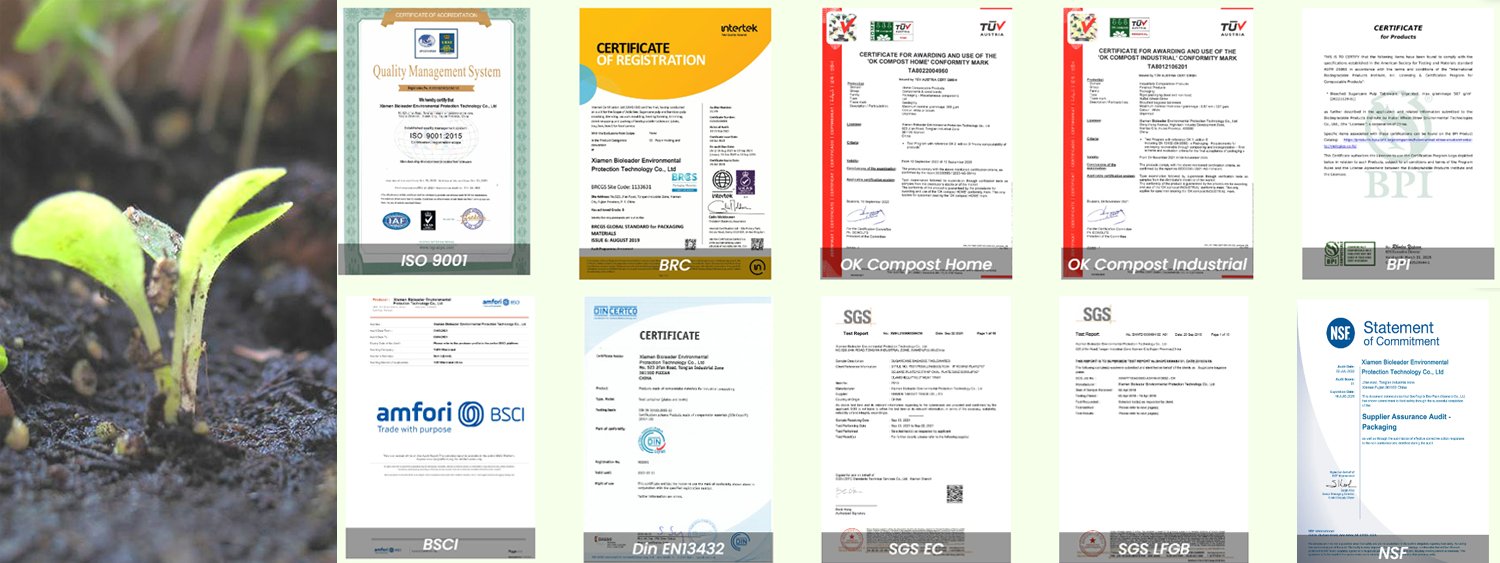
Bioleader® PLA Cups meet the world’s leading compostability standards:
✅ EN13432 — European standard for compostable packaging
✅ ASTM D6400 — U.S. standard for compostable plastics
✅ OK Compost & OK Compost HOME — TÜV Austria certification
✅ BPI Certified — Biodegradable Products Institute (North America)
✅ FDA & LFGB — Food contact safety certifications
These certifications guarantee that Bioleader® PLA cups are legally compliant for export and recognized across Europe, North America, the Middle East, and Asia-Pacific as safe, compostable, and sustainable.
Global Policy Push: Why Compostable Packaging Is Inevitable
Governments worldwide are rapidly tightening regulations on single-use plastics.
PLA cups align naturally with these new sustainability mandates:
| Region | Regulation | Year | Key Impact |
|---|---|---|---|
| European Union | Packaging and Packaging Waste Regulation (PPWR) | 2025 | Requires all food packaging to be recyclable or compostable. |
| France | AGEC Law | 2023 | Bans single-use plastics; mandates bio-based materials in foodservice. |
| United Kingdom | Plastic Packaging Tax | 2022 | Taxes petroleum plastics; encourages certified compostable packaging. |
| California, USA | SB54 Plastic Pollution Act | 2025 | 25% reduction in single-use plastics by 2032. |
| United Arab Emirates | Nationwide Plastic Ban | 2026 | Restricts import/sale of single-use plastics; promotes compostable alternatives. |
| Canada | SUPPR | 2024 | Nationwide prohibition of plastic straws, cutlery, and cups. |
The takeaway is clear: global law is catching up to sustainability. Businesses that switch to compostable materials now — like PLA — will not only stay compliant but also gain a strong environmental brand advantage.
Practical Performance: Where PLA Cups Excel
Despite being plant-based, eco-friendly PLA cups don’t compromise functionality.
They are rigid, leak-resistant, and crystal clear, making them ideal for:
🧃 Juice & Smoothie Bars: Enhance product presentation while staying eco-friendly.
☕ Cafés & Bubble Tea Shops: Perfect for cold drinks and iced coffees.
🍧 Dessert Stores & Frozen Yogurt Chains: Maintain clarity at low temperatures.
🏖️ Events & Outdoor Catering: Compostable and safe for one-time use.
🏢 Corporate Sustainability Programs: Replace plastic cups at offices and canteens.
Their light weight and stackability make PLA cups an easy drop-in replacement for PET or PP cups — no major equipment changes needed.

Beyond PLA: The Future of Bioplastic Innovation
PLA is only the beginning of the bioplastic revolution. Researchers and manufacturers like Bioleader® are exploring next-generation materials such as:
PHA (Polyhydroxyalkanoate): Fully marine biodegradable, even in cold environments.
Bagasse Fiber Composites: Combining plant fibers with bio-polymers for higher heat resistance.
Algae-Based Polymers: Using fast-growing seaweed as a carbon-neutral source.
These materials complement PLA to create a comprehensive ecosystem of compostable packaging that supports a circular, zero-waste economy.
How to Dispose of PLA Cups Correctly
Even the most compostable product must be disposed of properly to achieve its environmental promise.
Here’s how to handle environmentally friendly disposable PLA cups after use:
Separate PLA cups from general waste.
Place them in organic waste bins or designated compostable packaging streams.Industrial composting is best.
Composting facilities maintain ideal temperature and oxygen levels for full decomposition within 90–180 days.Avoid mixing with recyclable plastics.
PLA looks like PET but has a different chemical structure. Mixing the two contaminates recycling streams.Check local programs.
Many cities in Europe, the U.S., and Asia are expanding compostable packaging collection networks.Educate staff and consumers.
Clear labeling (e.g., “Compostable PLA Cup – Not for Recycling”) helps ensure proper disposal.
Correct disposal ensures that PLA truly returns to the earth — fulfilling its purpose as a sustainable, circular solution.
Case Example: How One Beverage Chain Switched to PLA Cups
In 2024, a mid-sized juice chain operating across Southeast Asia switched entirely to Bioleader® PLA cold cups.
Before the transition, their operations used around 12 million plastic cups per year, generating over 200 metric tons of CO₂ emissions.
After adopting PLA:
The company reduced its carbon footprint by 68%.
Customer satisfaction increased, as 87% preferred compostable cups.
They earned compliance with new EU export regulations.
The switch required no major machinery change — just a supplier with proven PLA expertise. This example demonstrates how sustainability can enhance brand value and compliance simultaneously.

FAQ
1. What are PLA cups made of?
PLA cups are made from renewable plant-based starches such as corn, cassava, or sugarcane. These natural materials are fermented into lactic acid and polymerized into polylactic acid resin, forming clear, compostable cups that look and feel like plastic but are fully biodegradable under industrial conditions.
2. Are PLA cups really compostable?
Yes. Certified PLA cups can break down completely under industrial composting conditions of 58–65°C within 90 to 180 days. The process turns the material into carbon dioxide, water, and organic biomass — leaving no microplastics or toxic residues.
3. Can PLA cups be used for hot drinks?
PLA cups are best for cold beverages such as juices, smoothies, or iced coffee. They have a heat resistance of up to around 50°C. For higher temperatures, it’s recommended to use CPLA (Crystallized PLA), which is specifically designed for hot drinks and lids.
4. How long do PLA cups take to decompose?
In an industrial composting facility, PLA cups typically decompose within 3 to 6 months. In home compost bins, where temperatures are lower, it can take up to 12 months depending on moisture, oxygen, and microbial activity.
5. Are PLA cups safe and certified for food use?
Yes. High-quality PLA cups are FDA, LFGB, EN13432, and ASTM D6400 certified, ensuring they’re safe for direct food contact and compliant with global compostability and safety standards. Always check for certification marks before purchase.
Conclusion: Transparent, Compostable, Responsible
PLA cups prove that clarity and sustainability can coexist.
They embody the next generation of eco packaging — made from plants, engineered for performance, and designed to return safely to the earth.
With governments, consumers, and brands aligning around the same goal — reducing plastic waste — switching to PLA cups is not just good practice; it’s smart business.
✨ Explore Bioleader® PLA Cup Range Today
Available from 8oz to 32oz, fully compostable, customizable, and export-ready under EN13432 and ASTM D6400 standards.
📚 Reference
European Bioplastics — Bioplastics Market Data 2024: Growth and Material Trends, 2024.
U.S. Environmental Protection Agency (EPA) — Sustainable Materials Management: Plastics and Biopolymers Report, 2023.
TÜV Austria — OK Compost and OK Compost HOME Certification Guidelines, 2024.
ASTM International — Standard Specification for Compostable Plastics (ASTM D6400), 2022.
European Committee for Standardization (CEN) — EN13432: Requirements for Packaging Recoverable through Composting and Biodegradation, 2023.
United Nations Environment Programme (UNEP) — Single-Use Plastics: A Roadmap for Sustainability, 2022.
NatureWorks LLC — The Science of PLA: Polylactic Acid and Its Environmental Benefits, 2023.
European Commission — Packaging and Packaging Waste Regulation (PPWR) Implementation Roadmap, 2025.
Biodegradable Products Institute (BPI) — Compostability Certification Guidelines for Foodservice Packaging, 2024.
Bioleader® Technical Department — Comparative LCA Data of PLA vs PET Cups in Beverage Applications, 2025.
Understanding PLA Cups: Science, Sustainability, and Market Impact
How PLA cups are made: PLA, or Polylactic Acid, is a bioplastic created from renewable crops like corn and sugarcane. Through fermentation and polymerization, these natural sugars are converted into clear, durable resin — molded into transparent cups that look like plastic but behave very differently after use.
Why they matter: Every PLA cup replaces petroleum-based plastics with a renewable material that can decompose under industrial composting conditions in 90–180 days. This process reduces CO₂ emissions by up to 70% compared with conventional plastics, supporting global decarbonization goals and waste reduction targets.
Where they decompose: Industrial composting facilities operating at 58–65°C allow microbes to fully digest PLA, converting it into water, CO₂, and organic matter. While home composting takes longer, the end result is the same — a safe return to nature with no toxic residue or microplastic contamination.
Global policy connection: Laws such as the EU PPWR (2025), California SB54, and the UAE’s 2026 plastic ban are accelerating adoption of compostable materials. PLA cups meet EN13432 and ASTM D6400 standards, making them globally compliant for eco packaging exports.
What to consider: Businesses choosing PLA cups should ensure certified compostability, proper waste segregation, and collaboration with composting partners. When paired with CPLA lids or kraft sleeves, PLA cups offer a full circular solution — from plant to product to soil.
Final insight: PLA cups represent the transition from a linear to a circular economy — proving that clarity, performance, and sustainability can exist in harmony. As consumers and regulations converge, compostable packaging is no longer a niche innovation but the new global standard for responsible foodservice.