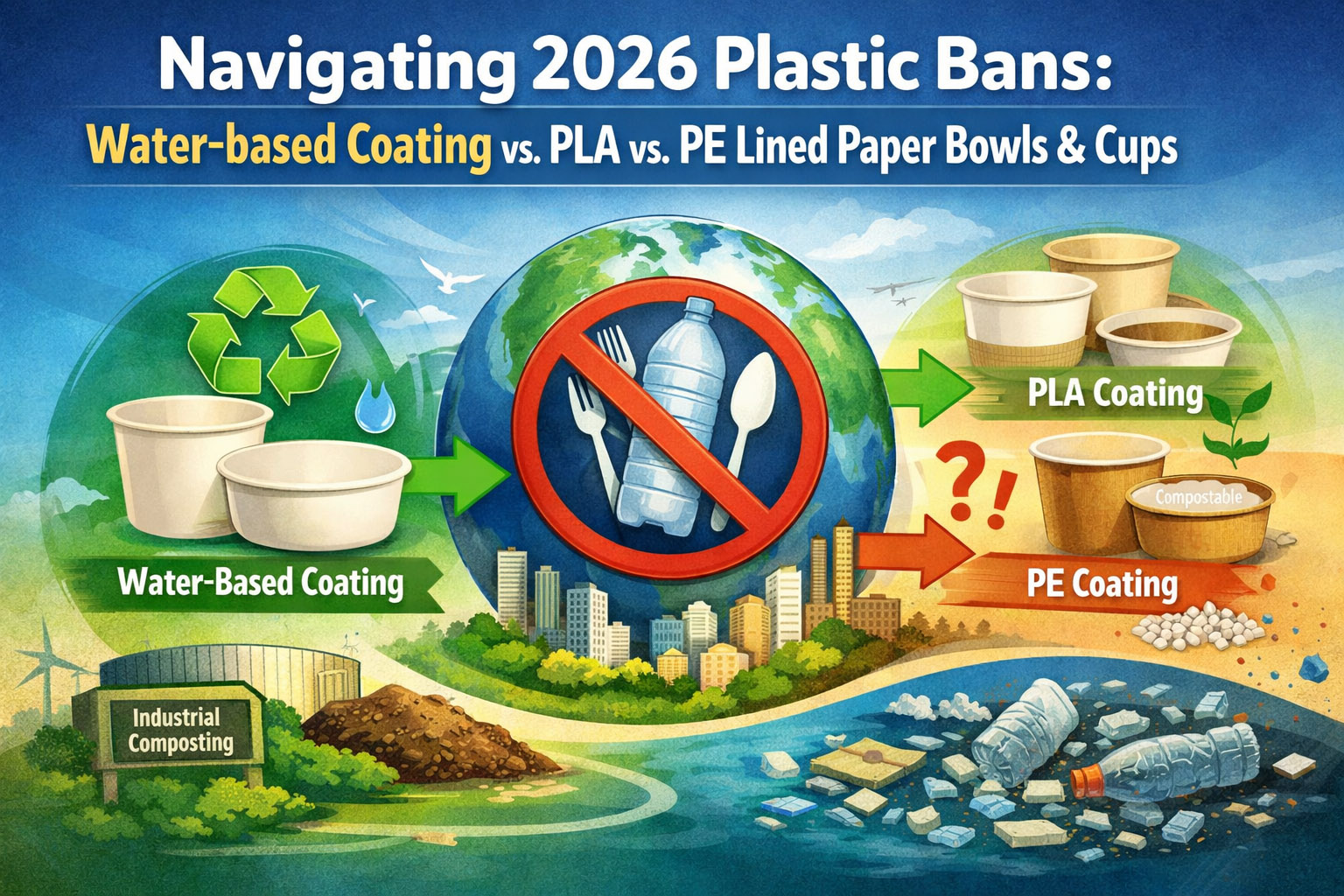
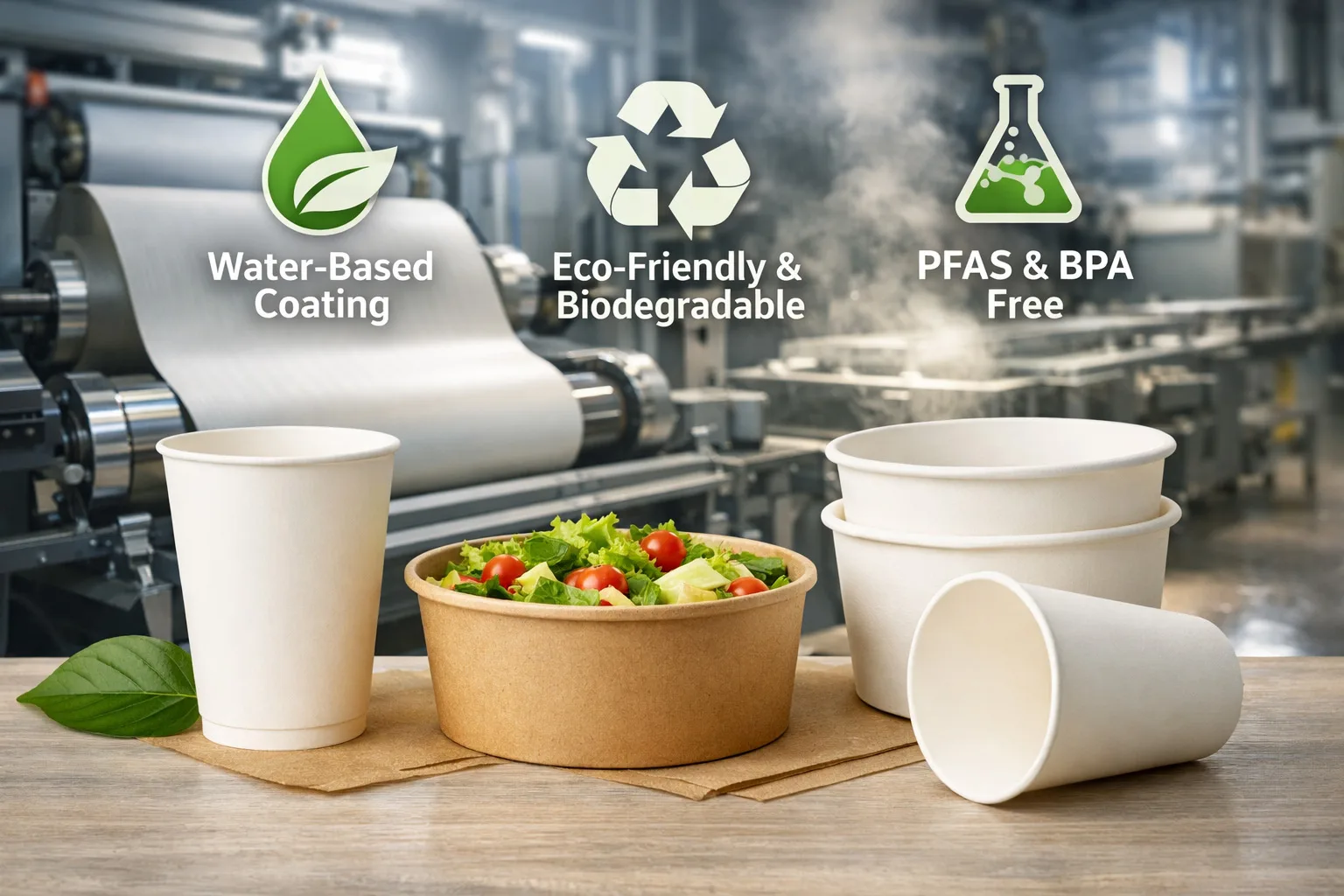
Introduction
Water-based coating technology underpins the performance, safety, and sustainability of disposable paper cups and bowls. Bioleader’s 2026 standards define precise targets for base paper grammage, coating weight, thickness, mechanical strength, moisture management, edge integrity, internal bonding, and food-contact safety. By aligning with international and national benchmarks, these standards ensure consistent product quality across markets while supporting eco-friendly packaging goals.
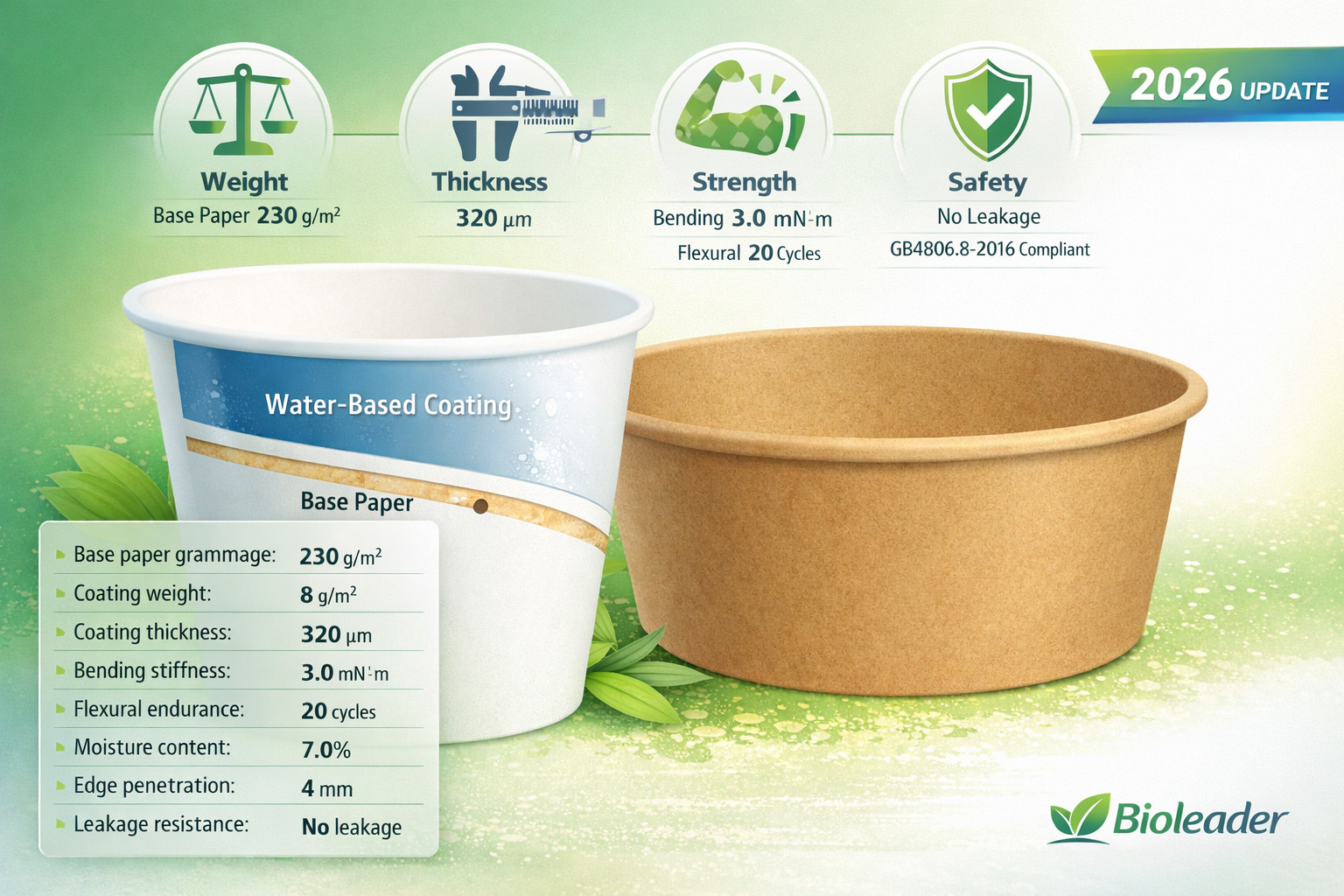
Water-Based Aqueous Coating Paper Cups
Water-based coatings on cups must deliver a reliable moisture barrier, maintain surface smoothness for printing, and preserve heat-seal integrity during packaging and consumer use. Key performance drivers include coating weight per face, coating thickness, and the adhesion between coating and paper. The cups’ end-use scenarios—hot beverages, cold drinks, and varying storage conditions—require a robust yet recyclable coating system. In practice, the cups’ coating formulation is selected to balance barrier performance with recyclability and compostability, while ensuring migration limits remain within regulatory allowances. Our DoCs (Declarations of Compliance) and test reports cover these aspects to facilitate global market access.
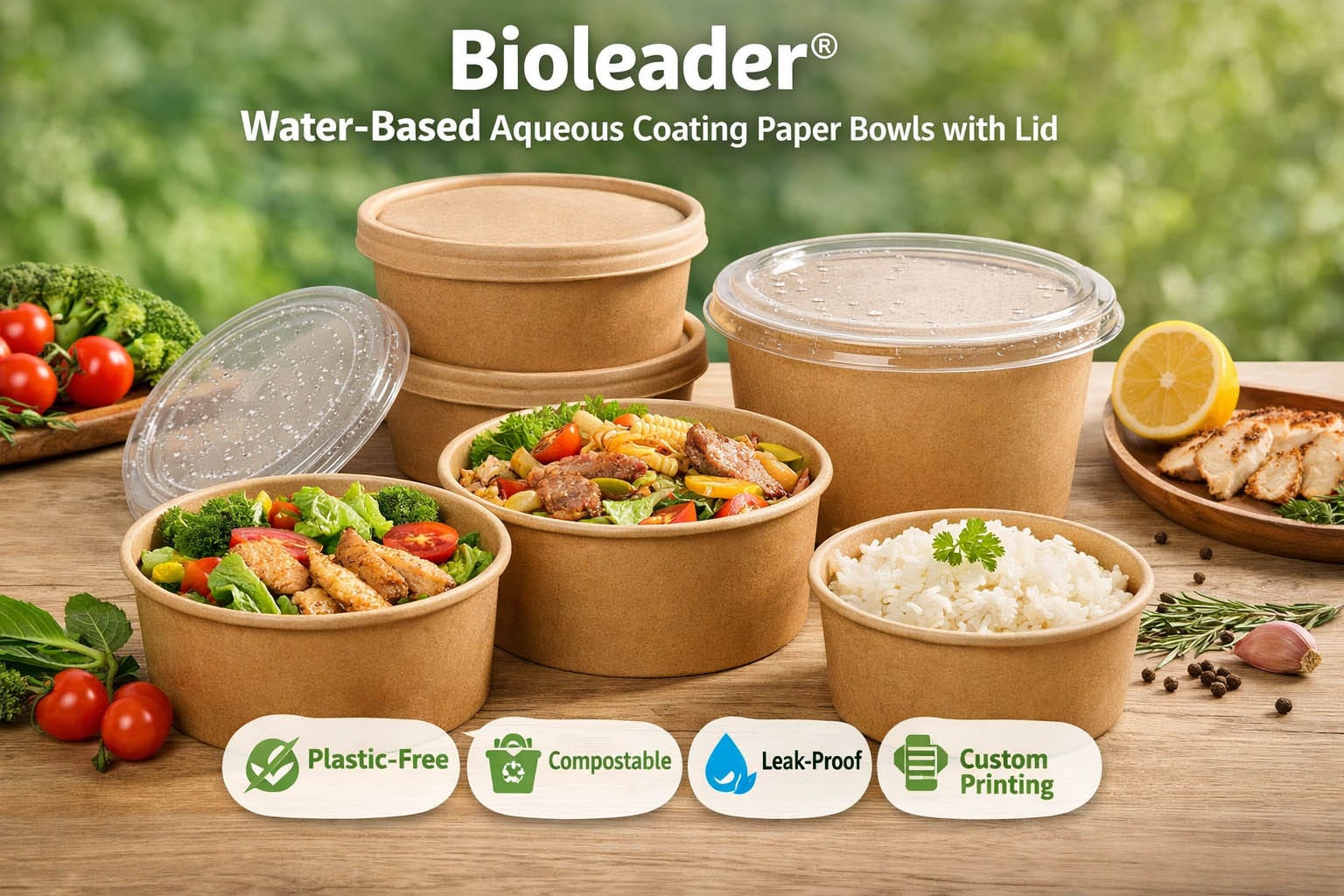
Water-Based Aqueous Coating Paper Bowls Lid
Lids for water-based coated bowls introduce an additional dimension of performance: seal integrity, edge stability, and compatibility with the cup body. The lid material and the coating system must form a reliable seal at ambient temperatures and resist leakage during transport and handling. Where lidding films are involved, the coating’s surface energy and the adhesion to the lid film are critical. Our standards address these factors, ensuring consistent performance across different lid designs (e.g., plain lids, printed lids, and tamper-evident variants) while maintaining compliance with food-contact safety requirements.
Core framework: what the standard covers
The Water-Based Aqueous Coating Technology Standards specify a suite of quantitative targets and tolerances for the base paper, the coating layer (single side), and the finished coated product. It also references the relevant GB/T standards and a national food-safety baseline. The main goal is to guarantee:
- Dimensional and optical stability (thickness, weight)
- Mechanical robustness (tensile/fold resistance, internal bonding)
- Moisture management and barrier performance (water content, edge penetration)
- Contaminant control (leakage, dust)
- Safety compliance for food-contact packaging (GB4806.8-2016)
Below is a structured walkthrough of each metric, what it means in practice, and how Bioleader applies it in production.
| Metric | Unit | Tolerance | Standard Reference | 190 | 210 | 230 | 250 | 280 | 300 |
|---|---|---|---|---|---|---|---|---|---|
| Base Paper Grammage (Original Paper Mass) | g/m² | ±3% | GB/T451.2 | 190 | 210 | 230 | 250 | 280 | 300 |
| Coating Weight (Single Face) | g/m² | ±2 | — | 0+10 | 0+10 | 0+10 | 0+10 | 0+10 | 0+10 |
| Thickness | μm | ±5% | GB/T451.3 | 260 | 275 | 310 | 325 | 380 | 410 |
| Bending Stiffness (CD) | mN·m | — | GB/T22364 | 1.8 | 2.5 | 3.0 | 4.0 | 5.0 | 6.5 |
| Flexural Endurance | Cycles | — | GB/T457-2008 | 20 | 20 | 20 | 20 | 20 | 20 |
| Moisture Content | % | ±2 | GB/T462 | 7.0 | 7.0 | 7.0 | 7.0 | 7.0 | 7.0 |
| Edge Penetration | mm | — | GB/T31905 | 4 | 4 | 4 | 4 | 4 | 4 |
| Internal Bonding Strength | J/m² | — | GB/T26203 | 100 | 100 | 100 | 100 | 100 | 100 |
| Leakage Resistance | – | – | GB/T4819 | No Leakage | No Leakage | No Leakage | No Leakage | No Leakage | No Leakage |
| Dustiness | Pieces/m² | — | GB/T1541 | 0.1–0.3mm²: 80 | 0.3–1.5mm²: 20 | 1.5–2.5mm²: 4 | ≥2.5mm²: None | ≥21.5mm²: None | None |
| Food Safety Standard | – | – | GB4806.8-2016 | Compliant | Compliant | Compliant | Compliant | Compliant | Compliant |
1) Raw paper basis: base grammage and tolerances
Metric
Original paper mass
- Unit: g/m²
- Tolerance: ±3%
- Standard reference: GB/T 451.2
- Typical range (illustrative values in the standard): 190, 210, 230, 250, 280, 300 g/m²
What this means in practice
The base paper’s weight directly affects stiffness, opacity, and printability. A ±3% tolerance ensures uniform density across rolls and lots, which translates to predictable coating behavior and end-use performance.
Bioleader application
We select base grammage within defined bands for each product line and enforce tight roll-to-roll consistency to minimize variation in coating uptake and downstream barrier properties.
2) Coating weight (single side)
Metric
Coating weight
- Unit: g/m²
- Tolerance: ±2
- Standard reference: GB/T 451.2
- Target range (as indicated in the table): 0 + 10 (interpreted as a permissible 0–10 g/m² on a single face)
What this means in practice
Coating weight controls moisture barrier, surface smoothness, and heat-seal performance. The 0–10 g/m² window gives manufacturing flexibility to tailor barrier performance without compromising recyclability or coating integrity.
Bioleader application
We calibrate coating weight per product tier (e.g., light-duty cups vs. heavier, moisture-intensive bowls) to balance barrier needs with cost and recyclability goals. Tighter controls are used for high-volume SKUs to ensure batch-to-batch consistency.

3) Coating thickness: a parallel quality dimension
Metric
Thickness
- Unit: μm
- Tolerance: ±5%
- Standard reference: GB/T 451.3
Typical values (illustrative)
260, 275, 310, 325, 380, 410 μm
What this means in practice
Thickness correlates with stiffness, surface energy, and printability. A ±5% tolerance keeps the surface geometry consistent, affecting folding behavior, stacking, and heat-seal performance.
Bioleader application
We map thickness targets to each product family, ensuring the coating layer contributes the desired barrier and rigidity without making the material brittle or overly glossy.
4) Mechanical robustness: bend and fold endurance
Metric 1
Bending stiffness
- Unit: mN·m
- Tolerance: Three (three-point tolerance; typical bands)
- Standard reference: GB/T 22364
- Typical values: 1.8, 2.5, 3.0, 4.0, 5.0, 6.5 (mN·m)
Metric 2
Flexural endurance
- Unit: Cycles
- Tolerance: three
- Standard reference: GB/T 457-2008
- Typical value: 20 cycles
What this means in practice
These metrics quantify how well the coated sheet resists bending and repeated folding—critical for reliable stacking, forming in packaging lines, and resisting creases that could compromise barrier layers.
Bioleader application
We design coating and liner combinations to meet a minimum bend stiffness and ensure the coated sheet survives standard carton/packaging handling without cracking or delamination.
5) Moisture management and edge behavior
Metric 1
Moisture content
- Unit: %
- Tolerance: ±2%
- Standard reference: GB/T 462
- Target: 7.0%
Metric 2
Edge penetration
- Unit: mm
- Target: ≤ 4 mm
What this means in practice
Moisture content affects printability, coating performance, and dimensional stability. Edge penetration reflects the coating’s barrier integrity at the sheet edge, important for leak resistance and hygiene.
Bioleader application
We optimize coating formulations and drying processes to hold moisture within spec and reduce edge-penetration risk, ensuring uniform barrier properties around the entire sheet.
6) Internal bonding and leakage resistance
Metric
Internal bonding strength
- Unit: J/m²
- Target: 100
- Standard reference: GB/T 26203
Metric
Leakage resistance
- Unit: –
- Target: No leakage
- Standard reference: GB/T 4819
What this means in practice
Internal bonding strength relates to the adhesion between the coating and the paper, impacting heat-seal integrity and overall barrier performance. Leakage resistance is a direct measure of the coated sheet’s ability to prevent liquid penetration.
Bioleader application
We validate adhesive systems and coating laminates to achieve robust adhesion and zero leakage under typical use conditions.
7) Dust and particulate control
Metric
Dustiness
- Ranges and targets:
- 0.1–0.3 mm² — 80 pieces/m²
- 0.3–1.5 mm² — 20
- 1.5–2.5 mm² — 4
- ≥2.5 mm² — No particles
Standard reference
GB/T 1541
What this means in practice
Dust contamination can affect printing quality, consumer safety, and aesthetic appearance. The standard sets thresholds to ensure a clean, consistent surface.
Bioleader application
We implement cleanroom-style handling in critical steps (coating application, drying, and stacking) and perform periodic surface cleanliness tests to keep dust levels within spec.
8) Food-contact safety baseline
Statement
“Food Safety Standard: Compliant with GB 4806.8-2016 (Food Contact Materials)”
What this means in practice
All coated papers used for cups and bowls comply with China’s national food-contact safety standard, covering migration limits, materials compatibility, and labeling requirements. This is essential for Bioleader’s global market access and consumer trust.
Bioleader application
We maintain DoCs (Declarations of Compliance), migration test results, and PFAS-free statements for each product family, and we provide technical dossiers to buyers upon request.
9) Real-world interpretation & production translation
- Process control: The ±3–5% tolerances on base grammage, coating weight, and thickness demand disciplined caliper control, consistent coating equipment settings, and rigorous roll testing.
- Quality assurance: Each batch undergoes a battery of tests aligned to the standards above—basis weight checks, coating weight verification, thickness measurement, bending/fold tests, moisture content, edge integrity, internal bond, and leakage tests.
- Regulatory readiness: The GB/T references map to familiar test methods for Chinese suppliers; the GB 4806.8 baseline ensures we can supply to markets with strict food-contact rules. For export, we also align with PFAS-free requirements and migration testing as part of DoC packages.
- Sustainability and performance: The coating system is selected to deliver moisture resistance and heat-seal stability without sacrificing recyclability or compostability where applicable.
10) Practical implementation roadmap
- Material selection and pre-qualification
- Choose base papers with tight grammage bands (per GB/T 451.2) and stable surface characteristics.
- Screen coating formulations for barrier performance, printability, and heat-seal compatibility.
- Coating formulation & application
- Establish per-product coating weights (0–10 g/m² per face) and thickness targets (260–410 μm) with ±2–5% tolerances.
- Validate adhesion and barrier properties at pilot scale before mass production.
- Quality control & in-line monitoring
- Use on-line gauges and periodic lab tests to monitor basis weight, coating weight, and thickness.
- Perform bend/fold tests and leakage tests on representative samples from each batch.
- Safety & compliance documentation
- Compile DoC, migration test results, PFAS statements, and other regulatory dossiers for each SKU.
- Ensure GB 4806.8-2016 conformity and maintain traceability across batches.
- Continuous improvement
- Collect performance data from customers and QA teams to refine coating recipes and processing windows.
- Align with evolving global standards (e.g., EN 13432, ASTM D6400) as Bioleader expands into new markets.
11) Value to customers
- Consistency across batches: Tight tolerances reduce variability in performance, improving consumer experience and reducing returns.
- Safe, compliant packaging: Adherence to GB/T and GB 4806.8-2016 supports market access in China and international markets with confidence.
- Performance with sustainability: Coating choices balance moisture barrier and stiffness with compostability/recyclability goals, supporting brands pursuing green packaging goals.
- Transparent documentation: Ready-to-share DoC and test reports help buyers meet their own compliance and audit needs.
Quick takeaways
- Bioleader’s Water-Based Coating Standards sets clear targets for base paper weight, coating weight, thickness, strength, moisture control, edge integrity, internal bonding, leakage resistance, and dust cleanliness.
- The standard is anchored in GB/T family tests and paired with GB 4806.8-2016 for food-contact safety.
- Implementing these metrics ensures Bioleader’s coated paper cups and bowls perform reliably in real-world use while supporting sustainability and global regulatory readiness.
FAQ
1. What is water-based coating for paper cups and bowls?
Water-based coating is an eco-friendly solution used to improve the performance of paper cups and bowls. It provides moisture resistance, surface smoothness for printing, and enhances durability, all while being safer for the environment compared to traditional coatings like plastic or wax.
2. How does Bioleader’s water-based coating meet sustainability standards?
Bioleader’s water-based coating adheres to strict environmental standards by using non-toxic materials that enhance recyclability and compostability. This coating reduces environmental impact while maintaining the strength and performance required for disposable packaging.
3. What are the key benefits of Bioleader’s 2026 coating standards for cups and bowls?
The 2026 coating standards ensure higher durability, moisture resistance, and safety for food contact. These updates include improvements in coating thickness, bonding strength, and leak resistance, ensuring that Bioleader products meet or exceed global packaging and food safety standards.
4. Can Bioleader cups and bowls be recycled or composted?
Yes, Bioleader’s cups and bowls are designed to be compostable or recyclable, depending on the specific product. The water-based coating ensures that these products are more environmentally friendly than traditional plastic-coated alternatives.
5. Are Bioleader’s coated cups and bowls safe for food contact?
Bioleader’s water-based coatings are fully compliant with the GB4806.8-2016 food safety standards, ensuring that all products are safe for direct food contact. The coatings used do not contain harmful chemicals and are tested for safety.
6. What are the key metrics of Bioleader’s water-based coating?
Key metrics include coating weight, thickness, bending stiffness, flexural endurance, moisture content, edge penetration, and leakage resistance. These performance benchmarks ensure that Bioleader’s coated cups and bowls meet the highest industry standards for quality and sustainability.
Copyright Notice:
© 2026 Bioleader®. If you wish to reproduce or reference this content, you must provide the original link and credit the source. Any unauthorized copying will be considered an infringement.