Single Use Plastics Directive Overview For Businesses | Bioleader® Guide

Actionable coverage of Single Use Plastics Directive: eco-friendly, biodegradable, compostable materials, performance data, and compliance under EN13432 & ASTM D6400. Includes BPI/TÜV references and Food-Contact Tested guidance for safe deployment. Buyer-focused: manufacturer insights, bulk/wholesale buying playbooks, OEM/ODM customization tips, full size range selection.

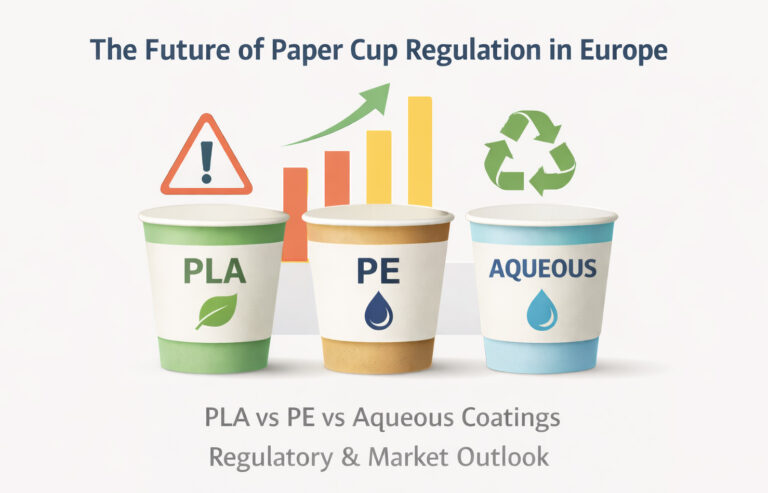
Has Europe Banned PLA-Coated Paper Cups? What Are the Alternatives? (Bioleader® Research Brief)

Quick Summary: No. Europe has not banned PLA-coated paper cups at the EU level. However, under Directive (EU) 2019/904 (Single-Use Plastics Directive), PLA is legally defined as plastic. As a result, PLA-lined beverage cups are regulated the same as conventional PE-lined cups, including mandatory plastic-content marking under Regulation (EU) 2020/2151 and inclusion in national Extended Producer Responsibility (EPR) schemes. Based on Bioleader®’s 2024–2025 questionnaire covering 30+ European paper-cup distributors, market demand is gradually shifting away from PLA due to compliance exposure and recycling system compatibility concerns. The most stable alternatives currently gaining adoption are (1) water-based barrier (aqueous) coated paper cups designed for improved repulpability, (2) fiber-dominant recyclable cup constructions aligned with paper-stream collection, and (3) reusable cup systems in regulated on-site consumption environments.

Single Use Plastics Directive — Quick Summary
  • Items displayed (articles): 12
  • Last updated: 2026-02-06
  • Includes test data, compliance guides, buyer FAQs, and real-world use cases.

Editor’s Picks: Top Single Use Plastics Directive Guides 2026

FAQ of Bioleader's Eco-friendly Disposable Tableware

Why Choose Sugarcane Bagasse?

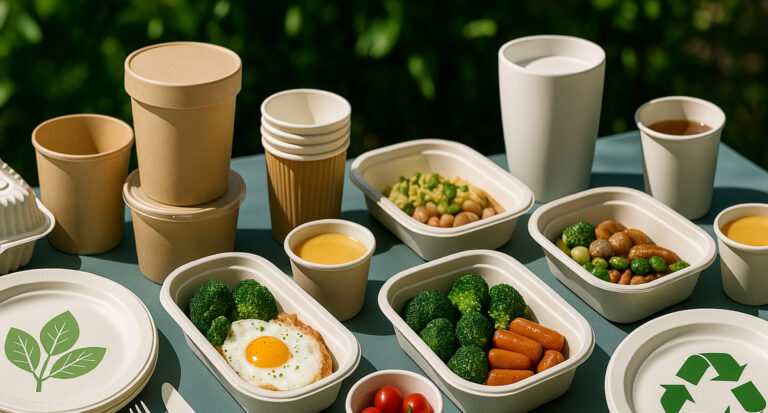
Renewable Resource: Since sugarcane is harvested and grown repeatedly, the containers become eco-friendly, and more products can be produced using bagasse fiber , Single Use Plastics Directive. This approach in a holistic way starts reducing waste entirely. Decomposable & Environment Friendly: Because of the usage of bagasse containers eliminate the need for plastic and styrofoam bowls. This approach further helps eliminate waste from dumping/filling grounds and further helps the environment while everything decomposes into compost materials.

Durable, Leak-Proof Design

Our bagasse pulp trays offer excellent waterproof and oil-resistant properties, making them ideal for a variety of food items, from oily dishes to soups. Their durable structure prevents leaks and breakage, ensuring a mess-free, reliable packaging experience. This strength and reliability make them suitable for demanding food service settings, including high-volume takeaway and food delivery. Practical Applications of Molded Pulp Trays

1. What are sugarcane bagasse molded pulp trays made from?

They are made from bagasse, the fibrous residue left after sugarcane stalks are crushed for juice. This agricultural waste is molded into strong, durable trays that are compostable, biodegradable, and plastic-free.

Regulatory Risk Comparison

Regulatory Factor PE Lining PLA Lining Aqueous Barrier* Classified as plastic under SUPD Yes Yes Formulation-dependent Mandatory marking Yes Yes Market-dependent EPR inclusion Yes Yes Likely reduced in some cases Branding friction High Moderate Lower Policy tightening risk High Moderate Lower Long-term compliance stability Weak Moderate Stronger *Note: Aqueous classification depends on polymer composition and national interpretation. The model illustrates a core reality: PLA no longer reduces compliance exposure relative to PE. Its advantages must therefore be justified on lifecycle or carbon grounds rather than regulatory grounds. 5 , Single Use Plastics Directive.

5.1 The Netherlands – Reuse as a Policy Signal

Beginning in 2024, the Netherlands implemented measures restricting the free provision of single-use plastic cups for on-site consumption. Businesses must offer reusable alternatives or apply strict collection systems. The Dutch approach does not explicitly ban PLA-lined cups — Single Use Plastics Directive. However, because PLA is classified as plastic, it falls within these measures.

Related Insights

🚀Ready to Go Green and Choose ?

Join the global movement toward zero-waste packaging.


Bioleader® offers:

  • 📦 Bulk order support & fast delivery

  • ✍️ Custom branding and OEM solutions

  • 🌍 Worldwide eco-packaging compliance

Get the Catalogue Products List  & Contact Us Now! 👉

Contact us Below

Click or drag files to this area to upload.You can upload up to 5 files.
The more details you share, the faster and more accurate our quotation will be.