Food packaging is no longer just a protective shell. For modern food brands, it has become part of the product experience, the sustainability narrative, and the brand identity itself. Whether a customer is picking up a takeaway lunch, opening a subscription snack box, or receiving a premium gift set, packaging is often the first physical interaction they have with the brand.
Yet many food businesses still approach packaging in fragments. Some focus heavily on sustainability but neglect presentation and differentiation. Others invest in eye-catching branding while overlooking material choices, disposal impact, or compliance risks. In practice, neither approach is complete. A strong packaging strategy is not built on one priority alone. It combines structural performance, food safety, material responsibility, print quality, and brand consistency into one coherent system.
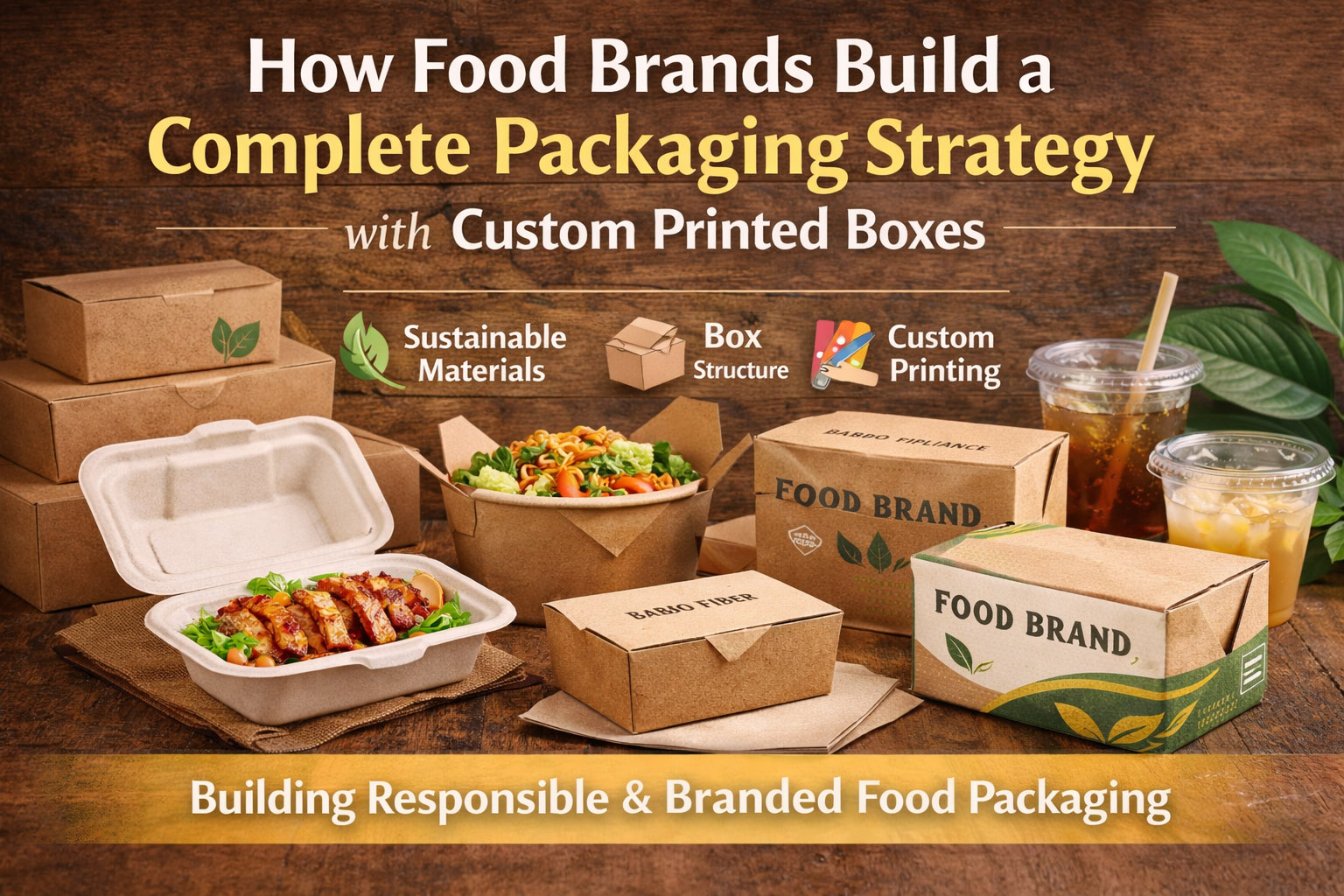
This is where custom printed packaging becomes more than a design exercise. When done properly, it helps food brands align product protection, logistics, customer perception, and sustainability goals. In many cases, brands begin that process by exploring tailored solutions such as custom boxes that support both packaging functionality and stronger visual identity.
If your brand is trying to build a more competitive and future-ready packaging system, the right place to start is not with decoration alone. It is with strategy.
Why Food Packaging Strategy Matters More Than Ever
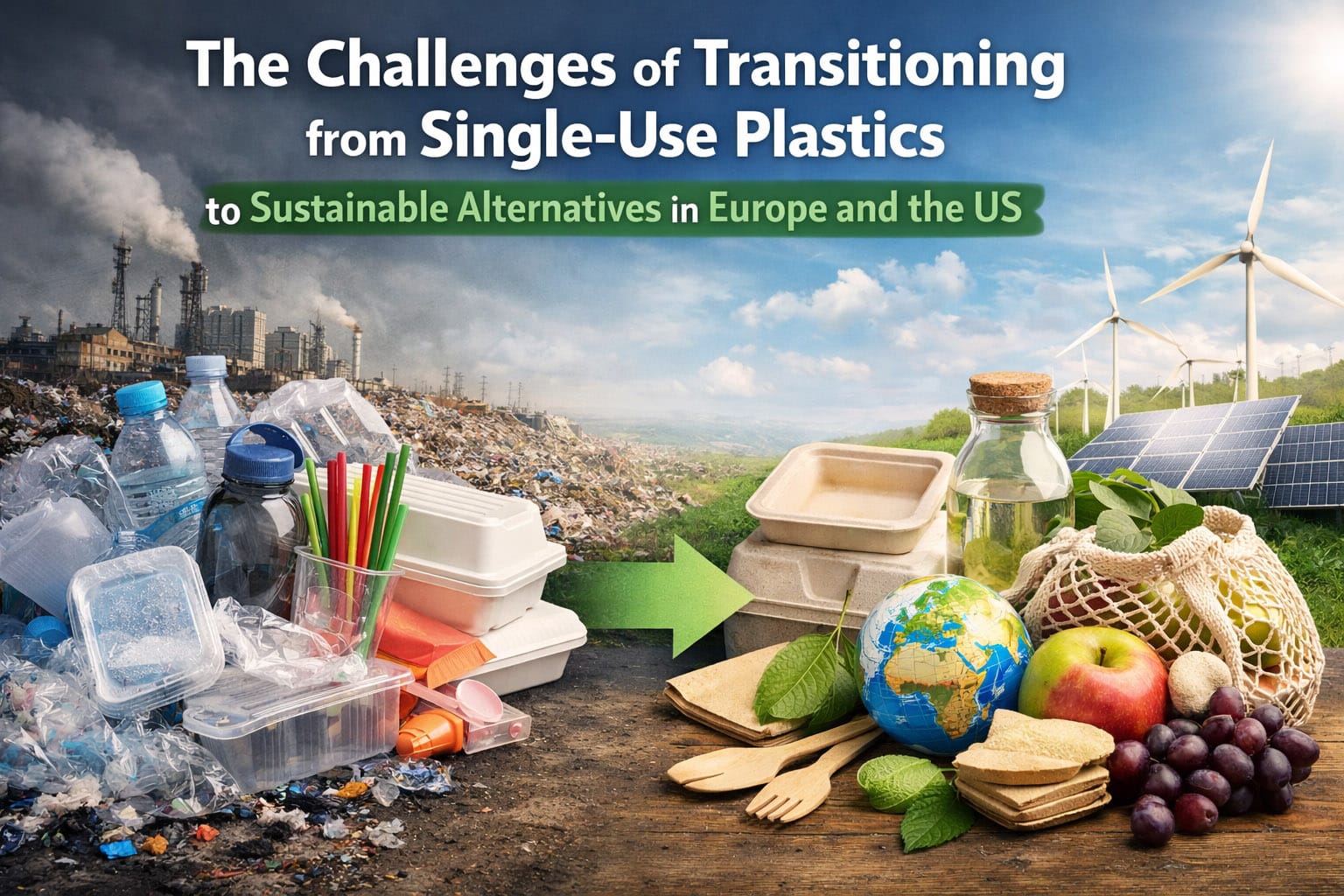
The food packaging environment has changed significantly in recent years. Consumers now pay closer attention to what packaging is made from, how it looks, how it feels, and what it says about the brand behind it. At the same time, regulators, retailers, and distribution partners are increasing expectations around recyclability, compostability, plastic reduction, traceability, and material transparency. These shifts are consistent with the broader global plastics outlook, which continues to highlight the scale of plastic waste and the need for more circular material systems.
For food brands, this means packaging must now perform on multiple levels at once. It must:
- protect food quality
- support transport and storage
- communicate brand value
- align with sustainability goals
- meet evolving compliance expectations
- create a consistent customer experience
A complete packaging strategy is therefore not simply about choosing a box. It is about building a packaging system that supports the product, the brand, and the market position of the business.
Start with Sustainable Materials
Material selection is the foundation of any modern custom boxes packaging strategy. Before brands think about printing finishes, visual hierarchy, or unboxing appeal, they need to evaluate what the packaging is made from and whether that material is suitable for both the product and its end-of-life pathway.
A packaging material should not be described as sustainable just because it looks natural or contains plant-based content. A more credible definition includes how the material is sourced, how it is manufactured, how it performs during use, and what realistic disposal route exists after use. In other words, sustainable packaging should be evaluated across its life cycle, not only at the point of purchase.
Bagasse

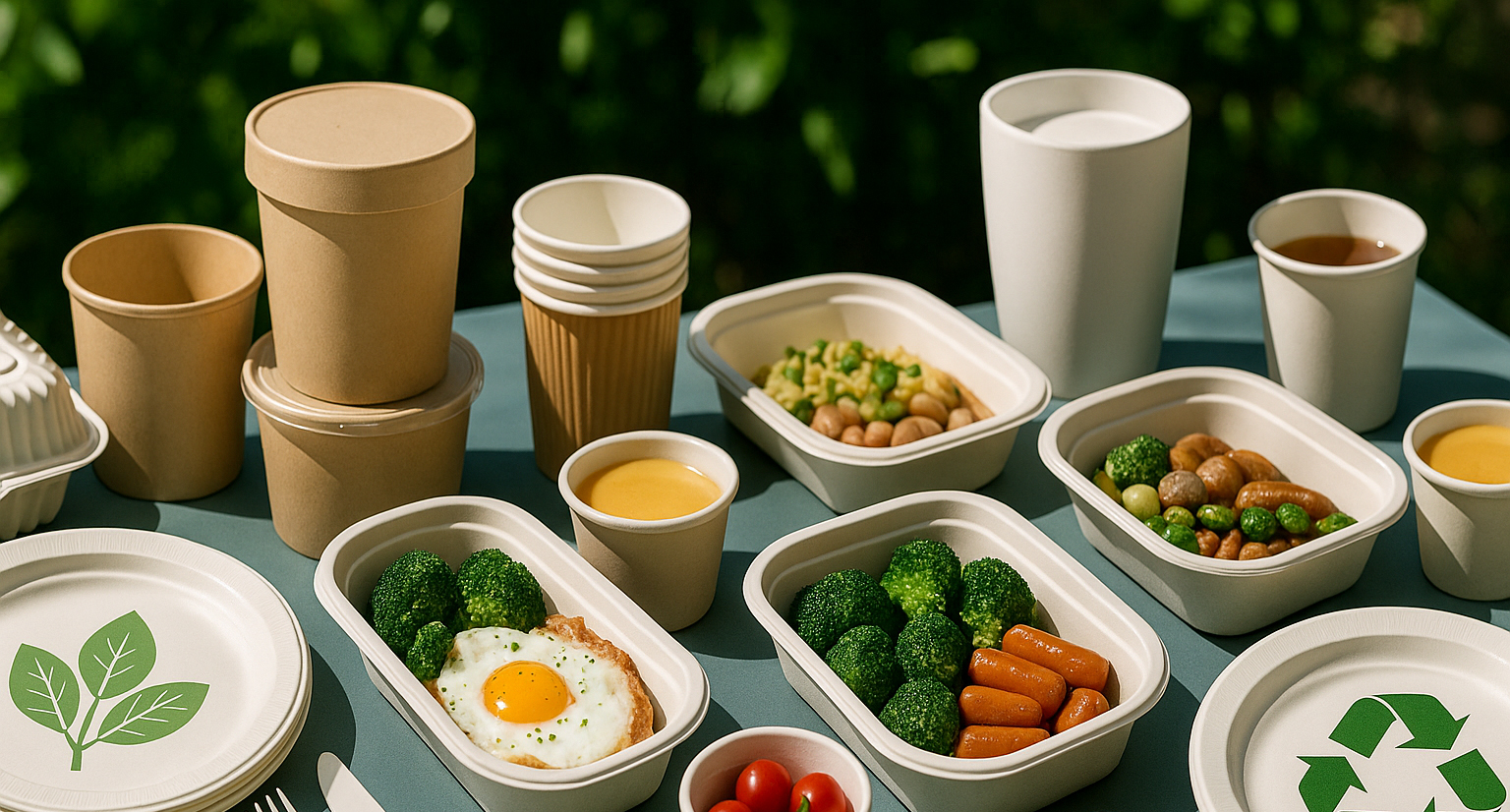
Bagasse is a molded fiber material made from the residue left after sugarcane processing. Because it uses agricultural by-products, it is widely regarded as a lower-impact alternative to conventional plastic in many foodservice applications. Bagasse is commonly used for takeaway clamshells, bowls, trays, and meal boxes because it offers good rigidity and performs well with many hot foods.
For food brands aiming to reduce reliance on fossil-based single-use plastics, bagasse can be a practical solution. However, performance still varies by product design, wall thickness, molding quality, and intended food application. It is most effective when tested against real menu items rather than selected on appearance alone.
Kraft Paper

Kraft paper remains one of the most commercially useful materials in food packaging because it combines a natural visual identity with broad printability and flexible structural applications. It is widely used for folding cartons, kraft takeaway boxes, sleeves, bowls, and dry-food packaging.
Its sustainability profile depends partly on its construction. Uncoated kraft may suit some dry applications, while food items involving oil, moisture, or sauces often require an additional barrier layer. From a branding perspective, kraft paper is particularly valuable because it offers a recognizable, tactile surface that supports premium yet environmentally conscious brand positioning.
PLA and Plant-Based Barrier Systems
PLA, or polylactic acid, is a bioplastic derived from renewable feedstocks such as corn starch or sugar-based inputs. In food packaging, PLA is often used as a coating, liner, or clear packaging material in applications where moisture resistance, grease resistance, or product visibility is important.
For paper-based packaging, PLA can serve as an alternative barrier layer in certain constructions. However, brands should be careful not to oversimplify its environmental profile. PLA is often associated with industrial compostability, but disposal outcomes depend heavily on local infrastructure and product design. That means it should be selected based on both functional performance and realistic end-of-life conditions.
Compostable Liners
Compostable liners are increasingly important in paper food packaging because they help replace traditional plastic barrier layers used to resist liquids, oils, and grease. These liners can improve the compostability profile of certain packaging systems, especially where industrial composting infrastructure exists.
That said, the best packaging decisions are always application-specific. A compostable liner may support a sustainability goal, but brands still need to confirm sealing performance, food compatibility, shelf life, and disposal claims before implementation.
A Complete Packaging Strategy Is More Than Material Choice
Choosing better materials is essential, but material alone does not create a complete packaging strategy. A food brand also needs to think about how the packaging will function operationally and how it will be experienced by the customer.
This is where many businesses lose clarity. They choose a material that sounds sustainable, but the structure is not suitable for transport. Or they invest in visual branding, but the box shape does not fit the product properly. In some cases, the packaging looks premium but creates inefficiencies in packing, stacking, or last-mile delivery.
A complete packaging strategy should align five key elements:
- Material – chosen for sustainability, food safety, and performance
- Structure – selected for protection, handling, and product fit
- Printing and branding – designed for recognition and communication
- Compliance – aligned with local and export packaging requirements
- Customer experience – optimized for convenience, perception, and repeat purchase
When these elements are aligned, packaging becomes a business asset rather than just a cost item.
Get the Right Box Structure
Food is sensitive to temperature, moisture, handling pressure, and transport time. That makes structural design one of the most important parts of packaging strategy. The right box format protects the product, improves operational efficiency, and supports the intended customer experience.
There is no single structure that works for every food item. The right choice depends on the type of product, whether it is sold in-store or delivered, how long it is in transit, and whether the packaging is intended for gifting, display, shipping, or everyday takeaway.
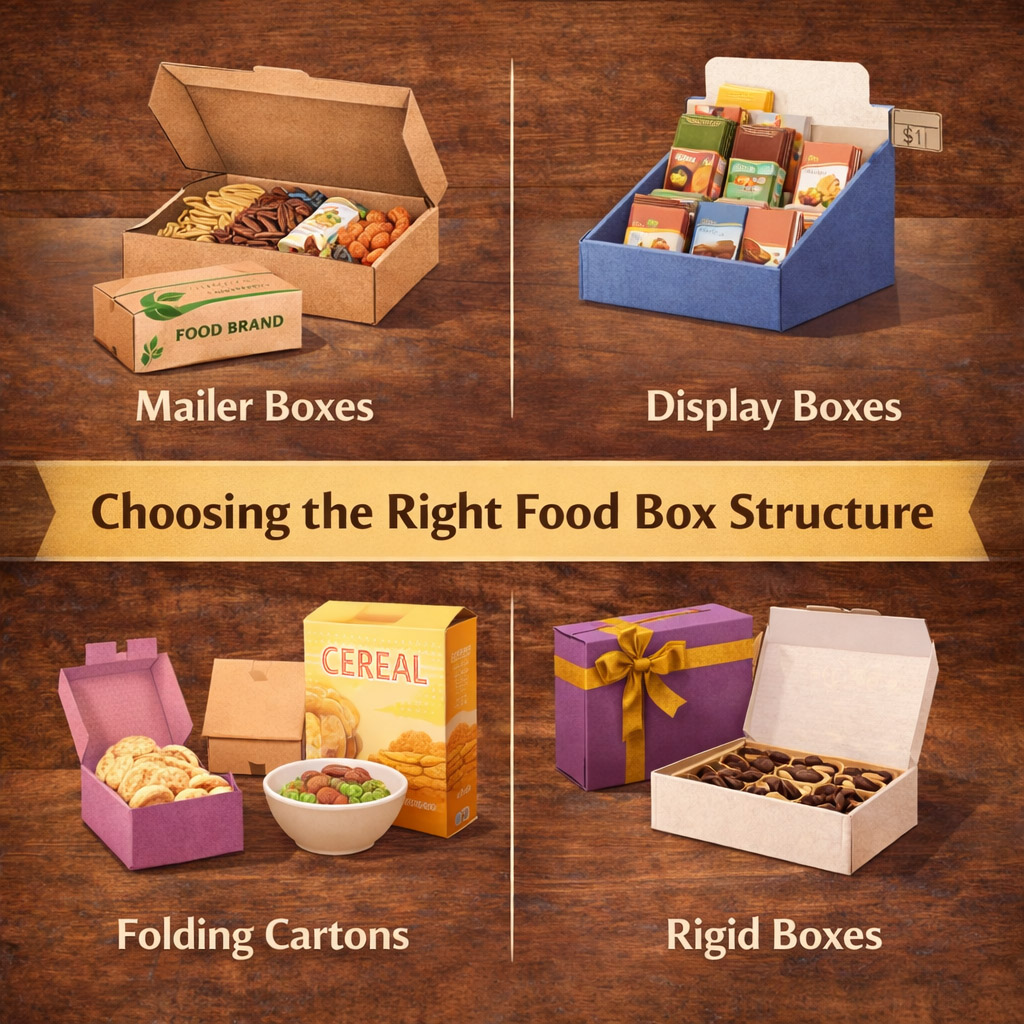
Mailer Boxes
Mailer boxes are widely used in e-commerce and subscription packaging because they are sturdy, easy to assemble, and suitable for branded presentation. For food brands, they work especially well for packaged snacks, cookies, bakery assortments, curated tasting kits, and premium direct-to-consumer shipments.
Their value is not limited to protection. A well-designed mailer box also creates a more intentional unboxing experience, which is particularly important for brands operating online or selling gift-oriented products.
Display Boxes
Display boxes are designed to present products clearly at point of sale. They are common in retail environments, counters, promotional setups, and shelf-ready packaging programs. For food brands, they are useful for presenting multiple units in an organized way, especially for confectionery, snacks, tea products, sauces, and small bakery formats.
In strategic terms, display boxes do more than hold products. They help packaging function as merchandising.
Folding Cartons
Folding cartons remain one of the most versatile box formats in the food industry. They are lightweight, cost-effective, printable, and suitable for a wide range of dry and semi-dry food products. Many brands use them for cereals, baked goods, confectionery, tea, frozen secondary packaging, and shelf-ready retail formats.
Their biggest strategic advantage is balance. They can support branding, storage efficiency, and cost control at the same time.
Rigid Boxes
Rigid boxes are typically associated with premium presentation. Made from high-density board, they offer stronger protection and a more elevated look than standard folding cartons. In food packaging, they are often used for gift-oriented formats, luxury confectionery, premium tea, specialty chocolates, or curated festive packaging.
Rigid boxes are not the default choice for every food brand, but they can be highly effective when the packaging itself is part of the perceived value of the product.
How to Match Structure with Strategy
The best box structure is not simply the most attractive or the most expensive one. It is the one that matches the product and the brand’s sales model.
A practical evaluation should include:
- product fragility
- portion size and dimensions
- shelf life
- heat or moisture exposure
- transport conditions
- stacking efficiency
- filling speed
- customer opening experience
- display requirements
- branding surface area
This is why many food brands work with experienced packaging suppliers or custom packaging partners during the design phase. Structural design decisions affect not only appearance but also cost, damage risk, packing efficiency, and consumer satisfaction.
Use Custom Printing to Express Brand Identity
Once the right material and structure are in place, printing becomes the layer that turns packaging into a recognizable brand asset. In competitive food categories, packaging is often the fastest way to communicate quality, positioning, and product differentiation.
Custom printing allows brands to present more than a logo. It helps build a complete visual language across packaging formats, including color systems, typography, imagery, product hierarchy, usage instructions, campaign graphics, traceability codes, and sustainability messaging.
In practical terms, custom printed packaging can support:
- stronger shelf visibility
- clearer SKU differentiation
- better unboxing experience
- improved customer recall
- more consistent cross-channel branding
- easier seasonal or promotional adaptation
For smaller and growing food brands, packaging can also become a cost-efficient branding tool compared with repeated spending on short-term advertising. A well-printed box travels with the product, appears in customer photos, supports social sharing, and reinforces brand memory at the exact moment of product use.
Choose Printing Methods Carefully
Not every print finish or decorative treatment is suitable for every food packaging application. Printing decisions should be made with both branding and packaging function in mind.
Common techniques such as CMYK printing, specialty coatings, embossing, or foil decoration can all play a role in food packaging, depending on the format and whether the printed area comes into direct or indirect contact with food. The most important principle is that the print system, ink selection, substrate compatibility, and food-contact requirements should all be reviewed together.
For paper-based packaging, kraft and coated paperboard often provide strong print surfaces. Molded fiber formats may also support branding, but usually through a different visual language than smooth printed cartons. In either case, the best results come from matching the print technique to the packaging material rather than applying one decorative approach across every format.
Packaging Strategy Must Also Support Operations
One of the biggest mistakes food brands make is treating packaging as a marketing decision only. In reality, packaging affects daily operations just as much as brand perception.
A complete packaging strategy should improve or at least support:
- packing speed
- warehouse efficiency
- shipping performance
- product protection
- inventory consistency
- retailer handling
- takeaway convenience
- delivery reliability
For example, a beautifully printed box that crushes in transit is not strategic. A compostable bowl that leaks during delivery is not strategic either. Packaging only becomes valuable when it performs under real business conditions.
That is why food brands should test packaging with actual products, actual handling conditions, and actual delivery scenarios before scaling production. Real-world validation is one of the strongest signals of a credible packaging strategy.
Align Packaging with 2026 Sustainability Expectations
Sustainability expectations in food packaging are continuing to rise, but regulatory requirements do not look the same in every market. Instead of assuming one global rule set, food brands should understand that packaging compliance now involves a mix of material restrictions, labeling requirements, recyclability targets, and producer responsibility obligations that vary by region. In the European market, the Packaging and Packaging Waste Regulation is becoming an important reference point for brands reviewing packaging design, recyclability, and long-term compliance planning.
Even so, several broad market directions are clear.
Material Simplification
Many markets are pushing brands toward simpler packaging systems that are easier to recycle, compost, or sort. This is increasing interest in mono-material formats, fiber-based solutions, and lower-plastic constructions.
Restrictions on Certain Single-Use Formats
In multiple regions, regulators are tightening controls on selected disposable plastic items, particularly those seen as difficult to recycle or unnecessary in single-use service settings. The exact scope differs by country, but the direction is clear: brands should reduce dependence on problematic materials and review which formats may face future pressure.
Extended Producer Responsibility
EPR requirements are becoming more relevant in many packaging markets. These rules can require businesses to report packaging data, material weight, recyclability characteristics, and in some cases contribute financially to waste management systems. For food brands, this means packaging decisions are increasingly tied to reporting obligations and long-term compliance costs.
Claim Accuracy
Another growing expectation is that environmental claims must be specific and supportable. Terms such as recyclable, biodegradable, compostable, plastic-free, and eco-friendly should not be used loosely. Brands need to ensure that sustainability messaging matches the actual material structure and realistic disposal route of the packaging.
Food Quality Still Comes First
No packaging strategy is complete if it ignores the product itself. The packaging can be sustainable, beautifully printed, and fully compliant, but if it fails to preserve taste, texture, freshness, or safety, the brand promise breaks down.
This is especially important in food. Consumers may notice the box first, but they judge the brand by the product inside it. That means packaging must protect aroma, texture, temperature, appearance, and handling convenience in a way that supports the food experience rather than disrupting it.
A good food packaging strategy therefore aligns outer presentation with inner performance. It is not enough for the brand to look responsible. The product must arrive in a condition that proves it.
What Strong Food Brands Do Differently
Food brands with stronger packaging systems usually do a few things differently. They do not choose packaging based only on trend language or visual appeal. Instead, they treat packaging as part of brand architecture and operational planning.
They typically:
- define what the packaging must achieve
- select materials based on real use conditions
- choose structures that support handling and logistics
- use printing to build consistent brand identity
- test packaging before scaling
- verify compliance and claim accuracy
- review packaging as part of customer experience, not just procurement
This is why the strongest packaging strategies usually look simple from the outside. The simplicity comes from clear decisions made early.
The Takeaway
A complete packaging strategy is not built by choosing between sustainability and branding. It is built by combining them with structure, functionality, and compliance in a practical way.
For food brands, that means starting with responsible material selection, choosing the right box structure, using custom printing strategically, and ensuring that packaging decisions reflect both regulatory direction and real product needs. Whether the brand is focused on takeaway, retail display, e-commerce shipping, gifting, or multi-channel food sales, packaging should work as an integrated system rather than a collection of disconnected choices.
Today, food packaging does far more than contain a product. It communicates quality, supports trust, shapes customer perception, and influences how a brand is remembered. Businesses that understand this are not just packaging food more effectively. They are building stronger brands through packaging strategy.
FAQ
- What is a complete packaging strategy for food brands?
A complete packaging strategy combines material selection, box structure, custom printing, compliance planning, and customer experience. It is not just about appearance or sustainability alone. The goal is to create packaging that protects food, supports branding, performs operationally, and aligns with market expectations.
- Why are custom printed boxes important for food brands?
Custom printed boxes help food brands present a consistent visual identity while improving recognition, shelf impact, and customer experience. They also turn packaging into a branding asset instead of treating it as a plain transport container.
- Which sustainable materials are commonly used in food packaging?
Common sustainable packaging materials include bagasse, kraft paper, molded fiber, and paper-based systems with plant-based or compostable barrier layers. Material choice should depend on the food application, required barrier performance, and the disposal infrastructure available in the target market.
- Is kraft paper a good packaging option for food brands?
Kraft paper is widely used because it is printable, versatile, and commercially practical for many dry and semi-moist food applications. Its suitability depends on whether the product needs an added barrier for moisture, grease, or liquid resistance.
- What box structure is best for food packaging?
There is no one-size-fits-all answer. Mailer boxes are useful for e-commerce and subscriptions, display boxes work well for retail presentation, folding cartons suit many everyday food products, and rigid boxes are often used for premium or gift-style packaging. The best choice depends on product type, handling needs, and brand positioning.
- How does packaging support food brand identity?
Packaging supports brand identity through structure, color, print design, messaging, and the overall customer experience. It helps communicate product quality, brand values, and market positioning before the customer even tastes the product.
- Do food brands need to consider packaging regulations?
Yes. Food brands increasingly need to consider packaging-related rules covering material restrictions, recyclability, compostability claims, labeling, and producer responsibility. These requirements vary by region, so packaging choices should be reviewed in line with the intended market. The EU, for example, now regulates packaging through the Packaging and Packaging Waste Regulation, which covers what packaging can be placed on the market and how packaging waste is managed.
- How can food brands make packaging more sustainable without weakening branding?
The strongest approach is to integrate both goals from the beginning. Brands can choose lower-impact materials, select a box structure that reduces waste, and use custom printing strategically rather than excessively. Sustainability and branding work best when they are designed as part of the same packaging system.
Copyright Notice:
© 2026 Bioleader®. If you wish to reproduce or reference this content, you must provide the original link and credit the source. Any unauthorized copying will be considered an infringement.