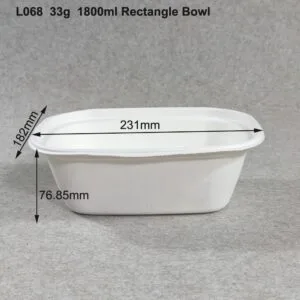
 |  |
 |  |
 Colour: White |  Colour: Nature Brown |
As sustainability becomes more and more of a priority, global concern over the use of biodegradable plates and bowls is expected to grow rapidly. The use of these disposables is on the rise not only because they are cheap and effective but also because they are environmentally friendly. This paper will focus on the composition, manufacturing process, features, portable and printable designs, and uses of compostable plates and bowls in detail.
The most widely used core ingredient for the manufacturing of biodegradable bowls and plates is the sugarcane bagasse, which is the fibrous residue remaining after the extraction of juice from sugarcane. This material is both renewable and highly biodegradable, and hence ideal for ecological tableware. Unlike plastic or Styrofoam, compostable plates and bowls made of sugarcane bagasse do not leave waste behind and end up in landfills.
The process of bio-plates and bio-bowls production includes pulp molding. To begin with, the sugarcane bagasse is processed into a pulp, which will then be pressed into the desired shapes under pressure. It also prevents leaks and grease from the final product – compostable bowls, plates, and other products from expanded thermoplastic laminates in the market. The process it, however, is eco-friendly and cost-effective, which adds significance to the products in the market.
 |  |
One key advantage of biodegradable plates and bowls is that they are disposable, and the waste can be added as nutrients to the soil. This means that there is an extreme need for plastic use. Such products can be taken up for composting in either domestic or industrial environments, thus decreasing a person’s carbon footprint.
Apart from the fact that these plates and utensils can be thrown into the compost, biodegradable bowls and plates are eco-friendly because they disintegrate easily in a matter of months without having to transform into small particles in landfills, unlike most tableware, which can last for hundreds of years.
These products are not made with harmful chemicals like BPA, PFAS, etc., thus preventing the leaching of any chemicals into the food. Compostable bowls and plates preclude the health risks posed to customers during the preparation process of food.
Due to the pulp-forming process, biodegradable plates and bowls have been made leak-proof, hence appropriate for hot soup meals, greasy salad meals with dressing, and any other related liquid foods.
Additionally, these products are microwave-safe, hence the need to heat the already-cooked meal without damaging either the bowl or the plate.
 |  |
Among the main competitive advantages of compostable bowls and plates is their ability to be branded with their packaging. Regardless of whether you are a restaurant owner and would like to brand your takeaway containers or an event planner who requires special themed giveaways, biodegradable plates and bowls provide flexible packaging options. One set can be easily manufactured in different sizes and shapes. Combining eco-friendliness and distinctiveness, hence promoting the image of the firm, can be achieved.
Stronger varieties of polystyrene, polypropylene, and PET are gaining popularity, even as plastic is on the decline and biodegradable plates and bowls extend to eating utensils. These properties and common applications include better cosmetics containers, oil-resistant paper bowls and carry-out food containers, among others. Also, its environmentally friendly aspect makes it appealing to the current consumers who are careful about the environment.
Event planners who are careful of the environment and promote sustainability can use these biodegradable bowls and plates instead of ordinary plastic tableware. These items are ideal for people who have to host big events, functions, and gatherings, which necessitate the use of disposables, but waste management is a problem.
Apart from the commercial ones, many consumers also buy these types of compostable bowls and plates at home for use during barbecues, picnics, and family get-together meals. Such products are handy and cut down on waste generated in households, which is why they are favored by green households.
Other Size:


Q: Are compostable plates and bowls, as claimed, completely decomposable?
A: Yes, the sugarcane bagasse biodegradable plates and bowls are compostable and within a short time, they will decompose which plastic products take many centuries to accomplish.
Q: Are the compostable bowls and plates suitable for use in the microwave?
A: Certainly! Compostable bowls and compostable plates are safe for usage in the microwave which also makes it possible for the heating of food without any chances of toxic food container materials leaching into the food.
Q: Are these plates and bowls leakproof?
A: Yes, Our biodegradable bowls and plates are designed for this purpose so they make no head scratch when they are used to serve even liquid dishes such as soup and salad.
Q: Is it possible to change the form of the packaging materials?
A: Yes, the compostable plates and bowls may be altered in terms of dimensions, contours, and type. This is particularly beneficial to companies that wish to use environmentally friendly types of packaging for their goods which include their company’s logo.