










A paper food box can be a stronger sustainability choice for takeaway and delivery, but only when the buyer evaluates the full system: food-contact safety, grease and moisture resistance, coating type, recyclability after use, and local collection reality. This matters because packaging already accounts for 40% of plastics used in the EU, EU packaging waste reached 186.5 kg per person in 2022, and only 9% of plastic waste is successfully recycled globally [1][2]. In practice, the best paper food box is not the one that looks the most “eco”, but the one that protects food, avoids leakage, fits the waste stream, and comes with verifiable compliance documents [3][4][5][6].
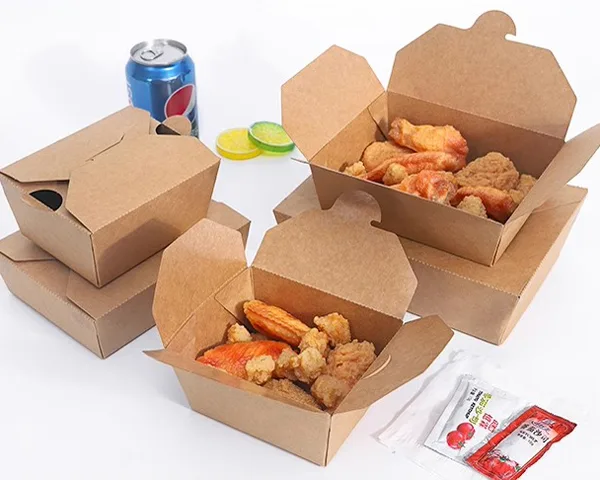
What is a Paper Food Box?
A paper food box is a food-contact package made mainly from paperboard, kraft board, or other fibre-based board structures. In practical foodservice use, it may include folds, glued seams, lock tabs, vent holes, window film, or barrier systems that improve grease and moisture resistance. That means a paper food box is not just “paper”. It is a packaging system made of board, converting design, barrier choice, printing, and closure engineering [4][5][6].
This distinction matters because two boxes can look similar on a website but perform very differently in real operations. One may work well for burgers, wraps, and dry fried foods; another may fail under oily noodles or saucy rice meals. One may be accepted in a fibre recycling stream if mostly clean and dry; another may fall out of that stream because of multilayer construction, heavy contamination, or local sorting limitations [6][7][9].
In short, the right definition is this: a paper food box is a fibre-based takeaway package whose real sustainability value depends on three things working together—food safety, functional performance, and end-of-life compatibility.
Why Paper Food Boxes Matter More Now
The pressure on takeaway packaging is structural, not temporary. The European Commission states that packaging uses large quantities of primary raw materials, that 40% of plastics used in the EU are in packaging, and that packaging waste reached 186.5 kg per person in the EU in 2022 [1]. At the same time, OECD reports that only 9% of plastic waste is successfully recycled globally [2]. Buyers, regulators, and food brands therefore increasingly expect packaging choices to reduce waste risk rather than simply shift materials.
Paper and paperboard are relevant in this context because fibre already has a stronger recovery base than many competing single-use materials. According to the U.S. EPA, approximately 46 million tons of paper and paperboard were recycled in 2018, for a recycling rate of 68.2%, while corrugated boxes reached 96.5% [3]. That does not mean every food box is automatically recyclable, but it does explain why fibre-based formats are strategically attractive when the pack is designed correctly and used in a compatible waste system.
Regulation is also moving the discussion from “cheap packaging” to “defensible packaging”. The EU’s Packaging and Packaging Waste Regulation entered into force on 11 February 2025 and generally applies from 12 August 2026, with the objective of making all packaging on the EU market recyclable in an economically viable way by 2030 [1]. For importers, distributors, and food brands, that means material selection is increasingly tied to future compliance and not only current unit price.
Benefits of Using Paper Food Boxes — With the Right Conditions
1. Better alignment with circular packaging strategy. Fibre-based packs can support a more circular packaging mix when they are designed for collection and sorting, and when the market has the right infrastructure [1][3][9]. This is one of the strongest reasons paper food boxes remain attractive for takeaway.
2. Strong branding value without overengineering. Kraft and paperboard formats communicate a cleaner and more natural visual language than many low-cost plastics. For many food brands, that improves shelf impression and takeaway presentation without requiring a complex packaging redesign.
3. Functional versatility across menu categories. Paper food boxes can be converted into clamshells, tuck-top meal boxes, snack boxes, fry scoops, salad boxes, bakery packs, and carry-out formats. This gives operators better menu-fit than a one-shape-fits-all container strategy.
4. Lower “greenwashing risk” than vague biodegradable claims. The strongest paper food box programs usually avoid broad, unqualified claims. Instead, they state the material structure clearly, explain the correct disposal route, and back food-contact suitability with documents [4][5][6][8].
5. Practical operations value. A well-designed paper food box is lightweight, stackable, printable, and efficient for restaurant counters and delivery packing stations. These operational advantages are real, but they only hold if the board grade, barrier level, and closure design match the menu being packed.
Types of Paper Food Boxes
| Format | Typical Use | Main Stress | What to Check Before Buying |
|---|---|---|---|
| Hamburger / sandwich box | Burgers, wraps, toasties | Steam buildup, moderate grease | Closure strength, venting, anti-soggy structure |
| Fry / snack box | Fries, nuggets, finger food | Oil staining, short hold time | Grease barrier, rigidity, easy hand carry |
| Meal box / rice box | Rice, noodles, mixed dishes | Heat, sauce, corner leakage | Fold integrity, bottom seam, hold-time validation |
| Salad / cold food box | Salads, fruit, chilled meals | Condensation, dressing contact | Moisture resistance, lid fit, visual presentation |
| Pizza / bakery box | Pizza, pastries, bakery items | Grease migration, shape retention | Board stiffness, ventilation, stacking strength |
A procurement mistake many buyers make is ordering by shape name alone. “Burger box” is not a performance specification. Menu weight, oil load, hold time, stacking method, and final disposal route should all be part of the packaging brief.

Technical Details Most Blogs Skip — But Buyers Cannot
The Food Standards Agency’s rapid evidence assessment on alternatives to single-use plastics makes a key point: packaging alternatives must be assessed in terms of both opportunities and risks, including sustainability and food safety [4]. That is the correct lens for paper food boxes. A paper food box is not successful because it is fibre-based. It is successful because it protects the food without creating avoidable compliance or disposal problems.
First, food-contact safety must be treated as a baseline requirement. The European Commission states that Regulation (EC) No 1935/2004 sets the general principles of safety and inertness for all food contact materials [5]. EDQM further notes that paper and board in contact with food can transfer substances such as metals, antioxidants, colourants, and plasticisers, and its guide therefore covers both fresh fibres and recycled materials [6]. The implication is simple: buyers should not approve a paper food box on appearance alone. They should request the relevant declaration or test documentation for the exact structure supplied.
Second, barrier choice decides real-world success. Hot, oily, or moist foods expose weak points fast: corner folds, base seams, lid locks, and cut edges. A box that looks perfect when empty may soften or wick at the crease line after 20 to 30 minutes in real delivery conditions. This is why functional validation with actual menu items is more important than relying on generic brochure wording.
Third, end-of-life claims must match local infrastructure. The European Commission’s policy framework on biobased, biodegradable and compostable plastics explicitly warns that such materials involve sustainability trade-offs and should be used under the right conditions [10]. In England’s workplace recycling guidance, packaging labelled “compostable” or “biodegradable” should not be placed with food waste unless a dedicated collection exists [8]. That is exactly why serious packaging copy should avoid saying “recyclable, biodegradable, compostable” all at once without context.
Common Buyer Mistakes When Choosing a Paper Food Box
Mistake 1: Treating “paper” as the performance answer.
Paper is the substrate family, not the finished-use guarantee. Greasy rice, saucy noodles, bakery items, and salads do not place the same demands on a box.
Mistake 2: Confusing recyclable with compostable.
These are different end-of-life pathways. The correct route depends on the full pack construction and the local collection system [8][10].
Mistake 3: Approving samples when empty.
Empty samples almost always look better than filled packs in a real delivery cycle. A proper approval should include a filled-food trial, a short transport simulation, and a post-hold leakage check.
Mistake 4: Ignoring contamination reality.
4evergreen notes that traces or stains of food contamination do not necessarily prevent recycling, but the quantity and nature of contamination matter [7]. That means disposal instructions should be realistic: “empty and reasonably clean/dry where accepted” is more useful than generic eco language.
Mistake 5: Failing to ask for documentation.
Buyers should request material structure details, food-contact compliance documents, application notes, and evidence supporting any compostable or recyclable claim [5][6][8].
How to Choose the Right Paper Food Box
A better purchasing process is to build selection around use-case logic:
Step 1: Define the menu profile. Is the food dry, oily, wet, acidic, or condensation-heavy? What is the serving temperature? Will the customer eat immediately or after 20 to 40 minutes?
Step 2: Define the service journey. Counter takeaway, platform delivery, meal prep, catering, and retail grab-and-go each create different stress points.
Step 3: Define the waste route. Do you want a recyclable fibre pack, a compostable pack, or simply a lower-plastic format? Those are related but not identical commercial decisions [8][10].
Step 4: Define the compliance pack. For export and branded supply, request food-contact compliance documents first, not after the artwork stage [5][6].
Step 5: Run a filled-food acceptance test. Use the actual menu item, hold it for the realistic service window, shake it for delivery simulation, then inspect the corners, base, lid fit, and staining after rest. This one operational step prevents many expensive packaging complaints.
Supplier Checklist: What Serious Buyers Should Request
To move this topic from blog theory to purchasing reality, buyers should ask suppliers for:
- Material structure description, including board type and barrier/coating system
- Food-contact declaration or relevant migration/compliance documentation for the selling market
- Application guidance for hot, cold, oily, or microwave-related use
- Evidence behind any recyclable, compostable, or biodegradable claim
- Filled-food test photos, validation notes, or sample trial guidance
- Printing and converting limitations, especially if heavy ink coverage or custom windows are planned
Conclusion
Paper food boxes are still one of the most promising formats for takeaway and delivery, but the strongest reason is not that they are simply made from paper. Their real advantage is that fibre-based packaging can support a more credible balance between brand presentation, operational convenience, food protection, and circularity when the design is fit for purpose [1][3][9].
The commercial takeaway is clear. Do not buy a paper food box because it looks sustainable. Buy it because the structure suits the menu, the compliance file is complete, the disposal route is realistic, and the performance has been checked under actual service conditions. That is the standard that separates a marketing-friendly pack from a defensible packaging decision.
FAQ: Paper Food Box Questions Buyers Search Most
1. Are paper food boxes recyclable?
Often yes, but not automatically. Fibre-based food boxes are more likely to fit recycling systems when they are mostly paper-based and not heavily contaminated. 4evergreen notes that light traces or stains do not necessarily stop recycling, but contamination level and local collection rules still matter [3][7][9].
2. Are paper food boxes compostable or biodegradable?
Not by default. “Paper”, “biodegradable”, and “compostable” are not interchangeable claims. Compostability depends on the full pack structure and local collection infrastructure, and some markets require dedicated collection rather than disposal with food waste [8][10].
3. Can paper food boxes hold hot and oily foods?
Yes, many can, but only when the board structure and barrier system are chosen for that exact application. For hot takeaway meals, performance depends on grease resistance, moisture resistance, base seam integrity, and hold time rather than on the word “paper” alone [4][5][6].
4. Can paper food boxes go in the microwave?
Only when the supplier clearly states that the specific box construction is suitable for microwave use. Coatings, inks, adhesives, structural design, and the food itself all influence the result. Buyers should never assume that all paper takeaway boxes are microwave-safe.
5. What documents should importers or food brands request before ordering?
Request the material structure, food-contact compliance documents, performance/application guidance, and support for any recyclability or compostability claim. For EU-facing business, food-contact compliance should be reviewed against the applicable legal framework and intended use [5][6].
References
- European Commission — Packaging waste
- OECD — Plastic pollution is growing relentlessly as waste management and recycling fall short
- U.S. EPA — Paper and Paperboard: Material-Specific Data
- Food Standards Agency — Alternatives to single-use plastics in food packaging and production
- European Commission — Food Contact Materials legislation
- EDQM — Paper and board used in food contact materials and articles
- 4evergreen — Guidance on the Improved Collection and Sorting of Fibre-based Packaging for Recycling
- GOV.UK — Simpler recycling: workplace recycling in England
- 4evergreen — Guidance on the Improved Collection and Sorting
- European Commission — Biobased, biodegradable and compostable plastics


One Response
Thanks for sharing. I read many of your blog posts, cool, your blog is very good. How can I buy the paper food box for my restaurant?