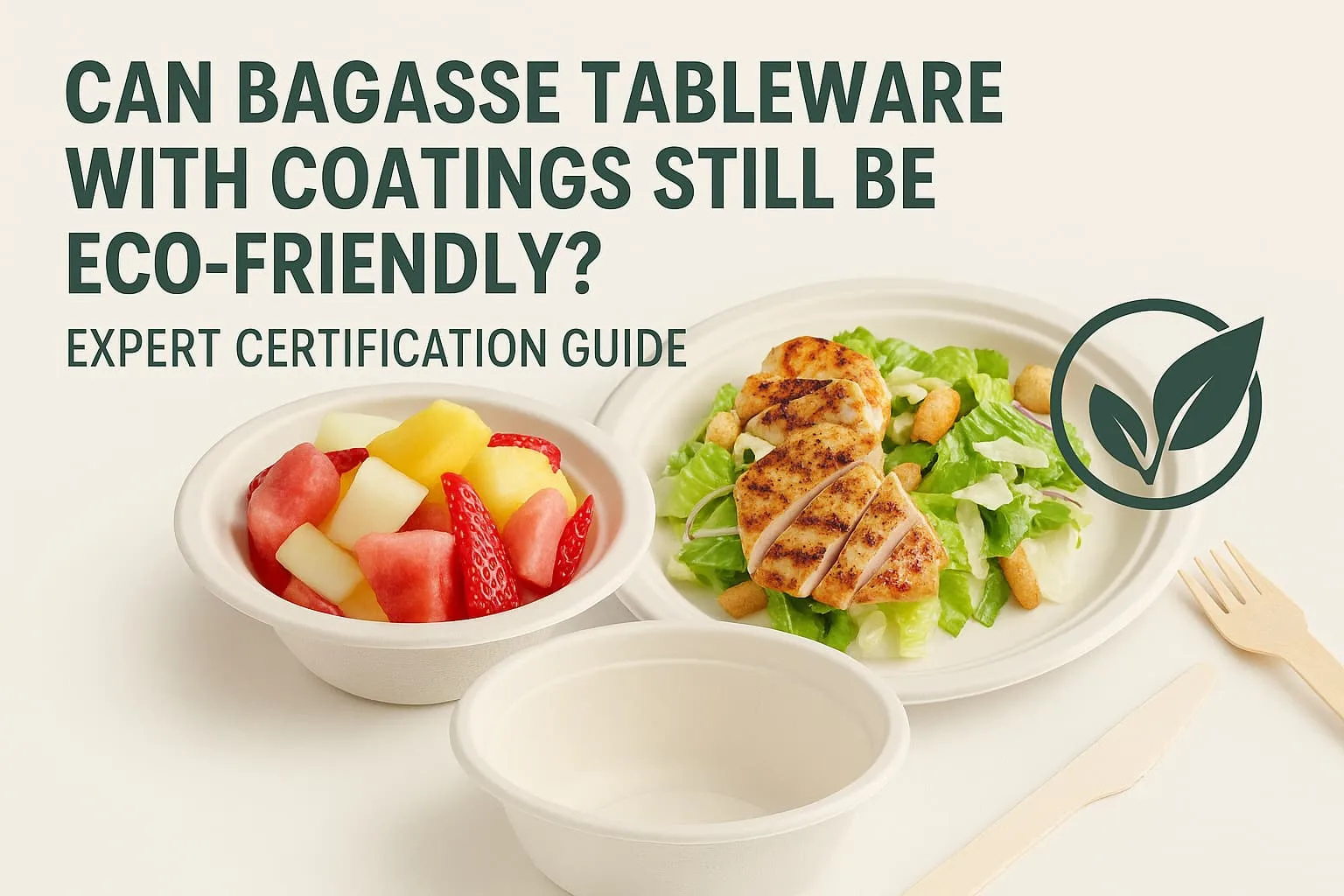










Snel antwoord: heeft bagasseverpakking FSC-certificering nodig?
Meestal is FSC-certificering niet de primaire certificering die wordt gebruikt om de suikerrietbagassevezel zelf te verifiëren. Suikerrietbagasse is een agrarisch residu en een niet-houtige plantenvezel, in plaats van conventionele op bos gebaseerde houtpulp. Binnen het FSC-kader voor chain of custody kunnen materialen die buiten een bosmatrix ontstaan, worden geclassificeerd als “neutrale materialen”, die anders worden behandeld dan door FSC gecontroleerde bosmaterialen.
Voor kopers die gegoten bagasse-voedselverpakkingen betrekken, omvatten de relevantere controles doorgaans materiaalsamenstelling, naleving van voedselcontact, composteerbaarheidsbewijs, PFAS-gerelateerde tests, productprestaties en kwaliteitsdocumentatie van de leverancier. FSC wordt relevanter wanneer het eindproduct of de verpakking ervan functionele boscomponenten bevat, zoals papier of karton.
Heeft suikerrietbagasseverpakking FSC-certificering nodig?
Wanneer inkoopteams papieren bekers, kraft-voedseldozen, kartonnen verpakkingen en gegoten vezelverpakkingen samen betrekken, wordt FSC vaak toegevoegd aan dezelfde kwalificatiechecklist voor leveranciers. Dit kan verwarring veroorzaken wanneer het product dat wordt gekocht, is gemaakt van suikerrietbagasse in plaats van conventionele houtpulp.
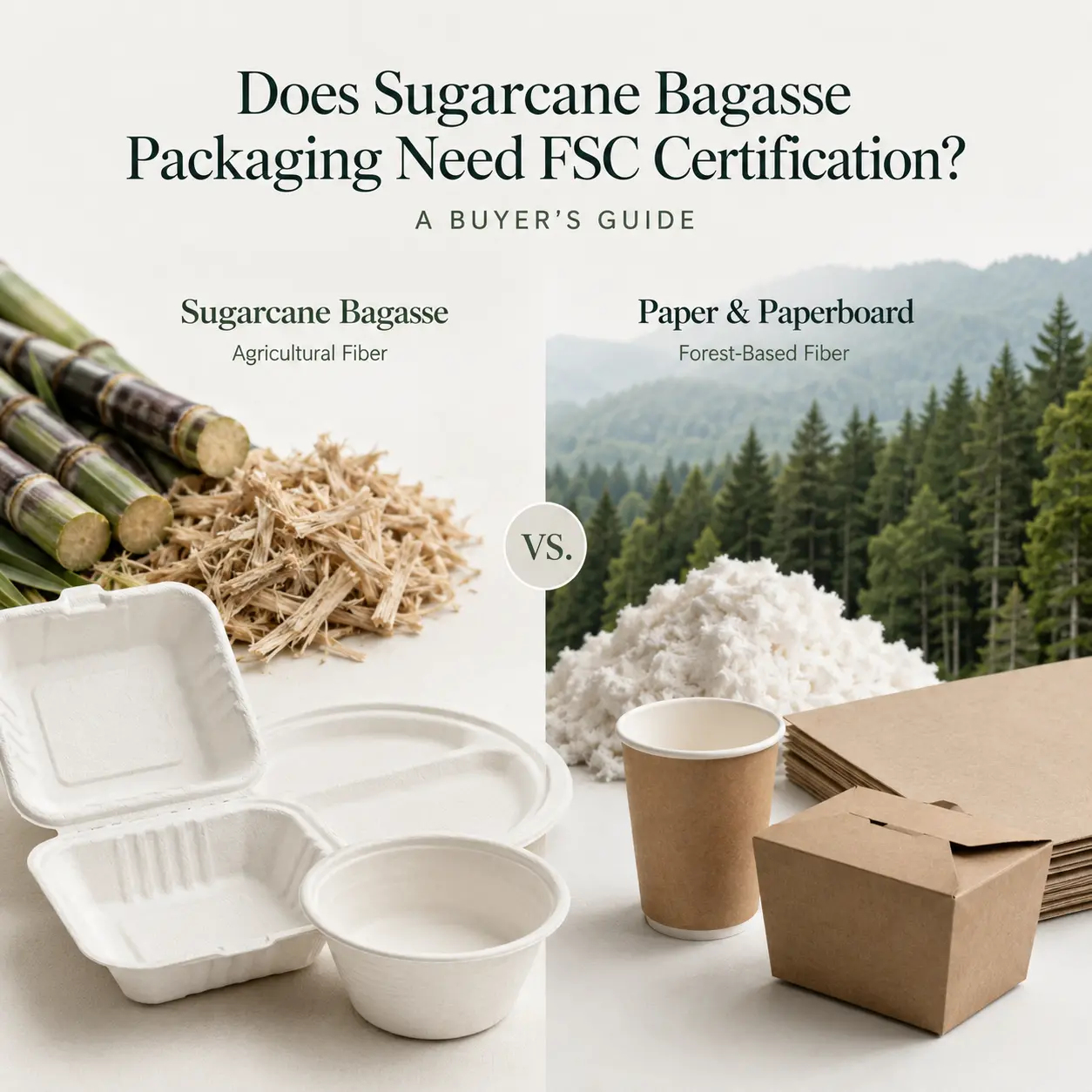
Het eerste onderscheid is eenvoudig: FSC is in de eerste plaats een systeem voor bosinkoop en chain of custody, terwijl suikerrietbagasse een agrarische vezel is. Dit zijn niet dezelfde materiaalcategorieën en mogen niet automatisch met exact dezelfde certificeringslogica worden geëvalueerd.
De Forest Stewardship Council beschrijft zijn chain of custody-systeem als een mechanisme voor het volgen van bosmaterialen door inkoop, verwerking, productie, handel en distributie. De huidige FSC-norm voor chain of custody-certificering definieert materiaal dat buiten een bosmatrix ontstaat als “neutraal materiaal” en geeft specifiek niet-houtige plantenvezels als voorbeeld.
Belangrijkste conclusie: Een koper mag niet aannemen dat een gegoten suikerrietbagassebord, -kom, -schaal of -clamshell dezelfde FSC-documentatie nodig heeft als een papieren beker van houtpulp of een kraftpapieren doos. De juiste nalevingsdocumenten hangen af van het werkelijke materiaal en de claim die wordt geverifieerd.
Wat is suikerrietbagasse?
Suikerrietbagasse is het vezelachtige residu dat overblijft nadat suikerrietstengels zijn geplet om sap te extraheren. In plaats van deze vezel alleen als agrarisch bijproduct te behandelen, kunnen fabrikanten het verwerken tot pulp en het vormen tot gegoten foodserviceproducten zoals borden, kommen, schalen, clamshell-containers en meeneem-voedselcontainers.
Deze oorsprong van de grondstof is wat wegwerpservies van suikerrietbagasse scheidt van conventionele kraftpapier, karton en wegwerpproducten op basis van houtpulp. Hoewel beide uiteindelijk cellulosevezels kunnen bevatten en beide er voor een koper uit kunnen zien als “papieren verpakking”, zijn hun inkooppaden verschillend.
Bioleader® vervaardigt gegoten vezelformaten, waaronder suikerrietbagasse voedselverpakkingen, suikerrietbagasse bakken met scharnierdeksel, kommen, borden en schalen voor foodservicetoepassingen. Voor inkoopdoeleinden moeten kopers de werkelijke vezelbron identificeren voordat ze beslissen welke certificering op de documentatiechecklist hoort.
Wat dekt FSC-certificering eigenlijk?
FSC mag niet worden behandeld als een universeel milieucertificaat voor elk plantaardig verpakkingsmateriaal. Het centrale doel is het bieden van zekerheid over verantwoord beheerde bossen en de gecontroleerde keten waarlangs in aanmerking komend bosmateriaal beweegt.
Volgens FSC is chain of custody-certificering ontworpen voor organisaties die bosproducten produceren en distribueren. Voor producten met een FSC-claim moeten toepasselijke boscomponenten en de organisaties die deze materialen controleren, voldoen aan de FSC-vereisten.
Dit maakt FSC zeer relevant voor materialen zoals houtpulp, papier, karton, kraftpapier, houten artikelen en andere in aanmerking komende bosinputs. FSC-inkoop is bijvoorbeeld direct relevant wanneer een koper FSC papier specificeert voor papieren bekers.
FSC bewijst niet, op zichzelf, niet dat een voedselverpakking veilig is voor voedselcontact, composteerbaar, PFAS-vrij, magnetronbestendig, vetbestendig of geschikt voor een bepaalde exportmarkt. Die vragen vereisen afzonderlijk bewijs.
Belangrijk onderscheid: FSC-certificering beantwoordt een vraag over vezelinkoop en chain of custody. Het mag niet worden gebruikt als vervanging voor voedselcontacttests, composteerbaarheidsverificatie, PFAS-tests of daadwerkelijke evaluatie van foodserviceprestaties.
Hoe behandelt FSC niet-bosmaterialen zoals bagasse?
Dit is het technische punt dat het meest belangrijk is voor inkoopteams.
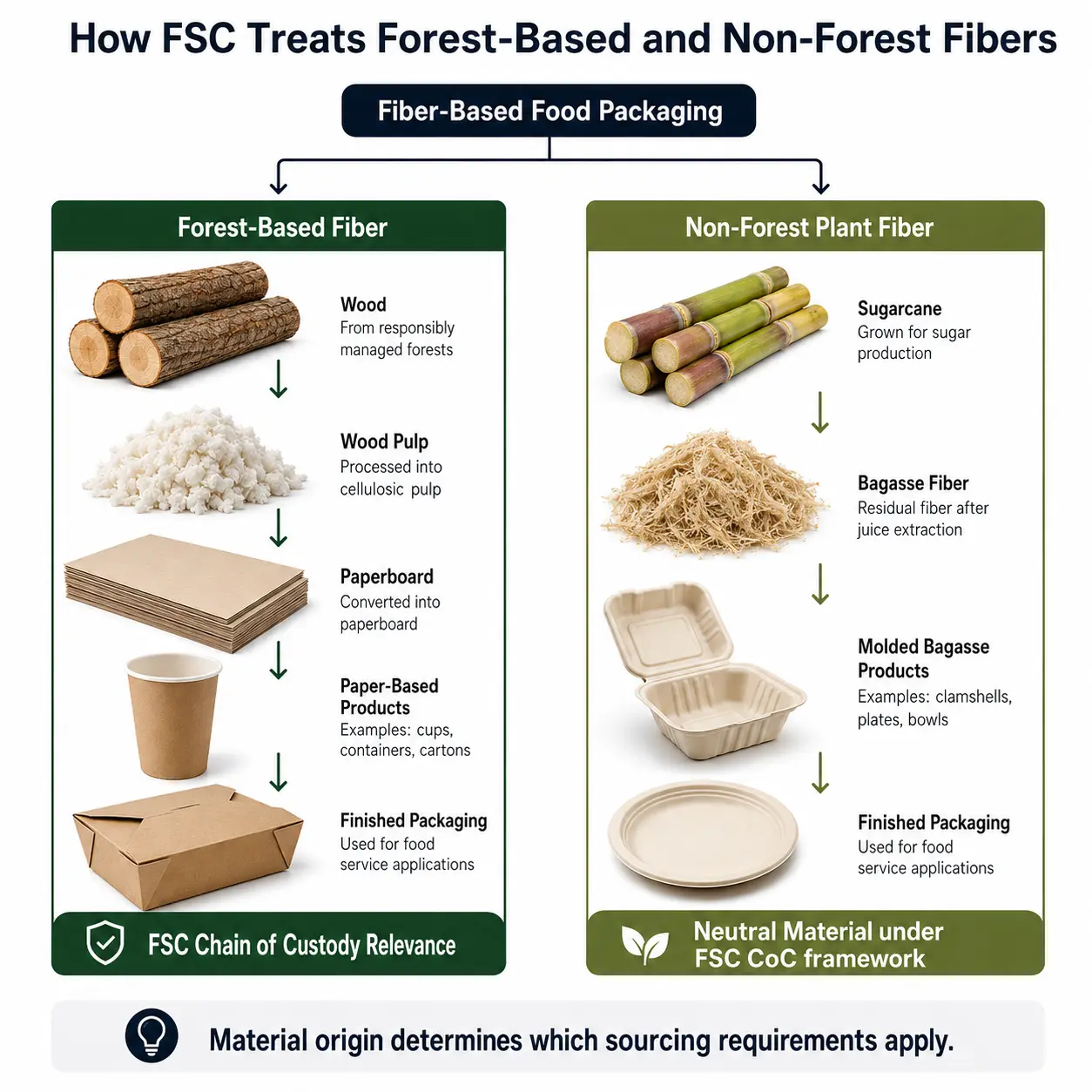
De FSC-norm voor chain of custody definieert een neutraal materiaal als materiaal dat buiten een bosmatrix ontstaat, wat een niet-bosmateriaal betekent. De voorbeelden omvatten niet-houtige plantenvezels en bepaalde synthetische of anorganische materialen. De norm stelt verder dat neutrale materialen die binnen FSC-productgroepen worden gebruikt, zijn vrijgesteld van de FSC-controlevereisten voor chain of custody.
Suikerriet is een agrarisch gewas in plaats van een bosbron, en bagasse is het vezelachtige residu dat ontstaat na suikerextractie. Daarom mag de suikerrietvezel zelf niet automatisch op dezelfde manier worden behandeld als door FSC gecontroleerde houtpulp.
Dit betekent niet niet dat “bagasse FSC-gecertificeerd is”. Het betekent iets anders: het niet-bosmateriaal en het door FSC gecontroleerde bosmateriaal moeten correct worden onderscheiden.
Inzicht van de fabrikant: vermijd het vragen van één certificaat om alles te bewijzen
In exportprojecten ziet Bioleader® soms dat inkoopspecificaties die oorspronkelijk voor papierproducten zijn geschreven, opnieuw worden gebruikt voor gegoten bagasse-serviesgoed. Een checklist kan daarom FSC, naleving van voedselcontact, composteerbaarheid, PFAS-tests en fabriekscertificaten vragen alsof elk document hetzelfde verifieert.
Een beter proces voor leveranciersgoedkeuring scheidt de vragen. Bevestig eerst de grondstof. Verifieer vervolgens voedselcontactveiligheid, chemische vereisten, composteerbaarheidsclaims, productprestaties en kwaliteitssystemen van de fabriek onafhankelijk. Dit levert een veel betekenisvoller nalevingsdossier op dan het verzamelen van niet-gerelateerde certificaten zonder hun reikwijdte te begrijpen.
Waarom is bagasse anders dan kraftpapier en karton?
De verwarring is begrijpelijk omdat bagasse-serviesgoed commercieel vaak wordt beschreven als gegoten vezel, pulp-serviesgoed, suikerrietpapieren borden of vezelvoedselverpakking. Visueel kan het ook lijken op papieren foodserviceverpakking.
De inkoopvraag moet echter gebaseerd zijn op vezelherkomst in plaats van uiterlijk.
| Vraag van de koper | Kraftpapier-/kartonverpakking | Suikerrietbagasseverpakking |
|---|---|---|
| Typische primaire vezelbron | Op hout gebaseerde pulp | Agrarisch residu van suikerriet |
| Relevantie van FSC | Direct relevant wanneer FSC-inkoop van bosvezels wordt gespecificeerd | Bagassevezel zelf is geen bosmateriaal en moet niet worden behandeld als conventionele FSC houtpulp |
| Belangrijkste bewijs voor inkoop | Papierbron, FSC claim waar vereist, coatingstructuur en leveranciersdocumentatie | Vezelsamenstelling, productspecificatie en materiaaldocumentatie van de leverancier |
| Naleving van voedselcontact | Moet afzonderlijk worden geverifieerd | Moet afzonderlijk worden geverifieerd |
| Composteerbaarheid | Niet aangetoond door FSC | Niet aangetoond door FSC; verifieer productspecifiek bewijs waar de claim vereist is |
| PFAS status | Niet aangetoond door FSC | Niet aangetoond door FSC; afzonderlijk verifiëren |
| Prestaties bij hitte, olie en lekkage | Hangt af van papierstructuur, coating en ontwerp | Hangt af van vezelformulering, vormproces, barrièresysteem en productontwerp |
Dit onderscheid wordt vooral belangrijk voor distributeurs die meerdere verpakkingscategorieën van één leverancier betrekken. Een FSC aanvraag kan passend zijn voor het papieren deel van de bestelling, terwijl ander bewijs geschikter is voor suikerrietbagasse kommen, suikerrietbagasse borden, of vormvezelbakken.
Kan een bagasseproduct ooit in verband worden gebracht met een FSC claim?
Kopers moeten een andere oversimplificatie vermijden: zeggen dat een product dat bagasse bevat “nooit” iets te maken kan hebben met FSC.
Een compleet verpakkingssysteem kan meerdere materialen bevatten. Een item kan bijvoorbeeld agrarische vezel combineren met een functioneel papier- of kartononderdeel. FSC regels beoordelen bosgebaseerde componenten, productgroepen, inkoopinputs, certificaatomvang en de voorwaarden waaronder een FSC claim of handelsmerk mag worden gemaakt.
FSC maakt ook een belangrijk onderscheid tussen een product en zijn verpakking. Onder de Chain of Custody-norm kan bosgebaseerde verpakking afzonderlijk worden beschouwd van het product dat erin zit. Dit betekent dat een gevormd bagasseproduct en een FSC-gecertificeerde kartonnen buitenverpakking niet automatisch als één identieke materiaalclaim moeten worden behandeld.
Waarschuwing voor kopers: Concludeer nooit dat het hele product FSC-gecertificeerd is, simpelweg omdat de doos, hoes, papieren etiket of een ander bosgebaseerd onderdeel een FSC claim draagt. Controleer precies welke component en productomvang het certificaat of de claim dekt.
Waarom vragen kopers vaak FSC voor bagasse servies?
Veel restaurantgroepen, distributeurs, importeurs, supermarkten en cateraars gebruiken gestandaardiseerde duurzaamheidsvragenlijsten. Deze vragenlijsten zijn mogelijk oorspronkelijk gemaakt voor papieren bekers, kartonnen verpakkingen, servetten, kraftdozen en andere bosvezelverpakkingen.
Wanneer hetzelfde formulier later naar een fabrikant van bagasse servies, wordt gestuurd, blijft het FSC veld vaak staan, ook al is de grondstof veranderd.
Er zijn vier veelvoorkomende redenen hiervoor:
- Inkoopteams groeperen alle vezelgebaseerde verpakkingen onder de algemene term “papieren verpakking”.”
- Interne ESG-beleid kan FSC als standaardvereiste gebruiken voor bosvezelpapier en -vezel, maar maakt geen onderscheid met agrarische restvezels.
- Formulieren voor retailer-onboarding kunnen één certificeringssjabloon gebruiken voor meerdere verpakkingsmaterialen.
- Kopers kunnen FSC begrijpen als een algemeen duurzaamheidscertificaat in plaats van een bosgericht inkoop- en Chain of Custody-systeem.
Het juiste antwoord van de leverancier is dus niet simpelweg “geen FSC”. Een technisch nuttig antwoord legt uit waarom het materiaal anders is en welk bewijs in plaats daarvan moet worden beoordeeld.
Wat moeten kopers verifiëren bij de aankoop van bagasse voedselverpakkingen?
Als FSC niet het primaire document is voor het verifiëren van suikerrietbagassevezel, wat moet een importeur of inkoopmanager dan aanvragen?
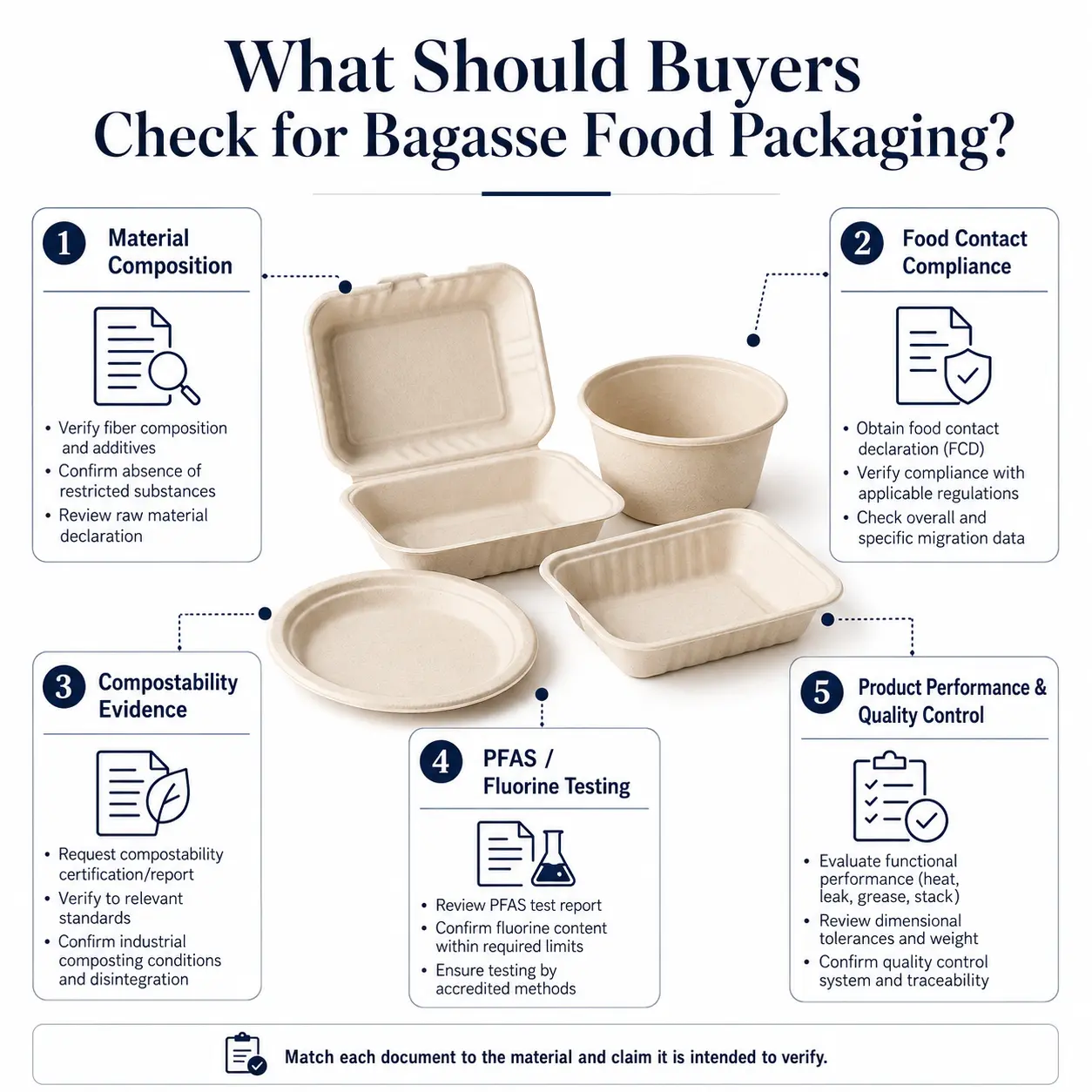
Nalevingschecklist voor kopers van bagasse verpakkingen
- Materiaalsamenstelling: Bevestig de primaire vezelbron en of andere plantvezels, papiervezels, additieven, coatings of barrièrematerialen aanwezig zijn.
- Documentatie voor levensmiddelencontact: Verifieer bewijs dat relevant is voor de doelmarkt en de beoogde omstandigheden van voedselcontact.
- Bewijs van composteerbaarheid: Als het product wordt verkocht als gecertificeerd composteerbaar, controleer dan de toepasselijke norm, certificeringsinstantie, certificaatomvang, productmodel en verwijderingsomgeving.
- PFAS-gerelateerde documentatie: Bevestig hoe de leverancier PFAS claims ondersteunt, inclusief toepasselijke verklaringen of analytische tests.
- Prestatietests: Beoordeel warm voedsel, water, olie, saus, magnetron, vriezer, stapelbaarheid, dekselpasvorm en bezorgomstandigheden volgens de beoogde toepassing.
- Kwaliteitssystemen van de fabriek: Controleer of productiecontroles, batchconsistentie, traceerbaarheid, inspectieprocedures en relevante managementcertificeringen herhaalbare productie ondersteunen.
- Productspecifieke documenten: Ga er niet vanuit dat een certificaat voor één materiaal, productfamilie of fabriek automatisch elke SKU dekt.
1. Voedselcontactconformiteit is gescheiden van FSC
Voedselcontactveiligheid moet onafhankelijk worden beoordeeld van de herkomst van het bosmateriaal. In de Europese Unie worden materialen die in contact komen met voedsel gereguleerd door het algemene kader dat is vastgesteld onder Verordening (EG) nr. 1935/2004 en andere toepasselijke maatregelen. In de Verenigde Staten moeten verpakkingscomponenten en stoffen die in contact komen met voedsel worden beoordeeld onder het toepasselijke FDA regelgevingskader en de beoogde gebruiksomstandigheden.
Voor een importeur van bagasse is de praktische vraag niet “Heeft het FSC?” maar eerder: Komt het beschikbare bewijs voor voedselcontact overeen met dit materiaal, dit product en mijn beoogde gebruik?
Bioleader® onderhoudt een speciale Certificaten & testrapporten bron waar kopers documentatiecategorieën kunnen bekijken voor producten van suikerrietbagasse en andere voedselverpakkingsmaterialen.
2. Composteerbaarheid wordt niet bewezen door FSC
FSC-gecertificeerde vezels en gecertificeerde composteerbaarheid zijn afzonderlijke concepten. Een product kan verantwoord geproduceerde bosvezels bevatten zonder composteerbaar te zijn, terwijl een bagasseproduct een composteerbaarheidscertificering kan volgen zonder dat de suikerrietvezel zelf FSC-gecertificeerd is.
Voor Europese verpakkingen is EN 13432 een erkende referentie voor verpakkingen die bedoeld zijn voor terugwinning door industriële compostering en biologische afbraak. Kopers moeten verifiëren of een specifiek certificaat daadwerkelijk het product dekt dat ze van plan zijn te kopen, in plaats van aan te nemen dat “bagasse” automatisch gecertificeerd composteerbaar betekent.
Dit onderscheid is vooral belangrijk voor producten van gevormde vezels in combinatie met deksels, coatings, etiketten, inkten of andere componenten. De claim over het einde van de levensduur moet de volledige verpakkingsconfiguratie weerspiegelen die wordt verkocht.
3. PFAS-conformiteit is ook een afzonderlijke vraag
FSC bepaalt niet of voedselverpakkingen van gevormde vezels opzettelijk toegevoegde PFAS bevatten of voldoen aan de specificatie van een koper met betrekking tot fluor. Dit zijn vragen over chemische conformiteit en vereisen ander ondersteunend bewijs.
Voor kopers die vetbestendige gevormde vezels evalueren, heeft Bioleader® een gedetailleerde technische uitleg gepubliceerd in De wetenschap achter PFAS-vrij suikerrietbagasse wegwerpservies. Het belangrijkste inkoopprincipe is eenvoudig: een natuurlijk vezel-uiterlijk, composteerbaarheidsclaim of FSC-logo vestigt op zichzelf geen PFAS-status.
Inkoopteams die te maken hebben met warme en vette voedingsmiddelen kunnen ook PFAS-vrij suikerrietbagasse wegwerpservies voor 100°C heet voedsel, bekijken, dat zich richt op de relatie tussen chemische eisen en echte foodservice-prestaties.
4. Materiaalsamenstelling moet vóór certificering worden geverifieerd
Voordat u certificaten aanvraagt, moet u vaststellen wat er precies wordt gekocht.
Een gevormd bord dat wordt omschreven als “milieuvriendelijke vezel” kan suikerrietbagasse, bamboevezel, houtpulp, andere plantenvezels of een mengsel bevatten. Een meeneembakje kan ook worden verkocht met een aparte PET, PP, PLA of deksel van gevormde vezels. Elke configuratie kan verschillende overwegingen met betrekking tot inkoop, voedselcontact, composteerbaarheid en recycling met zich meebrengen.
Om die reden raadt Bioleader® aan om de kwalificatie van leveranciers te starten met de productspecificatie en materiaalsamenstelling in plaats van te beginnen met een generieke lijst van certificaatnamen.
Aanbevolen monsterevaluatie vóór bulkaankoop
Certificeringsbeoordeling moet worden gecombineerd met fysieke productevaluatie. Voor bagasseverpakkingen moeten kopers het daadwerkelijke monster testen met het voedsel dat het zal bevatten, vooral waar hitte, olie, vocht, levertijd, dekselretentie, stapeling, koeling of opwarmen de prestaties kunnen beïnvloeden.
Een document kan een gedefinieerde nalevingsvereiste verifiëren, maar het kan applicatietesten voor de werkelijke serviceomstandigheden van de koper niet vervangen.
5. Fabriekscertificering is niet hetzelfde als productcertificering
Een andere veelvoorkomende inkoopfout is het combineren van FSC, voedselcontactrapporten, composteerbaarheidscertificaten, ISO-systemen, BRC-gerelateerde fabriekscontroles en chemische testrapporten onder de enkele noemer “productcertificeringen”.”
Deze documenten dienen verschillende doeleinden.
| Documenttype | Wat het voornamelijk helpt verifiëren | Wat het niet automatisch bewijst |
|---|---|---|
| FSC Chain of Custody | In aanmerking komende bosbouw en chain of custody | Voedselveiligheid, composteerbaarheid of PFAS-status |
| Voedselcontactrapport / nalevingsdocumentatie | Geschiktheid voor gespecificeerde voedselcontactvereisten en testomstandigheden | Bosbouw of composteerbaarheid |
| Composteerbaarheidscertificaat | Conformiteit met het gespecificeerde composteerbaarheidscertificeringsschema en de reikwijdte | FSC-inkoop of elke voedselcontactvereiste |
| PFAS / fluorgerelateerde test | Gedefinieerd chemisch testresultaat onder de vermelde methode en detectieomstandigheden | FSC-inkoop of algemene composteerbaarheid |
| Fabrieksmanagementcertificering | Gedefinieerde productie- of kwaliteitsmanagementsystemen | Automatische certificering van elke afgewerkte SKU |
Wat als uw bedrijf FSC vereist als onderdeel van een inkoopbeleid?
Als een retailer of foodservicebedrijf een interne regel heeft die stelt dat alle papier- en vezelverpakkingen FSC-gecertificeerd moeten zijn, is de eerste stap om te verduidelijken of het beleid specifiek bedoeld was voor bosvezels of dat het breed genoeg is geschreven om vezels van agrarische reststoffen te omvatten.
Inkoopteams kunnen drie vragen stellen:
- Is de FSC-eis bedoeld om de inkoop van hout en vezels uit bossen te controleren?
- Is het product daadwerkelijk gemaakt van vezels uit bossen, landbouwrestvezels of een combinatie van beide?
- Als het product beide bevat, welk onderdeel moet dan de FSC-claim dragen?
Deze verduidelijking voorkomt vaak dat een leverancier ten onrechte wordt afgewezen, simpelweg omdat een certificering die is geschreven voor houtpulppapier is toegepast op een andere grondstofcategorie.
Praktisch voorbeeld voor inkoopteams
Als een koper gevormde bagasse clamshells koopt samen met FSC papieren bekers, hoeft de documentatie niet noodzakelijkerwijs identiek te zijn. FSC-inkoopdocumentatie kan direct relevant zijn voor het op bos gebaseerde cupstock, terwijl de gevormde bagasse clamshell moet worden beoordeeld op basis van de suikerrietvezelsamenstelling, voedselcontactdocumentatie, composteerbaarheidsclaims, PFAS-vereisten en prestatie-specificaties.
Het doel is niet om het grootst mogelijke aantal certificaten te verzamelen. Het is om het juiste bewijs voor elk materiaal en elke claim te verzamelen.
Hoe Bioleader® kopers van bagasseverpakkingen ondersteunt
Bioleader® levert gevormde suikerrietvezelverpakkingen voor restaurants, distributeurs, groothandels, foodservice-exploitanten, cateringbedrijven, supermarkten, meal-prep-merken en private-label verpakkingsprogramma's.
Het productassortiment omvat suikerrietbagasse bakken met scharnierdeksel, suikerrietbagasse voedselverpakkingen, suikerrietbagasse kommen, suikerrietbagasse borden, en bagasse trays met deksels.
Voor B2B-inkoopprojecten is het praktische doel om het nalevingsdossier af te stemmen op het product en de bestemmingsmarkt, in plaats van niet-gerelateerde certificaten te presenteren als onderling uitwisselbare duurzaamheidsclaims.
Kopers die een breder technisch overzicht van gevormde suikerrietproducten nodig hebben, kunnen verwijzen naar de Uitgebreide gids voor suikerrietbagasse serviesgoed. Voor inkoopteams die bredere materiaal- en marktvereisten beoordelen, biedt de 2026 Global Sugarcane Bagasse Packaging White Paper extra technische en inkoopcontext.
Aanbeveling voor kopers
Stuur bij het aanvragen van offertes voor suikerrietbagasseverpakkingen de leverancier uw bestemmingsmarkt, voedseltype, serveertemperatuur, houdtijd, vereiste productgrootte, dekselvereiste, composteerbaarheidsdoelstelling, PFAS-specificatie, voedselcontactvereisten, merkbehoeften, geschatte hoeveelheid en eventuele specifieke nalevingschecklist van de retailer.
Hierdoor kan de fabrikant bepalen welke documenten daadwerkelijk relevant zijn voordat monsters, testen, certificeringsbeoordeling en bulkproductie beginnen.
Bagasse versus FSC papier: de inkoopbeslissing in één tabel
| Als u koopt… | Primaire materiaalvraag | Is FSC een belangrijke controle? | Andere belangrijke controles |
|---|---|---|---|
| Kraftpapieren doos | Wat is de bron van de papiervezels? | Ja, als FSC-inkoop is gespecificeerd | Voedselcontact, coating, bedrukking, prestaties |
| Papieren beker | Welk cupstock en welke coating worden gebruikt? | Ja, als FSC-gecertificeerd cupstock vereist is | Voedselcontact, coatingtype, hitteprestaties |
| Zuiver gevormd bagasse bord | Is de vezel daadwerkelijk suikerrietbagasse en wat zit er nog meer in de formulering? | Normaal gesproken niet het primaire bewijs voor de bagassevezel zelf | Voedselcontact, composteerbaarheid, PFAS, prestaties |
| Voedselbak van suikerrietbagasse | Wat is de vezelsamenstelling en het barrièresysteem? | Normaal gesproken niet het primaire bewijs voor de bagassevezel zelf | Voedselcontact, PFAS, prestaties bij heet/vettig voedsel, composteerbaarheid |
| Gemengde vezel / verpakking met meerdere componenten | Welke componenten zijn landbouwvezels en welke zijn op bos gebaseerd? | Mogelijk relevant voor toepasselijke op bos gebaseerde componenten | Naleving op componentniveau en claims voor het eindproduct |
De regel voor de koper: Kies certificaten niet op basis van het visuele uiterlijk van de verpakking. Identificeer eerst de grondstof, identificeer ten tweede de claim die u moet verifiëren, en vraag vervolgens het document aan dat die vraag daadwerkelijk beantwoordt.
FAQ: FSC-certificering en suikerrietbagasseverpakkingen
Is suikerrietbagasse FSC-gecertificeerd?
Suikerrietbagasse mag niet automatisch worden omschreven als FSC-gecertificeerde vezel. Het komt van suikerriet, een landbouwgewas, in plaats van conventionele op bos gebaseerde houtpulp. FSC-regels voor keten van bewaring maken onderscheid tussen niet-bosmaterialen en op bos gebaseerde inputs. Als een individueel eindproduct FSC-gecontroleerde op bos gebaseerde componenten bevat, moeten die componenten en elke FSC-claim worden beoordeeld volgens de toepasselijke FSC-regels en het certificeringsbereik.
Heeft bagasseverpakking FSC-certificering nodig?
Voor een gevormd product gemaakt van suikerrietbagasse is FSC over het algemeen niet het primaire document om de bagassevezel zelf te verifiëren. Kopers moeten in plaats daarvan prioriteit geven aan materiaalsamenstelling, voedselcontactvereisten van de bestemmingsmarkt, composteerbaarheidsbewijs waar geclaimd, PFAS-gerelateerde documentatie, producttesten en kwaliteitscontroles van de leverancier.
Waarom geldt FSC anders voor bagasse en kraftpapier?
Kraftpapier wordt normaal gesproken geproduceerd uit houtpulp en heeft daarom een directe verbinding met de inkoop van bosvezels. Suikerrietbagasse is een landbouwresidu en niet-houtige plantenvezel. FSC-regels voor keten van bewaring maken onderscheid tussen materialen die buiten een bosmatrix ontstaan en op bos gebaseerde materialen, dus de inkoopdocumentatie mag niet automatisch als identiek worden behandeld.
Kan een product dat bagasse bevat een FSC-claim dragen?
Mogelijk kan een product met meerdere materialen of een composietproduct zowel bagassevezel van niet-bosbouw als op bosbouw gebaseerde componenten bevatten die binnen de FSC Chain of Custody-eisen vallen. Of een FSC-claim is toegestaan, hangt af van de werkelijke productsamenstelling, de FSC productgroep, in aanmerking komende bosbouwinputs, de certificeringsscope en de toepasselijke FSC-merkregels. Kopers moeten de claim verifiëren in plaats van aan te nemen dat de bagassevezel zelf FSC-gecertificeerd is.
Welke certificaten moet ik aanvragen voor bagasse voedselcontainers?
Begin met de beoogde markt en het beoogde gebruik. Typisch due diligence kan productspecificaties, materiaalsamenstelling, relevante documentatie voor voedselcontact, composteerbaarheidscertificering waar die claim vereist is, PFAS- of fluorgerelateerd bewijs waar van toepassing, fabriekskwaliteitsdocumentatie en praktijktests voor hete, vette, natte, bevroren, magnetron-, afhaal- of bezorgomstandigheden omvatten.
Betekent FSC-certificering dat een voedselcontainer composteerbaar is?
Nee. FSC en composteerbaarheid beantwoorden verschillende vragen. FSC richt zich op in aanmerking komende bosbouwinkoop en Chain of Custody, terwijl composteerbaarheidsnormen beoordelen of een product voldoet aan gedefinieerde biologische afbreekbaarheid, desintegratie en andere eisen onder gespecificeerde composteringsomstandigheden. Een product mag niet op de markt worden gebracht als gecertificeerd composteerbaar alleen omdat het papier of de vezel FSC-gecertificeerd is.
Bewijst FSC-certificering dat verpakking PFAS-vrij is?
Nee. FSC verifieert geen PFAS-gehalte. PFAS-gerelateerde claims vereisen afzonderlijke chemische nalevingsdocumentatie of passende analytische tests. Dit is met name relevant voor gevormde vezelvoedselverpakkingen die worden gebruikt met vette of hete voedingsmiddelen, waar vetbestendigheid en chemische formulering onafhankelijk van vezelinkoopcertificering moeten worden geëvalueerd.
Conclusie: vraag het juiste certificaat aan voor het juiste materiaal
Sugarcane bagasse-verpakkingen mogen niet worden beoordeeld alsof het gewoon een ander type FSC-papier is. Bagasse is afkomstig van agrarisch suikerrietrestmateriaal, terwijl FSC Chain of Custody voornamelijk in aanmerking komende bosbouwmaterialen en claims controleert.
Voor kopers die gevormd bagasse tafelgerei inkopen, is het belangrijkste inkoopproces om te verifiëren waarvan het product is gemaakt, of het geschikt is voor voedselcontact, of composteerbaarheidsclaims goed zijn onderbouwd, of aan PFAS-gerelateerde eisen wordt voldaan, en of het product presteert onder de werkelijke foodservice-omstandigheden.
Waar papier, karton, hoezen, cartons, etiketten of andere op bosbouw gebaseerde componenten betrokken zijn, kan FSC nog steeds relevant zijn voor die componenten. De juiste aanpak is daarom niet “FSC of geen FSC,” maar het matchen van elk certificaat en testrapport met het materiaal en de claim die het moet verifiëren.
Bioleader® ondersteunt internationale kopers bij het inkopen wegwerpservies van suikerrietbagasse met productselectie, productspecificaties, beoordeling van nalevingsdocumentatie, monsterevaluatie, OEM/private-label-eisen en bulkexportlevering. Kopers kunnen vóór de offerte hun doelmarkt en nalevingschecklist verstrekken, zodat de relevante product- en documentatieroute vanaf het begin kan worden geëvalueerd.
Referenties
- Forest Stewardship Council — FSC-STD-40-004 V3-1, Chain of Custody-certificering
- Forest Stewardship Council — Chain of Custody Certification
- Forest Stewardship Council — Wat de FSC-labels betekenen
- Europese Commissie — Materialen die in contact komen met levensmiddelen
- U.S. FDA — Verpakking & Voedselcontactstoffen
- European Bioplastics — EN 13432 en industriële composteerbaarheid