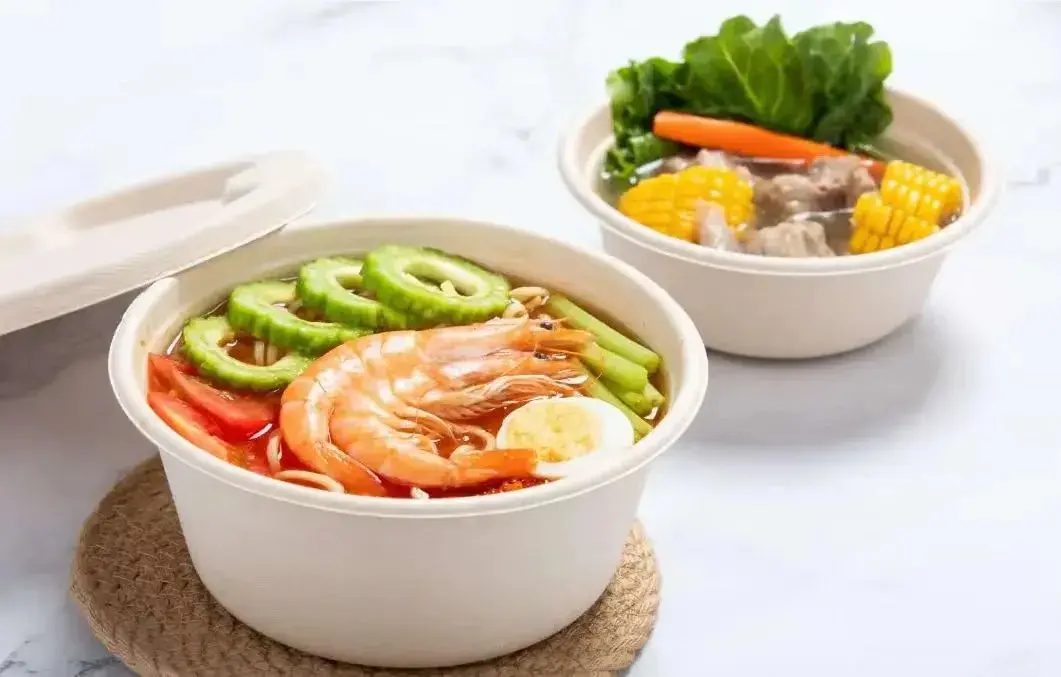










Quick Answer: Is Bamboo Tableware Safe?
Bamboo tableware can be safe for food contact, but “bamboo” alone does not tell buyers what the product is actually made from. A solid bamboo utensil, a bamboo-pulp molded plate, a bamboo-powder melamine bowl, and a bamboo-fiber plastic composite may all be marketed as “bamboo tableware,” yet they have very different material structures, manufacturing processes, additives, heat limits, food-contact requirements, and end-of-life routes.
- Solid bamboo and bamboo-pulp products are fundamentally different from plastic products that use bamboo powder only as a filler.
- Bamboo powder + melamine-formaldehyde resin has received particular regulatory attention in Europe because bamboo filler is not authorised for use in plastic food-contact materials under Regulation (EU) No 10/2011 and elevated melamine or formaldehyde migration has been documented in some tested products.
- Bamboo fiber + PP or another polymer remains a plastic composite even when the product looks natural or contains a substantial percentage of plant fiber.
- Bamboo + PLA/PBAT/starch composites cannot be assumed to be food-safe, plastic-free or compostable from their ingredient names alone. The finished formulation and relevant testing matter.
- Bamboo-pulp molded tableware uses a fiber-network structure rather than bamboo powder suspended in a plastic resin, but buyers should still verify barrier chemicals, additives, food-contact documents and the finished SKU.
The phrase “bamboo tableware” is a marketing category, not a precise material specification. That distinction matters because two bowls that look almost identical can be made by completely different processes. One may be formed from bamboo pulp fibers; another may be a melamine-formaldehyde plastic filled with ground bamboo powder.
For a foodservice buyer, importer or distributor, the useful question is therefore not simply “Is bamboo tableware safe?” It is: What material forms the continuous structure of the finished product, what has been added to it, and is that exact formulation suitable for the intended food, temperature and contact time?
Key takeaway: Bamboo itself is not the main safety question. The finished food-contact structure is. A renewable plant ingredient does not automatically make the complete product plastic-free, biodegradable, compostable or suitable for hot food.
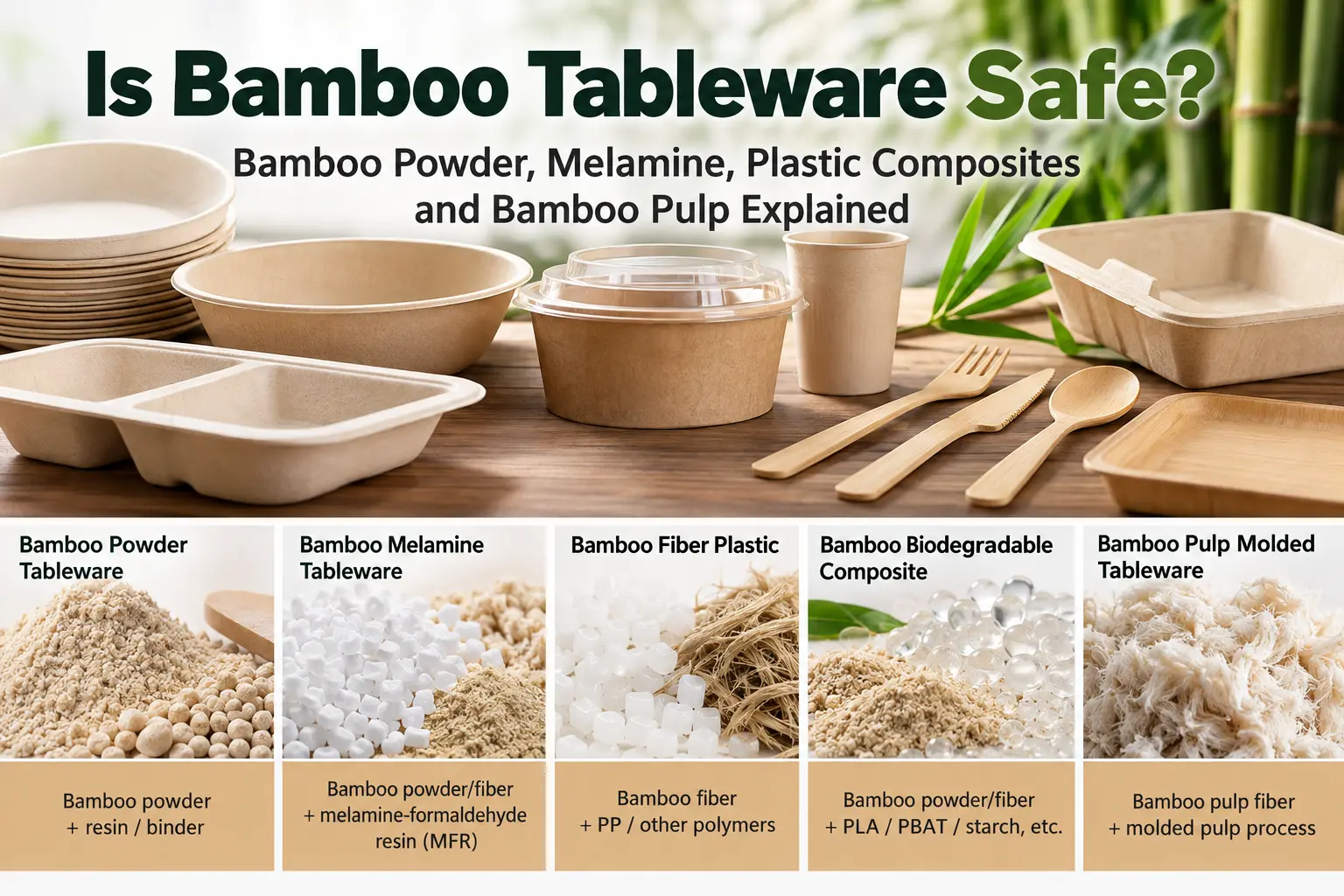
What Is Bamboo Tableware? Common Products and Material Types
Bamboo tableware is a broad commercial term for food-contact products made entirely or partly from bamboo-derived materials. It can refer to solid bamboo utensils, bamboo-pulp molded food containers, or composite products in which bamboo powder or bamboo fiber is mixed with a resin or polymer.
The term describes a product family rather than one specific material. This distinction is important because two products sold as “bamboo plates” may have completely different structures: one may be formed from bamboo pulp fibers, while another may contain bamboo powder held together by melamine-formaldehyde resin or another plastic polymer.
What Products Are Sold as Bamboo Tableware?
Bamboo-related foodservice products appear across both reusable and disposable tableware categories, including:
- Bamboo plates for meals, catering, desserts and foodservice;
- Bamboo bowls for rice, salads, snacks, soup and takeaway food;
- Bamboo cutlery, including forks, knives, spoons, sporks and tasting utensils;
- Bamboo food containers and takeaway boxes for prepared meals;
- Bamboo trays for food presentation, catering and portion packaging;
- Bamboo cups and mugs, including products marketed as reusable bamboo-fiber cups;
- Bamboo lunch boxes and compartment containers;
- Bamboo serving utensils, skewers, picks and small foodservice accessories.
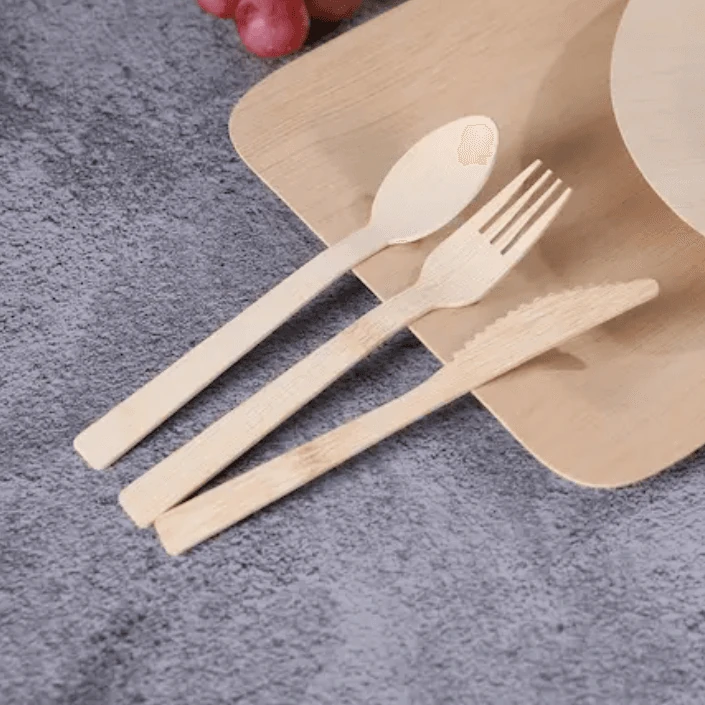
These products may look similar in online listings, but their manufacturing routes can be very different. A bamboo fork cut from a solid bamboo strip is not equivalent to a bamboo-powder spoon produced by compression molding. A molded bamboo-pulp tray is also not equivalent to a tray made from bamboo fiber dispersed in polypropylene.
Definition: “Bamboo tableware” tells a buyer what the product is marketed as, but not necessarily what the product is made from. The material structure must still be identified before food-contact safety, heat resistance, compostability or regulatory compliance can be evaluated.
“Bamboo Tableware” Can Mean Five Very Different Materials
The first sourcing mistake is treating every beige or wood-colored product containing bamboo as the same material. In practice, at least five distinct structures appear under bamboo-related commercial names.
| Market Name | Typical Material Structure | What Gives the Product Its Shape? | Typical Manufacturing Route | Main Safety Question | Buyer Interpretation |
|---|---|---|---|---|---|
| Bamboo powder tableware | Bamboo powder or ground fiber + resin or binder | A binder, polymer or resin matrix usually holds the particles together | Compression molding, hot pressing or injection molding depending on formulation | What exactly is the binder or resin, and is the complete formulation suitable for food contact? | “Bamboo powder” alone is not a complete material specification |
| Bamboo melamine tableware | Bamboo powder or fiber + melamine-formaldehyde resin (MFR) | Melamine-formaldehyde resin provides the structural plastic matrix | Usually compression molding under heat and pressure | Melamine and formaldehyde migration, particularly under hot-use conditions | A plastic food-contact material containing plant filler, not solid bamboo |
| Bamboo fiber plastic | Bamboo fiber + PP or another polymer | The plastic polymer forms the continuous matrix | Commonly injection or compression molding | Polymer identity, additives, plant-fiber authorization and migration performance | Still a plastic composite even if bamboo content is prominently advertised |
| Bamboo biodegradable composite | Bamboo powder or fiber + PLA, PBAT, starch-based or other polymer system | The polymer or biopolymer matrix provides cohesion and processability | Compounding followed by extrusion, injection molding, thermoforming or compression molding | Food-contact safety and compostability must be evaluated separately | “Biodegradable” cannot be assumed from the presence of bamboo or a bio-based polymer |
| Bamboo pulp molded tableware | Bamboo cellulose pulp fiber, sometimes blended with other plant fibers | An interlocked cellulose-fiber network forms the structural body | Pulping, slurry preparation, vacuum forming and hot pressing | Barrier treatment, processing chemicals, coatings and finished-product food-contact compliance | Fundamentally different from bamboo powder dispersed in plastic resin |
This distinction also explains why the term “plant-based” needs qualification. As discussed in Bioleader®’s guide to greenwashing in sustainable food packaging, a plant ingredient may be the main structural material, the feedstock for a polymer, or simply a filler inside another material. Those are not equivalent claims.
1. Bamboo Powder Tableware: The First Question Is “What Holds the Powder Together?”
Bamboo powder is produced by mechanically reducing bamboo into small particles or fine fibrous material. Once bamboo has been reduced to powder, it no longer behaves like intact bamboo strips or a long-fiber pulp network.
In a molded composite product, those particles normally require another material system to create cohesion, water resistance, dimensional stability and moldability. Depending on the product, this may be a thermosetting resin, thermoplastic polymer, biodegradable polymer blend, starch-based system or another proprietary binder.
Typical Production Logic
- Bamboo is dried and mechanically ground into powder or short fiber.
- The bamboo material is screened to control particle size.
- The powder is blended with a resin, polymer, binder and any necessary processing additives.
- The compound is fed into a compression mold, injection mold or other forming system.
- Heat and pressure create the final bowl, plate, cup or utensil.
The exact process varies by formulation, but the procurement principle does not: if bamboo powder is only one ingredient, the buyer needs to know the complete material system.
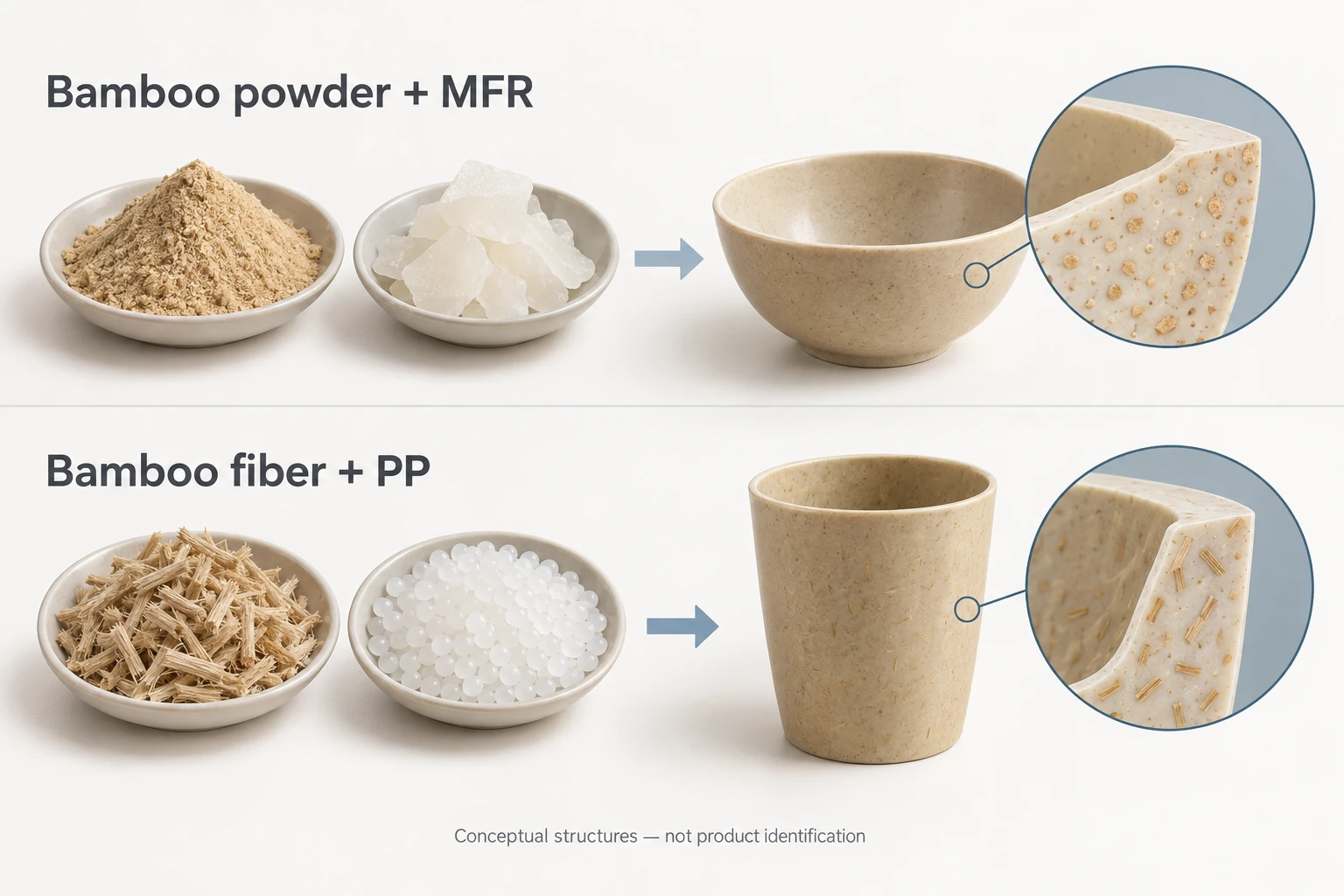
Manufacturer Insight: Bamboo Percentage Is Not Enough
A specification such as “40% bamboo fiber” or “60% natural bamboo” does not answer the most important food-contact question. If bamboo accounts for 40% of the formulation, the buyer still needs to know what forms the other 60%, which substances contact the food, what processing aids are present, and whether the finished article has been evaluated under the intended temperature and contact conditions.
This same logic appears in other plant-filled products. For example, starch-based tableware may also use polymer blends rather than pure starch. Buyers comparing such systems can review Bioleader®’s cornstarch tableware material options as an example of why formulation transparency matters more than a single plant-derived ingredient name.
2. Bamboo Melamine Tableware: Why Europe Focused on This Category
Melamine-formaldehyde resin (MFR) is a hard thermosetting plastic used in reusable plates, cups, bowls and kitchen utensils. It provides a smooth surface, rigidity, water resistance and dimensional stability. Fillers are incorporated into the resin system, and some manufacturers historically replaced conventional fillers with bamboo powder or bamboo fiber to give the product a more natural appearance.
The German Federal Institute for Risk Assessment (BfR) describes many products previously marketed as “bamboo ware” as MFR articles in which bamboo fiber or powder was used as filler. Despite the plant content, the structural material remains plastic.
Why Can the Bamboo-Filled MFR Structure Be Problematic?
BfR reports that high bamboo-filler content can reduce the physical and chemical stability of the melamine-formaldehyde structure. Under demanding conditions, particularly contact with hot food or beverages, melamine and formaldehyde can migrate from the resin system into food.
Testing cited by BfR found considerable product-to-product variation. The majority of tested articles remained within applicable migration limits, but approximately one third of the tested bamboo-containing MFR articles exceeded limits for melamine or formaldehyde release. BfR also reported a highest measured formaldehyde result of 60 times the permitted limit in the investigated bamboo-ware samples.
That evidence should not be rewritten as “all bamboo tableware releases dangerous chemicals.” The relevant finding is narrower: some bamboo-filled MFR articles have shown substantially higher migration, especially under hot-use conditions, and the material structure itself is subject to EU regulatory restrictions.
Important distinction: The European Commission’s enforcement action does not mean that a spoon carved from solid bamboo or every article made from bamboo pulp is prohibited. The EU action targeted plastic food-contact materials containing bamboo and other unauthorised plant-based additives.
The EU Bamboo-zling Enforcement Action
The European Commission and participating national authorities conducted a one-year coordinated enforcement action against plastic food-contact materials containing unauthorised bamboo powder and other plant-based additives. The coordinated action ended in April 2022, although national authorities have continued controls.
The action recorded 748 cases: 644 products found on the EU market and 104 goods rejected at the EU border. The Commission also documented one coffee-cup sample in which melamine migration was measured at 3.5 times and formaldehyde migration at 25 times the applicable maximum permitted levels.
Those numbers describe the enforcement action and a specific laboratory case; they should not be presented as universal migration rates for every bamboo product.
For the detailed EU regulatory history, import implications and enforcement background, see Bioleader®’s separate analysis of the EU crackdown on bamboo-plastic foodware. Keeping that regulatory discussion separate from this material-safety guide avoids confusing “illegal under a specific EU plastic FCM rule” with “inherently unsafe under every use condition.”
3. Bamboo Fiber Plastic: Plant Fiber Does Not Remove the Plastic Matrix
A second group of products combines bamboo fiber with polypropylene (PP) or another conventional polymer. The plant fiber can provide color, texture, stiffness, filler volume or a renewable-content claim, while the polymer provides the continuous moldable matrix.
A hypothetical formulation such as “30% bamboo fiber + 70% PP” should therefore be understood as a bamboo-filled plastic composite, not as solid bamboo.
Does Adding Bamboo Make PP Biodegradable?
No. Adding bamboo fiber does not automatically change the biodegradation behavior of the PP matrix. The plant fraction may degrade differently from the polymer, but that does not establish that the complete finished article is biodegradable or compostable.
The same principle applies to claims such as:
- plant-based;
- natural fiber;
- eco composite;
- renewable content;
- reduced plastic;
- biodegradable.
Each describes a different property. A product may contain renewable material while still being predominantly plastic. It may reduce virgin polymer content without being compostable. The finished material structure must support the specific environmental claim being made.
For food-contact applications, buyers should verify the identity of the polymer, plant-fiber content, additives, permitted use conditions and migration evidence for the actual finished article rather than relying on the visible bamboo particles.
4. Bamboo Biodegradable Composites: Food Safety and Compostability Are Two Separate Tests
Some products combine bamboo powder or short bamboo fiber with PLA, PBAT, thermoplastic starch or another biodegradable or bio-based polymer system. These structures are materially different from bamboo-filled melamine or PP, but they still require careful specification.
A material description such as:
bamboo fiber + PLA + PBAT + starch
does not, by itself, establish two things that buyers frequently assume:
- that the article complies with applicable food-contact requirements; or
- that the finished article is certified compostable.
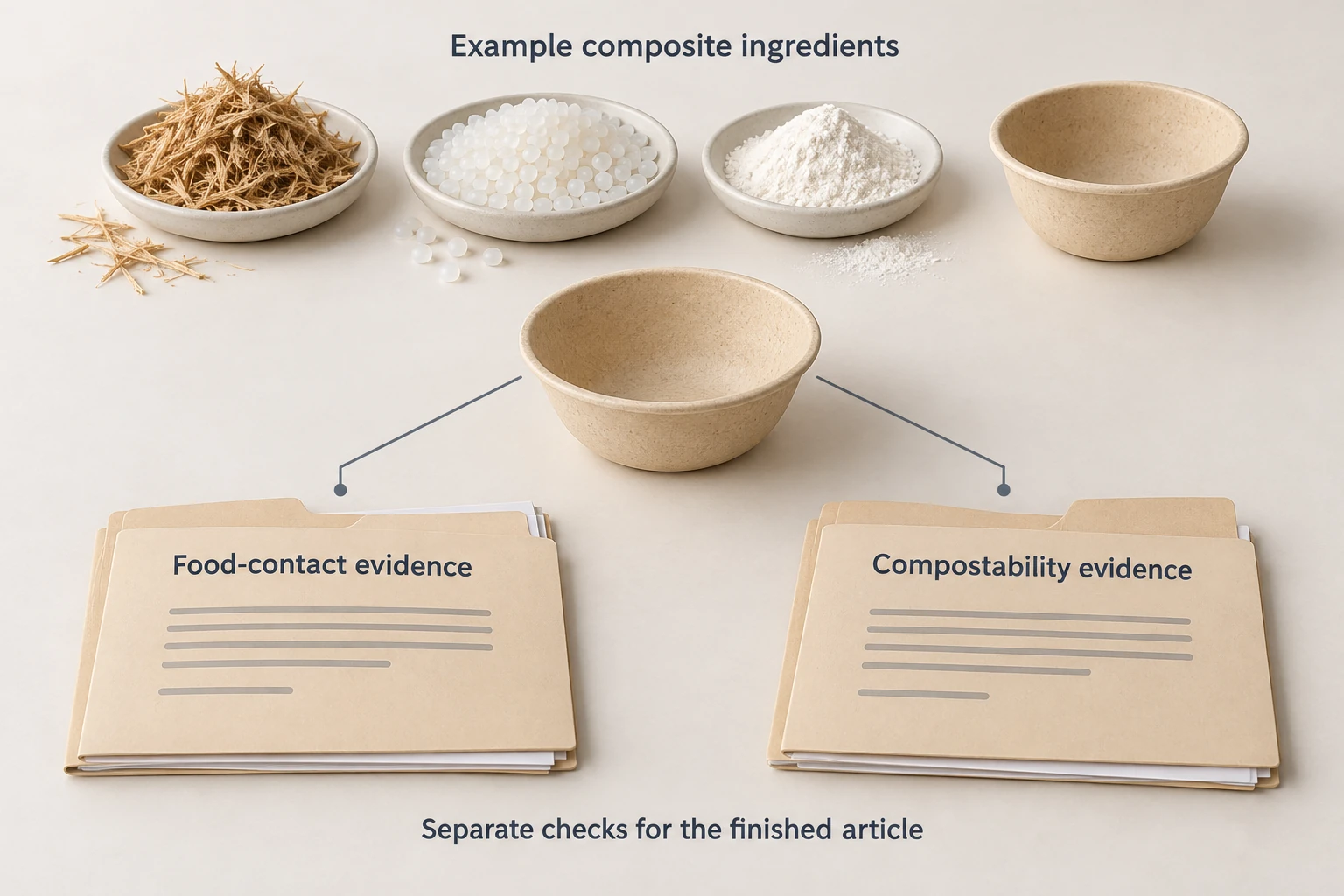
Why the Two Questions Must Be Separated
Food-contact compliance deals with whether the complete material and its constituents are suitable for contact with food under defined conditions.
Compostability deals with the behavior of the finished material or product under specified composting conditions, including criteria such as biodegradation, disintegration and other requirements defined by the applicable standard or certification scheme.
Using PLA or PBAT somewhere in a formulation does not automatically make the finished tableware compliant with EN 13432, ASTM D6400 or a particular certification program. Pigments, fillers, additives, product thickness and the complete formulation can all affect the finished article.
This is why Bioleader® separates material identity from certification scope in products such as CPLA compostable cutlery: CPLA is still a bioplastic, while compostability and food-contact claims need to match the relevant SKU and destination market.
Buyer rule: “Contains biodegradable material” and “the finished product is certified compostable” are not equivalent statements. Likewise, compostability certification does not replace food-contact documentation.
5. Bamboo Pulp Molded Tableware Is a Different Technology
Bamboo-pulp molded tableware should not be confused with bamboo powder mixed into resin.
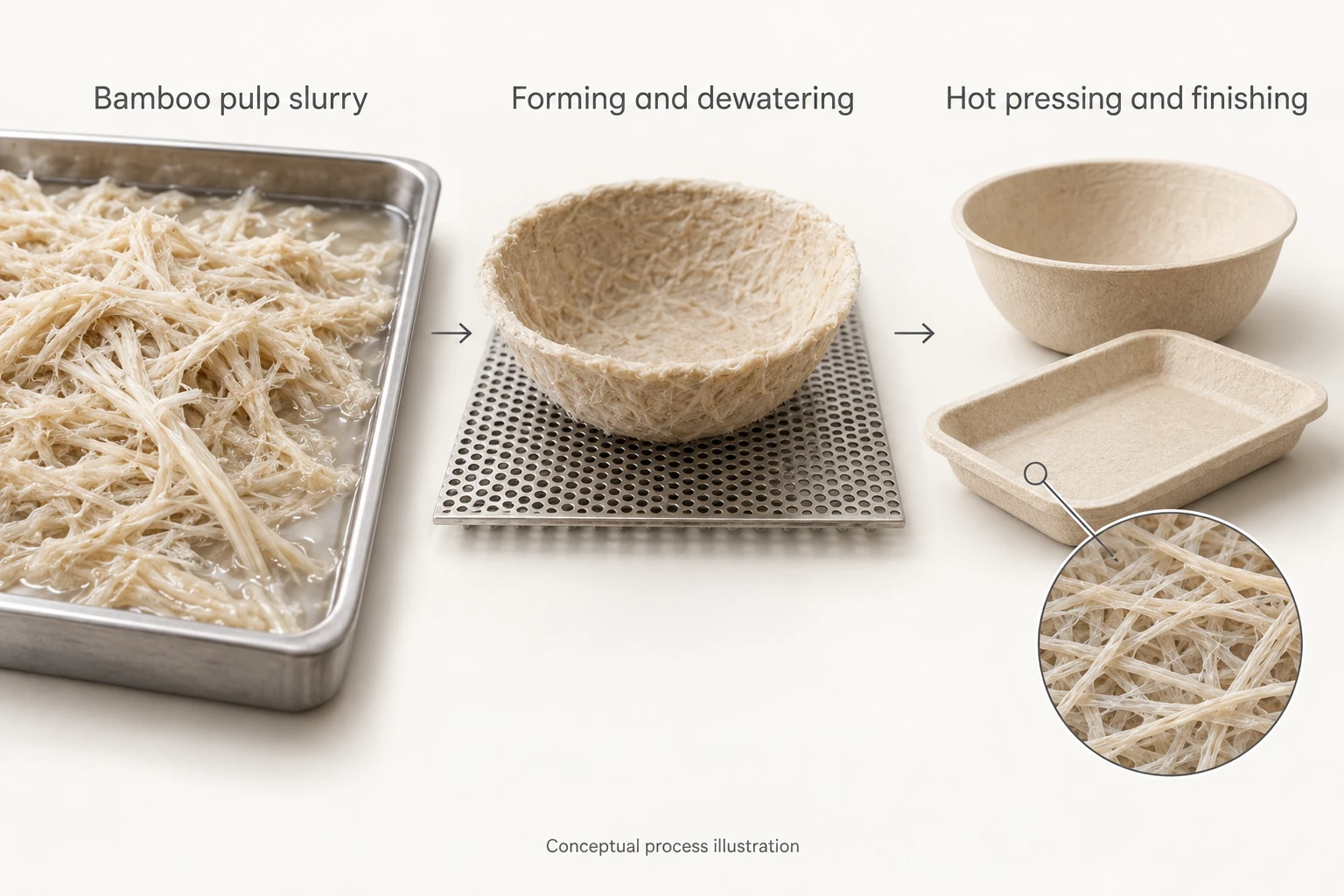
The manufacturing route is closer to molded fiber packaging:
- Bamboo is processed to separate cellulose fibers.
- The fibers are dispersed into a pulp slurry.
- A forming mold draws fibers from the slurry onto a shaped screen.
- The wet fiber preform is dewatered.
- Heat and pressure consolidate the fibers into the final plate, bowl, tray or container.
- Trimming, inspection and packing follow according to the product design.
The structural body is created primarily by an interlocked cellulose-fiber network. A large synthetic-resin matrix is not required simply to hold loose bamboo powder together.
Does That Mean Bamboo Pulp Is Automatically Chemical-Free?
No. Molded fiber manufacturing can still involve functional chemistry. Depending on the formulation and intended performance, manufacturers may use wet-strength systems, oil- or water-resistance treatments, retention aids, processing aids, pigments, surface coatings or other functional additives.
The right question therefore changes from:
“What plastic resin is holding the bamboo powder together?”
to:
“What fiber formulation, barrier system and process additives are used, and what evidence applies to the finished food-contact article?”
This manufacturing logic is similar to other molded-fiber systems. Bioleader®’s sugarcane bagasse tableware, for example, is produced through pulp-molding technology rather than by suspending bagasse powder in a plastic matrix. Buyers comparing bamboo pulp and bagasse can also refer to the existing Bamboo vs. Sugarcane Bagasse Tableware guide for the broader material-selection question.
Material Structure Matters More Than the Word “Bamboo”
| Question | Solid Bamboo | Bamboo Powder + MFR | Bamboo Fiber + PP | Bamboo Biopolymer Composite | Bamboo Pulp Molded Fiber |
|---|---|---|---|---|---|
| Is bamboo the primary visible feedstock? | Yes | Bamboo may be a substantial filler, but the resin forms the matrix | Bamboo is a filler or reinforcing fiber within plastic | Bamboo is one component within a polymer blend | Bamboo cellulose fiber forms the main structural network |
| Is the product a plastic composite? | No, if genuinely solid untreated bamboo | Yes | Yes | Usually a polymer composite, although the polymer may be bio-based or biodegradable | Not inherently; verify coatings, laminations and other components |
| Can “plastic-free” be assumed? | Only after checking finishes or coatings | No | No | No | Only after verifying the complete finished structure |
| Can “compostable” be assumed? | No | No | No | No; finished-product evidence is required | No; formulation and applicable evidence still matter |
| Main buyer question | Surface treatment and intended food use | MFR composition, EU legality and migration | Polymer identity and migration | Full formulation plus food-contact and compostability evidence | Fiber composition, barrier chemistry and finished-product documentation |
Does China’s “Bamboo Instead of Plastic” Policy Mean Bamboo Powder Tableware Is Safe?
No. China’s “Bamboo as a Substitute for Plastic” policy is an industrial and environmental strategy; it is not a blanket food-safety approval for every product containing bamboo powder.
China’s National Development and Reform Commission and other authorities issued the three-year action plan for accelerating “Bamboo as a Substitute for Plastic” in 2023. The policy supports the development of bamboo resources, processing technology, product manufacturing, market applications, standards and certification as part of plastic-pollution reduction.
That policy direction should not be interpreted as:
bamboo ingredient → automatically safe → automatically plastic-free → automatically biodegradable.
China maintains separate mandatory food-safety standards for food-contact materials. The national food-safety standard system includes, among others:
- GB 4806.7-2023 for plastic materials and articles intended to contact food;
- GB 4806.8-2022 for paper and paperboard food-contact materials and articles;
- GB 4806.12-2022 for bamboo and wood food-contact materials and articles;
- GB 4806.13-2023 for composite food-contact materials and articles.
Which standard applies depends on the actual structure and classification of the finished article. A plastic article containing bamboo filler should not be treated as equivalent to a piece of solid bamboo simply because both contain material from the same plant.
China Has Also Identified Plant-Fiber Misuse in Melamine Tableware
China’s State Administration for Market Regulation reported the results of its 2025 national supervision sampling of food-contact products in 2026. Among 53 batches of melamine plastic tableware tested, authorities identified one batch in which plant fiber had been illegally added to the material, making the product non-compliant with the applicable national food-safety standard.
This is an important regulatory signal: natural plant origin does not exempt an additive or filler from food-contact requirements.
Policy and safety should not be confused. Encouraging bamboo to replace selected plastic applications can support material innovation, but every food-contact product still needs to be evaluated according to its real material structure, intended use and applicable regulatory framework.
EU and China: Different Rules, Same Procurement Lesson
| Issue | European Union | China | Buyer Implication |
|---|---|---|---|
| Plastic food-contact materials | Regulation (EU) No 10/2011 controls substances used in plastic food-contact materials and sets migration requirements | GB 4806.7-2023 covers food-contact plastic materials and articles | Identify the actual polymer system before reviewing compliance |
| Bamboo in plastic FCM | Bamboo and other ground plant additives targeted by the EU Bamboo-zling action are not authorised as fillers under the Union list applicable to plastic FCMs | Plant origin does not remove the need to comply with applicable food-contact requirements; regulators have identified non-compliant melamine products with illegally added plant fiber | Do not approve a product from a “bamboo” marketing description alone |
| Solid bamboo / bamboo-based non-plastic materials | Must comply with the general food-contact safety framework applicable to the finished material | Relevant national standards include GB 4806.12-2022 for bamboo and wood food-contact materials | Natural origin still requires appropriate material and product control |
| Composite structures | Assess according to actual layers, polymers, additives and the applicable EU food-contact framework | GB 4806.13-2023 addresses food-contact composite materials and articles | Review the complete finished structure, not only the dominant marketing material |
Is Bamboo Tableware Safe for Hot Food?
There is no single temperature answer for “bamboo tableware” because the term covers different materials.
A solid bamboo utensil, an MFR coffee cup containing bamboo powder, a PP-bamboo plate and a molded bamboo-pulp bowl behave differently when exposed to hot soup, oil, acidic sauces or repeated washing.
| Material Type | Hot-Food Judgment | What Must Be Verified? |
|---|---|---|
| Solid bamboo | Suitability depends on surface treatment, construction and intended food-contact conditions | Coatings, adhesives, treatment chemicals, food type, temperature and contact time |
| Bamboo + melamine-formaldehyde resin | BfR recommends that MFR tableware should not be used with hot foods and should not be used to heat food in a microwave | Material declaration, intended-use restrictions and migration compliance |
| Bamboo fiber + PP | Do not infer performance from bamboo content; temperature capability comes mainly from the complete polymer composite | Polymer grade, formulation, finished-product heat conditions and migration evidence |
| Bamboo biodegradable composite | Depends strongly on the biopolymer formulation and finished-product design | Service-temperature specification, migration testing and exact formulation |
| Bamboo pulp molded fiber | Potentially suitable for hot food when designed and tested for that application | Barrier system, product thickness, oil/water exposure, holding time and food-contact documentation |
For buyers who specifically need hot takeaway containers, molded-fiber structures can be evaluated through the same practical framework used for sugarcane bagasse food containers: actual food temperature, oil content, sauce exposure, holding time, transport pressure and lid compatibility matter more than an isolated “heat-resistant” label.
How Can Buyers Tell What a “Bamboo” Product Is Actually Made From?
Appearance can give clues, but it is not reliable enough for commercial approval.
Solid bamboo normally preserves visible grain and natural plant structure. Bamboo-pulp molded fiber tends to have a fibrous, paper-like molded surface. Bamboo-filled MFR or plastic composites can feel smoother, denser and more plastic-like.
However, pigments, surface finishing, molding technology and coatings can make visual identification difficult. Commercial buyers should rely on documentation rather than touch or color.
Buyer Checklist: 10 Questions to Ask Before Ordering Bamboo Tableware
- What is the complete material composition? Ask for more than “bamboo fiber” or “plant-based material.”
- Is bamboo the structural material or only a filler?
- What resin, polymer or binder is used? Ask specifically about melamine-formaldehyde resin, PP, PE, PLA, PBAT, starch blends or proprietary binders.
- What percentage of the finished article is polymer or resin?
- Which additives, pigments, coatings or barrier treatments are present?
- What food types and temperatures is the product designed for?
- Does the food-contact documentation apply to this exact material structure and SKU?
- If the product is sold as compostable, what standard or certification applies to the finished article?
- Is the environmental claim about renewable content, reduced plastic, biodegradability or certified compostability? These claims are not interchangeable.
- Is the product legally marketable in the destination country? A formulation accepted in one market may face different requirements in another.
What Documents Should an Importer Request?
For commercial sourcing, the documentation package should match the material and destination market. A generic factory certificate does not establish that every bamboo-containing SKU is compliant.
Depending on the product and market, buyers may need:
- material composition or technical data sheet;
- food-contact test reports applicable to the relevant formulation;
- migration testing where required;
- Declaration of Compliance where applicable;
- intended-use temperature and contact-time conditions;
- information on coatings, binders and additives;
- compostability certification if the finished product is marketed as compostable;
- PFAS-related documentation where molded fiber barrier chemistry is relevant;
- SKU-level documentation linking the tested material to the supplied product.
Bioleader® maintains a public certificate and test-report resource covering its principal food-packaging material categories. The same sourcing principle applies regardless of supplier: documents should be matched to the material, finished SKU and destination market rather than treated as a general company-level approval.
How Should a Buyer Evaluate a Sample?
Sample Evaluation Should Reproduce the Actual Use Condition
A product described as “bamboo,” “natural” or “heat resistant” should not be approved from appearance alone. For foodservice procurement, sample evaluation should reproduce the conditions the package will actually face.
- Use the real food or a technically relevant food simulant.
- Record the initial serving temperature.
- Test the actual holding time expected during takeaway or delivery.
- Include oil, sauce, acidity or moisture if these occur in the application.
- Check deformation, cracking, odor, staining, leakage and surface deterioration.
- Test the lid or accessory together with the base rather than evaluating components separately.
- Do not microwave, oven-heat or dishwasher-test a product unless those use conditions are explicitly supported.
- Verify that the documentation supplied with the sample matches the material that will be mass-produced.
For buyers comparing several supposedly biodegradable bowl materials, Bioleader®’s guide to what biodegradable bowls are made of provides a broader comparison across bagasse, PLA, cornstarch-based materials, bamboo and other emerging feedstocks.
What Are Safer Material-Selection Alternatives for Disposable Foodservice?
The answer is not to reject bamboo as a raw material. It is to avoid making procurement decisions from an ambiguous material name.
For disposable foodservice, buyers can choose a material system whose structure and documentation are easier to define for the intended application.
Material Selection by Application
For molded hot-food containers: pulp-molded fiber such as sugarcane bagasse tableware provides a clearly identifiable fiber-based structure. Buyers should still verify barrier chemistry, PFAS status, temperature, holding time and relevant food-contact documentation.
For compostable cutlery programs: compostable cutlery based on CPLA or other defined formulations allows the polymer system and compostability evidence to be specified more directly than an undefined “bamboo composite” description.
For plant-filled molded plastics: request full formulation transparency. Do not approve a product solely because the supplier states a high percentage of bamboo, starch, rice husk or another natural ingredient.
The Practical Difference Between “Bamboo-Based” and “Bamboo-Looking”
The most useful distinction is not whether bamboo appears somewhere in the bill of materials. It is what creates the functional structure of the article.
If cellulose fibers themselves form the body, as in bamboo-pulp molded fiber, the material behaves as a fiber structure. If a polymer surrounds bamboo powder and creates the continuous matrix, it behaves as a polymer composite. If melamine-formaldehyde resin provides the hard body, it is an MFR plastic product even if the bamboo filler is visible and the packaging emphasizes natural ingredients.
This distinction also changes the environmental claim. A manufacturer can legitimately state a verified bamboo or renewable-fiber content without automatically claiming that the complete article is plastic-free, biodegradable or compostable.
Bioleader® Manufacturer View
For packaging procurement, material names should be translated into engineering specifications before price comparison begins. “Bamboo,” “plant fiber,” “bio-based,” “biodegradable” and “compostable” describe different aspects of a product. The specification should identify the structural material, binder or polymer, functional additives, intended food temperature, holding time, end-of-life claim and the documentation that applies to the finished SKU.
Final Buyer Judgment
Is bamboo tableware safe? It can be, but there is no responsible yes-or-no answer without identifying the material structure.
A solid bamboo fork, bamboo-pulp molded bowl, bamboo-filled PP plate, bamboo/PLA composite and bamboo-melamine cup are different food-contact materials. Their safety, legality, heat performance and environmental claims should be evaluated separately.
The highest-risk purchasing mistake is accepting “bamboo” as though it were the complete specification. Ask what holds the product together. Ask whether bamboo is the structural material or a filler. Ask what polymer, binder, barrier treatment and additives are present. Then match the finished SKU to the intended food, temperature, market and supporting documentation.
For disposable food packaging, Bioleader® supports buyers comparing clearly defined molded-fiber, bagasse, paper, cornstarch-based and compostable polymer systems according to actual foodservice conditions rather than relying on a generic “eco-friendly” material label.
Frequently Asked Questions About Bamboo Tableware Safety
Is bamboo tableware safe for food?
Bamboo tableware can be suitable for food contact, but safety depends on the finished material rather than bamboo alone. Solid bamboo, bamboo pulp, bamboo-filled plastic and bamboo-melamine products have different structures. Buyers should identify the binder or polymer, coatings, additives, intended temperature and the food-contact documentation applicable to the exact product.
Is bamboo melamine tableware safe for hot food?
Bamboo-filled melamine-formaldehyde tableware is a particular concern for hot-food applications. Germany’s BfR reports that heat can increase the release of melamine and formaldehyde from MFR and recommends that MFR tableware should not be used with hot food or for microwave heating. In the EU, bamboo is also not authorised as a filler in plastic food-contact materials under Regulation (EU) No 10/2011.
Is bamboo powder tableware biodegradable?
Not necessarily. Bamboo powder may be only the filler inside a resin or polymer matrix. If the matrix is a non-biodegradable plastic such as PP or melamine-formaldehyde resin, adding bamboo powder does not automatically make the finished product biodegradable. If a biodegradable polymer system is used, the compostability of the complete finished article should still be verified separately.
Is bamboo pulp tableware the same as bamboo fiber plastic?
No. Bamboo-pulp molded tableware forms its structural body from a network of cellulose fibers produced through pulping, slurry forming and hot pressing. Bamboo-fiber plastic uses bamboo fiber as a component inside a polymer matrix. Both may contain bamboo, but their manufacturing processes, food-contact considerations and end-of-life characteristics are different.
How can I tell whether bamboo tableware contains plastic?
Appearance alone is not reliable. A very smooth, dense molded surface can indicate a polymer composite, while molded pulp often has a more fibrous texture, but finishes can hide these differences. Commercial buyers should request a material declaration or technical data sheet showing bamboo content, polymer or resin type, additives and the composition of the complete finished article.
Does China’s “Bamboo as a Substitute for Plastic” policy mean bamboo powder tableware is approved for food contact?
No. China’s “Bamboo as a Substitute for Plastic” initiative promotes bamboo-product development and plastic substitution, but food-contact products must still comply with the applicable national food-safety standards. China maintains separate standards for plastics, bamboo and wood, paper and paperboard, and composite food-contact materials. The actual finished structure determines the relevant compliance pathway.
What should importers request before buying bamboo tableware?
Importers should request the full material composition, polymer or binder identity, coatings and additives, intended food-contact conditions, applicable migration or food-contact reports, and documentation linked to the specific SKU. If the product is marketed as biodegradable or compostable, buyers should also request evidence covering the finished article rather than relying on renewable-content or bamboo-percentage claims.
References
- European Commission. Bamboo-zling: EU Enforcement Action on Plastic Food Contact Materials Made of Bamboo Powder.
- European Union. Commission Regulation (EU) No 10/2011 on Plastic Materials and Articles Intended to Come into Contact with Food.
- German Federal Institute for Risk Assessment (BfR). Questions and Answers on Tableware and Kitchen Utensils Made from Melamine-Formaldehyde Resin, updated July 17, 2026.
- State Administration for Market Regulation of China. 2025 National Supervision Sampling Results for Food-Contact Paper Containers and Other Food-Related Products.
- National Health Commission of China. National Food Safety Standards Catalogue, including GB 4806.7-2023, GB 4806.8-2022, GB 4806.12-2022 and GB 4806.13-2023.
- National Development and Reform Commission of China. Three-Year Action Plan to Accelerate “Bamboo as a Substitute for Plastic”, 2023.