









For sushi restaurants, supermarket counters, delivery kitchens and foodservice distributors, the right packaging decision normally depends on five factors: tray size, lid height, material structure, service environment and end-of-life requirements.
This guide explains how to choose kraft paper sushi trays, how to compare different tray sizes, how kraft paper performs against plastic and sugarcane bagasse, and which packaging checks buyers should complete before placing a wholesale order.
Quick Summary
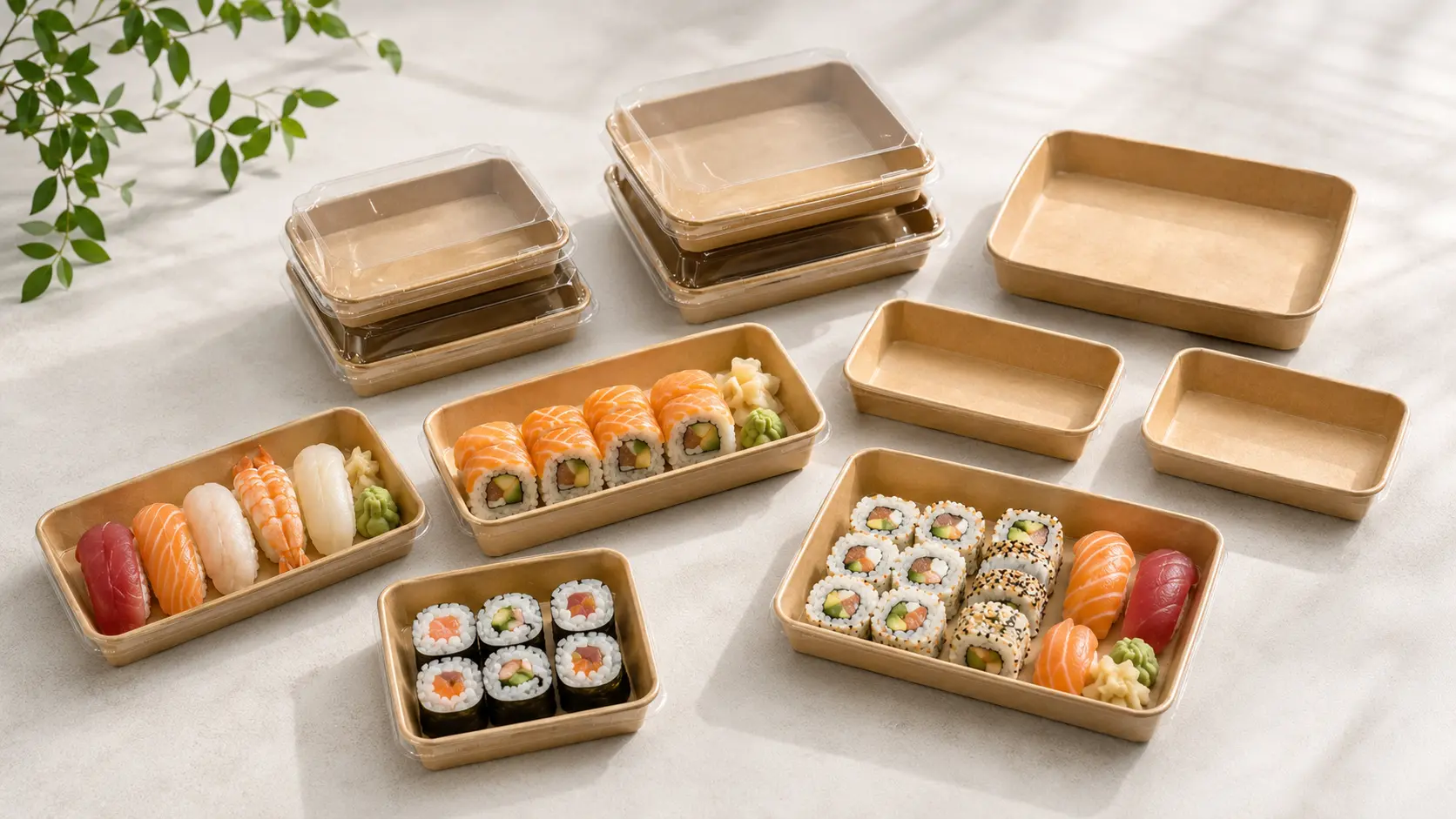
Kraft paper sushi trays are shallow paper-based food containers designed for sushi, sashimi, rolls, deli food and chilled takeaway meals. They are commonly paired with transparent PET dome lids to improve product visibility and handling protection.
Kraft trays are particularly suitable when buyers need a natural paper appearance, clear-lid presentation and custom branding. Plastic trays generally provide stronger moisture resistance, while sugarcane bagasse trays are more suitable for buyers prioritizing molded fiber construction and compostability-oriented packaging.
The final choice should be based on the actual sushi dimensions, tray usable area, lid clearance, refrigeration period, delivery route, coating structure and local waste-management system.
Core buying principle: The best sushi tray is not automatically the smallest, cheapest or most sustainable-looking option. It is the packaging system that correctly matches the food layout, storage conditions, delivery process and target-market requirements.
What Is a Kraft Paper Sushi Tray?
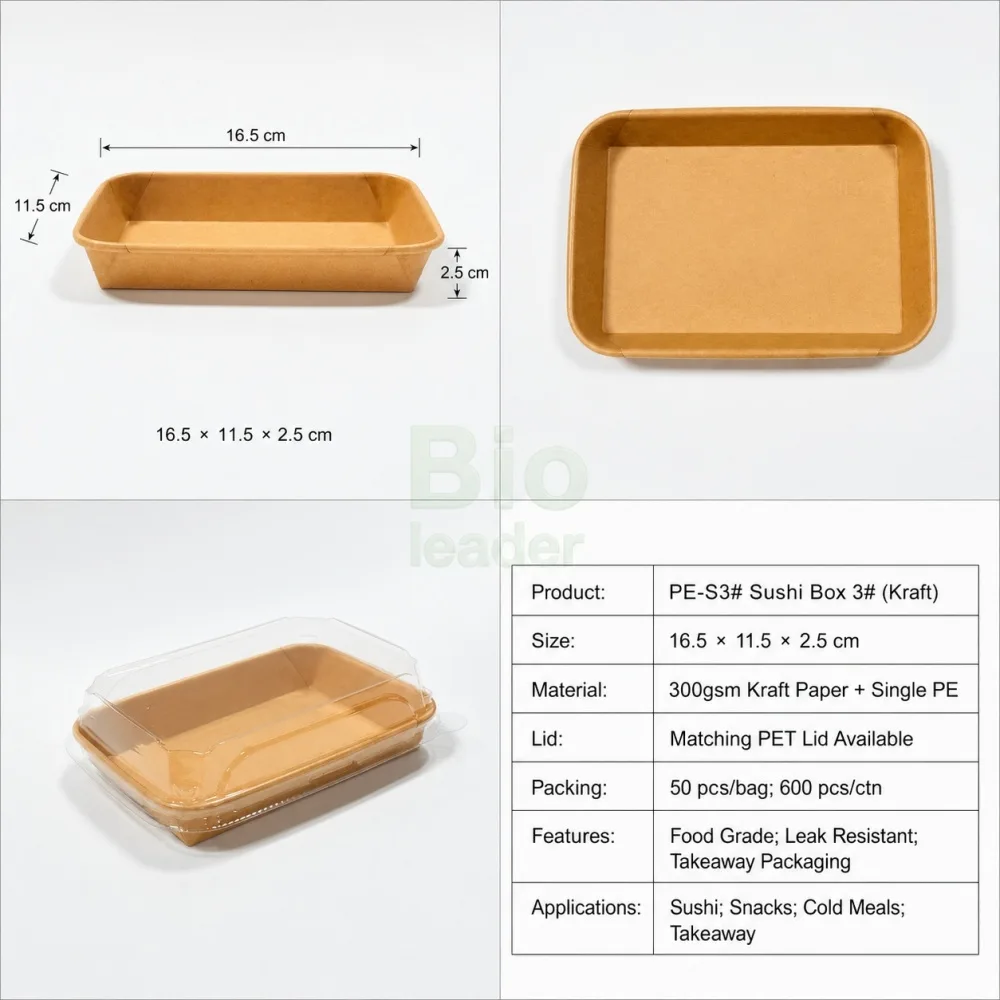
A kraft paper sushi tray is a shallow formed-paper container used to hold sushi rolls, nigiri, sashimi, appetizers, deli portions and other chilled takeaway foods. Its low-profile structure keeps the food visible, reduces unnecessary empty space and supports an organized presentation under a transparent lid.
Unlike a deep paper food box, a sushi tray is designed primarily for horizontal food arrangement. The tray must provide a flat loading area, adequate edge strength and a reliable rim that connects correctly with the matching lid.
Commercial kraft sushi trays normally use a food-contact barrier coating to improve resistance to moisture and oil. The standard Bioleader® kraft sushi tray structure uses kraft paperboard with a single PE coating and a matching clear PET dome lid. Buyers should therefore evaluate the tray and lid as one complete packaging system rather than treating them as separate components.
Why Are Clear PET Dome Lids Commonly Used?
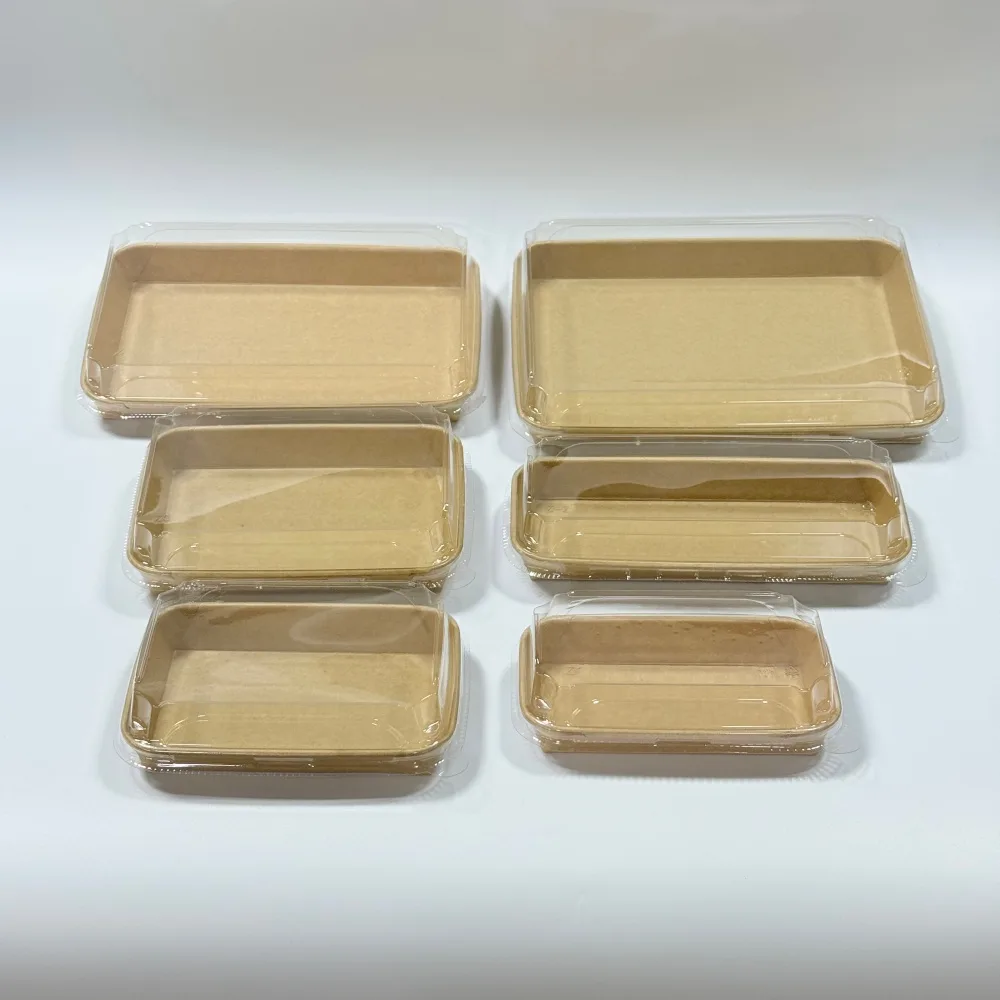
Sushi is a presentation-sensitive food. Customers frequently judge freshness, portion value and arrangement quality before opening the package. A clear PET dome lid allows the food to remain visible while helping protect toppings, garnishes and individual pieces during handling.
The raised lid also creates clearance above the tray surface. This is important for nigiri, gunkan sushi, decorated rolls and other items that may be damaged by a flat or excessively low lid.
However, the PET lid is intended primarily for chilled display and takeaway applications. Buyers should not assume that the complete tray-and-lid system is suitable for microwave heating. Any heating requirement must be reviewed according to the exact tray coating, lid material and food-contact specification.
Kraft Paper Sushi Tray Size Guide
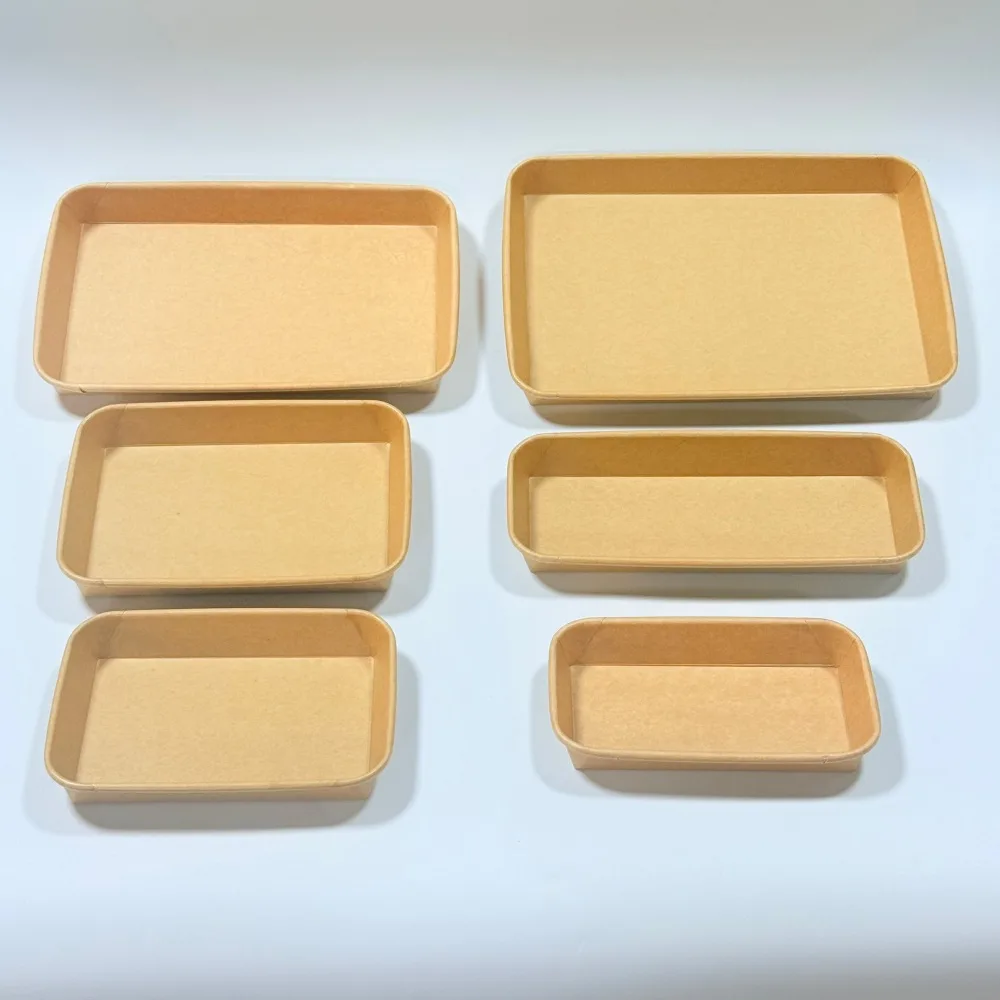
Sushi tray selection should begin with the internal usable area rather than the external product name. References such as “small,” “medium,” “large,” or “tray number 5” are useful for catalog management, but they do not confirm how many pieces of sushi will fit.
The actual capacity depends on the width, length and height of the food, as well as the spacing required between individual pieces. Two restaurants may use the same tray for completely different quantities because their sushi dimensions and presentation styles are different.
Why Piece Count Alone Is Not a Reliable Selection Method
A tray described as suitable for eight pieces may hold eight compact maki rolls but fail to accommodate eight large uramaki rolls. Similarly, a tray that fits a row of nigiri may not provide enough width for sashimi, garnishes, pickled ginger and a sauce container.
Professional buyers should consider the following factors before choosing a size:
- The diameter and height of maki, uramaki or futomaki rolls.
- The length and width of nigiri pieces.
- The arrangement of sashimi, garnishes and decorative leaves.
- The space required for ginger, wasabi or a separate sauce cup.
- The clearance between the food and the inside of the dome lid.
- The distance required between individual pieces to prevent sticking.
- The orientation of the tray inside takeaway bags and delivery cartons.
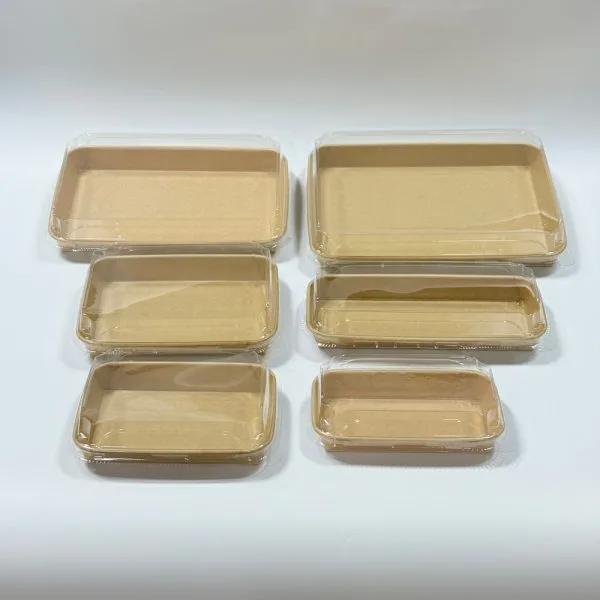
Available Kraft Sushi Tray Formats
| Tray Format | External Dimensions | Recommended Positioning | Typical Food Applications |
|---|---|---|---|
| Sushi Tray 0# | 14 × 8 × 2.5 cm | Compact individual portion | Small roll selections, tasting portions, snacks or side items. |
| Sushi Tray 1# | 16 × 9 × 2.5 cm | Narrow single-serving format | Maki rolls, compact sushi sets and individual takeaway portions. |
| Sushi Tray 2# | 22 × 9 × 2.5 cm | Long and narrow presentation | Linear roll arrangements, sashimi rows and elongated food layouts. |
| Sushi Tray 3# | 16.5 × 11.5 × 2.5 cm | Small mixed-set format | Nigiri and roll combinations, compact lunch sets and deli portions. |
| Sushi Tray 5# | 18.5 × 13 × 2.5 cm | Regular takeaway format | Standard mixed sushi sets, supermarket packs and grab-and-go meals. |
| Sushi Tray 7# | 22 × 13.7 × 2.5 cm | Large combination format | Multiple sushi types, larger lunch sets and premium retail portions. |
| Sushi Tray 9# | 24 × 15 × 2.5 cm | Sharing and catering format | Family portions, sharing sets, catering orders and premium combinations. |
| Sushi Tray 11# | 25.5 × 18.2 × 2.5 cm | Large platter format | Party trays, event catering, supermarket platters and group servings. |
Capacity note: The suggested applications above are general positioning references rather than guaranteed piece capacities. Buyers should confirm the internal usable area with their actual sushi dimensions, spacing requirements, garnish layout and lid height.
How to Confirm the Correct Size Before Bulk Ordering
The most reliable method is to prepare the actual food arrangement and test it inside a physical sample. Buyers should check whether the tray provides sufficient space without allowing excessive movement.
The selected tray should also leave enough room for staff to load the sushi quickly. A tray that is technically large enough may still be inefficient if employees must reposition every piece to close the lid correctly.
Buyers comparing available dimensions, paper specifications and matching lid options can review Bioleader®’s kraft paper sushi trays with clear PET lids for restaurant takeaway, supermarket display, catering and foodservice distribution.
Kraft Paper vs Plastic vs Bagasse Sushi Trays
No single sushi tray material is ideal for every operation. Kraft paper, plastic and sugarcane bagasse each provide different advantages in food presentation, moisture resistance, branding, storage and waste-management positioning.
A responsible comparison should evaluate the complete packaging configuration, including the tray body, barrier coating, lid material and available disposal infrastructure.
| Selection Factor | Kraft Paper Tray | Plastic Tray | Sugarcane Bagasse Tray |
|---|---|---|---|
| Food visibility | High when paired with a transparent PET lid. | High when the tray or lid is transparent. | Depends on the lid design and selected configuration. |
| Natural presentation | Strong kraft-paper appearance suitable for modern food branding. | Clean and conventional but less fiber-oriented in appearance. | Strong molded-fiber appearance with a natural texture. |
| Moisture resistance | Depends on the paper weight, barrier coating and exposure time. | Generally strong for chilled and high-moisture foods. | Suitable for many food applications but must be tested for the exact menu. |
| Custom printing | Well suited to logos, brand graphics, QR codes and printed information. | Printing options depend on the resin, surface and production process. | Direct surface printing is usually more limited than on paperboard. |
| Cold display | Suitable when the coating and lid fit are correctly matched. | Commonly used for extended chilled display. | Requires confirmation of condensation resistance and lid compatibility. |
| Microwave suitability | Depends on the coating and lid; the PET lid should not be treated as microwave-safe. | Depends on whether the plastic is PET, PP or another resin. | Many bagasse trays can support reheating after removing an incompatible lid, subject to specification. |
| Compostability potential | Depends on the coating and complete material configuration. | Conventional plastic trays are generally not compostable. | Often more suitable for certified compostable packaging programs. |
| Recycling potential | Depends on the coating, food contamination and local paper-recycling system. | Depends on the resin identification, cleanliness and local collection system. | Generally not processed through conventional paper-recycling streams. |
| Typical purchasing priority | Brand presentation, printability and paper-based appearance. | Moisture resistance, dimensional consistency and visibility. | Molded fiber structure and compostability-oriented positioning. |
When Is Kraft Paper the Better Choice?
Kraft paper sushi trays are particularly suitable for restaurants and retailers that want to combine a natural paper appearance with transparent product display. The flat paperboard surface also offers more branding flexibility than many molded-fiber trays.
Kraft trays are commonly considered for:
- Sushi restaurant takeaway and click-and-collect orders.
- Supermarket sushi counters and chilled grab-and-go displays.
- Premium food brands using natural or minimal packaging design.
- Custom printed packaging programs with multiple tray sizes.
- Catering businesses that require clear presentation and efficient stacking.
- Foodservice distributors building a coordinated sushi packaging range.
A kraft tray can reduce the amount of rigid plastic used in the tray base, but this does not automatically make the complete package plastic-free, recyclable or compostable. The coating and transparent lid must always be included in the environmental assessment.
When May a Plastic Sushi Tray Be More Practical?
Plastic trays may remain practical for applications involving extended refrigeration, high surface moisture, automated sealing or strict dimensional requirements. A fully plastic construction can provide strong moisture resistance and consistent forming accuracy.
Plastic may also be preferred when the tray itself must be transparent or when the retailer uses an established plastic-packaging collection system. The correct resin must still be selected according to temperature, food-contact and disposal requirements.
PET and PP should not be treated as interchangeable materials. PET is commonly used for clear chilled-food packaging, while PP is generally more appropriate for heat-resistant and microwave-oriented applications. Buyers should confirm the resin rather than relying only on the word “plastic.”
When Are Sugarcane Bagasse Trays Worth Considering?
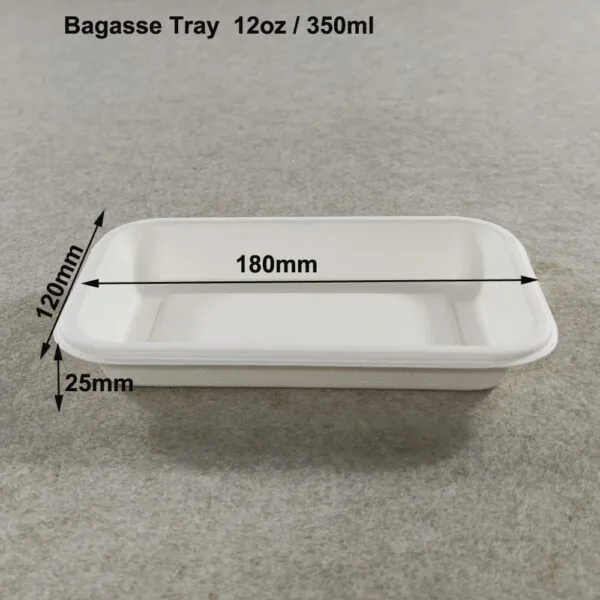
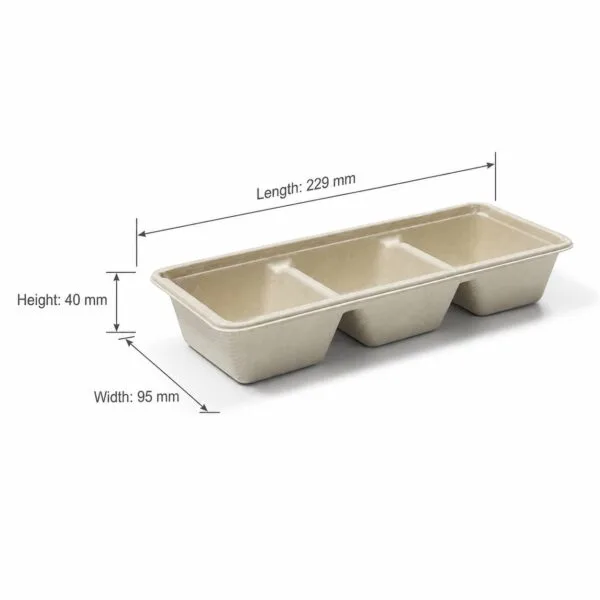
Sugarcane bagasse trays are molded-fiber products made from plant-based pulp. They are suitable for foodservice programs that prioritize fiber construction, rigid molded shapes and compostability-oriented packaging.
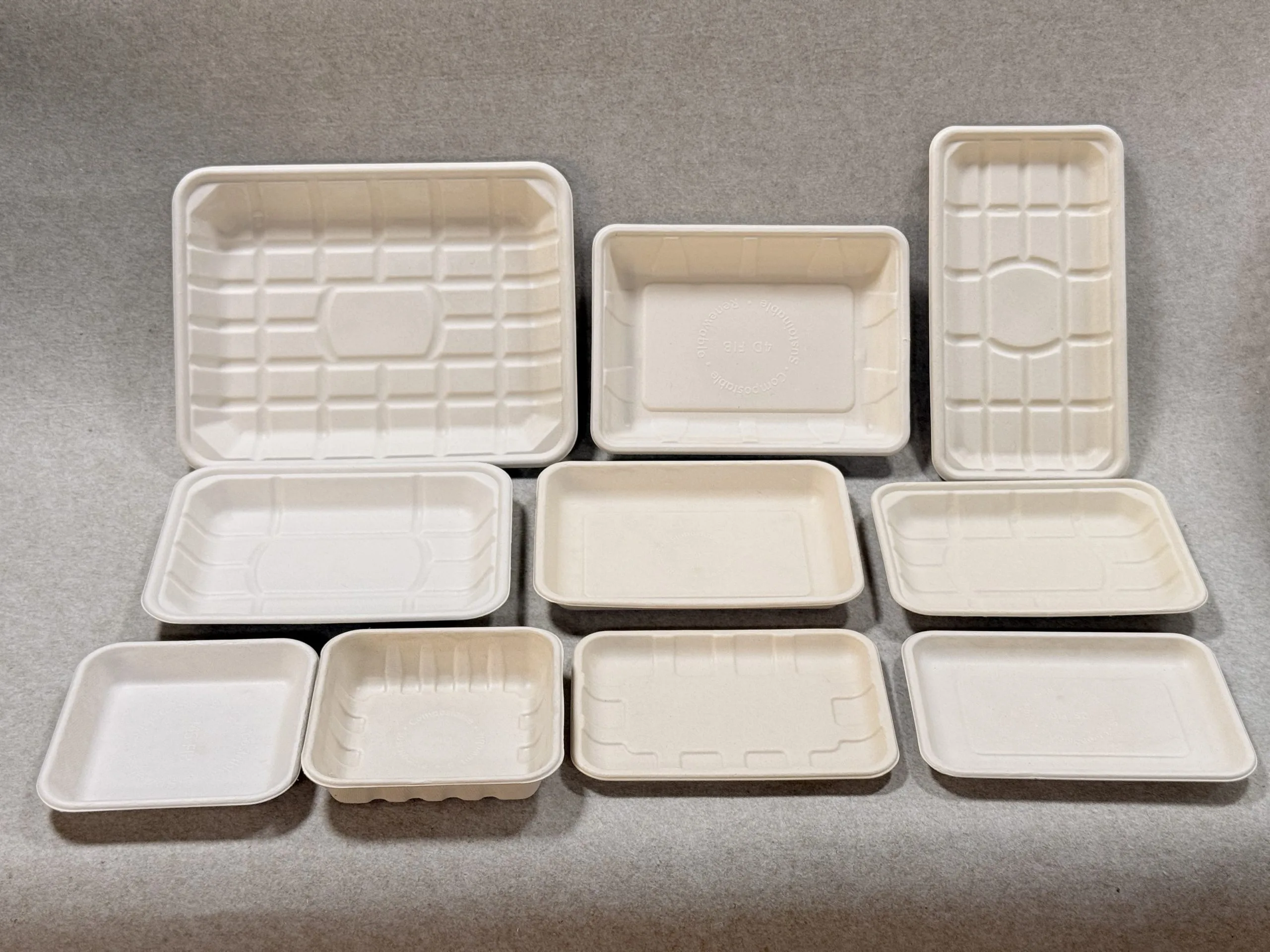
Bagasse may be considered when:
- The packaging program aims to reduce conventional plastic components.
- The tray must support both chilled food and selected reheating applications.
- The buyer needs molded compartments or deeper food-service formats.
- The destination market has suitable commercial composting infrastructure.
- The brand prefers a natural molded-fiber appearance over printed paperboard.
Bagasse trays do not automatically replace kraft sushi trays in every application. Their surface texture, product visibility, lid options, dimensions and printing possibilities are different. Buyers should compare the complete menu and service model before changing materials.
Foodservice buyers evaluating molded-fiber alternatives can also compare Bioleader®’s compostable sugarcane bagasse trays in different sizes, depths and compartment configurations.
Manufacturer Insight: Compare Packaging Systems, Not Material Names
In B2B food packaging procurement, material names alone do not provide enough information for a reliable decision. Two kraft trays may use different paper weights, coatings, forming processes and lid-lock structures. Two bagasse trays may differ in pulp formulation, wall thickness, surface finish and lid compatibility.
Bioleader® recommends comparing the complete system: tray dimensions, material structure, food-contact layer, matching lid, carton packing, storage conditions, delivery route and target-market requirements.
This approach reduces the risk of selecting a package that looks suitable in a catalog but performs poorly with the buyer’s actual food and operating process.
How Should a Sushi Tray Perform in Refrigeration and Delivery?
Sushi trays are primarily used for chilled and short-duration takeaway applications. Performance should therefore be evaluated under realistic conditions rather than only at room temperature with an empty container.
The main inspection areas are refrigeration stability, moisture resistance, lid fit, stacking performance and movement during transport.
Refrigeration Stability
Cold storage can expose the tray to moisture from rice, chilled ingredients and condensation. The paper base should remain sufficiently rigid for normal handling, and the rim should retain its shape so that the lid remains attached.
During sample testing, buyers should inspect:
- Whether the tray bottom becomes soft or distorted.
- Whether the tray corners or rim begin to curl.
- Whether moisture marks appear on the external surface.
- Whether the PET lid develops excessive condensation.
- Whether temperature changes affect the tray-and-lid connection.
- Whether stacked packages remain stable inside a refrigerator.
A tray that performs well for a two-hour restaurant takeaway window may not provide the same results after a full day in a supermarket refrigerator. Testing time should reflect the buyer’s actual operating model.
Moisture and Oil Resistance
Sushi packaging is exposed to moisture from cooked rice, raw fish, vegetables, pickled ginger and chilled condensation. It may also contact oil from salmon, avocado, mayonnaise-based sauces and fried ingredients.
A suitable barrier coating should delay moisture and grease penetration during the intended service period. However, a coated paper sushi tray should not automatically be treated as a container for free-flowing liquids.
Small amounts of sauce or food moisture are different from storing a pool of soy sauce in the bottom of the tray. When the menu includes substantial sauce, the buyer should use a separate portion cup or select packaging designed for liquid retention.
Lid Fit and Internal Clearance
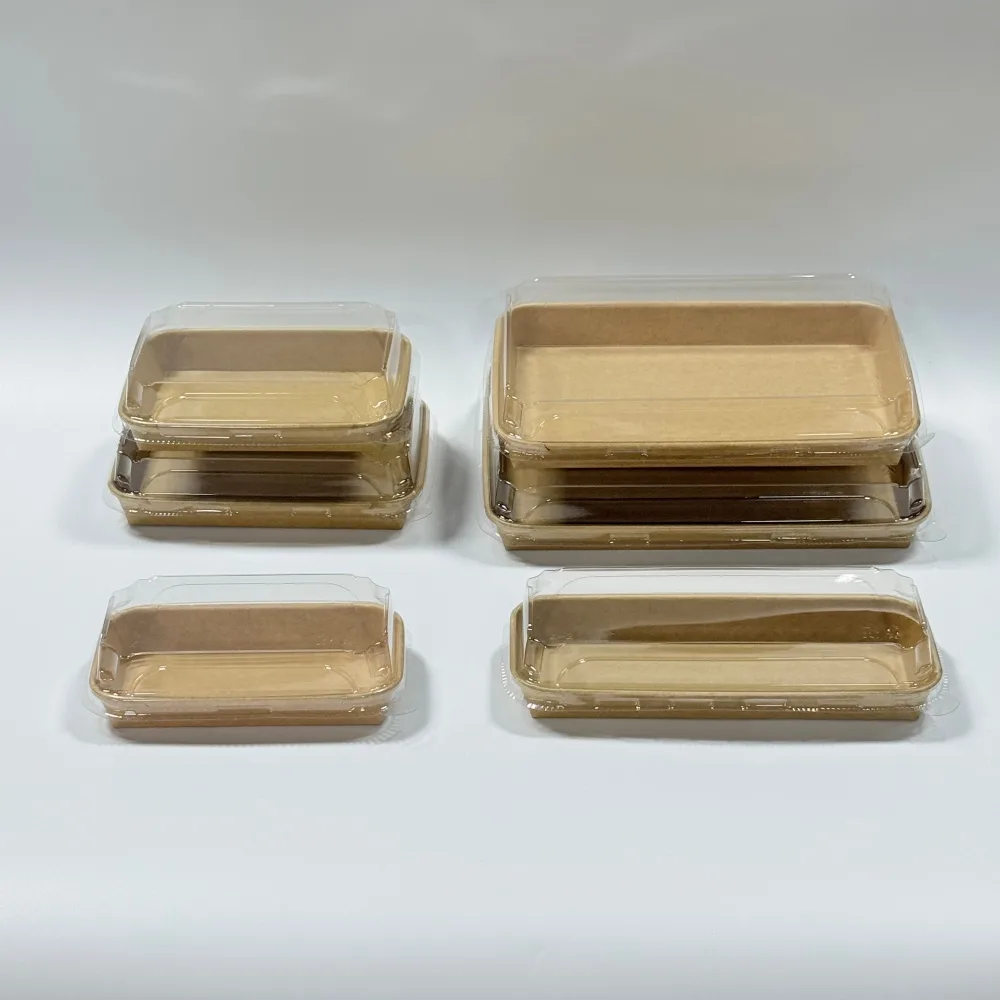
The lid must attach evenly around the tray rim without requiring excessive pressure. A weak connection can open during handling, while an overly tight lid may deform the paper edge or slow down packing operations.
Internal lid height is equally important. The lid should not press against decorated rolls, nigiri toppings, garnishes or sauce containers. Contact with the lid can damage the presentation and transfer food residue onto the transparent surface.
Buyers should inspect:
- The consistency of the lid connection on all four sides.
- The force required to close and reopen the package.
- The clearance above the tallest food item.
- The resistance of the lid to light side pressure.
- The stability of several closed trays when stacked.
- The position of labels or tamper-evident seals around the rim.
Delivery Movement and Presentation
Sushi movement during transport is not determined by the tray material alone. Excessive empty space is one of the most common causes of poor presentation after delivery.
The correct tray should limit movement without compressing the food. The food layout, tray orientation, bag size, delivery-box structure and transport conditions must all work together.
Delivery performance can be improved by:
- Selecting a tray that closely matches the planned food arrangement.
- Positioning the sushi in stable rows rather than loose diagonal layouts.
- Keeping sauce containers separated and securely closed.
- Using correctly sized takeaway bags or secondary cartons.
- Avoiding excessive vertical stacking during motorcycle delivery.
- Testing the complete packed order rather than testing an empty tray.
Recommended Sample Evaluation Protocol
Before approving a bulk order, Bioleader® recommends evaluating the selected tray with the buyer’s actual sushi, garnishes, labels and delivery packaging.
| Evaluation | Suggested Method | Inspection Points |
|---|---|---|
| Food-fit evaluation | Load the planned sushi quantity and arrange the complete serving. | Usable area, spacing, garnish placement, sauce-cup position and lid clearance. |
| Refrigeration evaluation | Store the packed tray under the actual planned chilled conditions. | Tray softening, rim deformation, condensation, lid fit and stacking stability. |
| Moisture evaluation | Use the actual rice, fish, vegetables and sauces from the menu. | Internal staining, external moisture marks, edge absorption and structural changes. |
| Delivery simulation | Pack the tray in the intended bag or carton and reproduce the delivery route. | Food movement, lid opening, tray deformation and presentation on arrival. |
| Stacking evaluation | Stack several filled trays at the expected operating height. | Lid compression, tray sliding, rim damage and worker handling efficiency. |
| Label evaluation | Apply the planned barcode, product label or tamper seal. | Adhesion under refrigeration, visibility, opening convenience and lid security. |
Test observations should be recorded using specific descriptions such as “no visible external leakage,” “minor internal staining,” “lid remained connected,” or “tray softened after extended storage.” Buyers should avoid using an undefined pass-or-fail result without documenting the actual conditions.
Which Sushi Tray Is Best for Each Application?
The same tray may perform differently across restaurant takeaway, supermarket display, food delivery and catering. Buyers should align the packaging specification with the service channel.
Sushi Restaurants and Takeaway Counters
Restaurants normally require several tray sizes for individual rolls, mixed sets and sharing portions. Fast lid closure, compact storage and consistent presentation are important for busy takeaway operations.
Kraft trays are particularly useful when the restaurant wants a natural visual identity or custom printed packaging. The tray range should be simplified enough for staff to select the correct size without slowing down service.
Supermarket Sushi Counters
Supermarket packaging must support chilled display, clear product visibility, barcode labeling and stable shelf stacking. The lid should remain clear enough for customers to inspect the food, while the paper tray should retain acceptable rigidity throughout the intended display period.
Retail buyers should test labels under refrigeration and confirm that adhesive products do not interfere with lid opening. The front-facing tray area should also leave sufficient space for mandatory product information.
Delivery Kitchens and Online Food Platforms
Delivery kitchens should prioritize lid security, tray-to-food fit and secondary packaging. A visually attractive tray will not protect the meal if it moves freely inside an oversized delivery bag.
The packaging test should reproduce the actual route, including motorcycle vibration, cornering, stacking and handover. Longer delivery distances may require additional stabilization or a different material configuration.
Catering and Party Platters
Large sushi trays provide more presentation space but also experience greater bending forces during handling. Buyers should check base rigidity, hand-carry stability and lid compression when selecting catering formats.
Party trays should not be selected only by piece count. Large decorative rolls, sashimi arrangements and garnishes may require more usable area and additional lid height than a tightly packed standard sushi assortment.
Foodservice Distribution
Distributors normally need a balanced product range rather than every possible size. A practical selection may include compact, standard, large and platter formats that cover the majority of restaurant and retail applications.
Carton quantity, warehouse space, container loading and demand by size should be reviewed before expanding the range. A slow-moving size can increase inventory costs even when its unit price appears competitive.
Are Kraft Paper Sushi Trays Recyclable or Compostable?
The environmental profile of a kraft paper sushi tray depends on its complete material structure, not only on the visible paper surface.
A standard kraft sushi package may contain a paperboard tray, a polymer barrier coating and a separate PET lid. These components may require different waste-treatment routes. Food contamination and local collection rules can further affect whether the materials are accepted.
Can the Kraft Paper Tray Be Recycled?
Paper-based trays may be accepted by some recycling systems when the coating is compatible with local processing and the tray is not heavily contaminated. Other facilities may reject coated or food-soiled packaging.
Buyers should not make a universal recyclability claim without checking the target market. A claim that is correct in one city may be inaccurate in another region with different collection and pulping capabilities.
Is the Complete Tray and Lid Compostable?
A kraft tray with conventional PE coating and a PET lid should not be described as a completely compostable packaging system. The paper appearance does not change the material characteristics of the coating or lid.
When compostability is a procurement requirement, buyers should verify:
- The exact barrier-coating material used on the tray.
- The material used for the transparent lid.
- Whether the certification applies to the complete product or only one component.
- Whether the destination market has industrial or home-composting infrastructure.
- Whether local operators accept food-contaminated compostable packaging.
- Whether the disposal instructions can be communicated accurately to consumers.
Environmental claim warning: Terms such as recyclable, biodegradable, compostable, plastic-free and eco-friendly describe different characteristics. Buyers should verify the complete material configuration and certification scope before printing these claims on packaging.
Custom Printing and Branding Considerations
Kraft paper sushi trays can support restaurant logos, brand graphics, QR codes, product information and seasonal packaging designs. The natural brown surface works particularly well with minimal branding, dark colors and simple line artwork.
White paperboard may be considered when the buyer requires stronger color contrast, brighter graphics or a cleaner retail presentation. The final printing result depends on the paper surface, ink system, artwork coverage and forming process.
What Buyers Should Confirm Before Printing
- The exact tray size and printable area.
- Whether printing is required on the exterior base, side wall or another surface.
- The number of printing colors and required color references.
- The difference between printing on natural kraft and white paperboard.
- The artwork format required by the manufacturer.
- The position of logos, QR codes and mandatory product information.
- The custom-printing MOQ for each tray size.
- The sample approval process before mass production.
- The expected visual variation caused by the kraft-paper background.
Buyers should provide editable vector artwork whenever possible. Physical or production-equivalent samples are recommended when brand colors must be matched closely.
The printed design should also remain readable after forming. Artwork placed too close to a fold, rim or curved surface may shift or distort during tray production.
Wholesale Buying Checklist for Kraft Paper Sushi Trays
A complete request for quotation helps the manufacturer recommend the correct tray and reduces repeated specification changes. Buyers should provide information about the food, packaging structure, quantity and destination market.
Product and Food Information
- Provide the required tray dimensions or the dimensions of the current packaging.
- State the sushi type, individual piece size and planned number of pieces.
- Describe the arrangement of rolls, nigiri, sashimi, garnishes and sauce cups.
- Confirm whether the food will be chilled, frozen or used only for immediate takeaway.
- State the expected storage time and delivery distance.
Material and Lid Requirements
- Confirm whether natural kraft or white paperboard is preferred.
- Specify the required paper weight and barrier-coating structure when known.
- Confirm whether a clear PET dome lid is acceptable.
- Provide the minimum internal lid height required for the food.
- State whether anti-fog performance or special sealing is required.
Branding and Packing Requirements
- Confirm whether the tray is plain, custom printed or private label.
- Provide the artwork file, printing colors and logo position.
- State the preferred pieces per bag and pieces per carton.
- Confirm barcode, carton-marking and pallet requirements.
- Provide any warehouse or container-loading restrictions.
Commercial and Compliance Information
- Provide the required quantity for each tray size.
- Confirm whether multiple sizes will be combined in one shipment.
- State the destination country, destination port and preferred trade term.
- List any required food-contact reports, certificates or declarations.
- Confirm whether samples are required before order approval.
Common Purchasing Mistakes to Avoid
Choosing a Tray Only by External Dimensions
External dimensions do not represent the complete usable area. Rim width, wall angle and formed corners reduce the internal loading space. A sample or technical drawing should be reviewed before approval.
Assuming One Tray Fits a Fixed Number of Pieces
Sushi dimensions vary significantly between restaurants and markets. Piece-count claims should be treated as general references rather than guaranteed capacity.
Ignoring Lid Height
A tray may have sufficient base area but still damage the food if the lid is too low. The tallest sushi piece, garnish or sauce container should be measured.
Testing the Empty Tray Instead of the Complete Meal
An empty tray cannot reproduce moisture, oil, condensation, food movement or actual stacking pressure. Performance testing should use the real menu and delivery packaging.
Using Environmental Claims Based Only on Appearance
Brown kraft paper may look natural, but appearance does not confirm recyclability or compostability. The coating, lid and local waste infrastructure must be reviewed.
Comparing Only the Unit Price
A lower unit price may be offset by poor carton efficiency, lid mismatch, excessive inventory, product damage or slower staff packing. Buyers should evaluate the total operating cost of the packaging system.
Bioleader® Kraft Sushi Packaging Solutions
Bioleader® manufactures and supplies kraft paper sushi trays for restaurant takeaway, supermarket display, catering, delivery platforms and foodservice distribution.
Available support can include:
- Multiple kraft sushi tray dimensions for compact portions, standard sets and large platters.
- Matching clear PET dome lids for product visibility and food protection.
- Natural kraft and white paperboard options based on the required presentation.
- Material and coating confirmation according to the selected product configuration.
- Custom printing, OEM branding and private-label packaging support.
- Sample evaluation for food fit, lid compatibility and handling performance.
- Carton-packing and container-loading planning for bulk wholesale orders.
- Food-contact and export-document coordination according to the order and target market.
As a China food packaging manufacturer, Bioleader® helps buyers compare material options, confirm specifications and reduce sourcing risk before mass production. Final product claims and compliance documentation should always correspond to the exact tray, coating, lid and destination-market requirements.
Conclusion: How Should Buyers Choose a Sushi Tray?
The correct sushi tray should match the food rather than forcing the food into a standard container.
Kraft paper trays are a strong option for brands that value natural presentation, transparent-lid visibility and custom printing. Plastic trays may remain practical when extended moisture resistance or highly consistent plastic forming is required. Sugarcane bagasse trays offer an alternative for buyers prioritizing molded fiber and compostability-oriented packaging.
Before placing a wholesale order, buyers should test the actual sushi arrangement, refrigeration period, lid height, label position, stacking method and delivery process. They should then confirm the material structure, coating, carton packing, order quantity and compliance requirements with the manufacturer.
Commercial recommendation: Choose the smallest tray that provides sufficient usable area and lid clearance without compressing the food or allowing excessive movement. This normally improves presentation, carton efficiency and total packaging cost at the same time.
Frequently Asked Questions About Kraft Paper Sushi Trays
What size kraft paper sushi tray should I use?
The correct size depends on the dimensions and arrangement of the sushi rather than piece count alone. Measure the rolls, nigiri or sashimi, include space for garnishes and sauce cups, and confirm the internal lid height. A physical sample should be tested with the actual meal before bulk ordering.
Are kraft paper sushi trays suitable for refrigeration?
Kraft paper sushi trays with an appropriate barrier coating can be used for chilled sushi and supermarket display. Performance depends on the coating, refrigeration time, food moisture and condensation conditions. Buyers should test the tray for the complete intended storage period instead of assuming that all coated paper trays perform identically.
Can a kraft sushi tray hold soy sauce?
A coated kraft sushi tray can normally tolerate ordinary food moisture and limited sauce contact during its intended service period. It should not automatically be used as a liquid container. When the meal includes free-flowing soy sauce or another dressing, a separate sealed portion cup is the safer packaging choice.
Are kraft paper sushi trays recyclable?
Recyclability depends on the tray coating, food contamination and local recycling infrastructure. Some facilities accept coated paper food packaging, while others do not. The PET lid may need to be separated and handled through a different recycling stream. Buyers should verify local collection rules before making a recyclability claim.
Are kraft paper sushi trays compostable?
Not all kraft paper sushi trays are compostable. A standard tray may contain a conventional polymer coating, and the clear lid may be PET. Buyers requiring compostable packaging should verify the coating material, lid material, certification scope and available composting infrastructure for the complete packaging system.
Is a PET lid suitable for cold sushi?
A clear PET dome lid is commonly used for chilled sushi because it provides good visibility and helps protect the food during display and handling. PET lids should not be assumed to be suitable for microwave heating. Any temperature-related use should be confirmed against the exact product specification.
Is kraft paper better than plastic for sushi packaging?
Kraft paper is often better for natural presentation, printability and paper-based branding. Plastic may provide stronger resistance to prolonged moisture and may be preferred for some chilled retail systems. The better choice depends on the menu, storage time, delivery route, waste infrastructure and commercial priorities.
Can kraft sushi trays be custom printed?
Yes. Kraft sushi trays can support logos, brand graphics, QR codes and product information. Buyers should confirm the printable area, artwork format, printing colors, MOQ and sample-approval process. Natural kraft affects color appearance, while white paperboard may provide stronger contrast for bright or detailed designs.
What information is required for a wholesale quotation?
Buyers should provide the tray size, food layout, lid requirement, material or coating preference, order quantity, printing requirements, carton packing, destination country and destination port. Details about refrigeration, delivery distance and required compliance documents will help the manufacturer recommend a more suitable configuration.