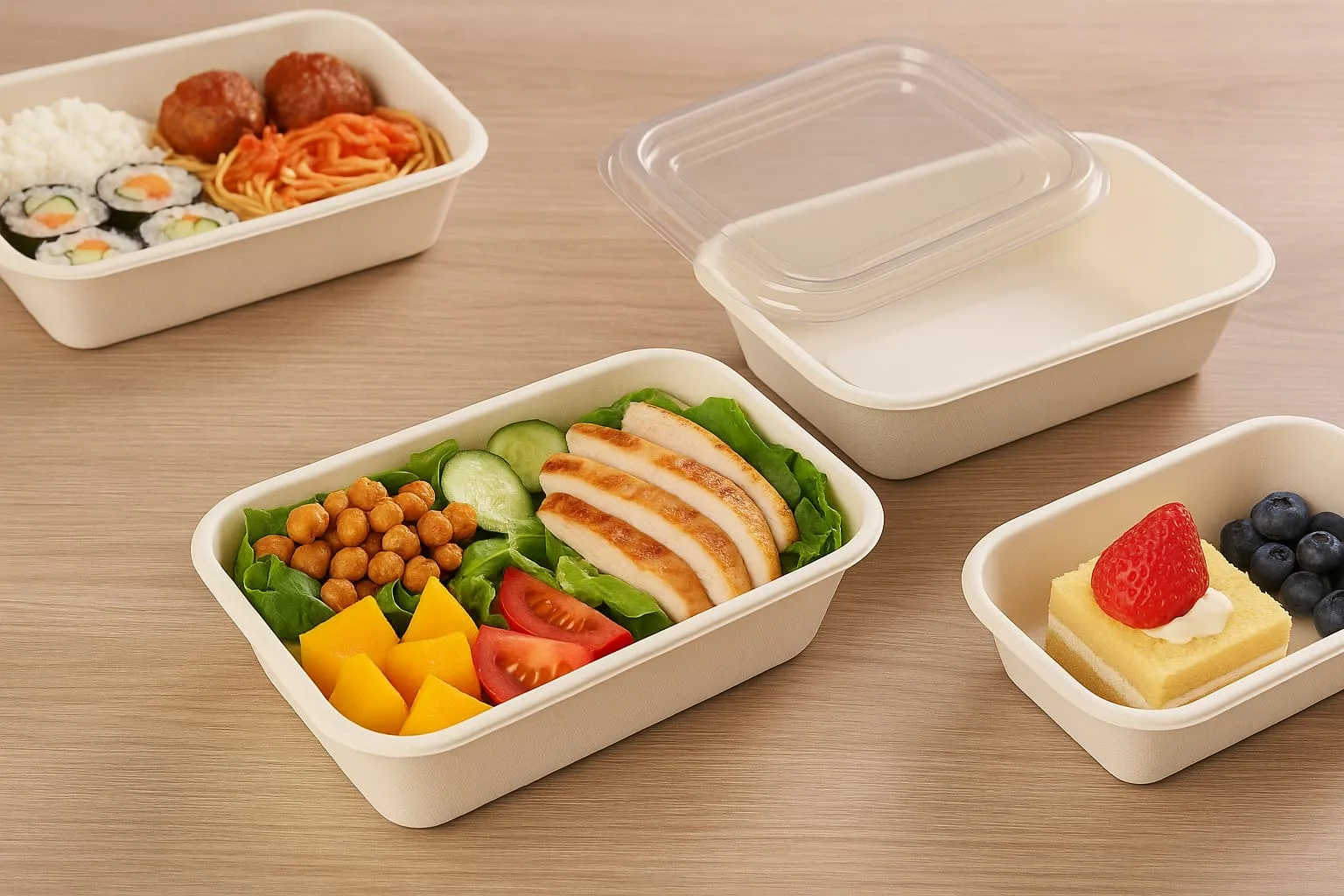










L'emballage pour sushi a une tâche plus exigeante que simplement contenir les aliments. Un plateau doit garder les sushis bien arrangés, permettre aux clients de voir le produit, résister à l'humidité du riz et des ingrédients réfrigérés, s'adapter précisément à son couvercle, survivre à la manipulation en vente à emporter, soutenir l'affichage en magasin et rester commercialement viable à grande échelle.
Pour les acheteurs B2B, deux options à base de fibres de plus en plus courantes sont les plateaux à sushi en papier kraft avec couvercles transparents PET et les plateaux à sushi en bagasse de canne à sucre. Les deux peuvent convenir pour les sushis, sashimis, makis, plats de charcuterie et repas réfrigérés à emporter, mais ils résolvent le problème de l'emballage différemment.
Résumé rapide : Les plateaux à sushi en papier kraft avec couvercles transparents PET sont particulièrement adaptés à l'affichage en supermarché, aux sushis à emporter, à l'image de marque personnalisée et aux applications où la visibilité des aliments est importante. Les plateaux en bagasse offrent une alternative en fibre moulée qui peut mieux soutenir les programmes d'emballage axés sur la compostabilité et une utilisation plus large en restauration chaude et froide. Le meilleur choix dépend de la présentation des aliments, du type de couvercle, de la résistance à l'humidité, des conditions de livraison, de la personnalisation, des objectifs de gestion des déchets et du coût total de l'emballage.
Règle de décision clé : Choisissez l'emballage à sushi comme un système complet. Une bonne décision de plateau combine visibilité des aliments + stabilité structurelle + ajustement du couvercle + contrôle de l'humidité + image de marque + logistique + exigences de fin de vie. Le matériau seul ne détermine pas quel plateau est meilleur.
Que doit réellement faire un bon emballage à sushi ?
Le sushi est un aliment réfrigéré et sensible à la présentation. Contrairement à un burger ou un bol de nouilles, une grande partie de sa valeur commerciale est communiquée visuellement avant l'ouverture de l'emballage. Les couleurs du saumon, du thon, de l'avocat, du riz, des sauces et des garnitures font partie de la présentation du produit.
Pour cette raison, les acheteurs devraient évaluer l'emballage à sushi selon plusieurs exigences pratiques :
- Visibilité des aliments : Les clients peuvent-ils voir clairement les makis, sashimis, nigiris et garnitures avant l'achat ?
- Rigidité du plateau : La base reste-t-elle plate lorsqu'elle est soulevée, empilée ou manipulée pendant le service ?
- Ajustement du couvercle : Le couvercle se ferme-t-il de manière cohérente sans appuyer sur les sushis ?
- Résistance à l'humidité : Le plateau peut-il gérer la condensation, l'humidité du riz, les sauces et les courtes périodes de maintien ?
- Empilage : Les sushis emballés peuvent-ils être empilés pour la préparation, l'affichage réfrigéré et la livraison à courte distance ?
- Présentation de la marque : L'emballage peut-il supporter des logos imprimés, des étiquettes, des codes QR ou des illustrations en marque propre ?
- Efficacité de distribution : Les dimensions du carton, le nombre de pièces par carton et l'efficacité de chargement du conteneur sont-ils acceptables ?
- Stratégie de fin de vie : La combinaison plateau-couvercle complète correspond-elle à l'objectif de recyclage, de compostage ou de réduction du plastique de l'acheteur ?
Le bon matériau dépend donc du canal de vente. Une chaîne de sushis servant des clients à emporter peut privilégier l'image de marque et la présentation, tandis qu'un supermarché peut privilégier la visibilité du produit et la cohérence en rayon. Un programme de restauration axé sur le développement durable peut accorder plus de poids aux critères de fibre moulée et de compostabilité.
Qu'est-ce qu'un plateau à sushi en papier kraft avec un couvercle transparent PET ?
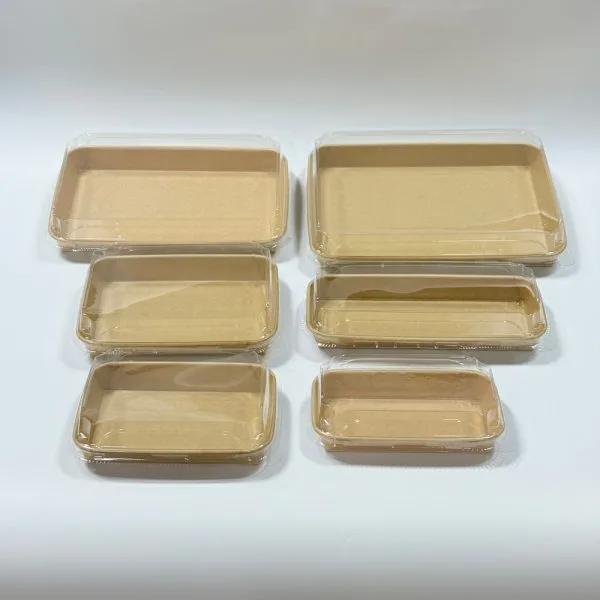
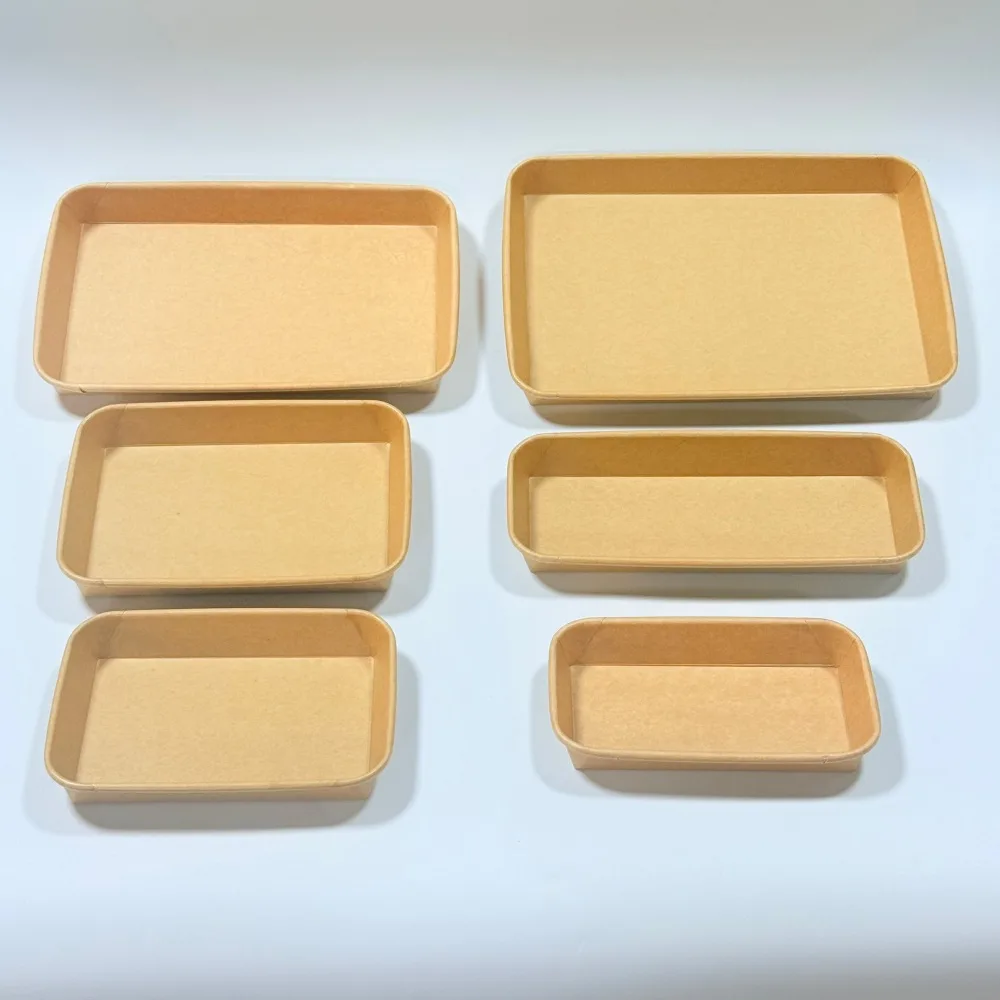
Un plateau à sushi en papier kraft est une base en carton formé conçue pour présenter des sushis et d'autres aliments réfrigérés sur une surface relativement plate. Le produit actuel de Bioleader® plateau à sushi en papier kraft avec couvercle transparent PET utilise du carton kraft de 300 g/m² ou 320 g/m² avec un revêtement unique PE et un couvercle dôme transparent assorti PET.
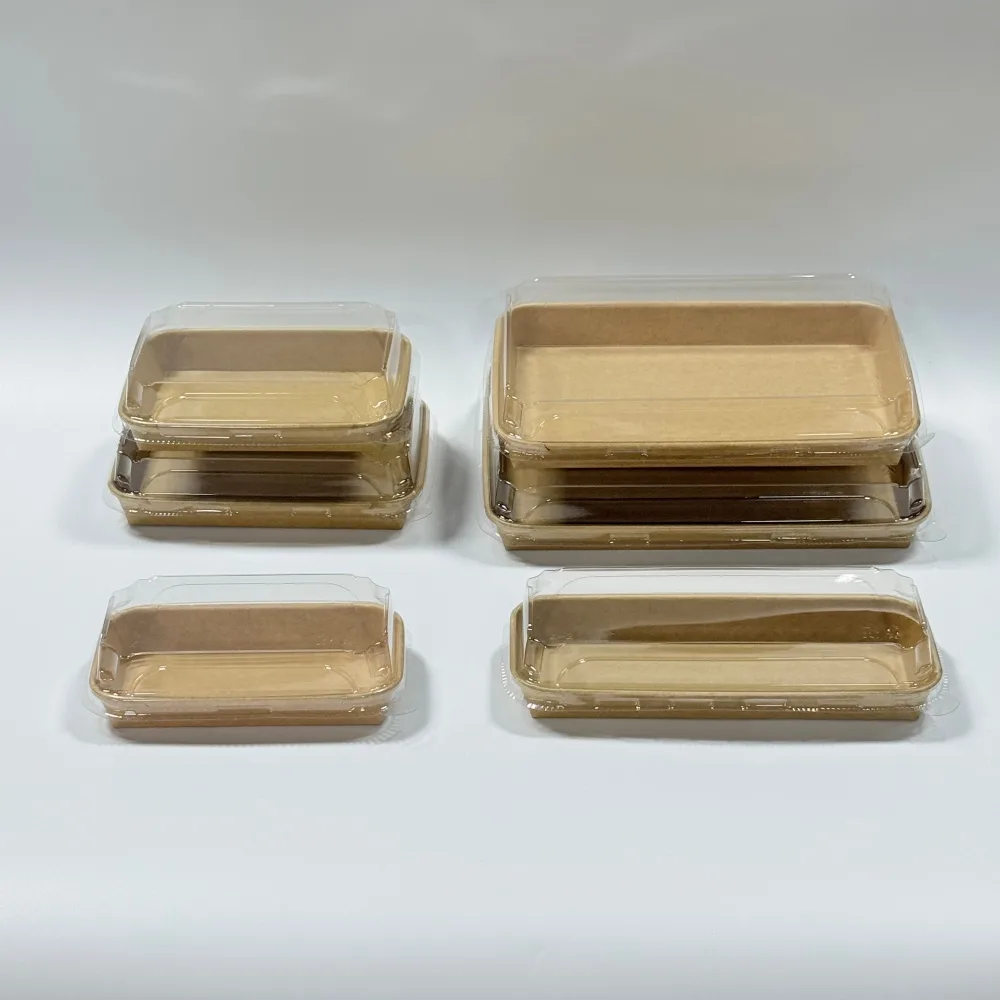
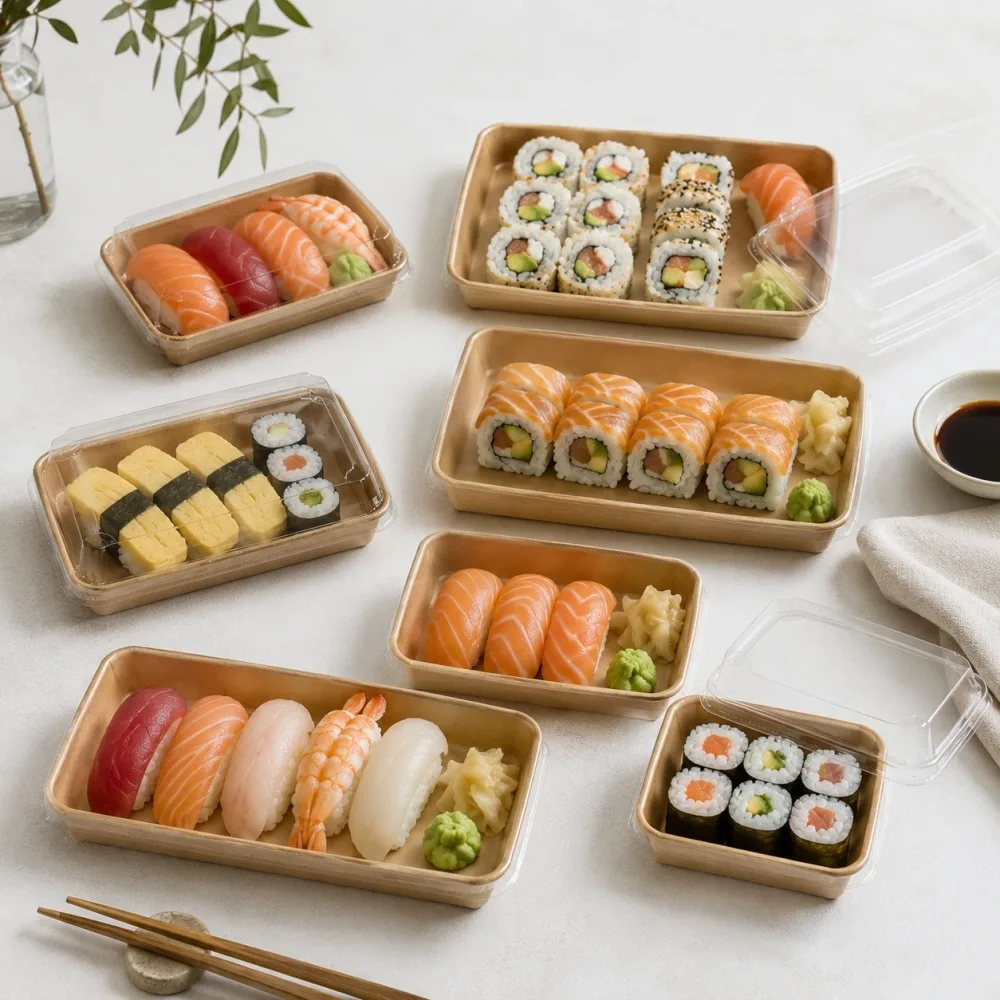
La gamme de produits comprend plusieurs tailles de plateaux pour les petites portions de makis, les assortiments de sushis réguliers, les combinaisons de sashimis, les plats de charcuterie et les plus grands packs pour fêtes. Le couvercle transparent PET est une partie importante du système car il permet aux clients d'inspecter les aliments sans ouvrir l'emballage.
Pourquoi le papier kraft fonctionne bien pour les sushis au détail
Le carton kraft offre une base plate et visuellement propre avec une apparence brun naturel. Cela peut fonctionner particulièrement bien pour les sushis car le fond neutre ne concurrence pas trop les aliments eux-mêmes.
La structure en carton peut également supporter une image de marque personnalisée. Une chaîne de restaurants, un programme de marque propre en supermarché ou un distributeur de restauration peut utiliser des logos, des étiquettes, des codes QR, des blocs de couleur ou des graphiques saisonniers pour créer un système d'emballage reconnaissable sur plusieurs tailles de plateaux.
Les acheteurs envisageant une gamme plus large de formats en papier à emporter peuvent également consulter les boîtes alimentaires en papier kraft de Bioleader® pour comparer comment les structures en carton sont utilisées dans différentes applications de vente à emporter et de livraison.
Aperçu du fabricant : Le couvercle transparent n'est pas simplement un accessoire. Pour les sushis, le couvercle fait partie du système de marchandisage. Un dôme transparent PET aide à rendre les aliments visibles sur les étagères réfrigérées et les comptoirs de vente à emporter, tandis que la base en kraft fournit la surface structurelle et de marque en dessous.
Qu'est-ce qu'un plateau à sushi en bagasse ?
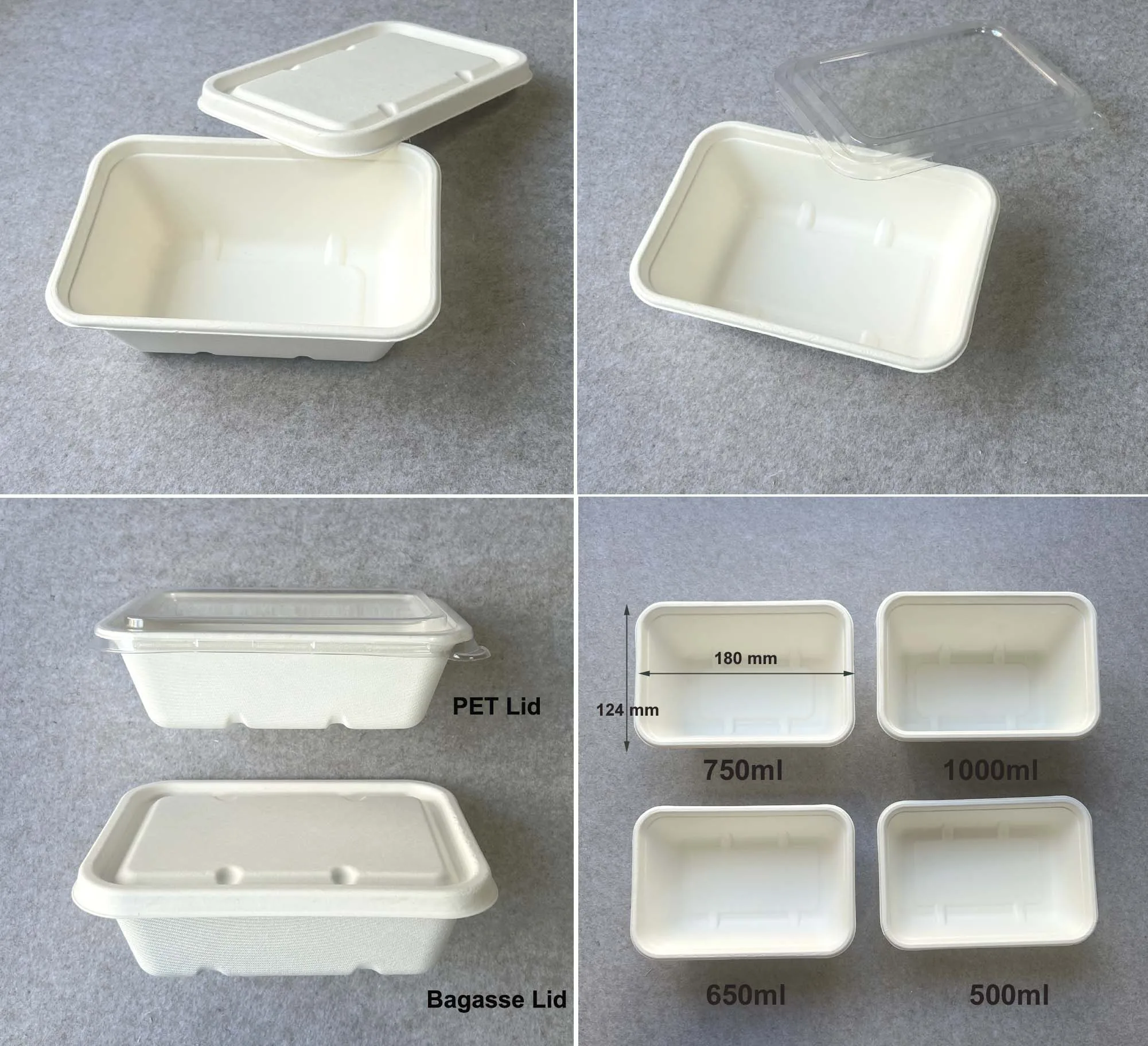
Les plateaux en bagasse sont des contenants alimentaires en fibre moulée fabriqués à partir de fibre de canne à sucre. Au lieu de former une feuille de carton plat en plateau, le matériau est moulé dans sa forme tridimensionnelle finale.
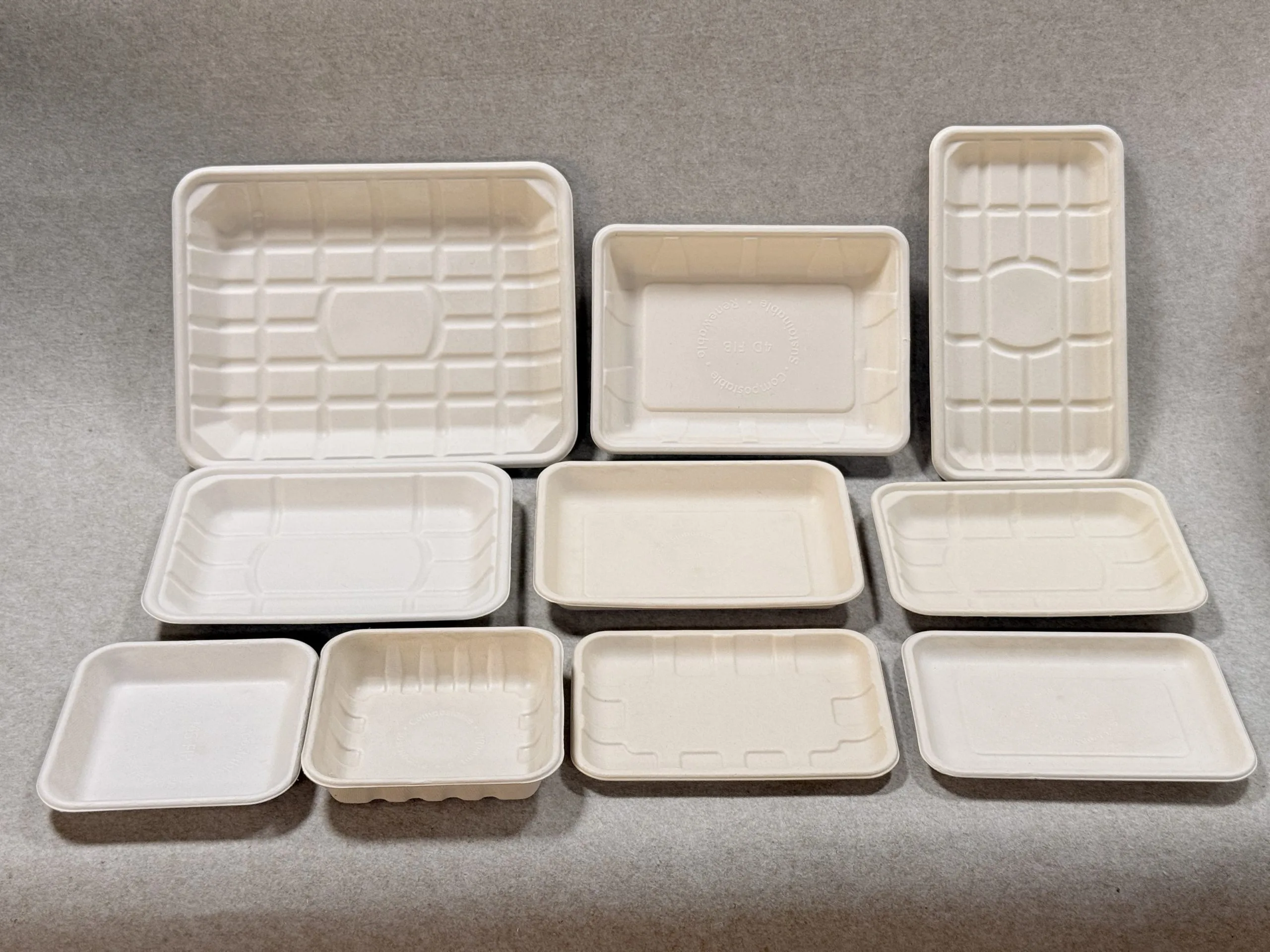
Bioleader® fournit une large gamme de barquettes en bagasse de canne à sucre pour la restauration, la vente à emporter, les plats de charcuterie, la restauration collective et les applications de sushis. La gamme comprend des plateaux peu profonds, des plateaux alimentaires plus profonds et des formats conçus pour fonctionner avec des couvercles assortis.
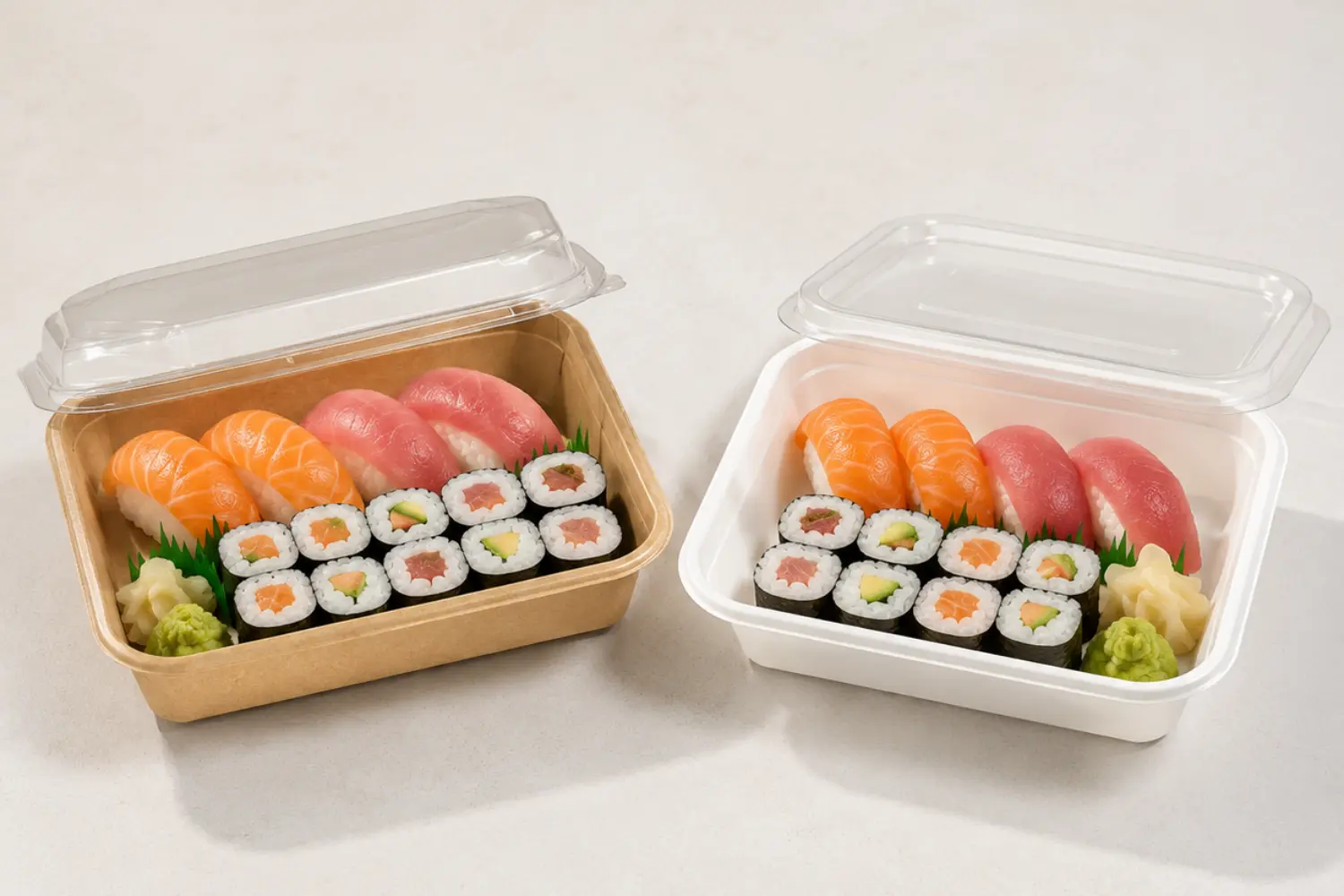
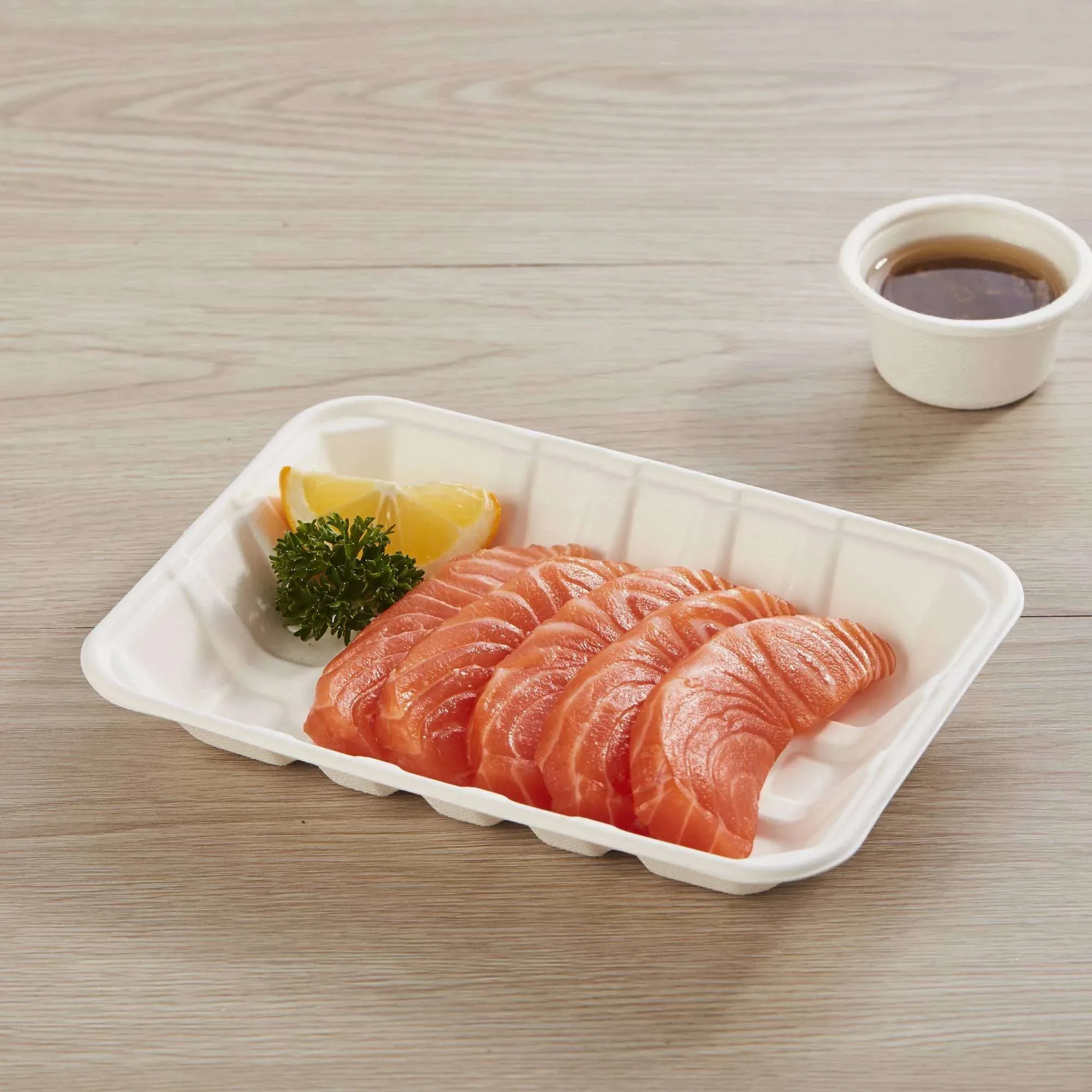
Pour les acheteurs recherchant spécifiquement un emballage à sushi, Bioleader® propose également un plateau à sushi en bagasse avec couvercle comme alternative en fibre moulée au format carton kraft.
Pourquoi la bagasse séduit les programmes axés sur la durabilité
La bagasse offre une structure moulée à base de fibres et peut soutenir des stratégies d'emballage orientées compostage lorsque le produit spécifique, la configuration du couvercle, la certification et le système local de gestion des déchets soutiennent cette affirmation.
Elle peut également être utilisée dans un portefeuille plus large de services alimentaires, ce qui peut être utile pour les acheteurs qui souhaitent la même famille de matériaux pour les sushis, les plats d'accompagnement, les plats préparés, les snacks et autres aliments à emporter.
Cependant, la fibre moulée ne doit pas être choisie simplement parce qu'elle semble plus durable. La cohérence structurelle, l'ajustement du couvercle, la finition de surface, la résistance à l'huile et à l'eau, le démoulage et l'emballage d'exportation doivent encore être évalués. Bioleader® aborde ces questions dans son Guide de contrôle qualité de la vaisselle en bagasse de canne à sucre.
Plateaux à sushi en papier kraft vs bagasse : comparaison côte à côte
| Facteur d'achat | Plateau à sushi en papier kraft + couvercle transparent PET | Plateau à sushi en bagasse |
|---|---|---|
| Visibilité des aliments | Excellente lorsqu'il est associé à un couvercle en dôme transparent PET. | Dépend de la configuration du couvercle assorti. |
| Présentation en supermarché | Convient parfaitement aux rayons réfrigérés, aux produits à emporter et à la présentation visible en magasin. | Convient lorsque la présentation en fibre moulée correspond au concept de vente au détail. |
| Surface du plateau | Surface en carton plat avec une apparence propre pour le commerce de détail. | Surface en fibre moulée avec une texture de fibre naturelle. |
| Impression personnalisée | Avantage certain pour les logos, les graphiques en couleur, les codes QR et les systèmes de marque multi-tailles. | La personnalisation est différente et repose souvent davantage sur le gaufrage, l'étiquetage, les manchons ou des composants de marque externes. |
| Barrière contre l'humidité | Le plateau à sushi kraft standard Bioleader® utilise une structure en carton enduit de PE. | Dépend de la formulation de la fibre moulée, des conditions alimentaires et des spécifications du produit. |
| Utilisation à froid pour sushis | Très bien adapté aux sushis réfrigérés, sashimis et présentoirs de vente au détail. | Convient lorsque la configuration du plateau et du couvercle correspond à l'application. |
| Polyvalence plus large pour les aliments chauds | Dépend de la structure du papier, du revêtement et de la conception du produit. | La bagasse peut prendre en charge une large gamme d'applications de plats préparés lorsque l'UGS est approuvée pour l'usage prévu. |
| Positionnement compostable | Le plateau standard enduit de PE plus le couvercle PET ne doivent pas être traités comme un système d'emballage entièrement compostable. | Potentiel plus fort lorsque la configuration complète du produit et la certification soutiennent les allégations de compostabilité. |
| Apparence de la marque | Aspect kraft naturel avec un fort potentiel d'impression. | Apparence naturelle en fibre moulée. |
| Meilleure adaptation | Chaînes de sushis, supermarchés, comptoirs à emporter, vente à emporter de marque et présentoirs de vente au détail. | Programmes de restauration axés sur les fibres, projets axés sur la durabilité et systèmes d'emballage plus larges en fibre moulée. |
Quel plateau offre une meilleure présentation des sushis ?
Pour les sushis, la présentation n'est pas une caractéristique d'emballage secondaire. Elle influence directement la perception des aliments avant l'achat.
Un couvercle transparent peut révéler :
- La disposition des rouleaux et le nombre de portions.
- La couleur du poisson et l'apparence de fraîcheur.
- La disposition des sashimis.
- Les garnitures et les sauces.
- Les ingrédients premium.
- L'organisation des assortiments.
Cela donne au format papier kraft plus PET un avantage important dans les environnements où les clients sélectionnent le produit visuellement.
Jugement sur la présentation en magasin : Si la visibilité du produit est l'un des principaux critères d'achat, un plateau en papier kraft avec un couvercle transparent PET bien ajusté est généralement le point de départ le plus solide. La bagasse devient plus attrayante lorsque la composition en fibres et la stratégie de fin de vie pèsent plus lourd que la visibilité maximale du produit.
Quel est le meilleur choix pour les comptoirs à sushis des supermarchés ?
L'emballage de sushi pour supermarché doit se comporter différemment de la vaisselle de restaurant. Les produits peuvent être préparés en lots, déplacés vers des présentoirs réfrigérés, empilés lors du réapprovisionnement, étiquetés avec des codes-barres et manipulés plusieurs fois avant que l'acheteur ne les achète.
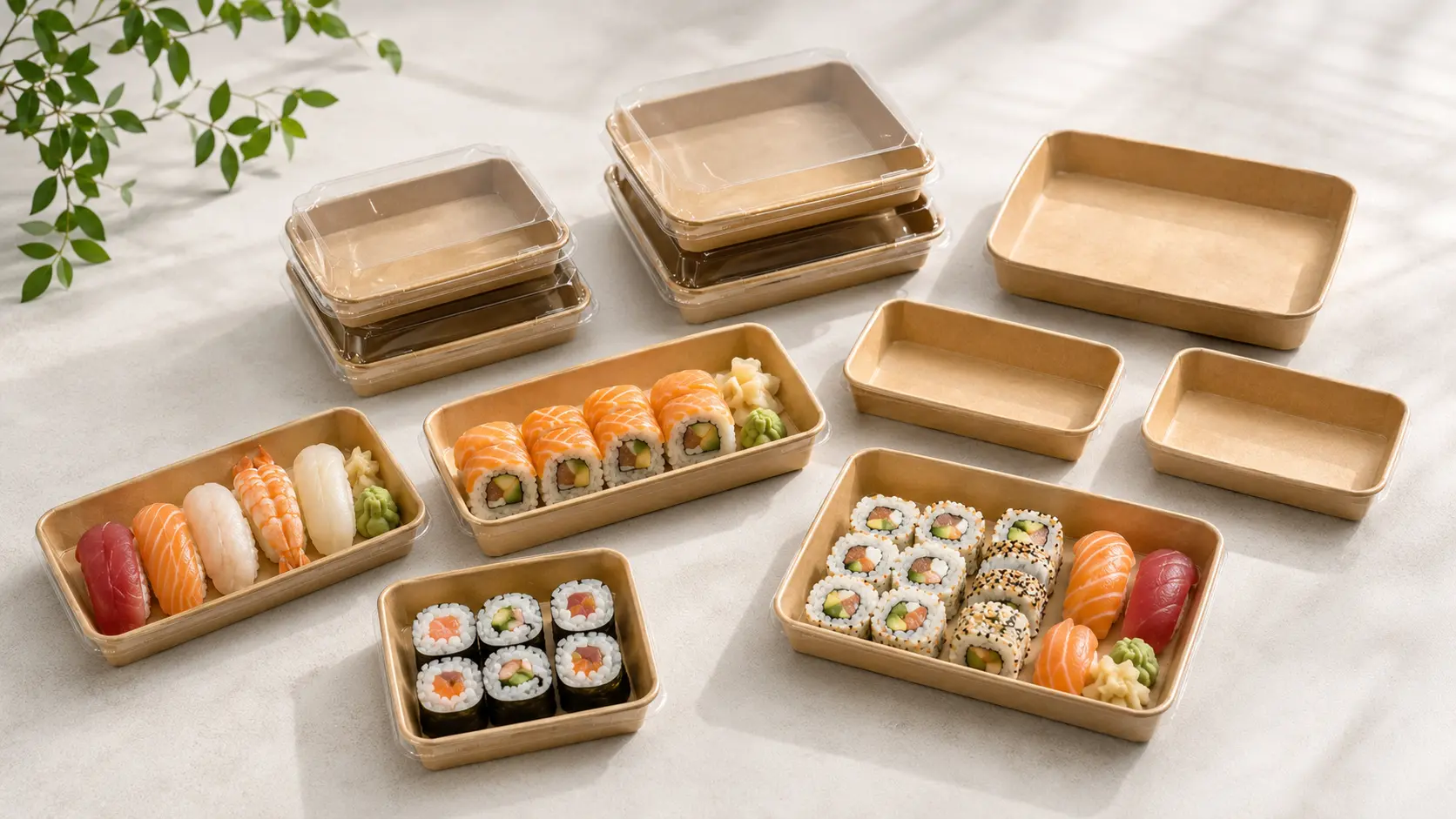
Pour cet environnement, les acheteurs devraient privilégier :
- Une visibilité claire du produit.
- Un ajustement constant du couvercle.
- Une présentation plate.
- Un empilage facile.
- Plusieurs tailles de portions.
- Un espace pour codes-barres et étiquettes.
- Une efficacité du carton.
- Une manipulation rapide par le personnel.
Les plateaux à sushi en papier kraft avec couvercles transparents PET performent particulièrement bien lorsque le supermarché souhaite que les clients voient clairement les aliments sans ouvrir l'emballage. La même famille d'emballages peut également prendre en charge différentes tailles de portions sous un même système de marque visuelle.
Pour les détaillants utilisant déjà des systèmes d'emballage en carton plus larges, les solutions d'emballage alimentaire en papier de Bioleader® offrent des options supplémentaires pour les bols, les tasses, les boîtes alimentaires et les formats à emporter qui peuvent être coordonnés avec un programme de marque privée plus large.
Quel est le meilleur choix pour la vente à emporter et la livraison ?
La vente à emporter et la livraison changent la décision. Le plateau ne repose plus principalement sur une étagère réfrigérée ; il doit survivre à la mise en sac, au mouvement, aux vibrations du véhicule et à la manipulation par le client.
Les plateaux en papier kraft et en bagasse peuvent tous deux fonctionner, mais les acheteurs doivent évaluer l'emballage complet plutôt que le matériau de base seul.
Plateau à sushi en papier kraft pour la livraison
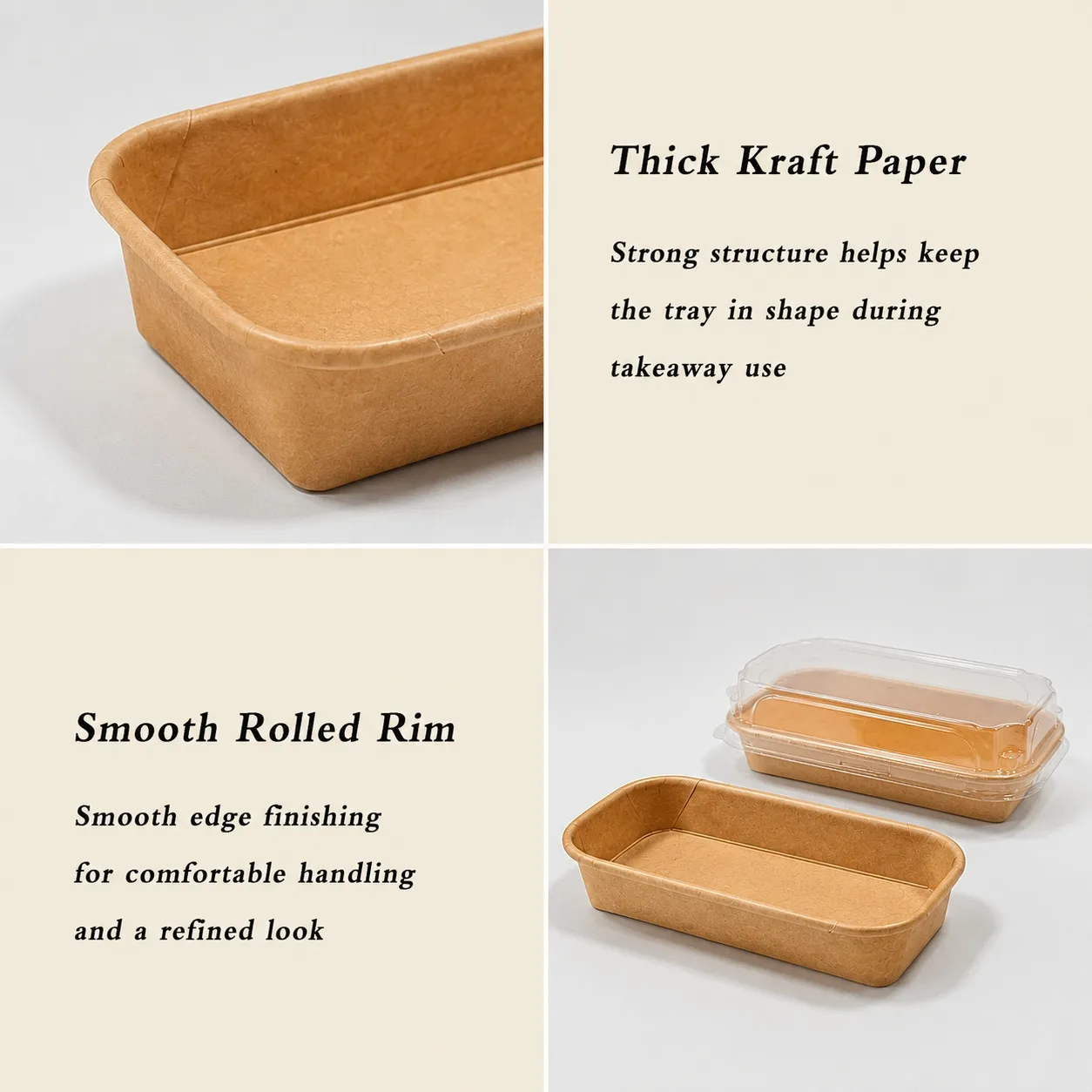 | 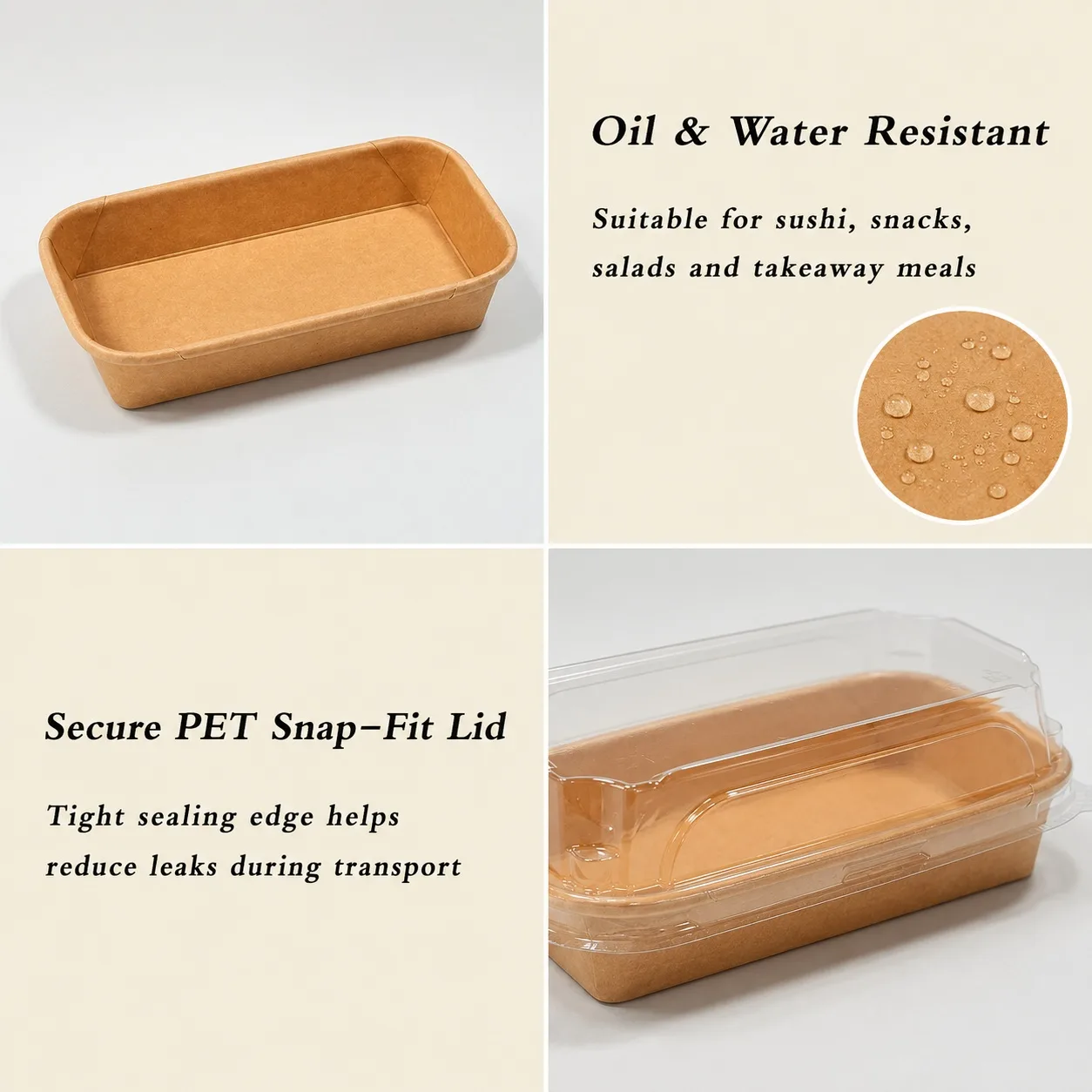 |
Les avantages sont principalement la présentation, la visibilité du couvercle et une base relativement plate. Cela est utile pour les restaurants de sushi de marque qui souhaitent que le repas arrive en conservant une apparence similaire à celle qu'il avait en quittant le comptoir.
L'acheteur doit encore vérifier :
- La solidité du verrouillage plateau-couvercle.
- Si le couvercle fléchit pendant l'empilage.
- Si le sushi entre en contact avec le couvercle.
- Comment l'emballage se comporte lorsqu'il est incliné.
- La condensation après maintien au froid.
- Comment les sauces sont emballées séparément.
Plateau à sushi en bagasse pour la livraison
La fibre moulée peut fournir une structure de plateau ferme et peut convenir aux entreprises utilisant déjà la bagasse pour d'autres repas à emporter. Cependant, la performance réelle doit être vérifiée au niveau de l'unité de gestion des stocks (SKU), en particulier la compatibilité du couvercle, l'empilage et la performance de surface avec des aliments humides ou gras.
 |  |
Test d'échantillon recommandé pour l'emballage de sushi
- Emballez l'ensemble de sushi exact prévu pour un usage commercial.
- Fermez avec le couvercle de production, pas un couvercle de substitution.
- Maintenez l'emballage dans les conditions de froid attendues.
- Empilez plusieurs emballages chargés comme ils le seraient dans le restaurant ou le supermarché.
- Placez les emballages dans le sac de livraison réel ou le carton de vente au détail.
- Simulez le mouvement de livraison sur courte distance.
- Vérifiez le mouvement du couvercle, la déformation du plateau, le déplacement des aliments, la condensation et la présentation.
- Répétez le test avec plusieurs échantillons plutôt que d'approuver une pièce visuellement parfaite.
Quel matériau est le meilleur pour la personnalisation de marque ?
Le carton kraft présente un avantage clair lorsque le plateau lui-même est destiné à porter des graphiques de marque imprimés.
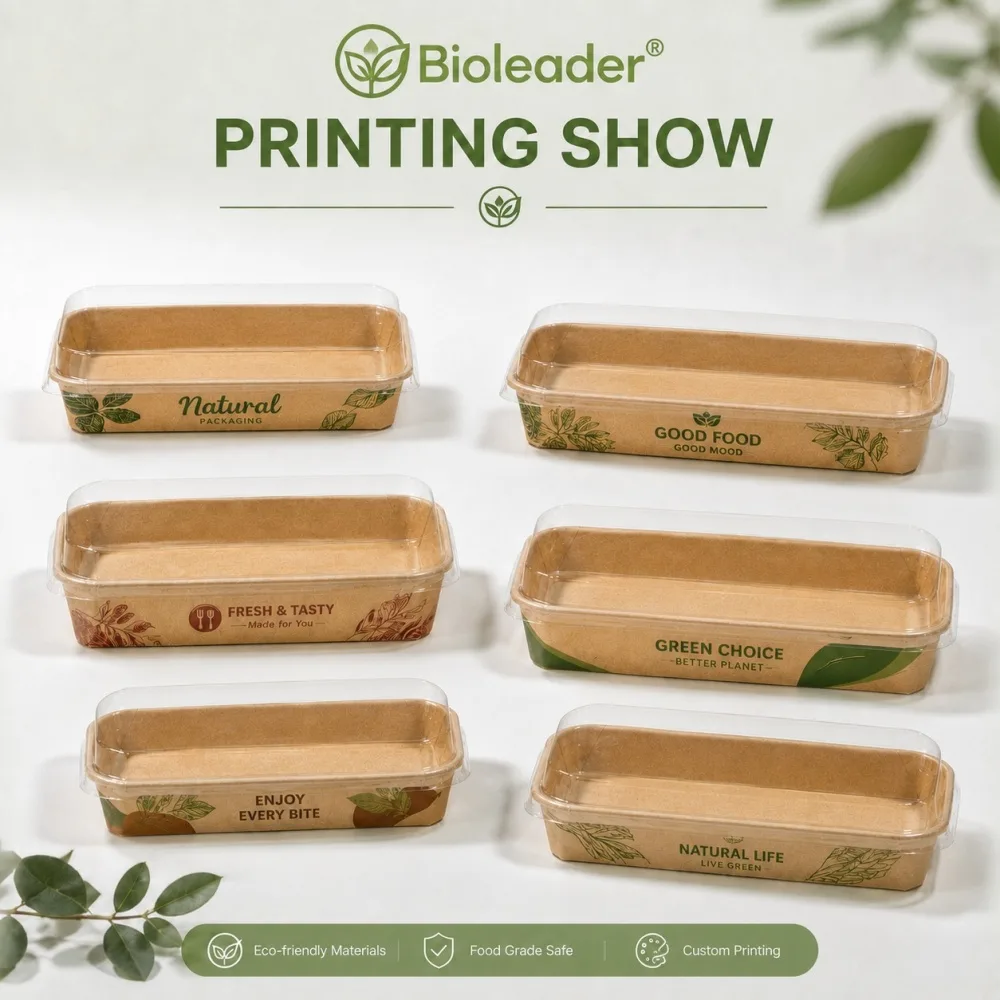
Les éléments de marque possibles incluent :
- Les logos du restaurant ou du supermarché.
- Des illustrations en une ou plusieurs couleurs.
- Des codes QR.
- Des graphiques de famille de produits.
- Des campagnes saisonnières.
- Des designs de marque privée.
- Des illustrations différentes sur plusieurs tailles de plateaux.
Le papier kraft crée une apparence chaleureuse et naturelle, mais son substrat brun modifie la façon dont les couleurs imprimées apparaissent. Les couleurs claires et les graphiques à faible contraste peuvent sembler différents de la même illustration imprimée sur du carton blanc.
Bioleader® explique la relation plus large entre la couleur du papier, les illustrations et la production dans son guide sur impression de logo personnalisé sur emballages alimentaires en papier. Bien que les gobelets et les bols utilisent des procédés de transformation différents de ceux des plateaux à sushi, le même principe d'achat s'applique : l'illustration doit être évaluée avec le substrat plutôt que conçue isolément.
Aperçu du fabricant : Les acheteurs évaluent souvent l'emballage personnalisé sur un écran d'ordinateur. L'usine doit l'évaluer sur le carton kraft réel. Avant la production en série, le contraste du logo, la couleur de fond, la couverture d'impression et la zone imprimable doivent être vérifiés par rapport au dieline réel du plateau.
Le papier kraft signifie-t-il automatiquement compostable ?
Non. C'est l'une des distinctions les plus importantes en matière de durabilité pour les acheteurs.
Le plateau à sushi kraft standard Bioleader® utilise du carton avec un revêtement unique PE et un couvercle transparent PET. Il doit donc être décrit comme un plateau à base de papier avec revêtement barrière en plastique et couvercle PET, et non automatiquement comme un emballage à sushi entièrement compostable.
Sa véritable fin de vie dépend de :
- Le revêtement du plateau.
- Le matériau du couvercle.
- La contamination alimentaire après usage.
- La capacité locale de recyclage des fibres.
- Si le plateau et le couvercle sont séparés.
- Les règles locales de collecte et de tri.
Ce principe plus large est également expliqué dans le guide de Bioleader® sur les boîtes alimentaires en papier pour la vente à emporter et la livraison: la durabilité des emballages à base de fibres dépend des performances alimentaires et de la gestion réaliste de la fin de vie, et non simplement du mot “ papier ”.”
La bagasse signifie-t-elle automatiquement que l'ensemble de l'emballage à sushi est compostable ?
Pas nécessairement. La base du plateau en bagasse peut être conçue pour la compostabilité, mais l'ensemble du paquet doit encore être évalué.
Un acheteur doit vérifier :
- La référence exacte de bagasse.
- Si la documentation de compostabilité pertinente correspond à ce produit.
- Le matériau du couvercle assorti.
- Si les étiquettes, films ou autres accessoires modifient la revendication de fin de vie.
- Si le marché cible dispose d'une filière de compostage appropriée.
Avertissement sur les revendications : “ À base de papier ”, “ à base de fibres ”, “ biodégradable ” et “ compostable ” ne sont pas des termes interchangeables. Les spécifications d'achat doivent décrire le plateau réel, le revêtement, le couvercle et la certification applicable plutôt que de s'appuyer sur une étiquette environnementale générale.
Coût du plateau à sushi kraft vs bagasse : que doivent réellement comparer les acheteurs ?
Le prix unitaire seul ne montre pas le coût total de l'emballage.
La structure de coût du plateau à sushi kraft peut inclure :
- Carton.
- Revêtement barrière.
- Impression.
- Découpe et formage du plateau.
- Couvercle transparent PET.
- Emballage intérieur et cartons.
- Chargement à l'exportation.
La structure de coût du plateau en bagasse est différente :
- Fibre de canne à sucre et préparation de la pâte.
- Formage de fibre moulée.
- Séchage et rognage.
- Exigences de surface ou de résistance à la graisse.
- Couvercle assorti.
- Emballage et chargement à l'exportation.
Pour cette raison, les acheteurs professionnels doivent comparer le coût par ensemble complet utilisable, et non seulement le prix du corps du plateau.
Inclure la logistique dans la comparaison
L'expédition peut modifier considérablement le résultat pour les emballages alimentaires à grand volume. Un plateau avec un prix unitaire légèrement inférieur peut ne pas être moins cher après avoir pris en compte le volume des cartons et le chargement du conteneur.
Avant de choisir entre kraft et bagasse, demandez :
- Le nombre de pièces par carton.
- Les dimensions du carton.
- La méthode d'emballage du plateau et du couvercle.
- CBM par carton.
- La quantité estimée de chargement 20ft ou 40HQ.
- Si les couvercles sont emballés séparément.
- Les exigences de palette si applicable.
Pour les acheteurs comparant plus largement l'économie de l'emballage en carton, Bioleader® couvre également les considérations de matériau, de revêtement, de performance alimentaire et d'approvisionnement dans son guide sur contenants alimentaires en papier kraft.
Matrice de décision : plateau à sushi en kraft vs bagasse
| Priorité | Meilleur point de départ | Pourquoi |
|---|---|---|
| Visibilité maximale des sushis | Kraft + couvercle transparent PET | Le couvercle transparent rend les aliments très visibles pour les clients. |
| Présentation en rayon réfrigéré en supermarché | Kraft + couvercle transparent PET | Présentation soignée, base plate et marchandisage clair. |
| Marquage personnalisé imprimé | Plateau en papier kraft | Le carton offre une surface imprimable pratique pour le marquage. |
| Apparence naturelle en fibre moulée | Barquette en bagasse de canne à sucre | La fibre de canne à sucre moulée offre une apparence distincte à base de fibres. |
| Programme d'emballage axé sur la compostabilité | Bagasse, sous réserve de vérification complète de l'emballage | La bagasse peut soutenir une voie de compostabilité plus solide lorsque le plateau, le couvercle et la certification sont alignés. |
| Programme de sushis de marque multi-tailles | Gamme de plateaux à sushi en kraft | Plusieurs tailles de plateaux peuvent partager un marquage de vente au détail coordonné. |
| Système de restauration plus large en fibre moulée | Barquette en bagasse de canne à sucre | La même famille de matériaux peut être utilisée pour plusieurs types d'aliments et formats de plateaux. |
| Coût total le plus bas | Spécifique au projet | Comparez le plateau, le couvercle, l'impression, MOQ, les cartons, le chargement et le fret ensemble. |
Jugement commercial : Pour les chaînes de sushis et les supermarchés où la visibilité des aliments, la présentation premium et l'impression de la marque sont des priorités majeures, les plateaux à sushi en papier kraft avec couvercles transparents PET sont souvent l'option la plus pratique commercialement. Pour les acheteurs construisant un système de restauration en fibre moulée ou axé sur la compostabilité, les plateaux en bagasse peuvent être la direction la plus solide.
Que doivent vérifier les importateurs avant de commander des plateaux à sushi en gros ?
Liste de contrôle de l'acheteur
- Dimensions du plateau : Confirmez l'espace interne utilisable, pas seulement les dimensions extérieures.
- Hauteur du couvercle : Vérifiez si les rouleaux premium, les sashimis ou les garnitures touchent le couvercle.
- Ajustement du couvercle : Testez plusieurs échantillons pour un verrouillage et un alignement cohérents.
- Disposition des aliments : Confirmez le nombre de rouleaux, de nigiris ou de pièces de sashimi que le plateau doit présenter.
- Performance de barrière : Testez avec le riz, les sauces et les conditions de réfrigération réels.
- Empilage : Chargez et empilez les emballages finis, pas seulement les plateaux vides.
- Marquage : Confirmez la couleur du kraft, le contraste du logo, la zone d'étiquetage et la méthode d'impression avant la production.
- Allégation matériau : Spécifiez séparément le carton, le revêtement, la composition de bagasse et le matériau du couvercle.
- Conformité : Demandez la documentation de contact alimentaire et toute autre documentation pertinente pour le SKU exact et le marché de destination.
- MOQ : Confirmez si MOQ s'applique par taille, par visuel ou par design imprimé.
- Emballage : Vérifiez les pièces/carton, la taille du carton et la disposition d'emballage des couvercles.
- Chargement du conteneur : Comparez la logistique totale débarquée plutôt que le prix unitaire seul.
Comment Bioleader® aide les acheteurs à choisir les emballages pour sushis
Bioleader® prend en charge à la fois les emballages en carton kraft et en bagasse moulée, permettant aux acheteurs de comparer deux systèmes d'emballage différents plutôt que d'être contraints à un seul matériau.
 |  |
 |  |
Pour un projet typique d'emballage de sushis, la séquence d'évaluation est la suivante :
- Confirmez le canal de vente — restaurant de sushis, supermarché, plateforme de livraison, traiteur ou distributeur.
- Définissez la disposition des aliments — nombre de rouleaux, disposition des sashimis, taille des portions et hauteur des garnitures.
- Choisissez l'orientation de l'emballage — plateau en papier kraft avec couvercle transparent PET ou plateau en bagasse moulée.
- Vérifiez la compatibilité du couvercle — ajustement, hauteur, empilage et visibilité du produit.
- Examinez les exigences de marque — impression, étiquettes, codes QR, visuels en marque propre et marquage des cartons.
- Testez les aliments réels — humidité, temps de conservation, réfrigération et conditions de livraison sur courte distance.
- Confirmez la documentation — documentation sur le contact alimentaire et les matériaux pertinente pour la référence sélectionnée.
- Comparez l'emballage et le chargement — quantité par carton, CBM, chargement du conteneur et impact sur le fret.
- Approuvez les échantillons avant la production en série — surtout lorsque plusieurs tailles de plateaux ou un marquage personnalisé sont impliqués.
Cette approche aide les restaurants, importateurs, distributeurs et acheteurs de supermarchés à sélectionner les emballages en fonction des conditions d'exploitation réelles plutôt que de choisir uniquement selon l'apparence du matériau.
Recommandation finale : papier kraft ou bagasse pour les emballages de sushis ?
Ni le papier kraft ni la bagasse n'est automatiquement le meilleur plateau à sushis pour chaque acheteur.
Les plateaux à sushis en papier kraft avec couvercles transparents PET sont particulièrement adaptés lorsque la priorité commerciale est la visibilité des aliments, la présentation en supermarché, la présentation premium, la multiplicité des tailles et le marquage personnalisé. Cela en fait un choix pratique pour les chaînes de sushis, les supermarchés, les comptoirs à emporter, les restaurants et les programmes de vente à emporter de marque.
Les plateaux à sushis en bagasse deviennent plus attrayants lorsque les acheteurs souhaitent un système d'emballage en fibres moulées, une polyvalence plus large pour la restauration ou une stratégie matérielle davantage orientée vers la compostabilité. La configuration complète plateau-couvercle doit encore être vérifiée avant de faire des déclarations environnementales.
La décision d'approvisionnement la plus judicieuse n'est donc pas “ papier ou bagasse ? ” mais : Quel système de plateau protège les sushis, les présente clairement, s'adapte au couvercle, résiste à la distribution, soutient la marque et correspond à la stratégie de fin de vie de l'acheteur à un coût total acceptable ?
Bioleader® peut aider les acheteurs B2B à comparer la taille des plateaux, la structure des matériaux, la configuration des couvercles, l'impression, les performances des échantillons, l'emballage en carton et le chargement à l'exportation avant la production en série.
FAQ : Plateaux à sushis en papier kraft ou en bagasse
Un plateau à sushis en papier kraft est-il meilleur qu'un plateau à sushis en bagasse ?
Cela dépend de l'application. Les plateaux en papier kraft avec couvercles transparents PET sont particulièrement adaptés pour les sushis visibles en vente au détail, les rayons de supermarché, la vente à emporter de marque et les programmes d'emballage multi-tailles. Les plateaux en bagasse peuvent être mieux adaptés aux programmes de restauration en fibres moulées et aux acheteurs privilégiant une stratégie matérielle orientée compostabilité.
Pourquoi les couvercles transparents PET sont-ils populaires pour les emballages de sushis ?
Le sushi est un aliment très visuel, donc un couvercle transparent permet aux clients d'inspecter les rouleaux, les sashimis, les nigiris, les garnitures et la taille des portions avant l'achat. Cela est particulièrement précieux pour les présentoirs réfrigérés des supermarchés, les comptoirs à emporter et la vente à emporter en restaurant. Les acheteurs doivent néanmoins tester l'ajustement du couvercle, l'empilage et la condensation dans des conditions de service réelles.
Les plateaux à sushis en papier kraft sont-ils compostables ?
Pas automatiquement. Le plateau à sushis en kraft standard de Bioleader® utilise du carton enduit PE avec un couvercle transparent PET, donc l'emballage complet ne doit pas automatiquement être décrit comme compostable. L'élimination dépend du revêtement, du matériau du couvercle, de la contamination alimentaire et des infrastructures locales de collecte et de recyclage.
Les plateaux à sushis en bagasse sont-ils compostables ?
Les bases de plateaux en bagasse peuvent soutenir un emballage orienté compostabilité lorsque la référence spécifique et la certification applicable soutiennent cette affirmation. Cependant, les acheteurs doivent également vérifier le couvercle, les étiquettes et les autres composants de l'emballage. La déclaration de fin de vie doit s'appliquer à la configuration complète achetée plutôt qu'à la seule base en bagasse.
Quel plateau à sushis est le meilleur pour la présentation en supermarché ?
Les plateaux en papier kraft avec couvercles dômes transparents PET sont souvent un choix judicieux car le couvercle transparent offre une grande visibilité du produit tandis que la base en carton offre une présentation propre et une surface de marquage. Les plateaux en bagasse peuvent également fonctionner dans les programmes de supermarché où la fibre moulée correspond mieux à la stratégie matérielle du détaillant.
Les plateaux à sushis en kraft peuvent-ils être imprimés sur mesure ?
Oui. Le carton kraft peut supporter des logos, des graphiques de marque, des codes QR, des étiquettes et des designs en marque propre. Les acheteurs doivent évaluer le contraste des couleurs sur le substrat kraft brun réel car les couleurs imprimées peuvent apparaître différentes du même visuel affiché sur un écran d'ordinateur blanc ou sur du carton blanc.
Que doivent tester les acheteurs avant de commander des plateaux à sushis en gros ?
Testez la portion réelle de sushis, l'ajustement du couvercle, la rigidité du plateau, la réfrigération, l'humidité, l'empilage, le transport sur courte distance et la présentation finale. Pour les projets personnalisés, les acheteurs doivent également approuver les visuels, la structure des matériaux, l'emballage en carton, les pièces par carton et le chargement à l'exportation avant la production en série.