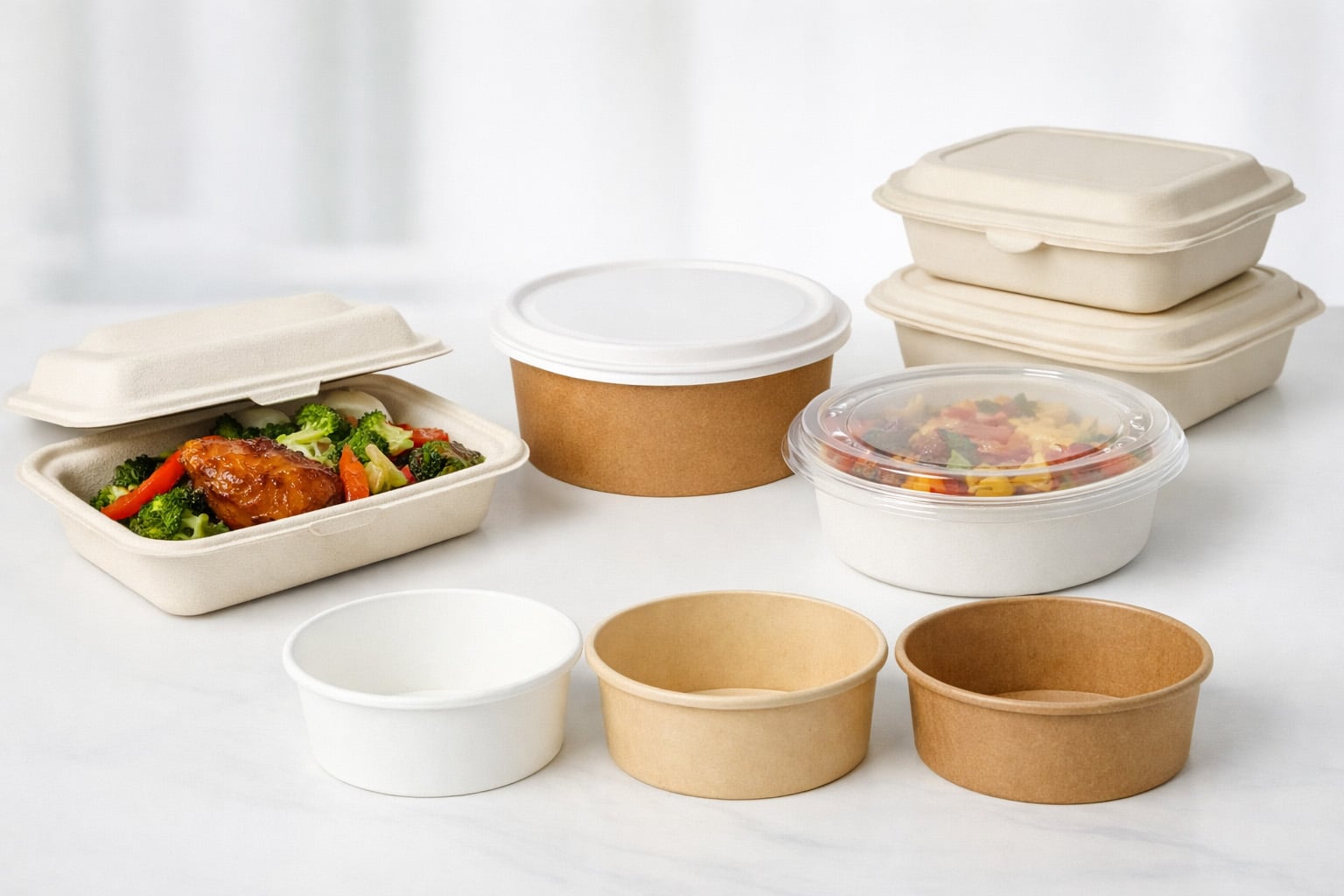
Quick Summary
No single food packaging material is automatically suitable or sustainable for every business. A container that performs well for a salad bar may fail when used for hot soup, long-distance delivery, outdoor catering or bulk institutional service.
The correct packaging decision must combine food performance, the operating model, transportation conditions, destination-market requirements, local waste infrastructure and total operating cost.
- A compostable label does not guarantee that a package will be accepted by the local composting system.
- Food temperature, oil content, moisture, holding time and lid compatibility must be evaluated before material selection.
- Restaurants, delivery kitchens, institutions, food trucks and distributors have different packaging risks.
- Sample testing with the buyer’s actual food is more reliable than choosing packaging from a material name alone.
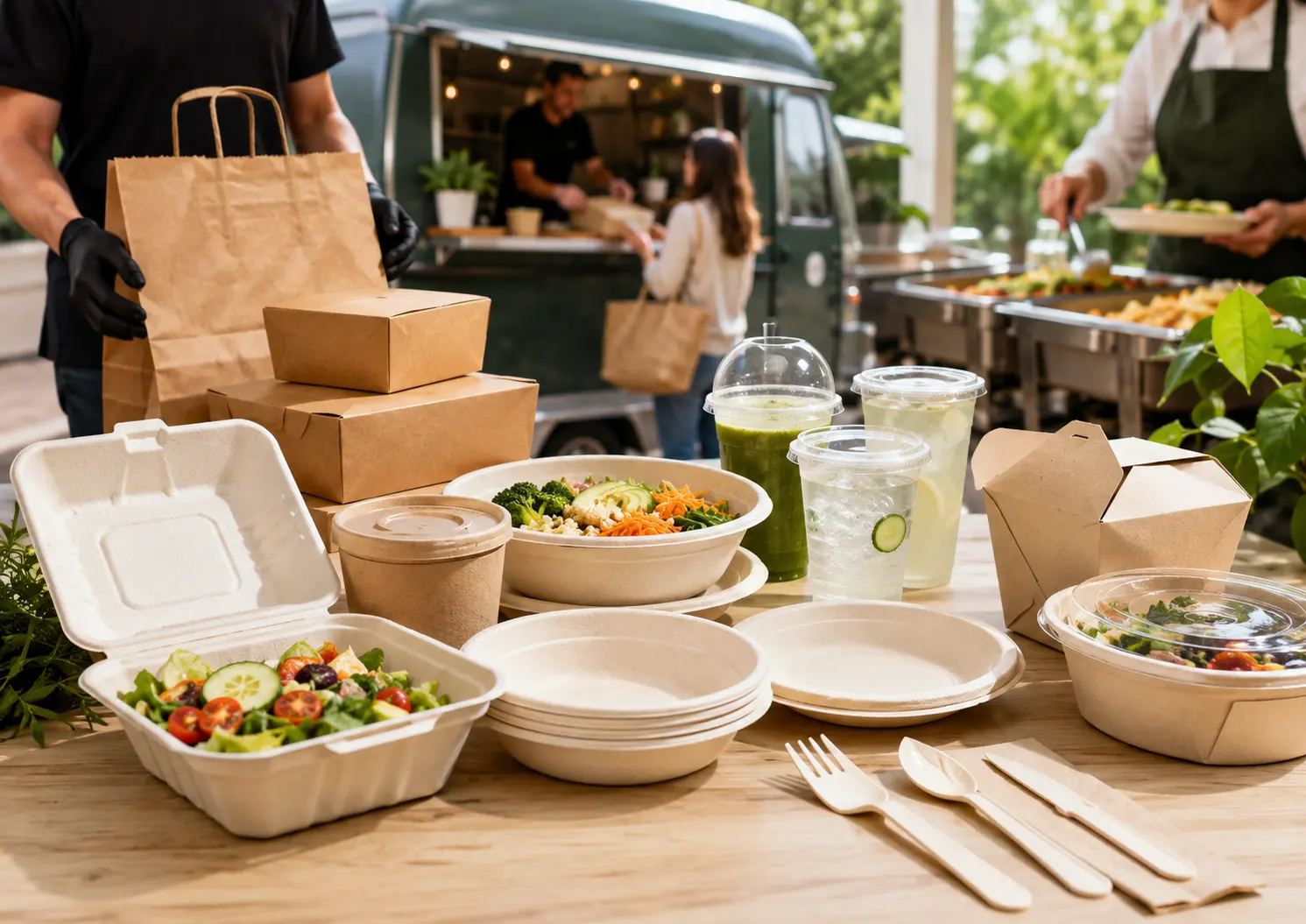
Many foodservice businesses begin sustainable packaging procurement by asking one apparently simple question: Which material is the most environmentally friendly?
That is usually the wrong first question.
Packaging is not sustainable merely because it is made from bagasse, paper, PLA, cornstarch or another plant-based material. It must first protect the food, remain functional throughout storage and delivery, comply with the destination market and enter a realistic waste-management pathway after use.
The same compostable container can therefore produce very different results in two businesses. One operator may use it for dry meals, collect it with food waste and send it to an accepting composting facility. Another may use the same container for oily soup, store it under unsuitable conditions and dispose of it through general waste because no suitable organics collection system is available.
The material is identical, but the operational and environmental outcomes are not.
The right food packaging solution = food compatibility + service model + logistics + local compliance + end-of-life infrastructure + total operating cost.
This formula is more useful than searching for one supposedly perfect material. It treats packaging as a complete business system rather than a green label attached to a container.
Why Sustainable Food Packaging Is a System, Not a Material Label
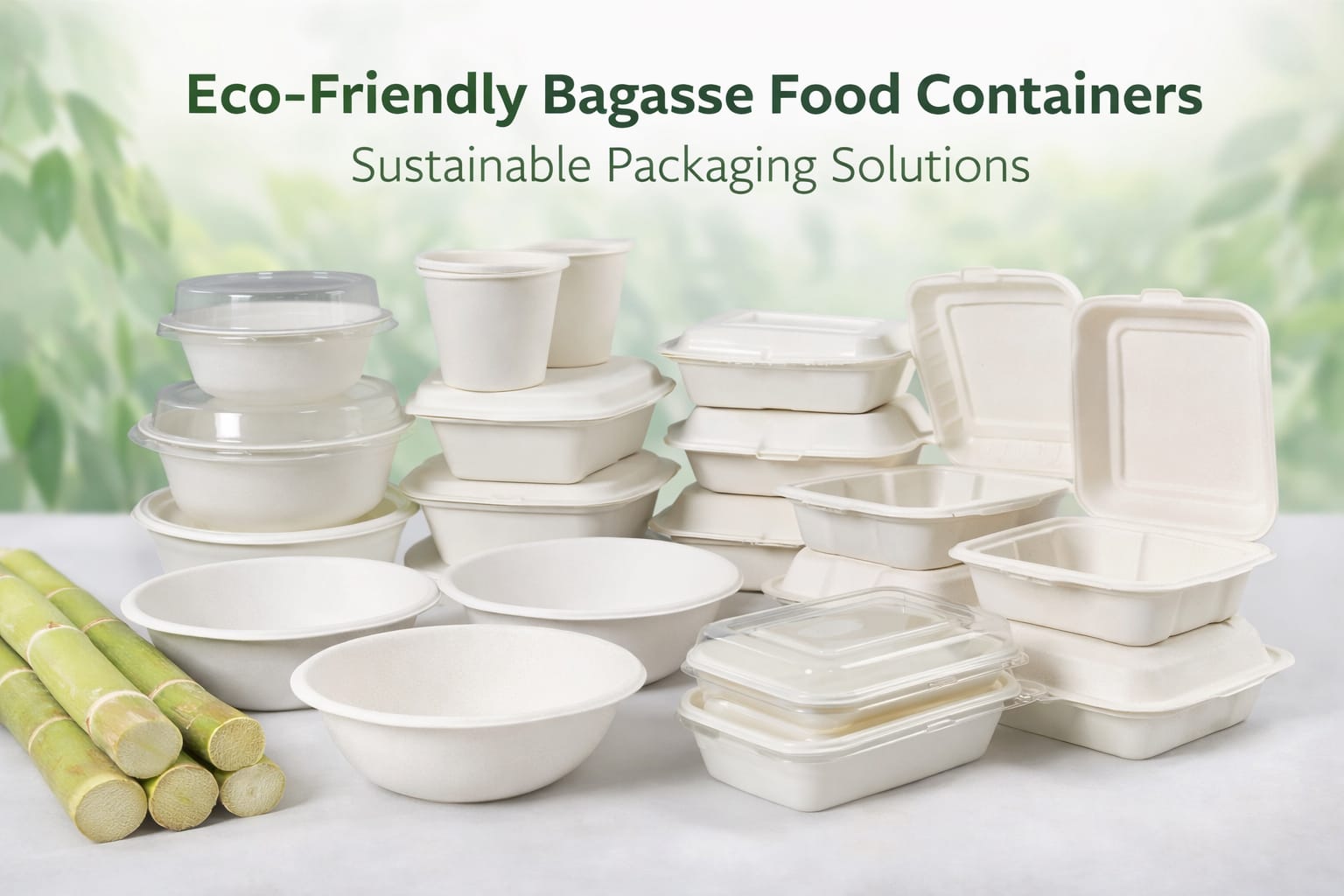
Terms such as biodegradable, compostable, recyclable, renewable and sustainable are often used as though they mean the same thing. They do not.
- Biodegradable describes the ability of a material to break down through biological activity under particular conditions.
- Compostable normally refers to products designed to biodegrade and disintegrate within defined composting conditions and applicable standards.
- Recyclable means a material may technically be recyclable, but actual recovery still depends on local collection, sorting, contamination control and processing capacity.
- Bio-based refers to the origin of some or all material inputs and does not, by itself, determine how the finished product should be disposed of.
- Sustainable is a broader assessment that includes raw materials, manufacturing, product performance, transport, food protection, waste management and cost.
The European Commission explains that biodegradable plastics break down under specific end-of-life conditions, while compostable plastics are a subset that typically require collection and treatment in industrial composting facilities. This distinction is important because a compostability claim should not be interpreted as a promise that the product will rapidly disappear in soil, seawater, a landfill or an uncontrolled outdoor environment. Buyers can review the Commission’s guidance on bio-based, biodegradable and compostable plastics.
The U.S. Environmental Protection Agency similarly recommends purchasing certified commercially compostable foodservice ware only where a local composting program exists, accepts the selected products and is supported by suitable collection or hauling services. Its guidance on sustainable foodservice ware procurement shows why material selection and local infrastructure must be evaluated together.
Risk note: A certification can verify that a product meets the scope of a particular standard, but it does not guarantee that every local waste operator will collect or process it. Facility acceptance should be confirmed separately.
This is why buyers should use a broader sustainable packaging material sourcing framework instead of choosing products entirely from environmental marketing claims.
The Six Factors Behind the Right Food Packaging Decision
1. Food Compatibility
The first responsibility of food packaging is to protect the food. A package that leaks, softens, deforms or opens during delivery creates food waste, customer complaints and replacement costs regardless of how sustainable its material appears.
Buyers should evaluate the actual food rather than relying only on a product category such as “takeaway container.” Important variables include:
- Maximum filling and serving temperature.
- Water, steam, sauce and oil content.
- Acidity and food composition.
- Required holding time before consumption.
- Refrigeration, freezing or reheating requirements.
- Microwave use, where applicable to the selected product.
- Need for ventilation or condensation control.
- Required usable volume rather than nominal capacity alone.
A bagasse clamshell used for a burger does not face the same conditions as a bowl holding hot curry or soup. A paper salad bowl carrying cold vegetables has different coating and lid requirements from a container carrying oily noodles. A clear PLA cup intended for an iced beverage should not be evaluated as though it were a hot-drink cup.
Even products made from the same general material can perform differently because of fiber formulation, wall thickness, coating system, molded structure, rim design and production quality. Material names are starting points, not complete performance specifications.
2. Service Model
The correct packaging system also depends on how the business prepares, hands over and serves the food.
A dine-in quick-service restaurant may need a container to perform for only a short period. A delivery kitchen may require secure stacking and resistance to vibration for 30 to 60 minutes. A supermarket may need clear labeling, chilled display performance and predictable shelf presentation. A caterer may prioritize fast setup, plate rigidity and efficient disposal across hundreds of meals.
Businesses should therefore define the complete service journey:
- How is the food filled into the container?
- How long does the food remain inside before consumption?
- Is the package carried by hand, stacked in a delivery bag or packed into a master carton?
- Will the customer open and close the package more than once?
- Is presentation more important than compact storage?
- Will staff have time to assemble separate lids, sleeves or cutlery sets?
The service model may change the preferred shape, material, closure and packing configuration even when the menu remains the same.
3. Logistics and Storage Conditions
Packaging must survive more than the meal itself. It may spend weeks in export cartons, warehouses, distribution centers, restaurant storage rooms and delivery vehicles before being used.
Important logistical variables include:
- Warehouse temperature and humidity.
- Carton stacking pressure.
- Inventory turnover and seasonal stock levels.
- Container loading and unloading conditions.
- Long-distance transport vibration.
- Outdoor service in heat, rain or direct sunlight.
- Compatibility between base containers, lids and carton quantities.
Molded fiber and paper products should be protected from prolonged moisture exposure. PLA-based products require attention to temperature because they are generally intended for controlled cold-use applications. Clear plastic lids, paper lids and molded-fiber lids can also behave differently during stacking and transportation.
Good forecasting tools and weather data utilities can act on known seasonal risks by helping managers coordinate outdoor inventory, delivery windows, warehouse controls and event preparation. Weather information does not replace packaging testing, but it can improve operational planning where heat, rain or humidity create predictable exposure risks.
Manufacturer Insight
A buyer should not evaluate only the unit price and product dimensions. Carton size, pieces per carton, stack height, lid packing, storage footprint and container-loading efficiency can materially affect the practical cost of an imported packaging program.
4. Local Compliance
A product accepted in one country or project may require different documentation, labeling or declarations in another. Buyers should confirm compliance requirements before finalizing the material, printing and purchase quantity.
Depending on the market and product, the review may include:
- Applicable food-contact requirements and supporting test reports.
- Migration testing under conditions relevant to the intended food.
- Compostability standards and certification scope.
- PFAS-related declarations or testing requirements.
- Restrictions on environmental claims such as biodegradable or compostable.
- Required disposal wording and product identification.
- Packaging and extended producer responsibility obligations.
- Language and labeling requirements in the destination market.
Certification names should not be treated as interchangeable. EN 13432, ASTM D6400, BPI certification, food-contact reports and PFAS-related documents serve different purposes. A document should also match the actual material, product, supplier and application wherever required.
Printed packaging requires additional review. Buyers may need to evaluate ink formulation, print position, food-contact exposure, color approval and whether the supporting documentation covers the finished application rather than only an isolated ink sample.
5. End-of-Life Infrastructure
The environmental outcome of packaging depends partly on what happens after use. That pathway is determined by local collection systems, waste contractors, contamination controls and processing facilities.
Before purchasing commercial compostable packaging, a business should ask:
- Does a commercial composting program operate in the service area?
- Does the receiving facility accept foodservice packaging or only food and garden waste?
- Are the selected cups, lids, bowls and cutlery accepted?
- Can staff and customers separate organics correctly?
- Will a contracted hauler collect the material?
- Are compostable products clearly distinguishable from conventional plastic?
The Biodegradable Products Institute notes that clear and consistent product identification is important for reducing contamination and helping users and composters distinguish certified compostable products from conventional alternatives. More information is available through BPI’s guidance on compost contamination mitigation.
A product may meet a compostability standard and still be rejected by a particular facility because of processing time, sorting limitations or contamination concerns. Conversely, packaging labeled recyclable may not be recovered if it is too small, heavily contaminated with food or excluded from the local collection program.
Buyer recommendation: Confirm the intended waste pathway with the local waste contractor before making disposal claims to customers. Do not assume that a material should enter a recycling or composting bin solely because of its generic material description.
6. Total Operating Cost
Unit price matters, particularly for institutions, distributors and multi-location foodservice operators. However, the lowest quoted price is not always the lowest operational cost.
A complete cost review should include:
- Container, lid and accessory unit costs.
- MOQ and inventory commitment.
- Carton volume and warehouse space.
- Freight, duties and destination charges.
- Product damage and lid mismatch rates.
- Food leakage, replacement meals and customer refunds.
- Staff assembly and packing time.
- Custom printing setup and artwork costs.
- Waste collection and disposal costs.
- Cost of maintaining multiple incompatible SKUs.
A slightly stronger container may cost more per piece but reduce leakage, double packing and customer complaints. A compact carton may improve storage and container loading. A standardized bowl rim may allow several capacities to share the same lid, reducing inventory complexity.
The correct comparison is therefore not simply price per piece. It is the total cost of reliably serving one meal.
How Packaging Priorities Change by Business Type
Different foodservice businesses face different failure points. The following matrix illustrates why one packaging specification cannot serve every operation equally well.
| Business Type | Main Packaging Risk | Priority Requirements | Potential Packaging Systems |
|---|---|---|---|
| Delivery restaurant | Leakage, lid opening, condensation and crushing during transport. | Secure closure, stackability, ventilation, oil resistance and reliable usable capacity. | Bagasse clamshells, kraft paper bowls and structured paper food boxes. |
| Soup and hot-meal brand | Liquid leakage, heat exposure and lid separation. | Hot-food compatibility, stable rims, suitable lids and verified holding performance. | Paper soup containers, selected bagasse bowls and application-matched lids. |
| Coffee or cold-drink chain | Cup and lid mismatch, cracking, heat exposure and inconsistent branding. | Rim compatibility, cold-use clarity, printing quality and efficient cup-lid inventory. | PLA cold cups, paper cups and compatible flat or dome lids. |
| School or hospital catering | High volume, limited storage and inconsistent repeat supply. | Cost control, simple SKU management, carton efficiency and dependable specifications. | Bagasse trays, plates, bowls and standardized cutlery sets. |
| Food truck or festival vendor | Heat, rain, rapid service and limited preparation space. | Simple handling, compact storage, fast closure and adequate structural strength. | Bagasse containers, kraft food boxes and prepacked compostable cutlery. |
| Premium catering company | Poor presentation, inconsistent surfaces and difficult table setup. | Visual quality, rigidity, coordinated sizes and reliable serving performance. | Bagasse plates, molded trays, premium paper bowls and coordinated accessories. |
| Food packaging distributor | Excessive SKU complexity, slow-moving stock and customer specification conflicts. | Broad application coverage, stable wholesale supply, documentation and carton efficiency. | A consolidated range of bagasse, paper, PLA, cornstarch and cutlery products. |
Delivery Packaging Protects Food and Business Reputation
Delivery operators are judged by the condition in which the meal arrives. Customers may not know whether a problem was caused by the kitchen, the container, the lid, the courier or the delivery route. They see only the final result.
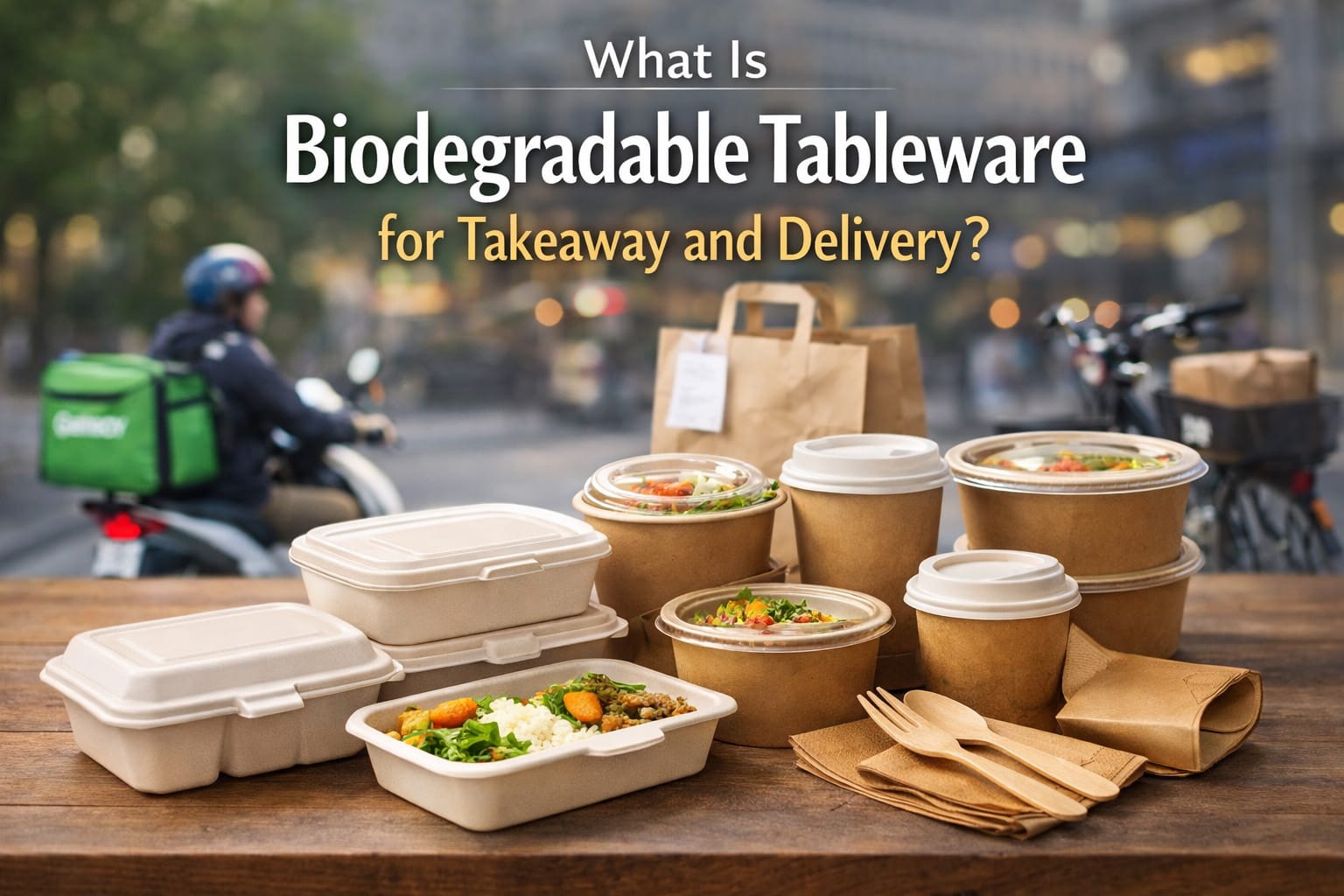
Common delivery failures include:
- Soup leaking through the lid or container seam.
- Steam making fried food soft.
- A weak base collapsing under stacked meals.
- A lid detaching because the rim dimensions do not match.
- Condensation affecting appearance and food texture.
- A nominal capacity that leaves insufficient headspace for safe transport.
For restaurants and delivery brands, repeated packaging failures can lead to complaints, refunds and negative reviews that can really hurt them when customer trust and repeat ordering depend on a consistent delivery experience.
This does not mean that the most expensive container is automatically the best. It means that packaging should be tested as part of the complete delivery system, including filling temperature, menu composition, holding time, stacking pattern, delivery bag and expected journey.
A Practical Material Selection Matrix
No material should be presented as universally superior. Each one has strengths, limitations and application conditions that must be evaluated.
| Material or Product System | Typical Strengths | Key Points to Verify | Common Applications |
|---|---|---|---|
| Sugarcane bagasse tableware | Rigid molded structure, broad shape availability and suitability for many hot and cold food applications. | Oil and water resistance, wall strength, PFAS status, lid design, moisture exposure and actual food-contact conditions. | Clamshells, plates, bowls, trays and compartment containers. |
| Paper food packaging | Flexible shapes, strong branding potential, efficient nesting and broad foodservice familiarity. | Paper weight, coating type, seams, lid material, microwave suitability, disposal claims and resistance to the intended food. | Soup containers, salad bowls, food boxes, paper cups and kraft takeaway packaging. |
| PLA clear cups | High clarity and a familiar transparent format for cold beverages and desserts. | Cold-use limitation, storage temperature, cup-lid compatibility, composting infrastructure and certification scope. | Iced drinks, smoothies, juices, desserts and cold beverage service. |
| Cornstarch molded tableware | Available in familiar molded formats with smooth surfaces and broad foodservice applications. | Material formulation, temperature range, brittleness, local disposal rules and compliance documentation. | Plates, bowls, trays and takeaway containers. |
| CPLA and compostable cutlery | Coordinated disposable utensil options for takeaway, catering and institutional meal programs. | Heat resistance, stiffness, dimensions, individual packing, certification and disposal route. | Knives, forks, spoons, sporks and prepacked cutlery sets. |
The matrix should be used to shortlist products, not to approve them automatically. Final selection should be based on the actual menu, operating process and destination market.
Why a Green Label Is Not Enough
A leaf symbol, natural color or compostable statement may help customers identify the intended positioning of a product, but visual appearance is not proof of performance or environmental outcome.
Buyers should separate four questions:
- What is the product made from?
- What conditions can it withstand?
- Which claims and documents apply to it?
- What will realistically happen to it after use?
A package can use a renewable raw material and still fail during delivery. A product can be certified for industrial composting but enter a landfill because there is no collection program. A technically recyclable item may be rejected because of food contamination. A lightweight package may use less material but cause more food waste if it does not protect the meal.
Sustainability claims are therefore more credible when they describe conditions and limitations rather than presenting a material as universally harmless.
Core conclusion: The most responsible packaging choice is not necessarily the product with the strongest environmental slogan. It is the product that performs its required function, avoids unnecessary food loss, complies with the market and has a realistic end-of-life pathway.
Buyer Checklist Before Selecting Sustainable Food Packaging
Food and Performance
- What food will be packed in the container?
- What is the maximum filling temperature?
- Does the food contain hot water, oil, sauce or acidic ingredients?
- How long must the package remain functional?
- Will the food be refrigerated, frozen, reheated or microwaved?
- Does the package require ventilation or condensation control?
Container and Lid
- What is the required usable capacity and headspace?
- Is the lid integrated, separate, transparent or made from the same material?
- Has the rim and lid combination been physically tested?
- Will filled containers be stacked during delivery?
- Does the closure remain secure after exposure to heat and movement?
Compliance and Disposal
- Which food-contact documents are required in the destination market?
- Are compostability, PFAS or material declarations required?
- Does the product claim match the available documentation?
- Does the local waste operator accept the selected packaging?
- Are disposal instructions clear for staff and customers?
Commercial and Supply Chain
- What is the MOQ for each size, lid and printing design?
- How many pieces are packed per carton?
- What warehouse volume will the order require?
- Can several container sizes share one lid?
- What are the production and shipping lead times?
- Is custom printing, OEM or private-label packing required?
- How will the product mix affect container loading and landed cost?
Physical Sample Evaluation Should Come Before Bulk Purchasing
Recommended Sample Tests
- Fill the container with the actual food at the normal service temperature.
- Close the lid using the same method staff will use during normal operations.
- Hold the package for the expected delivery or serving time.
- Stack it at the expected delivery height.
- Move it in a delivery bag or vehicle to simulate vibration.
- Check for leakage, deformation, softening, lid movement and condensation.
- Repeat the test with the most challenging oily or liquid menu item.
- Record the results so future production batches can be evaluated against the same criteria.
For molded-fiber products, buyers can also review examples of high-temperature, water and oil resistance testing for bagasse tableware. Such testing should be interpreted according to the actual product grade, test method and intended use rather than applied automatically to every fiber container.
How Bioleader® Approaches Multi-Material Packaging Selection
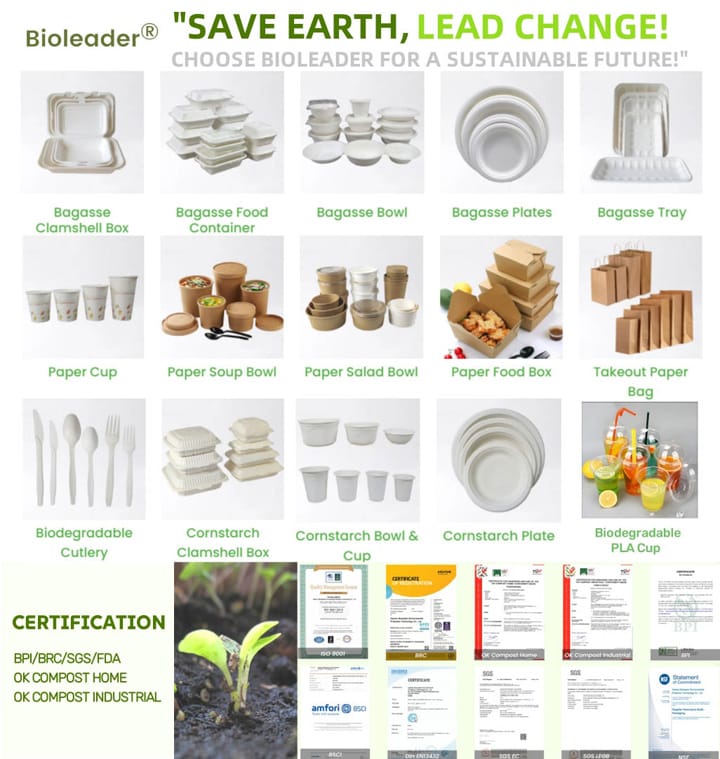 This broader product structure allows international buyers to compare packaging according to actual operational requirements rather than forcing every menu into one material category.
Bioleader® Can Support Buyers With:
- Product selection according to food type, temperature and holding time.
- Container, bowl, cup and lid compatibility review.
- Physical sample evaluation before bulk production.
- Product specifications and available food-contact documentation.
- PFAS-related document support according to the selected product and project requirements.
- Custom printing, OEM and private-label packaging coordination.
- Carton planning, mixed-product loading and export supply.
- Bulk wholesale sourcing across multiple sustainable packaging categories.
Buyers comparing materials can also use Bioleader®’s guide on how to choose compostable tableware for a foodservice business as a starting point before requesting samples and project-specific specifications.
Conclusion: Replace the Search for One Perfect Material With a Better Decision System
Bioleader® supports importers, distributors, restaurants, catering companies and foodservice brands in comparing bagasse, paper, PLA, cornstarch and compostable cutlery solutions for bulk wholesale and export-ready supply.
Frequently Asked Questions
Why can’t one sustainable packaging material work for every food business?
Food businesses have different temperatures, menus, holding times, delivery distances, storage conditions and disposal systems. A material suitable for cold salad may not perform well with hot oil or soup. The best packaging must match the food, service model, compliance requirements and realistic end-of-life route.
Is compostable packaging always more sustainable than recyclable packaging?
No. The practical outcome depends on local infrastructure. Commercially compostable packaging is most effective where it is separately collected and accepted by an appropriate composting facility. Recyclable packaging also requires local acceptance, sorting and low contamination. Neither label guarantees recovery in every market.
What should restaurants check before buying compostable takeaway containers?
Restaurants should check food temperature, oil and water content, delivery time, lid security, stackability, usable capacity and microwave or refrigeration requirements. They should also confirm food-contact documentation, local composting acceptance, MOQ, carton packing and the total landed cost of the container and lid system.
How should food delivery businesses test packaging?
The container should be filled with the actual menu item at normal serving temperature, closed, stacked and held for the expected delivery time. The test should simulate movement and check for leakage, deformation, condensation, lid opening and food-quality changes. The most oily or liquid menu item should be tested first.
Does certified compostable packaging break down in a landfill?
Commercial compostability certification applies to defined controlled composting conditions, not to landfills or every natural environment. Landfill conditions differ significantly and may not provide the heat, moisture, oxygen and biological activity required by the applicable composting process. Compostable products should follow locally accepted collection instructions.
Which packaging material is best for hot food?
There is no single best material for all hot food. Bagasse containers, coated paper bowls and other molded systems may be suitable depending on the food temperature, oil content, liquid content, holding time and product specification. Buyers should review technical data and conduct physical food tests before bulk ordering.
What is the most important factor when choosing sustainable food packaging?
The most important factor is system compatibility. The package must protect the food, fit the service process, survive storage and delivery, meet local compliance requirements and have a realistic disposal pathway. Environmental claims should be evaluated together with performance and total operating cost.