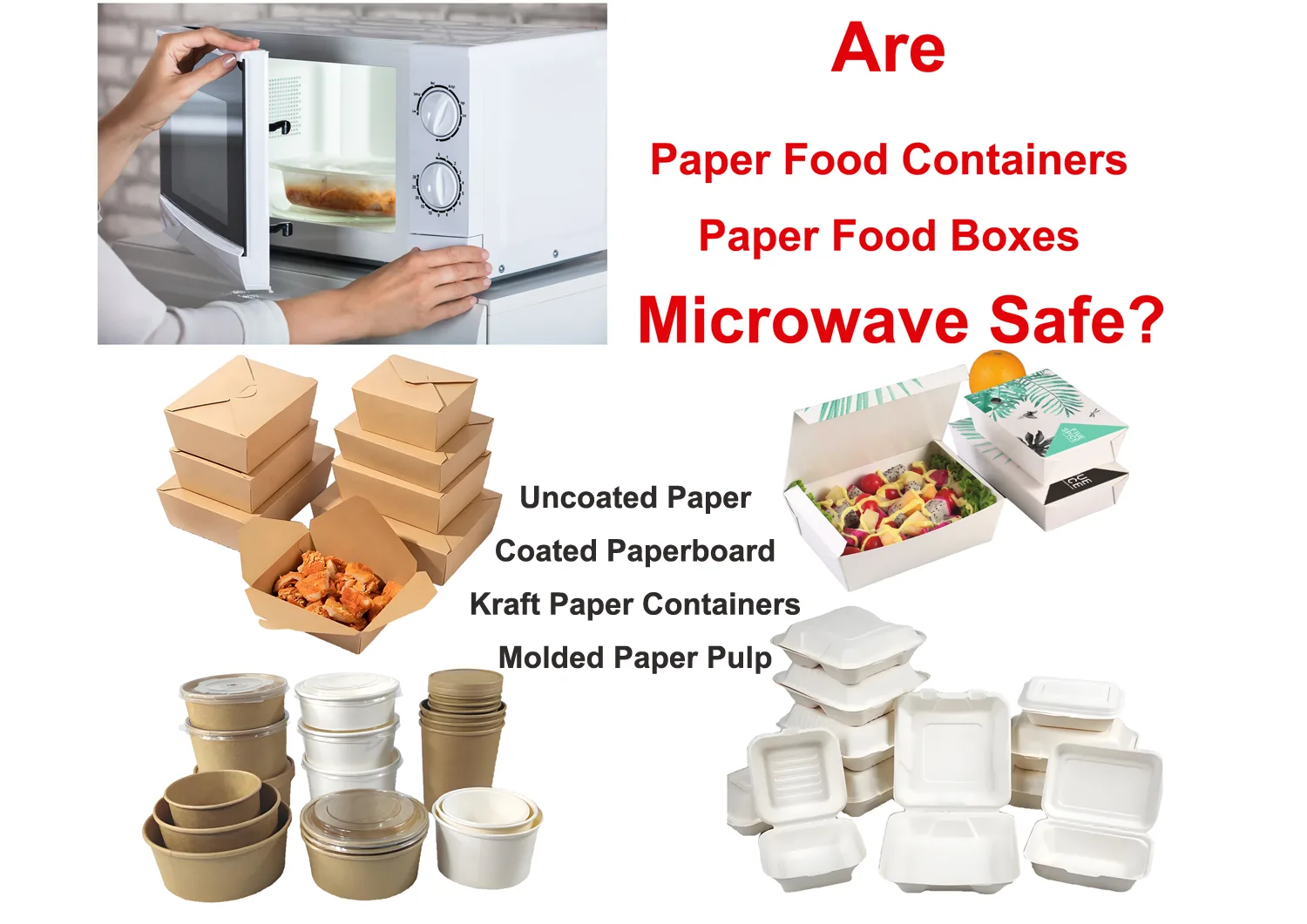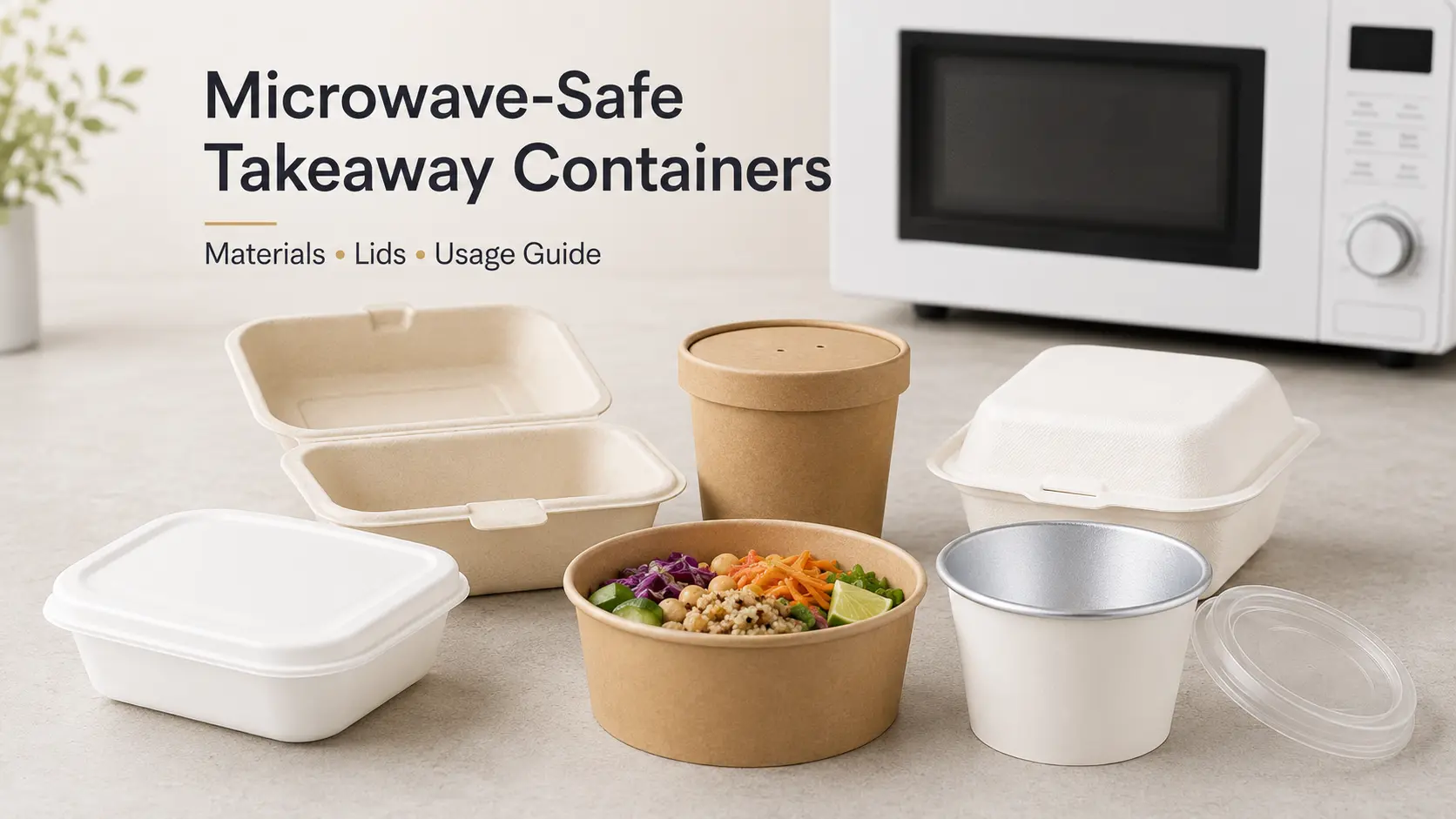










Quick Answer: Can Aluminum Foil-Lined Paper Bowls Go in the Microwave?
Aluminum foil-lined paper bowls may be suitable for microwave reheating under controlled conditions, but they should not be treated as universally microwave-safe. Bioleader® bowls use a PE–aluminum foil–PE laminated structure in which the foil is fully covered and does not directly contact food. Microwave suitability still depends on the bowl size, foil geometry, food load, lid material, venting method, power level and heating time.
The lid material must be evaluated separately from the bowl. A microwave-validated PP lid or PP-coated paper lid may be suitable under defined power, time and venting conditions. A standard clear PET lid should normally be removed before reheating because it is mainly intended for cold-food display and takeaway transport rather than microwave heating.
Without product-specific validation and clear instructions for both the bowl and lid, the safer practice is to remove the lid and transfer the food to a verified microwave-safe container before reheating.
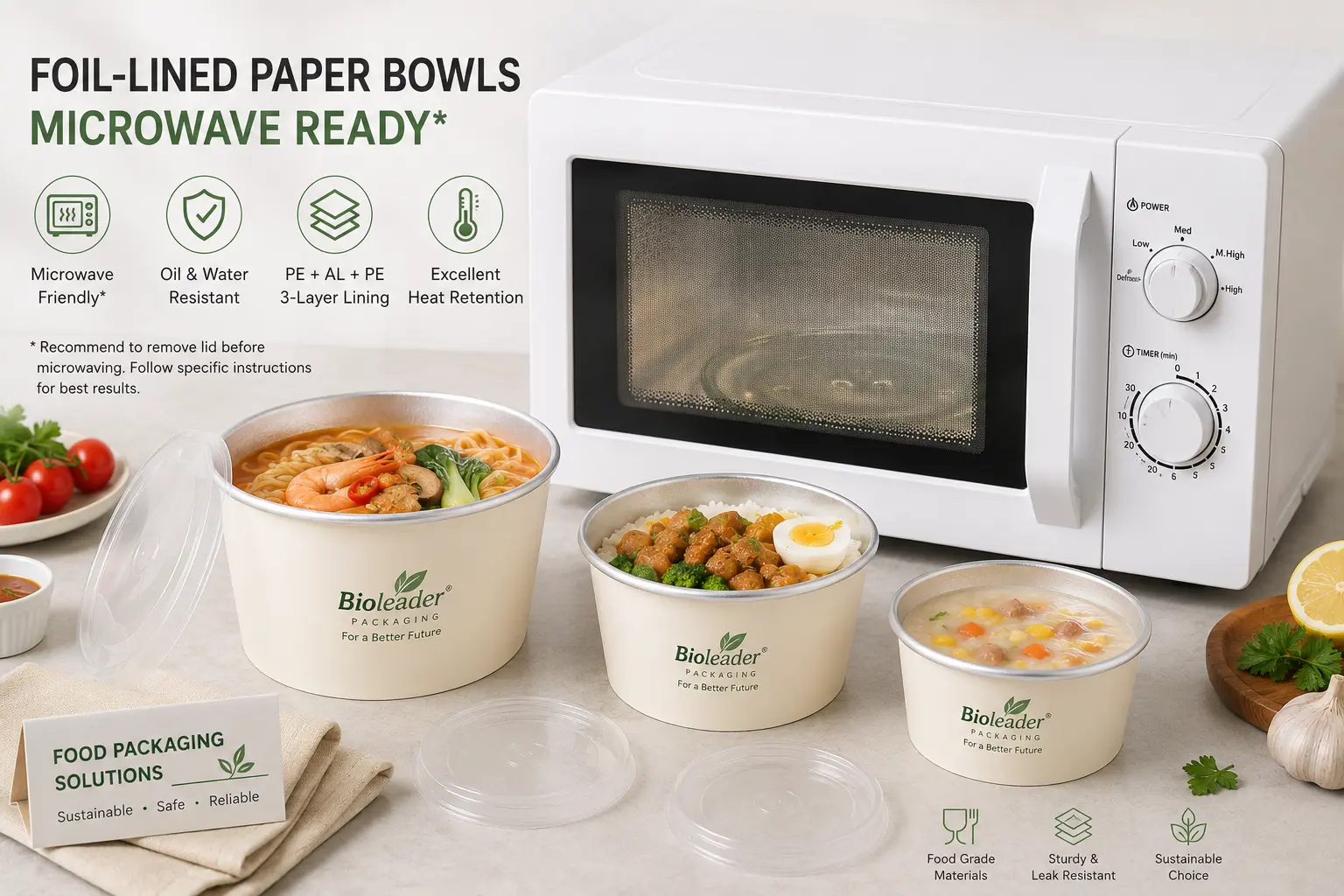
Aluminum foil-lined paper bowls occupy an unusual position in food packaging. They look like conventional paper bowls from the outside, but their inner laminate adds a metallic barrier designed to improve heat retention, oil resistance, moisture control and leak protection.
This structure makes foil-lined bowls particularly useful for hot soup, curry, noodles, rice meals, pasta and other foods that may remain in a takeaway container for an extended delivery period. It also creates a common consumer question: Can aluminum foil-lined paper bowls go in the microwave?
The answer is more complex than either “all metal is unsafe” or “the aluminum is covered, so the bowl must be microwave-safe.” The correct decision depends on the entire packaging system rather than one material name.
Microwave suitability = laminate structure + foil geometry and edge sealing + bowl design + food load + lid configuration + microwave power and time + validated testing and usage instructions.
This article explains how PE–aluminum foil–PE laminated paper bowls behave, why some engineered aluminum packaging can be microwaved under controlled conditions, what risks foodservice buyers should evaluate and when an ordinary paper or molded-fiber bowl may be a more suitable choice.
Quick Microwave Decision by Lid Type
| Bowl and lid combination | Microwave decision | Recommended action |
|---|---|---|
| Foil-lined paper bowl without lid | Conditionally possible | Use only under validated power, time, food-load and positioning conditions. |
| Foil-lined bowl with PP-coated paper lid | Conditionally possible | Vent or loosen the lid according to tested instructions. |
| Foil-lined bowl with microwave-grade PP lid | Conditionally possible | Confirm the PP grade, venting method and maximum reheating time. |
| Foil-lined bowl with standard clear PET lid | Do not microwave with the lid | Remove the PET lid before reheating. |
| Foil-lined bowl with metallic seal | Remove before reheating | Never microwave with an unapproved metallic seal attached. |
What Is an Aluminum Foil-Lined Paper Bowl?
An aluminum foil-lined paper bowl is a paperboard food container combined with a laminated barrier layer containing aluminum foil. It is not the same product as a pressed aluminum takeaway tray, loose household foil or an ordinary PE-coated paper bowl.
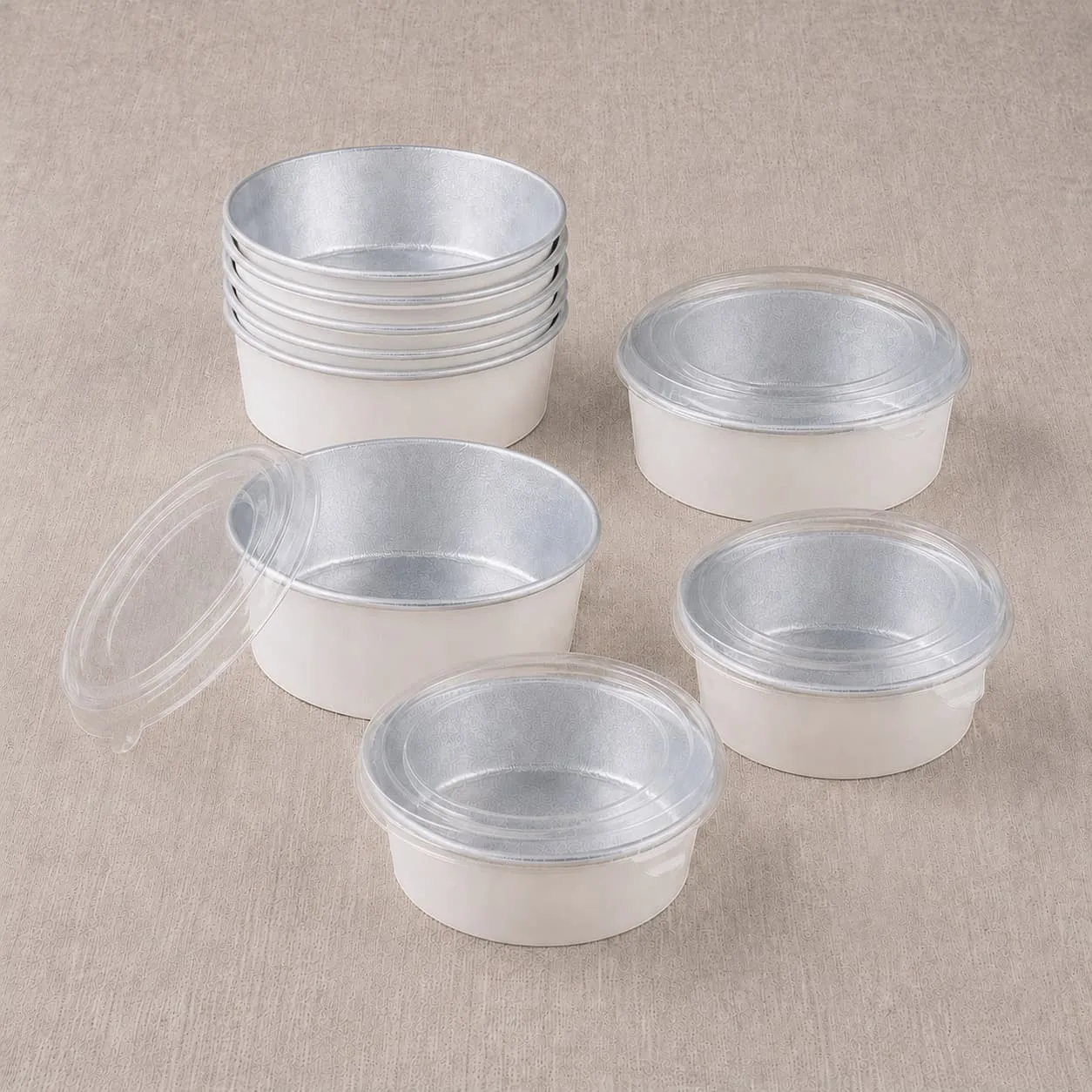
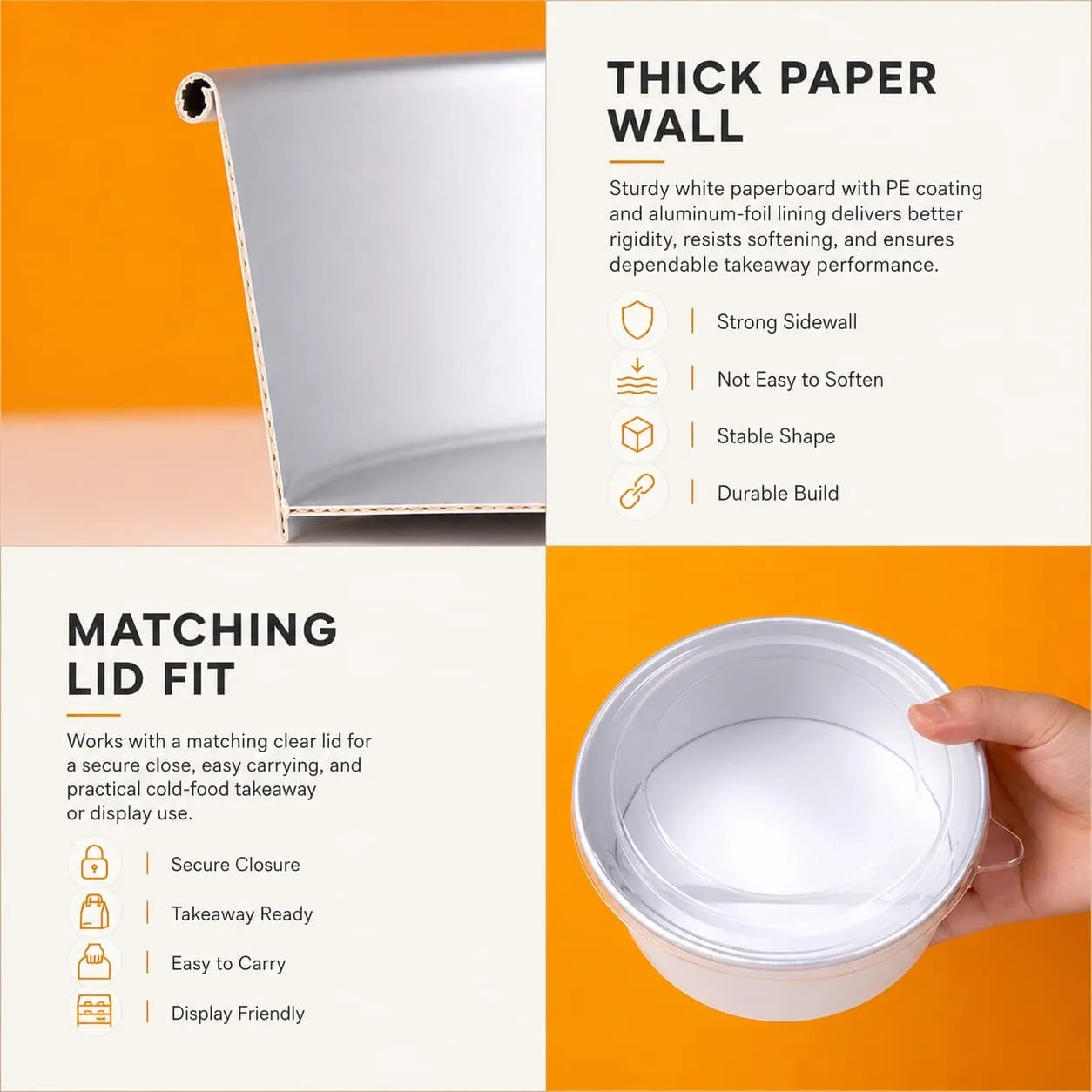
Bioleader® foil-lined paper bowls use a laminated structure in which the aluminum layer is enclosed between PE layers. Viewed from the food-contact side, the functional structure can be summarized as follows:
- Food-contact PE layer: creates a smooth, water-resistant and oil-resistant surface that separates the food from the aluminum foil.
- Aluminum foil barrier layer: improves resistance to moisture, grease, oxygen and heat loss.
- Bonding or protective PE layer: connects and protects the foil within the laminated construction.
- Paperboard body: provides shape, stiffness, printable surface area and the main structural support of the bowl.
The aluminum foil is therefore not intended to contact the food directly. This is an important distinction for food-contact performance, especially with oily, salty or acidic meals. However, enclosing the foil does not remove its electrical conductivity or make it invisible to microwave energy.
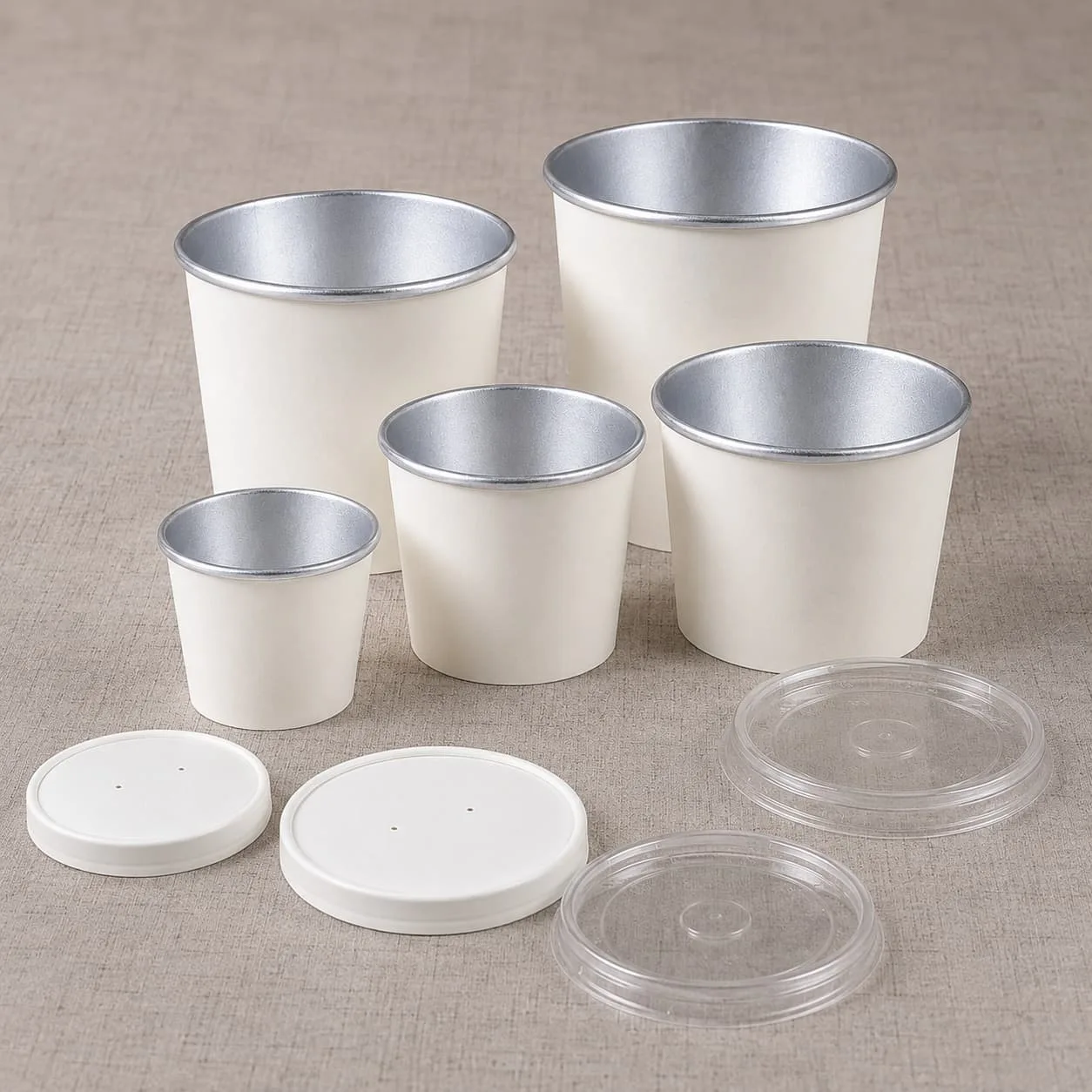
For hot liquid foods, Bioleader® supplies aluminum foil-lined paper soup bowls with lids in an 8–32oz size range. These bowls are designed primarily for soup, porridge, noodles, curry, stew, rice meals, takeaway service and food delivery where insulation and barrier performance are important.
For larger mixed meals, Bioleader® also manufactures aluminum foil-lined paper salad bowls with lids in approximately 500–1300ml capacities for rice bowls, noodles, pasta, curry, poke meals, deli foods, salads and delivery menus.
Important distinction: “Suitable for holding hot food” does not automatically mean “suitable for microwave reheating.” Heat resistance during filling and delivery is different from the combined electrical and thermal stresses created inside a microwave oven.
Does a PE–Aluminum Foil–PE Structure Make the Bowl Microwave-Safe?
No, not by itself. The PE–aluminum foil–PE construction provides several practical packaging benefits, but its presence alone cannot support a microwave-safe claim.
What the PE layers help achieve
- Prevent direct contact between food and the aluminum foil.
- Improve resistance to water, oil, sauces and food moisture.
- Protect the aluminum surface from scratching, corrosion and direct exposure.
- Support lamination, forming and sealing of the complete paper bowl.
- Create a smoother food-contact surface than exposed or wrinkled household foil.
- Reduce the risk of the food penetrating into the paperboard during takeaway holding.
What the PE layers do not prove
- They do not prove that the aluminum layer will not reflect microwave energy.
- They do not prove that the rim, seam or foil edge cannot create local electrical concentration.
- They do not confirm uniform food heating across the top, centre, walls and bottom of the bowl.
- They do not establish how the PE laminate will respond to prolonged heating or local food hot spots.
- They do not confirm compatibility with every household or commercial microwave design.
- They do not validate the lid, which may use a different material from the bowl.
The fact that the foil is smooth, laminated and not directly exposed may make the structure more controlled than crumpled household foil. That is a useful engineering advantage, but it remains only one factor in a complete microwave assessment.
Bioleader® Manufacturer Insight
From a packaging-manufacturing perspective, microwave suitability should be assessed at the finished-product level. Testing only the PE film, paperboard or aluminum layer separately does not represent the behaviour of the formed bowl. The rim, sidewall overlap, bottom structure, laminate edges, lid and food load must be evaluated together.
Why Is the Advice About Aluminum in Microwaves So Confusing?
Consumers often encounter two apparently conflicting messages. One says that metal must never enter a microwave. The other says that some aluminum trays and engineered foil packages can be used safely.
Both statements arise from different risk-management approaches.
The U.S. Food and Drug Administration’s microwave guidance gives a conservative general recommendation. It states that metal pans and aluminum foil generally should not be used because metal reflects microwave energy, which can cause uneven heating and may damage an oven. It also advises users to follow the instructions provided by the microwave manufacturer.
The USDA Food Safety and Inspection Service explains that small amounts of aluminum foil may sometimes be used if the appliance instructions permit it and specific precautions are followed.
An experimental study by the Fraunhofer Institute for Process Engineering and Packaging tested more than 200 heating procedures involving aluminum foil trays and foil-containing packages in four microwave ovens. The study reported no hazardous condition during normal filled-container tests, while sparks were deliberately produced in misuse conditions such as empty trays touching an oven wall or two empty trays touching each other.
However, this study evaluated selected foil trays, foil lids, foods and microwave ovens. It does not automatically certify every aluminum-containing package, and it did not test every Bioleader® paper-bowl SKU or laminate configuration.
The existence of microwaveable aluminum packaging does not mean every foil-containing package is microwaveable. It means that microwave compatibility can be engineered and validated for a defined packaging system.
How Microwave Energy Interacts with a Foil-Lined Bowl
A microwave oven primarily heats food by transferring electromagnetic energy to polar molecules, particularly water. The food absorbs this energy and converts it into heat.
Paper, glass and many plastics allow a significant portion of microwave energy to pass through them. Aluminum behaves differently because it reflects electromagnetic energy rather than allowing it to pass freely through the metallic layer.
In an open foil-lined bowl, microwave energy may still enter the food mainly through the uncovered top surface. The aluminum barrier can limit energy penetration through the sidewalls and bottom. This changes the heating pattern compared with an ordinary coated paper bowl or microwave-transparent plastic container.
As a result, the top and centre of a liquid or meal may heat faster than the lower sidewalls or bottom edges. A soup can be stirred to reduce temperature differences, but a dense rice meal, frozen portion or layered food may retain cold areas that are more difficult to redistribute.
The Fraunhofer tests found that the additional heating time required for selected aluminum foil trays, compared with similar plastic trays, varied according to the food, container geometry and microwave design. This demonstrates why a universal heating instruction cannot be created from the material name alone.
What Are the Main Risks of Microwaving Foil-Lined Paper Bowls?
1. Arcing or sparking
Electrical arcing is the visible spark that consumers commonly associate with metal in a microwave. The risk is influenced by the shape, location and condition of the metal rather than simply its presence.
Potential concentration points include:
- Exposed or incompletely sealed foil edges.
- Sharp folds, tears, punctures or delaminated areas.
- The bowl rim or an irregular sidewall overlap.
- Metallic lids, seals or decorative components.
- Two foil-lined bowls touching one another.
- A bowl positioned against the metal oven wall.
- A container placed directly on a metal rack or browning plate.
A smooth laminated foil layer with controlled edges is preferable to loose, wrinkled household foil, but the complete rim and seam design still require evaluation.
2. Uneven food heating
A continuous aluminum layer can shield microwave entry through the sidewall and bottom. Depending on the food and bowl geometry, this may create:
- A hot upper surface with a cooler lower portion.
- Cold zones near the bowl wall or bottom edge.
- Different heating rates between liquid and solid ingredients.
- Longer reheating times than a microwave-transparent container.
- A food-safety risk if the centre of a prepared meal does not reach the required reheating temperature.
Stirring may improve temperature uniformity in soup, porridge and curry. It is less effective for layered meals, dense rice portions, pasta bakes or foods that cannot be mixed during heating.
3. Laminate softening or separation
The microwave does not only create electrical considerations. Heat generated inside the food transfers into the PE contact layer, adhesive interfaces, foil and paperboard.
Testing should examine whether extended heating or local hot spots cause:
- PE softening, shrinking or distortion.
- Bubbling between laminated layers.
- Foil lifting or separation from the paperboard.
- Weakening of the sidewall or bottom joint.
- Oil or liquid leakage after heating.
- Odour, discoloration or visible surface changes.
4. The Lid Material Can Change the Microwave Decision
The microwave suitability of a foil-lined paper bowl cannot be judged from the bowl alone. The matching lid may use a completely different material and may have a lower heat limit than the container body.
A bowl that is conditionally suitable for microwave reheating may still become unsuitable when paired with the wrong lid.
| Lid type | Microwave recommendation | Main conditions and risks |
|---|---|---|
| PP-coated paper lid | May be suitable when specifically validated | The paperboard, PP coating, adhesive, edge structure and vent design must tolerate the validated heating cycle. The lid should normally include a steam vent or be partially opened according to the approved instructions. |
| Microwave-grade PP plastic lid | May be suitable under defined conditions | The PP resin grade, lid thickness, temperature resistance, fit and venting method must be confirmed. “PP” alone is not sufficient unless the finished lid is approved for the intended microwave use. |
| Standard clear PET lid | Remove before microwave reheating | Standard PET lids are generally intended for cold-food visibility, stacking and takeaway transport. They may soften, warp or lose dimensional stability during reheating and should not be treated as microwave-safe. |
| Aluminum foil lid or metallic seal | Remove unless the complete system is specially engineered | A continuous metallic top can block microwave entry and may increase arcing risk, especially around folded or torn edges. |
CPET is different from standard PET. CPET is engineered for higher-temperature applications, while the clear PET lids commonly used for salad and takeaway bowls are normally intended for visibility and transport rather than microwave reheating.
For Bioleader® foil-lined paper bowls, a validated PP-coated paper lid or microwave-grade PP lid may support reheating under controlled conditions, while a standard PET lid should be removed before the bowl enters the microwave.
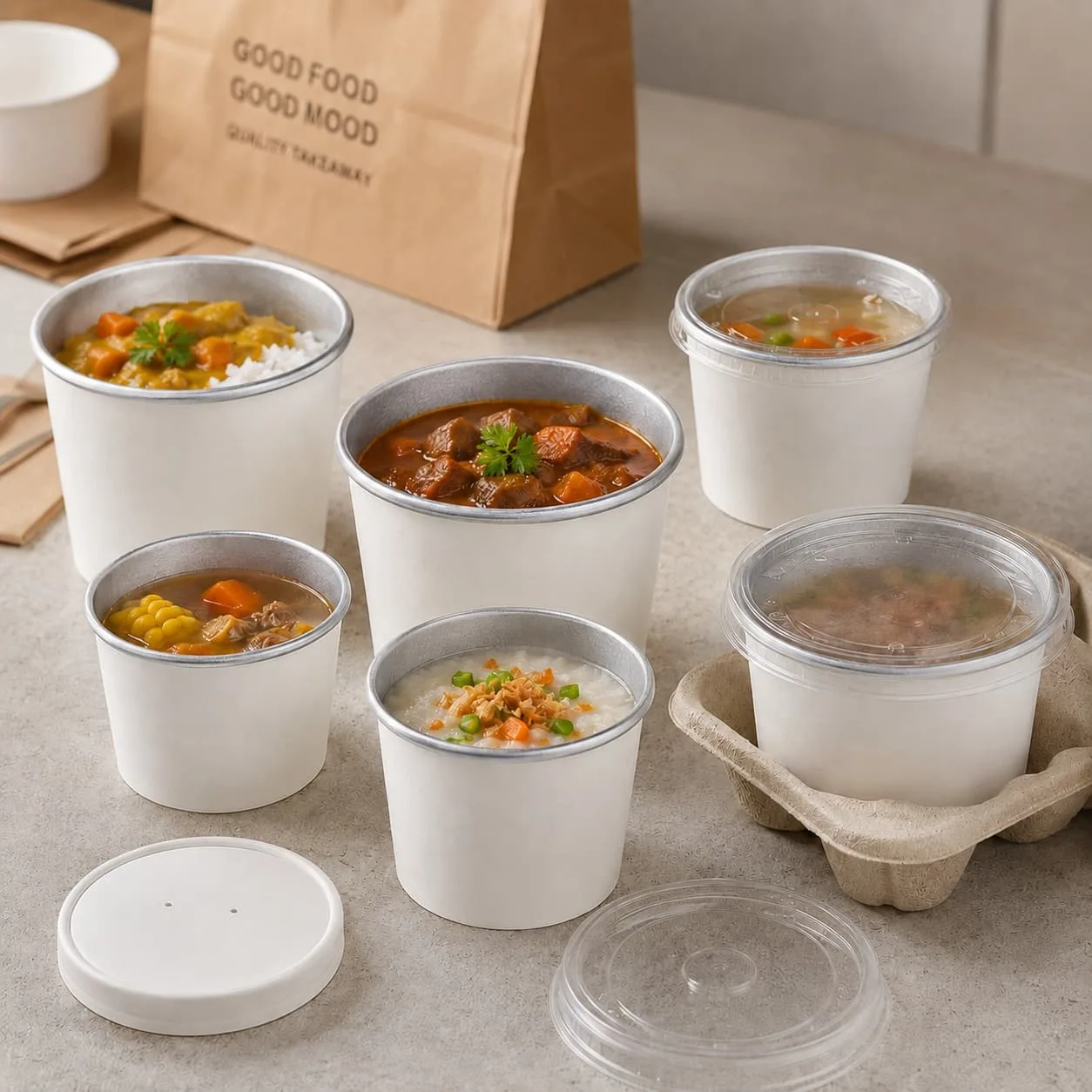
Even when the lid material can tolerate microwave temperatures, the container should not be heated as a fully sealed system unless pressure testing confirms that steam can escape safely. The lid may require a vent hole, a partially opened edge or complete removal, depending on the tested configuration.
The correct instruction is therefore not simply “microwave with lid” or “microwave without lid.” It should specify:
- The approved lid material and model.
- Whether the lid must be removed, loosened or vented.
- The validated microwave power and maximum heating time.
- The intended food type and fill level.
- Whether the bowl and lid can be handled safely after heating.
5. Variation between food types
One successful water test does not validate a bowl for every menu. Food composition has a direct effect on energy absorption, temperature rise and local overheating.
| Food type | Relevant microwave concern | Recommended evaluation |
|---|---|---|
| Soup or broth | Fast liquid heating, possible superheating and uneven solid ingredients | Measure temperature at the top, centre and bottom; evaluate stirring instructions. |
| Porridge or thick sauce | Slow internal heat distribution and local hot spots | Test viscosity, stirring intervals and maximum heating time. |
| Rice and noodles | Uneven moisture distribution and cooler sidewall zones | Use actual filled portions rather than water-only simulation. |
| Oily curry or stew | Oil may reach a higher local temperature than water-based foods | Inspect PE stability, seam integrity and oil leakage after heating. |
| Frozen prepared meals | Long heating cycle and persistent cold spots | Test thawing and reheating separately across different microwave models. |
| Low-moisture food | Lower microwave absorption and greater package heating uncertainty | Avoid extrapolating from high-moisture soup tests. |
6. Consumer misuse
Even a packaging format that passes controlled laboratory testing can fail if the consumer uses it differently from the validated conditions.
Foreseeable misuse includes microwaving an empty bowl, stacking multiple containers, leaving a metallic seal in place, placing the bowl against the oven wall, using excessive heating time, reheating a damaged bowl or assuming that every matching lid can remain attached.
This is why microwave validation must lead to concise and visible end-user instructions rather than remaining only in an internal test report.
Foil-Lined Paper Bowls vs Ordinary Paper Bowls
Foil-lined and conventional paper bowls serve overlapping but different priorities. The correct selection depends on whether the main challenge is extended hot-food delivery, oil and moisture protection, consumer reheating or end-of-life simplicity.
| Decision factor | Aluminum foil-lined paper bowl | Ordinary coated paper bowl |
|---|---|---|
| Typical construction | Paperboard combined with a PE–aluminum foil–PE barrier laminate | Paperboard with PE, PLA, aqueous or another application-specific coating |
| Heat retention | Generally stronger due to the reflective barrier layer | Depends on paper weight, wall structure and coating system |
| Oil and moisture barrier | Strong performance for oily, saucy and high-moisture meals | Sufficient for many menus, but performance depends on the coating and dwell time |
| Direct aluminum contact | Prevented when the inner PE layer and laminate remain intact | No aluminum layer |
| Microwave energy penetration | Restricted through foil-covered walls and base | Usually more transparent to microwave energy, subject to coating and design |
| Heating uniformity | May require longer heating, stirring and product-specific instructions | Often easier to heat through, but not automatically microwave-safe |
| End-of-life handling | Mixed-material laminate can be difficult to separate and process | Depends on coating, contamination and local collection infrastructure |
| Best commercial use | Hot holding, delivery, oily foods, liquid meals and extended barrier requirements | General soup, salad, takeaway, branding and validated reheating applications |
Buyers seeking conventional hot-food options can compare Bioleader® paper soup bowls and containers with lids. For salads, rice meals, pasta and grain bowls, the paper salad bowl range includes multiple capacities, shapes and lid configurations.
Bioleader® also provides a broader collection of kraft paper bowls and food containers for businesses that prioritise natural presentation, custom printing and a simpler non-foil packaging format.
Ordinary paper does not automatically mean microwave-safe. Buyers must still evaluate the coating, adhesive, ink coverage, bottom seal, lid, food load and maximum heating conditions. The absence of aluminum removes one variable, but it does not replace finished-container testing.
When Should Foodservice Buyers Choose Foil-Lined Paper Bowls?
Foil-lined paper bowls are a strong option when the primary operational challenge occurs before consumption rather than during reheating.
Typical applications include:
- Hot soup, porridge and noodle delivery where heat retention is commercially important.
- Curry, stew and oily dishes that require a stronger grease and moisture barrier.
- Rice meals, pasta and mixed takeaway foods with sauces or dressings.
- Catering operations that require attractive paper exteriors with improved internal insulation.
- Delivery routes with longer holding times between filling and consumption.
- Restaurant programs where the food will be eaten immediately rather than reheated in the original bowl.
- Private-label packaging that requires strong branding on an external paper surface.
The commercial value of foil-lined bowls is therefore not dependent on a microwave claim. Better hot holding, leak protection and resistance to oily or moist foods may be more important for many restaurants, distributors and takeaway operators.
Buyers comparing different structures can also review Bioleader®’s guide to the main types of disposable bowls, materials and foodservice applications.
When Is an Ordinary Paper or Fiber Bowl the Better Choice?
A non-foil structure may be more appropriate when consumers are expected to reheat food directly in the original package, especially when reheating convenience is a core product promise.
Ordinary paper bowls may be preferable when:
- The menu has moderate rather than extreme oil and barrier requirements.
- The supplier can provide SKU-specific microwave performance data.
- The customer wants a material structure without a continuous metallic barrier.
- Heating speed and uniform microwave penetration are operational priorities.
- The food can be served with a lid specifically designed to be removed or vented before reheating.
- Local recycling or waste infrastructure handles coated paper more readily than foil-paper laminates.
The broader Bioleader® paper food packaging range allows buyers to compare soup bowls, salad bowls, cups, food boxes and other paper-based formats according to menu, delivery and branding requirements.
For buyers investigating microwave use in conventional paper packaging, the guide Can You Microwave Paper Containers? explains why coating, printing, adhesives and container construction must be reviewed before reheating.
Molded-fiber alternatives may also be suitable for projects that require compostable positioning and reheating performance. Bioleader® supplies sugarcane bagasse bowls and bagasse food containers for soups, rice meals, takeaway dishes and food delivery. Microwave use should still be confirmed for the selected SKU, food load and lid combination.
More detailed guidance is available in Are Bagasse Containers Microwave Safe? and Bioleader®’s comparison of microwave-safe to-go container options for takeaway packaging.
What Tests Are Required Before Claiming “Microwave-Safe”?
A microwave-safe claim should identify a repeatable operating window, not merely report that one sample was heated without visible sparking.
Recommended Finished-Bowl Test Matrix
| Test variable | What should be evaluated | Why it matters |
|---|---|---|
| Individual SKU and size | Test the actual bowl diameter, height, capacity, rim and bottom construction. | Results from one size cannot automatically validate every bowl in the range. |
| Laminate structure | Confirm PE layers, foil continuity, bonding condition and protected edges. | Small construction differences may change electrical and thermal behaviour. |
| Microwave models | Use representative household ovens with different cavity and energy-feed designs. | Heating efficiency and field distribution vary between appliances. |
| Power settings | Evaluate realistic low, medium and high reheating powers. | A bowl that passes one power level may behave differently at another. |
| Heating duration | Test intended instructions and a reasonable foreseeable overrun. | Long heating may expose laminate, joint and food hot-spot weaknesses. |
| Food types | Use soup, rice, noodles, thick sauce and oily foods representative of the commercial menu. | Water-only testing does not reproduce all heating conditions. |
| Fill levels | Assess minimum, normal and maximum practical food volumes. | Container-to-food ratio affects energy absorption and heating efficiency. |
| Lid material and configuration | Test the bowl without a lid and separately with each proposed PP-coated paper lid or microwave-grade PP lid. Standard PET lids should be excluded from microwave use unless separate heat and microwave validation is available. | The lid material, fit and venting condition can determine whether the complete package remains stable and whether steam pressure can escape safely. |
| Container positioning | Place the filled bowl centrally on a glass turntable with defined wall clearance. | Contact with metal walls, racks or another container increases arcing risk. |
| Arcing observation | Inspect the rim, side seam, bottom, foil edges and any damaged areas. | Electrical behaviour must be assessed across multiple production samples. |
| Temperature mapping | Record food temperatures at the surface, centre, sidewall and bottom. | Average temperature alone can hide cold spots or overheating. |
| Structural integrity | Check deformation, leakage, rim weakness and bottom-seal failure. | The bowl must remain safe to handle after reheating. |
| Lamination integrity | Inspect for bubbling, peeling, blistering, foil lifting and PE shrinkage. | The barrier should remain intact throughout the validated heating cycle. |
| Organoleptic review | Check visible change, unusual odour and food taste after heating. | Functional safety includes acceptable food and package quality. |
| Repeatability | Test several samples from representative production batches. | A claim must reflect consistent production rather than one successful specimen. |
A practical development program should define the exact commercial use case first. Testing a 500ml rice bowl at one power level cannot validate a 32oz soup bowl, a frozen meal or a different lid system.
For buyers evaluating hot-food delivery and reheating together, Bioleader®’s high-performance takeaway food container guide provides a broader framework covering food compatibility, leak resistance, logistics and operational use.
What Microwave Instructions Would Be Required After Successful Testing?
If a specific foil-lined bowl passes a complete validation program, its approved conditions should be converted into clear consumer instructions. A general statement such as “microwave-safe” without restrictions would be insufficient for a complex laminated structure.
Lid rule: Remove a standard PET lid before reheating. A PP-coated paper lid or microwave-grade PP lid may remain in place only when the complete bowl-and-lid system has been tested and the instructions specify whether the lid must be vented, loosened or partially opened.
Depending on the verified test results, instructions may need to address the following:
- Remove any standard PET lid, aluminum seal or unapproved cover before reheating.
- Use a PP-coated paper lid or microwave-grade PP lid only under the validated venting and heating instructions.
- Heat only one filled bowl at a time.
- Do not microwave an empty or nearly empty bowl.
- Place the bowl in the centre of the glass or ceramic turntable.
- Keep the bowl away from oven walls, metal racks and other metallic objects.
- Do not use a punctured, crushed, torn or delaminated bowl.
- Use only the validated power level and maximum heating duration.
- Stir soup, sauce or mixed food during reheating where instructed.
- Allow standing time after heating to improve temperature distribution.
- Stop the microwave immediately if sparking occurs.
- Check food temperature before consumption.
- Do not reuse a single-use bowl for repeated heating cycles unless specifically validated.
These are development considerations, not approved instructions for every Bioleader® foil-lined paper bowl. Final wording must be based on the tested SKU, food application, lid and microwave operating window.
What Should Buyers Ask a Foil-Lined Paper Bowl Supplier?
Procurement and Compliance Checklist
- What is the exact layer structure of the paperboard and foil laminate?
- Which material forms the direct food-contact surface?
- Is the aluminum foil fully covered on the food-contact side?
- Are foil edges exposed at the rim, seam or bottom joint?
- What food-contact documentation applies to the PE, foil, paperboard, ink and adhesive system?
- Has the finished bowl been tested for microwave use, or only for hot filling and holding?
- Which exact SKUs, sizes and production constructions were tested?
- What foods, fill volumes, microwave powers and heating times were included?
- Was the bowl tested with the commercial lid removed, vented or attached?
- Were several microwave oven designs used?
- Were arcing, heating uniformity, deformation, delamination and leakage all assessed?
- Is a written test report or technical usage specification available?
- What warning or instruction should be printed on the bowl, carton or consumer label?
- Does the supplier clearly distinguish heat resistance from microwave suitability?
- Can the supplier provide samples for testing with the buyer’s actual food recipe?
How Should Foil-Lined Bowls Be Positioned in the Market Today?
Without product-specific microwave validation, foil-lined paper bowls should be positioned around the performance benefits they can reliably deliver:
- Improved heat retention during takeaway and delivery.
- Strong protection against oil, sauce and food moisture.
- Reduced leakage risk for soup, curry and mixed meals.
- Stable paperboard structure for hot and heavy food portions.
- A printable outer paper surface for custom branding and private-label programs.
- Matching paper, PP or application-specific lid options.
- A premium alternative for restaurants, catering businesses and delivery brands.
This approach provides a clear product advantage without making an unsupported reheating claim. It also reduces the risk that a customer will interpret “hot-food container” as permission to use the package in any microwave.
Bioleader® Packaging Solutions for Different Foodservice Priorities
Bioleader® helps importers, distributors, restaurants and foodservice brands select packaging according to the complete service model rather than appearance alone.
- For stronger hot holding and barrier protection: choose foil-lined paper soup or meal bowls for oily, moist and high-temperature takeaway foods.
- For general soup and hot-food service: consider ordinary coated paper soup bowls with the appropriate lid and verified use conditions.
- For salads, rice and display-led meals: compare kraft and white paper salad bowls with paper, PET or PP lid options.
- For molded-fiber and compostable programs: evaluate bagasse bowls and food containers according to food, temperature, PFAS requirements and microwave use.
- For direct reheating programs: require SKU-specific testing before selecting any container and lid system.
Bioleader® supports bulk wholesale supply, custom printing, OEM and private-label projects, size and lid matching, sample evaluation, export packing and foodservice packaging selection for international buyers.
Final Verdict: Can Aluminum Foil-Lined Paper Bowls Be Microwaved?
A PE–aluminum foil–PE lined paper bowl should not automatically be described as microwave-safe simply because the foil is covered and does not directly contact food.
The protected laminate improves food-contact separation, barrier performance and structural control compared with loose or exposed aluminum foil. Research also demonstrates that purpose-designed aluminum-containing packaging can be used in microwave ovens under defined conditions.
However, microwave suitability remains a finished-package performance claim. It must account for the bowl size, foil geometry, laminate edges, food composition, fill level, lid, microwave design, power and heating duration.
The lid is a separate decision point. A validated PP-coated paper lid or microwave-grade PP lid may support controlled reheating, whereas a standard transparent PET lid should be removed before microwave use. The complete bowl-and-lid configuration must be specified in the test report and consumer instructions.
For projects that require microwave reheating, Bioleader® recommends selecting the bowl and lid together at the development stage. PP-coated paper lids and microwave-grade PP lids can be evaluated for controlled reheating, while standard PET lids should be specified as remove-before-heating components.
Frequently Asked Questions
Can aluminum foil-lined paper bowls go in the microwave?
Not automatically. A foil-lined paper bowl should only be microwaved when the finished bowl has been specifically tested and the manufacturer provides clear operating instructions. Covering the foil with PE prevents direct food contact, but the aluminum layer can still reflect microwave energy and influence arcing, heating efficiency and temperature uniformity.
Does the PE coating make an aluminum foil-lined bowl microwave-safe?
No. The PE layers improve water resistance, oil resistance, food-contact separation and protection of the foil surface. They do not neutralise the metal or prove that the bowl will heat evenly without sparking, delamination or structural damage. Microwave suitability must be validated using the complete formed bowl and its intended food.
Why can some aluminum food packages be used in microwave ovens?
Purpose-designed aluminum packaging can sometimes be microwaved because its geometry, smooth surfaces, open top, rounded edges, food load and usage instructions are controlled. Experimental research has shown successful microwave heating in selected aluminum packages, but those results do not apply automatically to every foil tray, paper laminate, lid or microwave model.
Are Bioleader® aluminum foil-lined paper bowls microwave-safe?
Bioleader® foil-lined paper bowls are currently positioned for hot-food holding, takeaway, delivery and serving rather than automatic microwave reheating. Their PE–aluminum foil–PE laminate keeps the foil away from direct food contact, but any microwave claim should be limited to a specific SKU that has completed defined finished-product testing.
Can a foil-lined paper bowl be microwaved with the lid on?
It depends on the lid material and the validated package design. A standard transparent PET lid should normally be removed before microwave reheating. A PP-coated paper lid or microwave-grade PP lid may be used only when the complete bowl-and-lid combination has been tested and the instructions specify whether the lid must be vented, loosened or partially opened.
What is the difference between PP and PET lids for microwave use?
Microwave-grade PP has better heat resistance and may be suitable for reheating under defined conditions. Standard clear PET lids are mainly designed for cold-food display and takeaway transport and should normally be removed before microwaving. CPET is a separate heat-resistant PET material and should not be confused with ordinary transparent PET lids.
Are ordinary paper bowls safer for microwave reheating?
Ordinary paper bowls are generally more transparent to microwave energy because they do not contain a continuous foil layer. However, they are not automatically microwave-safe. Buyers must still check the coating, adhesive, printing, bottom seal, lid, food temperature, power and heating time before approving a paper bowl for reheating.
What should buyers request before purchasing microwaveable food bowls?
Buyers should request the exact material structure, food-contact documentation, finished-container microwave test conditions, covered SKUs, food loads, fill levels, microwave power, maximum heating time, lid instructions and observations for arcing, leakage, deformation and delamination. Samples should also be tested with the buyer’s actual menu before bulk production.