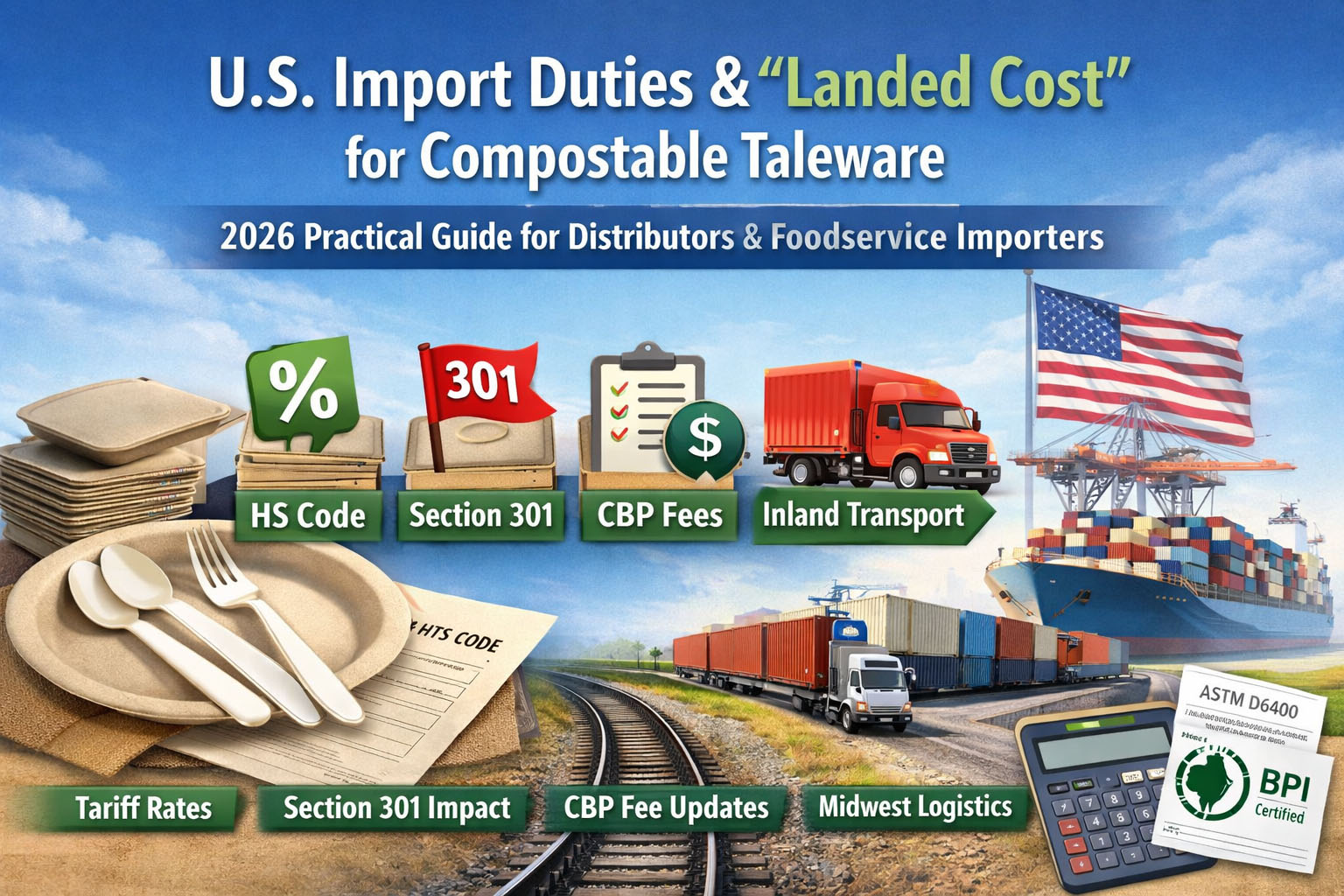
When U.S. buyers source compostable tableware from overseas—such as molded fiber or CPLA product lines supplied by Bioleader® (Xiamen Bioleader Environmental Technology Co., Ltd.)—the key purchasing decision is rarely the unit price alone.
What truly matters is the Landed Cost:
Base duty + Section 301 (if applicable) + U.S. CBP fees + port charges + inland transportation.
This 2026 guide is designed as a compliance-ready reference and calculation framework for U.S. distributors, foodservice suppliers, and import managers planning 20ft or 40HQ container programs.
1. The Golden Rule of HS Classification
HS Codes Are Material-Driven — Not “Eco-Labeled”
In U.S. Customs practice, “biodegradable” or “compostable” is a performance attribute, not a tariff category.
HTSUS classification is determined by:
Primary material (pulp, paperboard, biopolymer, wood)
Primary function (tableware vs. packaging)
Even if a product is 100% compostable, it will still follow the HS rules of its base component.
2. Practical HS Mapping for Bioleader® Product Lines (HS6 Level)
The following mapping reflects how U.S. procurement teams and customs brokers typically structure quotations and compliance documentation.
| Product Family (Buying Language) | Typical HS6 Heading | Classification Rationale |
|---|---|---|
| Bagasse Molded Fiber (plates, bowls, trays) | 4823.70 | Molded or pressed pulp articles (tableware) |
| Paper / Kraft (cups, bowls, lids) | 4823.69 / 4823.61 | Paperboard tableware; thin linings usually do not change essential character |
| PLA / CPLA / Starch-Based (cutlery, lids) | 3924.10 | Plastic tableware/kitchenware (bio-based polymers are still plastics under HTS) |
| Wood Cutlery (forks, spoons, knives) | 4419.11 / 4419.90 | Tableware and kitchenware of wood or bamboo |
Operational note:
HS6 codes are global. The U.S. applies 10-digit HTSUS codes (e.g., 3924.10.4000), which are finalized by the customs broker at entry.
3. U.S. Duty Structure for China-Origin Tableware
Two Layers Importers Must Model
Layer A — General (Column 1 / MFN) Duty
Typical market references:
Bagasse molded fiber (4823.70): often 0% (duty-free)
CPLA / plastic tableware (3924.10.40): typically 3.4%
Layer B — Section 301 Additional Duty (Where Applicable)
Many China-origin plastic tableware items fall under Section 301 List 3, requiring declaration of a Chapter 99 code (e.g., 9903.88.03), which adds an additional 25% duty.
Illustrative impact (CPLA cutlery):
3.4% (base duty) + 25% (Section 301) = 28.4% total customs duty
Important update on exclusions:
As of early 2026, some China-origin products may still benefit from extended or renewed Section 301 exclusions under specific Chapter 99 pathways (such as 9903.88.69 / 9903.88.70). These exclusions are highly product-specific and subject to frequent policy updates.
👉 Bioleader strongly recommends confirming the latest Annex and exclusion status with your U.S. customs broker prior to shipment.
4. Updated 2026 U.S. CBP Import Fees (FY2026)
Beyond duties, U.S. Customs and Border Protection applies user fees that must be budgeted, even when duty is low.
MPF — Merchandise Processing Fee (Formal Entry)
Rate: 0.3464% (unchanged)
2026 Minimum: USD 33.58
2026 Maximum: USD 651.50 (capped per entry)
HMF — Harbor Maintenance Fee
Rate: 0.125%
Applies to: Ocean freight arriving at regulated U.S. ports only
5. The “Real” Landed Cost Stack (What Importers Actually Pay)
Most U.S. Bioleader® customers model door-to-door cost using this structure:
A) Product & Compliance
Invoice value (FOB or CIF)
Base duty
Section 301 (if applicable)
Documentation support (e.g., ASTM D6400, BPI certificates)
B) Port & Entry
MPF (FY2026 limits apply)
HMF (ocean only)
Customs broker fee
ISF filing
Terminal Handling Charges (THC)
C) Inland Delivery
Drayage (port → rail yard)
Rail or truck linehaul (e.g., LA/LB → Midwest)
Final-mile warehouse delivery
6. 2026 Landed-Cost Calculator (Importer Reference)
| Cost Item | Formula / Model | 2026 Status |
|---|---|---|
| Goods Value | Invoice Value (FOB / CIF) | Base for all calculations |
| Base Duty | Value × HTS rate | e.g., 0% (Bagasse) / 3.4% (CPLA) |
| Section 301 | Value × 25% | If applicable to plastics |
| MPF | Value × 0.3464% | Min $33.58 / Max $651.50 |
| HMF (Ocean) | Value × 0.125% | Ocean freight only |
| Broker & ISF | Flat service fee | Per shipment |
| Inland Transport | Market quote | High-volatility factor |
7. Strategic Routing for Midwest Distribution
Why LA / Long Beach + IPI Matters
For distribution into the Midwest (Illinois, Ohio, Indiana), routing via Los Angeles / Long Beach remains the industry standard due to:
Highest sailing frequency from Asia
Strong IPI (Interior Point Intermodal) rail connectivity
In 2026, rail + short drayage to Chicago/Elgin is often more cost-stable than long-haul trucking alone—especially under fuel surcharge volatility.
8. Frequently Asked Questions (FAQ)
Does “compostable” reduce U.S. customs duty?
No. U.S. HTSUS classification is determined by material and primary use, not by “compostable” or “biodegradable” claims. Import duty is assessed based on the final HTSUS code used at entry.
Is there VAT in the United States for imported tableware?
No. The United States does not apply VAT. Importers typically pay customs duties (including Section 301 if applicable) and CBP/port fees at entry. State sales tax is handled later at domestic resale.
What are the FY2026 CBP fees importers should budget for?
For formal entries, CBP charges MPF at 0.3464%, with a FY2026 minimum of USD 33.58 and a maximum of USD 651.50 per entry.
For ocean shipments arriving at regulated ports, HMF is 0.125% of cargo value.
How does Section 301 affect China-origin CPLA/PLA tableware?
Depending on the final HTSUS code and current U.S. policy, certain China-origin plastics tableware lines may be subject to an additional 25% Section 301 duty via Chapter 99 reporting. Some products may qualify for exclusions under specific Chapter 99 pathways, so importers should verify the latest Annex and exclusion status with a customs broker prior to shipment.
What routing is often best for Midwest distribution in 2026?
For Midwest destinations, routing via Los Angeles / Long Beach with IPI (Interior Point Intermodal) rail to the Chicago area plus short drayage is often more cost-stable than long-haul trucking, especially when fuel surcharges fluctuate. The best option should be confirmed with a forwarder close to shipment date.
Final Note: The Bioleader® Approach

Bioleader® supports U.S. importers with:
FY2026-ready landed-cost modeling
Broker-friendly compliance documentation
This allows buyers to evaluate not just product sustainability—but true import cost predictability.