Quick Summary: How Is Paper Cup Quality Actually Controlled?
Paper cup quality cannot be judged by cup size, appearance or paper grammage alone. A reliable paper cup must combine consistent paperboard, a suitable barrier coating, accurate forming, secure side and bottom seals, stable rim dimensions, correct lid fit, controlled printing, food-contact compliance and repeatable batch performance.
For bulk buyers, the most useful quality evidence is not a generic factory certificate. It is a complete chain of evidence covering the approved product specification, raw-material parameters, in-process inspection, finished-cup measurements, leakage testing, lid compatibility, food-contact documentation and pre-shipment inspection.
- Material QC: paper grammage, thickness, moisture, coating structure and barrier consistency.
- Forming QC: side seam, bottom seal, rim curl, cup shape and dimensional consistency.
- Performance QC: leakage, hot-liquid performance, cup stiffness and lid compatibility.
- Printing QC: artwork version, registration, color, seam position and visible defects.
- Compliance QC: food-contact documentation must match the material structure and destination market.
- Shipment QC: packing quantity, carton condition, deformation risk and batch traceability must also be controlled.
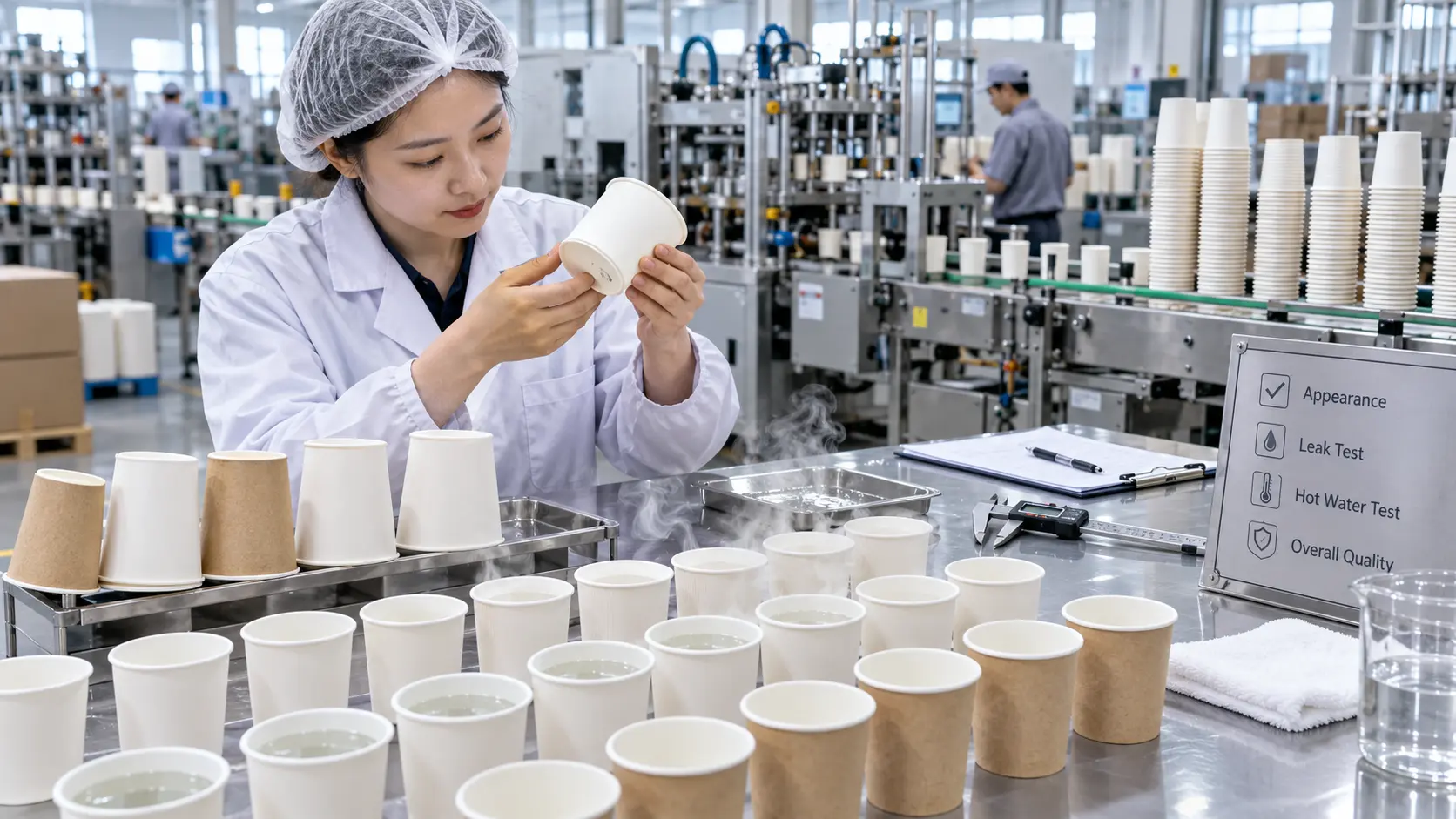
A paper cup looks simple, but reliable mass production depends on several variables working together. Two cups may both be described as “12 oz paper cups” while using different paperboard, barrier coatings, cup dimensions, tooling, bottom-sealing conditions and lids. They may therefore perform very differently with hot coffee, takeaway delivery or high-speed café service.
This is why professional paper cup quality control should not begin with a finished cup alone. It should begin with an approved product specification and continue through raw material inspection, printing, die-cutting, forming, sealing, testing, packing and final shipment inspection.
A 100% fabrica copos de papel e outros embalagens de papel descartáveis para alimentos for international foodservice buyers. The following guide combines practical factory quality-control logic with actual material parameters and product testing already used or published by Bioleader®.
What Determines the Quality of a Paper Cup?
For procurement purposes, cup quality should be separated into several measurable areas. A supplier may perform well in one area and poorly in another. For example, a cup may have attractive printing but weak bottom sealing, or it may pass a simple water test but use a lid that does not lock securely onto the rim.
| Quality Area | What Should Be Checked | Typical Failure Risk |
|---|---|---|
| Cartão | Grammage, thickness, stiffness, moisture and consistency | Soft cup, deformation, uneven forming |
| Barrier system | PE, PLA or aqueous coating type, coating consistency and seal compatibility | Seepage, barrier failure, poor sealing |
| Side seam | Bonding position and seal integrity | Side leakage or seam opening |
| Bottom seal | Bottom insertion, knurling and sealing consistency | Fuga no fundo |
| Rim | Top diameter, roundness and curl quality | Loose lid, overly tight lid or lid popping off |
| Impressão | Artwork, registration, color, seam position and cleanliness | Brand inconsistency or rejected printed stock |
| Finished cup | Dimensions, appearance, weight consistency and stacking | Batch-to-batch variation |
| Embalagem | Sleeve count, carton count, carton strength and deformation | Transit damage or incorrect shipment quantities |
Paperboard and Coating Quality Control Starts Before Cup Forming
The quality of a finished cup depends heavily on the coated paperboard entering the forming line. Paper grammage is important, but grammage alone does not determine performance. Thickness, stiffness, moisture, internal bonding and the barrier system also affect how the material prints, folds, seals and performs after hot or cold liquid is added.
Bioleader® has published quantitative specifications for its water-based coated paper range. These values provide a useful example of how paper cup material control can be converted from vague descriptions into measurable parameters.
Example: Bioleader® Water-Based Coated Paper Parameters
| Parâmetro | Published Specification | QC Significance |
|---|---|---|
| Base paper grammage | 190 / 210 / 230 / 250 / 280 / 300 g/m² | Influences stiffness, forming performance and cup structure |
| Grammage tolerance | ±3% | Controls roll-to-roll and batch consistency |
| Single-face coating weight | Published specification format: 0 + 10 g/m² | Influences moisture barrier and sealing behavior |
| Coating-weight tolerance | ±2 g/m² | Reduces barrier variation |
| Material thickness | 260 / 275 / 310 / 325 / 380 / 410 μm depending on grade | Influences rigidity and forming geometry |
| Thickness tolerance | ±5% | Supports dimensional consistency |
| Bending stiffness, CD | 1.8–6.5 mN·m depending on grade | Supports structural rigidity and handling |
| Resistência à flexão repetida | 20 cycles | Evaluates resistance to repeated bending |
| Teor de humidade | 7% ±2% | Affects forming, stiffness and dimensional stability |
| Penetração nas bordas | 4 mm | Indicates resistance to liquid entering exposed paper edges |
| Resistência da ligação interna | 100 J/m² | Helps control layer separation and structural integrity |
| Leakage requirement | Sem fugas | Finished barrier performance target |
Importante: These figures describe the referenced Bioleader® water-based coated paper specification and should not be treated as a universal specification for every paper cup SKU. PE-coated, PLA-coated and different aqueous formulations may use different paperboard and coating structures.
This distinction is important for procurement. Buyers should not ask only, “How many GSM is the cup?” A more useful specification request is: What is the paperboard grade, coating structure, finished construction and intended beverage application for this exact SKU?
PE, PLA and Water-Based Coatings Require Different QC Thinking
The barrier layer is what prevents beverage moisture from rapidly penetrating the paper fibers. Different barrier systems behave differently during coating, printing and heat sealing, so the production settings and inspection criteria cannot simply be assumed to be identical. Buyers comparing these structures can also review Bioleader®’s guide to water-based coating vs. PLA vs. PE-lined paper cups and bowls.
| Barrier Type | Primary QC Focus | Buyer Should Confirm |
|---|---|---|
| PE revestimento | Film continuity, bonding, sealability and leakage | PE structure, paper specification and intended hot/cold application |
| PLA revestimento | Coating integrity, storage conditions and forming/sealing window | Actual PLA-coated compostable paper cup SKU and intended temperature range |
| Revestimento à base de água | Coating weight, surface uniformity, barrier performance and seal compatibility | Exact coating formulation and product-specific performance |
A supplier therefore should not use one generic statement such as “waterproof paper” to describe every paper cup. The barrier structure must be tied to the actual approved product. Buyers assessing environmental claims should also distinguish material structure from marketing terminology; Bioleader® explains this in Are Paper Cups & Bowls Really “Plastic-Free”?
Bioleader® PE Paper Cup QC Reference: 8oz, 12oz and 16oz Hot Cups
To make paper cup quality control more measurable, Bioleader® uses defined product specifications together with dimensional checks, hot-water holding tests and cup-and-lid compatibility inspection. The following three standard single-wall PE-coated hot cups illustrate how a practical factory QC program can be structured.
The selected models cover two common lid platforms: an 80 mm rim for the 8 oz cup and a 90 mm rim shared by the 12 oz and 16 oz cups. This allows QC teams to check not only individual cup dimensions but also whether different cup geometries remain compatible with their specified lid systems.
PE Paper Cup Product Specifications
| Especificação | 8oz Hot Cup | 12oz Hot Cup | 16oz Hot Cup |
| Bioleader® Item Code | PE-SW08 | PE-SW12 | PE-SW16 |
| Estrutura do copo | Single-wall hot cup | Single-wall hot cup | Single-wall hot cup |
| Paperboard Base | 280 GSM + 18 GSM PE | 300 GSM + 18 GSM PE | 300 GSM + 18 GSM PE |
| Nominal Volume | 8 oz (240 ml) | 12 oz (360 ml) | 16 oz (480 ml) |
| Brimful Volume | 275 ± 5 ml | 410 ± 5 ml | 535 ± 5 ml |
| Target Cup Weight | 7.2 ± 0.3 g | 10.5 ± 0.4 g | 13.8 ± 0.5 g |
| Diâmetro superior | 80 mm | 90 mm | 90 mm |
| Bottom Diameter | 56 mm | 58 mm | 58 mm |
| Altura | 94 mm | 108 mm | 137 mm |
| Matching Lid Code | PSHL80 | PSHL90 | PSHL90 |
| Lid Diameter / Weight | 79.5 mm / 2.6 ± 0.2 g | 89.5 mm / 3.3 ± 0.2 g | 89.5 mm / 3.3 ± 0.2 g |
Factory Dimensional QC
For routine dimensional inspection, multiple finished cups should be randomly selected from the same production lot rather than relying on one sample. The nominal dimensions above provide the reference values for checking forming consistency.
| QC Check | 8oz PE-SW08 | 12oz PE-SW12 | 16oz PE-SW16 |
|---|---|---|---|
| Recommended Sample Quantity | 10 cups | 10 cups | 10 cups |
| Nominal Top Diameter | 80 mm | 90 mm | 90 mm |
| Nominal Bottom Diameter | 56 mm | 58 mm | 58 mm |
| Nominal Height | 94 mm | 108 mm | 137 mm |
| Measurement Method | Digital caliper | Digital caliper | Digital caliper |
| QC Objective | Confirm rim, bottom and height consistency | Confirm rim, bottom and height consistency | Confirm rim, bottom and height consistency |
Top-rim dimensions are particularly important because lid fit depends on more than nominal cup capacity. The 12 oz and 16 oz models both use a 90 mm rim and the same PSHL90 lid platform, even though their cup heights differ substantially at 108 mm and 137 mm. Each formed cup therefore still requires independent dimensional control. For capacity planning beyond these three QC examples, see the 8oz to 24oz paper cup size comparison guide.
Finished-Cup Weight Consistency Check
Finished cup weight can be used as an additional process-control indicator. Bioleader® recommends weighing multiple cups from the same production lot and comparing the average, minimum and maximum values rather than using the weight of one cup alone.
| Weight QC Item | Recommended Method |
|---|---|
| Sample Quantity | 10 cups per size |
| Scale Resolution | 0.01 g recommended |
| Data Recorded | Individual weight of every cup |
| Calculated Values | Average, minimum, maximum and total range |
| Finalidade | Detect unusual variation in material, cutting or forming |
QC interpretation: Finished weight is useful for checking consistency within the same approved SKU, but a heavier cup should not automatically be considered a higher-quality cup. Paper stiffness, coating structure, forming quality and final performance are more important than weight alone.
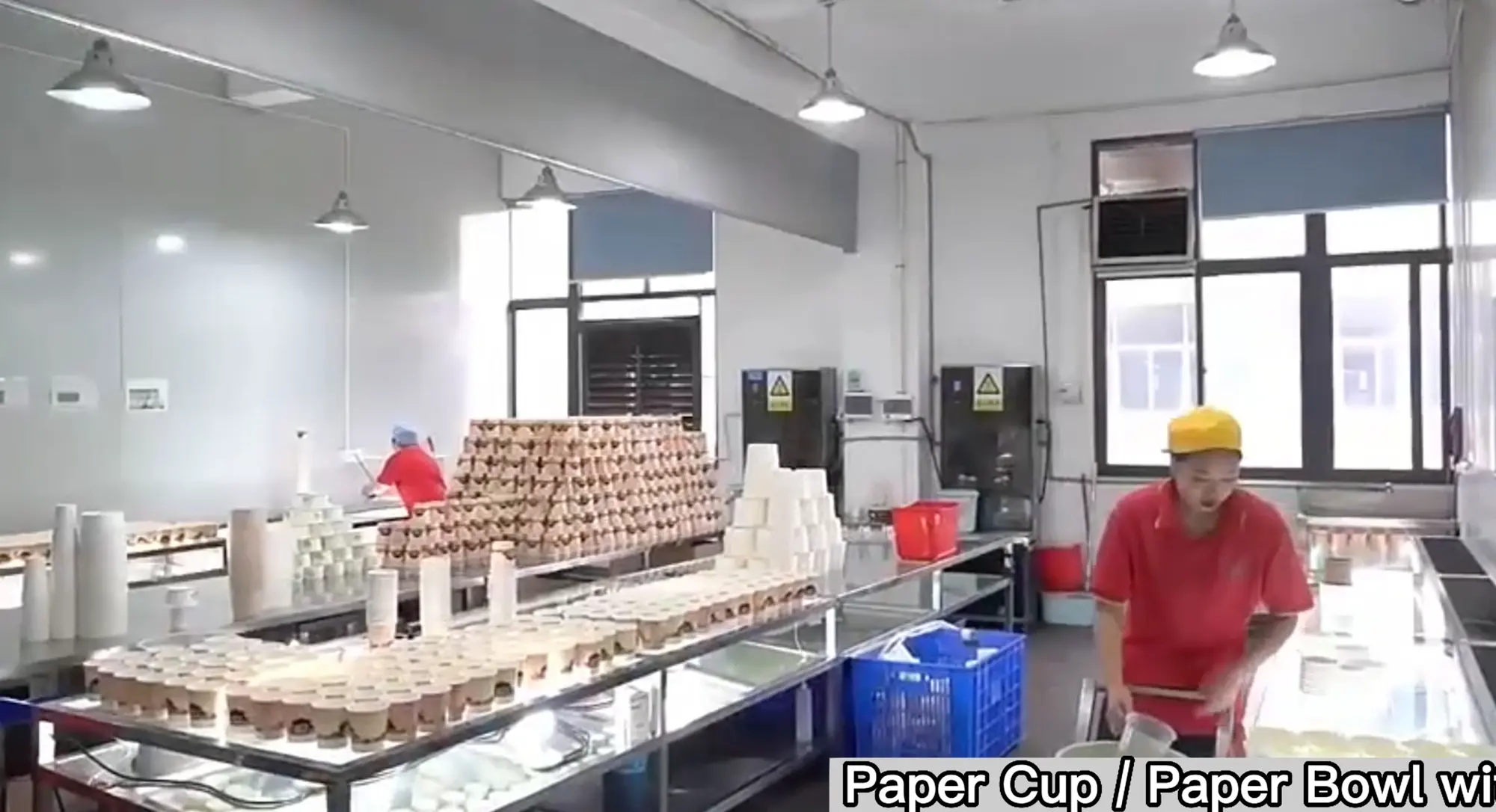
100°C Hot-Water QC Protocol for PE Paper Cups
For internal hot-cup performance verification, representative finished cups can be filled with freshly heated water at approximately 100°C and observed over a defined holding period. This is a practical factory stress test rather than a regulatory migration test.
| Test Condition | 8oz PE-SW08 | 12oz PE-SW12 | 16oz PE-SW16 |
|---|---|---|---|
| Estrutura do Papel | 280 GSM + 18 GSM PE | 300 GSM + 18 GSM PE | 300 GSM + 18 GSM PE |
| Recommended Samples | 3 chávenas | 3 chávenas | 3 chávenas |
| Initial Water Temperature | Approx. 100°C | Approx. 100°C | Approx. 100°C |
| First Observation | Immediately after filling | Immediately after filling | Immediately after filling |
| Second Observation | 15 minutos | 15 minutos | 15 minutos |
| Final Observation | 30 minutos | 30 minutos | 30 minutos |
| Side Seam | Check for visible seepage or opening | Check for visible seepage or opening | Check for visible seepage or opening |
| Bottom Seal | Check for leakage or moisture | Check for leakage or moisture | Check for leakage or moisture |
| Parede lateral | Check softening or deformation | Check softening or deformation | Check softening or deformation |
| After Emptying | Inspect bottom, seam and PE-paper interface | Inspect bottom, seam and PE-paper interface | Inspect bottom, seam and PE-paper interface |
Test boundary: A 100°C internal holding test evaluates physical cup performance under a defined factory test condition. It does not establish a recommended consumer serving temperature and does not replace food-contact migration testing or destination-market regulatory compliance.
Cup-and-Lid Compatibility Check
Lid fit should be verified as part of the finished packaging system. Nominal diameter alone does not guarantee compatibility because rim curl geometry, lid tooling and manufacturing tolerances also influence engagement.
| Compatibility Item | 8oz PE-SW08 | 12oz PE-SW12 | 16oz PE-SW16 |
|---|---|---|---|
| Cup Rim | 80 mm | 90 mm | 90 mm |
| Tampa Correspondente | PSHL80 | PSHL90 | PSHL90 |
| Published Lid Diameter | 79.5 mm | 89.5 mm | 89.5 mm |
| Full-Rim Engagement | Obrigatório | Obrigatório | Obrigatório |
| Visible Loose Sections | Not acceptable | Not acceptable | Not acceptable |
| Excessive Installation Force | Not acceptable | Not acceptable | Not acceptable |
| Lid Retention During Normal Handling | Obrigatório | Obrigatório | Obrigatório |
Manufacturer Insight: Why These Three Cup Sizes Are Useful for QC Comparison
The three models provide a practical comparison of two common hot-cup platforms. The 8 oz PE-SW08 uses 280 GSM paperboard and an 80 mm lid system. The 12 oz and 16 oz models use 300 GSM paperboard and share the same 90 mm lid platform, but their different heights create different forming geometries. This makes them useful for checking both material consistency and the repeatability of cup-and-lid production across several standard sizes.
Finished Paper Cup Dimensional Inspection
Once cups are formed, dimensional inspection becomes critical. Nominal capacity such as 8 oz, 12 oz or 16 oz does not by itself determine whether a cup will work with a buyer’s filling equipment, dispenser or lid.
Typical measurements include:
- Diâmetro superior
- Diâmetro da base
- Cup height
- Rim diameter and roundness
- Bottom geometry
- Overall cup shape
Measurements can be taken using suitable gauges or calipers against the approved drawing and production specification.
Manufacturer Insight: Capacity Is Not the Same as Fit
A cup can meet its nominal beverage capacity and still cause operational problems if the rim diameter or rim shape is inconsistent. For coffee shops and takeaway beverage programs, top-rim control is especially important because the cup and lid must function as one packaging system.
Why Cup Weight Can Be Useful in QC
Finished cup weight can be used as an additional production-control indicator, although it should not be treated as a standalone definition of quality.
For example, a QC team can randomly select multiple cups from the same production lot, record individual weights and compare the average and variation with the approved production specification. Unexpected variation may indicate changes in substrate, coating, cutting or forming.
However, comparing two different paper cups only by finished weight can be misleading. A heavier cup is not automatically a better cup. Structure, paper stiffness, coating system and forming quality all influence real performance.
Side-Seam and Bottom-Seal Inspection
For liquid-containing paper cups, the two most important structural sealing areas are the side seam and the bottom assembly.
Side-Seam QC
The cup blank is wrapped into shape and bonded along the side seam. Inspection should identify incomplete bonding, excessive overlap, visible opening, distortion or contamination in the sealing area.
Bottom-Seal QC
The bottom disc must be correctly positioned and securely joined to the sidewall. Forming equipment uses controlled pressure, geometry and sealing conditions to create the bottom structure.
A cup that looks acceptable from the outside can still fail if the bottom joint is inconsistent. For this reason, leakage testing should be performed on representative finished cups rather than relying only on visual inspection.
Real Bioleader® Test Example: 100°C Hot Water Observation
Bioleader® has published a practical hot-water demonstration using water-based PHA aqueous coated paper cups with bagasse pulp lids. This provides a useful real-product example of how finished-cup performance can be evaluated separately from material specifications.
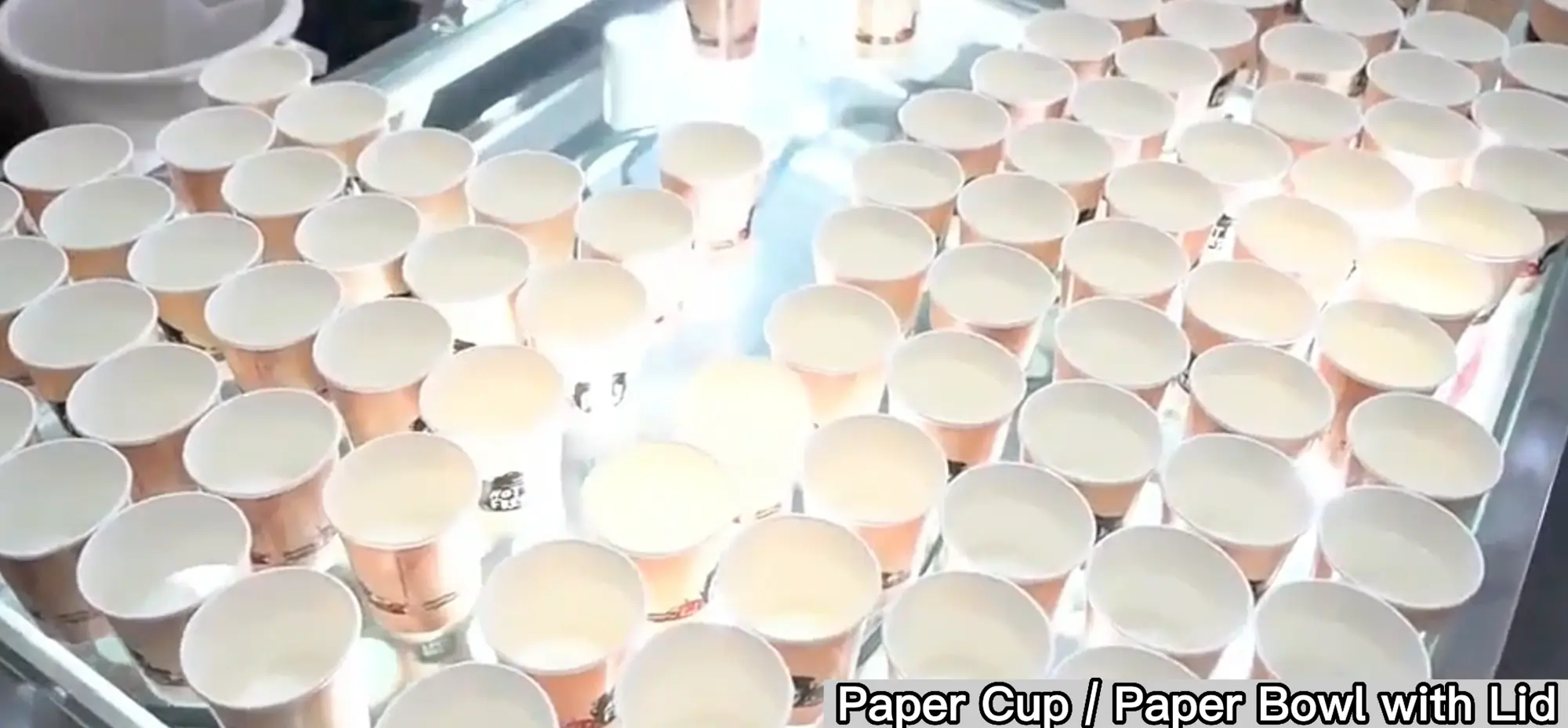
Tested Cup Configuration
| Cup sizes shown | 8 oz and 12 oz |
| Cartão | 280 GSM |
| Barrier coating | 12 g water-based PHA aqueous coating |
| Water temperature | 100°C |
| Observation point 1 | 15 minutos |
| Observation point 2 | 30 minutos |
| Observed leakage | No leakage observed at 15 or 30 minutes |
| Post-test inspection | No visible seepage or coating failure was observed at the cup bottom or sidewall after the water was emptied |
The demonstration also included 80 mm and 90 mm molded bagasse pulp lids and showed flat, coffee-sipper and dome lid configurations.
Evidence boundary: This 100°C test is an internal product-performance demonstration and observation. It should not be described as a third-party laboratory certification, and its result should not automatically be applied to every Bioleader® paper cup, coating formulation, production batch or beverage application.
This distinction is important for serious B2B documentation. Internal performance testing answers one question: How did this actual finished cup behave under a defined use test? Third-party food-contact testing answers a different question concerning chemical and regulatory requirements.
Why the 12 g PHA Test Does Not Conflict with the General Water-Based Specification
Buyers may notice that Bioleader®’s general published water-based coated paper specification uses a different coating-weight range from the 12 g coating used in the PHA demonstration cup.
This is precisely why quality control must remain SKU-specific. A general aqueous-coated paper specification and a particular PHA aqueous-coated product are not necessarily the same formulation or construction.
The correct procurement practice is to link each test result to the exact material structure, sample and production specification rather than combining data from different products into one generic claim.
Paper Cup Leak Testing: What Should Buyers Look For?
A practical leakage test should define more than a simple “pass” or “fail.” At minimum, the test record should identify:
- The exact cup SKU and material structure
- Liquid used for testing
- Liquid temperature where relevant
- Nível de enchimento
- Observation time
- Side-seam condition
- Bottom condition
- Visible seepage, softening or deformation
- Result after the liquid is emptied
For different markets and use cases, additional testing may be appropriate. A hot-coffee cup, cold-drink cup and long-hold takeaway beverage package should not automatically use the same performance assumption. The engineering differences are discussed further in Bioleader®’s hot cup vs. cold cup selection guide.
Lid Fit Is Part of Paper Cup Quality Control
One of the most common purchasing mistakes is evaluating the cup and lid separately. In real foodservice use, they function as one system.
Lid compatibility depends on several factors:
- Cup top diameter
- Rim roundness
- Rim curl geometry
- Lid tooling geometry
- Material stiffness
- Manufacturing tolerances
A nominal diameter does not automatically guarantee interchangeability between every supplier. For example, two products may both be marketed under the same nominal lid diameter while differences in tooling and tolerance produce a noticeably different fit.
Quality checks should therefore confirm whether the lid engages evenly with the rim, whether it becomes loose during handling, whether excessive force is required, and whether the assembled cup-and-lid system remains stable in its intended application.
Custom Printed Paper Cup Quality Control
For OEM and private-label orders, structural approval and artwork approval should be treated as two separate control steps.
Before mass production, buyers should confirm the correct artwork version, dieline, printing position and color requirements. During production, QC should monitor:
- Artwork version
- Logo orientation
- Print registration
- Consistência de cor
- Text and barcode readability where applicable
- Relationship between artwork and side seam
- Die-cutting alignment
- Surface scratches, ink defects or contamination
- Consistency across the production lot
For custom cups, a visually attractive flat printed blank is not enough. The final design should also be reviewed after the blank is converted into a three-dimensional cup because the seam, taper and rim can change how the artwork appears.
How Paper Cup Quality Control Fits into Factory Production
Bioleader®’s paper cup and bowl production workflow includes paperboard selection, coating, printing, die-cutting, forming, rimming and curling, testing and packaging. Each stage introduces a different potential source of variation. Buyers evaluating aqueous structures can also review the detailed water-based coating paper cups and bowls production process.
| Production Stage | QC Focus | What Can Go Wrong |
|---|---|---|
| Incoming paperboard | Material specification, thickness, grammage, moisture | Wrong substrate or unstable forming |
| Tempo SO (min) | Barrier structure and coating consistency | Weak barrier or sealing problems |
| Impressão | Artwork, color and registration | Incorrect branding or visible defects |
| Die-cutting | Blank dimensions and cutting position | Misalignment during forming |
| Formação | Shape, seam, bottom and machine consistency | Leakage or deformation |
| Rimming | Diameter, roundness and curl | Poor lid fit |
| Ensaios do produto acabado | Dimensions, appearance, leakage and fit | Defective cups entering packing |
| Embalagem | Quantity, sleeve integrity and carton condition | Shortage, crushing or transport damage |
Bioleader® Manufacturer Perspective
For bulk production, quality control is most effective when the approved specification is fixed before the order enters mass production. Cup size, material, paper specification, coating type, matching lid, printing artwork, packing requirement, beverage application and destination-market documentation should be confirmed as one project rather than handled as unrelated items.
Paper Cup QC Does Not End at the Forming Machine
International buyers should also consider packing and logistics. Cups that leave a forming line in acceptable condition can still arrive damaged if packing density, carton strength, storage conditions or container handling are unsuitable.
Pre-shipment inspection can include:
- Correct SKU and quantity
- Pieces per sleeve
- Sleeves per carton
- Carton dimensions and markings
- Carton condition
- Random finished-product appearance checks
- Random dimensional checks
- Random lid-fit checks where lids are included
- Protection against crushing or deformation
- Batch or purchase-order traceability
This is particularly important in export orders where goods may remain in cartons and containers for weeks before reaching the distributor or foodservice operator.
Factory Testing and Food-Contact Testing Are Not the Same Thing
A strong paper cup quality program separates physical performance from regulatory compliance.
| Evidência | What It Shows | O que não prova automaticamente |
|---|---|---|
| Leak test | Performance under the defined liquid, time and temperature conditions | Chemical food-contact compliance |
| Lid-fit test | Mechanical compatibility between cup and lid | Migration compliance |
| Dimensional inspection | Conformity to product dimensions and tolerances | Barrier chemistry |
| Food-contact laboratory report | Results for the tested specimen and analytical scope | Perfect dimensions or leak performance |
| Factory certification/audit | Management or production-system evidence within its scope | Automatic approval of every SKU and every future lot |
In China, GB/T 27590-2022 Paper Cup is the current national product standard for paper cups and has been effective since February 1, 2023.
For food-contact paper and paperboard, the current Chinese national food-safety reference is GB 4806.8-2022, which replaced GB 4806.8-2016 and has been in force since June 30, 2023.
For the European Union, food-contact packaging must also be assessed against the applicable regulatory framework, including Regulation (EC) No 1935/2004 and relevant Good Manufacturing Practice requirements. Destination-market requirements should therefore be confirmed for the exact material, coating, ink, lid and intended use rather than inferred from a generic certificate.
Distinção importante: A leak test is not a migration test. A migration report is not proof of lid fit. A factory audit is not proof that every production batch is dimensionally identical. Professional paper cup qualification normally uses several different forms of evidence together.
What Do Bioleader®’s Existing Paper Packaging Documents Cover?
Bioleader® maintains a certificate and test-report library for its paper cup, paper bowl and paper box ranges. Publicly listed documentation includes EC/EU reports for representative kraft paper products, PE white paper products, PLA-coated kraft and white paper products, as well as PFAS-related reports for representative PE and PLA product structures.
For representative conventional PE-coated products, Bioleader® has also published targeted PFAS test evidence for PE-coated paper cups and bowls, covering a white paper cup and a kraft paper bowl. The listed targeted PFAS substances in those submitted specimens were reported as not detected below the laboratory’s stated detection limits.
This evidence should be interpreted at the correct scope: a report supports the tested specimen and analytical list. It should not be rewritten to claim that every cup size, ink, lid, material combination or future production lot has automatically undergone exactly the same test.
How Should Importers Inspect Paper Cups Before a Bulk Order?
Paper Cup Buyer QC Checklist
- Confirm the exact cup size and drawing. Do not approve only by an ounce description.
- Confirm the paperboard structure. Ask about grammage, construction and coating system.
- Confirm the intended application. Hot coffee, tea, cold beverage and other uses can require different constructions.
- Confirm the matching lid. Treat the cup and lid as one system.
- Check dimensional consistency. Especially the top diameter, bottom diameter, height and rim.
- Review sealing performance. Side seam and bottom seal are critical liquid-containment areas.
- Request defined leak-test evidence where necessary. Temperature, time and test conditions matter.
- Approve custom printing separately. Confirm artwork, color and final formed-cup appearance.
- Review food-contact documentation. Make sure the document matches the material and intended market.
- Review representative samples before mass production when appropriate.
- Define packing requirements. Confirm sleeve quantity, carton quantity and export-carton specifications.
- Keep batch and order traceability. Production evidence should be linked to the actual order wherever possible.
What Buyers Should Request from a Paper Cup Manufacturer
For a routine bulk project, buyers do not necessarily need dozens of certificates. They need the right evidence for the right decision.
A practical qualification package may include:
- Product specification or drawing
- Material and coating description
- Matching lid specification
- Approved artwork for printed cups
- Relevant food-contact test documentation
- Product-specific performance data where required
- Pre-production or production sample when commercially appropriate
- Final packing specification
- Purchase-order or batch traceability
For higher-risk projects, additional laboratory, migration, chemical, PFAS or destination-market testing may be required depending on the material system and regulatory environment.
Why Real Testing Is More Valuable Than Generic “Premium Quality” Claims
Terms such as “premium,” “food grade,” “leak-proof” and “high quality” are common in paper cup marketing, but they provide limited procurement value unless the supplier can explain what those claims mean in measurable terms.
A more credible manufacturer should be able to answer questions such as:
- Which paper and coating structure is used?
- What dimensions are controlled?
- How are side and bottom seals inspected?
- How is lid compatibility checked?
- What liquid and temperature were used for performance testing?
- Which test report belongs to this material?
- What changes when the customer selects another coating or lid?
For Bioleader®, this evidence-based approach is increasingly important because the paper packaging range includes conventional PE-coated paper, PLA-coated paper and newer aqueous-coated constructions. Each solution has its own performance, compliance and end-of-life considerations.
Conclusion: Paper Cup Quality Must Be Proven as a System
A high-quality paper cup is not defined by appearance, paper grammage or nominal capacity alone. Reliable performance depends on the complete system: paperboard, barrier layer, printing, die-cutting, side seam, bottom seal, rim geometry, matching lid, packing and food-contact documentation.
Real production data also needs context. Bioleader®’s published water-based paper specifications provide measurable parameters for material control, while the 280 GSM + 12 g PHA aqueous-coated cup demonstration provides a separate example of real finished-product testing with 100°C water for 15 and 30 minutes. These data points are useful because their scope is clearly defined rather than generalized to every paper cup.
For importers, distributors, coffee chains and foodservice operators, the safest procurement approach is to qualify the complete SKU and its intended application before mass production. Bioleader® supports buyers with paper cup manufacturing, coating options, custom printing, cup-and-lid matching, product testing, compliance documentation and export-ready bulk supply.
Perguntas frequentes
Como é que os fabricantes testam a qualidade dos copos de papel?
Paper cup quality is normally evaluated through a combination of raw-material checks, dimensional inspection, side- and bottom-seal inspection, leakage testing, rim and lid-fit checks, printing inspection and packing control. Food-contact laboratory testing is a separate compliance step and should not be confused with physical factory QC.
Durante quanto tempo deve um copo de papel passar num teste de fugas?
Não existe uma duração de teste única que defina todas as aplicações de copos de papel a nível mundial. A condição de teste deve refletir a especificação do copo e o uso pretendido da bebida. Bioleader® demonstrou uma configuração de copo de papel com revestimento aquoso PHA utilizando água a 100°C, sem fugas observadas aos 15 e 30 minutos. Esse resultado aplica-se à configuração testada e não a todos os copos de papel.
Os copos de papel aguentam água quente a 100°C?
Some correctly designed hot-drink paper cups can contain very hot water, but performance depends on paperboard, barrier coating, sealing and cup construction. In Bioleader®’s published demonstration, 8 oz and 12 oz cups made with 280 GSM paperboard and a 12 g PHA aqueous coating showed no observed leakage after 15 and 30 minutes with 100°C water.
O que faz com que um copo de papel verta pelo fundo?
A fuga pelo fundo pode resultar de posicionamento incorreto do disco de fundo, parâmetros de formação instáveis, selagem inadequada, contaminação, variação do material ou danos durante a conversão. Como um defeito pode não ser sempre óbvio visualmente, devem ser incluídos ensaios de fuga em copos acabados representativos no controlo de qualidade da fábrica.
Porque é que algumas tampas de copos de papel assentam mal?
O ajuste da tampa depende de mais do que o diâmetro nominal. O diâmetro do rebordo do copo, a circularidade, a geometria do enrolamento, o molde da tampa, a rigidez do material e as tolerâncias de fabrico influenciam todos o ajuste. Uma tampa descrita como 90 mm, por exemplo, não deve ser automaticamente considerada compatível com todos os copos de 90 mm nominal de todos os fabricantes sem verificação.
Que gramagem de papel é utilizada nos copos de papel descartáveis?
There is no universal grammage for every paper cup. Bioleader®’s published water-based coated paper range includes base-paper grades from 190 to 300 g/m², while the specific PHA aqueous-coated cups used in its hot-water demonstration used 280 GSM paperboard. The correct grade should be selected according to cup size, structure, coating and application.
Que documentos devem os importadores solicitar a um fornecedor de copos de papel?
Os compradores devem normalmente analisar a especificação do produto, as informações sobre o material e o revestimento, a especificação da tampa correspondente, a arte-final de impressão aprovada, os relatórios relevantes de contacto com alimentos e os requisitos de embalagem. Dependendo do mercado de destino e do material, podem também ser exigidas evidências adicionais de migração, químicas, PFAS, de compostabilidade ou outras evidências de conformidade.
Referências
- State Administration for Market Regulation / Standardization Administration of China — GB/T 27590-2022, Paper Cup.
- GB 4806.8-2022 — National Food Safety Standard for Food Contact Paper and Paperboard Materials and Products.
- European Commission — Regulation (EC) No 1935/2004 and EU Food Contact Materials guidance.
- European Commission — Good Manufacturing Practice requirements for food-contact materials.
- Bioleader® — Water-Based Coating Standards for Bioleader Cups & Bowls (2026).
- Bioleader® — Plastic-Free Paper Cups with Bagasse Pulp Lids: PHA Aqueous Coating Solution.
- Bioleader® — Certificates & Test Reports for Paper Cups, Paper Bowls and Paper Boxes.
- Bioleader® — Paper Cup & Paper Bowl Production Process.
- Bioleader® — PE-Coated Paper Cups and Bowls PFAS Evidence.