Introduction : pourquoi 2026 est un tournant pour les emballages alimentaires jetables
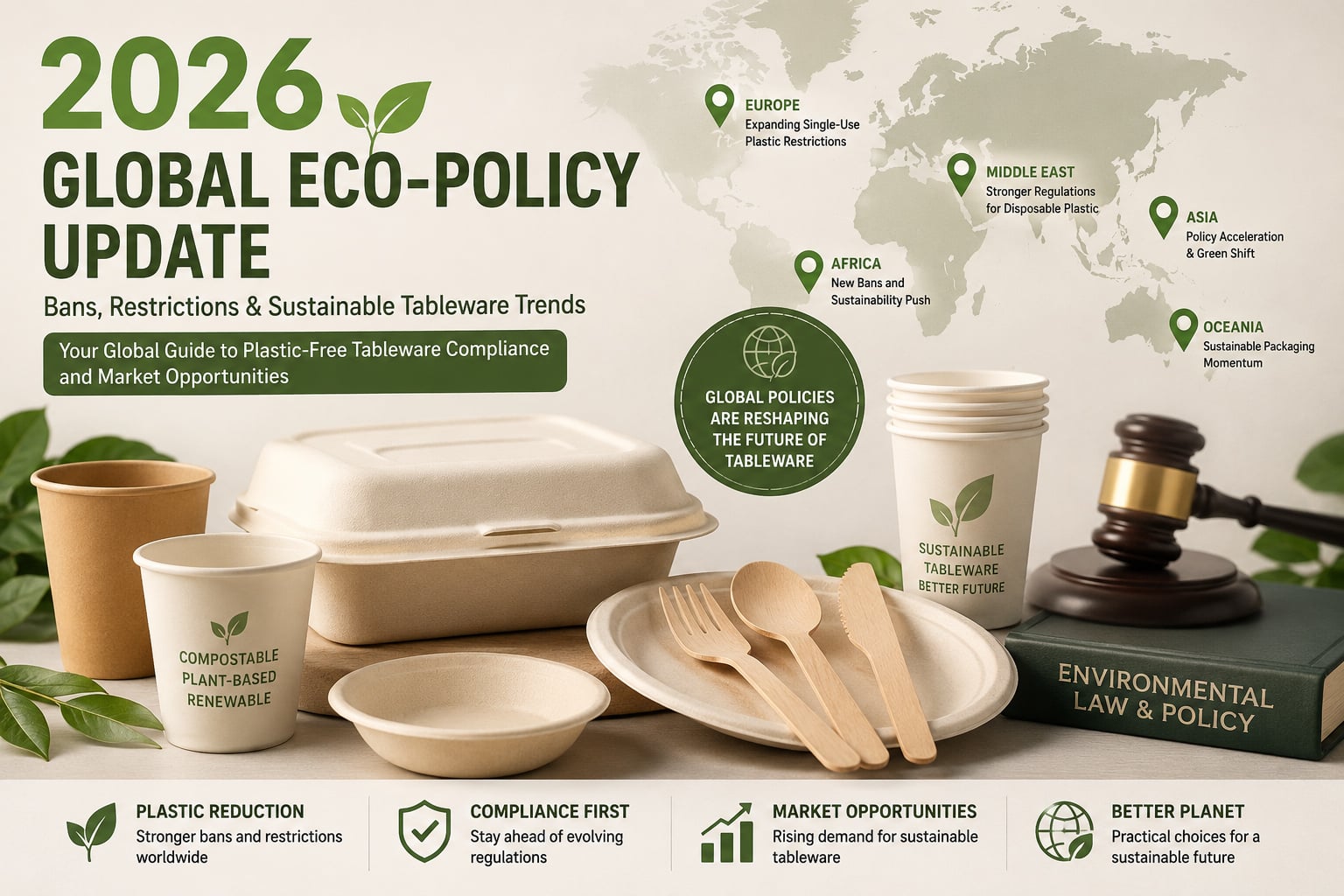
Résumé rapide : mise à jour de la politique mondiale sur la vaisselle en plastique 2026
- Les emballages alimentaires jetables deviennent une catégorie prioritaire dans la politique mondiale sur le plastique.
- Les couverts en plastique, les assiettes en plastique, les gobelets en plastique, les pailles, les agitateurs et les contenants alimentaires en mousse EPS comptent parmi les articles les plus fréquemment restreints.
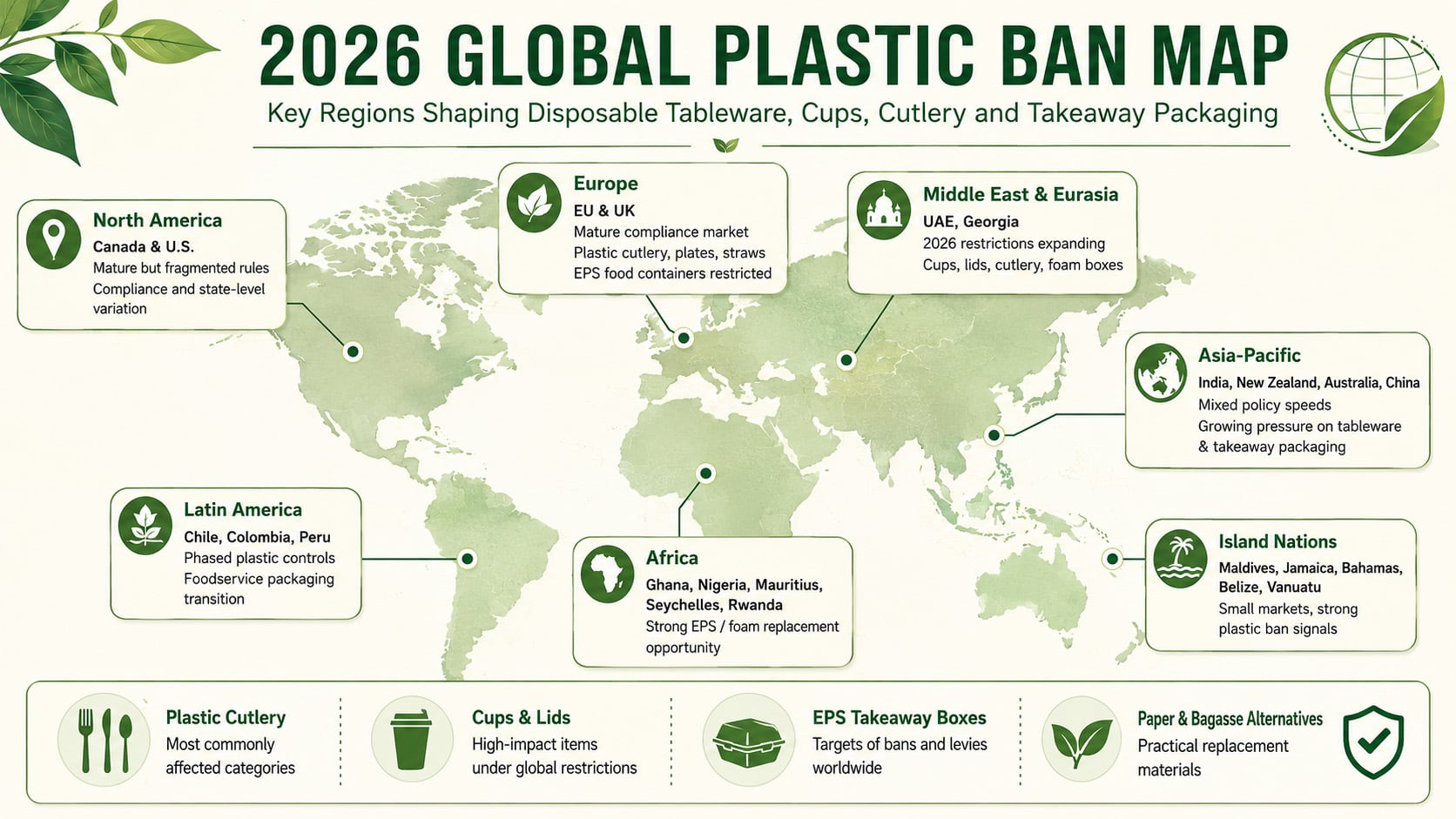
- L'Europe et le Canada sont des marchés de conformité matures, où la documentation et les allégations sur les emballages sont examinées de près.
- La Géorgie et les Émirats arabes unis sont des exemples importants de nouvelles restrictions affectant les plastiques de restauration en 2026.
- L'opportunité la plus pratique en Afrique est le remplacement des boîtes à emporter en EPS / Styrofoam, en particulier dans des pays comme le Ghana, les Seychelles, Maurice, le Rwanda et le Nigeria.
- L'Asie-Pacifique est très diversifiée : l'Inde et la Nouvelle-Zélande ont des restrictions plus strictes, tandis que l'Asie du Sud-Est progresse plus progressivement grâce à une réduction progressive du plastique et à une demande axée sur le tourisme.
- Pour les acheteurs mondiaux, la stratégie la plus sûre est un portefeuille de matériaux mixtes : bagasse de canne à sucre, carton, papier kraft, papier enduit sans plastique, couverts en bois et matériaux compostables certifiés là où ils sont acceptés.
1. Tendances politiques mondiales : des interdictions des sacs en plastique au contrôle des emballages de restauration
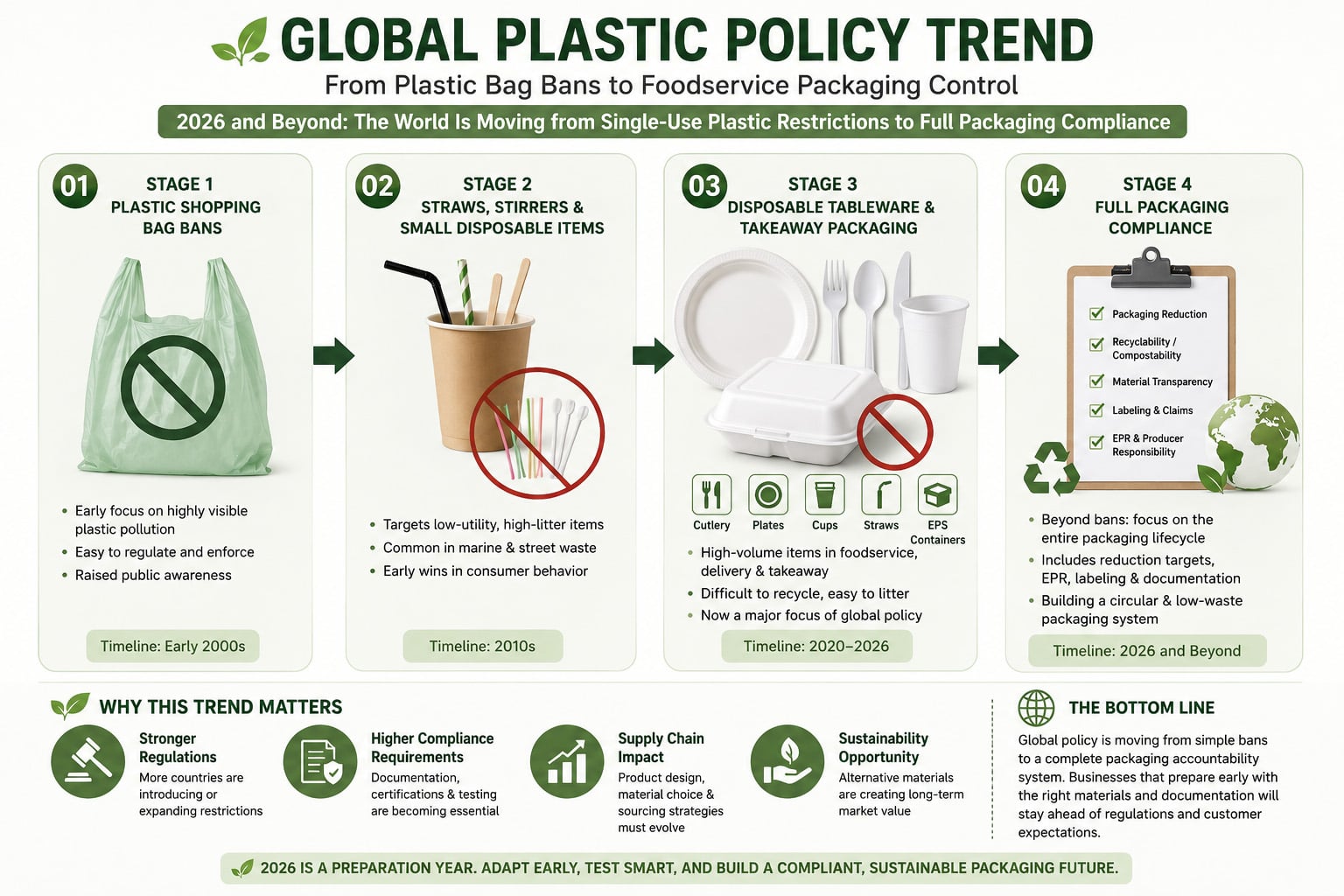
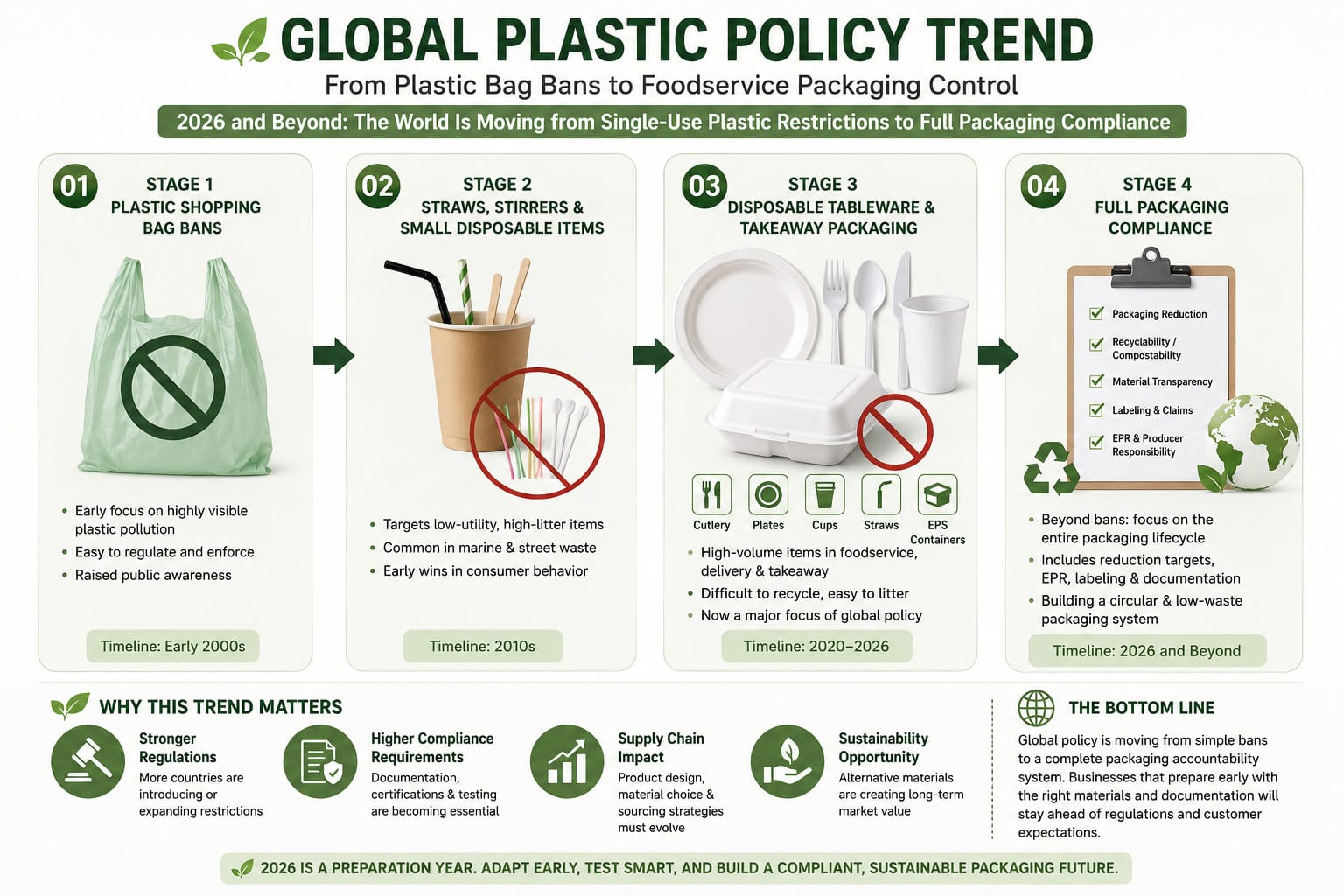
Au cours de la dernière décennie, la réglementation sur le plastique a évolué par étapes claires. De nombreux pays ont commencé par les sacs de courses en plastique parce qu'ils étaient visibles, légers et souvent jetés comme déchets. L'étape suivante a ciblé les pailles en plastique, les agitateurs et d'autres articles de petit format à faible valeur fonctionnelle mais à forte visibilité environnementale. D'ici 2026, l'attention politique s'est déplacée vers un domaine plus important sur le plan commercial : les emballages alimentaires jetables.
Ce changement est important car les emballages de restauration sont utilisés à grande échelle. Une seule chaîne de restaurants, un réseau de cafés, un traiteur aérien, une plateforme de livraison de repas ou un groupe hôtelier peut consommer des millions de gobelets, couvercles, plateaux, bols, assiettes, ensembles de couverts et contenants à emporter chaque année. Lorsque les gouvernements restreignent ces produits, les acheteurs ne peuvent pas simplement retirer un article d'une étagère. Ils doivent reconstruire les spécifications d'emballage, tester des matériaux alternatifs, vérifier les systèmes d'élimination locaux, confirmer la sécurité du contact alimentaire et sécuriser un approvisionnement stable avant que les réglementations ne soient pleinement appliquées.
Quatre étapes de la réglementation mondiale sur les emballages en plastique
Étape 1 : les sacs de courses en plastique
Les premières politiques sur le plastique se concentraient souvent sur les sacs de courses légers. Ces mesures ont sensibilisé le public et ont donné aux gouvernements de l'expérience dans la réglementation des produits à usage unique à volume élevé.
Étape 2 : pailles, agitateurs et petits articles jetables
Les pailles en plastique et les agitateurs de boissons sont devenus des cibles précoces car ils sont souvent inutiles, difficiles à recycler et fréquemment trouvés dans les déchets marins et les déchets de rue.
Étape 3 : vaisselle jetable et emballages à emporter
Les couverts en plastique, les assiettes en plastique, les bols en plastique, les gobelets en plastique, les barquettes en mousse EPS et les contenants alimentaires sont désormais réglementés plus agressivement en raison de leur lien direct avec les restaurants, les repas à emporter et la livraison de nourriture.
Étape 4 : conformité complète des emballages
Les marchés matures passent des interdictions à des systèmes de conformité complets, y compris la recyclabilité, la compostabilité, l'étiquetage, la sécurité du contact alimentaire, EPR, les objectifs de réduction des emballages et le contrôle des allégations environnementales.
Pourquoi 2026 est différent des interdictions précédentes sur le plastique
Les interdictions précédentes sur le plastique étaient souvent simples : arrêter d'utiliser un sac, une paille ou une boîte en mousse spécifique. L'environnement politique de 2026 est plus technique. Les régulateurs et les acheteurs demandent si l'emballage est réutilisable, recyclable, compostable, à base de fibres, enduit de plastique, sans PFAS, compostable industriellement ou adapté à la collecte locale des déchets. Cela est particulièrement important pour des produits tels que les gobelets en papier enduit, les bols en fibres moulées, les couverts en plastique compostable et les gobelets transparents en PLA.
Un produit étiqueté “ biodégradable ” n'est pas automatiquement accepté sur tous les marchés. Certains pays autorisent les plastiques compostables certifiés dans certaines conditions. D'autres classent toujours les articles en PLA, CPLA ou d'autres bioplastiques comme plastique à usage unique. C'est pourquoi les acheteurs mondiaux devraient éviter une stratégie à matériau unique. Une approche d'approvisionnement plus résiliente consiste à combiner des fibres moulées, du papier, du carton kraft, des revêtements sans plastique, du bois et des matériaux compostables certifiés en fonction de chaque marché de destination.
Aperçu Bioleader® : la conformité fait désormais partie de la performance du produit
Pour les acheteurs B2B d'emballages alimentaires, un contenant jetable n'est plus jugé uniquement sur le prix, la résistance aux fuites ou l'apparence. La performance de conformité devient tout aussi importante. Une solution d'emballage pratique doit répondre à quatre questions : est-elle légalement acceptable sur le marché de destination ? Est-elle sûre pour le contact alimentaire direct ? L'allégation de fin de vie est-elle étayée par des preuves ? Le fournisseur peut-il fournir une qualité et une documentation constantes à l'échelle de l'exportation ?
Catégories de produits les plus touchées par la pression politique de 2026
| Catégorie de produit | Pourquoi il est ciblé | Alternatives courantes | Point de risque pour l'acheteur |
|---|---|---|---|
| Couverts en plastique | Utilisé une fois, difficile à recycler et courant dans les déchets à emporter. | Couverts en bois, couverts en CPLA, couverts en amidon de maïs, kits de couverts enveloppés dans du papier. | Les couverts en plastique compostable peuvent encore être restreints sur certains marchés. |
| Assiettes et bols en plastique | Articles à volume élevé dans la restauration, les événements, les aires de restauration et les repas en plein air. | Assiettes en bagasse de canne à sucre, bols en bagasse, plateaux en fibres moulées, bols en papier. | Les acheteurs doivent confirmer la résistance à la chaleur, à l'huile et aux sauces pour les applications alimentaires réelles. |
| Gobelets et couvercles en plastique | Consommation élevée dans les cafés, les bars à jus, les événements et les canaux de livraison. | Gobelets en papier, gobelets en papier enduit sans plastique, gobelets en PLA là où ils sont acceptés, couvercles en fibres. | Les gobelets en PLA sont des produits à usage froid et peuvent ne pas être exemptés de toutes les interdictions sur le plastique. |
| Contenants alimentaires en EPS / Styrofoam | Encombrants, de faible valeur, difficiles à recycler et très visibles dans les flux de déchets. | Barquettes en bagasse, plateaux en bagasse, boîtes alimentaires en papier kraft, contenants en fibres moulées. | Les produits de remplacement doivent répondre aux besoins réels de la vente à emporter : chaleur, huile, humidité et empilage. |
| Pailles et agitateurs en plastique | Articles à faible utilité qui deviennent souvent des déchets et des débris marins. | Pailles en papier, pailles en bagasse, agitateurs en bois, pailles CPLA là où c'est autorisé. | Le type de boisson, le temps de trempage et l'expérience client doivent être testés avant un achat en gros. |
Pour les acheteurs mondiaux, la leçon stratégique est claire : 2026 est une année de préparation. Même sur les marchés où l'application est progressive, les marques de restauration et les distributeurs évaluent déjà des alternatives. Une préparation précoce donne aux acheteurs le temps de tester les emballages avec des repas chauds, des aliments gras, des soupes, des salades, des boissons fraîches, des itinéraires de livraison et des conditions de stockage avant que les réglementations ou les exigences des clients ne deviennent urgentes.
Bioleader® soutient cette transition avec une large gamme de vaisselle jetable en bagasse de canne à sucre, d'emballages alimentaires en papier et de couverts compostables conçus pour les acheteurs de la restauration qui ont besoin d'alternatives pratiques aux emballages conventionnels en plastique et en mousse. La stratégie produit la plus solide ne consiste pas à remplacer chaque article en plastique par un seul matériau, mais à associer chaque catégorie de produit au matériau et à l'exigence de marché les plus appropriés.
2. Europe : réglementations matures et exigences de conformité plus élevées
L'Europe est l'une des régions les plus matures en matière de réglementation de la vaisselle en plastique. Le cadre de l'Union européenne sur les plastiques à usage unique restreint déjà une série d'articles tels que les couverts en plastique, les assiettes, les pailles, les agitateurs, les contenants alimentaires en polystyrène expansé et les gobelets à boisson en polystyrène expansé. Le nouveau Règlement sur les emballages et les déchets d'emballages fait également évoluer l'Europe vers un modèle de conformité des emballages plus complet, avec une attention accrue à la réduction, au recyclage, à la réutilisation, à l'étiquetage et à la responsabilité élargie du producteur.
Cela signifie que l'Europe ne doit pas être traitée comme un simple marché d“” interdiction du plastique ». C'est un marché de conformité. Les acheteurs ne demandent pas seulement si un produit jetable est écologique ; ils demandent s'il est appuyé par des rapports d'essai, des déclarations de contact alimentaire, des certificats de compostabilité, des déclarations sans PFAS et des informations précises sur les matériaux. En pratique, un fournisseur qui comprend la documentation peut avoir plus de valeur qu'un fournisseur offrant uniquement un prix unitaire bas.
Orientation politique européenne par marché
| Marché | Orientation politique | Impact sur l'emballage de la restauration | Points d'attention recommandés pour l'acheteur |
|---|---|---|---|
| Union européenne | Restrictions SUP plus conformité plus large des emballages PPWR. | Les couverts en plastique, les assiettes, les pailles, les agitateurs, les gobelets EPS et les contenants alimentaires EPS sont des catégories clés concernées. | EN13432, conformité au contact alimentaire, preuves de recyclabilité ou de compostabilité, étiquetage des matériaux. |
| Royaume-Uni | Les restrictions sur les plastiques à usage unique incluent les couverts en plastique et les contenants alimentaires et boissons en polystyrène. | Les acheteurs sont prudents concernant les articles enduits de plastique et les allégations de plastique compostable. | Déclarations claires sur les matériaux, sécurité du contact alimentaire et alternatives non plastiques lorsque c'est possible. |
| France | Forte orientation politique anti-gaspillage et économie circulaire. | Les opérateurs de la restauration sont sous pression pour réduire les plastiques jetables et améliorer les performances en fin de vie des emballages. | Alternatives réutilisables, recyclables, compostables et à base de papier avec des preuves crédibles. |
| Allemagne | Culture stricte de conformité des emballages et attentes en matière de documentation. | Les importateurs exigent généralement des dossiers techniques, des spécifications produit et des documents de conformité. | Tests de contact alimentaire, rapports de migration, sensibilisation à l'enregistrement des emballages et traçabilité. |
| Italie | La compostabilité et les règles sur les emballages de restauration sont étroitement liées aux systèmes de gestion des déchets. | Les produits compostables certifiés peuvent avoir des opportunités, mais les allégations environnementales vagues sont risquées. | Matériaux certifiés et instructions d'élimination acceptables localement. |
| Espagne | La réduction du plastique et la pression de la taxe sur les emballages soutiennent la demande d'alternatives. | Les acheteurs de la restauration évaluent les options en papier, en fibre moulée et compostables. | Emballages durables rentables avec une documentation solide. |
| Pays-Bas | Forte concentration sur les emballages circulaires et la réduction des plastiques jetables dans la restauration. | Les gobelets jetables, les contenants et les emballages à emporter sont soumis à un examen minutieux. | Clarté sur la fin de vie, preuve de recyclabilité ou de compostabilité, et performance pratique en restauration. |
La vraie question des acheteurs européens : le produit peut-il survivre à un examen de conformité ?
En Europe, “ biodégradable ” ne suffit pas. Un importateur professionnel peut demander une certification EN13432 pour les produits compostables, la conformité au contact alimentaire de l'UE, des tests de migration, une déclaration de conformité, des déclarations liées à PFAS, des fiches techniques produit, des informations sur le revêtement, des détails sur le carton et des données de traçabilité. Si le produit est un gobelet en papier, l'acheteur peut demander si le revêtement est en PE, PLA, un revêtement aqueux à base d'eau ou un autre système barrière. Si le produit est en fibre moulée, l'acheteur peut demander s'il est sans PFAS, compatible micro-ondes, résistant à l'huile et adapté aux aliments chauds.
Cela fait de l'Europe un marché solide pour les fournisseurs techniquement préparés. Par exemple, boîtes à couvercle articulé en bagasse peut être positionné comme une alternative directe aux contenants en mousse EPS et aux boîtes à emporter en plastique, mais l'argument de vente doit aller au-delà de la durabilité. Les acheteurs ont également besoin d'informations sur la résistance aux fuites, les performances thermiques, la fermeture du couvercle, la stabilité à l'empilage, le statut sans PFAS et les documents de conformité.
Aperçu Bioleader® de l'Europe
Le marché européen récompense les allégations vérifiables. Les exportateurs doivent éviter les formulations vagues telles que “ vert ”, “ éco-sûr ” ou “ entièrement biodégradable ” sans preuve. Des formulations plus fortes incluent le matériau, l'utilisation prévue, la plage de température applicable, le type de revêtement, le statut de contact alimentaire, la voie de compostabilité et les limitations d'élimination.
Alternatives les mieux adaptées pour les acheteurs européens
Vaisselle jetable en bagasse de canne à sucre
Idéal pour remplacer les barquettes en EPS, les assiettes en plastique, les bols jetables et les plateaux à emporter. C'est une option solide pour les restaurants, la restauration collective, les repas livrés et l'emballage de restauration rapide.
Contenants alimentaires en papier
Les boîtes en papier kraft, les gobelets à soupe, les bols à salade et les contenants à emporter en papier restent importants pour la restauration européenne. Le type de revêtement et la conformité au contact alimentaire doivent être clairement indiqués avant l'importation.
Gobelets en papier sans plastique avec revêtement
Là où les emballages recouverts de plastique sont sous surveillance, les gobelets en papier avec revêtement à base d'eau ou sans plastique peuvent offrir un positionnement plus solide pour les chaînes de café, les événements et la restauration collective.
Couverts en bois et couverts compostables certifiés
Les couverts en bois sont largement acceptés comme une option simple sans plastique. Les couverts CPLA et en amidon de maïs peuvent être envisagés là où les plastiques compostables industriels sont acceptés par les règles locales et les systèmes de gestion des déchets.
Une stratégie européenne solide devrait inclure la documentation produit dès le début, et non après que l'acheteur l'ait déjà demandée. Pour les exportateurs, cela signifie constituer un dossier de conformité pour chaque grande catégorie de produits : barquettes en bagasse, bols en papier, gobelets en papier, plateaux, assiettes et couverts. Pour les acheteurs, cela signifie comparer les fournisseurs non seulement sur le prix, mais aussi sur la préparation documentaire, la cohérence des produits et la capacité à soutenir les audits ou les exigences des détaillants.
3. Moyen-Orient et Eurasie : 2026 devient une fenêtre d'application plus stricte
Le Moyen-Orient et l'Eurasie deviennent plus actifs dans la réglementation des plastiques à usage unique. Historiquement, ces marchés étaient souvent considérés comme des marchés de restauration axés sur l'importation, avec une forte demande de gobelets en plastique, de couverts en plastique, de boîtes en mousse et d'emballages à emporter. En 2026, cette image change. Les Émirats arabes unis et la Géorgie sont deux exemples importants où la pression politique devient plus spécifique et où les restrictions au niveau des produits affectent les emballages de restauration.
Pour les distributeurs d'emballages, les fournisseurs de l'hôtellerie et les chaînes de restaurants, cela crée une opportunité de précurseur. Les acheteurs qui se préparent avant que l'application ne soit pleinement mature peuvent tester des alternatives, négocier un approvisionnement stable, redessiner les emballages de marque et éviter les pénuries soudaines lorsque les articles restreints sont retirés du marché.
Principaux marchés du Moyen-Orient et d'Eurasie à surveiller
| Marché | Orientation politique 2026 | Principaux produits concernés | Opportunité commerciale |
|---|---|---|---|
| Émirats arabes unis | Les restrictions s'étendent à davantage de produits de consommation en plastique à usage unique en 2026. | Gobelets en plastique, couvercles, assiettes, couverts, pailles, agitateurs et contenants alimentaires en polystyrène. | Emballages de restauration haut de gamme pour hôtels, cafés, traiteurs et chaînes de restaurants. |
| Géorgie | Les restrictions de 2026 affectent les produits en plastique à usage unique en contact avec les aliments et les articles en EPS. | Fourchettes, couteaux, cuillères, baguettes, assiettes, pailles, agitateurs, contenants EPS, gobelets et couvercles en plastique. | Demande de remplacement directe pour les produits de restauration en bagasse, en papier et compostables. |
| Arabie saoudite | La réduction des déchets plastiques et le développement durable gagnent une attention accrue des gouvernements et des entreprises. | Les articles jetables de restauration, les emballages à emporter et les emballages alimentaires de détail doivent être surveillés. | Canaux à volume élevé : hôtellerie, restauration rapide, supermarchés et traiteurs. |
| Qatar | Les secteurs de l'hôtellerie, de la restauration et des événements sont de plus en plus liés aux exigences de durabilité. | Boîtes de repas, assiettes, gobelets, ensembles de couverts et jetables pour la restauration événementielle. | Emballages haut de gamme pour hôtels, événements, aéroports et restauration d'entreprise. |
| Oman | Les politiques de réduction du plastique progressent progressivement, en particulier autour des articles à usage unique. | Sacs en plastique, emballages de restauration et jetables à emporter. | Croissance pilotée par les distributeurs pour les alternatives en papier, bagasse et compostables. |
| Bahreïn | La durabilité des emballages devient plus pertinente pour les canaux de restauration et d'importation. | Gobelets en plastique, pailles, assiettes et emballages à emporter pour restaurants. | Gammes de produits d'emballage écologiques pour les fournisseurs de restauration. |
| Turquie | Les restrictions sur les sacs en plastique et les discussions sur la durabilité des emballages soutiennent une transition progressive. | Gobelets en papier, boîtes alimentaires, sacs à emporter et emballages alimentaires durables. | Approvisionnement régional, emballages de restauration de marque et distribution à l'export. |
Pourquoi les Émirats arabes unis et la Géorgie comptent en 2026
Les Émirats arabes unis sont importants car leurs restrictions de 2026 touchent directement des produits de restauration courants tels que les gobelets en plastique, les couvercles, les assiettes, les couverts et les contenants alimentaires en polystyrène. Cela a une forte pertinence commerciale car le pays possède un grand secteur hôtelier, un marché de restaurants haut de gamme, des opérations de restauration importantes et une forte culture du café. Les acheteurs de ce marché se soucient souvent de l'apparence des emballages, de la personnalisation de la marque et de la fiabilité des livraisons.
Géorgie est important car c'est un cas clair de 2026 où les produits en plastique en contact avec les aliments sont restreints. Le champ d'application comprend des articles que les distributeurs de restauration comprennent immédiatement : fourchettes, couteaux, cuillères, baguettes, assiettes, pailles, agitateurs, contenants alimentaires EPS, gobelets et couvercles. Cela crée une demande directe pour des gammes de produits alternatives, en particulier pour les importateurs qui doivent approvisionner les restaurants, les cafés, les supermarchés et les opérateurs de vente à emporter.
Note aux fournisseurs pour les acheteurs B2B
Pour des marchés comme la Géorgie et les Émirats arabes unis, un portefeuille de produits complet est plus utile qu'un seul SKU isolé. Bioleader® peut soutenir les acheteurs avec emballage alimentaire en papier, des contenants en bagasse de canne à sucre, des gobelets en papier, des boîtes alimentaires en kraft et des couverts compostables pour les programmes de remplacement en restauration.
Stratégie produit recommandée pour cette région
Pour les restrictions sur les gobelets en plastique
Les gobelets en papier, les gobelets à double paroi, les gobelets à paroi ondulée et les gobelets à revêtement à base d'eau conviennent aux cafés, hôtels et services de boissons à emporter. Les gobelets froids PLA ne peuvent être envisagés que là où les règles locales acceptent les plastiques compostables.
Pour le remplacement des assiettes et bols en plastique
Les assiettes et bols en bagasse sont pratiques pour les buffets, les événements, les repas à emporter et les aires de restauration. Ils offrent une alternative sans plastique plus directe que les plastiques compostables sur les marchés plus stricts.
Pour le remplacement des boîtes à emporter en EPS
Les barquettes en bagasse et les boîtes alimentaires en papier kraft sont les remplacements les plus directs des boîtes en mousse utilisées pour les plats de riz, les grillades, les burgers, les sandwichs et les plats prêts à consommer.
Pour les restrictions sur les couverts en plastique
Les couverts en bois, les couverts CPLA, les couverts en amidon de maïs et les kits de couverts enveloppés dans du papier peuvent répondre aux besoins des repas à emporter, de la restauration aérienne, du service hôtelier et des programmes de livraison des restaurants.
Au Moyen-Orient, la meilleure opportunité ne réside pas toujours dans le produit au coût le plus bas. De nombreux acheteurs recherchent des emballages qui semblent propres, modernes et personnalisables tout en soutenant leurs objectifs de durabilité. Cela rend les gobelets en papier imprimés sur mesure, les boîtes alimentaires en kraft, les assiettes en bagasse haut de gamme et les kits de couverts emballés particulièrement pertinents pour les hôtels, les cafés et les groupes de restauration.
4. Asie-Pacifique : de grands marchés, des rythmes politiques différents
L'Asie-Pacifique est l'une des régions les plus importantes pour les emballages alimentaires jetables, mais aussi l'une des plus complexes. La région comprend de grandes économies manufacturières, des marchés denses de livraison de repas en milieu urbain, des destinations touristiques insulaires, des marchés développés hautement réglementés et des secteurs de la restauration en croissance rapide. Par conséquent, les règles sur les plastiques à usage unique n'évoluent pas au même rythme dans chaque pays.
Certains pays ont des restrictions étendues qui incluent la vaisselle jetable. L'Inde a restreint une gamme d'articles en plastique à usage unique tels que les assiettes, les gobelets, les couverts, les pailles, les plateaux et les agitateurs. La Nouvelle-Zélande a interdit les assiettes, les bols et les couverts en plastique à usage unique, y compris les articles fabriqués à partir de plastique recyclable, biodégradable ou compostable. L'Australie utilise une approche par État, de nombreux États restreignant les couverts, les assiettes, les bols, les pailles et les articles de restauration en EPS. La Chine continue de réduire les produits en plastique à usage unique non dégradables dans les canaux de restauration et de vente au détail. L'Asie du Sud-Est progresse plus progressivement, mais le tourisme, la pression des déchets urbains et la croissance de la livraison de repas accélèrent la demande d'alternatives.
Paysage politique de l'Asie-Pacifique
| Marché | Orientation politique | Opportunité d'emballage | Prudence stratégique |
|---|---|---|---|
| Chine | Les restrictions sur les produits en plastique à usage unique non dégradables se poursuivent dans la restauration et le commerce de détail. | Gobelets en papier, bols en papier, contenants alimentaires en bagasse et alternatives biodégradables conformes. | Les politiques varient selon l'application et la région ; les allégations sur les produits doivent être précises. |
| 1er juillet 2022 | Les restrictions sur les plastiques à usage unique incluent les articles jetables en contact avec les aliments tels que les assiettes, les gobelets, les couverts, les pailles et les plateaux. | Demande en volume élevé pour des alternatives en papier, en fibre moulée et compostables à coût maîtrisé. | La sensibilité au prix est élevée ; les performances du produit et l'efficacité de chargement sont importantes. |
| Japon | Forte attention à la circulation des ressources plastiques, à la réduction des déchets et à l'utilisation responsable des emballages. | Emballages en papier haut de gamme, spécifications précises et alternatives sans danger pour les aliments. | La documentation et la déclaration des matériaux sont essentielles. |
| Corée du Sud | La réduction du plastique est liée au recyclage, au tri des déchets et à la réduction de l'utilisation jetable. | Contenants alimentaires à base de papier, gobelets et emballages durables vérifiés. | Les voies d'élimination locales et les attentes en matière d'étiquetage doivent être vérifiées. |
| Thaïlande | La réduction des déchets plastiques reste importante, en particulier dans le commerce de détail, le tourisme et la restauration urbaine. | Gobelets en papier, boîtes en kraft, contenants en bagasse et emballages pour la restauration hôtelière. | Toutes les catégories de vaisselle jetable ne sont pas restreintes de manière égale. |
| Vietnam | La responsabilité élargie des producteurs et la gestion des déchets plastiques deviennent des thèmes politiques plus forts. | Bols en papier, boîtes en bagasse et alternatives à emporter pour les cafés et les marques de livraison. | Le développement des politiques est progressif ; l'éducation du marché est importante. |
| Malaisie | La réduction du plastique progresse grâce à des politiques progressives et des initiatives locales. | Les distributeurs de restauration peuvent rechercher des alternatives pour les emballages à emporter et les gobelets. | Vérifiez la mise en œuvre au niveau de l'État et de la ville avant de proposer un devis. |
| Singapour | La réduction des déchets d'emballage et l'efficacité des ressources favorisent des pratiques de restauration durables. | Bols en papier haut de gamme, contenants en bagasse et systèmes d'emballage compacts pour la vente à emporter urbaine. | Les acheteurs apprécient la constance de la qualité, un design propre et une logistique fiable. |
| Indonésie | La réduction du plastique varie selon les villes et les régions, avec une forte pression dans les zones touristiques et côtières. | Emballages en bagasse, en papier et en kraft pour les restaurants, les hôtels et les chaînes de boissons. | Les règles locales et leur application diffèrent selon les régions. |
| Philippines | Les gouvernements locaux et les politiques environnementales augmentent la pression sur les plastiques à usage unique. | Alternatives écologiques pour les restaurants rapides, les cafés et les marchés touristiques insulaires. | Les exigences de conformité peuvent varier entre les villes et les acheteurs. |
| Australie | Les interdictions au niveau des États couvrent de nombreux articles en plastique à usage unique, y compris les couverts, les assiettes, les bols, les pailles et les contenants de restauration en EPS. | Alternatives en bagasse, papier, carton et bois pour la distribution de restauration. | Chaque État peut avoir des calendriers, des exemptions et des définitions de produits différents. |
| Nouvelle-Zélande | Les assiettes, bols et couverts en plastique sont restreints, y compris les versions en plastique recyclable, biodégradable et compostable. | Les alternatives en carton, fibre moulée, bagasse et bois sont plus fiables. | Ne supposez pas que PLA ou le plastique compostable est automatiquement accepté. |
L'Asie-Pacifique exige un positionnement produit par produit
Une erreur courante est de décrire l'Asie-Pacifique comme un marché unique. Ce n'est pas exact. La demande à volume élevé de l'Inde diffère de l'approvisionnement axé sur la documentation du Japon. L'approche stricte de la Nouvelle-Zélande envers la vaisselle en plastique diffère des restrictions progressives et au niveau des villes en Asie du Sud-Est. Le système basé sur les États en Australie nécessite un examen attentif avant de faire des déclarations de conformité. Pour les exportateurs, la stratégie gagnante consiste à construire un positionnement produit flexible par destination, matériau et application.
Dans les marchés où les plastiques compostables sont acceptés, gobelets PLA peuvent servir pour les boissons froides telles que le café glacé, les jus, les smoothies et les boissons lors d'événements. Cependant, PLA ne doit jamais être présenté comme universellement exempté des interdictions sur le plastique. Dans les marchés plus stricts, les gobelets en papier, les gobelets en fibre moulée, les bols en bagasse et les options en papier sans plastique avec revêtement peuvent être des choix plus sûrs.
Bioleader® Aperçu de l'Asie-Pacifique
La bonne question n'est pas “ Quel matériau est le plus écologique ? ” La question plus pertinente pour l'acheteur est “ Quel matériau est accepté sur mon marché de destination, adapté à mon type d'aliment, soutenu par des documents et commercialement stable à la quantité dont j'ai besoin ? ”
Stratégie recommandée par type d'acheteur
Pour les importateurs à volume élevé
Concentrez-vous sur les barquettes en bagasse, les gobelets en papier, les bols en papier, les boîtes alimentaires en kraft et les couverts compostables. L'efficacité du chargement des conteneurs, la taille des cartons et la planification multi-SKU peuvent fortement affecter le coût débarqué.
Pour les cafés et les chaînes de boissons
Les gobelets en papier, les gobelets à paroi ondulée, les gobelets pour boissons froides, les couvercles et les manchons de marque sont essentiels. Le type de revêtement doit être choisi en fonction de la politique locale et des objectifs de durabilité des clients.
Pour les hôtels et les marchés touristiques
Les boîtes en kraft premium, les assiettes en bagasse, les bols en bagasse et les kits de couverts emballés peuvent soutenir le service du petit-déjeuner, les événements, le service en chambre, les repas sur la plage et les repas à emporter.
Pour les marques de livraison et de préparation de repas
Les contenants en bagasse, les bols à salade en papier, les bols à soupe en papier et les plateaux avec couvercles doivent être testés pour l'étanchéité, l'empilabilité, le réchauffage, la résistance à l'huile et le mouvement de livraison.
En Asie-Pacifique, les fournisseurs les plus résilients commercialement ne pousseront pas un seul matériau pour chaque client. Ils aideront les acheteurs à choisir entre le papier, la bagasse, l'amidon de maïs, CPLA, le bois et PLA selon les règles du marché, l'application alimentaire et le positionnement de l'acheteur. Cela est particulièrement important pour les entreprises de livraison de nourriture et de plats à emporter, où la durabilité doit encore fonctionner sous une pression opérationnelle réelle.
5. Afrique : Le remplacement des boîtes à emporter en EPS est l'opportunité la plus pratique
L'Afrique mérite une attention particulière en 2026 car plusieurs pays vont au-delà du contrôle des sacs en plastique et s'orientent vers des restrictions plus larges sur les plastiques à usage unique, les emballages alimentaires en mousse et les articles de restauration jetables. Cependant, le marché africain ne doit pas être décrit trop largement. L'opportunité commerciale la plus forte n'est pas nécessairement une interdiction continentale de la vaisselle en plastique. L'opportunité la plus pratique est le remplacement des boîtes à emporter en EPS / Styrofoam.
Les contenants en mousse EPS sont largement utilisés dans de nombreux marchés de restauration africains car ils sont bon marché, légers et familiers aux restaurants locaux. En même temps, ils sont difficiles à recycler, encombrants dans les flux de déchets et très visibles dans les déchets de rue et de littoral. Cela en fait une cible politique facile. Pour les fournisseurs d'emballages en fibre moulée et à base de papier, cela crée une demande directe pour les barquettes en bagasse, les plateaux en bagasse, les boîtes alimentaires en papier kraft et les bols en papier.
Carte des politiques et opportunités en Afrique
| Marché | Orientation politique | Produits concernés | Alternatives les mieux adaptées |
|---|---|---|---|
| Seychelles | Restrictions précoces et strictes sur les ustensiles en plastique et les boîtes en polystyrène. | Fourchettes, cuillères, couteaux, assiettes, bols, gobelets, plateaux en plastique et boîtes à emporter en polystyrène. | Assiettes en bagasse, barquettes en bagasse, gobelets en papier, bols en papier et couverts en bois. |
| Maurice | Les contrôles sur les produits en plastique à usage unique couvrent plusieurs articles de restauration. | Gobelets, cuillères, fourchettes, couteaux, pailles, bols, plateaux, contenants à charnière, agitateurs et couvercles. | Contenants en bagasse, bols en papier, boîtes en kraft et kits de couverts emballés. |
| Rwanda | L'un des marchés les plus stricts d'Afrique en matière de réduction du plastique, avec des restrictions étendues sur les articles en plastique à usage unique. | Sacs en plastique, contenants alimentaires, couverts, pailles et autres plastiques à usage unique. | Emballages en fibre moulée, contenants alimentaires en papier et vaisselle non plastique. |
| Kenya | Politique stricte sur les sacs en plastique et restrictions sur les plastiques à usage unique dans les zones protégées. | Bouteilles en plastique, gobelets, assiettes, couverts et pailles dans les contextes touristiques et de zones protégées. | Emballages pour hôtels et tourisme : assiettes en bagasse, gobelets en papier, boîtes en kraft et couverts en bois. |
| Ghana | Interdiction nationale du Styrofoam / EPS annoncée pour 2027, faisant de 2026 une année de préparation. | Emballages à emporter en Styrofoam, bols en mousse, gobelets en mousse et autres emballages alimentaires en polystyrène. | Barquettes en bagasse, plateaux en bagasse, boîtes alimentaires en papier et bols à soupe en papier. |
| Nigéria / Lagos | Grand marché avec des restrictions croissantes et une pression d'application sur la mousse et les plastiques à usage unique. | Contenants alimentaires en polystyrène, assiettes en plastique, couverts, pailles et emballages à emporter. | Boîtes en bagasse à coût maîtrisé, contenants en papier et gammes de vaisselle prêtes pour les distributeurs. |
| Sénégal | Les règles de gestion des produits et déchets plastiques soutiennent une orientation plus large vers la réduction. | Les plastiques de restauration, les contenants de boissons et les articles d'emballage doivent être surveillés. | Alternatives en papier, bagasse et emballages alimentaires recyclables ou compostables. |
| Éthiopie | Les restrictions sur les sacs en plastique se renforcent, avec des réformes plus larges de la gestion des déchets. | L'accent actuel porte principalement sur les sacs en plastique, mais la pression sur les emballages à usage unique pourrait augmenter. | Éducation précoce du marché pour les alternatives en papier et en fibre moulée. |
| Tanzanie | Les restrictions sur les sacs en plastique sont établies ; la politique de restauration est plus progressive. | L'accent principal est mis sur les sacs en plastique, avec une pression de durabilité dans le tourisme et l'hôtellerie. | Emballages de restauration pour le tourisme, sacs en papier, assiettes en bagasse et contenants à emporter. |
| Afrique du Sud | Les discussions sur la durabilité des emballages et les plastiques problématiques augmentent. | Les emballages alimentaires en EPS, les couverts en plastique et les emballages jetables doivent être surveillés. | Emballages en papier prêts pour la vente au détail, contenants en fibre moulée et alternatives certifiées. |
| Zimbabwe | Les pressions politiques passées ont ciblé les contenants alimentaires en EPS / mousse. | Boîtes de repas en mousse et emballages à emporter. | Coquilles en bagasse et boîtes de repas en papier kraft. |
Pourquoi l'Afrique est un marché fort pour la bagasse
Pour les acheteurs de la restauration africaine, le produit de remplacement doit être pratique. Il doit contenir du riz chaud, des aliments frits, de la viande grillée, des sauces, des haricots, des ragoûts et des repas à emporter. Il doit également être abordable pour les distributeurs et les vendeurs de nourriture. C'est pourquoi les emballages en bagasse de canne à sucre sont commercialement pertinents. Ils offrent une alternative à base de fibres aux contenants en mousse et peuvent être utilisés pour les boîtes à clapet, les plateaux, les bols et les assiettes.
Bioleader® contenants alimentaires en bagasse sont particulièrement pertinents pour les marchés remplaçant les boîtes de repas en polystyrène. Pour les acheteurs au Ghana, au Nigeria, à Maurice, aux Seychelles et au Rwanda, le principal argument de vente n'est pas seulement la compostabilité. C'est la capacité de remplacer les emballages en mousse par une solution en fibre moulée adaptée au contact alimentaire, compatible micro-ondes, résistante à l'huile et prête pour l'exportation.
Bioleader® Aperçu de l'Afrique
L'opportunité africaine doit être décrite avec soin. Certains pays ont des interdictions nationales strictes. D'autres ont des contrôles régionaux, progressifs ou spécifiques à certains produits. Le message le plus précis et le plus utile commercialement est : “ Les emballages alimentaires en EPS et en plastique à usage unique deviennent des cibles prioritaires, créant une demande pour des alternatives non plastiques pratiques. ”
Stratégie commerciale pour les distributeurs africains
Pour le Ghana et le Nigeria
Concentrez-vous sur le remplacement des boîtes à emporter en mousse. Construisez une gamme de produits autour de coquilles en bagasse, de plateaux en bagasse, de boîtes alimentaires en papier kraft et d'options de couverts à coût maîtrisé.
Pour Maurice et les Seychelles
Positionnez les produits pour le tourisme, les hôtels, les restaurants, les cafés et la restauration collective. L'apparence premium et la documentation sur la sécurité alimentaire sont plus importantes que le seul prix bas.
Pour le Rwanda et le Kenya
Concentrez-vous sur les acheteurs soucieux des politiques, les canaux hôteliers et les distributeurs qui veulent des alternatives aux articles de restauration en plastique jetable.
Pour les marchés sensibles aux prix
Recommandez des stratégies de conteneurs mixtes, des tailles standard, des SKU non personnalisés et un chargement efficace des cartons pour réduire le coût débarqué.
L'opportunité africaine 2026 n'est pas une simple histoire de “ tout le plastique est interdit ”. C'est une histoire de pression politique, de défis de gestion des déchets urbains, de durabilité touristique et du remplacement progressif des articles de restauration en mousse et en plastique. Pour les exportateurs, cela fait de l'Afrique une région importante pour des solutions d'emballage pratiques plutôt que seulement des allégations de durabilité premium.
6. Amérique latine : les contrôles progressifs du plastique s'étendent aux emballages de restauration
L'Amérique latine évolue selon un modèle de réduction progressive du plastique. De nombreux pays ont commencé par les sacs en plastique et les pailles, mais l'orientation politique est de plus en plus liée aux emballages de restauration, aux ustensiles à usage unique, aux gobelets jetables, aux assiettes en plastique, aux contenants en EPS et aux emballages de livraison. Pour les acheteurs B2B, cette région est importante car de nombreuses réglementations ne sont pas seulement des déclarations environnementales ; elles commencent à influencer les opérations des restaurants, les emballages de vente au détail et la sélection de produits des importateurs.
Le marché latino-américain est également commercialement diversifié. Certains acheteurs servent des chaînes alimentaires premium et des supermarchés, tandis que d'autres fournissent des restaurants à emporter locaux, des aires de restauration et des vendeurs de rue. Cela signifie que la bonne solution doit équilibrer durabilité, prix, performance et conformité locale.
Carte des politiques et opportunités en Amérique latine
| Marché | Orientation politique | Articles de restauration à surveiller | Opportunité d'emballage |
|---|---|---|---|
| Chili | La loi limite les produits à usage unique dans les établissements alimentaires et promeut des alternatives réutilisables, recyclables ou compostables. | Gobelets, bols, couverts, assiettes, boîtes, plateaux, pailles, sachets et couvercles. | Emballages de restauration certifiés compostables, en papier, en bagasse et en fibre moulée. |
| Colombie | La loi 2232 élimine progressivement plusieurs produits en plastique à usage unique via une mise en œuvre par étapes. | Sacs en plastique, pailles, agitateurs, couverts, assiettes et autres catégories de vaisselle au fil du temps. | Gammes de produits de remplacement précoces pour les distributeurs et les opérateurs de restauration. |
| Pérou | La loi 30884 réglemente les plastiques à usage unique et les contenants jetables. | Sacs en plastique, pailles, emballages en mousse, vaisselle en plastique et contenants jetables. | Boîtes alimentaires en kraft, boîtes à clapet en bagasse, gobelets en papier et couverts compostables. |
| Mexique | Les restrictions sur le plastique varient selon les États et les villes, avec une pression croissante sur les articles à usage unique. | Sacs en plastique, pailles, contenants en mousse et articles jetables pour la restauration dans certaines régions. | Stratégies de produits spécifiques à chaque région pour les distributeurs de restaurants et les détaillants. |
| Costa Rica | L'orientation de la politique environnementale favorise la réduction du plastique et les alternatives durables. | Les articles de restauration en plastique, les sacs et les emballages hôteliers doivent être surveillés. | Solutions d'emballage pour le tourisme et l'éco-hôtellerie. |
| Panama | Les mesures de réduction du plastique et la pression en faveur du développement durable soutiennent la demande d'emballages alternatifs. | Pailles en plastique, sacs et articles jetables pour la restauration dans des contextes progressifs. | Gobelets en papier, assiettes en bagasse, boîtes alimentaires en kraft et kits de couverts. |
| Équateur | Les efforts locaux et nationaux de réduction du plastique soutiennent un positionnement plus large en matière de durabilité. | Les sacs en plastique, les emballages de restauration et les articles jetables doivent être surveillés. | Alternatives en papier et en fibre moulée pour les détaillants et les distributeurs de restauration. |
| Argentine | Les règles sur le plastique se développent souvent par le biais de mesures provinciales ou municipales. | Sacs en plastique, pailles et certains articles de restauration selon le lieu. | Éducation du marché et portefeuilles d'emballages durables pilotés par les distributeurs. |
| Brésil | Grand marché avec des initiatives de réduction du plastique au niveau des villes et des États. | Pailles en plastique, sacs, contenants en mousse et emballages de restauration dans certaines juridictions. | Gobelets en papier à grand volume, boîtes en kraft, plateaux en fibre moulée et emballages alimentaires personnalisés. |
L'Amérique latine a besoin d'alternatives pratiques, pas seulement de produits éco haut de gamme
Les acheteurs en Amérique latine ont souvent besoin d'emballages capables de rivaliser sur le prix tout en soutenant les allégations de durabilité. Un produit compostable haut de gamme peut être attrayant pour les restaurants haut de gamme ou les supermarchés, mais un distributeur desservant des milliers de petits restaurants peut avoir besoin de tailles standard, d'un approvisionnement stable et d'un coût débarqué compétitif. C'est là que la standardisation des produits devient importante.
Par exemple, boîtes alimentaires en papier kraft peuvent servir des burgers, des nouilles, des plats de riz, des collations, des aliments frits et des plats à emporter combinés. Ils sont faciles à personnaliser, efficaces pour la restauration et familiers aux clients. Les boîtes à clapet et les plateaux en bagasse peuvent ensuite couvrir les repas chauds et le remplacement des boîtes en mousse. Ce portefeuille mixte donne aux importateurs plus de flexibilité que de s'appuyer sur un seul matériau.
Bioleader® Aperçu de l'Amérique latine
Dans les marchés à réglementation progressive, les acheteurs ne devraient pas attendre que chaque article restreint soit pleinement appliqué. La stratégie la plus intelligente consiste à introduire des SKU alternatifs tôt, à tester l'acceptation des clients et à établir des relations avec les fournisseurs avant que la demande n'augmente soudainement.
Mix de produits recommandé pour l'Amérique latine
- Boîtes à clapet en bagasse : idéales pour remplacer les boîtes en mousse, les repas chauds et les plats à emporter combinés.
- Boîtes alimentaires en papier : adaptées aux burgers, collations, nouilles, plats de riz et plats à emporter personnalisés.
- Gobelets en papier : utiles pour le café, les boissons froides et la restauration événementielle.
- Bol à soupe et bols à salade en papier : très adaptés à la livraison, à la préparation de repas et aux aires de restauration.
- Couverts compostables ou en bois : pertinents là où les fourchettes, couteaux et cuillères en plastique sont restreints.
L'Amérique latine est une région où les importateurs doivent combiner la connaissance des politiques avec un réalisme commercial. La stratégie d'emballage la plus performante comprendra généralement plusieurs catégories de matériaux plutôt qu'un seul produit “ parfait ”. Cela permet aux distributeurs de servir des restaurants à différents niveaux de prix tout en s'éloignant du plastique et de la mousse conventionnels.
7. Nations insulaires et marchés touristiques : petits pays, signaux forts d'interdiction du plastique
Les nations insulaires sont souvent parmi les plus rapides à restreindre le plastique car elles subissent directement la pollution marine par le plastique. La capacité de gestion des déchets peut être limitée, le tourisme est très visible et les plages sont au cœur de l'économie nationale. Pour ces pays, les pailles en plastique, les gobelets, les couverts, les assiettes et les boîtes à emporter en mousse ne sont pas seulement des problèmes de déchets ; ils affectent l'image touristique et les écosystèmes côtiers.
Ces marchés ne génèrent pas toujours les plus grands volumes de contenants, mais ils sont importants pour la restauration haut de gamme, les hôtels, les resorts, les aéroports, les événements, la restauration de croisière et les marques d'écotourisme. Pour les exportateurs, les marchés insulaires peuvent également servir de preuves de l'adoption d'emballages durables.
Marchés insulaires et touristiques à surveiller
| Marché | Signal politique | Articles couramment concernés | Solutions les mieux adaptées |
|---|---|---|---|
| Maldives | Élimination progressive des plastiques à usage unique liée à la protection marine et au tourisme. | Pailles, gobelets, assiettes, couverts et autres articles à usage unique en plastique. | Gobelets en papier premium, assiettes en bagasse, boîtes en kraft et kits de couverts emballés. |
| Vanuatu | Connu pour ses restrictions strictes sur le plastique parmi les nations insulaires du Pacifique. | Sacs en plastique, pailles, assiettes, couverts et contenants alimentaires en polystyrène. | Barquettes en bagasse, contenants alimentaires en papier et vaisselle non plastique. |
| Fidji | La réduction du plastique est liée au tourisme et à la protection marine. | Sacs en plastique, pailles, emballages à emporter et articles jetables pour la restauration. | Gammes d'emballage pour hôtels et resorts utilisant du papier et de la fibre moulée. |
| Samoa | Les efforts de réduction du plastique dans les îles du Pacifique soutiennent les alternatives aux plastiques jetables. | Sacs en plastique, pailles et emballages alimentaires dans les zones prioritaires des politiques. | Gobelets en papier, assiettes en bagasse, bols et boîtes à emporter. |
| Jamaïque | Des restrictions élargies couvrent certains contenants alimentaires en plastique à usage unique, y compris les contenants PE, PP et PLA. | Contenants alimentaires en plastique, contenants alimentaires en EPS et articles à usage unique associés. | Contenants en bagasse, boîtes alimentaires en papier et emballages alimentaires non plastiques. |
| Barbade | Les restrictions sur les plastiques jetables soutiennent les alternatives non plastiques pour la restauration. | Contenants à usage unique en plastique, couverts et pailles. | Vaisselle en bagasse, gobelets en papier et couverts en bois. |
| Bahamas | Les restrictions couvrent plusieurs articles de restauration en plastique et en polystyrène. | Gobelets en polystyrène, assiettes, contenants alimentaires, couverts en plastique et pailles. | Barquettes en bagasse, gobelets en papier et contenants alimentaires à base de fibres. |
| Belize | Les restrictions ciblent les emballages alimentaires en plastique et en mousse. | Barquettes en plastique, assiettes, bols, gobelets, couvercles, couverts et pailles. | Emballages alimentaires en papier, en bagasse et compostables. |
| Maurice | Marché insulaire axé sur le tourisme avec des contrôles sur les plastiques à usage unique. | Gobelets, bols, plateaux, couverts, contenants à charnière et couvercles. | Bagasse premium, bols en papier, boîtes en kraft et emballages hôteliers. |
| Seychelles | Restrictions strictes précoces sur les ustensiles en plastique et les boîtes en polystyrène. | Gobelets en plastique, assiettes, bols, plateaux, couverts et boîtes en polystyrène. | Assiettes en bagasse, barquettes, gobelets en papier et couverts en bois. |
Pourquoi les marchés insulaires sont stratégiquement utiles
Les marchés insulaires sont souvent plus petits, mais leurs exigences en matière de durabilité sont très visibles. Les hôtels, les resorts et les opérateurs touristiques peuvent être plus disposés à adopter des emballages premium s'ils protègent l'image de marque et s'alignent sur les engagements environnementaux. Cela rend les marchés insulaires adaptés aux gobelets en papier personnalisés, aux boîtes en kraft de marque, aux assiettes en bagasse premium et aux ensembles complets d'emballages à emporter.
Bioleader® gobelets en papier et la vaisselle en fibre moulée peuvent soutenir les hôtels, les resorts, les traiteurs et les chaînes de boissons qui souhaitent réduire leur exposition aux plastiques à usage unique sans compromettre la qualité du service. Pour ces acheteurs, l'emballage doit être à la fois fonctionnel et prêt à présenter.
Bioleader® Aperçu du marché insulaire
Les nations insulaires montrent pourquoi la politique sur le plastique ne concerne pas seulement la législation. Il s'agit aussi de la pollution marine, de la réputation touristique, de la capacité limitée des décharges et des attentes des clients. Pour les exportateurs, ces marchés exigent une qualité fiable, un design propre et des affirmations de durabilité pratiques.
8. Amérique du Nord : réglementation mature mais fragmentée
L'Amérique du Nord est un marché mature pour les emballages alimentaires durables, mais ce n'est pas un environnement réglementaire uniforme. Le Canada dispose d'un cadre fédéral plus centralisé pour certains articles en plastique à usage unique, tandis que le États-Unis sont fragmentés entre les États, les règles municipales et locales. Pour cette raison, un acheteur américain peut être confronté à des exigences différentes selon que les produits sont vendus en Californie, à New York, dans l'État de Washington, au New Jersey ou dans une autre juridiction.
Pour les exportateurs B2B, l'essentiel est d'éviter les simplifications excessives. Les États-Unis ne disposent pas d'une interdiction nationale unique de la vaisselle en plastique qui s'appliquerait uniformément à tous les emballages de restauration. Au lieu de cela, les acheteurs sont souvent confrontés à des interdictions au niveau des États, à des restrictions municipales sur la mousse, à des exigences des détaillants, à des règles liées à PFAS, à des normes d'approvisionnement et à des engagements de durabilité de la part des chaînes de restaurants ou des supermarchés.
Carte des politiques et des opportunités en Amérique du Nord
| Marché | Orientation politique | Impact sur l'emballage de la restauration | Stratégie pour les acheteurs |
|---|---|---|---|
| Canada | Les réglementations fédérales sur les plastiques à usage unique restreignent les sacs de caisse, les couverts, certains articles de restauration, les anneaux de six, les bâtonnets mélangeurs et les pailles. | Les importateurs ont besoin d'alternatives aux articles de restauration et couverts en plastique problématiques. | Utilisez des alternatives certifiées et bien documentées en papier, en fibre moulée et compostables. |
| États-Unis | Réglementations fragmentées au niveau des États et des villes, ainsi que des exigences des détaillants et des chaînes de restauration. | Les interdictions de PSE, les règles sur les pailles, les lois sur les sacs en plastique, les restrictions liées à PFAS et les règles d'étiquetage de compostabilité varient selon le marché. | Confirmez les règles de l'État de destination avant de faire des devis ou des déclarations de conformité. |
| Californie | L'un des environnements politiques les plus stricts en matière d'emballage, de recyclage, d'étiquetage et de préoccupations liées à PFAS. | Les acheteurs d'emballages de restauration exigent souvent une documentation solide et des déclarations prudentes. | Fibre moulée sans PFAS, emballages en papier et produits compostables vérifiés là où ils sont acceptés. |
| New York | Restrictions sur les contenants en mousse et pression plus large pour la réduction des plastiques. | Le remplacement des emballages à emporter en PSE reste pertinent. | Coquilles en bagasse, plateaux en fibre moulée et contenants alimentaires en papier. |
| Washington | Orientation politique forte en faveur de la durabilité des emballages et des questions liées à PFAS. | Les emballages de restauration doivent être examinés pour la sécurité des matériaux et les déclarations environnementales. | Produits sans PFAS et documentation technique claire. |
| New Jersey | Les restrictions sur les sacs à usage unique et les contenants en mousse influencent les choix d'emballages de restauration. | Les contenants à emporter et les articles de restauration jetables sont affectés par les restrictions locales. | Alternatives en papier, en bagasse et à base de fibres avec documentation sur le contact alimentaire. |
Les acheteurs nord-américains regardent au-delà de l'interdiction elle-même
En Amérique du Nord, un acheteur peut poser des questions qui vont au-delà de la question de savoir si un produit est légalement autorisé. Il peut demander si l'emballage en fibre moulée est sans PFAS, si les produits compostables sont acceptés dans les programmes de compostage locaux, si le produit peut être étiqueté comme compostable, s'il répond aux normes des détaillants, et si les produits en fibre moulée d'origine chinoise sont exposés à des mesures correctives commerciales ou à des droits de douane supplémentaires.
Cela fait de l'Amérique du Nord un marché à forte opportunité mais à fortes exigences. L'emballage doit être pratique, rentable, bien documenté et conforme aux règles d'étiquetage locales. Barquettes en bagasse de canne à sucre avec couvercles, les boîtes à clapet, les bols en papier et les couverts compostables peuvent tous être de bonnes options, mais l'acheteur doit vérifier les règles de l'État de destination et la structure des coûts d'importation avant de passer de grandes commandes.
Bioleader® Aperçu de l'Amérique du Nord
Sur le marché américain, la conformité n'est pas seulement environnementale. Elle peut également inclure des règles d'emballage spécifiques à l'État, des exigences liées à PFAS, des règles d'étiquetage de compostabilité et une exposition aux droits de douane. Les acheteurs devraient travailler avec leur courtier en douane local et leur conseiller juridique avant de faire des déclarations finales ou des décisions d'importation.
9. Quels matériaux sont les plus pratiques pour les acheteurs mondiaux ?
Aucun matériau unique ne peut résoudre toutes les exigences du marché. La meilleure stratégie d'emballage mondiale est une stratégie de portefeuille. Les acheteurs doivent sélectionner les matériaux en fonction de l'utilisation du produit, du marché de destination, de l'infrastructure locale d'élimination, du budget, des besoins de certification et des attentes des clients.
Comparaison des matériaux pour les marchés de restriction du plastique en 2026
| Matériau | Meilleures applications | Points forts | Prudence en matière de conformité |
|---|---|---|---|
| Bagasse de canne à sucre | Coquilles, assiettes, bols, plateaux, contenants alimentaires. | Excellent remplacement pour les contenants en PSE et en plastique ; convient aux repas chauds et à emporter. | Le statut sans PFAS et la documentation sur le contact alimentaire doivent être vérifiés. |
| Papier kraft et carton | Boîtes alimentaires, bols à soupe, bols à salade, gobelets en papier et contenants à emporter. | Personnalisable, familier aux acheteurs de la restauration et adapté à de nombreux formats à emporter. | Le type de revêtement est important ; PE, PLA et les revêtements à base d'eau peuvent être traités différemment. |
| Papier enduit sans plastique | Gobelets en papier, bols en papier et contenants alimentaires où les revêtements en plastique sont sous surveillance. | Positionnement plus fort sur les marchés préoccupés par les emballages doublés de plastique. | Les performances, la recyclabilité et les déclarations de certification doivent être étayées par des tests. |
| Bois | Couverts, agitateurs et petits ustensiles de restauration. | Simple, sans plastique et largement accepté dans de nombreux marchés stricts. | L'expérience client, le contrôle des éclats et la qualité du contact alimentaire doivent être vérifiés. |
| CPLA / fécule de maïs | Couverts, kits repas, ensembles de couverts emballés et certains articles de restauration. | Utile là où les plastiques compostables sont acceptés et où il existe un compostage industriel. | Peut encore être classé comme plastique dans certaines interdictions ; une vérification du marché de destination est requise. |
| PLA | Gobelets pour boissons froides, gobelets transparents, emballages pour salades et desserts dans les marchés acceptés. | Apparence claire et positionnement à base de plantes pour le service de boissons froides. | Ne convient pas aux boissons chaudes ; n'est pas automatiquement exempté des interdictions sur le plastique. |
Pourquoi la bagasse est souvent le remplacement le plus sûr pour la mousse EPS
Les contenants alimentaires en mousse EPS sont l'une des cibles politiques les plus courantes car ils sont difficiles à recycler et très visibles dans les flux de déchets. Pour cette catégorie, la bagasse de canne à sucre est souvent le remplacement le plus pratique. Elle est à base de fibres, convient à de nombreuses applications alimentaires chaudes et peut être moulée en boîtes à clapet, plateaux, bols et assiettes.
Les acheteurs qui évaluent le remplacement de la mousse peuvent également consulter la discussion orientée terrain de Bioleader®, Les boîtes à clapet en bagasse de canne à sucre sont-elles fiables ?, qui se concentre sur des facteurs de performance pratiques tels que la résistance aux fuites, le mouvement de livraison, le réchauffage et la compatibilité alimentaire. Ces questions d'utilisation réelle sont exactement ce que les importateurs devraient tester avant de passer de la mousse à la fibre.
Orientation produit Bioleader®
Pour les acheteurs qui se préparent aux restrictions sur le plastique de 2026, Bioleader® recommande de constituer un portefeuille de remplacement de base autour des boîtes à clapet en bagasse, des assiettes en bagasse, des gobelets en papier, des boîtes en papier kraft, des bols à soupe en papier, des bols à salade en papier et des couverts compostables. Cette combinaison couvre la plupart des catégories de restauration réglementées sans dépendre d'un seul matériau pour chaque application.
10. Que doivent faire les importateurs et les marques alimentaires en 2026 ?
La décision la plus importante pour 2026 n'est pas simplement de choisir un produit “ vert ”. Les importateurs et les marques alimentaires doivent créer une feuille de route d'emballage conforme. Cette feuille de route doit identifier quels produits actuels sont à risque, quels matériaux sont acceptables sur chaque marché de destination, quelle documentation est requise et comment les produits alternatifs se comportent dans des conditions réelles de restauration.
Liste de contrôle pratique pour l'approvisionnement
- Confirmer le marché de destination : les règles sur le plastique peuvent différer selon le pays, l'État, la ville ou le canal de restauration.
- Identifier la catégorie de produit restreinte : les couverts, les gobelets, les assiettes, les bols, les pailles, les couvercles, les contenants en EPS et les produits en papier enduit peuvent être traités différemment.
- Vérifier si les plastiques compostables sont acceptés : PLA et CPLA peuvent être autorisés dans certains marchés mais restreints dans d'autres.
- Demander la documentation sur les matériaux : demander la composition du matériau, le type de revêtement, la sécurité du contact alimentaire et les preuves de compostabilité le cas échéant.
- Tester les applications alimentaires réelles : la soupe chaude, les aliments gras, le curry, les aliments frits, la salade fraîche, le mouvement de livraison et le réchauffage au micro-ondes doivent être testés avant les commandes en gros.
- Examiner les exigences PFAS : les emballages alimentaires en fibre moulée doivent être vérifiés pour leur statut sans PFAS lorsque cela est requis par les acheteurs ou les règles locales.
- Calculer le coût débarqué : le prix unitaire, le volume du carton, le chargement du conteneur, le fret, les droits et les frais de manutention locaux affectent tous la compétitivité finale.
- Construire un portefeuille de produits mixte : combiner la bagasse, le papier, le kraft, le bois et les matériaux compostables au lieu de dépendre d'un seul matériau.
Feuille de route d'approvisionnement recommandée
| Étape | Action de l'acheteur | Pourquoi c'est important |
|---|---|---|
| Étape 1 | Cartographier les SKU actuels en plastique et en mousse. | Aide à identifier les produits les plus exposés au risque politique. |
| Étape 2 | Sélectionner les matériaux de remplacement par application. | Évite l'erreur d'utiliser un seul matériau pour chaque type d'aliment. |
| Étape 3 | Demander des échantillons et des documents techniques. | Permet les tests de performance et l'examen de conformité avant l'achat. |
| Étape 4 | Tester la compatibilité alimentaire et les performances de livraison. | Réduit les plaintes causées par les fuites, le ramollissement, la déformation ou la défaillance du couvercle. |
| Étape 5 | Confirmer les exigences locales d'importation et d'étiquetage. | Évite les problèmes de conformité douanière, de détaillant ou de place de marché. |
| Étape 6 | Passer des commandes d'essai avant la conversion à grande échelle. | Donne aux distributeurs le temps de recueillir les commentaires des clients et d'ajuster la gamme de produits. |
Pour les marques alimentaires et les distributeurs, l'approche la plus résiliente consiste à commencer par les catégories à haut risque : les boîtes en mousse EPS, les couverts en plastique, les assiettes en plastique, les gobelets en plastique, les pailles en plastique et les emballages à emporter enduits de plastique. Une fois ces catégories cartographiées, les acheteurs peuvent construire un plan de transition structuré en utilisant la bagasse, le papier, le kraft et des alternatives aux couverts.
11. Solutions Bioleader® pour les marchés mondiaux de restriction du plastique
Bioleader® fournit des emballages de restauration jetables pour les acheteurs mondiaux qui se préparent aux restrictions sur le plastique, aux interdictions des contenants en mousse et aux transitions vers des emballages durables. Le portefeuille de produits de l'entreprise couvre plusieurs voies de remplacement au lieu de dépendre d'un seul matériau. Ceci est important car différents pays traitent différemment le plastique, les plastiques compostables, les revêtements en papier et la fibre moulée.

Pour les importateurs, les grossistes d'emballages, les chaînes de restaurants, les fournisseurs de restauration collective et les marques de livraison de repas, Bioleader® peut accompagner la sélection de produits par application, notamment les plats chauds, les soupes, les salades, les boissons froides, les menus à emporter, les plateaux de restauration, les couverts et les emballages personnalisés de marque.
Gammes de produits clés pour la demande liée aux politiques de 2026
Contenants et boîtes à clapet en bagasse de canne à sucre
Adaptés pour remplacer les boîtes à emporter en mousse EPS, les contenants de repas en plastique et les plateaux jetables. Recommandés pour les restaurants, la livraison de repas, la préparation de repas, la restauration rapide et la restauration collective.
Assiettes, bols et plateaux en bagasse
Pratiques pour la restauration, les hôtels, les buffets, les événements et la restauration rapide. Ces produits conviennent aux applications d'aliments chauds et aux stratégies d'emballage en fibre moulée.
Gobelets et bols en papier
Adaptés au service de boissons, soupes, nouilles, salades, desserts et repas à emporter. Les options de revêtement doivent être sélectionnées en fonction des exigences du marché et de l'application alimentaire.
Boîtes alimentaires en papier kraft
Personnalisables et polyvalentes pour les burgers, les plats de riz, les snacks, les aliments frits, les produits de boulangerie et les emballages de livraison.
Couverts compostables
CPLA, kits de couverts en amidon de maïs et emballés peuvent soutenir les marchés qui restreignent les fourchettes, couteaux, cuillères et accessoires de service de repas en plastique.
Support d'emballage personnalisé
Bioleader® prend en charge l'impression personnalisée, l'emballage en marque privée, la correspondance des spécifications produit et la planification des cartons prêts à l'exportation pour les acheteurs B2B.
Les acheteurs qui ont besoin d'une gamme complète de remplacement de couverts peuvent explorer la gamme de Bioleader®, couverts biodégradables et compostables comprenant fourchettes, cuillères, couteaux et ensembles emballés pour les repas à emporter, la restauration et la distribution alimentaire. Pour les acheteurs axés sur les soupes, les salades et les repas livrés, bols à soupe en papier avec couvercles et les solutions de bols en papier pour salade peuvent offrir des alternatives pratiques aux bols en plastique et aux contenants en mousse.
Besoin d'un portefeuille d'emballages prêt pour les politiques ?
Bioleader® peut aider les importateurs et les distributeurs à élaborer une stratégie de produits mixte pour les marchés de restriction du plastique en 2026, notamment la vaisselle en bagasse de canne à sucre, les boîtes alimentaires en papier kraft, les gobelets en papier, les bols en papier et les couverts compostables. Pour une devis précis, les acheteurs doivent préparer le marché cible, le type de produit, la quantité, l'exigence de couvercle, l'exigence d'impression et les documents de certification préférés.
12. Perspectives finales : 2026 est l'année pour se préparer, pas pour attendre
La direction mondiale est claire : les emballages alimentaires jetables deviennent une catégorie réglementée. Les gouvernements ne ciblent pas seulement les sacs en plastique et les pailles ; ils se concentrent de plus en plus sur les couverts en plastique, les gobelets, les assiettes, les bols, les couvercles, les contenants à emporter et les emballages en mousse EPS. Pour les acheteurs B2B, la meilleure réponse n'est pas d'attendre la date d'application finale. La meilleure réponse est de se préparer tôt, de tester des alternatives et de construire un portefeuille d'emballages qui peut s'adapter aux différentes règles régionales.
La stratégie la plus fiable est la diversification des matériaux. La bagasse de canne à sucre est un remplacement solide pour les contenants de repas en mousse et en plastique. Le papier kraft et le carton sont efficaces pour les emballages à emporter de marque. Le papier enduit sans plastique peut soutenir les marchés préoccupés par les revêtements en plastique. Les couverts en bois sont simples et largement acceptés. CPLA, l'amidon de maïs et les produits PLA peuvent être utiles là où les plastiques compostables sont légalement acceptés et soutenus par des systèmes d'élimination appropriés.
En 2026, l'emballage alimentaire durable n'est plus seulement un message marketing. Il devient une partie de la conformité réglementaire, de la protection de la marque et de la résilience de la chaîne d'approvisionnement. Les acheteurs qui agissent tôt peuvent réduire les risques, sécuriser des fournisseurs stables, tester correctement les produits et construire des allégations de durabilité plus solides avant que le marché ne devienne plus encombré.
FAQ : Réglementations sur la vaisselle en plastique 2026 et alternatives durables
1. Tous les pays interdisent-ils la vaisselle en plastique en 2026 ?
Non. Les règles sur la vaisselle en plastique varient selon le pays, l'État et la ville. Certains marchés restreignent déjà les couverts en plastique, les assiettes, les gobelets et les contenants EPS, tandis que d'autres se concentrent encore sur les sacs en plastique ou la réduction progressive du plastique. Les acheteurs doivent vérifier le marché de destination avant d'importer.
2. Les gobelets PLA sont-ils toujours autorisés dans le cadre des interdictions du plastique ?
Non. PLA est d'origine végétale et compostable dans des conditions industrielles appropriées, mais certaines réglementations classent toujours PLA comme plastique. Les gobelets PLA ne doivent être utilisés que là où les règles locales acceptent les produits en plastique compostable et où les applications de boissons froides sont appropriées.
3. Quelle est la meilleure alternative aux boîtes à emporter en mousse EPS ?
Les boîtes à clapet en bagasse de canne à sucre et les contenants alimentaires en fibre moulée sont parmi les alternatives les plus pratiques aux boîtes à emporter en mousse EPS. Les boîtes alimentaires en papier kraft peuvent également convenir selon le type d'aliment, le niveau de sauce et les exigences de livraison.
4. Quels documents les importateurs doivent-ils demander pour la vaisselle écologique ?
Les importateurs doivent demander les spécifications du produit, les rapports de test de contact alimentaire, les déclarations de matériaux, les certificats de compostabilité le cas échéant, les déclarations sans PFAS pour les emballages en fibre moulée, les détails des cartons et tout document requis par le marché de destination.
5. Quelles régions offrent les opportunités les plus fortes en 2026 pour la vaisselle durable ?
Les régions à forte opportunité comprennent l'Europe, les Émirats arabes unis, la Géorgie, l'Inde, l'Australie, la Nouvelle-Zélande, le Ghana, le Nigéria, Maurice, les Seychelles, le Chili, la Colombie, le Canada et les marchés touristiques insulaires. L'opportunité produit diffère selon la région, donc les acheteurs doivent construire un portefeuille de matériaux mixtes.
6. La vaisselle en bagasse est-elle adaptée aux aliments chauds ?
Oui, la vaisselle en bagasse de canne à sucre de qualité est largement utilisée pour les repas chauds, les plats de riz, les nouilles, les aliments frits et les applications à emporter. Les acheteurs doivent néanmoins tester la résistance à l'huile, la résistance à l'humidité, la fermeture du couvercle et les performances au micro-ondes selon leur propre application alimentaire.
7. Les marques alimentaires doivent-elles passer tous leurs emballages à un seul matériau ?
Non. Une stratégie à matériau unique n'est généralement pas la meilleure approche. Les marques alimentaires doivent combiner bagasse, papier, papier kraft, couverts en bois et matériaux compostables certifiés en fonction du type de produit, de la réglementation locale, de la voie d'élimination et des attentes des clients.
Références et lectures complémentaires
- Commission européenne : Plastiques à usage unique
- Commission européenne : Règlement sur les emballages et les déchets d'emballages
- Gouvernement du Royaume-Uni : Interdictions et restrictions sur les plastiques à usage unique
- Gouvernement du Canada : Règlement sur l'interdiction des plastiques à usage unique
- Ministère de l'Environnement de Nouvelle-Zélande : Produits en plastique interdits à partir de juillet 2023
- Ministère de la Protection de l'environnement et de l'Agriculture de Géorgie : Restrictions sur les plastiques en contact alimentaire en 2026
- Journal officiel des Seychelles : Restriction sur les ustensiles en plastique et les boîtes en polystyrène
- Maurice : Règlement de 2020 sur le contrôle des produits en plastique à usage unique
- Jamaïque : Quatrième phase de l'interdiction des plastiques à usage unique
- Guide expert CMS : Lois sur les plastiques et les emballages au Chili