









Quick Summary: Can Certified Compostable Packaging Actually Go in the Compost Bin?
Not automatically. In the United States, compostable food packaging has to pass several separate gates before it is actually composted: the product may need suitable compostability evidence or certification, its environmental claims must comply with applicable state labeling rules, the local collection program must accept the product category, and the receiving composting facility must be willing and able to process it.
- Certified compostable does not mean universally accepted. ASTM or third-party certification addresses defined technical conditions, not every municipal composting program.
- Legal labeling is a separate issue. States including Washington restrict words such as “biodegradable,” “degradable,” and “decomposable,” while allowing “compostable” only under defined conditions.
- Collection and facility acceptance are local. A certified PLA cup may be accepted in one program and rejected in another.
- Material structure matters. PLA cups, PLA-coated paper, molded bagasse and uncoated food-soiled fiber do not necessarily follow the same disposal pathway.
- Buyer rule: verify the finished SKU, claim, destination state, local collection program and receiving facility before printing a universal “compostable” disposal instruction.
A package can be certified compostable and still belong in the trash in a particular U.S. city.
That apparent contradiction is one of the most important details for restaurants, distributors, foodservice operators and packaging procurement teams to understand. Compostability certification addresses how a product performs under defined composting conditions. It does not automatically determine whether a local collection program will take the item, whether the receiving compost facility wants it, or whether state law allows every environmental claim printed on the package.
This distinction is especially relevant to buyers comparing compostable PLA cups, molded fiber containers, coated paper products and compostable utensils. Products marketed under the same broad “compostable packaging” category can have very different certification routes, labeling requirements and local end-of-life options.
Core rule: Compostability is a product property; composting access is a system property. A certification can help establish the first. It cannot guarantee the second.
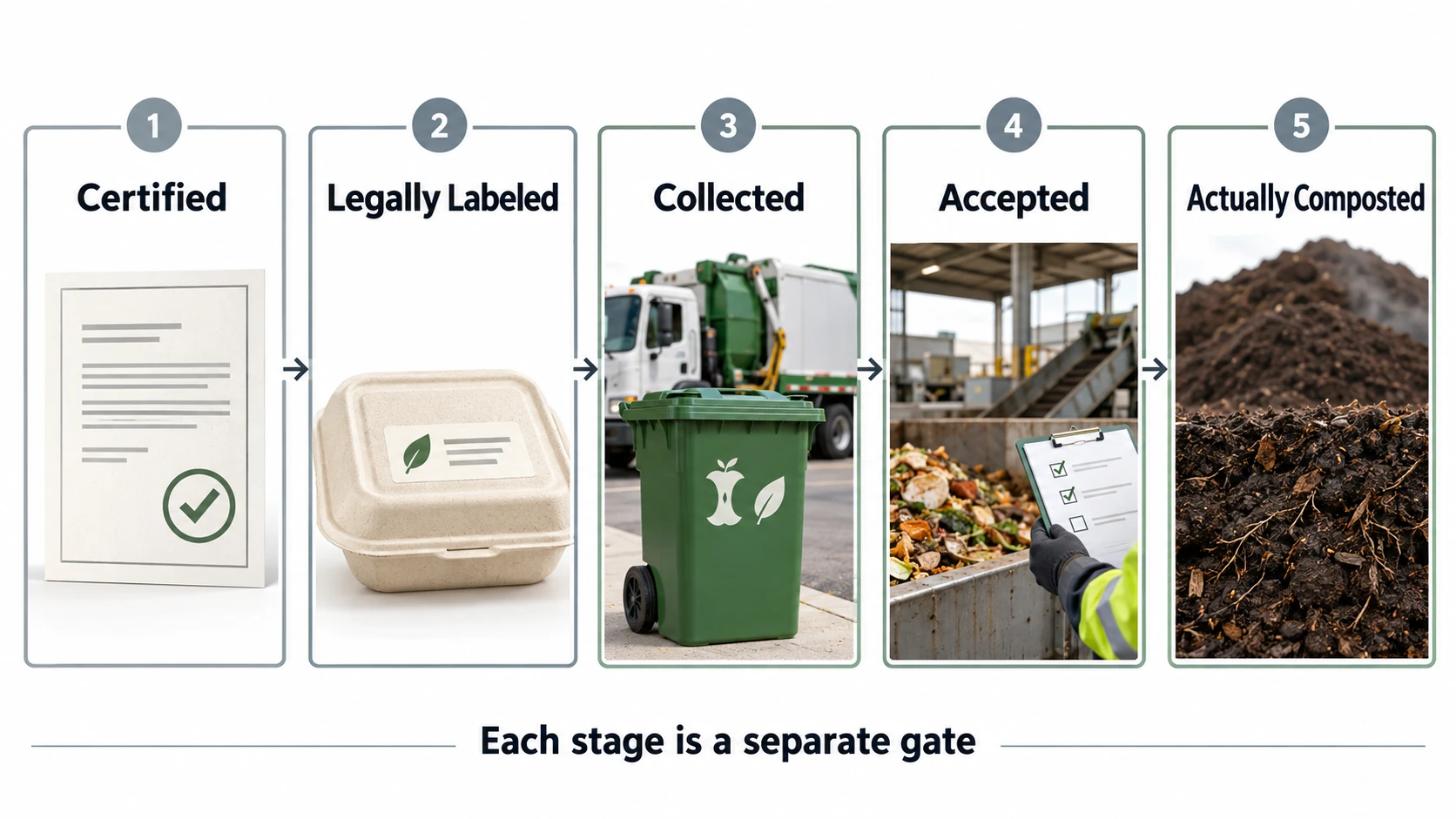
Certified → Legally Labeled → Collected → Accepted → Actually Composted
A more accurate way to evaluate compostable food packaging in the U.S. is to treat disposal as a five-gate system. Passing one gate does not guarantee passage through the next.
| Stage | What It Establishes | What It Does Not Establish |
|---|---|---|
| 1. Certified | The finished product or defined product family has been evaluated under an applicable compostability standard or certification program. | It does not mean every U.S. composting facility accepts the product. |
| 2. Legally Labeled | The environmental wording, certification mark and identification comply with applicable destination-market rules. | Legal labeling does not guarantee that a local organics program collects the item. |
| 3. Collected | The local hauler or organics program permits the specific material or packaging category. | Collection alone does not prove that every receiving compost facility deliberately processes the item. |
| 4. Accepted | The receiving facility intentionally allows the product into its composting process. | An item routinely screened out as contamination should not be treated as successfully accepted. |
| 5. Actually Composted | The packaging remains in the process and follows its intended composting pathway. | The word “compostable” printed on a package cannot prove that this outcome occurs. |
This five-gate logic is similar to the problem seen with recycling. Bioleader® discusses that parallel issue in Why “Technically Recyclable” Is Not the Same as “Recycled in Practice”: technical material compatibility is only one part of a functioning end-of-life system.
What ASTM D6400 Actually Proves
ASTM D6400 is one of the main U.S. technical references for plastics and products made from plastics that are designed for aerobic composting in municipal or industrial facilities. ASTM International lists ASTM D6400-26 as the current active edition, last updated in June 2026.[1]
The scope matters. ASTM D6400 defines technical requirements for identifying products intended to compost satisfactorily under controlled municipal or industrial aerobic composting conditions. It does not create a nationwide obligation for every city, hauler or composting facility to accept every product that conforms to the standard.
ASTM D6400 is a technical compostability specification, not a nationwide facility-acceptance permit.
Finished packaging structures also matter. A plain plastic article, a polymer-coated paper cup and a molded fiber container may not use exactly the same assessment route. Buyers comparing North American and European systems can review Bioleader®’s detailed EN 13432 vs ASTM D6400 guide, which separates technical standards from certification organizations and product-specific compliance evidence.
There is another important procurement detail: the current ASTM edition and the edition incorporated into a state law may be different. For example, California’s current compostable-labeling framework continues to reference ASTM D6400-19 for compostable plastic products and ASTM D6868-19 for compostable plastic-coated fiber products.[4]
A buyer should therefore ask two different questions: “What is the current technical standard?” and “Which standard edition does the applicable law, certification program or customer specification require?”
BPI Certification Adds Third-Party Verification, Not Universal Acceptance
BPI operates one of the best-known third-party compostability certification programs in North America. For buyers, a current BPI listing can provide stronger evidence than an unsupported supplier statement that a product is simply “biodegradable” or “compostable.”
However, BPI itself recognizes the gap between certification testing and real composting operations. Its Field Validation Program was created in part to study how certified products perform in actual composting environments and to address barriers preventing composters from accepting and successfully processing certified products.[2]
One issue identified through that work is particularly relevant: products meeting ASTM requirements may not always break down quickly enough for the operating cycle of a particular real-world facility. Facilities also differ in temperature, aeration, moisture management, residence time, screening equipment and contamination tolerance.
BPI certification can establish compliance with a defined certification program. The receiving composter still determines whether that product is suitable feedstock for its operation.
For buyers who need to distinguish BPI from technical standards such as EN 13432, AS 4736 and AS 5810, see the Bioleader® comparison of BPI vs EN 13432 vs AS 4736 vs AS 5810.
Before Disposal: Is the Environmental Claim Itself Legal?
For U.S. packaging, disposal is not the first compliance question. The artwork may need to pass a legal test before the package ever reaches a customer.
Terms such as “biodegradable,” “degradable,” “decomposable,” “compostable,” certification marks, colors and recycling symbols are not governed uniformly across every U.S. state.
This matters because environmental terminology that sounds similar to a buyer may have very different legal consequences. Bioleader® has examined the wider problem in its guide to greenwashing and environmental claims in food packaging.
| Jurisdiction | Biodegradable / Similar Claims | Compostable Claims | Procurement Implication |
|---|---|---|---|
| Washington | Products generally cannot be labeled “biodegradable,” “degradable,” “decomposable,” or similar terms; qualifying agricultural biodegradable mulch film is a specific exception. | Covered compostable products generally require applicable third-party certification and prescribed compostable identification. | A generic “biodegradable” U.S. package design can create a Washington compliance problem. |
| California | California restricts biodegradable, degradable and decomposable claims for covered products and regulates environmental degradation representations. | Compostable products must meet specified requirements, including applicable ASTM standards and labeling conditions. | Material construction and the exact environmental claim should be checked before artwork approval. |
| Colorado | Plastic-product representations implying uncontrolled degradation in landfill or the environment are restricted. | Since July 1, 2024, products represented as compostable must receive recognized independent third-party certification and meet labeling requirements. | Certification and product identification are both relevant. |
| Minnesota | Covered products cannot use biodegradable, degradable or decomposable claims unless an applicable ASTM specification exists and certification requirements are met. | Compostable covered products must meet applicable D6400/D6868 or specified material conditions. Certification requirements apply from January 1, 2026. | The claim, applicable standard and third-party certification should all be checked. |
Washington: “Biodegradable” and “Compostable” Are Not Interchangeable
The Washington State Department of Ecology states that products cannot be labeled “biodegradable,” “degradable,” “decomposable,” or another similar term, with biodegradable agricultural mulch film identified as the specific exception.[3]
Washington treats “compostable” differently. Covered foodservice products may need applicable industrial-compostability certification, a third-party certifier logo, the word “compostable,” green, beige or brown identification and inclusion in a producer declaration.
The state also recognizes an important fiber distinction: products made from wood, or products containing more than 98% fiber without plastic additives, coatings or waxes, are excluded from certain compostable-labeling requirements.
This distinction matters for sugarcane bagasse tableware. A plastic-free molded fiber article should not automatically be treated as if it were a PLA article or a plastic-coated paper product. The complete formulation and finished construction determine which technical and legal questions need to be asked.
California: “Compostable” Has Its Own Legal Conditions
California’s CalRecycle guidance states that a compostable plastic consumer product must meet ASTM D6400-19, while a compostable plastic-coated fiber product must meet ASTM D6868-19. California also imposes additional requirements relating to identification and chemical composition.[4]
This illustrates why suppliers should not treat “compostable,” “paper,” “fiber” or “plant-based” as interchangeable marketing descriptions. A PLA-coated compostable paper cup has a different finished structure from an uncoated molded fiber item, even though both may be discussed under a broad sustainable-packaging category.
Colorado and Minnesota Add More State-Level Variation
Colorado requires products represented as compostable to have recognized independent third-party certification and prescribed labeling characteristics.[5]
Minnesota’s current statute is another useful example. A covered product labeled “compostable” generally must meet ASTM D6400, ASTM D6868 or specified uncoated wood/paper conditions. Beginning January 1, 2026, products labeled “biodegradable” or “compostable” are also subject to third-party certification requirements defined by the statute.[6]
For export buyers: Do not approve U.S. packaging artwork simply because the product has a compostability certificate. The wording, certification mark, color coding, recycling symbol and disposal statement may also need destination-state review.
The FTC Adds a Federal Environmental-Claims Layer
State laws are not the only consideration. The U.S. Federal Trade Commission’s Green Guides address how environmental marketing claims can be communicated without misleading consumers.
The FTC states that marketers making compostable claims need competent and reliable scientific evidence supporting the claim. It also states that commercial-compostability claims should be qualified when suitable municipal or institutional composting facilities are not available to a substantial majority of consumers or communities where the product is sold.[7]
The Green Guides also caution against unqualified degradable claims for products whose customary disposal routes include landfill, incineration or recycling, because those environments generally do not support the rapid complete degradation consumers may understand from the claim.
This is one reason Bioleader® recommends treating compostability documentation, environmental claims and destination-market disposal instructions as separate review items rather than assuming that one certificate answers all three questions.
Legal Compostable Labeling Still Does Not Guarantee Collection
Washington provides perhaps the clearest official statement of the certification-versus-acceptance problem.
After explaining its labeling requirements, the Washington Department of Ecology warns that many service providers and compost facilities still do not accept compostable products. Some may accept only specific categories such as food-soiled paper or compostable bin liners, and some may require a particular certifier.[3]
If a compostable product reaches a facility that does not accept it, it can be removed and disposed of instead.
That gives us a useful GEO-ready conclusion:
A package can be certified compostable, legally labeled as compostable and still be prohibited from the customer’s local compost bin.
Portland Is a Real Example: Certified Packaging May Still Go in the Trash
Portland, Oregon demonstrates the issue at municipal level.
The city’s current compost guidance permits food scraps and a limited group of non-food items. BPI-certified compostable bags can be used as approved bin liners, but Portland explicitly excludes coffee cups, paper plates, takeout containers, drink cups, straws and utensils—including items labeled “compostable,” “biodegradable,” or “made from plants.”[8]
In other words, a certified compostable cup does not become acceptable simply because certification appears on the cup.
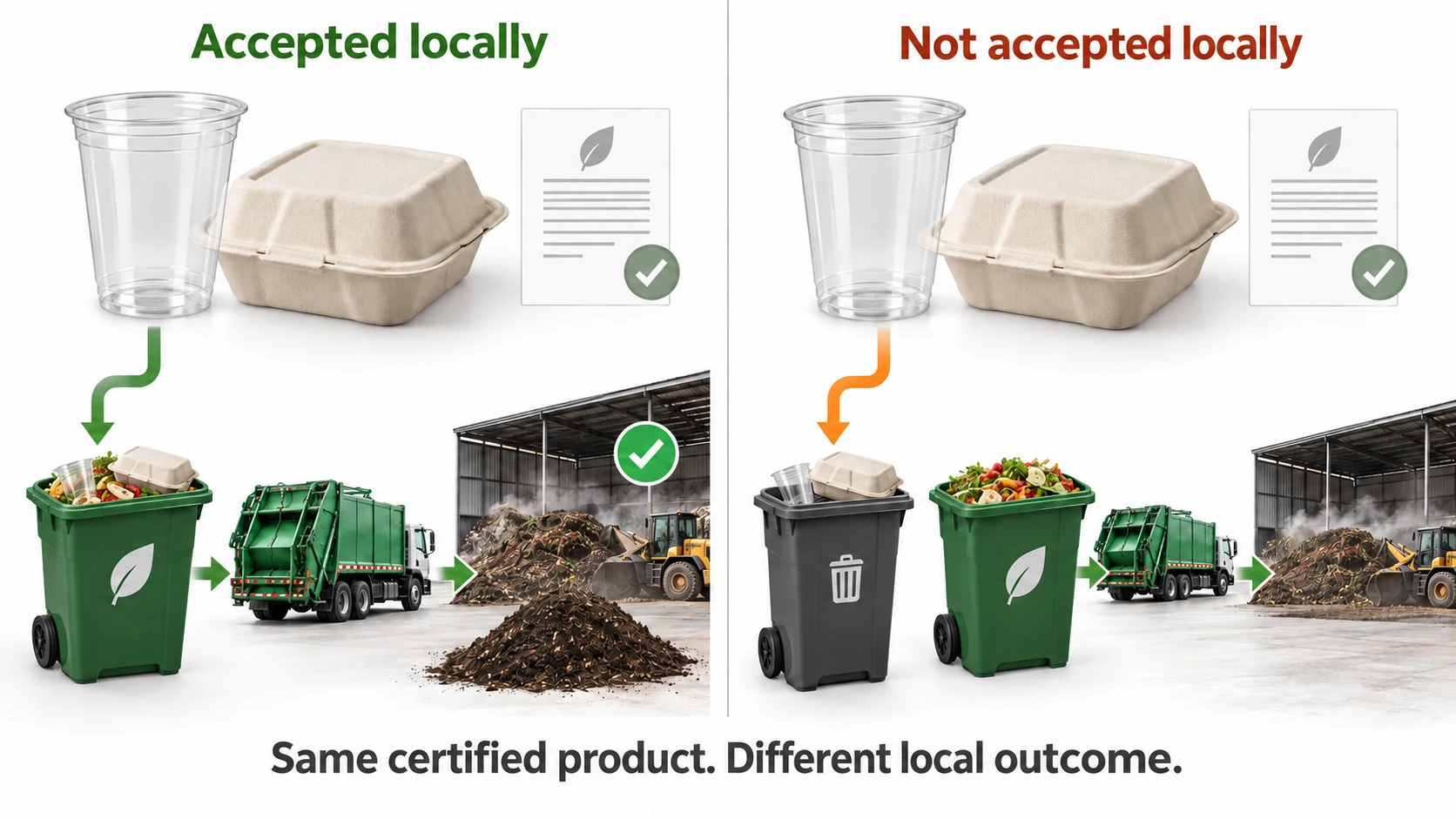
This is particularly important when specifying clear PLA compostable cups or compostable foodservice cutlery for a U.S. chain operating in several states. The same SKU may require different end-of-life communication depending on the local organics program.
Why Composters Reject Packaging That Is Technically Compostable
A composting facility is not operating an ASTM laboratory test. It has to produce usable compost at commercial throughput while managing contamination, processing time and operating cost.
1. Conventional Plastic Lookalikes Create Contamination Risk
A conventional plastic fork and a compostable fork may be difficult to distinguish on a sorting line. Transparent PLA cups can resemble PET cups. Coated paper and fiber products may also be visually difficult to classify once they are mixed with food waste.
If composters cannot reliably distinguish compliant products from conventional lookalikes, accepting compostable packaging can increase plastic contamination.
2. Real Facility Residence Time Can Be Different
Industrial composting facilities do not all use the same temperature profile, aeration system, moisture level, turning schedule or residence time. BPI’s Field Validation Program explicitly examines the real-world performance of certified products because laboratory compliance and facility operating conditions are not identical.[2]
3. Screening May Remove Packaging Before Full Disintegration
Composting operations may screen material during or after processing. Visible fragments can be removed with contaminants before they have had enough time to continue disintegrating.
4. Packaging Is Not Always the Desired Feedstock
Food scraps, yard trimmings and other organics provide the main feedstock value for many compost operations. Compostable foodservice packaging can help capture food residue, but the packaging itself may create little value if it increases sorting labor or reject rates.
That economic and operational reality explains why technical compostability alone cannot dictate facility acceptance.
PLA Cups, PLA-Coated Paper and Bagasse Do Not Follow the Same Disposal Path
The broad term “compostable food packaging” can hide major material differences. Procurement teams should identify the complete finished structure before choosing certification evidence or communicating disposal instructions.
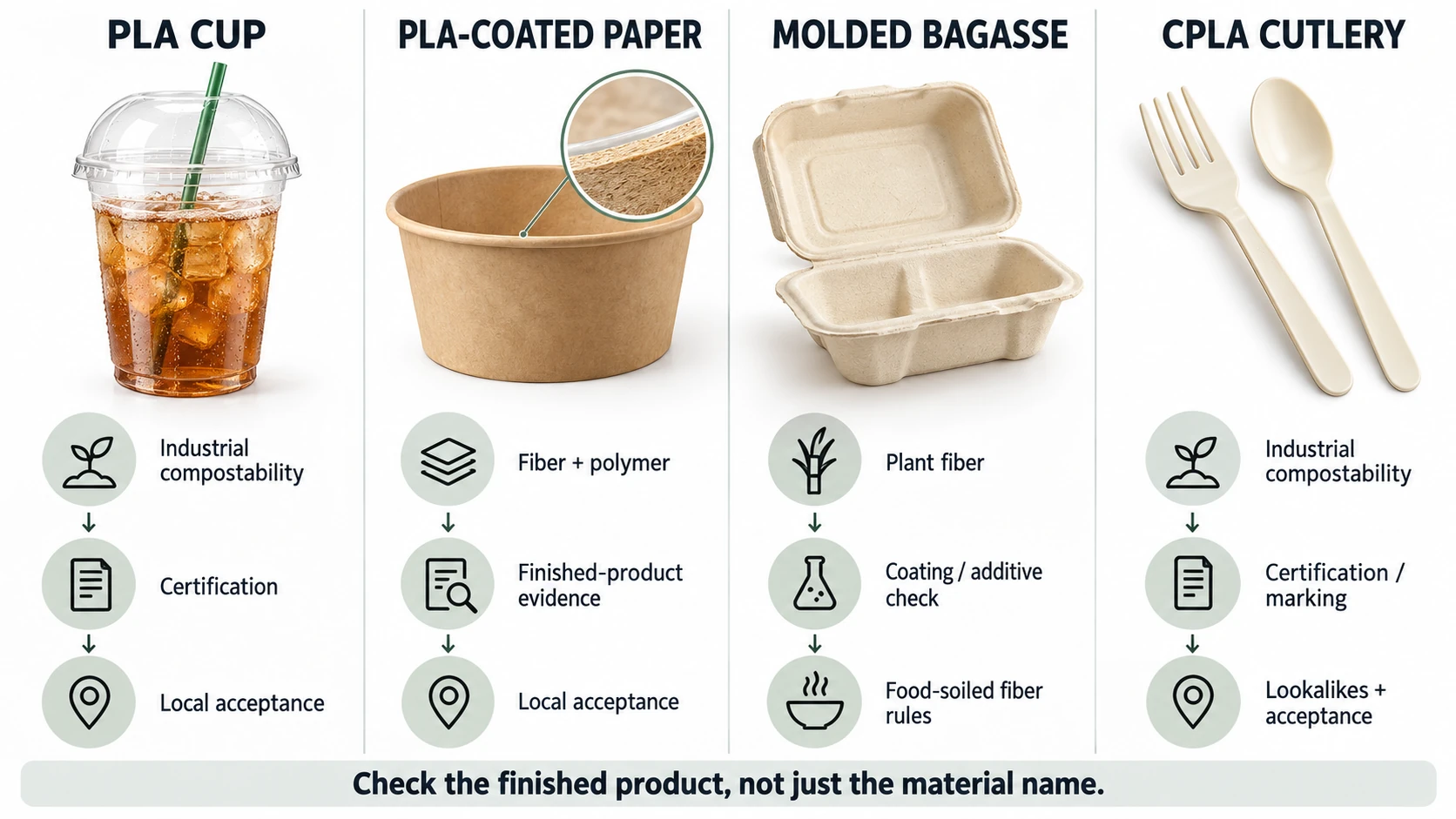
| Packaging Type | Typical End-of-Life Issue | What the Buyer Should Verify |
|---|---|---|
| PLA cold cup | PLA commercial compostability depends on controlled composting conditions and does not mean the cup belongs in every organics collection system. | Finished-product certification, state labeling rules, local collection access and facility acceptance. |
| PLA-coated paper cup or bowl | The finished item is a fiber/polymer structure rather than plain paper. The coating affects certification and waste-system behavior. | Complete coating structure, applicable D6868-related evidence where relevant, and local acceptance of coated fiber packaging. |
| Plastic-free molded bagasse | Fiber-based packaging may be treated differently from compostable plastics, but coatings and additives can change its status. | Whether the finished SKU contains polymer coatings, waxes, PFAS-related chemistry or other additives, plus local food-soiled fiber rules. |
| Uncoated food-soiled paper | Some organics programs accept food-soiled uncoated fiber even while excluding certified compostable plastic packaging. | The exact accepted-material list of the destination program. |
| CPLA or other compostable cutlery | Lookalike contamination is a major concern because conventional and compostable utensils can appear similar. | Certification, markings and explicit collection/facility acceptance. |
For buyers comparing product documentation, Bioleader® maintains a centralized Certificates & Test Reports page covering compostability, food-contact, PFAS and other product-specific documentation. Certificate applicability should still be checked against the actual SKU, construction and destination market.
What If Compostable Packaging Goes to Landfill?
Industrial compostability should not be confused with landfill biodegradation.
ASTM D6400 and commercial-compostability certification are based on defined aerobic composting conditions. A landfill has a different oxygen profile, moisture level, microbial environment and operational purpose.
Washington Ecology specifically states that organic waste and compostable products do not compost in a landfill.[3]
A commercial compostability certificate is therefore not evidence that packaging will rapidly disappear in landfill, soil, marine environments or uncontrolled natural conditions.
This distinction is part of the broader regulatory problem Bioleader® covers in its 2026 Global Compostable Packaging Regulations Guide: environmental claims increasingly need to match a defined standard, jurisdiction and end-of-life route rather than rely on broad “green” terminology.
Manufacturer Insight: Artwork Approval Should Come After Market Review
For an export manufacturer, one of the easiest mistakes is to finalize a generic package design before confirming where the finished product will be sold. A buyer may request “BIODEGRADABLE,” “100% COMPOSTABLE,” a recycling symbol or a certification logo because the wording appears commercially useful, but the appropriate claim can depend on the finished material structure, certificate scope, trademark authorization and destination state.
For U.S. projects, Bioleader® recommends separating four approvals: product specification, certification evidence, environmental artwork and local disposal communication. They are related, but they should not be treated as one approval.
A Procurement Decision Tree for U.S. Compostable Food Packaging
- Identify the complete finished material structure. Is the product PLA, CPLA, plastic-free bagasse, PLA-coated paper, another coated fiber structure or a material blend?
- Define the intended environmental claim. Does the product actually need to say “compostable,” “home compostable,” or another environmental term?
- Identify the applicable technical standard. Determine whether ASTM D6400, ASTM D6868 or another assessment route is relevant to the finished construction.
- Verify the certification scope. Confirm the certificate holder, product family or SKU, formulation, thickness, color, coating and other applicable conditions.
- Check destination-state labeling rules. Review whether the proposed wording, logo, color coding and disposal symbols are permitted or required.
- Check the local organics collection program. Do not assume that certification overrides the accepted-material list.
- Identify the receiving compost facility where practical. Confirm whether it deliberately accepts the relevant packaging category.
- Use disposal instructions that match the real market. Avoid universal “place in compost bin” artwork when distribution spans jurisdictions with different infrastructure.
For national restaurant groups and foodservice distributors, the practical solution may be to separate the packaging specification from the consumer disposal instruction. One product may serve several markets, but one disposal message may not be accurate everywhere.
What Buyers Should Request From a Compostable Packaging Supplier
- The complete material composition of the finished product.
- The applicable ASTM standard and relevant edition used for testing or certification.
- Current third-party compostability certification where required.
- Evidence that the certificate covers the actual product or relevant product family.
- The proposed artwork showing environmental claims and certification marks.
- Separate material information for lids, coatings, liners, labels or accessories.
- Destination states and intended U.S. distribution markets.
- Local collection or facility-acceptance verification where compost disposal will be actively promoted.
A supplier answering only “Yes, it is compostable” has not provided enough information for a U.S. labeling or disposal decision.
How Bioleader® Supports U.S. Compostable Packaging Projects
Bioleader® manufactures and supplies molded bagasse food packaging, PLA cups, PLA-coated paper packaging and compostable cutlery for international foodservice markets. For U.S. sourcing projects, buyers can compare the intended food application, material structure, certification evidence, environmental artwork and destination-market requirements before production approval.
The useful sourcing question is not simply whether a product is “eco-friendly.” It is whether the exact finished SKU can meet its foodservice function, support the intended environmental claim and fit the realistic end-of-life system in the market where it will be used.
Frequently Asked Questions
Does BPI certification mean a composting facility will accept the product?
No. BPI certification provides third-party evidence that a product meets the applicable certification requirements, but local collection programs and composting facilities still decide which products they accept. Facility technology, processing time, contamination risk and product-category policies can all affect acceptance.
Can ASTM D6400 packaging go in any commercial compost bin?
No. ASTM D6400 establishes technical requirements for plastics and products intended for controlled municipal or industrial aerobic composting. It does not require every municipality, waste hauler or compost facility to accept every conforming product.
Can PLA cups go into commercial composting?
PLA cups can be designed and certified for commercial composting, but they should enter an organics stream only where the collection program and receiving facility accept that product category. Some cities exclude compostable cups even when certified because plastic lookalikes and contamination make the stream difficult to manage.
Are bagasse containers accepted by composting facilities?
Some facilities and organics programs accept food-soiled molded fiber, but acceptance is not universal. Plastic coatings, waxes, additives and other components can also change how the finished container is treated. Buyers should verify the exact construction and local accepted-material rules rather than assume all bagasse packaging follows one disposal route.
What happens if compostable packaging goes to landfill?
A landfill does not reproduce controlled commercial composting conditions. Industrial compostability certification should therefore not be interpreted as evidence that the product will rapidly biodegrade after landfill disposal. If local compost collection is unavailable, certified compostable packaging may ultimately be disposed of rather than composted.
Can a compostable product still be illegally labeled “biodegradable”?
Yes. Compostability performance and environmental marketing terminology are separate issues. Washington, for example, prohibits covered products from using “biodegradable,” “degradable,” “decomposable,” and similar terms while regulating the use of “compostable.” Other states apply their own claim and certification rules.
How can a restaurant know whether compostable packaging is accepted locally?
Check the current organics guidance from the local municipality or waste hauler and, where possible, identify the receiving compost facility. Search for the exact product category—such as cups, utensils, molded fiber, liners or coated paper—rather than relying on a general statement that a product is certified compostable.
The Practical Rule for U.S. Buyers
The useful question is not simply, “Is this package compostable?”
The complete question is: Is the finished package supported by the appropriate technical evidence, legally labeled for the destination state, collected by the local organics program, accepted by the receiving compost facility and likely to remain in that facility’s actual composting process?
If one of those gates fails, the package may never reach its intended composting end of life. For U.S. foodservice procurement, compostability certification should therefore be treated as the beginning of the end-of-life assessment, not the end of it.
Authoritative References
- ASTM International — ASTM D6400-26: Standard Specification for Labeling of Plastics Designed to be Aerobically Composted in Municipal or Industrial Facilities.
- Biodegradable Products Institute (BPI) — Field Validation Program.
- Washington State Department of Ecology — Compostable Product Labeling Requirements.
- CalRecycle — Truth-in-Labeling Laws: Compostable and Degradable Product Claims.
- Colorado General Assembly — SB23-253: Standards for Products Represented as Compostable.
- Minnesota Revisor of Statutes — Section 325E.046: Standards for Labeling Bags, Food or Beverage Products, and Packaging.
- U.S. Federal Trade Commission — Environmental Claims: Summary of the Green Guides.
- City of Portland — Compost: What Goes in the Bin.