Introduction: Most Customs Problems Are Preventable
As Mexico increases scrutiny on imported food-contact and environmentally positioned products, compostable and biodegradable disposable tableware has become a frequent focus during customs clearance.
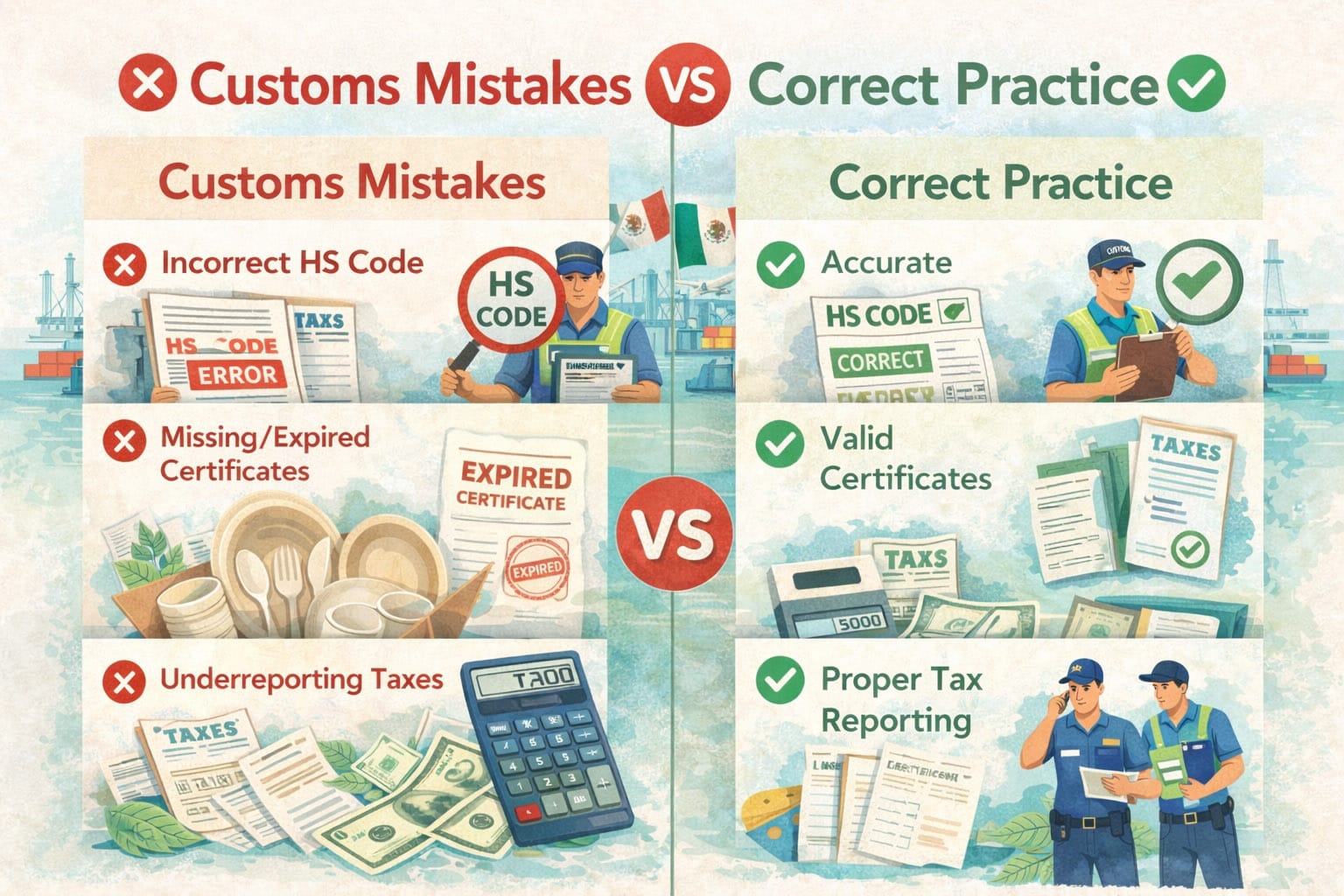
In practice, most customs delays, inspections, or penalties are not caused by banned products, but by avoidable procedural mistakes—often made before the container even leaves the port of origin.
This guide outlines the most common customs mistakes encountered when importing compostable tableware into Mexico and explains how importers can proactively avoid them.
Mistake 1: Assuming “Compostable” or “Biodegradable” Equals Automatic Approval
A common misconception is that environmentally friendly products receive simplified or preferential customs treatment.
Reality:
Mexican customs clearance is based on:
HS code classification
Material structure
Declared product use
Environmental claims such as compostable, biodegradable, or eco-friendly do not replace proper HS classification or documentation.
How to avoid it:
Finalize HS codes and product descriptions first; treat sustainability claims as secondary marketing attributes, not customs criteria.
Mistake 2: Incorrect or Inconsistent HS Code Classification
HS misclassification remains the single most common trigger for customs inspection.
Typical errors include:
Using one HS code for mixed-material sets without justification
Applying plastic HS codes to molded fiber products
Changing HS codes between quotation, invoice, and bill of lading
How to avoid it:
Lock HS codes at the SKU level early and maintain a clear classification rationale, especially for sets or composite products.
Mistake 3: Treating Product Sets as Separate Items Without Clear Logic
Many compostable tableware products are sold as sets (e.g., bowl + lid).
Common mistake:
Declaring each component separately without considering essential character, or worse, mixing approaches across documents.
Customs risk:
This often results in valuation disputes or document inconsistencies.
How to avoid it:
Decide in advance whether the shipment is treated as:
A single set (essential character rule), or
Separate components (each with its own HS code)
Apply the same logic consistently across all documents.
Mistake 4: Vague or Marketing-Oriented Product Descriptions
Descriptions such as:
“Eco container”
“Green packaging”
“Sustainable food box”
may be suitable for sales—but they are problematic for customs.
Why this matters:
Customs officers require clarity on:
Material type
Manufacturing method
Intended use
How to avoid it:
Use functional, material-based descriptions (e.g., “molded sugarcane fiber food container for takeaway use”).
Mistake 5: Missing or Weak Supporting Documentation
Even when products are allowed, insufficient documentation can trigger delays.
Common gaps include:
No material composition statement
No clarity on food-contact use
Inconsistent weights or quantities
How to avoid it:
Prepare a basic SKU Evidence Pack containing:
Material declaration
Product photos
Weight and structure details
HS classification rationale
This reduces discretionary inspections.
Mistake 6: Assuming Courier Clearance Works for All Shipments
Some buyers assume courier clearance (DHL, FedEx, UPS) can be used for regular imports.
Reality:
Courier clearance is typically limited to:
Samples
Very low-value shipments
Commercial quantities of compostable tableware require formal customs clearance with an appointed broker.
How to avoid it:
Plan sea freight imports with a licensed Mexican customs broker or an experienced logistics partner.
Mistake 7: Importer Qualification Not Fully Completed
Even with perfect documents, clearance will fail if the importer lacks:
Active RFC
Valid Padrón de Importadores registration
Verified tax domicile
Why this happens:
Some importers focus on products but overlook importer-side compliance.
How to avoid it:
Confirm importer readiness before shipment booking—not after arrival.
Mistake 8: Last-Minute Changes After Production or Booking
Changing:
Product descriptions
Consignee details
after production or booking often causes document mismatches.
How to avoid it:
Implement a 48-hour pre-departure document consistency check and freeze all commercial details before shipment.
Mistake 9: Underestimating Inspection Risk for Food-Contact Products
Food-contact packaging—especially biodegradable alternatives—is more likely to be reviewed.
Common oversight:
Assuming packaging is “non-food” and does not require clarity.
How to avoid it:
Explicitly state whether products are intended for food contact and ensure supporting documents are aligned.
Mistake 10: Lacking a Contingency Plan for First-Time Imports
First-time importers often underestimate the complexity of clearance.
Risk:
Delays, demurrage charges, or incorrect filings.
How to avoid it:
Work with experienced suppliers and logistics partners. If the importer lacks experience, paid customs clearance and delivery support through qualified freight forwarders can significantly reduce risk.
Final Takeaway: Customs Success Is About Discipline, Not Complexity
Importing compostable tableware into Mexico is not inherently difficult—but it is unforgiving of inconsistency.
Most customs issues arise from:
HS ambiguity
Documentation misalignment
Importer readiness gaps
Companies that approach customs compliance as a process, not an afterthought, achieve faster clearance and more predictable logistics.
One-Stop Support for Importing Compostable Tableware into Mexico
Bioleader® is not only a manufacturer of compostable and biodegradable disposable tableware, but also a long-term partner for international importers navigating complex customs and compliance requirements.
Beyond product supply, Bioleader provides end-to-end import support, including export documentation preparation, HS code coordination, compliance guidance, and close cooperation with experienced international freight forwarders. For buyers who are new to importing into Mexico, our team can assist—through our logistics partners—with customs clearance coordination and final delivery services (fee-based), helping reduce delays, compliance risks, and operational friction.
Whether you are sourcing compostable tableware for the first time or scaling an existing supply chain, Bioleader’s integrated service approach helps ensure a smoother, more predictable import process from China to Mexico.

Copyright Notice:
© 2026 Bioleader®. If you wish to reproduce or reference this content, you must provide the original link and credit the source. Any unauthorized copying will be considered an infringement.