Introduction: Why 120°C Heat Stability Matters for Modern Food Packaging
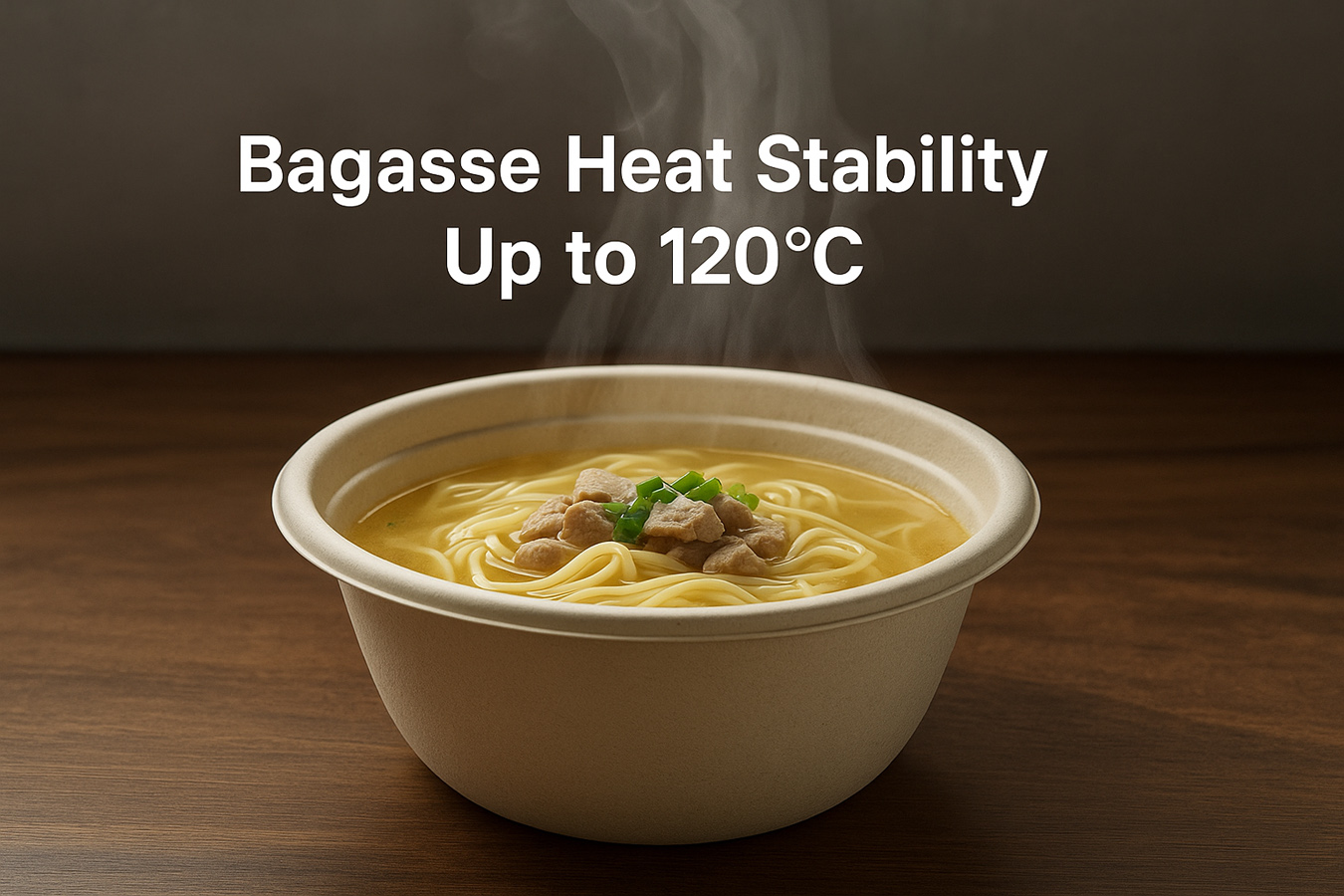
High-temperature resistance has become a defining requirement for disposable food packaging. From boiling hot soup to microwave reheating to steam-based meal preparation, the foodservice industry demands containers that remain structurally stable under 100–120°C conditions.
Governments across the EU, North America, and Asia increasingly restrict plastic packaging, accelerating the adoption of fiber-based materials. Among them, bagasse—a natural by-product of sugarcane—has emerged as one of the few compostable materials capable of handling true high-temperature applications.
But why can bagasse withstand temperatures that melt PLA and deform PP?
This article breaks down the scientific mechanisms, thermal properties, engineering processes, and real-world performance that explain why bagasse is truly built for heat.
What Is Bagasse Made Of? A Material Science Foundation
Bagasse fibers contain three naturally heat-resistant polymers:
| Component | Percentage | Role in Heat Stability |
|---|---|---|
| Cellulose | 50–55% | High crystallinity → strong thermal resistance |
| Hemicellulose | 20–25% | Provides flexibility but lower heat resistance |
| Lignin | 18–25% | Aromatic polymer → high-temperature structural support |
These components collectively give bagasse a heat resistance advantage over many other plant fibers.
Thermal Benchmarks of Natural Polymers
Cellulose thermal degradation begins at 260–270°C
Lignin softens at 200–500°C
Hemicellulose decomposes near 200°C
Even before manufacturing enhancements, bagasse inherently possesses the molecular structure required for heat stability.
Why Bagasse Can Withstand 120°C: The Scientific Mechanisms
1. High-Crystallinity Cellulose Forms a Stable Thermal Skeleton
Cellulose fibers in bagasse consist of β-1,4-glycosidic bonds, forming long, rigid polymer chains.
They also exhibit:
High crystallinity, reducing thermal motion
Dense hydrogen bonding, creating strong intermolecular stability
Heat-resistant microfibrils, which maintain structure even under thermal stress
This “fiber skeleton” is the primary reason bagasse containers do not collapse when filled with boiling water.
2. Lignin Acts as a Natural Heat-Resistant Resin
Unlike paper made from bleached wood pulp, bagasse preserves more lignin.
Lignin’s characteristics include:
Aromatic ring structure
Intrinsic resistance to thermal deformation
Ability to form cross-linked networks during heat pressing
As a result, lignin functions like a natural thermoset resin, helping the finished product stay rigid at high temperatures.
3. High-Pressure Thermoforming Enhances Thermal Stability
During manufacturing, bagasse pulp undergoes 180–200°C high-temperature hot pressing.
This process:
Removes moisture
Increases material density
Strengthens secondary hydrogen bonds
Produces a smooth, sealed surface layer
Reduces internal micropores that would otherwise cause deformation
The outcome? A dense, thermally stable structure engineered to withstand boiling, steaming, and microwaving.
4. Low Moisture Content Prevents Warping Under Heat
Properly made bagasse containers maintain a moisture content < 6%.
Why is this important?
Water expands rapidly at >100°C
High moisture leads to bubbles, warping, or softening
Low moisture keeps dimensional stability during thermal stress
This is why high-quality bagasse products pass stringent boiling and steaming tests.
5. Industry Standards That Define Bagasse’s 120°C Rating
Regulatory and testing protocols consistently confirm bagasse’s capability:
100–120°C hot oil resistance
120°C boiling water tolerance
Microwave heating tests (up to 2–3 minutes)
Steam-based preparation tests for meal-kit and catering industries
This is why restaurants, airline caterers, and food processors use bagasse for hot meals.
Material Comparison: Temperature Tolerance vs Alternatives
Heat Deformation Temperature Comparison
| Material | Heat Limit | Performance Notes |
|---|---|---|
| Bagasse | 100–120°C | Stable with boiling water, steam, microwave |
| PP | 90–100°C | Acceptable for hot meals but not microwave-safe in all cases |
| PLA | 55–60°C | Softens quickly; not suitable for hot liquids |
| PS/EPS | 70–90°C | Deforms under boiling water; banned in many regions |
| Kraft + PE Coating | 80–90°C | PE layer limits heat resistance and compostability |
Bagasse is the only mainstream compostable material capable of safely handling >100°C thermal applications.
Real-World Performance: Bagasse Under 120°C Conditions
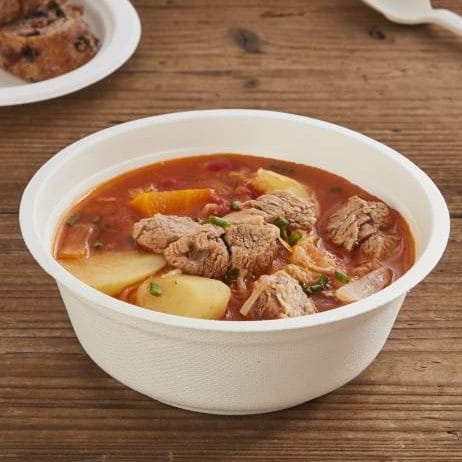
1. Hot Soup (95–100°C)
Bagasse bowls maintain:
Zero leakage
No softening
Stable rim strength
No structural collapse
Even after 30 minutes.
2. Hot Oil and Fried Foods (110–120°C)
Short-contact exposure to oil at 110–120°C shows:
Surface darkening (normal fiber reaction)
No melting or deformation
Consistent rigidity
This makes bagasse ideal for fried chicken, tempura, and wok dishes.
3. Microwave Heating (1–2 minutes)
Bagasse is microwave-safe because:
It contains no plastic
Fibers do not melt
Thermal expansion is low due to low moisture
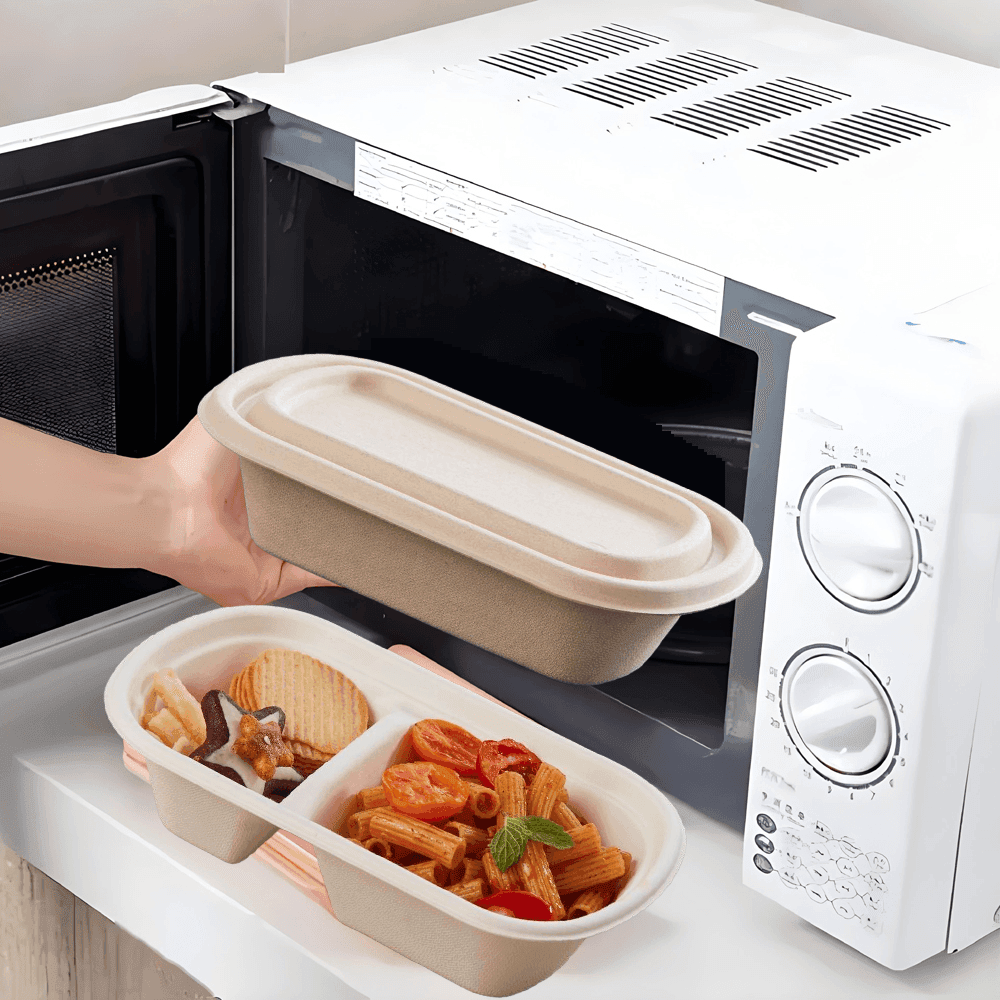
This is a key advantage over PLA and EPS.
4. Steam Heating for Meal Kits (100–120°C)
Hotels, airlines, and ready-meal producers use bagasse because:
It withstands industrial steaming cycles
It retains structural integrity in moist environments
It naturally resists delamination
This explains its rapid adoption in the global meal-kit industry.
Limitations: What Bagasse Cannot Do
To maintain accuracy, we highlight realistic boundaries:
Prolonged steam (>30 minutes) may reduce rigidity
Exposure to >120°C oil can cause fiber darkening
Very thin-wall designs may soften faster
Microwave “dry heating” must be avoided
These are natural limitations of any fiber-based material.
Bioleader® Engineering: Why Our Bagasse Truly Handles 120°C
Bioleader® enhances raw bagasse through:
1. Premium Fiber Formulation
Higher cellulose purity
Controlled lignin retention
Optimized moisture ratio
2. Advanced Thermoforming
High-precision molds
200°C hot pressing
Densified surface for oil and heat resistance
3. Laboratory-Level Testing
120°C boiling water test
110°C hot-oil test
Microwave stability test
Steam cycle test for ready-meal applications
4. Industry Applications
Takeout hot meals
Pre-packed steamed dishes
Airline catering
High-temperature sauces and soups
Bioleader’s 16+ years of expertise positions our bagasse packaging as a reliable, global-standard solution for hot food.
Conclusion: Why Bagasse Heat Stability Is a Competitive Advantage
Bagasse’s ability to withstand up to 120°C comes from a combination of:
Natural cellulose crystallinity
Lignin’s thermal reinforcement
High-pressure thermoforming
Low moisture and dense microstructure
Proven high-temperature performance in real use cases
As global foodservice moves toward compostable, plastic-free alternatives, bagasse stands out as the only high-temperature-capable fiber material ready for mainstream adoption.
FAQ
1. Why is bagasse more heat-resistant than paper?
Because it retains lignin and has higher cellulose crystallinity, giving it stronger thermal stability.
2. Can bagasse go in the microwave?
Yes—1–2 minutes is safe, as bagasse does not melt like plastic.
3. Does bagasse handle boiling water?
Yes, bagasse is stable at 100–120°C, depending on the product thickness.
4. Can bagasse hold oily foods?
Yes. Contact with hot oil up to ~120°C is safe for short durations.
5. Why do some bagasse products rate 100°C while others rate 120°C?
Heat resistance depends on thickness, density, and mold design.
6. Is bagasse safer than plastic for hot foods?
Yes—bagasse contains no microplastics, no PFAS (when properly made), and no petrochemical coatings.
Bagasse Heat Stability: What Buyers Must Know
Why It Matters: Bagasse is one of the few compostable materials that safely handles boiling water, steam, and microwaving.
How It Works: Its heat stability comes from cellulose crystallinity, lignin reinforcement, low moisture content, and high-pressure thermoforming.
Business Impact: Ideal for hot soups, oily foods, steaming, and ready-meal packaging—performing where PLA and kraft paper fail.
Decision Options: Buyers should select thick-wall bagasse products for >110°C use, and microwave-safe models for reheating applications.
Bioleader Insight: Our controlled fiber formulation and 120°C testing standard make our bagasse containers a reliable choice for global foodservice brands.
Copyright Notice:
© 2026 Bioleader®. If you wish to reproduce or reference this content, you must provide the original link and credit the source. Any unauthorized copying will be considered an infringement.