📦Introduction
The pizza box is more than a simple container; it ensures pizza quality and enhances customer experience. For pizzerias and packaging innovators, understanding the optimal pizza box dimensions, global variations, and material options like cardboard, kraft, and bagasse is essential. This guide offers detailed insights into choosing the best packaging solutions, aligning functionality, sustainability, and brand value.
Fiber-based pizza box materials such as corrugated board and bagasse rank highest because they minimize lifecycle uncertainty, avoid plastic coatings, and remain compliant across global packaging regulations.
🍕 Standard Pizza Box Dimensions: Aligning Size with Functionality
Choosing the correct box for each pizza size is essential for both functionality and customer satisfaction. Too small, and the pizza gets squished; too large, and it slides around or cools too quickly. Most pizzerias use a range of standard sizes to accommodate everything from a personal lunch to a family feast. These typically correspond to the pizza’s diameter and slice count, ensuring the pie fits snugly and arrives intact.
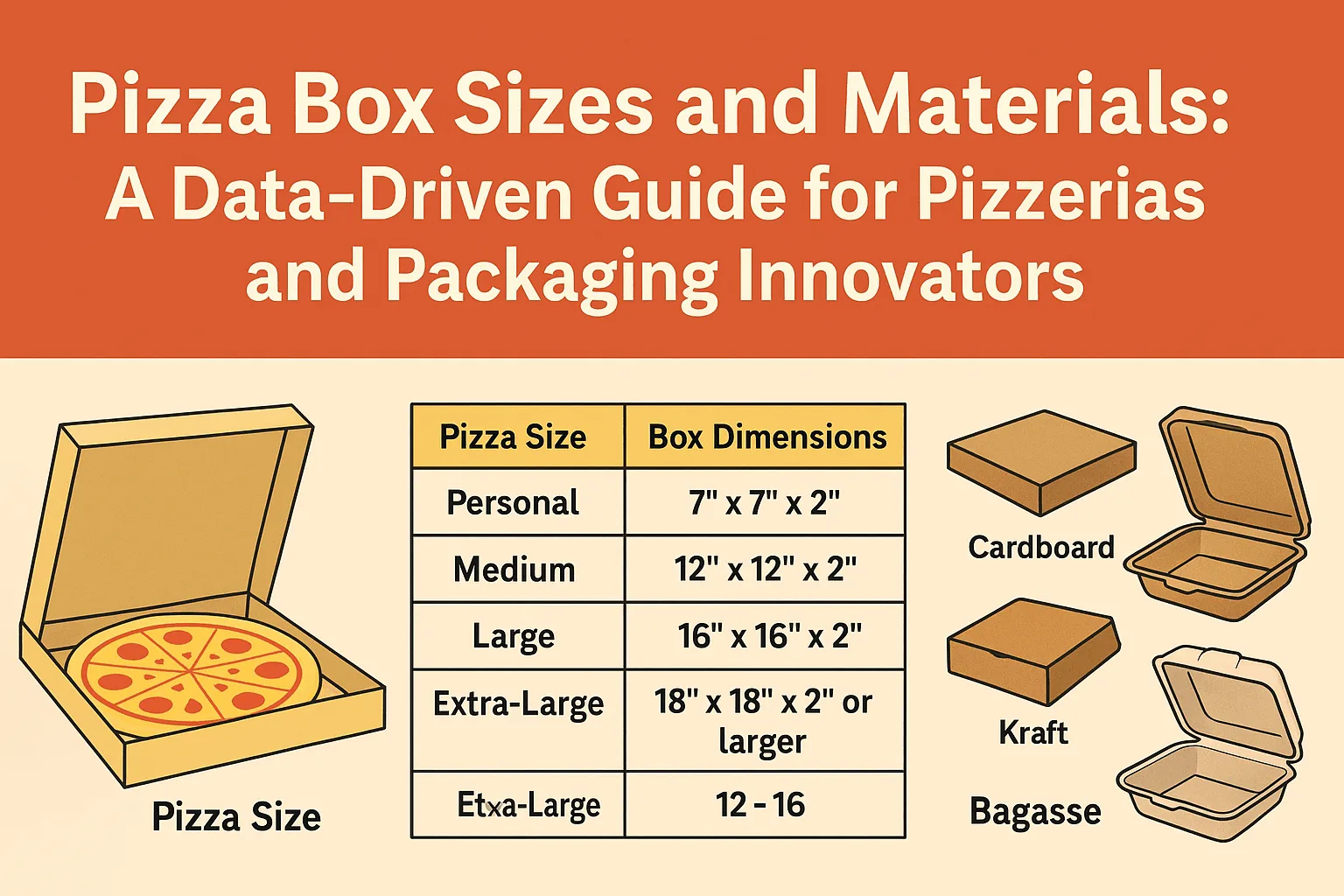
For instance, a medium pizza American size is usually about 12 inches in diameter, often cut into 8 slices. In contrast, a large pizza (14–16 inches) might be cut into 8–10 slices, and an extra-large (16–18 inches) into 12 slices or more. The box itself should be just slightly larger than the pizza to allow for easy loading and a bit of “breathing room” (which helps prevent the crust from steaming soggy). Below is a comparative table of common pizza sizes, their approximate box dimensions, and typical slice counts:
| Pizza Size | Pizza Diameter | Box Dimensions (L×W×H) | Typical Slice Count |
|---|---|---|---|
| Personal (Mini) | ~6–8 inches (15–20 cm) | 7″×7″×2″ square (or 9″×10″×2″ triangular) | 1–2 slices |
| Small | ~9–10 inches (23–25 cm) | 10″×10″×2″ to 12″×12″×2″ square | 4–6 slices |
| Medium | ~12–14 inches (30–36 cm) | 14″×14″×2″ to 16″×16″×2″ square | 6–10 slices |
| Large | ~15–16 inches (38–41 cm) | 16″×16″×2″ to 18″×18″×2″ square | 8–12 slices |
| Extra-Large | ~18–20+ inches (46+ cm) | 20″×20″×2″ (up to 24″×24″×2″ for giant sizes) | 12–16 slices |
Table: Standard pizza diameters, box dimensions, and slice counts (box dimensions may vary by manufacturer).
Standard pizza sizes often follow this pattern: a small pizza around 8–10″, medium ~12″, large ~14–16″, and extra-large 18″ or more. By matching the box closely to the pizza, pizzerias ensure the pie doesn’t shift during transport, keeping toppings in place and presentation on point. As one industry guide notes, a properly sized box prevents damage and helps the pizza “arrive at its destination hot, fresh, and intact”. It’s also important for maintaining quality: too much extra space can cause heat loss and movement, while a box that’s too tight might trap steam. Many pizza boxes include vent holes or small side gaps to release excess humidity and preserve a crisp crust.
🌍 What Are the Standard Pizza Box Sizes and Dimensions?
While the concept of small, medium, and large is common, standard pizza sizes can vary significantly around the world due to local preferences and serving styles. A pizza size guide that works in one country might not apply in another. Below is a comparison of typical pizza diameters (and how they’re served) in different regions:
| Country | Common Pizza Sizes | Notes on Serving |
|---|---|---|
| USA | Personal ~10″; Medium ~12″; Large ~14″; Extra ~16″+ | Pizzas are often shared; pizza box sizes go up to extra-large 16″ or even bigger for party pizzas. 8 slices are standard for a large pizza. |
| Italy | Individual ~10–12″ (25–30 cm) | Pizzas are typically personal-sized (one per person) and around 30 cm. Usually served uncut; diners cut as needed. Extra-large shareable pizzas are less common, though some pizzerias offer half-meter-long pizzas for groups. |
| United Kingdom | Small ~9–10″; Medium ~11–12″; Large ~13–14″ | Sizes run slightly smaller than in the US. A medium pizza in the UK is often 11–12″ (~8 slices), with a large around 13.5″. Many UK chains also offer a personal 7″ and an extra-large ~15–16″ for parties. |
| Germany | Small ~10″ (26 cm); Medium ~12″ (30 cm); Large ~14–15″ (35–38 cm) | Traditional Italian-style pizzerias in Germany often have one standard size (~30 cm). However, American-style pizza chains offer 2–3 sizes similar to the US/UK. Large shareable pizzas (~15″) are available for group orders. |
| Canada | Similar to USA (Medium ~12″, Large ~14″, XL ~16″) | Canada’s pizza chains mirror U.S. sizes, with medium around 12″ and large 14″ (often 8 slices each). Metric measures are used unofficially (e.g., 30 cm for 12″). |
| Japan | Medium ~10–11″ (25–28 cm); Large ~13–14″ (33–36 cm) | Pizza Hut dimensions and Domino’s sizes in Japan are smaller than Western standards. A large in Japan (~33 cm) can be about an inch narrower than a US large. Pizzas are commonly cut into more slices (e.g., 10–12 small slices) to accommodate group sharing, and some chains offer only two sizes (often called M and L). |
Table: Approximate pizza diameters and serving norms in different countries.
These global variations mean a “medium pizza” isn’t the same everywhere – e.g., an American medium (12″) would be considered a large in some regions. In Italy, the notion of pizza sizes is less prevalent; most pizzas come in a single size meant for one person Meanwhile, the U.K. and Europe tend to offer sizes in between the U.S. and Italian approach (with the U.K. large ~13″ and some European pizzerias offering a “family pizza” of 15–18″ for sharing). Japan’s pizzas are notably smaller on average, influenced by both local preferences and higher pricing; as one source notes, a Japanese large can be ~2.5 cm smaller in diameter than a Western large.
For pizzeria owners, understanding these differences is crucial if you serve an international clientele or operate in multiple markets. Pizza box dimensions may need to be adjusted for local pizza diameters. For instance, a box that is 14″ square (typical U.S. large) might be oversized in Italy, where 12″ is a common diameter. Conversely, U.S. chains launching abroad often adjust their offerings – Domino’s in the UK, for example, sets its large at 13.5″ to balance local expectations. Always tailor your pizza size guide to the region to ensure customers get the portion they expect, and use appropriately sized boxes to match.
Why Is a Pizza Box Square?
Manufacturing Simplicity: Square boxes are cut from flat sheets with minimal waste and folded easily, keeping production costs low.
Stacking & Transport: Uniform shape stacks neatly in delivery bags and storage, maximizing space and stability.
Protection & Function: Corners prevent crusts from touching sides; the flat surface aids cutting and allows space for condiments or napkins.
Though round prototypes exist, square remains the most economical and practical design.
🧱Different Types Of Pizza Boxes: Materials and Features
What Are the Most Common Pizza Box Materials? Pizza box material selection directly impacts product performance, brand perception, and sustainability goals. Here we analyze the four major material types:
📦Cardboard (Corrugated Fiberboard)
Structure & Strength: Corrugated with a fluted interior, it offers excellent crush resistance and thermal insulation. Ideal for medium to large pizza box sizes.
Ventilation Design: Small vents allow steam escape, preserving crust crispness.
Food Safety: Typically food-grade; concerns around PFAS are now addressed with “No PFAS Added” certifications.
Recyclability: High recyclability rate, even with slight grease contamination.

🌾Kraft (Unbleached Cardboard)
Eco-Friendly Image: Natural brown appearance signals sustainability and “organic” branding.
Strength: Same structural integrity as white cardboard if properly fluted.
No Bleaching: No chemical bleaching is involved, making it safer and more environmentally responsible.
Recyclability & Compostability: Excellent, especially when uncoated.

🍃Sugarcane Bagasse Fiber Pulp
Biodegradable & Compostable: Made from sugarcane waste, it composts naturally without industrial processing.
Grease and Heat Resistance: Naturally greaseproof; some models microwave- and freezer-safe.
Rigid Clamshell Designs: Common for eco-forward branding; protects pizzas effectively.
Sustainability: Zero tree cutting involved, promotes circular economy.


📃White Cardboard (Clay-Coated Paperboard)
Premium Appearance: Smooth, white, glossy surface perfect for high-quality full-color branding.
Lightweight: Best for personal pizzas, flatbreads, and frozen pizza packaging.
Heat and Grease Sensitivity: Less tolerant to moisture and heavy grease without additional treatment.
Food-Safe with Caution: Must ensure certified food-grade materials.
Limited Recyclability: The clay coating can complicate recycling processes in some regions.

Four Material Comparison Table
| Material | Strength | Heat Resistance | Grease Resistance | Eco-Friendliness | Best For |
|---|---|---|---|---|---|
| Cardboard (Corrugated) | ★★★★☆ | ★★★★☆ | ★★★☆☆ | ★★★☆☆ | Medium to Large Hot Pizzas |
| Kraft | ★★★★☆ | ★★★★☆ | ★★★☆☆ | ★★★★★ | Eco-Conscious, Rustic Branding |
| Sugarcane Bagasse | ★★★★☆ | ★★★☆☆ | ★★★★☆ | ★★★★★ | Eco-Friendly and Compostable Needs |
| White Cardboard | ★★★☆☆ | ★★☆☆☆ | ★★☆☆☆ | ★★☆☆☆ | Frozen/Flatbread Pizzas, High-Printability |
How to Choose the Right Pizza Box Material
Choosing the right pizza box material depends on more than size or cost. Pizzerias must balance heat retention, food safety, sustainability, and local waste regulations. In most cases, fiber-based materials outperform plastic-lined boxes by offering reliable performance with lower environmental and regulatory risk.
For hot, oily pizzas and takeaway delivery, corrugated fiberboard and molded fiber (bagasse) provide the best balance of insulation, structural strength, and compostability. Plastic-coated boxes may appear moisture-resistant, but often fail recyclability and sustainability requirements.
The optimal choice is the material that performs consistently in real-world use without relying on specialized disposal infrastructure.
| Decision Factor | Corrugated Cardboard | Bagasse Fiber | Plastic-Coated Paper | Plastic Box |
|---|---|---|---|---|
| Heat & Grease Resistance | High | High | Medium | High |
| Compostability | Limited* | Yes | No | No |
| Infrastructure Dependency | Medium | Low | High | Low |
| Regulatory Risk (2025+) | Medium | Low | High | Very High |
📋Important Considerations for Pizza Boxes
♨️Can You Put a Pizza Box in the Oven?
Not Recommended: Cardboard ignites around 400°F; greasy paper can smoke or catch fire. At low temps (<200°F), short warming may be possible if monitored closely, but transferring pizza to a baking tray is safer.
♻️Can You Recycle Pizza Boxes?
Yes: Empty boxes with minor grease are recyclable. Remove food scraps and liners. Heavy grease areas may be composted or trimmed off first. Most recycling facilities now accept pizza boxes.
🎨 How to Customize Your Pizza Box?
Custom Printing: Order bulk boxes with logos, slogans, and contact info via flexographic printing.
Stamps & Stickers: For small runs, rubber stamps or branded stickers offer low-cost branding.
Design Tips: Use high-resolution, simple artwork; leave margins; pick white or kraft depending on ink visibility and brand image.
Branded boxes become mobile billboards, reinforcing your business every time a customer carries one.
🧪Case Studies: Innovations in Pizza Box Design
1. Pizza Hut’s Family Box & Round Box Pilot
Big Dinner Box: A bundled meal box holding two medium pizzas plus sides, priced ~$20–25. Simplifies large orders and group dining.
Round Compostable Box: Tested in 2019 with Zume, this circular fiber box used less material, snapped shut securely, and was fully compostable. Intended to keep pizzas hotter and align with sustainability goals.
2. Bioleader Customized Bagasse Pizza Box
Eco-Branding: Offers custom-branded bagasse boxes in multiple sizes. Compostable, grease-resistant, and microwave-safe designs support green marketing and operational needs.

3. Domino’s “Recycle This Box” Campaign
On-Box Messaging: Swapped logo space for “Recycle This Pizza Box” and a QR code linking to local recycling info, boosting consumer awareness.
Recycled Content: Increased box recycled fiber to 72%, demonstrating scale-driven sustainability improvements.
📈 Market Trends and Sustainability Considerations
Delivery Growth: Global pizza box market >$3 billion (2024), fueled by delivery demand.
Eco Materials: Adoption of bagasse, wheat straw fibers, and PFAS-free barriers accelerates.
Recycling & Composting: Partnerships and on-box prompts increase diversion of boxes from landfills.
Design Efficiency: Innovations in octagonal boxes, multi-purpose serve-and-store designs, and digital printing for personalization.
Cost Pressures: Material shortages and price fluctuations drive thinner flutes and optimized box shapes, saving millions of pounds of cardboard annually.
The future of pizza packaging lies in balancing cost, performance, and environmental impact—delivering hot, intact pizzas while minimizing ecological footprints.
❓Frequently Asked Questions About Pizza Box Selection
What size pizza box should I choose?
The ideal pizza box size should be approximately 1–2 inches larger than the pizza diameter to allow airflow and prevent condensation. Common box sizes range from 10 to 16 inches, depending on pizza style and portion size.
What is the most sustainable pizza box material?
Fiber-based materials such as corrugated cardboard and bagasse are considered the most sustainable pizza box options. They are made from renewable sources and generally have lower environmental impact than plastic-coated or petroleum-based alternatives.
Are bagasse pizza boxes heat resistant?
Yes. Bagasse pizza boxes offer high heat resistance and structural stability, making them suitable for hot pizza, takeaway, and delivery applications without deformation.
Can pizza boxes be composted?
Clean fiber-based pizza boxes and bagasse boxes can be composted in appropriate composting systems. Boxes with plastic coatings or heavy grease contamination are usually not compostable.
Additional Common Questions About Pizza Boxes
Can you recycle pizza boxes?
Yes—lightly greasy boxes are recyclable. Remove food debris and liners; compost heavy grease areas if needed.
Can you put a pizza box in the oven?
Not advised. Cardboard can ignite at around 400°F, and grease may smoke or burn. Use a baking tray instead.
Can you microwave a pizza box?
Generally no. Cardboard inks and glues are not microwave-safe. Transfer pizza to a microwave-safe plate.
What size is a medium pizza?
A medium pizza is typically around 12 inches in diameter in the U.S., yielding 6–8 slices. Sizes may vary by country or brand.
Do all sizes of pizzas have 8 slices?
No. Small pizzas often have 4–6 slices, while large pizzas can have 8–12 or more slices depending on cutting style.
Conclusion
A pizza box is much more than packaging—it’s an engineering, branding, and sustainability tool. By understanding standard pizza sizes, global variations, and material choices (cardboard, kraft, bagasse), pizzerias and suppliers can optimize delivery quality, reduce waste, and strengthen brand identity. Innovations from Pizza Hut, Bioleader, and Domino’s show that smart packaging delivers business, customer, and environmental benefits. As the industry evolves, those who embrace sustainable, functional, and branded solutions will lead—ensuring every pizza arrives hot, intact, and memorable.
References Source List:
WebstaurantStore – “Pizza Box Sizing Guide” (Dec 20, 2024) – WebstaurantStore Food Service Resources. Describes standard pizza box sizes (personal, small, medium, large, extra-large) and their dimensions, uses, and slice counts.
Jake Randall – “Pizza Sizes & Slices Explained: A Complete Pizza Ordering Guide” (Apr 5, 2025) – PizzaForno Blog. Provides an overview of standard pizza diameters (small 8–10″, medium 12″, large 14–16″, etc.) and typical slice counts.
Lexi Williams – “Pizza Box Sizes and Dimensions – A Comprehensive Guide” (Aug 23, 2023) – Instant Custom Boxes Blog. Details common pizza box sizes (12″ small, 16″ medium, 18″ large, 20″ family) and notes global size differences (e.g. Italy ~12″, Japan ~8″)
Nathan Legare – “We’re Begging You Not To Put A Pizza Box In The Oven” (April 20, 2025) – Tasting Table. Explains the dangers of heating pizza in the box, citing cardboard’s ignition around 400°F and health risks from chemicals in the box when heated.
Hungry Howie’s – “Can You Put a Pizza Box in the Oven?” – Hungry Howie’s Article. Provides safety tips for warming pizza in the box at low oven temps (below 350°F) and warns never to leave it unattended.
TrustPrints – “Why is a Pizza Box Square When a Pizza is Round?” (May 25, 2024) – TrustPrints Packaging Blog. Discusses the practical reasons for square boxes: ease of manufacturing, stackability, protecting the pizza, etc.
Dami Lee – “Pizza Hut is testing plant-based ‘Incogmeato’ sausage toppings and round boxes” (Oct 22, 2019) – The Verge. Reports on Pizza Hut’s test of a round, compostable pizza box (developed with Zume), noting it uses less packaging and is industrially compostable.
Katie Pyzyk – “Domino’s and WestRock launch initiative to boost pizza box recycling” (Sept 22, 2022) – Waste Dive. Provides insight into Domino’s recycling campaign: printing recycling messages on boxes, increasing recycled content to 72%, and partnering with Recycling Partnership.
Restaurantware Product Description – “Pulp Safe No PFAS Added White Sugarcane/Bagasse Pizza Box” – Details features of a 13.8″ bagasse fiber pizza box: no added PFAS, clamshell design with hinged lid, greaseproof and microwave-safe, commercially compostable.
WebstaurantStore – Product Specs for 16″ Kraft Pizza Box – Shows a 16″×16″×2″ B-flute corrugated kraft pizza box made of 100% recycled material, with features like “No PFAS Added” and structural details.
Business Insider – “US vs UK Domino’s Pizza size differences” (Mar 2022) – Insider Food (portion size comparison). Notes that a UK Domino’s large pizza is 13.5″ across vs. a US Domino’s extra-large at 16″.
Japanesetaste.nl – “Japanese Pizza vs Western Pizza: What’s The Difference?” (Jason Brock, June 18, 2023) – Explains that Japanese pizzas are generally smaller; a large in Japan can be ~2.5 cm smaller in diameter than a Western large.
Mile High on the Cheap – “Unbox Big Savings with Pizza Hut’s Big Dinner Box” (Feb 23, 2024) – Local deals blog post by Bryan. Lists Pizza Hut Big Dinner Box options and prices (e.g.,$24.99 for two mediums + wings, etc.).