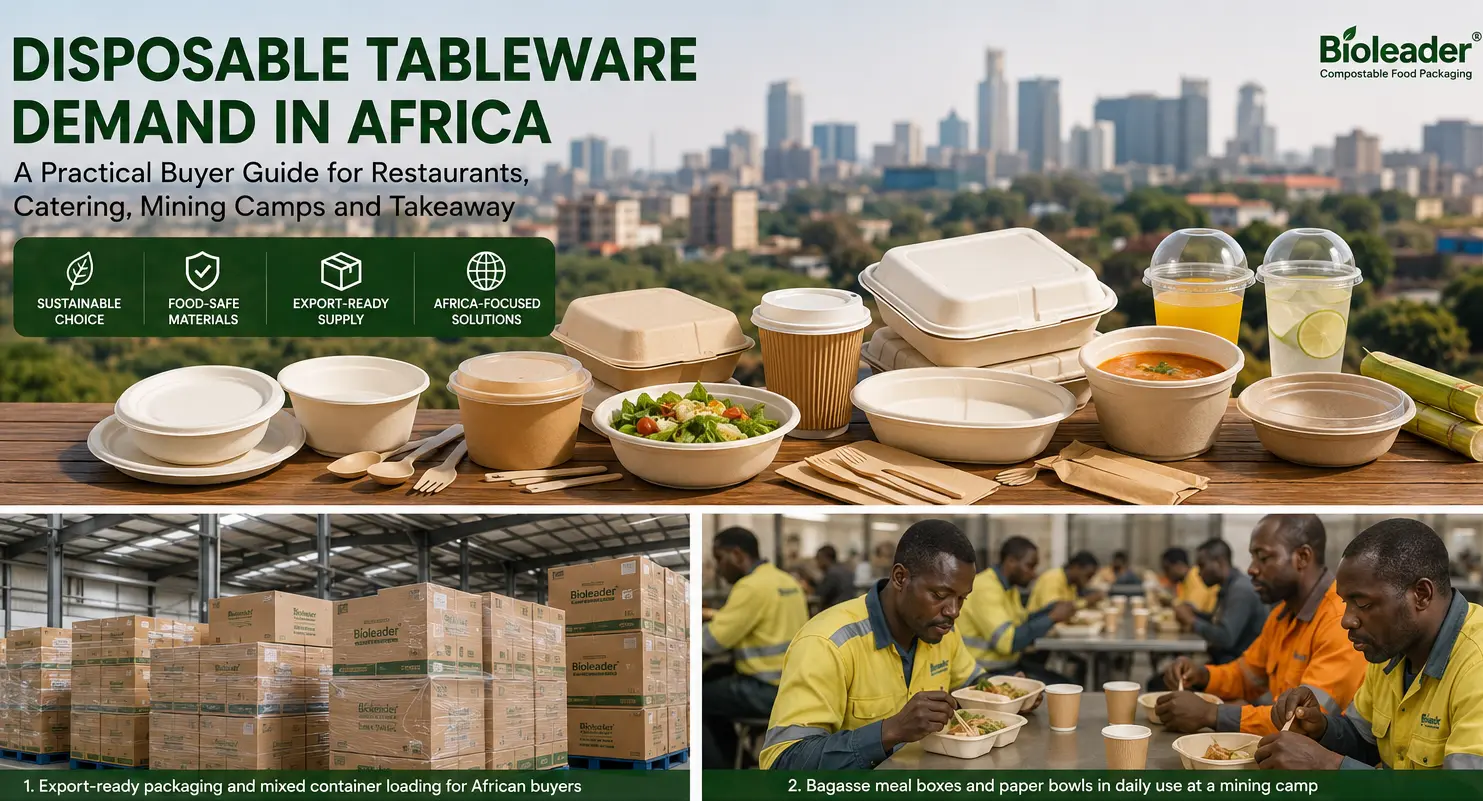
Disposable Tableware Demand in Africa: Quick Summary
Africa’s disposable tableware market is no longer only a low-cost plastic and Styrofoam market. Urban takeaway, restaurant delivery, hotel catering, supermarkets, schools, events, mining camps and industrial canteens are creating demand for stronger, safer and more sustainable foodservice packaging.
For African importers, the best strategy is not to buy every “eco-friendly” product at once. The stronger approach is to build a practical product portfolio: sugarcane bagasse containers for hot meals, kraft paper bowls for soups and salads, paper cups for hot drinks, PLA cups for cold beverages, and compostable cutlery for meal kits and catering.
- Africa’s demand should be analyzed by foodservice scenario, not by country alone.
- Bagasse clamshells, paper bowls, cups and compostable cutlery are the most practical starter categories.
- Mining camps, industrial catering and institutional foodservice are important but often underestimated demand channels.
- Buyers should calculate total landed cost, carton volume, MOQ, documents and repeat-order potential before confirming bulk imports.
Africa’s Disposable Tableware Market Is Entering a Practical Transition
Disposable tableware demand in Africa is changing because foodservice itself is changing. In many cities, takeaway meals, delivery platforms, fast food, supermarkets, hotels, events and institutional catering are growing more structured. At the same time, many governments and municipalities are under pressure to reduce visible plastic waste, plastic bags, foam takeaway boxes and low-quality single-use packaging.
The important point is that Africa is not moving toward sustainable packaging in a single, uniform way. Lagos is not the same as Nairobi. Accra is not the same as Kigali. A mining camp in Liberia or Zambia does not buy packaging like a coffee shop in Cape Town. This is why serious African packaging importers need a product strategy, not only a price list.
Bioleader®’s view is clear: the next growth stage in Africa will be driven by practical sustainable packaging, not by slogans. Buyers still care about price, but they also need packaging that can hold hot food, survive transport, stack in cartons, support repeat orders and satisfy customers who increasingly want alternatives to foam and thin plastic.
 |  |
Why Demand Is Growing: Four Market Drivers
The first driver is urban takeaway and restaurant delivery. Large cities generate recurring demand for clamshell boxes, food containers, paper bowls, cups and cutlery. Even where food delivery platforms face profitability challenges, takeaway culture and restaurant packaging consumption continue to expand because urban consumers need convenient meals.
The second driver is foodservice professionalization. Hotels, supermarket prepared-food counters, cafés, event caterers, school suppliers and office meal providers need more consistent packaging than informal street food vendors. These buyers often care about presentation, lid matching, hygiene and brand perception.
The third driver is industrial and project-based catering. Mining camps, construction projects, oil and gas sites, port operations and remote work camps can consume large volumes of disposable meal packaging every day. For this segment, packaging is not a marketing accessory. It is part of daily food distribution.
The fourth driver is regulatory and reputational pressure. Several African countries and cities have restricted plastic bags, Styrofoam or certain single-use plastic items. Enforcement differs by market, but the direction is clear: importers who depend only on foam boxes and low-quality plastic products face increasing long-term risk.
Africa Is Not One Market: Segment Demand Before Choosing Products
A common mistake is to describe Africa as a single packaging market. In reality, demand varies by customer type, food format, budget level and distribution channel. A wholesale distributor may need fast-moving SKUs with low stock risk. A hotel may need better appearance and coordinated product sets. A mining camp may need strong, stackable meal boxes and predictable monthly supply.
This segmentation matters because sustainable packaging is not one material. Sugarcane bagasse, kraft paper, white paperboard, PLA, CPLA and cornstarch all have different performance limits. The buyer should begin with the food and service model, then select the material.
| Demand segment | Typical foodservice use | Recommended product categories | Procurement priority |
|---|---|---|---|
| Restaurants and takeaway shops | Rice meals, grilled meat, fried food, fast food, stews and daily takeaway meals. | Bagasse clamshell boxes, bagasse food containers, kraft paper bowls, paper soup containers and compostable cutlery. | Leak resistance, lid closure, hot food performance, price level and reorder speed. |
| Supermarkets and meal prep brands | Salads, ready meals, cold foods, fruit, deli foods and prepared bowls. | Paper salad bowls, kraft paper bowls, clear lids, bagasse trays and cold cups. | Shelf presentation, clear lid visibility, size range and food contact documentation. |
| Hotels, tourism and events | Breakfast service, buffet support, outdoor dining, events, conferences and catering packs. | Bagasse plates, bagasse bowls, paper cups, CPLA cutlery, wrapped cutlery sets and paper food boxes. | Brand image, hygiene, coordinated product appearance and bulk availability. |
| Mining camps and industrial catering | Daily meals for workers, remote-site dining, boxed lunches and high-volume food distribution. | Bagasse compartment trays, clamshell meal boxes, paper bowls, paper cups and wrapped compostable cutlery. | Strength, portion control, carton durability, storage efficiency and stable repeat supply. |
| Distributors and wholesalers | Regional resale to restaurants, caterers, supermarkets, cafés and institutional buyers. | Mixed containers of bagasse containers, paper bowls, cups and cutlery. | Fast-moving SKU mix, MOQ balance, landed cost and product range coverage. |
Which Products Should African Importers Source First?
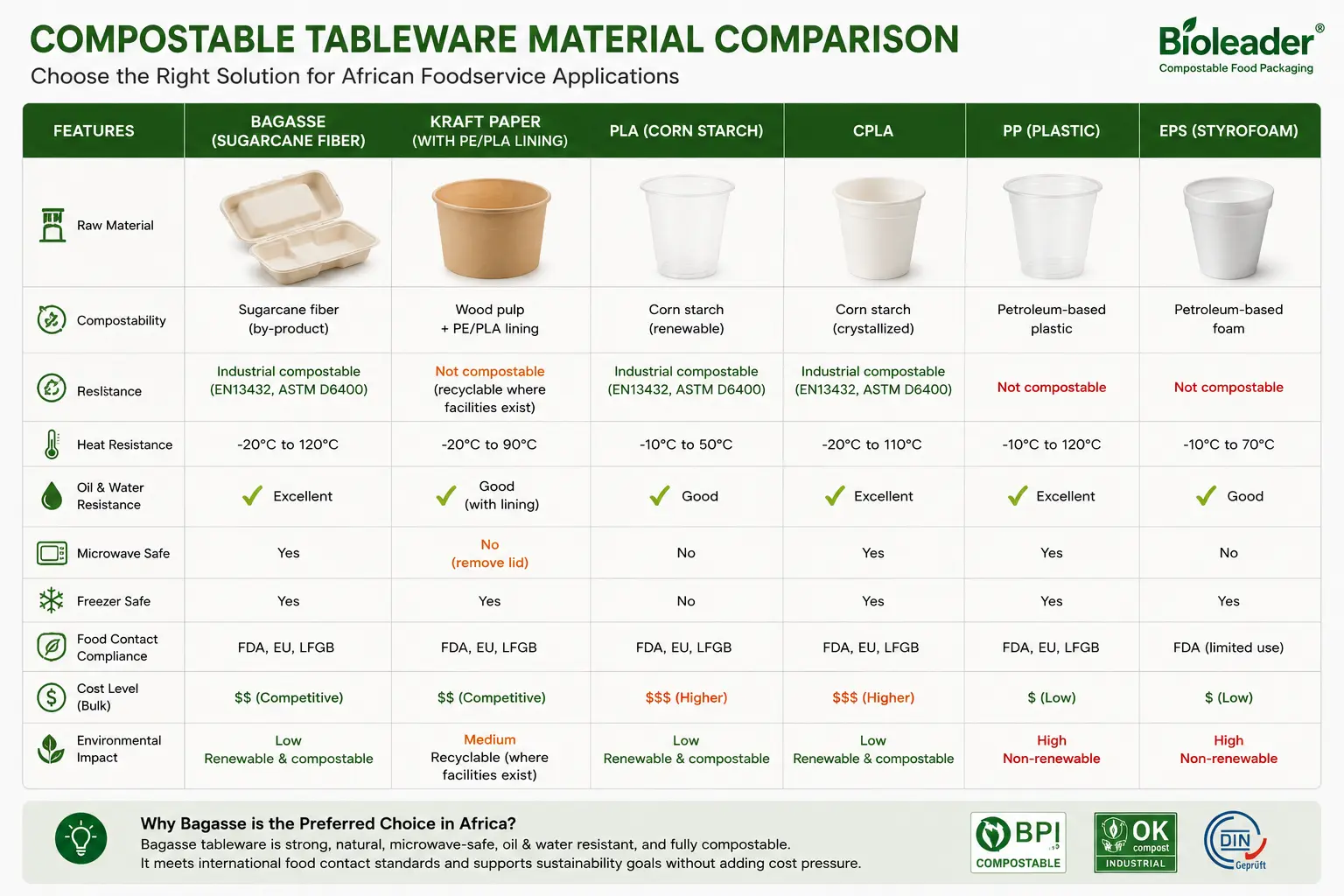
For a first sustainable packaging program, Bioleader® does not recommend starting with too many slow-moving items. A stronger import plan begins with a focused product mix that solves real foodservice problems and can be sold repeatedly.
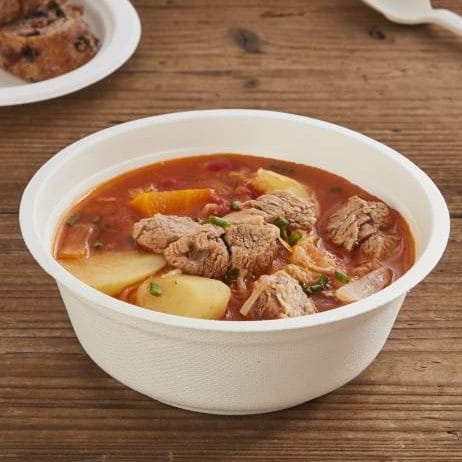
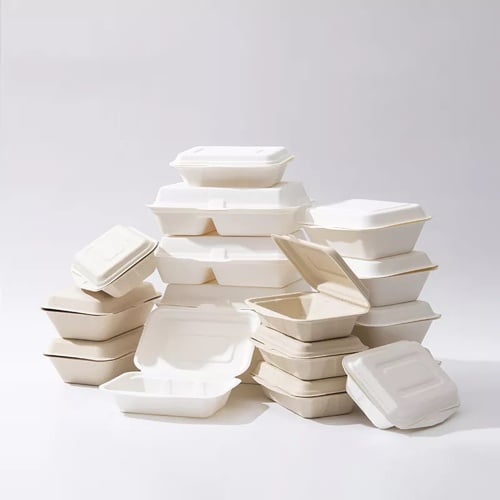
The first category should be sugarcane bagasse clamshell boxes and bagasse food containers. These products are practical alternatives to Styrofoam takeaway boxes for many hot meal applications. They are suitable for rice, chicken, grilled food, fast food, fried snacks, boxed lunches and catering meals. Buyers should test oil resistance, lid closure, stacking and holding time with real food before confirming large orders.
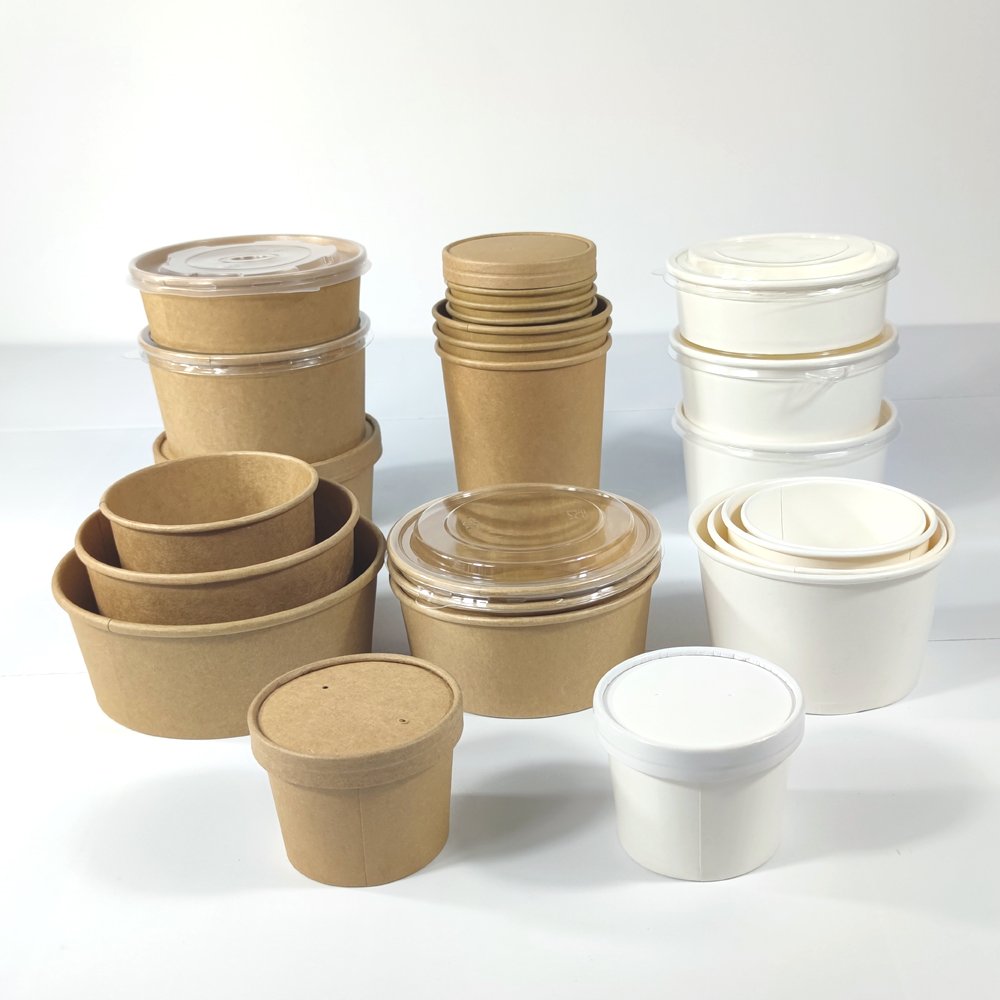
The second category should be kraft paper bowls, paper soup containers and paper salad bowls. These products serve soups, noodles, salads, rice bowls, porridge, meal prep and supermarket ready-to-eat food. For hot soup, buyers should focus on coating, lid fit and heat holding. For salads and cold meals, clear lid presentation and shelf appearance become more important.
The third category should be paper cups and PLA cups. Paper cups support coffee, tea and hot beverage service in cafés, offices, hotels, schools and events. PLA cups are more suitable for cold drinks, juices, smoothies, iced coffee and dessert beverages. Buyers should avoid using PLA cups for high-temperature drinks unless the product is specifically designed for that condition.
The fourth category should be compostable cutlery, CPLA cutlery and cornstarch tableware. Cutlery is a high-volume add-on for takeaway meals, events, hotels and industrial catering. Wrapped cutlery sets are especially useful where hygiene, distribution and meal-kit assembly matter.
Bioleader® Recommended Starter Product Matrix for Africa
Based on Bioleader®’s recent Africa-focused inquiries, serious buyers rarely ask for one item only. Most importers compare food boxes, bowls, cups and cutlery together because they need a sellable product range. The practical opportunity is not one “green product”; it is a complete foodservice packaging line.
| Starter level | Product mix | Best buyer type | Business logic |
|---|---|---|---|
| Entry portfolio | Bagasse clamshell boxes, bagasse plates, kraft paper bowls and compostable cutlery. | New importers, wholesalers and local foodservice distributors. | Focus on fast-moving products that can replace foam boxes and basic plastic tableware. |
| Food delivery portfolio | Bagasse food containers, paper soup containers, paper salad bowls, paper cups and cutlery sets. | Takeaway restaurants, cloud kitchens, cafés and delivery suppliers. | Build a practical packaging system for hot meals, soups, salads and drinks. |
| Institutional catering portfolio | Compartment trays, clamshell meal boxes, paper bowls, paper cups and individually wrapped cutlery. | Mining camps, construction projects, schools, hospitals and industrial caterers. | Prioritize strength, portion control, hygiene, daily use and predictable supply. |
| Premium sustainable portfolio | PFAS-conscious bagasse products, custom printed paper bowls, branded paper cups and selected compostable cutlery. | Hotels, resorts, international foodservice brands and sustainability-led distributors. | Support brand image, documentation expectations and higher-value customer segments. |
Manufacturer Insight: The Real Cost Is Not Only Unit Price
Many African buyers start negotiations by asking for the lowest unit price. This is understandable, but it is not enough for disposable tableware imports. A low price can become expensive if the carton volume is inefficient, the product breaks during inland transport, the lid does not fit well, or the imported SKU does not match local food habits.
For bulky disposable food packaging, container loading can change the real landed cost. A product that looks cheap per piece may consume too much volume in a 20ft or 40HQ container. Buyers should always request carton dimensions, pieces per carton, gross weight, estimated CBM and loading quantity before comparing offers.
Bioleader® recommends that African importers evaluate each product by five cost layers: factory price, carton efficiency, sea freight impact, local storage pressure and complaint risk. A slightly stronger container can be a better business decision if it reduces leakage, breakage and customer complaints.
Testing Before Bulk Order: What Buyers Should Actually Do
Sample testing should not be limited to looking at the product on a desk. Packaging must be tested with real food and real handling. A bagasse clamshell should be tested with hot rice, oil, sauce and delivery movement. A paper soup container should be tested with hot liquid, lid closure and holding time. A paper salad bowl should be tested for lid fit and shelf appearance. Cutlery should be tested for stiffness, heat resistance and comfort.
For African markets, warehouse and inland transport conditions also matter. Cartons may travel through humid environments, long inland routes or rough handling. Buyers should check carton strength, pallet requirements, stacking height and whether the supplier can support export-ready packing.
- Test hot food, oily food, saucy food and cold food separately.
- Check whether lids close properly after filling real food portions.
- Stack filled containers to simulate delivery and catering movement.
- Review carton strength and total CBM before confirming container orders.
- Ask for product specifications and food contact documents where required.
- Confirm MOQ by SKU and avoid too many slow-moving sizes in the first order.
Regulation Is Important, But It Should Be Handled Country by Country
Plastic restrictions in Africa are real, but buyers should not treat the continent as one single regulatory market. Kenya, Rwanda, Tanzania, Nigeria, Ghana and South Africa have different policy tools, different enforcement levels and different product scopes. Some policies focus on plastic bags. Some address Styrofoam or single-use plastic items. Some focus on producer responsibility and packaging waste management.
The commercial lesson is simple: do not make broad claims such as “accepted everywhere in Africa” or “fully compliant in all African countries.” A more professional approach is to verify requirements by destination country, product category and customer type before shipment.
| Market signal | What it means for buyers | Packaging opportunity |
|---|---|---|
| Plastic bag bans and restrictions | Governments are reducing visible plastic pollution and pushing alternatives. | Creates broader awareness for paper, fiber-based and compostable foodservice packaging. |
| Styrofoam and single-use plastic pressure | Foam takeaway boxes may face stronger scrutiny in selected cities and countries. | Supports demand for bagasse clamshells, molded fiber containers and paper bowls. |
| EPR and packaging responsibility | Importers and brand owners may need to understand post-consumer packaging obligations. | Increases demand for documented packaging choices and supplier transparency. |
| Tourism and hospitality standards | Hotels and resorts may adopt sustainable packaging faster than low-end retail markets. | Supports premium paper cups, bagasse plates, bowls, trays and wrapped cutlery sets. |
Why Mining Camps and Industrial Catering Deserve Special Attention
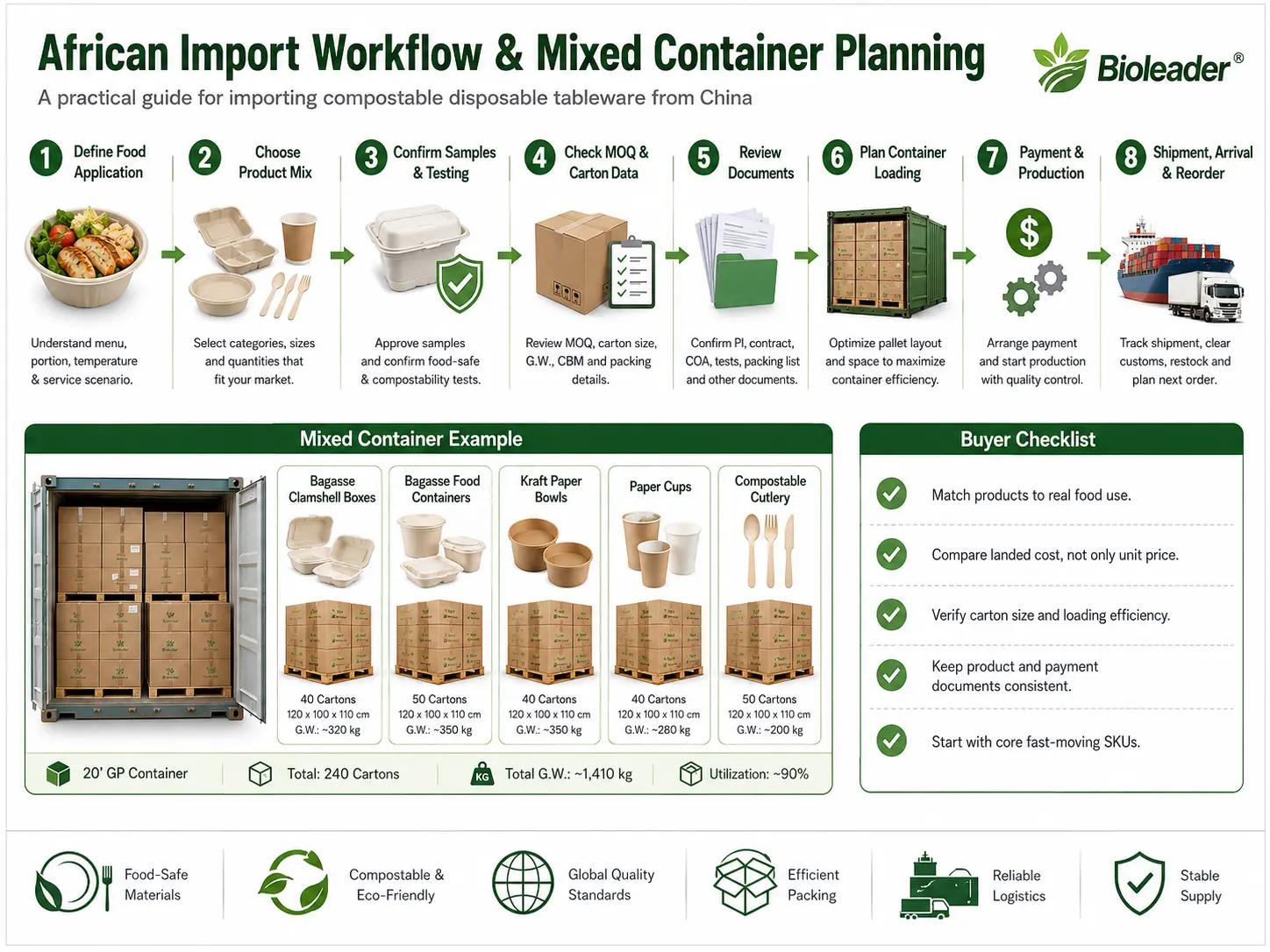
One of the strongest opportunities in Africa is often not visible in ordinary restaurant packaging research: mining camps and industrial catering. These buyers may need daily disposable meal packaging for remote-site workers, construction teams, port operations, oil and gas projects or large institutional dining programs.
This segment values reliability more than decoration. A mine camp does not usually need luxury packaging. It needs strong meal boxes, stable supply, clear portion control, carton durability, predictable delivery and documentation that procurement teams can understand. For this reason, bagasse compartment trays, bagasse clamshell meal boxes, paper cups and wrapped compostable cutlery are practical products to evaluate.
Bioleader® can support these buyers by helping convert vague requests into clear product lists. For example, instead of asking only for “biodegradable lunch boxes,” the buyer should specify meal type, portion size, number of meals per day, whether the food is hot or oily, whether the container needs compartments, and whether the order should be mixed in a 20ft or 40HQ container.
How African Importers Should Build a Mixed Container
For many importers, a mixed container is more practical than a single-product order. It allows the buyer to test multiple product categories, serve different customers and reduce the risk of overstocking one item. However, mixed-container planning must be disciplined.
A recommended approach is to divide the container into high-rotation core SKUs and supporting add-on SKUs. Core SKUs may include bagasse clamshell boxes, bagasse food containers, kraft paper bowls and paper soup containers. Add-on SKUs may include paper cups, PLA cold cups, compostable cutlery, wrapped cutlery sets or selected premium items.
Buyers should not mix too many sizes in the first shipment. Too many SKUs increase inventory complexity and slow down reorder decisions. A better first order focuses on common sizes, proven foodservice uses and products that can serve more than one customer type.
Buyer Checklist for Africa Disposable Tableware Imports
| Checklist item | What to confirm | Why it matters |
|---|---|---|
| Food application | Hot meal, oily food, soup, salad, cold drink, dessert or meal kit. | Wrong material choice can cause leakage, softening, cracking or poor user experience. |
| Product family | Bagasse, paper, PLA, CPLA, cornstarch or a mixed solution. | Each material has different cost, temperature and positioning advantages. |
| MOQ and SKU mix | Minimum quantity by item, carton and mixed-container option. | Controls inventory risk and avoids slow-moving stock. |
| Carton and CBM | Pieces per carton, carton size, gross weight and loading quantity. | Determines real landed cost and warehouse pressure. |
| Documents | Specification sheet, food contact documents, invoice, packing list and shipping documents. | Reduces customs, bank and customer documentation friction. |
| Claims | Biodegradable, compostable, PFAS-free or plastic-reduction claims. | Claims should match product documentation and destination-market expectations. |
| Supplier capability | Manufacturing capacity, export experience, sample process and repeat-order support. | Prevents one-time sourcing failure and unstable supply. |
Bioleader® Manufacturer Perspective: What Serious Buyers Usually Need
From a manufacturer’s perspective, the best Africa-focused inquiries are not the longest inquiries. They are the clearest inquiries. Buyers who provide food type, target customer, destination country, estimated monthly demand, preferred material, budget range and import plan can receive much more accurate recommendations.
Bioleader® supports African buyers with sugarcane bagasse tableware, bagasse food containers, bagasse clamshell boxes, bagasse bowls, bagasse plates, bagasse trays, kraft paper bowls, paper soup containers, paper salad bowls, paper cups, PLA cups, compostable cutlery, CPLA cutlery and cornstarch tableware. The goal is to help buyers build a product program that can be sold repeatedly, not just a sample order that looks good in photos.
For a new importer, Bioleader® can help narrow the first product mix. For an established distributor, the discussion can focus on private label, custom printing, carton optimization and container loading. For a mining camp or catering buyer, the focus can shift toward durability, portion size, hygiene and monthly supply planning.
Common Mistakes African Buyers Should Avoid
- Buying “biodegradable” products without testing them with real hot, oily or wet food.
- Comparing only unit price and ignoring carton volume, freight cost and breakage risk.
- Importing too many sizes before confirming local demand and reorder speed.
- Using compostable or PFAS-free claims without checking SKU-specific documentation.
- Assuming one country’s plastic policy applies to all African markets.
- Choosing PLA cups for hot drinks without confirming temperature suitability.
- Ignoring lid matching, stacking and delivery movement during sample testing.
- Separating product selection from payment documents, commercial invoice and packing list accuracy.
Bioleader® Solutions for Africa’s Foodservice Packaging Transition
Bioleader® supplies compostable and biodegradable foodservice packaging for B2B buyers who need practical product matching, export-ready packing and bulk wholesale support. The company’s Africa-ready product lines include sugarcane bagasse clamshells, bagasse food containers, plates, bowls, trays, kraft paper bowls, paper soup containers, paper salad bowls, paper cups, PLA cups, CPLA cutlery, compostable cutlery and cornstarch tableware.
For importers and distributors, Bioleader® can support mixed-container planning, product range selection, MOQ discussion, sample review, food application matching, carton data confirmation and export documentation coordination. For foodservice operators, Bioleader® can help compare materials based on meal type, temperature, service format and customer positioning.
The recommended next step is to share a product list, target food application, estimated quantity, destination country and preferred price level. With this information, Bioleader® can help narrow the product mix before quotation and reduce the risk of importing the wrong packaging.
FAQ
What disposable tableware products are most suitable for African foodservice markets?
The most practical starter products are bagasse clamshell boxes, bagasse food containers, kraft paper bowls, paper soup containers, paper salad bowls, paper cups, PLA cold cups and compostable cutlery. The best product mix depends on food type, temperature, delivery time, customer segment and target price level.
Are bagasse food containers a good alternative to Styrofoam in Africa?
Yes, bagasse food containers can be a practical alternative for many hot meal and takeaway applications. Buyers should still test oil resistance, moisture tolerance, lid closure, stacking strength and carton protection before placing bulk orders.
Should African importers buy one product or a mixed container?
A mixed container is often better for distributors because it allows them to test several fast-moving categories, including food boxes, paper bowls, cups and cutlery. However, the first mixed container should focus on proven sizes and avoid too many slow-moving SKUs.
What should buyers check before importing disposable tableware from China?
Buyers should check samples, MOQ, carton size, loading quantity, food application, product documents, payment documents, production lead time, shipping terms and destination-market requirements. Total landed cost is more important than unit price alone.
Can PLA cups be used for hot drinks in African markets?
PLA cups are generally more suitable for cold drinks such as juices, smoothies, iced coffee and cold beverages. For hot drinks, paper cups are usually the safer product category unless a specific cup is designed and verified for hot use.
How does Bioleader® help African packaging importers?
Bioleader® helps buyers select suitable products, review samples, compare bagasse, paper, PLA, CPLA and cornstarch options, plan mixed containers, confirm carton data and prepare export-ready packaging solutions for restaurants, distributors, hotels, catering companies and industrial foodservice buyers.
Conclusion: Africa Needs Practical Sustainable Packaging, Not Just Green Claims
Disposable tableware demand in Africa is growing, but it is not a simple market. Restaurants, hotels, supermarkets, events, mining camps, industrial caterers and distributors all need different product solutions. The strongest opportunity is not to sell one “eco” item, but to build a practical foodservice packaging portfolio.
Bioleader®’s view is that Africa’s next packaging transition will be driven by products that work in real conditions: hot meals, oily food, delivery movement, limited storage space, container freight pressure, institutional catering and price-sensitive purchasing. Buyers who prepare early with the right product mix can reduce their reliance on Styrofoam and low-quality plastics while building a stronger long-term packaging business.
For African importers and foodservice buyers planning this transition, Bioleader® can support product selection, sample testing, mixed-container planning and export-ready quotation for compostable and biodegradable disposable tableware.