Quick Summary: Paper Bowl Quality Control For B2B Buyers
Paper bowl quality control is the process of checking whether paper bowls and matching lids can withstand real foodservice conditions before bulk ordering. Buyers should evaluate paper structure, rim stiffness, bottom support, coating integrity, seam bonding, lid fit, heat resistance, printing safety, odor, raw material purity, stacking and denesting performance.
- Strong paper bowls are not judged by appearance alone; they need physical checks for structure, leakage, heat exposure, lid compatibility and handling.
- For importers and restaurant groups, poor QC can create delivery leakage, customer complaints, unstable stacking, brand damage and costly shipment disputes.
- The safest sourcing approach is to approve samples with a written QC checklist before confirming artwork, production and bulk shipment.
Introduction
Paper bowls are now used for soup, noodles, rice meals, salads, deli foods, meal prep and takeaway delivery. For B2B buyers, the main question is not only whether a bowl looks sustainable, but whether it performs consistently in real service. A bowl that softens with hot soup, leaks through a weak side seam, smells of ink, loses its lid during delivery or stacks poorly in a restaurant kitchen can turn a low-cost sourcing decision into a quality complaint.
This guide gives procurement teams a practical framework for paper bowl quality control. It focuses on 12 physical checks that buyers can use when reviewing supplier samples, approving production specifications and communicating acceptance criteria with a manufacturer. It is written for importers, distributors, restaurant chains, foodservice operators, private label buyers and packaging sourcing managers who need to reduce risk before placing bulk orders.
Bioleader® manufactures and supplies paper food packaging for international B2B buyers, including kraft paper bowls, paper soup bowls, paper salad bowls, paper bowls with matching lids and custom printed bowl programs. From a manufacturing and sourcing perspective, a reliable paper bowl project should connect material selection, coating choice, lid matching, sample review, custom printing confirmation and bulk supply planning before mass production.
Why Paper Bowl Quality Control Matters For B2B Buyers
A paper bowl is a small item, but in B2B foodservice it carries many commercial risks. It may need to hold hot soup for delivery, keep salad fresh under a clear lid, survive stacking in a warehouse, support custom branding and meet food-contact expectations in the buyer’s market. If one part fails, the problem is rarely isolated. A weak rim affects lid fit. Poor coating affects leakage. Inconsistent stacking affects packing efficiency. Odor affects customer trust.
Buyers who source biodegradable paper bowls for wholesale or private label programs should treat QC as a procurement control system, not as a final visual inspection. The goal is to identify practical risks before artwork approval, deposit payment, container loading or marketplace launch.
| Quality risk | Buyer impact | QC response |
|---|---|---|
| Soft bowl body after hot filling | Foodservice complaints and poor customer experience | Check paper weight, bottom strength and coating compatibility with the intended food temperature. |
| Loose lid or rim deformation | Delivery leakage and packaging returns | Test the actual bowl and lid combination, not the bowl alone. |
| Ink odor or print transfer | Brand risk and possible food-contact concern | Review ink placement, drying, heat resistance and odor before approving printed production. |
| Poor denesting during service | Slow packing operations and damaged rims | Check nesting depth, rim consistency and carton compression after transport simulation. |
What Bioleader® Checks Before Paper Bowls Enter Bulk Production
Before paper bowls enter bulk production, a manufacturer should confirm more than artwork and unit price. The sample approval stage should check whether the selected paper structure, coating, forming process, lid combination, printing method and packing plan match the buyer’s real food application. This is especially important for importers, distributors and foodservice brands that need consistent performance across repeated orders.
Bioleader® reviews paper bowl projects from a practical production angle: paper structure and bowl stiffness, rim forming, bottom support, coating surface, side seam bond, lid compatibility, print quality, packing and stacking, and whether approved samples can be repeated consistently in bulk production.
| Buyer concern | Bioleader® QC focus | Procurement value |
|---|---|---|
| Will the bowl stay firm with hot or saucy food? | Paper weight, multi-layer structure, bottom support and coating surface. | Reduces leakage, softening and customer complaints after launch. |
| Will the lid fit the selected bowl size? | Rim forming, diameter consistency, snap-fit feel and lid deformation checks. | Helps buyers avoid delivery leakage and unstable takeaway presentation. |
| Will printed packaging look and smell acceptable? | Artwork position, ink drying, odor review, rub checks and printed sample approval. | Protects brand presentation before private label or chain-store rollout. |
| Will the cartons support warehouse and restaurant handling? | Stacking, denesting, carton packing method and sample consistency review. | Improves handling speed, carton planning and bulk order reliability. |
Paper Bowl Quality Control: The 12 Physical Checks Buyers Should Review
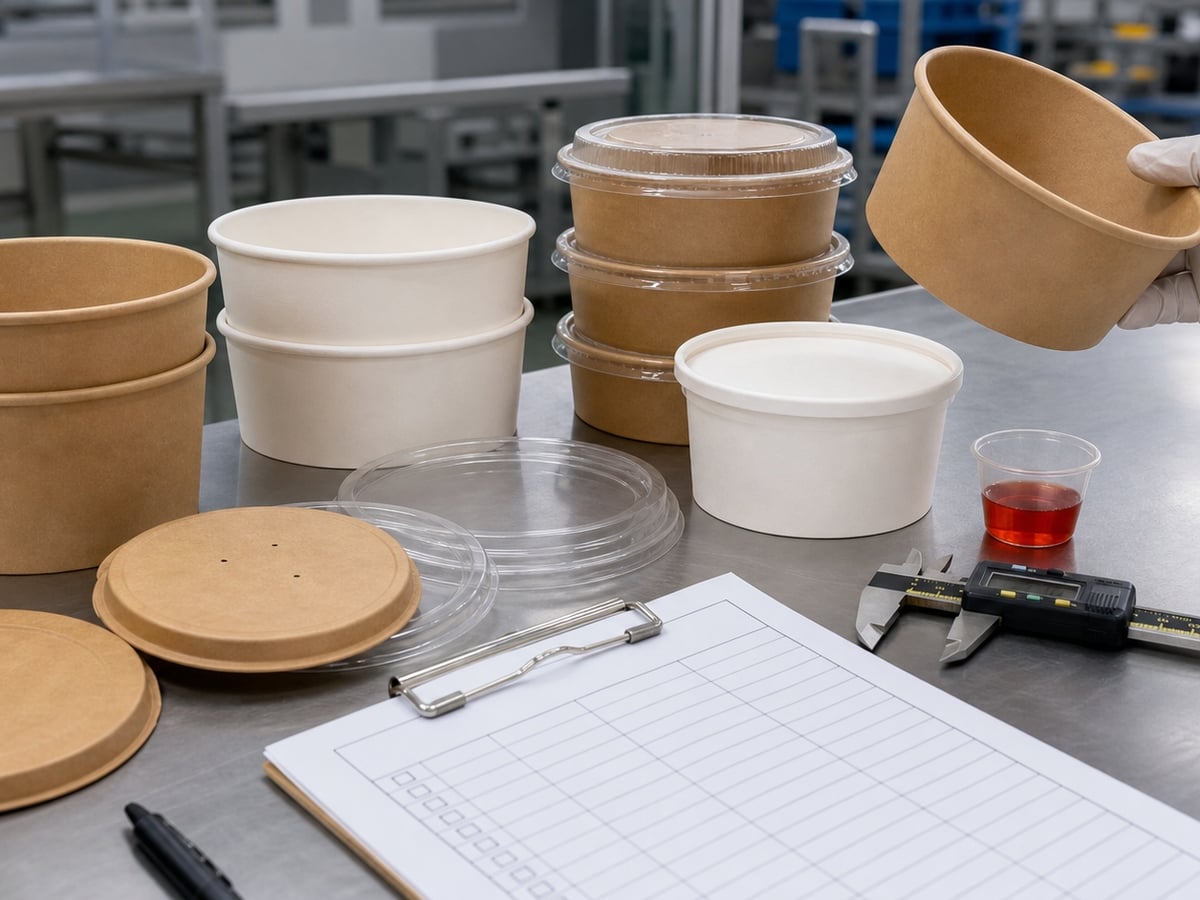
The following 12 checks give buyers a structured way to review paper bowls and lids before bulk ordering. They are not a substitute for formal laboratory testing when regulations require it, but they help sourcing teams identify visible and functional risks early. The same framework can be used when comparing suppliers, reviewing pre-production samples or preparing a final inspection checklist.
1. Base Paper Weight And Multi-layer Structure
Base paper weight affects stiffness, hand feel, compression strength and resistance to softening. A paper bowl made from material that is too light may look acceptable when empty but deform once filled with soup, rice, noodles or sauce-heavy meals. Buyers should ask for the paper specification, check whether the bowl uses single-wall or multi-layer construction and compare sample stiffness across the full size range.
For kraft paper bowls, the natural fiber appearance can make the bowl look strong, but visual texture alone is not proof of performance. Buyers should press the side wall gently, check recovery after compression and compare bowls from different cartons. Inconsistent wall feel can signal unstable forming or material variation.
From a manufacturer review perspective, the selected paper structure should match the buyer’s target size range, food weight and holding time. This helps buyers avoid approving one attractive sample that cannot support the full product family in bulk supply.
2. Rim Stiffness And Rim Rolling Quality
The rim is one of the most important parts of a paper bowl because it affects handling, lid fit and customer perception. A good rolled rim should feel smooth, even and resistant to deformation. If the rim is thin, oval, cracked or uneven, the lid may not snap on securely and the bowl may feel low quality even if the body material is acceptable.
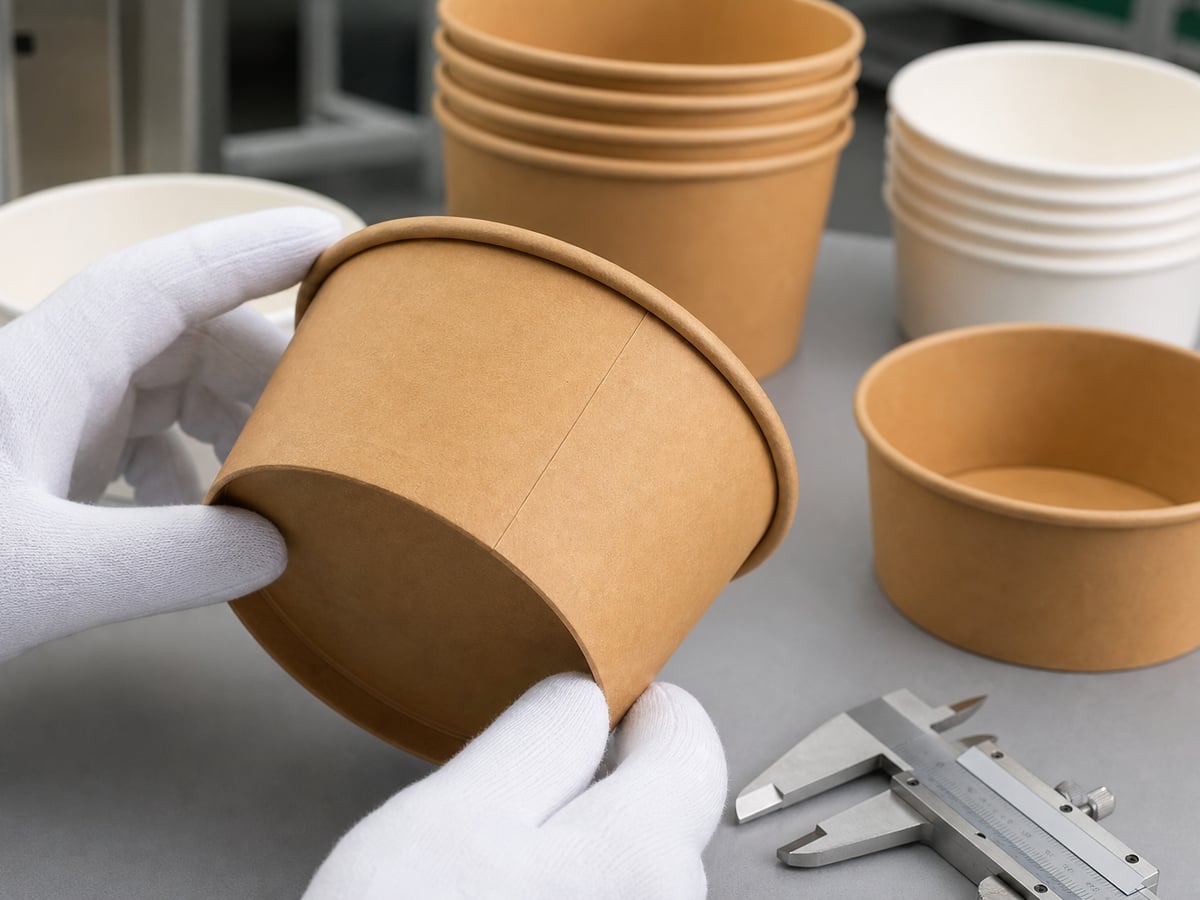
During inspection, buyers should compare rim diameter across multiple samples, check for rough edges and confirm whether lids from the same supplier fit without excessive force. Rim QC is especially important for bowls with plastic, paper or fiber lids because small dimensional differences can cause major delivery problems.
3. Bottom Double-wall Strength And Bottom Support
The bottom structure carries the food load and stabilizes the bowl on tables, trays and delivery shelves. A weak bottom can flex under hot liquid, separate at the base or tilt when filled. Buyers should inspect the bottom seal, check whether the base is level and test stability with realistic food weight.
For wholesale programs such as kraft paper bowls and food containers, bottom strength should be checked across several sizes because large bowls face different stress than small tasting or side-dish bowls. A sample approval for one size does not automatically prove performance for every volume.
4. Coating Uniformity And Pinhole Risk
The coating layer is the barrier between food and paper. It helps control moisture, oil penetration and leakage. Buyers do not need to turn every QC review into a full coating-material study, but they should check whether the coating looks uniform and whether any pinholes, scratches, thin spots or bubbles appear inside the bowl.
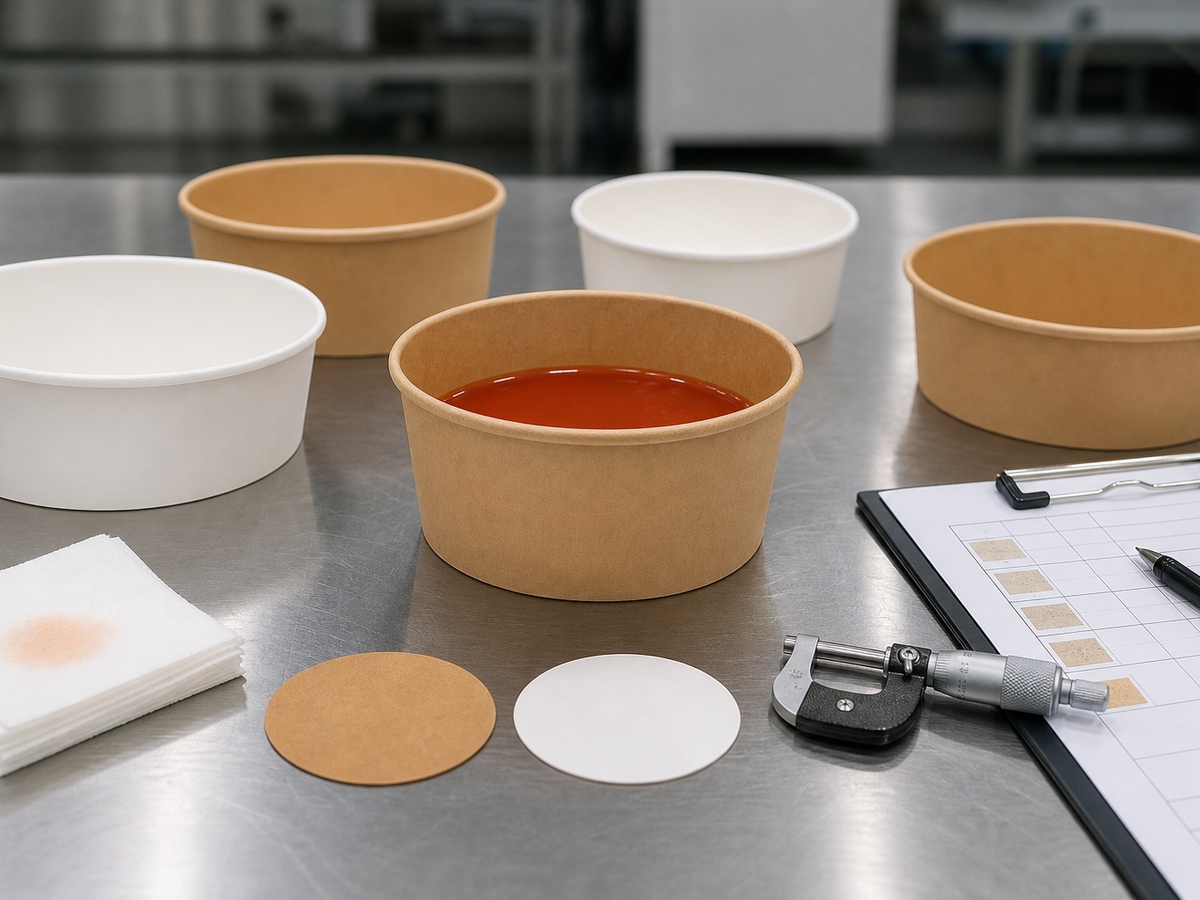
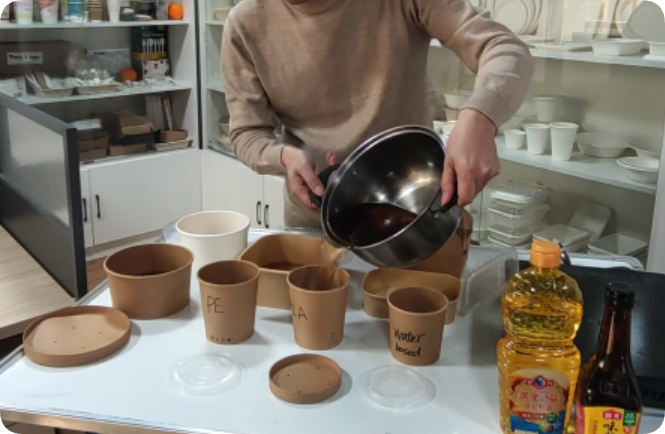
Simple water, oil or red-oil observation tests can reveal early signs of barrier weakness. When comparing PE, PP, PLA, aqueous or other coatings, buyers should separate two decisions: material selection and finished-product performance. At the QC approval stage, the practical question is direct: does the bowl resist the intended food under the expected holding time and service temperature?
For coating selection, the food application should come first: hot soup, oily noodles, chilled salad and sauced rice meals do not create the same barrier demand. Buyers should confirm both the coating option and the finished bowl performance before approving a bulk order.
5. Side Seam Bond Strength
The side seam is a common leakage and failure point. A good side seam should be straight, fully bonded and resistant to separation after hot filling or light pressure. Buyers should inspect the inside and outside seam, look for gaps, wrinkles, excess adhesive or uneven overlap and test whether liquid moves along the seam line.
For heat and oil performance context, the article on high-temperature, waterproof and oil resistance testing of kraft and paper bowls is useful supporting reading. In the final QC decision, however, the buyer should still test the exact bowl size, coating and food application being ordered.
6. Lid Snap-fit And Seal Performance
Paper bowls are often purchased with matching lids, so lid performance should be part of bowl QC. A lid that fits one sample may not fit another batch if rim dimensions are unstable. Buyers should test snap-fit by pressing the lid around the full rim, lifting the closed bowl carefully, tilting it at a realistic angle and checking whether the lid loosens during light movement.
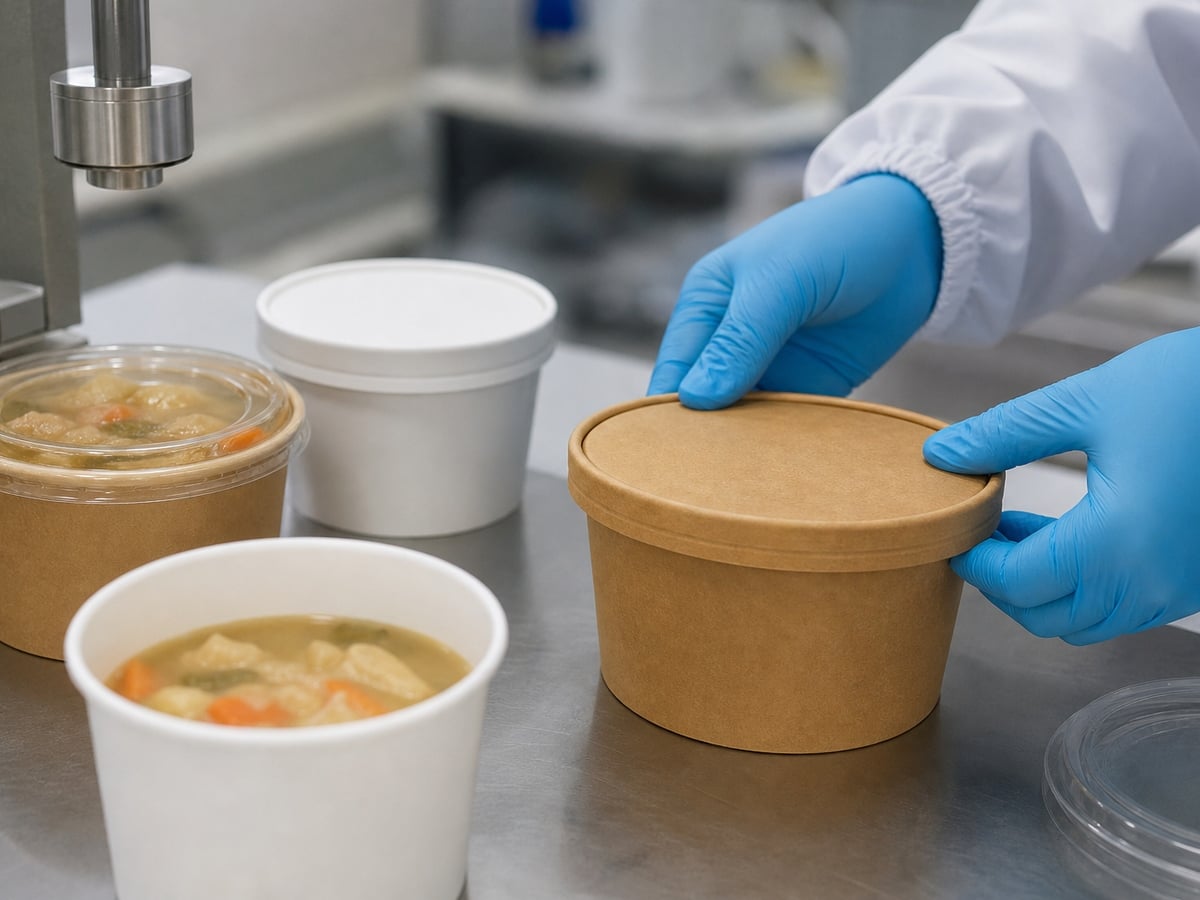
For soup and delivery packaging, disposable soup bowls with lids need more than visual matching. The lid and bowl must work together under temperature, movement and stacking conditions. Buyers should avoid approving lids from photos alone.
When buyers request PET, PP or paper lids, the lid should be reviewed with the actual bowl rim rather than treated as a separate accessory. This is important because lid compatibility depends on both material behavior and forming tolerance.
7. Lid Material Heat Resistance And Deformation Risk
Lid material affects heat resistance, clarity, sealing feel and food presentation. PET lids are often used for visibility, PP lids may be selected for warmer applications and paper lids may support a more fiber-based packaging position. For QC approval, buyers do not need to complete a full lid-material comparison at this stage. They should first confirm whether the selected lid stays stable, resists deformation and remains easy to remove under the intended food temperature.
A practical test is to fill the bowl with the buyer’s target food or a temperature-equivalent substitute, close the lid for the expected delivery time and then inspect fit, condensation, deformation and leakage. The result should be recorded by size and lid type.
8. Ink Migration And Heat Resistance
Custom printing can improve shelf presence and brand recognition, but it also adds QC risk. Ink should not transfer to hands, lids, cartons or food-contact areas. Buyers should confirm print placement, ink type, drying quality and heat behavior before approving mass production. Printed bowls used for hot food need extra attention because heat can make odor or migration concerns more visible.
For buyers sourcing custom printed paper bowls, the safest approach is to approve a printed pre-production sample, not only a digital artwork file. The sample should be checked after stacking, rubbing, hot filling and normal storage time.
In custom printing projects, artwork placement review, printed sample confirmation and private label discussion should happen before production. The goal is to identify print alignment, odor and rub-resistance issues while changes are still practical.
9. Graphic Alignment And Side Seam Printing Accuracy
Graphic alignment affects the professional look of branded packaging. Common issues include logos crossing the side seam poorly, uneven color density, distorted artwork near the rim or bottom and inconsistent position between units. These problems may not affect food safety, but they can damage brand presentation for chain restaurants, retail food products or private label buyers.
Buyers should review print alignment on several bowls from different parts of the sample batch. If the design includes a front-facing logo, the acceptable position tolerance should be defined before production.
10. Odor Control
Odor is a practical quality issue because customers experience it immediately when opening a bowl or lid. Possible odor sources include base paper, coating, ink, adhesive, storage conditions and carton materials. A bowl may pass visual checks but still fail customer acceptance if it smells chemical, musty or smoky.
Buyers should check odor after opening sealed cartons, after adding hot food and after leaving samples closed for a realistic delivery period. The assessment should involve more than one person because odor perception varies.
11. Fluorescence And Raw Material Purity
For food-contact packaging, buyers should pay attention to raw material clarity and avoid suspicious brightness or unknown recycled content where it is not appropriate. Fluorescence concerns should be handled through supplier documentation and testing where required by the target market. During routine sample review, buyers can at least check whether the paper color, surface and fiber appearance are consistent across samples.
When selling into stricter retail or foodservice channels, buyers should request the relevant food-contact declarations, material specifications and compliance documents from the supplier. Do not rely only on sustainability language or product photos.
12. Stacking, Nesting And Denesting Performance
Stacking and denesting affect warehouse handling, restaurant speed and packing-line efficiency. Bowls that nest too tightly can slow staff down or damage rims when pulled apart. Bowls that stack too loosely can waste carton space or shift during shipping. Buyers should test whether bowls separate smoothly, remain round after compression and keep rim shape after being packed in cartons.
For paper bowls with lids, sizes, coatings, custom printing and MOQ planning, stacking performance should be considered before finalizing carton quantity and product mix. At this stage, buyers should treat stacking as a functional QC issue. Detailed size planning and container-loading calculations should be reviewed separately during procurement planning.
For bulk wholesale and export orders, stacking and denesting should be treated as both a product quality issue and a packing planning issue. Stable nesting helps protect rims, improve carton use and reduce handling friction for restaurants, warehouses and distributors.
Buyer Inspection Checklist Table
The following checklist can be used during sample review or pre-shipment discussion. Buyers can adapt it into their own QC form and add acceptance levels for each product size.
| QC point | What to inspect | Buyer acceptance question |
|---|---|---|
| Base paper and structure | Paper weight, stiffness, wall feel and consistency across samples | Does the bowl keep its shape with the intended food load? |
| Rim quality | Rolled rim smoothness, roundness, stiffness and lid compatibility | Does the lid fit without deformation or excessive force? |
| Bottom support | Bottom seal, standing stability and resistance to flexing | Does the bowl remain stable after hot filling? |
| Coating and seam | Uniform surface, pinholes, side seam bonding and oil resistance | Does the bowl resist moisture and oil for the expected service time? |
| Lid performance | Snap-fit, seal, heat deformation and delivery movement | Does the bowl and lid combination protect food during delivery? |
| Printing and odor | Ink transfer, color alignment, smell and heat response | Does the printed bowl meet brand and foodservice expectations? |
| Stacking and denesting | Nesting depth, rim damage, carton compression and easy separation | Can staff handle the bowls efficiently in real operation? |
How To Evaluate Supplier Samples Before Bulk Order
Sample evaluation should be structured. A buyer should not approve a paper bowl only because the first unit looks good on a desk. The sample should be reviewed in the same way the buyer expects the package to be used: with the target food type, filling temperature, lid, holding time, transport movement and handling process.
- Confirm the intended application, such as hot soup, noodles, rice, salad, deli food or delivery meal kits, before judging the sample.
- Request the exact bowl size, coating, lid and printed version that will be used for production approval.
- Inspect multiple samples from the same batch so that rim, seam, bottom and print consistency can be compared.
- Run practical filling, lid, leakage, stacking and odor checks before confirming artwork or bulk order details.
- Document the results with photos, supplier comments and clear acceptance criteria for production.
- Use supplier questions to confirm material specification, lid compatibility, packaging method, food-contact documentation and lead-time assumptions.
- For complex projects, review the kraft paper bowl manufacturer buying guide style of supplier questions before final approval.
- When a product-page example is needed, compare the sample against a relevant reference such as disposable paper bowls with lids, but keep the final acceptance based on the buyer’s exact specification.
For B2B buyers, the most useful sample test is not the most complicated one. It is the test that repeats the real use case closely enough to expose leakage, softening, loose lids, odor, ink transfer and stacking problems before production.
How Bioleader® Supports Paper Bowl Quality Control For B2B Buyers
Paper bowl quality control works best when the supplier understands the buyer’s application before recommending a product. Bioleader® supports B2B paper bowl sourcing by connecting application-based material selection, coating and food type matching, lid compatibility review, printed sample review, food contact documentation support, bulk wholesale planning and export order coordination.
For buyers comparing paper bowls with lids, soup bowls, salad bowls, kraft bowls and custom printed bowls, the practical process is to define the food, temperature, lid, packing quantity, branding need and target market first. The sample can then be reviewed against a clear checklist instead of a general product photo.
| Buyer requirement | Bioleader® support | Why it matters |
|---|---|---|
| Hot soup, noodles, rice meals or chilled salad | Application-based material and coating matching. | Helps buyers choose a bowl system that fits the food instead of relying on appearance alone. |
| Takeaway and delivery with lids | Lid compatibility review across PET, PP or paper lid options where relevant. | Reduces snap-fit, leakage, deformation and presentation risks before launch. |
| Custom printed or private label packaging | Artwork placement review, printed sample confirmation and OEM/private label discussion. | Protects brand consistency and avoids discovering print problems after mass production. |
| Import, wholesale and repeat supply | Food contact documentation support, carton planning and export order coordination. | Supports smoother procurement, shipment preparation and repeated bulk purchasing. |
The conclusion is simple: quality control should protect the buyer’s food, brand and supply chain. Sustainability matters, but a sustainable package still needs to perform in the hands of restaurant staff, delivery riders and end customers.
Conclusion
Paper bowl quality control is a procurement risk-control process. Buyers should check base paper structure, rim stiffness, bottom support, coating uniformity, side seam strength, lid fit, lid heat resistance, print safety, graphic alignment, odor, raw material purity and stacking performance before placing a bulk order. These checks help buyers move beyond appearance and evaluate how a bowl will perform in real foodservice conditions.
For importers, distributors and foodservice brands planning a paper bowl program, Bioleader® can support material selection, sample review, lid matching, custom printing discussion and bulk order planning. A clear QC checklist at the sample stage is the best way to reduce disputes later and build a more reliable packaging program.
FAQ
What is paper bowl quality control?
Paper bowl quality control is the process of checking whether paper bowls and lids meet practical foodservice requirements before bulk ordering. It includes structure, rim stiffness, bottom strength, coating integrity, leakage resistance, lid fit, printing quality, odor, raw material purity and stacking performance.
How do buyers test paper bowls for leakage?
Buyers can start with practical water, oil or red-oil observation tests using the intended holding time and temperature. The goal is to check whether liquid penetrates the coating, moves through pinholes or leaks along the side seam or bottom seal.
Why is lid fit important for paper bowls?
Lid fit affects leakage, delivery safety and customer experience. A lid should snap onto the bowl evenly, stay secure during light movement and resist deformation under the intended food temperature. Buyers should always test the actual bowl and lid combination.
Should custom printed paper bowls receive extra QC checks?
Yes. Custom printed paper bowls should be checked for ink odor, color consistency, graphic alignment, side seam accuracy and possible transfer after rubbing, stacking or heat exposure. Buyers should approve printed samples before mass production.
What should buyers check before approving paper bowl samples?
Buyers should check structure, rim quality, bottom support, coating uniformity, seam bonding, lid fit, heat resistance, printing, odor, raw material consistency and stacking. The sample should be tested with the intended food type, lid and delivery condition.
Are thicker paper bowls always better?
Not always. Higher paper weight can improve stiffness, but performance also depends on forming quality, coating, rim design, bottom structure and lid compatibility. Buyers should evaluate the complete bowl system instead of judging thickness alone.
How can Bioleader® help buyers control paper bowl quality before bulk ordering?
Buyers can receive support with intended food application review, bowl material and coating matching, lid compatibility checks, printed sample confirmation, packing discussion and food-contact documentation where relevant. Buyers still need to approve samples against their own use conditions before confirming bulk orders.