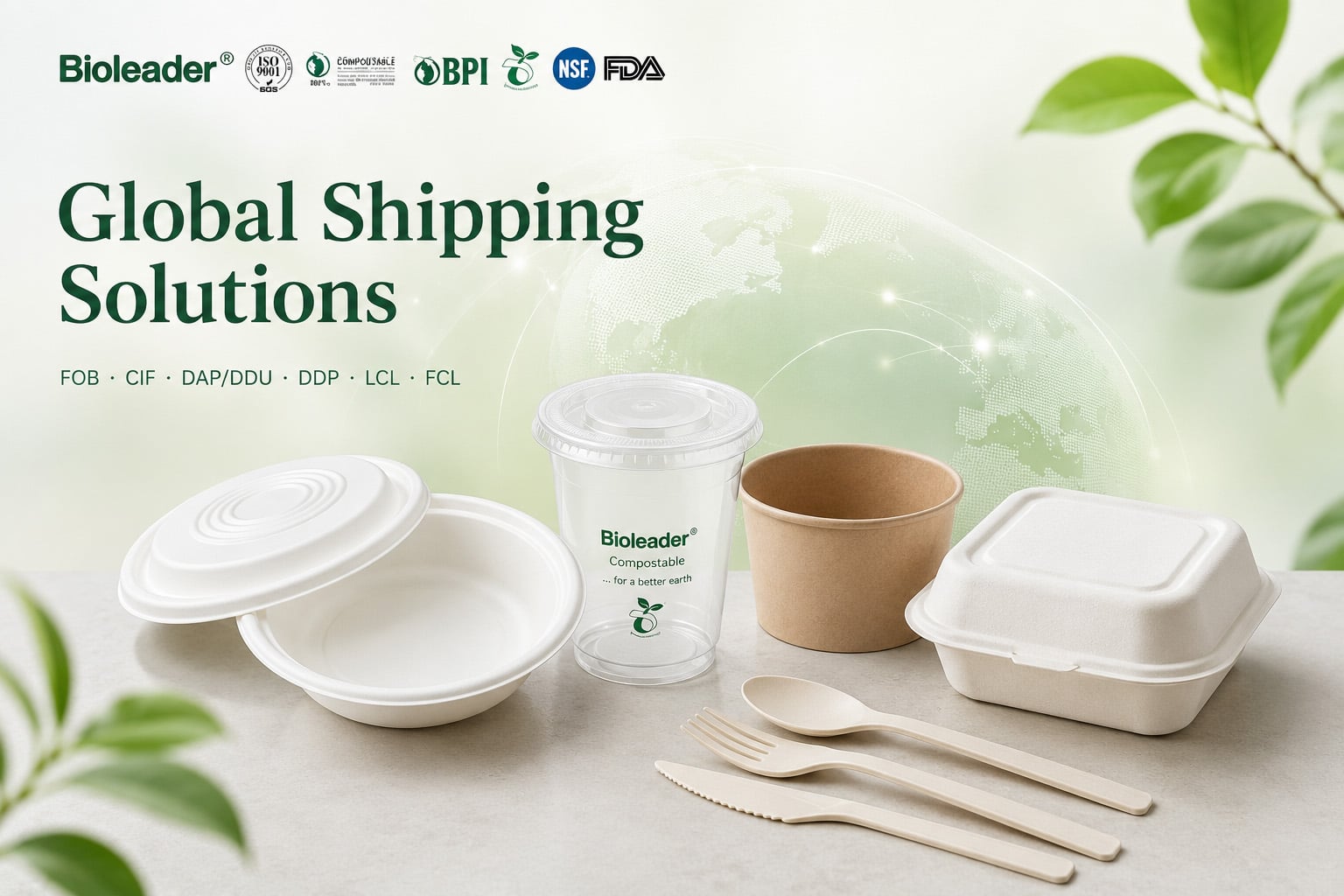
Quick Summary: Bioleader® provides global shipping solutions for compostable food packaging, including FOB Xiamen, CIF/CFR, DAP/DDU-style delivery, DDP, LCL and FCL container shipping. For international buyers sourcing sugarcane bagasse tableware, PLA cups, paper cups, paper bowls, cornstarch tableware and compostable cutlery, Bioleader helps compare product cost, sea freight, customs responsibility, destination risk and total landed cost before shipment.
Beyond FOB: Why Global Buyers Need a Complete Shipping Solution for Compostable Food Packaging
For many international buyers, the first question in a packaging inquiry is simple: “What is your FOB price?” FOB Xiamen is still an important starting point for comparing factory quotations, especially for experienced importers with their own freight forwarders and customs brokers. However, in today’s biodegradable food packaging market, FOB price alone does not show the real purchasing cost.
The more strategic question is: what is the final landed cost after production, export packing, container loading, sea freight, customs clearance, import duties, port charges and local delivery? This is especially important for compostable food packaging because many products are volume-sensitive. Sugarcane bagasse clamshells, molded fiber bowls, paper soup bowls, PLA cups, kraft paper food boxes and cornstarch containers often occupy more container space than their weight suggests.
Bioleader® is positioned as more than a China-based manufacturer of biodegradable tableware. The company supports global B2B buyers with practical export shipping options, including FOB Xiamen, CIF/CFR destination port shipping, DAP/DDU-style delivery, DDP where feasible, LCL shipment and FCL container loading. The goal is to help importers, distributors, foodservice brands and packaging wholesalers choose a purchasing route that matches their market, product category, order volume and customs capability.
Procurement takeaway: For compostable food packaging, the best sourcing decision is not always the lowest unit price. The stronger decision is the route that gives the buyer the best balance of product cost, freight efficiency, customs clarity, delivery responsibility and resale margin.
This guide explains how Bioleader® helps buyers plan global shipments for sugarcane bagasse tableware, compostable PLA cups, paper cups, paper bowls, kraft paper food boxes, cornstarch tableware, CPLA cutlery and biodegradable forks, spoons and knives. It is designed for buyers comparing FOB, CIF, DAP, DDU-style and DDP options before placing trial orders, mixed-container orders or long-term wholesale programs.
What Shipping Terms Can Bioleader® Support for Global Packaging Buyers?
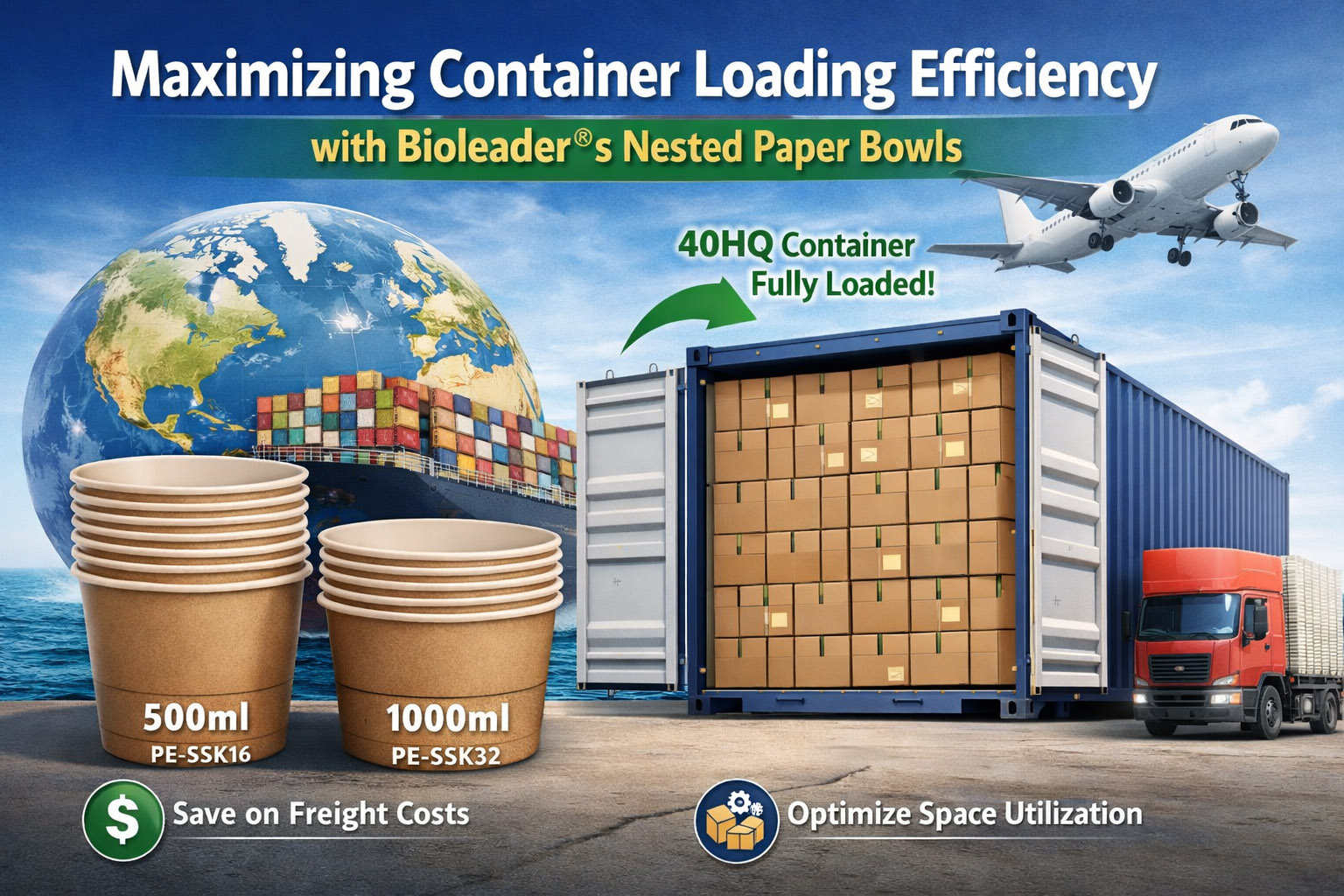
Different buyers need different delivery structures. A mature importer may prefer FOB because it gives maximum logistics control. A new distributor may prefer CIF because the sea freight is already included to the destination port. Some customers need DAP or DDU-style support because they want delivery assistance but still handle import duties locally. In selected markets and under confirmed conditions, DDP may be evaluated for buyers who need a more simplified duty-included purchasing model.
Bioleader® does not recommend choosing a trade term only by habit. Instead, each quotation should be evaluated according to product type, destination country, destination port, order quantity, container volume, HS code, local tax rules, customs clearance responsibility and delivery address.
| Shipping Option | What Bioleader® Can Support | Buyer Responsibility | Best-Fit Buyer |
|---|---|---|---|
| FOB Xiamen | Production, export packing, local delivery to port and China export documentation. | Sea freight, insurance, import clearance, duties, port charges and inland delivery. | Experienced importers with freight forwarders and customs brokers. |
| CIF / CFR | Sea freight quotation to destination port, with CIF including insurance where applicable. | Destination port clearance, duties, local taxes and inland trucking. | Buyers who want a clearer port-to-port cost comparison. |
| DAP / DDU-Style | Delivery support to an agreed place or address, subject to destination feasibility. | Import duties, VAT/GST, customs clearance responsibility and local tax compliance. | Buyers who need delivery support but can handle local import tax and clearance. |
| DDP | Duty-included delivery evaluation where customs, tax and logistics conditions allow. | Buyer provides accurate destination details, product usage information and import requirements. | New importers or distributors seeking simplified landed-cost control. |
| LCL Shipment | Small-volume sea shipment by CBM for trial orders or mixed SKUs. | Higher unit freight cost and destination-side LCL charges. | Market testing, first orders and multi-product sampling programs. |
| FCL 20GP / 40HQ | Full container loading plan, mixed-product container strategy and export packing coordination. | Order planning by SKU, destination confirmation and import-side arrangement. | Wholesalers, distributors, chain brands and long-term B2B buyers. |
Important note: DDU is still widely used by buyers in daily trade communication, but the more current professional expression is usually DAP. For this reason, Bioleader® describes this option as DAP / DDU-style delivery to keep the wording both searchable and commercially accurate.
FOB Xiamen: Best for Experienced Importers Who Control Their Own Logistics
FOB Xiamen remains one of the most common quotation models for biodegradable food packaging exported from China. Under this structure, Bioleader® focuses on manufacturing, quality control, export packing, carton marking, loading coordination, local delivery to Xiamen port and export documentation. The buyer then arranges the main sea freight, cargo insurance, import customs clearance, duties, port handling and inland delivery.
When FOB Works Best
FOB is suitable for buyers who already understand international packaging imports. These buyers usually have a freight forwarder, customs broker, local warehouse, import tax process and experience with HS code classification. For them, FOB Xiamen provides strong cost transparency at the factory level and allows full control over shipping routes, carriers, customs brokers and destination handling.
Typical FOB Products from Bioleader®
FOB Xiamen is commonly used for sugarcane bagasse clamshell containers, bagasse bowls, bagasse plates, molded fiber trays, paper cups, paper soup bowls, kraft paper food boxes, PLA cups, cornstarch food containers and compostable cutlery. It is also suitable for custom printed packaging when the buyer needs to manage freight consolidation with other suppliers.
FOB Is Clear, But It Does Not Show the Full Landed Cost
The limitation of FOB is also clear. FOB price does not include sea freight, import duties, customs clearance, port-side charges or last-mile delivery. For bulky biodegradable food packaging, these cost blocks may strongly affect the final unit cost. A bagasse bowl may look competitive at the factory level, but the final margin depends on container loading efficiency and destination-side charges.
Buyer insight: FOB Xiamen is the right choice when the buyer wants full logistics control. It is not the right choice when the buyer needs a supplier to estimate destination-side cost, customs responsibility or duty-included delivery.
CIF and CFR: Better Port-to-Port Visibility for Compostable Packaging Imports
CIF and CFR are useful when buyers want Bioleader® to include sea freight to the destination port in the quotation. This model is often preferred by distributors and packaging wholesalers who do not want to check freight rates separately for every inquiry, but still have the ability to handle import customs clearance after the goods arrive.
How CIF / CFR Helps Buyers Compare Real Port Cost
For compostable food packaging, freight can change the purchasing decision. Products such as paper bowls, paper cups, bagasse food containers and PLA cups may be light in weight but large in volume. When Bioleader® provides a CIF or CFR quotation, the buyer can compare the product cost together with the estimated sea freight to the destination port.
Common destination port quotations may include routes such as CIF Hamburg, CIF Rotterdam, CIF Felixstowe, CIF Sydney, CIF Melbourne, CIF Jebel Ali, CIF Santos, CIF Callao, CIF Durban or CIF Los Angeles, depending on the buyer’s market and shipping schedule.
Typical CIF / CFR Buyer Profile
CIF or CFR is especially suitable for buyers who want a clearer port-to-port cost but still prefer to manage customs clearance, duties, VAT/GST and local trucking by themselves. It gives better freight visibility than FOB while keeping import-side responsibility in the buyer’s local market.
CIF / CFR Advantage
The buyer can compare factory price and sea freight together, making it easier to estimate the cost at destination port before customs clearance.
CIF / CFR Limitation
The buyer still needs to handle import customs clearance, duties, VAT/GST, port charges and inland delivery after the goods arrive.
Bioleader® Recommendation
Use CIF or CFR when you want Bioleader® to support sea freight estimation, but your local team or broker can manage import clearance.
DAP / DDU-Style Delivery: Delivery Support Without Duty-Included Import Handling
Many buyers still ask suppliers for “DDU shipping” because the term is familiar in daily trade communication. In practical sourcing discussions, they usually mean that the supplier helps arrange international transport and delivery to a named place, while the buyer remains responsible for import duties, VAT/GST and customs clearance in the destination country.
Bioleader® can evaluate DAP / DDU-style delivery for selected markets when the destination address, product category, shipment volume and local delivery conditions are clear. This option is useful for buyers who do not want to manage the full international freight process alone, but still prefer to use their own import tax account, customs broker or local clearance process.
When DAP / DDU-Style Delivery Is Useful
This model is often practical for buyers in Europe, the United Kingdom, Australia, New Zealand, parts of Asia, the Middle East and selected Latin American markets. It can be used for paper cups, paper bowls, kraft paper food containers, bagasse tableware, compostable cutlery, cornstarch tableware and PLA cups, depending on the destination and freight feasibility.
What Buyers Should Confirm Before Requesting DAP / DDU-Style Delivery
- Destination country and full delivery address
- Whether the buyer has an importer record or tax registration
- Product category, material and HS code reference
- Order quantity, carton quantity, CBM and gross weight
- Whether the shipment is LCL, 20GP or 40HQ
- Whether local customs clearance will be handled by the buyer or buyer’s broker
Procurement takeaway: DAP / DDU-style delivery is a practical middle route. It gives the buyer more delivery support than FOB or CIF, but it does not remove the buyer’s responsibility for import duties, VAT/GST and customs compliance.
DDP Shipping: A Simplified Import Option Where Destination Conditions Allow
For some global buyers, especially new importers, distributors entering a new market, foodservice brands without an internal import team, or packaging wholesalers testing a new product category, DDP shipping for compostable food packaging can be an attractive option. Under a DDP-style arrangement, the quotation may include product cost, export handling, international freight, import clearance support, duty-related cost and delivery to an agreed destination, depending on the country and shipment conditions.
However, Bioleader® treats DDP carefully and professionally. DDP is not a universal promise for every country, every product and every order size. It must be evaluated according to destination country, HS code, product material, customs rules, VAT/GST requirements, shipment volume, delivery address and local logistics feasibility. This is especially important for biodegradable and compostable food packaging because different materials may be classified differently at customs.
Important delivery note: Bioleader® can evaluate DDP shipping where feasible, but DDP availability depends on destination-country customs rules, tax structure, importer requirements, cargo volume and logistics conditions. For professional B2B orders, each DDP quotation must be confirmed case by case.
When DDP Is Most Useful for Global Packaging Buyers
DDP is most useful when the buyer needs a clearer landed-cost structure and wants to reduce the operational burden of international shipping. For example, a food packaging distributor may want to know the final cost of bagasse food containers delivered to a warehouse. A beverage brand may want to compare the landed cost of custom printed PLA cups with matching lids. A restaurant supply company may want to import paper bowls, kraft paper food boxes and compostable cutlery without managing every step of the shipping process internally.
In these cases, Bioleader® can review whether DDP is practical or whether a safer route such as CIF, DAP or FOB is more appropriate. The goal is not to force one trade term into every shipment. The goal is to select the route that protects the buyer’s margin, reduces logistics uncertainty and keeps compliance risk under control.
Typical Products That May Be Evaluated for DDP Shipping
Depending on destination feasibility, Bioleader® may evaluate DDP shipping for several product categories, including sugarcane bagasse clamshell boxes, bagasse bowls, molded fiber trays, paper cups, paper soup bowls, kraft paper food containers, PLA cold cups, cornstarch tableware, CPLA cutlery and biodegradable cutlery kits. For each category, carton quantity, CBM, gross weight and HS code must be reviewed before confirming the most suitable shipping structure.
DDP Is About Landed-Cost Control, Not Only Convenience
A professional DDP quotation should help the buyer understand the true commercial picture. It should not only answer “Can you deliver?” It should answer how the product cost, freight cost, import cost and delivery cost affect the final unit cost. This is why Bioleader® encourages buyers to compare DDP with FOB, CIF and DAP before making a long-term sourcing decision.
| Buyer Situation | Recommended Option | Reason |
|---|---|---|
| Buyer has its own forwarder and customs broker | FOB Xiamen | Best for logistics control and direct factory-price comparison. |
| Buyer wants sea freight included to destination port | CIF / CFR | Better for port-to-port cost visibility before import clearance. |
| Buyer needs delivery support but can handle duties locally | DAP / DDU-Style | Suitable when the buyer has local tax and customs capability. |
| Buyer wants a more simplified landed-cost solution | DDP, if feasible | Useful when customs, duties and local delivery can be evaluated clearly. |
| Buyer is testing a new product category | LCL | Good for trial orders, but unit freight cost is usually higher. |
| Buyer has stable monthly or quarterly demand | FCL 20GP / 40HQ | Better for container utilization, lower unit logistics cost and long-term supply. |
Buyer insight: DDP is not only a shipping term. For compostable packaging buyers, it is a landed-cost planning tool. The right DDP quotation should make the buyer’s final import cost more predictable, not less transparent.
LCL vs FCL: How Bioleader® Helps Buyers Choose the Right Shipping Mode
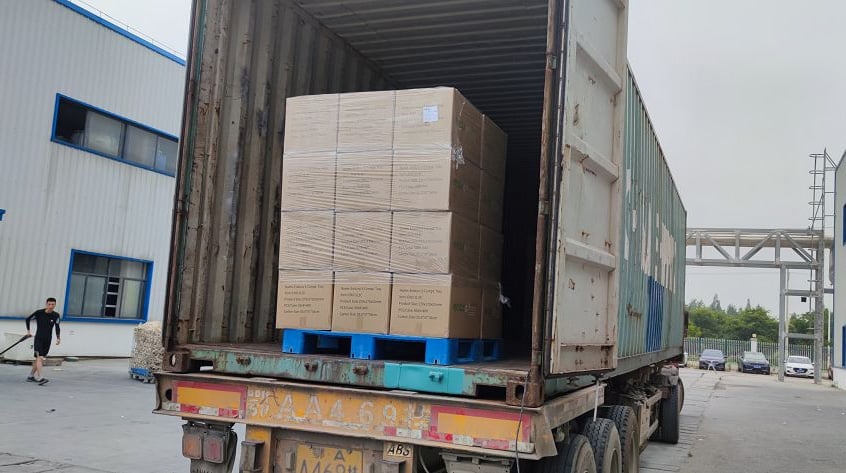
In biodegradable food packaging sourcing, shipping mode can directly affect profitability. Many compostable packaging products are not heavy cargo. They are often volume-sensitive products, meaning the shipment cost is strongly influenced by carton size, CBM, container loading efficiency and destination handling fees. This is why Bioleader® reviews LCL and FCL options before recommending the most practical export solution.
A buyer importing paper cups, paper salad bowls, PLA cups, bagasse containers, cornstarch tableware or compostable cutlery should not only ask for the unit price. The buyer should also ask how many cartons will be shipped, how much CBM the order occupies, whether the products can be mixed into one container, and whether LCL or FCL gives a better final cost.
LCL Shipping for Trial Orders, Mixed SKUs and New Market Testing
LCL shipping is suitable when the order does not fill a full container. It is often used for first orders, new-market testing, mixed SKU purchases or small-volume product validation. For example, a buyer may want to test bagasse bowls, paper soup bowls, CPLA cutlery and PLA clear cups together before committing to a full container program.
The advantage of LCL is flexibility. Buyers can start with lower total quantity and evaluate product quality, packaging performance, customer feedback and local resale potential. The limitation is cost structure. LCL shipments usually have a higher unit freight cost because the buyer pays by CBM and may also face destination-side LCL handling charges.
When LCL Makes Sense
- The buyer is testing a new biodegradable food packaging category.
- The buyer needs several SKUs but does not have enough quantity for a 20GP container.
- The buyer wants to compare bagasse, paper, PLA, cornstarch and cutlery products before scaling.
- The buyer accepts a higher unit logistics cost in exchange for lower initial purchasing risk.
FCL Shipping for Better Unit Cost and Long-Term Supply
FCL shipping is usually the better option for mature importers, wholesalers, distributors, restaurant supply companies and chain brands. When the buyer can fill a 20GP or 40HQ container, the unit shipping cost is normally more competitive. FCL also reduces cargo handling frequency, improves carton protection and gives the buyer better control over loading structure.
Bioleader® can help buyers plan full-container shipments by combining compatible products. For example, a buyer may ship sugarcane bagasse clamshells, bagasse plates, paper bowls, kraft paper boxes and compostable cutlery in one container. Another buyer may build a beverage packaging container with PLA cups, PET lids, paper cups and custom printed cartons, depending on order structure and product compatibility.
20GP vs 40HQ: How Buyers Should Think About Container Planning
A 20GP container is often suitable for first bulk orders or controlled inventory planning. A 40HQ container is generally better for regular wholesale programs because it provides more loading volume and often reduces the logistics cost per carton. For bulky products such as bagasse clamshells, molded fiber bowls and paper food containers, container utilization can be a decisive factor in the final landed cost.
| Shipping Mode | Best For | Main Advantage | Main Limitation | Bioleader® Recommendation |
|---|---|---|---|---|
| LCL | Trial orders, mixed SKUs, new market testing | Lower initial order volume and flexible product testing | Higher unit freight cost and destination-side handling charges | Use LCL for product validation, then move to FCL after demand is confirmed. |
| 20GP FCL | First bulk orders and controlled inventory programs | Better container control and lower unit cost than LCL | Requires higher quantity planning by SKU | Use 20GP when moving from trial purchase to regular import planning. |
| 40HQ FCL | Stable distributors, chain brands and wholesale importers | Strong loading efficiency and better landed-cost control | Requires stronger inventory and sales planning | Use 40HQ for long-term supply, private label programs and multi-category purchasing. |
Procurement takeaway: LCL is a good testing tool, but FCL is usually the stronger commercial model for regular biodegradable tableware imports. Once demand is stable, container-level planning is one of the most effective ways to reduce landed cost.
Product Lines Covered by Bioleader® Global Shipping Solutions
Bioleader® supports global shipping not only for one product category, but for a complete range of compostable and biodegradable food packaging. This gives international buyers a practical advantage: multiple product lines can be evaluated under one supplier system, one export documentation process, one container planning structure and one communication channel.
For distributors and foodservice packaging buyers, this is commercially important. A buyer may need bagasse food containers for hot meals, PLA cups for cold drinks, paper bowls for soups and salads, kraft paper boxes for takeaway food, cornstarch containers for cost-sensitive programs and compostable cutlery for complete meal kits. Instead of sourcing each category separately, Bioleader® can help organize a more integrated packaging supply plan.
Sugarcane Bagasse Tableware Shipping Solutions

Sugarcane bagasse tableware is one of the most important product categories for global sustainable food packaging buyers. Bioleader® supplies bagasse clamshell boxes, bagasse bowls, bagasse plates, molded fiber trays, bagasse food containers, bagasse cups and matching lids for takeaway meals, catering, meal prep, supermarkets, restaurants and institutional foodservice.
Because molded fiber tableware is usually volume-sensitive, bagasse products are often more suitable for FCL shipping or carefully planned mixed-container shipments. For U.S. importers, Bioleader® can also help evaluate specialized routes such as FOB China, FOB Thailand and DDP U.S. Port solutions where applicable. For other global markets, FOB, CIF, DAP/DDU-style delivery and DDP evaluation may be considered based on destination conditions.
PLA Cups and Compostable Plastic Cups Shipping Solutions

Bioleader® supplies PLA clear cups, compostable PLA cups, biodegradable plastic cups, cold drink cups, matching flat lids, dome lids and custom printed PLA cups for cafés, juice brands, bubble tea chains, dessert stores, event organizers and beverage packaging distributors.
PLA cups require more careful shipping planning than ordinary plastic cups because PLA is more temperature-sensitive. For container shipments, Bioleader® can help evaluate export carton protection, insulated packing arrangements, container-level thermal protection and shipment timing. PLA cups can be shipped by LCL for selected trial orders, but FCL is usually more practical for serious import programs and private label beverage packaging projects.
Paper Cups, Paper Bowls and Kraft Paper Food Boxes Shipping Solutions
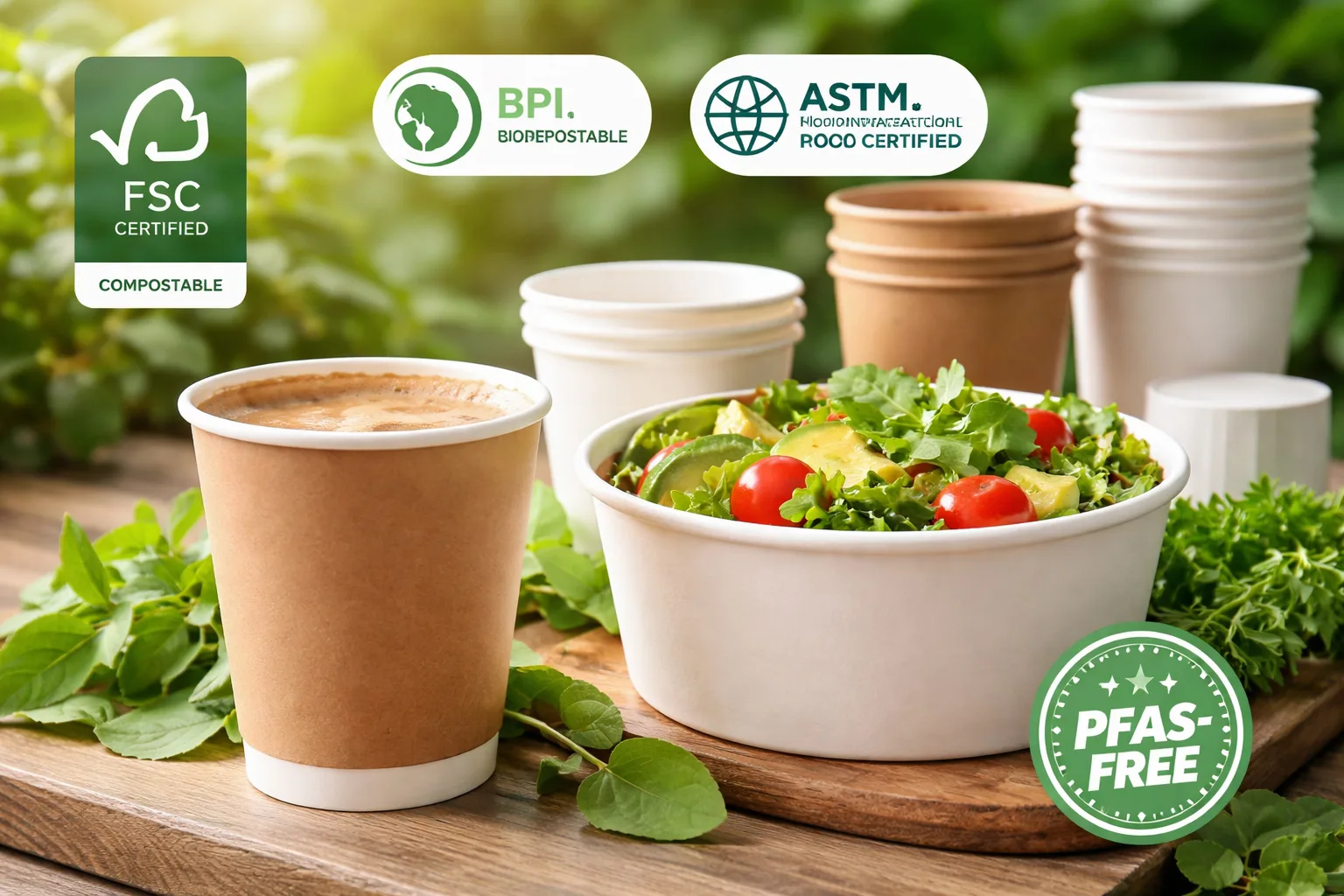
Paper packaging remains a core category for cafés, takeaway restaurants, soup brands, salad shops, bakeries and foodservice distributors. Bioleader® supplies paper cups, double wall paper cups, paper soup bowls, paper salad bowls, kraft paper bowls, paper takeaway containers and paper bags, with different coating and customization options depending on market requirements.
Paper cups and paper bowls are often ordered by size, print design, coating type and lid compatibility. For this reason, buyers should plan quantities by SKU before shipping. Bioleader® can help calculate carton quantity, CBM, gross weight and container loading structure so the buyer can compare LCL, 20GP and 40HQ options more clearly.
Cornstarch Tableware and Cornstarch Food Containers Shipping Solutions

Cornstarch tableware is often selected by buyers looking for a cost-effective alternative to conventional plastic food packaging. Bioleader® supplies cornstarch clamshell boxes, cornstarch food containers, cornstarch plates, cornstarch bowls, cornstarch cups and cornstarch cutlery for restaurants, takeaway chains, catering suppliers and packaging distributors.
Cornstarch products can be shipped by FOB, CIF, DAP/DDU-style delivery or DDP evaluation depending on the destination market. For buyers building mixed product programs, cornstarch tableware can also be combined with paper packaging, bagasse containers or compostable cutlery in one container, subject to packing compatibility and order volume.
Compostable Cutlery: CPLA and Cornstarch Forks, Spoons and Knives
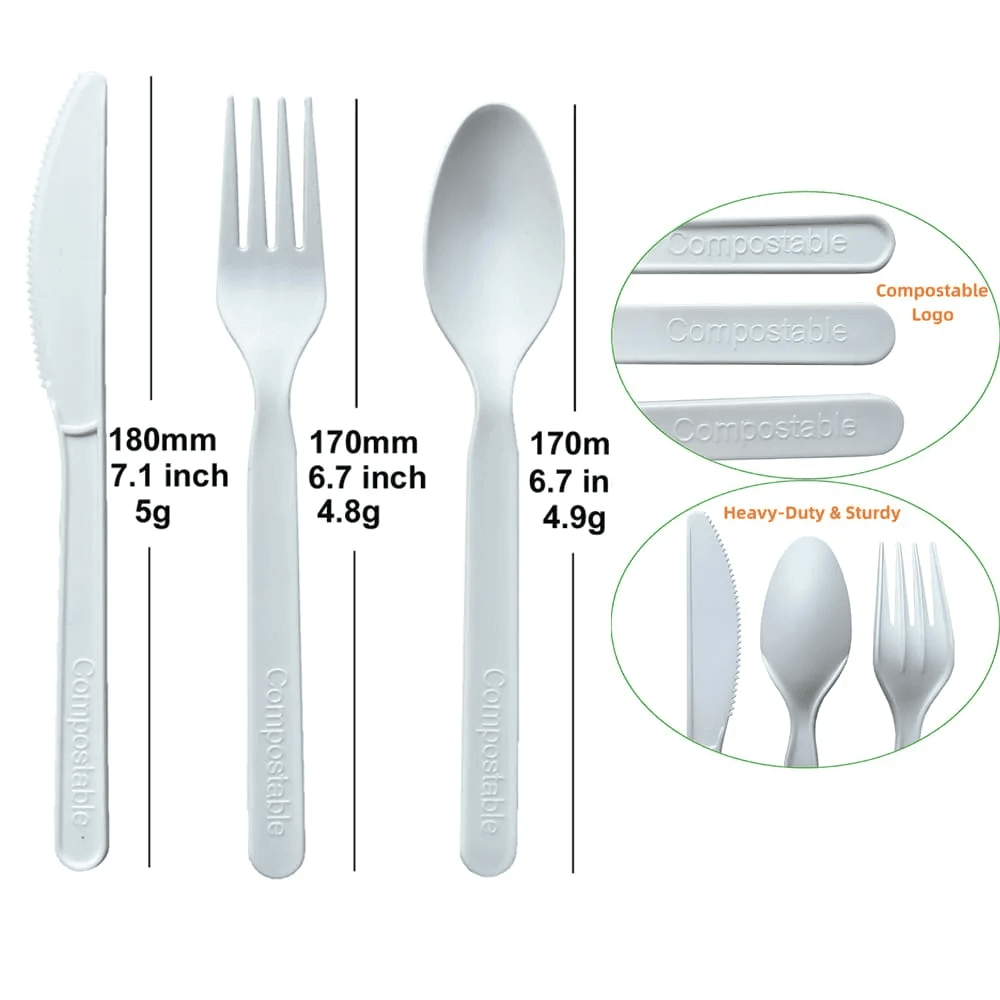
Compostable cutlery is a strong complementary product for global food packaging programs. Bioleader® supplies CPLA forks, CPLA spoons, CPLA knives, cornstarch cutlery, biodegradable forks and spoons, individually wrapped cutlery and compostable cutlery kits for restaurants, airlines, hotels, catering services, takeaway platforms and institutional buyers.
Compared with bulky molded fiber or paper packaging, cutlery is usually easier to fit into container planning. It can help improve mixed-container value when shipped together with bagasse clamshells, paper bowls, PLA cups or kraft paper food boxes. For many buyers, adding compostable cutlery to a container is an efficient way to build a complete disposable tableware supply program.
| Bioleader® Product Line | Typical Products | Suitable Shipping Mode | Best-Fit Buyer | Logistics Note |
|---|---|---|---|---|
| Sugarcane Bagasse Tableware | Clamshell boxes, bowls, plates, trays, cups and lids | FOB, CIF, DAP/DDU-style, DDP evaluation, FCL | Meal prep brands, distributors, restaurants, supermarkets | Volume-sensitive; FCL or mixed-container planning is recommended. |
| PLA Cups | Clear PLA cups, cold cups, flat lids, dome lids, custom printed cups | FOB, CIF, selected LCL, FCL, DAP evaluation | Cafés, juice brands, bubble tea chains, beverage distributors | Temperature-sensitive; export packing and container protection should be reviewed. |
| Paper Cups and Paper Bowls | Hot cups, soup bowls, salad bowls, lids and printed paper packaging | FOB, CIF, LCL, FCL, DAP/DDU-style | Coffee chains, soup brands, salad shops, foodservice wholesalers | SKU planning is important because sizes, lids and print designs vary. |
| Kraft Paper Food Boxes | Kraft boxes, paper food containers, takeaway boxes and paper bags | FOB, CIF, LCL, FCL, DAP evaluation | Takeaway restaurants, bakeries, delivery brands and distributors | Good for mixed packaging programs with bowls, cups and cutlery. |
| Cornstarch Tableware | Cornstarch clamshells, bowls, plates, cups and cutlery | FOB, CIF, DAP/DDU-style, DDP evaluation, FCL | Cost-sensitive distributors and foodservice buyers | Can be combined with other disposable tableware categories. |
| Compostable Cutlery | CPLA forks, spoons, knives, cornstarch cutlery and cutlery kits | FOB, CIF, LCL, FCL, DAP/DDU-style | Restaurants, airlines, hotels, catering companies and wholesalers | Efficient for container consolidation with bowls, boxes and cups. |
Integrated Supply Advantage
Bioleader® can help buyers combine multiple compostable food packaging categories into one export program. For global procurement teams, this reduces supplier fragmentation, improves container planning, simplifies documentation and makes it easier to build a complete biodegradable tableware product line for local resale or foodservice use.
Regional Delivery Options: How Bioleader® Supports Buyers Worldwide
Global compostable food packaging procurement is not a one-route business. A buyer in the United States may need a different shipping model from a buyer in Germany, Chile, Australia, the United Arab Emirates or South Africa. For this reason, Bioleader® evaluates each export project by region, product category, order volume, customs requirements and final delivery expectation.
The objective is simple: help buyers choose a realistic shipping route before production starts. For biodegradable tableware, paper cups, PLA cups, paper bowls, cornstarch food containers and compostable cutlery, early shipping planning can reduce unexpected cost, avoid documentation gaps and improve supply-chain predictability.
North America: United States, Canada and Mexico
North America is one of the most important markets for compostable food packaging. For U.S. buyers, Bioleader® can help compare FOB China, FOB Thailand, CIF U.S. port, DAP/DDU-style delivery and DDP U.S. Port solutions where applicable. This is especially valuable for sugarcane bagasse tableware buyers who need to evaluate tariff exposure, origin strategy and landed-cost control.
For Canada and Mexico, Bioleader® can evaluate FOB, CIF, DAP/DDU-style delivery and selected DDP options depending on customs conditions, product category and shipment volume. Typical products include bagasse clamshells, molded fiber bowls, paper bowls, PLA cups, kraft paper food boxes and compostable cutlery.
Europe and the United Kingdom
European and UK buyers usually pay close attention to food contact safety, compostability claims, product documentation, HS code classification, VAT, EPR-related obligations and local packaging rules. For this reason, Bioleader® often recommends a structured quotation comparison using FOB, CIF, DAP/DDU-style delivery and DDP evaluation.
For buyers importing paper cups, paper soup bowls, bagasse tableware, PLA cups, kraft paper containers or compostable cutlery, the best route depends on whether the buyer has an importer record, local customs broker and tax-handling capability. CIF is useful for port-to-port clarity, while DAP/DDU-style delivery can be practical when the buyer needs delivery support but remains responsible for local import duties and taxes.
Central America and South America
Buyers in Central and South America often request CIF quotations because destination-port visibility is important for early cost comparison. Bioleader® can evaluate shipments to ports such as Santos, Callao, Buenaventura, Valparaíso, Buenos Aires, Cartagena and other regional gateways depending on the final market.
LCL shipments may be useful for first orders, while FCL shipments are usually more economical for regular distribution. Common product combinations include paper cups, paper bowls, bagasse clamshell boxes, cornstarch tableware, kraft paper boxes and biodegradable cutlery.
Oceania and Island Markets
Australia, New Zealand and island markets often require flexible shipping planning because order structures may vary by market size, port access and local distribution model. Bioleader® can support FOB, CIF, DAP/DDU-style delivery and selected DDP evaluation depending on destination feasibility.
For island markets, LCL or consolidated shipping can be practical for testing demand. For larger buyers, FCL shipments of bagasse plates, bagasse bowls, paper food containers, PLA cups and compostable cutlery usually offer better landed-cost control.
Asia and Southeast Asia
Asian and Southeast Asian markets often benefit from shorter shipping distances and more flexible sea routes. Buyers may choose FOB when they have strong local logistics partners, or CIF when they want Bioleader® to quote sea freight to a destination port. DAP/DDU-style delivery may also be evaluated when the delivery address and import process are clear.
Common products for this region include paper cups, PLA cups, cornstarch tableware, bagasse containers, kraft paper food boxes and compostable cutlery. For regional distributors, mixed-container purchasing can improve SKU coverage while reducing supplier fragmentation.
Middle East and Africa
The Middle East and Africa include diverse buyer groups, from hotels, restaurants and catering companies to supermarkets, foodservice distributors and government-related procurement programs. Bioleader® can evaluate CIF, FOB, DAP/DDU-style delivery and selected DDP options depending on customs rules, port conditions and shipment scale.
Common destination gateways may include Jebel Ali, Dammam, Doha, Kuwait, Durban, Mombasa, Tema and Lagos. Typical products include bagasse trays, disposable bowls, paper food boxes, PLA cups, cornstarch containers and compostable forks, spoons and knives.
| Region | Common Shipping Options | Typical Buyers | Suitable Bioleader® Products | Practical Note |
|---|---|---|---|---|
| North America | FOB, CIF, DAP/DDU-style, DDP U.S. Port evaluation | Importers, distributors, restaurant supply companies | Bagasse tableware, PLA cups, paper bowls, compostable cutlery | U.S. buyers may compare China, Thailand and U.S. port delivery routes. |
| Europe / UK | FOB, CIF, DAP/DDU-style, DDP evaluation | Foodservice brands, distributors, packaging wholesalers | Paper cups, paper bowls, bagasse containers, PLA cups, cutlery | Compliance documents and tax responsibility should be confirmed early. |
| Central / South America | FOB, CIF, LCL, FCL, DAP evaluation | Regional distributors, food packaging importers | Paper cups, bagasse clamshells, cornstarch tableware, cutlery | CIF is often useful for port-to-port cost comparison. |
| Oceania / Island Markets | FOB, CIF, LCL, FCL, DAP/DDU-style | Eco packaging distributors, restaurants, tourism-related foodservice buyers | Bagasse plates, paper containers, PLA cups, compostable cutlery | LCL can support trial demand; FCL is better for stable supply. |
| Asia / Southeast Asia | FOB, CIF, DAP/DDU-style, FCL | Distributors, food chains, beverage brands, wholesalers | PLA cups, paper cups, cornstarch tableware, bagasse containers | Shorter routes can support faster replenishment planning. |
| Middle East / Africa | FOB, CIF, FCL, DAP/DDU-style, selected DDP evaluation | Hotels, catering suppliers, distributors, supermarket suppliers | Bagasse trays, paper food boxes, disposable bowls, cutlery | Customs and port conditions should be confirmed by destination. |
How Bioleader® Builds a Practical Shipping Quote
A professional compostable packaging quotation should not stop at product price. For global procurement teams, a useful quotation should connect product specification, carton data, shipment volume, destination route, customs responsibility and delivery term. Bioleader® follows a practical export quotation workflow to help buyers compare FOB, CIF, DAP/DDU-style and DDP options more clearly.
Step 1: Confirm Product Category, SKU and Application
The first step is to confirm the exact product requirement. A buyer should provide the product category, item code, material, size, capacity, lid requirement, application, quantity and whether custom printing is needed. For example, a quotation for a 32oz bagasse bowl with lid is different from a quotation for a 12oz PLA cup with dome lid or a double wall paper hot cup with custom logo printing.
Step 2: Calculate Cartons, CBM and Gross Weight
After confirming SKUs, Bioleader® calculates carton quantity, carton size, CBM and gross weight. This step is critical because many biodegradable food packaging products are volume-sensitive. The CBM result helps determine whether the buyer should choose LCL, 20GP FCL, 40HQ FCL or a mixed-container solution.
Step 3: Compare FOB, CIF, DAP/DDU-Style and DDP Options
Once product data and shipment volume are clear, Bioleader® can help compare different shipping structures. FOB is useful for buyers with their own logistics network. CIF is useful for port-to-port cost visibility. DAP/DDU-style delivery is useful when the buyer needs destination delivery support but handles duties locally. DDP may be evaluated when the buyer wants a more simplified landed-cost solution and the destination conditions allow.
Step 4: Review HS Code, Duties and Compliance Documents
HS code and customs classification can influence import duties, clearance requirements and local compliance. Different materials such as sugarcane bagasse, paperboard, PLA, cornstarch composite materials and compostable cutlery may require different customs review. Bioleader® can support buyers with product specifications, commercial invoice, packing list, material information, test documents and certificate references for local review.
Step 5: Finalize Shipment Mode and Commercial Terms
After comparing product cost, freight cost, customs responsibility and destination requirements, the buyer can decide whether to proceed with LCL, 20GP, 40HQ, FOB, CIF, DAP/DDU-style or DDP evaluation. For long-term procurement, Bioleader® recommends building a repeatable shipping model rather than recalculating every order from zero.
| Quotation Step | Information Needed | Why It Matters | Example |
|---|---|---|---|
| Product confirmation | SKU, material, size, capacity, lid, application | Prevents wrong quotation and wrong carton calculation. | Bagasse bowl with lid, PLA cup with dome lid, paper soup bowl |
| Quantity review | Quantity per SKU and total order volume | Determines LCL, 20GP, 40HQ or mixed-container feasibility. | 50,000 pcs per item or one mixed 20GP container |
| Destination planning | Country, port, city, warehouse address | Allows FOB, CIF, DAP/DDU-style or DDP comparison. | CIF Rotterdam, DAP Melbourne, DDP U.S. Port evaluation |
| Customs review | HS code, duty rate, importer status, tax ID if required | Clarifies who handles customs clearance and duties. | Buyer broker confirms HS classification locally |
| Final shipping model | Preferred Incoterm, shipment mode and delivery responsibility | Turns product sourcing into a practical import plan. | FOB Xiamen 40HQ or CIF destination port quotation |
What Buyers Should Send Before Requesting a FOB, CIF, DAP or DDP Quote
Accurate information leads to accurate quotation. Before requesting a shipping quote for biodegradable food packaging, buyers should prepare basic product, quantity and destination details. This helps Bioleader® calculate carton quantity, CBM, loading volume, sea freight, delivery feasibility and customs-related responsibility more efficiently.
Product Information Checklist
- Product category: bagasse tableware, PLA cups, paper cups, paper bowls, cornstarch tableware or compostable cutlery
- Item code, product photo or size reference
- Capacity, dimensions, lid requirement and application
- Material preference and food contact requirements
- Plain product, custom printed product or private label packaging
- Inner packing, carton marking or retail packaging requirements
Quantity and Shipping Information Checklist
- Quantity per SKU
- Trial order, regular order or annual procurement plan
- Preferred shipment mode: LCL, 20GP or 40HQ
- Destination country and destination port
- Delivery city or warehouse address for DAP/DDU-style or DDP evaluation
- Whether the buyer has a freight forwarder, customs broker or importer record
Compliance and Market Information Checklist
- Required food contact standard or testing document
- Compostability requirement, if applicable
- Local packaging rule, labeling requirement or plastic restriction
- HS code reference used by the buyer’s customs broker
- Whether duties, VAT/GST or local taxes should be included in the quote
Buyer insight: The more complete the buyer’s information is, the more accurate the shipping comparison becomes. For compostable food packaging, product size, carton volume and destination responsibility are just as important as unit price.
Final Recommendation: Compare Total Landed Cost, Not Only Unit Price
In global compostable food packaging sourcing, the lowest factory price is not always the strongest purchasing decision. A buyer importing bagasse tableware, paper cups, paper bowls, PLA cups, cornstarch containers or compostable cutlery must compare product cost together with carton volume, sea freight, destination port charges, customs clearance, import duties, VAT/GST and local delivery.
Bioleader® recommends evaluating each order through a landed-cost framework: product category + order quantity + carton volume + destination country + shipping term + customs responsibility + delivery requirement. This approach gives buyers a more realistic view of margin, resale price and supply-chain risk.
FOB Xiamen is still the right choice for experienced importers with strong logistics control. CIF is useful when buyers want sea freight included to the destination port. DAP/DDU-style delivery can support buyers who need delivery assistance but handle duties locally. DDP can be evaluated where customs, tax and logistics conditions allow. LCL is useful for testing, while FCL is usually the better model for long-term wholesale supply.
Work with Bioleader® on a Practical Global Shipping Plan
Bioleader® helps global buyers source compostable food packaging with flexible shipping options, including FOB Xiamen, CIF/CFR, DAP/DDU-style delivery, DDP evaluation, LCL shipments and FCL container programs.
Contact Bioleader® with your product list, quantity, destination port or delivery address, and preferred shipping term. Our team can help evaluate a practical quotation for sugarcane bagasse tableware, PLA cups, paper cups, paper bowls, kraft paper food boxes, cornstarch tableware and compostable cutlery.
Frequently Asked Questions About Bioleader® Global Shipping Solutions
Does Bioleader® only provide FOB Xiamen pricing?
No. Bioleader® can support FOB Xiamen, CIF/CFR destination port shipping, DAP/DDU-style delivery, DDP evaluation, LCL shipments and FCL container programs depending on product category, destination country, order quantity and customs feasibility.
Can Bioleader® provide DDP shipping for compostable food packaging?
Bioleader® can evaluate DDP shipping where feasible. DDP availability depends on destination-country customs rules, HS code, tax structure, importer requirements, cargo volume and local delivery conditions. Each DDP request should be reviewed case by case.
What is the difference between FOB and CIF for biodegradable tableware orders?
Under FOB, the buyer usually controls sea freight, insurance, import clearance, duties and local delivery after the goods leave the export port. Under CIF, the seller includes sea freight and insurance to the destination port, while the buyer normally handles import clearance, duties, local taxes and inland delivery.
Is DDU still used for international food packaging shipments?
Many buyers still use the term DDU in daily trade communication. In modern professional shipping discussions, the closer current term is usually DAP. Bioleader® uses the phrase DAP/DDU-style delivery to make the meaning clear while matching how buyers commonly search and communicate.
Can Bioleader® ship LCL orders?
Yes. Bioleader® can evaluate LCL shipment for trial orders, mixed SKU programs and new-market testing. However, LCL usually has a higher unit freight cost than FCL because the shipment is charged by CBM and may include destination-side LCL handling fees.
Which Bioleader® products are suitable for FCL shipment?
FCL shipping is suitable for sugarcane bagasse clamshells, bagasse bowls, molded fiber trays, paper cups, paper soup bowls, kraft paper food boxes, PLA cups, cornstarch tableware and compostable cutlery. For regular wholesale programs, 20GP or 40HQ container planning usually gives better landed-cost control.
Can different product categories be mixed in one container?
Yes, compatible product categories can often be mixed in one container. For example, buyers may combine bagasse food containers, paper bowls, kraft paper boxes and compostable cutlery. Bioleader® reviews carton size, CBM, packing stability, product compatibility and loading safety before confirming a mixed-container plan.
What information is needed for a CIF, DAP or DDP quotation?
Buyers should provide product category, item code or photo, size, quantity per SKU, lid requirement, printing requirement, destination country, destination port, delivery address if applicable, and whether the buyer can handle customs clearance and duties locally.
Does Bioleader® help with HS codes and customs documents?
Bioleader® can provide product specifications, commercial invoice, packing list, material information, certificate references and HS code guidance for buyer review. Final HS code confirmation and import declaration should be checked with the buyer’s local customs broker or import agent.
Which shipping option is best for new importers?
New importers usually start with LCL, CIF or DAP/DDU-style delivery to understand product performance and landed cost. Once demand becomes stable, FCL shipping under FOB, CIF or a confirmed delivery model is usually more cost-effective for long-term procurement.