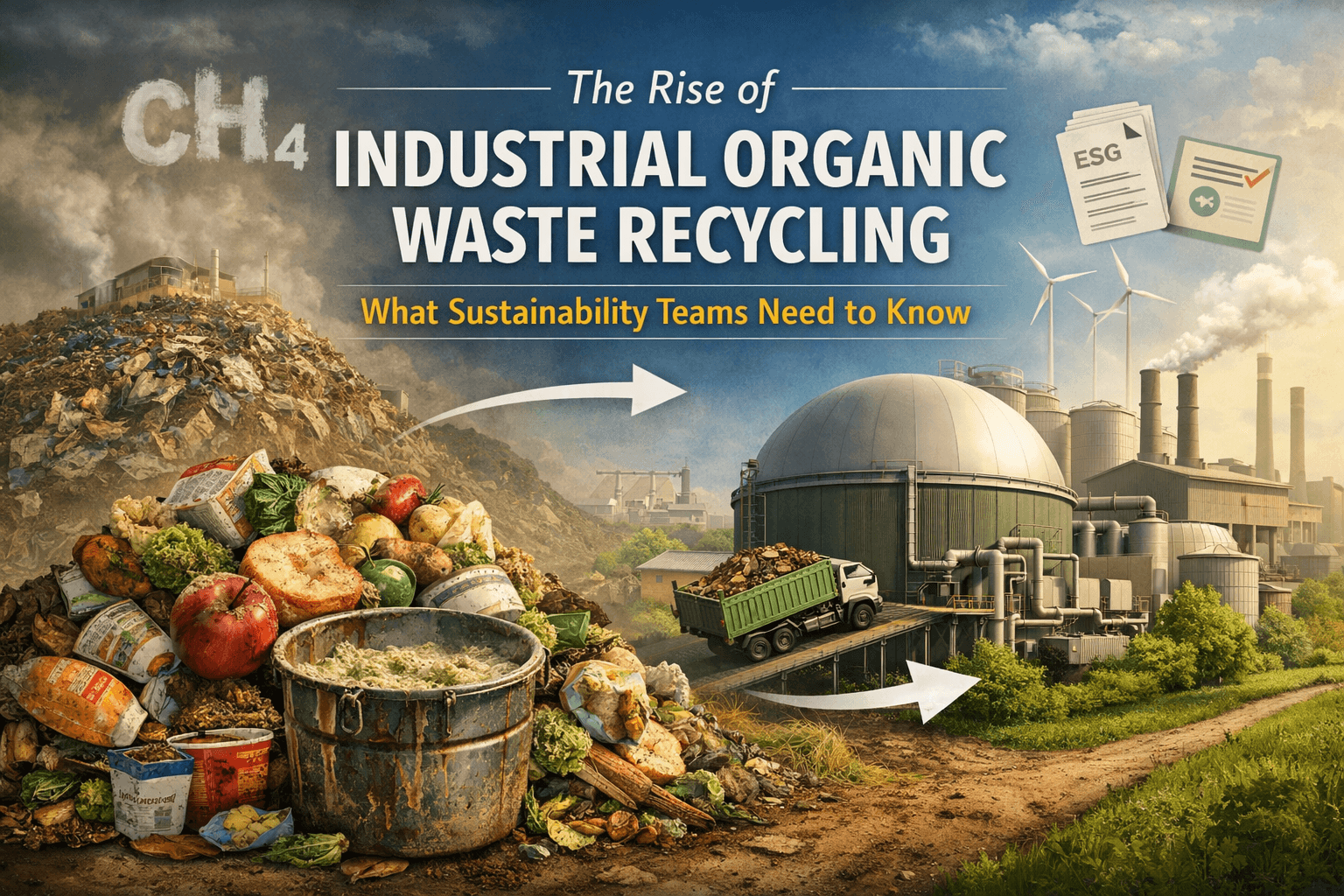
Landfill disposal keeps getting more expensive, and it is getting harder to justify in sustainability planning. According to the Environmental Research & Education Foundation, the average U.S. landfill tipping fee reached about $62.28 per ton in 2025, continuing a steady climb. For companies that generate large volumes of organic waste, those costs add up quickly. At that point, industrial organic waste recycling stops being a nice-to-have and becomes a real financial and environmental consideration.
A lot of this pressure shows up well before products ever reach consumers. Manufacturing losses, processing leftovers, expired inventory, and liquid waste all count as industrial organic waste. These materials tend to move in large, predictable volumes. They also attract more attention because of their role in methane emissions and the growing number of rules around organic waste disposal. Sustainability teams are now expected to take a closer, more deliberate approach to how these streams are handled.
This article looks at what industrial organic waste recycling actually involves, why interest in it keeps growing, and how sustainability teams can work through the benefits and challenges, with a closer look at beverage and liquid waste.
What Is Industrial Organic Waste
Industrial organic waste covers organic material generated through industrial operations rather than everyday consumer activity. Regulators do not track it as a single category. Instead, they capture pieces of it across manufacturing, processing, and wastewater treatment data. For sustainability teams, that often means pulling information from several places to understand the full picture.
Typical industrial organic waste streams include:
- Byproducts from manufacturing and processing
- Liquid organic waste generated during production and handling
- Unsaleable or expired packaged goods
- Organic residuals from industrial wastewater treatment
These streams behave differently from commercial or municipal organic waste. Volumes are higher, timing follows production cycles, and packaging or contamination is common. That combination makes recycling more complex.
In some sectors, this complexity is even more pronounced. Beverage manufacturing is a common example. Large volumes of liquid product often need controlled handling through industrial beverage destruction before they can move into recycling or recovery pathways.
In practice, industrial organic waste management usually depends on specialized infrastructure and experienced partners rather than local collection programs.
The Scale of Organic Waste
Organic waste represents a large share of what ends up in landfills, which explains why it keeps resurfacing in sustainability discussions.
- Globally, more than 1 billion metric tons of food waste are generated each year, according to UN estimates.
- In the United States, organic materials account for roughly half of landfill waste when food, yard waste, paper, and wood are combined.
- Landfilled organic waste is a major source of methane emissions, which carry strong short-term climate impact.
For industrial operations, the scale shows up differently.
- Organic waste is generated in concentrated volumes at manufacturing and processing sites.
- These streams follow production schedules, which makes them consistent and easier to manage if addressed directly.
For sustainability teams, the takeaway is simple. Industrial organic waste recycling is not a marginal improvement. It targets one of the largest and most controllable sources of waste-related emissions within industrial operations.
Why Industrial Organic Waste Recycling Is Accelerating
Industrial organic waste recycling is picking up speed because several pressures are hitting at the same time. For many companies, this is no longer about preparing for future risk. It is about dealing with what is already happening on the ground.
Climate and methane pressure
When organic waste goes to a landfill, it produces methane. That connection is now hard to ignore. Regulators and climate teams increasingly focus on methane because of its short-term climate impact, and landfill disposal of organic waste sits directly in that conversation.
Rising disposal costs and landfill constraints
Tipping fees continue to rise, and landfill capacity remains limited in many regions. For industrial generators moving large volumes of waste, disposal costs now show up clearly in budgets instead of being absorbed as overhead.
Regulatory requirements
Rules such as California’s SB 1383 require significant reductions in organic waste sent to landfill and push companies toward diversion and recovery. Similar requirements are taking shape at the state and regional level.
ESG and reporting expectations
Waste diversion increasingly appears in ESG frameworks and investor disclosures. Sustainability teams are expected to show measurable progress, not just long-term plans.
Taken together, these factors explain why industrial organic waste recycling has moved from a secondary operational issue to a strategic focus for sustainability teams.
The Benefits of Industrial Organic Waste Recycling
When it works, industrial organic waste recycling delivers benefits that go well beyond meeting a requirement. It changes how waste shows up in budgets, reporting, and day-to-day operations.
Environmental benefits
- Less organic waste going to the landfill, which directly reduces methane emissions
- A smaller waste-related carbon footprint that sustainability teams can actually track
- Better alignment with climate targets and broader circular economy efforts
Operational benefits
- More predictable handling of waste streams that follow production schedules
- Reduced exposure to swings in disposal costs and landfill availability
- Cleaner, more consistent processes during audits and inspections
Strategic and reporting benefits
- Clear progress toward zero-waste and diversion goals
- Stronger inputs for ESG reporting and investor disclosures
- Lower reputational risk tied to poor waste handling or non-compliance
For sustainability teams, these benefits matter because they show up in concrete ways. They support reporting requirements, reduce operational friction, and give leadership something measurable to point to.
How Industrial Organic Waste Is Recycled
Industrial organic waste can move through several recycling and disposal pathways. Each option comes with limits, and not every pathway fits every waste stream.
Landfilling
Still common, especially where alternatives are limited. Rising costs, tighter rules, and climate impact make it a weaker long-term option for organic waste.
Composting
Works for some organic materials when contamination stays low. It tends to struggle with large volumes of liquid waste or mixed packaging.
Anaerobic digestion
A strong fit for high-moisture, consistent industrial waste. It converts organic material into biogas and digestate, supporting renewable energy and nutrient recovery.
Energy recovery and co-processing
Used in specific cases where regulations allow and waste characteristics meet facility requirements.
The right recycling pathway depends on practical details, including what the waste looks like, how much of it is generated, and where operations are located. Sustainability teams tend to see better outcomes when decisions reflect how waste is produced in day-to-day operations.
Highest-Impact Industrial Organic Waste: Beverage Waste
Across industrial operations, beverage waste often stands out as the most visible and high-impact form of organic waste. It concentrates several challenging waste types into a single stream and moves in volumes that are hard to ignore.
In practice, beverage waste usually includes three core forms of industrial organic waste.
Production-related waste
Beverage manufacturing generates losses during production, quality control, and changeovers. These materials move regularly and can add up quickly over time.
Liquid organic waste
Finished or semi-finished liquid product makes up a large share of beverage waste. Its moisture content affects transport, treatment, and recycling options, which raises both cost and complexity.
Packaged product waste
Expired inventory, labeling errors, and recalls introduce packaging into the waste stream. This adds traceability, compliance, and brand considerations on top of organic waste handling.
Because beverage waste combines all three at scale, it often becomes the first place companies focus when addressing industrial organic waste recycling. These streams typically require controlled handling through industrial beverage destruction before recycling or recovery.
That is why sustainability teams often work with beverage destruction companies such as Shapiro when addressing these streams within broader industrial organic waste recycling efforts.
Challenges in Managing Industrial Organic Waste at Scale
Industrial organic waste recycling often looks manageable at a small scale. The challenges become clearer once programs expand across sites and operations.
- Contamination and separation: Packaging, labels, and non-organic materials regularly end up mixed with organic waste. Keeping separation consistent across teams and shifts takes ongoing effort.
- Logistics and storage: Industrial volumes, especially liquids, require the right containers, transport schedules, and storage space. When any part breaks down, operations feel it quickly.
- Infrastructure: Recycling options vary widely by location. Some facilities lack reasonable access to composting or anaerobic digestion, which limits available pathways.
- Regulations: Permitting, reporting, and compliance rules differ by waste type and jurisdiction. Managing those requirements adds time and administrative burden.
- Data and tracking: Many teams struggle to track diversion rates, emissions impact, and downstream outcomes without consistent documentation from end to end.
Addressing these issues usually means closer coordination between sustainability, operations, and compliance, along with processes designed for industrial-scale waste rather than small pilots.
What Sustainability Teams Should Focus on First
The hardest part of industrial organic waste recycling is deciding where to begin. Teams tend to make faster progress when they narrow their focus early instead of trying to address every waste stream at once. High-volume waste and areas with compliance risk usually offer the clearest starting point.
Once priorities are clear, it helps to follow how waste actually moves through operations. Mapping real handling practices often reveals gaps between policy and reality. Being honest about data limits and aligning operations and compliance early keeps early efforts practical and prevents rework later.
Turning Industrial Organic Waste Into a Strategic Advantage
Industrial organic waste no longer sits quietly in the background. It has become a visible source of cost, risk, and environmental impact. When sustainability teams approach it deliberately, they can reduce landfill use, improve traceability, and make progress on methane reduction that shows up in reporting.
Focusing on high-impact waste streams and aligning solutions with real operating conditions turns industrial organic waste recycling into something more practical than compliance alone. It becomes a useful tool for supporting climate goals and strengthening a long-term sustainability strategy.