

Korte samenvatting: welke voedselverpakkingsmaterialen zijn zinvol voor 2027?
Voor foodservice-inkopers die geëxpandeerd polystyreen (EPS)-schuim of conventioneel plastic vervangen in 2027,, zijn gevormde suikerrietbagasse, passend gespecificeerd verpakkingskarton en gevormde vezel praktische uitgangspunten voor veel voedselbakken. Bij papieren bekers en kommen moet de barrièrecoating nader worden bekeken; PLA en CPLA kunnen voor specifieke toepassingen dienen, maar blijven plastics onder regels zoals de EU-richtlijn inzake wegwerpplastics. Maïszetmeelblends, met mineralen gevuld polypropyleen en opkomende biopolymeren kunnen niet louter op basis van hernieuwbaar gehalte worden beoordeeld. De degelijkste vervanging combineert vijf voorwaarden: legaliteit in de bestemmingsmarkt, voedselveiligheid bij contact met voedsel, voedselprestaties, een realistische route voor het einde van de levensduur en een commercieel werkbare toeleveringsketen. Geen enkel materiaal voldoet in elke markt aan alle eisen.
Reikwijdte van het rapport: Afhaalverpakkingen voor foodservice, servies, drankbekers en geselecteerde gevormde-vezelformaten. Datum regelgevingsbeoordeling: november 4, 2026. Benadering van bewijs: Gepubliceerde regelgeving en richtlijnen van instanties worden onderscheiden van productieoverwegingen van Bioleader® en vooruitkijkende redactionele beoordelingen.
Belangrijkste hoogtepunten en productieperspectief van Bioleader®
- Vervanging van EPS is toepassingsgestuurd: Een stijve suikerrietbagasse bak met scharnierdeksel kan veel schuimmaaltijdboxen vervangen, maar soep, sterk geolied voedsel en langdurige bezorging vereisen afzonderlijke tests.
- Regelgevende geschiktheid is productspecifiek: Biobased plastic, biologisch afbreekbaar plastic, gecertificeerde composteerbare verpakkingen en plasticvrije verpakkingen zijn geen uitwisselbare juridische categorieën.
- De beleidskalender van 2027 is reëel: EU-afhaalexploitanten krijgen vanaf februari 2027, de verplichting om klanten hun eigen bakje te laten meenemen, terwijl Ghana een landelijk EPS-verbod per januari 2027. heeft aangekondigd.
- Barrièrechemie is van belang: De herkomst van vezels bepaalt niet de PFAS-status, de recycleerbaarheid of de composteerbaarheid van het afgewerkte, gecoate artikel.
- Inkoopbeslissingen vereisen landingskostenlogica: Mislukte monsters, niet-passende deksels, omdoosvolume, matrijzen en documentatie kunnen een klein verschil in de geoffreerde stuksprijs tenietdoen.
1. Waarom 2027 een nieuwe fase inluidt voor duurzame voedselverpakkingen
Wanneer een foodservice-distributeur een schuimcontainer vervangt, is de eerste vraag vaak het materiaal: suikerrietbagasse, papier of bioplastic? De moeilijkere vragen komen pas nadat het monster is gekozen. Houdt de verpakking vette rijst vast gedurende een bezorging van 40 minuten? Is het deksel van hetzelfde materiaal gemaakt? Geldt de vermelde composteerbaarheid voor het afgewerkte product? Kan de importeur de conformiteit documenteren in het land waar de verpakking wordt verkocht?
Die vragen bepalen de vooruitzichten voor duurzame voedselverpakkingen in 2027 nauwkeuriger dan een lijst van modieuze materialen. Eind 2026, is de Europese verordening inzake verpakkingen en verpakkingsafval (PPWR) al algemeen van toepassing, en aanvullende afhaalverplichtingen naderen. Andere markten verscherpen de beperkingen op specifieke wegwerpproducten, waaronder EPS-voedselverpakkingen. Bedrijven hebben mogelijk zowel betere wegwerpvervangers als, waar passend, herbruikbare of navulsystemen.
Van materiaalvervanging naar gedocumenteerde verpakkingskwalificatie
De commerciële opgave is niet langer alleen een plastic uitziende container van de toonbank verwijderen. Het is een vervanging kwalificeren tegen het werkelijke voedsel, de serveertemperatuur, de opslag, de lokale wettelijke definitie en het inzamelsysteem. Een vezelkom met een ongeschikte barrière kan net zo goed falen als een plastic kom die buiten het ontworpen temperatuurbereik is gekozen. Een gecertificeerde composteerbare plastic beker kan nog steeds verboden zijn in een rechtsgebied dat bepaalde wegwerpplasticartikelen beperkt.
Voor importeurs pleit dit voor een gefaseerde aanpak: classificeer de oorspronkelijke verpakking en de beoogde bestemmingsmarkt, maak een shortlist van fysiek werkbare vervangers, test ze met echt voedsel en vraag vervolgens documenten aan voor het exacte afgewerkte artikel. Hoe eerder een leverancier deze specificaties ontvangt, hoe kleiner de kans dat een ogenschijnlijk goedkoop alternatief een dure vertraging bij de lancering wordt.
2. Welke verpakkingsregelgeving verandert daadwerkelijk de beslissing voor 2027?
De EU-PPWR: onderscheid 2026-regels van 2027- en 2028-mijlpalen
Verordening (EU) 2025/40 trad in werking op februari 11, 2025 en is algemeen van toepassing sinds augustus 12, 2026.. Op grond van artikel 32, moeten relevante afhaalverkopers in de horeca (HORECA) uiterlijk februari 12, 2027, klanten in staat stellen hun eigen bakjes mee te nemen voor dranken en kant-en-klaar bereid voedsel, onder de voorwaarden van de verordening. Op grond van artikel 33, volgt uiterlijk februari 12, 2028. een verdere verplichting om herbruikbare verpakkingen binnen een hergebruiksysteem aan te bieden. Deze verplichtingen komen niet niet neer op een algeheel EU-verbod op elke wegwerp papieren of bagasse container in 2027.
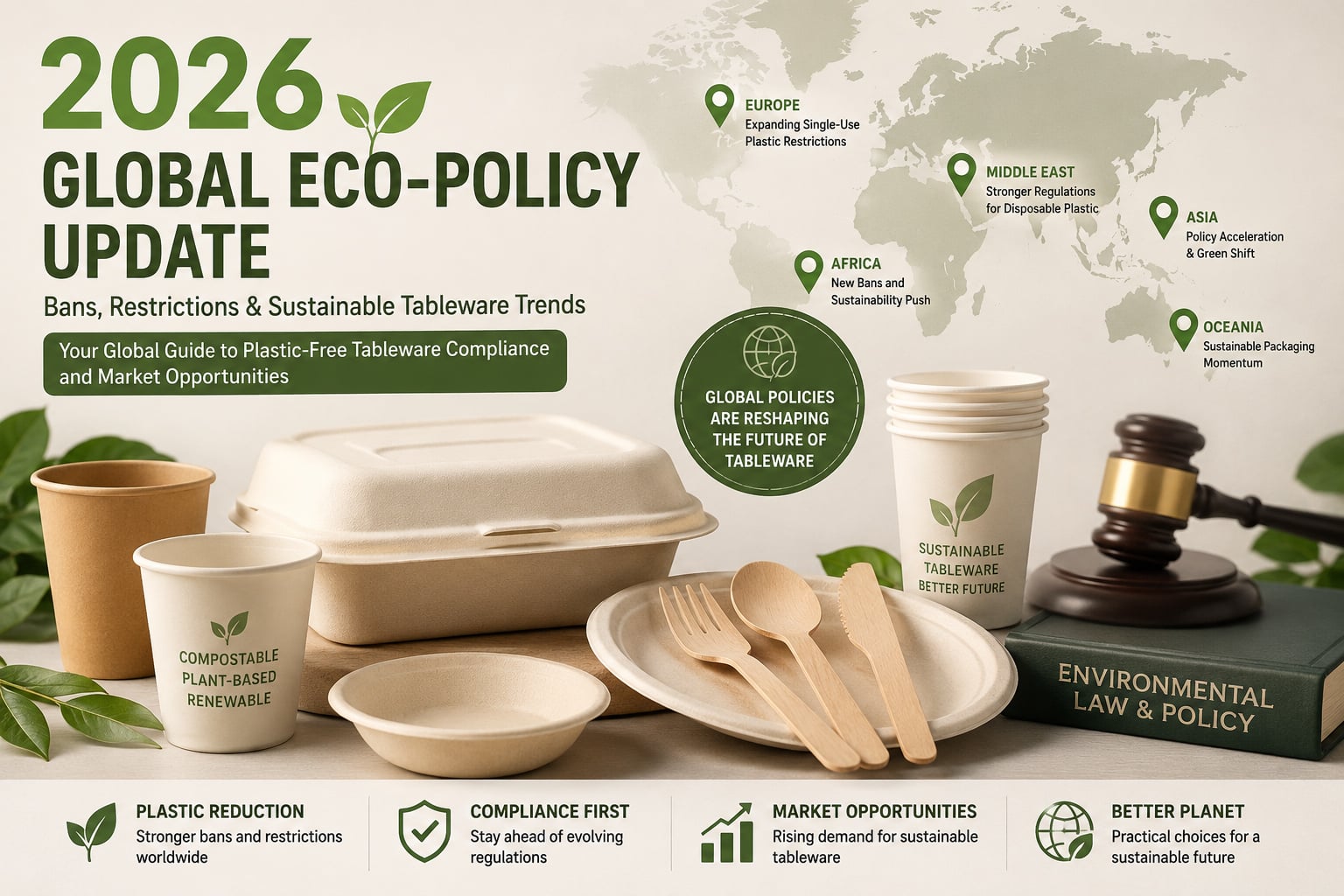
De PPWR reguleert ook zorgwekkende stoffen en biedt een langetermijnkader voor verpakkingsminimalisatie en recycleerbaarheid. De beperkingen en mijlpalen ervan moeten worden gelezen in samenhang met bestaande wetgeving inzake voedselcontact en de EU-richtlijn inzake single-use plastics (SUPD). Voor historische context per land, zie Bioleader’s beleidsupdate 2026 voor wereldwijd plastic tafelgerei.
De aangekondigde EPS-uitfasering van Ghana biedt een duidelijk voorbeeld van vervanging van 2027
De Environmental Protection Authority van Ghana heeft aangekondigd dat een landelijke beperking op polystyreenschuimproducten, waaronder afhaalmaaltijdverpakkingen, van kracht zou worden op januari 1, 2027. Het is officiële verklaring van mei 2026 en daaropvolgende publieke betrokkenheid wijzen producenten, importeurs, distributeurs en voedselverkopers aan als betrokken partijen. Op het moment van dit rapport is de startdatum een aangekondigde, aanstaande handhavingsmijlpaal, geen bewijs dat handhaving al heeft plaatsgevonden. Inkopers dienen lokale implementatieberichten te bevestigen voordat zij zendingen plaatsen of inklaren.
| Datum / status | Vereiste of aangekondigde maatregel | Praktische implicatie voor verpakkingen |
|---|---|---|
| augustus 12, 2026 — van toepassing | De meeste bepalingen van de EU-PPWR beginnen van toepassing te worden, inclusief gespecificeerde PFAS-limieten voor verpakkingen die met voedsel in contact komen. | Vraag productspecifiek bewijs aan voordat u betrokken voedselverpakkingen op de EU-markt brengt. |
| januari 1, 2027 — aangekondigd door de EPA van Ghana | Het landelijke verbod van Ghana op gespecificeerde EPS-schuimproducten staat gepland om van kracht te worden. | Kwalificeer alternatieven voor schuim bakken met scharnierdeksel, bekers en borden en controleer de actuele invoer- en handhavingsrichtlijnen. |
| februari 12, 2027 — EU artikel 32 | Relevante afhaalondernemingen moeten een systeem bieden waarbij consumenten hun eigen verpakking kunnen meenemen. | Overweeg hervulactiviteiten naast de inkoop van wegwerpverpakkingen. |
| Februari 12, 2028 — EU-artikel 33 | Relevante afhaalondernemingen moeten herbruikbare verpakkingen aanbieden binnen een hergebruiksysteem. | Beoordeel de logistiek voor retour, hygiëne en afwassen; dit is niet uitsluitend een materiaalwijziging. |
| Vanaf 2030 — toekomstige EU-fasen | Verdere PPWR-eisen op het gebied van design-for-recycling, verpakkingsformaat en andere eisen gelden volgens de respectieve bepalingen en uitvoeringsmaatregelen. | Ontwerp een nieuw verpakkingsprogramma niet uitsluitend rond de normen van vandaag. |
Regelgevende grens: Dit is een overzicht van de inkoop van voedselverpakkingen, geen universele lijst voor juridische goedkeuring. Controleer het toepasselijke PPWR-artikel, de nationale uitvoeringsmaatregelen, de regels voor voedselcontact en de precieze productdefinitie voor elke bestemming. Voorgestelde maatregelen, richtsnoeren en toekomstige deadlines mogen niet worden beschreven als wetten die al van kracht zijn.
3. Welke duurzame materialen kunnen plastic in 2027 realistisch vervangen?
Materiaalgereedheid is nuttiger dan een algemene ranglijst van welke stof het “groenst” is. Een volwassen productieproces kan betrouwbare doorlooptijden bieden, maar een specifieke coating vereisen. Een nieuw polymeer kan veelbelovende afbraakeigenschappen hebben, maar een geschikte kwaliteit, een lokale inzamelroute of een concurrerende levering voor het formaat van de koper missen. De onderstaande vergelijking is een kwalitatieve redactionele beoordeling, geen gemeten levenscyclusanalyse of een vaststelling van juridische conformiteit.
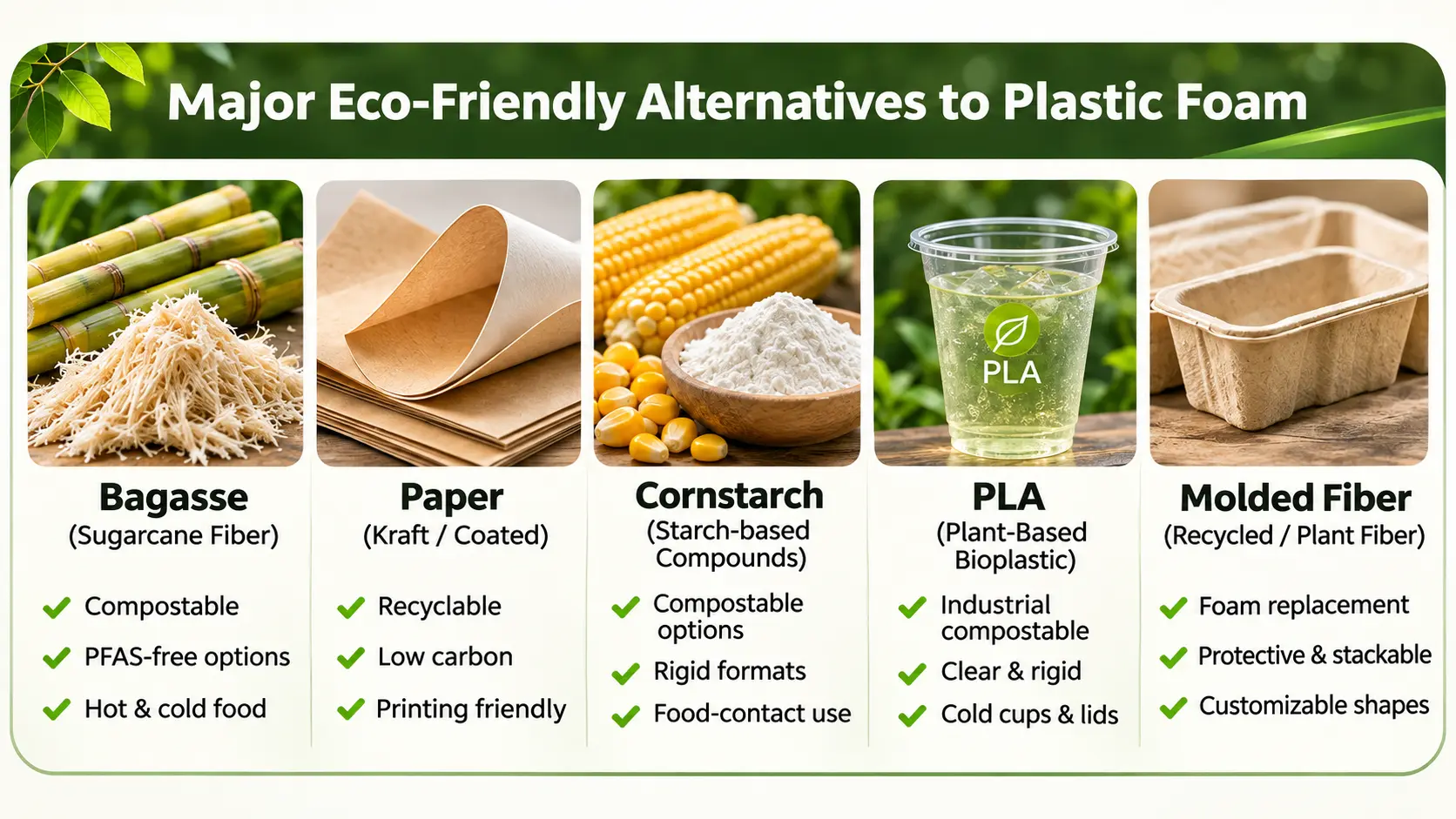
| Materiaal of systeem | Commerciële gereedheid voor relevante toepassingen | Praktische vervangende toepassing | Kritieke beperking om te verifiëren |
|---|---|---|---|
| Gevormde vezel van suikerrietbagasse | Gevestigd voor wegwerpvoedselverpakkingen en servies voor foodservice. | EPS-bakken met scharnierdeksel, borden, dienbladen en bepaalde kommen. | Vet- en waterbestendigheid, samenstelling voor voedselcontact en daadwerkelijke composteerroute verschillen per afgewerkte SKU. |
| Verpakkingskarton en andere gevormde vezelformaten | Gevestigd voor verpakkingskartonnen bekers, kommen en dozen en voor geselecteerde gevormde vezelformaten die geschikt zijn voor voedselcontact. Gerecyclede gevormde pulp is ook gevestigd in niet-voedselverpakkingen. | Verpakkingskartonnen bekers, kommen en dozen; andere voor voedselcontact geschikte gevormde vezelformaten zoals dienbladen en inzetstukken; en gerecyclede gevormde pulp voor beschermende niet-voedselverpakkingen. | Coatings, natsterkte, drukinktchemie en dekselmaterialen beïnvloeden de prestaties en de afvoer. Gerecyclede gevormde pulp voor niet-voedseltoepassingen mag niet als geschikt voor direct voedselcontact worden beschouwd; verifieer het afgewerkte artikel voor het beoogde gebruik en de markt. |
| Hout en correct gespecificeerde bamboe producten | Gevestigd in geselecteerde toepassingen voor voedselcontact. | Bestek, stokjes en sommige stijve serveerartikelen. | Controles voor voedselcontact, splinterbestendigheid en het onderscheid tussen massieve vezel en met bamboe gevulde plastic composieten. |
| Maïszetmeelgebaseerde compounds / PSM | Beschikbaar in commerciële kwaliteiten voor gevormd servies, met sterk variërende formuleringen. | Geselecteerde kommen, bakken met scharnierdeksel, borden en bestek. | Het zetmeelpercentage bepaalt niet of iets plasticvrij of composteerbaar is; maak de polymeerbestanddelen bekend. |
| PLA / gekristalliseerd PLA (CPLA) | Gevestigd voor specifieke bekers en bestek. | Transparante koude bekers en bestekkwaliteiten voor hogere temperaturen. | Ze blijven plastics voor relevante wettelijke definities; einde levensduur en gebruikstemperatuur zijn afhankelijk van de kwaliteit. |
| Met calciumcarbonaat gevuld polypropyleen | Commercieel gevestigd als een gevuld plastic compound. | Sommige gevormde of thermisch gevormde stijve artikelen waar dit wettelijk is toegestaan. | Bevat nog steeds PP-polymeer; het vulstofgehalte alleen maakt het artikel niet composteerbaar of vrijgesteld van plasticbeperkingen. |
| PHA en andere opkomende biopolymeren | Commercieel in sommige toepassingen; schaal en prijsstelling op verpakkingskwaliteit variëren. | Geselecteerde films, coatings en speciale producten. | Controleer de daadwerkelijke hars, het coatingsysteem, de goedkeuring voor voedselcontact, de conversieopbrengst en het bewijs voor einde levensduur. |
| Zeewiergebaseerde materialen en myceliumsystemen | Formaatspecifiek en over het algemeen minder gestandaardiseerd voor grootschalige vervanging in foodservice. | Geselecteerde films, speciale verpakkingen en beschermende opvulling. | Geschiktheid voor voedselcontact, vochtbeheersing, houdbaarheid en betrouwbare volumetoevoer moeten worden aangetoond. |
Where molded sugarcane fiber has a practical advantage
For an opaque takeaway box that must support a hot meal, molded bagasse offers a familiar rigid structure without a conventional EPS or PP container body. It can be formed as a hinged box, plate, bowl or tray. Different products serve different foods: a shallow plate for a short meal service is not the same specification as a sealed bowl carrying curry. Bioleader® manufactures sugarcane bagasse tableware for foodservice applications, but selection should begin with the required food contact, temperature and holding time rather than the material name alone.
Paperboard and molded fiber: the barrier decides much of the outcome
Paper packages can provide printability, nested shipping efficiency and a familiar foodservice format. Yet a paperboard cup lined with polyethylene (PE) is not the same article as a PLA-lined cup or a water-based barrier-coated cup. The same issue appears in soup bowls and folded food boxes. Buyers can review Bioleader’s papieren voedselverpakkingsoplossingen by format, then inspect the finished wall construction, lid type and application-specific reports.
Bioplastics are application materials, not universal legal shortcuts
PLA is useful for transparent cold beverages where the specified product can remain within its intended temperature and storage limits. Crystallized PLA (CPLA) is more relevant to heat-tolerant cutlery applications, but neither term guarantees home composting or an exemption from single-use plastic law. PHA is a family of polymers rather than one standardized food container material. Buyers should distinguish what a resin can do under a laboratory condition from what a finished article can legally claim in its destination market. The EU’s policy framework explicitly separates biobased, biologisch afbreekbaar en composteerbaar.
For detailed material chemistry rather than a repeated primer here, see Bioleader’s gids voor duurzame verpakkingsmaterialen.
4. Best Alternatives to EPS Foam Food Containers: Choose by Meal and Service Model
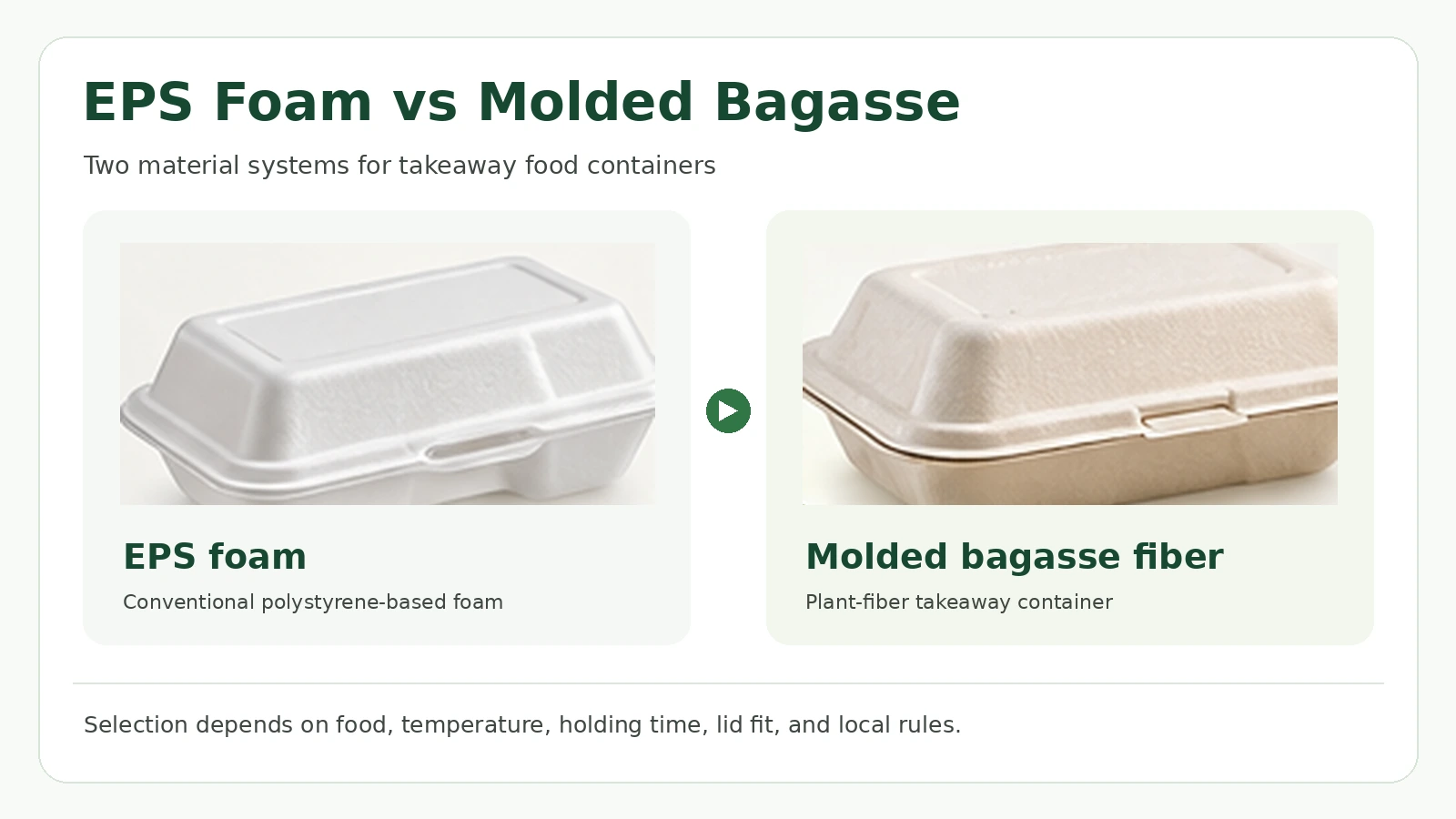
There is no one-to-one EPS replacement that works across every foodservice format. Foam’s low weight and insulation have made it useful in takeaway, but a substitute must also control leaks, stacking pressure, reheating and delivery handling. A buyer replacing a nine-inch hinged foam box should first define the menu and portion size, then approve the alternative product and its lid as one complete system.
| Current EPS use | Practical replacement to evaluate | Sample approval test |
|---|---|---|
| 9 × 9-inch hinged hot-meal box | Rigid bagasse clamshell with matching closure. | Hot, oily meal holding; hinge closure; stacking and delivery deformation. |
| Foam soup or noodle bowl | Correctly lined paper soup bowl or qualified molded-fiber bowl with lid. | Near-service-temperature liquid, 30–60-minute holding, tilt and lid leakage. |
| Foam cafeteria plate or compartment tray | Bagasse plate or molded-fiber meal tray. | Wet-food sagging, divider stability, tray handling and meal presentation. |
| Foam produce or retail display tray | Food-contact-qualified molded-fiber produce tray, where moisture and shelf-life requirements permit. | Chilled moisture, condensation, product damage and film/lid compatibility. |
| Closed-campus disposable service | Returnable food container system where washing and recovery are controlled. | Return rate, wash hygiene, loss, labor and total system cost. |
For takeaway and delivery, a natural starting point is a range of bagasse clamshell food containers. For wet or liquid dishes, the more appropriate comparison may be a paper soup bowl with a compatible lid. These product groups solve different problems; they should not be treated as interchangeable on the basis of volume alone.
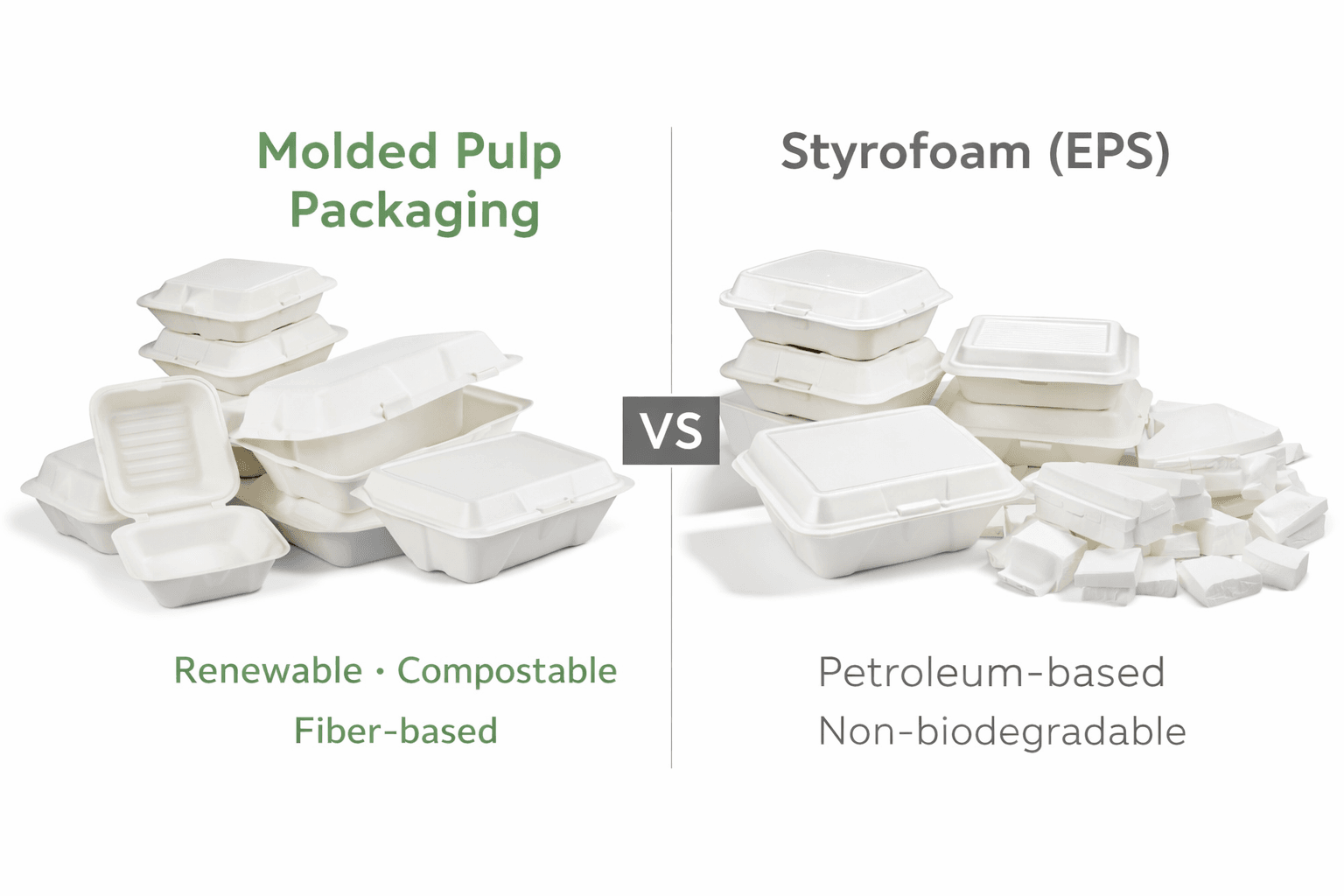
The sustainability comparison also changes with use. A high-return reusable system may be attractive in a hospital, campus or stadium where collection and washing are organized. For dispersed delivery routes without a return mechanism, a single-use fiber pack may be operationally more realistic. Actual environmental superiority requires a consistent functional unit and local end-of-life data, not just an assumption based on material origin. For a narrower material comparison, see molded pulp versus Styrofoam (EPS).
5. The Hidden Trade-Off: Starch-PP and Mineral-Filled Plastics
Cornstarch blends: renewable content is not a compostability test
“Cornstarch tableware” can describe products with different material compositions. A finished part may contain starch with biodegradable polymers, conventional polymers or additives selected for molding and performance. These variations affect heat behavior, brittleness, food-contact assessment and whether an industrial compostability claim can be supported. The term PSM or “plant-based” is not, by itself, a recognized universal compliance certificate.
Bioleader supplies a range of wegwerpservies op basis van maïszetmeel. Buyers need the formulation or reliable material declaration for the actual grade, together with applicable finished-product evidence. A product should not be sold as compostable merely because it includes starch. More detail appears in the scientific comparison of cornstarch packaging and CPLA compostability.
Calcium carbonate in PP: possible resin reduction, not plastic elimination
Highly filled polypropylene (PP) can reduce the proportion of polymer in a molded article and may alter compound cost, rigidity, weight and processing behavior. But the container remains a polymer-containing composite. Claims such as “70% minerals,” even if supported by formulation data, do not prove that a finished food box is plastic-free, biodegradable or exempt from plastic restrictions. Greater mineral loading can also change impact resistance, sealing and transportation weight; the outcome must be evaluated on the complete article.
2027 editorial judgement: Cost-driven filled plastics may remain competitive in markets where their use is permitted, while fiber-based alternatives may be a clearer starting point where regulations target specified plastic or foam formats. The best commercial option depends on the market’s legal definition and the finished product’s performance—not a supplier’s headline filler percentage.
6. Coatings, PFAS and Waste Collection Can Reverse an Apparent Sustainability Advantage
PFAS-free, plastic-free and compostable answer different questions
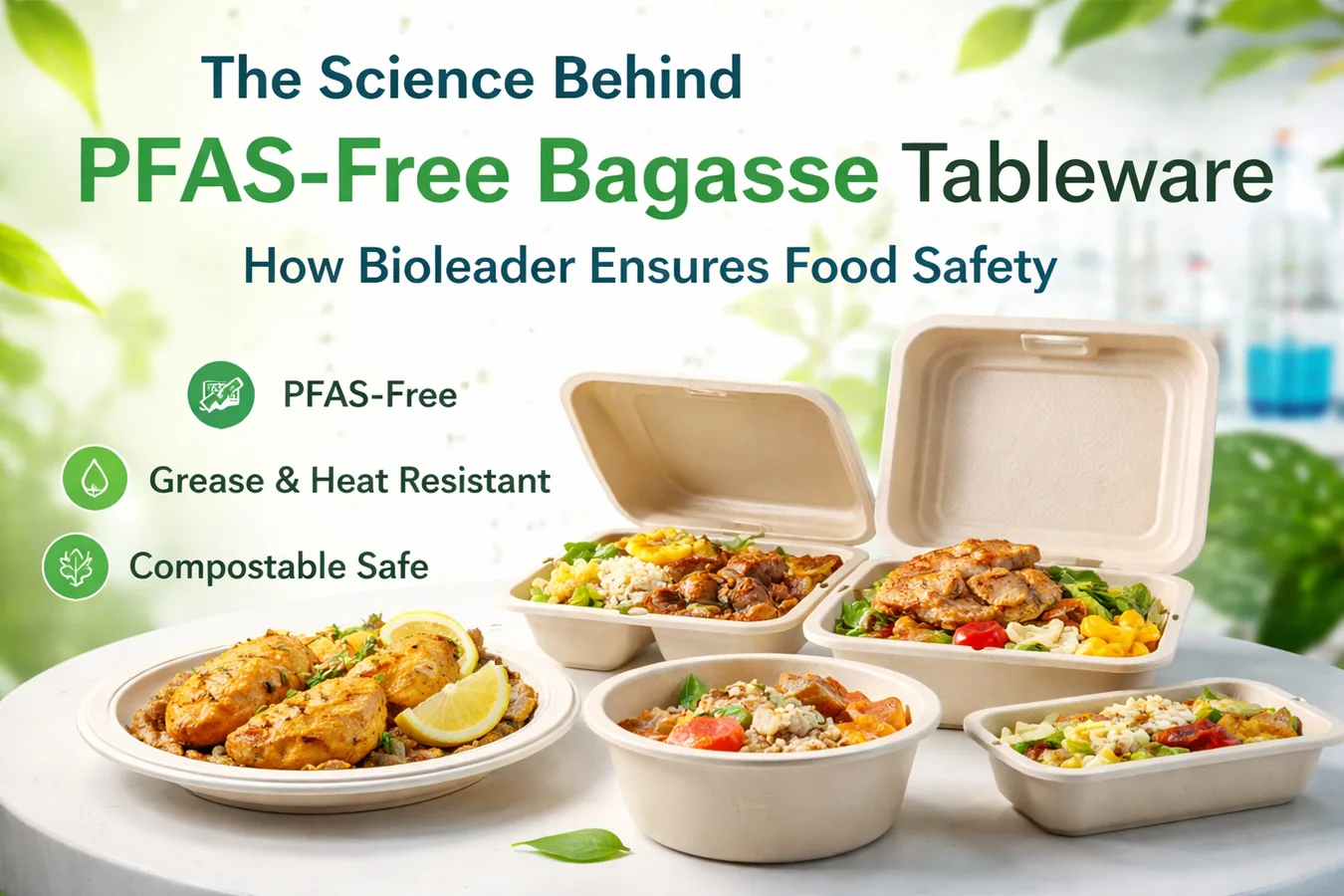
A PFAS declaration concerns a group of chemicals. A plastic-free claim concerns the material composition and the applicable legal definition. A compostability claim concerns behavior under defined treatment conditions. One does not establish either of the others. A fiber bowl may be manufactured without intentionally added PFAS yet still require finished-product testing for regulated substances; a paper cup may be PFAS-free while retaining a polymer barrier.
Under Article 5(5) of the EU PPWR, from August 12, 2026, food-contact packaging must not be placed on the market at or above specified PFAS thresholds: 25 ppb voor een individuele gerichte PFAS, 250 ppb for the targeted PFAS sum en 50 ppm for PFAS including polymeric PFAS, with related total-fluorine evidence provisions. Total fluorine is a screening indicator, not an interchangeable measurement of all PFAS. A supplier’s “no intentionally added PFAS” statement or one non-detect result cannot alone demonstrate conformity with every applicable PPWR condition.
Why the complete paper cup or bowl must be assessed
Paperboard packaging can use PE, PLA or water-based coating systems. Their heat performance, polymer classification, recycling compatibility and compostability depend on the complete structure. A water-based application process does not automatically make the dried barrier layer polymer-free or legally plastic-free; the final coating chemistry and applicable market definition must be assessed. Bioleader has documented a PHA-based aqueous barrier option for certain paper cup formats. That description should not be converted into a universal claim that every water-based coated cup is legally plastic-free, home compostable or suitable for all hot beverages. The exact SKU, coating weight, lid and available test report still matter.
Collection and processing are part of the environmental specification
A technically recyclable structure may not be collected or sorted in a particular municipality. Industrially compostable packaging may be rejected by a local organics processor, and industrial compostability is not proof of home compostability. Contaminated multi-material packs may have a different fate from clean, single-material paperboard. An honest environmental assessment should state the intended disposal route and whether it is actually available to the buyer’s customers.
For deeper life-cycle and end-of-life distinctions, see compostable versus recyclable packaging and carbon impacts. When communicating environmental claims, avoid describing a product as “zero-impact,” “ocean biodegradable” or “fully recyclable everywhere” without product-specific and location-relevant evidence.
7. Bioleader® Manufacturing Insights: What Actually Works at Commercial Scale?
Heat and grease specifications must describe a service condition
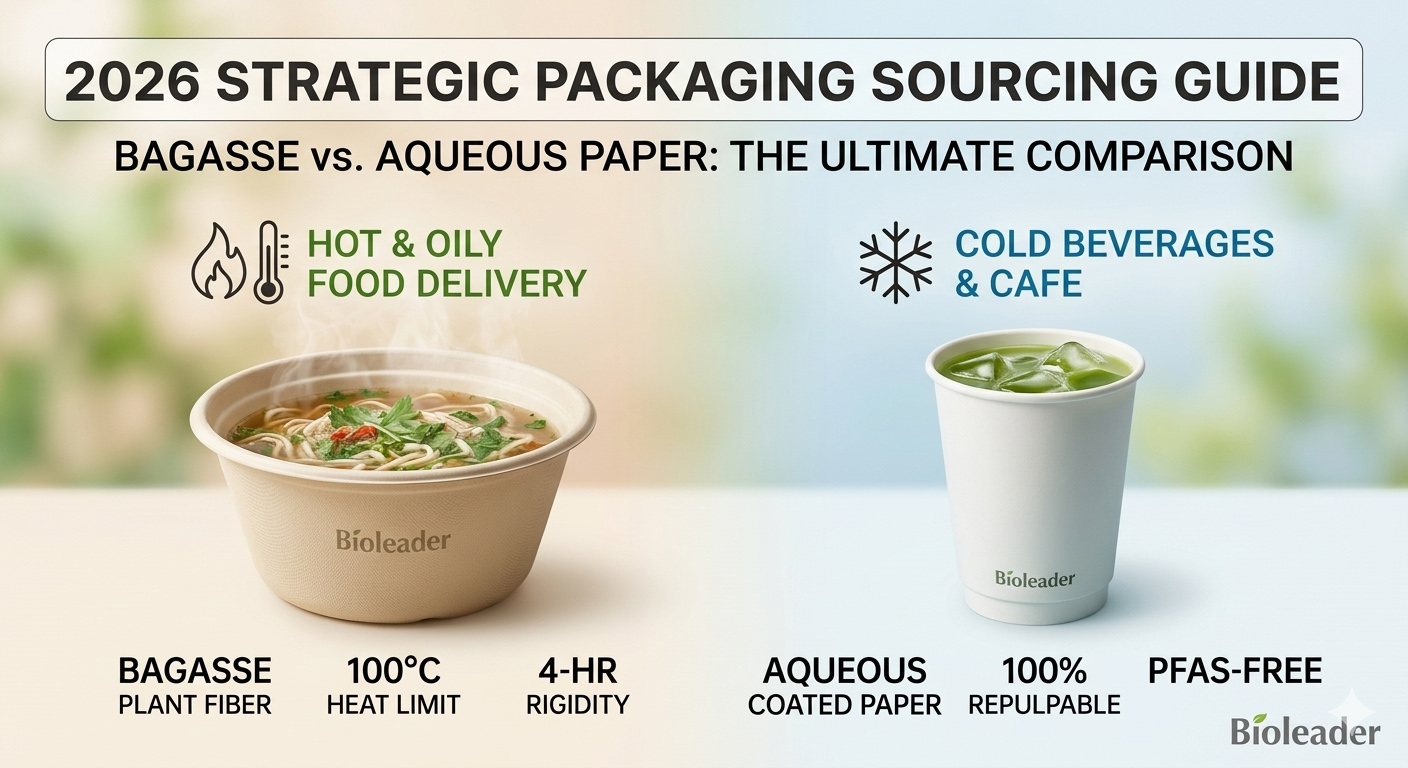
In molded-fiber production, grease resistance and wet strength are influenced by fiber structure, forming conditions and the barrier formulation. Bioleader’s bagasse range includes different PFAS-free performance specifications. A standard food box designed for moderate service should not inherit a specialized high-performance SKU’s claims. For a hot takeaway project, the useful specification is not simply “heat-resistant”; it is the actual food temperature, oil and sauce exposure, holding duration, expected reheating procedure and compatible lid.
Voorbeeld evaluatieprotocol: Fill the container with the intended meal at the target service temperature, close it using the proposed lid, and observe leakage, hinge movement, bottom softening and stacking stability over the expected delivery interval. If microwave use is required, verify the complete configuration, including whether the lid must be removed. Results from one model cannot be generalized to every bagasse format.
Barrier performance and manufacturing cost are linked
Adding a separate post-forming barrier application to molded pulp introduces additional process steps, drying or curing considerations and production cost. That may be justified for some high-performance applications, but it is not automatically an economical choice for a low-cost disposable clamshell. The more practical question is whether the selected forming formulation already meets the food application with acceptable yield, cost and documented food-contact performance.
MOQ, molds and freight determine whether substitution is executable
For Bioleader’s regular bagasse formats, indicative minimum quantities are commonly about 50,000 pieces per item, with some products available from approximately 30,000 pieces, subject to the confirmed specification. Other material systems and customized printing may have different minimums. A conventional production lead time is often about 30–40 dagen after order and artwork conditions are settled; new tooling, printed samples and special material formulations require separate scheduling.
Buyers comparing an EPS tray with a fiber alternative should look beyond unit weight and EXW or FOB price. Nesting, carton dimensions, a 20-foot or 40-foot container’s loading pattern, breakage allowance, port and destination charges, mold ownership and the number of SKUs can change the delivered cost substantially. A low-priced component is not a low-cost replacement if its lid does not fit or the revised carton count makes shipping inefficient.
For applications outside standard catalog dimensions, Bioleader can review custom molded pulp and bagasse packaging development, including sampling and tooling. Food-contact packaging and non-food protective molded pulp must be specified separately; recycled paper pulp used for industrial cushioning should not be assumed suitable for direct food contact.
8. The 2027 Buyer Decision Matrix: Approve a System, Not a Material Label
The framework below is intended for first-pass procurement screening. “Preferred to evaluate” identifies a logical starting point, not an assurance of legal conformity or suitability without testing.
| Buyer scenario | Preferred material or system to evaluate first | Condition that can change the decision |
|---|---|---|
| Hot, oily takeaway meal with no return system | Qualified rigid bagasse clamshell or compartment tray. | Extended hot-oil contact or long holding time may require a different formulation and lid. |
| Hot soup, curry or noodles for delivery | Tested paper soup container or compatible molded-fiber bowl. | Coating, sealing, lid pressure and liquid-temperature testing determine viability. |
| Cold transparent drinks and smoothies | Appropriately specified PLA cold cup where permitted and collection claims are justified. | Hot filling, storage heat, local single-use plastic restrictions or lack of composting acceptance. |
| Branded salad or grain bowl | Paperboard bowl with coating and lid chosen for the food. | Wet salads, oil dressing, cold-chain condensation and transparent lid composition. |
| Large workplace or campus with controlled return | Reusable packaging within a managed return and washing system. | Low return rates, long transport loops or hygiene burden can undermine the case. |
| Cost-sensitive rigid cutlery procurement | Wood, CPLA or a specifically documented starch-based compound, according to market and food temperature. | Local plastic-product restrictions, heat performance, breakage and unit economics. |
For clear drinks, Bioleader’s PLA cold cup range is an application-specific option, not a general substitute for hot beverage cups. The purchaser should compare clarity, cup and lid dimensions, cold-service temperature, shipping heat exposure and destination-market rules before requesting a final sample.
How to compare total procurement cost
Use the same functional requirement and buying volume for each alternative. A workable model is: landed packaging cost per successfully served meal = product cost + freight and import costs + allocated tooling and testing + expected damage or leakage loss + applicable handling and end-of-life system costs. Reusable programs also need collection, washing, losses and rotation assumptions. Do not compare a lightweight foam box’s unit price against a heavy-duty fiber container without checking whether they perform the same service.
9. Bioleader® 2027 Outlook: Five Predictions to Test Against Real Market Evidence
The following statements are Bioleader® editorial forecasts as of November 2026, not audited market-share findings or promises about future legislation. Each identifies a practical signal that procurement teams can monitor.
Prediction 1: Molded fiber will remain a serious EPS replacement candidate
Ghana’s announced foam restrictions and established molded-fiber manufacturing capability create a specific reason for buyers to compare clamshells and trays now. The qualification bottleneck is likely to be performance consistency, appropriate local certification and competitive delivered cost rather than the mere availability of bagasse material. Watch: announced bans, importer guidance, sample approvals and actual contract specifications.
Prediction 2: Barrier composition will carry more weight in supplier selection
As PFAS and food-contact evidence receives more scrutiny, buyers should ask what creates oil and water resistance instead of accepting “natural fiber” as a sufficient answer. Watch: SKU-level testing, supplier declarations and whether a coating changes the package’s legal or end-of-life classification.
Prediction 3: PLA and CPLA demand will diverge by product and market
Transparent cold cups and rigid cutlery solve different needs. Compostability alone will not secure market access where plastic-based articles are restricted. Watch: local definitions, actual collection acceptance, hot-food performance and whether suppliers overgeneralize from resin certification to finished goods.
Prediction 4: Filled PP and starch blends will be discussed as cost alternatives—but not universal environmental substitutes
Compound formulations that reduce conventional resin content may attract interest where purchasers prioritize price or stiffness. However, legal classification, resin composition and disposal claims will determine whether they are a credible response to a plastic ban. Watch: transparent specifications and complete-product performance, not advertised filler ratios alone.
Prediction 5: Buyers will favor suppliers able to connect test results with shipment-ready specifications
Imported packaging must satisfy more than a design brief. A supplier who can connect the test report, exact SKU, lid, artwork, packing list, shipping terms and destination-market requirement is easier to qualify than one offering only a general sustainability certificate. Watch: documentation completeness, corrective actions during sample approval and repeatability in production.
10. Practical 2027 Procurement Checklist for Importers and Foodservice Brands
- Define the item being replaced: Record current EPS or plastic model, dimensions, portion weight, food type, serving temperature, holding time and disposal setting.
- Confirm the destination-country rule: Distinguish a ban, a reporting duty, a future deadline, a voluntary certification and a labeling requirement.
- Request a material breakdown: Identify the fiber, polymer, mineral filler, coating, additive, adhesive, ink and lid material where applicable.
- Check finished-product food-contact evidence: Match the test report and declaration to the SKU, intended foods, time/temperature conditions and destination market.
- Check the exact environmental claim: Ask whether compostability is industrial or home-based, whether the complete pack is covered and whether local processors accept it.
- Run a service-condition sample trial: Test hot oil, sauce, liquid leakage, stacking, lid retention, chilling and microwave use only where relevant to the specified product.
- Confirm commercial details: Request MOQ per item, custom-print requirements, sample and tooling schedule, master-carton data, container loading, Incoterms and realistic lead time.
- Approve a final specification: Keep an approved sample, bill of materials where available, artwork, document set and inspection criteria aligned with the bulk order.
For product-specific evidence, review the Bioleader® certificate and test-report center. The scope of a document can differ by product, material, manufacturing location and target market. It should not be treated as an automatic site-wide conformity statement.
Bioleader® Packaging Options for a 2027 Material Transition
Bioleader® manufactures and supplies molded bagasse food packaging, paper cups and bowls, paper takeaway boxes, cornstarch tableware, PLA cold cups and selected cutlery systems for wholesale and OEM orders. The appropriate solution depends on the original packaging format and target market. For example, an EPS hinged meal box can be assessed against bagasse; a coated paper soup bowl requires a separate barrier and lid evaluation; a takeaway cutlery replacement needs material, heat and local legal checks.
For utensils supplied alongside replacement food containers, buyers can review compostable and biodegradable cutlery options, subject to the applicable product and market definitions. Custom printing, private-label packing, mixed-product shipments and documentary requirements should be confirmed before finalizing quantities and prices.
Frequently Asked Questions About Sustainable Food Packaging in 2027
What is the best alternative to EPS foam food containers in 2027?
For many hot takeaway meals, molded sugarcane bagasse is a practical first material to evaluate because it offers a rigid, formed container without a conventional EPS body. It is not automatically the best fit for every menu. Soup may require a specially lined paper bowl, and controlled venues may benefit from reusable packs. Test food temperature, oil resistance, lid fit and delivery time before approving the replacement.
Which food packaging materials can be considered plastic-free?
Uncoated paper, suitably manufactured molded plant fiber and solid wood may be plastic-free in relevant constructions, but the complete finished article must be assessed. Coatings, binders, laminated films, windows and lids can introduce polymers. A product made partly from starch, bamboo powder or minerals is not automatically plastic-free if its structure still contains plastic resin. Check the market’s definition and supplier material declaration before using the claim.
Is PLA packaging allowed under EU single-use plastic restrictions?
PLA is a plastic polymer and bio-based origin does not generally exempt a covered single-use plastic article from the EU Single-Use Plastics Directive. Whether a particular PLA product may be sold depends on its format, the restriction involved and applicable national measures. A compostability certificate cannot override a prohibition on a defined article. Review the exact cup, lid or cutlery format with legal and product documentation before importing.
Are cornstarch and mineral-filled PP food containers biodegradable?
Not necessarily. Cornstarch-based compounds may contain different biodegradable or conventional polymers, while a polypropylene article containing calcium carbonate still contains PP. The presence of plant starch or mineral filler does not establish biodegradation of the entire item. Require the full material specification and evidence for the finished product under a clearly defined test standard and disposal condition. Avoid broad environmental claims based solely on ingredient percentages.
Does PFAS-free packaging automatically meet EU PPWR requirements?
No. PFAS is one part of the PPWR compliance framework, and a “no intentionally added PFAS” declaration is not interchangeable with testing against every applicable regulatory threshold. A finished food-contact pack may also need conformity assessment, technical documentation and compliance with food-contact and other packaging requirements. Ask for the relevant report’s analytical scope, detection limits, tested SKU and intended market rather than relying on a generic claim.
Are paper food containers always recyclable or compostable?
No. Paperboard can be combined with PE, PLA or other coatings, adhesives, windows and lids, changing how the finished pack is sorted and processed. Grease and food contamination can also affect recycling acceptance. Compostability needs suitable evidence for the complete article under the claimed conditions, and local facilities may not accept it. Buyers should specify the intended collection route rather than assuming that every paper package follows the same disposal pathway.
What documents should importers request before replacing plastic packaging?
Request the material and component specification, relevant finished-product food-contact documents, applicable PFAS test information, environmental certification or test evidence for the claimed disposal route, and any required declarations for the destination market. Match the documents to the exact SKU and intended food conditions. Also obtain approved samples, lid specifications, carton dimensions, MOQ, tooling and printing details, commercial terms and an agreed bulk inspection plan.
Conclusion: The Best 2027 Replacement Is the One That Works in the Real World
For disposable hot-food containers, qualified molded fiber is often a sensible starting point when EPS must be removed. Paperboard is valuable for cups, soup containers and branded takeaway formats, provided its coating and lid are evaluated as part of the pack. PLA, CPLA and starch-based products should be selected for the applications and markets where their properties and legal status fit—not simply because they are called plant-based. Filled PP can be a cost or resin-efficiency option where permitted, but is not a plastic-free answer to an EPS or plastic restriction.
A workable replacement specification names the food, temperature, service time, destination market, evidence requirements and expected order quantity before it names the preferred material. Bioleader® can help importers and restaurant packaging buyers compare available formats, request suitable samples and assess OEM, MOQ, lid and export-document needs against those conditions.
References and Regulatory Sources
Source review date: November 4, 2026. The regulatory requirements below are attributed to the issuing authorities; Bioleader’s material-readiness rankings and predictions above are editorial assessments rather than official regulatory determinations.
- Europese Unie — Verordening (EU) 2025/40 betreffende verpakking en verpakkingsafval. Primary legal text, including Articles 5, 32 and 33 and phased obligations.
- Europese Commissie — Richtsnoerendocument 2026 voor Verordening (EU) 2025/40. Commission guidance on interpretation of selected PPWR provisions.
- European Commission — Packaging Waste and PPWR Overview. Policy context, objectives and staged packaging requirements.
- Ghana Environmental Protection Authority — Announced EPS Foam Prohibition for January 2027. Official policy announcement and transition notice.
- Europese Commissie — Materialen die in contact komen met levensmiddelen. General EU food-contact regulatory framework, including Regulation (EC) No 1935/2004.
- European Commission — Bio-based, Biodegradable and Compostable Plastics. Policy terminology and distinction among material claims.
- US Environmental Protection Agency — Plastic Recycling and Composting FAQ. Industrial versus home composting and collection acceptance guidance.