










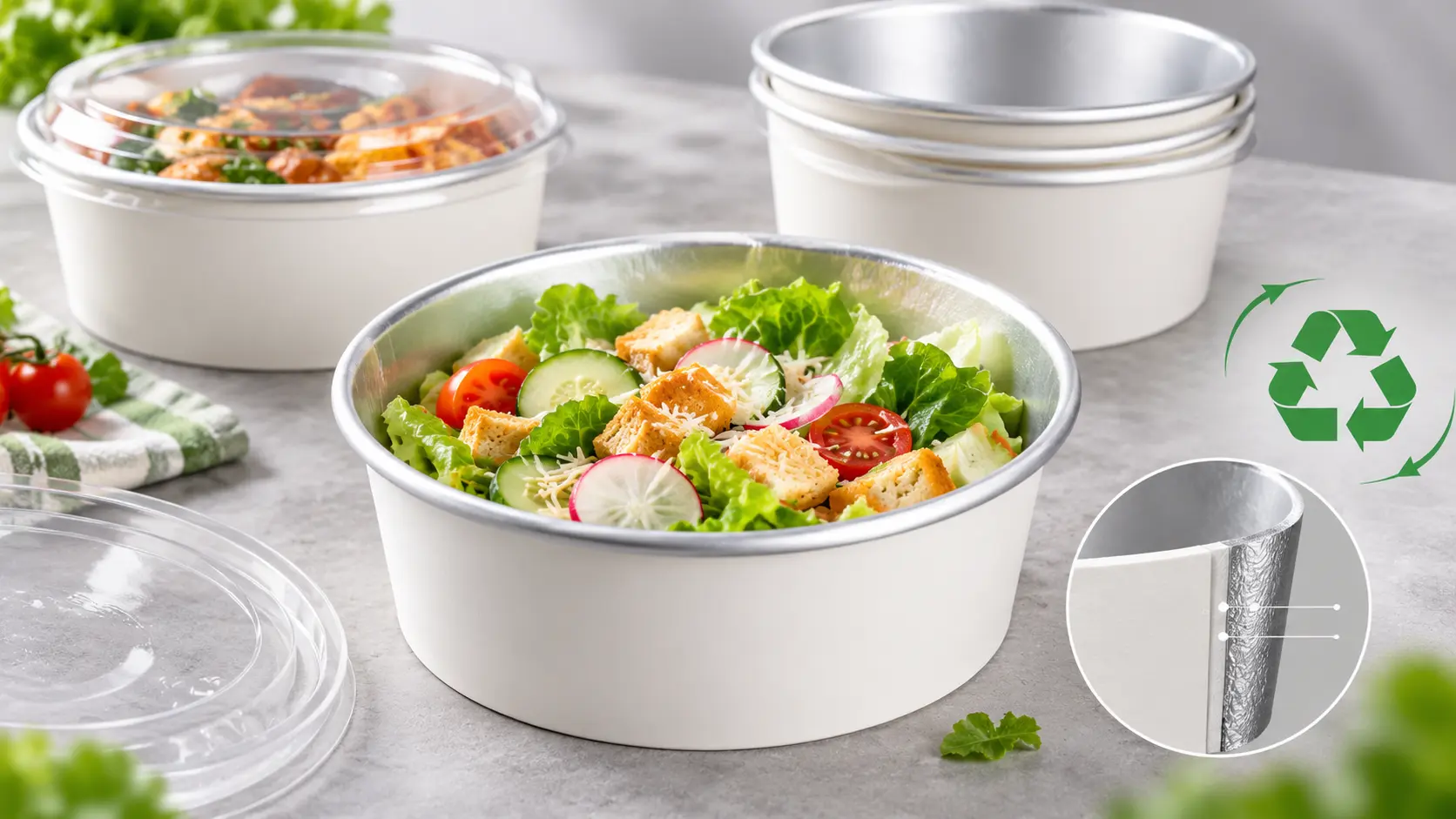
Quick Answer: Are Aluminum Foil-Lined Paper Bowls Recyclable?
Aluminum foil-lined paper bowls may be recyclable in suitable paper-recycling systems, but they are not automatically or universally recyclable. The finished bowl is a composite structure combining paperboard with aluminum foil, barrier layers and bonding materials. Its real recycling outcome depends on paper content, repulpability, screening yield, sorting, mill acceptance and the infrastructure available in the destination market.
- The complete bowl must be evaluated as composite packaging, not as paper and aluminum separately.
- Under current 4evergreen guidance, paper-based packaging designed for a conventional paper-mill recycling process generally starts from at least 80% paper content.
- Technical recyclability, local recycling acceptance and recycling in practice are different claims.
- EU PPWR recyclability grades are based on a future harmonised design-for-recycling assessment, not simply on the percentage of paper in the package.
Paper is recyclable. Aluminum is recyclable. It is therefore easy to assume that a food bowl made from paperboard and aluminum foil must also be recyclable.
The difficulty begins when those materials become one finished package. A recycler does not receive separate sheets of clean paper and aluminum. It receives a formed food container containing paper fiber, foil, coatings, adhesives, printing and often food residue. Each of those elements can affect pulping, screening, recovered-fiber quality and the amount of material rejected during processing.
This distinction is particularly relevant to products such as Bioleader® アルミ箔ライナー紙製スープボウル, where a paper-based structural body is combined with a metallic barrier system for soup, noodles, curry, porridge and other demanding takeaway foods.
What Is an Aluminum Foil-Lined Paper Bowl Made Of?
An aluminum foil-lined paper bowl is not the same product as a pressed aluminum container. Paperboard remains the main structural body, while a laminated inner structure provides the barrier required for oily, wet or hot foods.
Published Bioleader® specifications for current foil-lined bowl ranges list paperboard in approximately the 300–337 gsm class, depending on the SKU and paper grade, together with an aluminum foil liner and application-specific coating system. Exact foil thickness, coating weight and individual layer weight should be taken from the technical data sheet for the SKU being evaluated rather than assumed from a generic industry structure.
| 構成部品 | 主な機能 | Recycling Relevance |
|---|---|---|
| Paperboard body | Provides stiffness, shape, printability and most of the structural strength. | Usually provides the main recoverable fiber fraction in a paper-recycling process. |
| Aluminum foil layer | Provides additional barrier performance against moisture, grease and heat transfer. | Becomes part of the non-fiber fraction that must be separated or otherwise managed during recycling. |
| Food-contact / protective coating | Supports moisture resistance, food contact and protection of the laminate. | Coating chemistry and weight can affect disintegration, screening and recovered-fiber quality. |
| Bonding layer | Keeps the laminate stable during forming and foodservice use. | Adhesive behaviour can influence screening rejects and sheet quality. |
| Printing and decoration | Provides branding and product information. | Inks and coatings form part of the finished packaging assessment. |
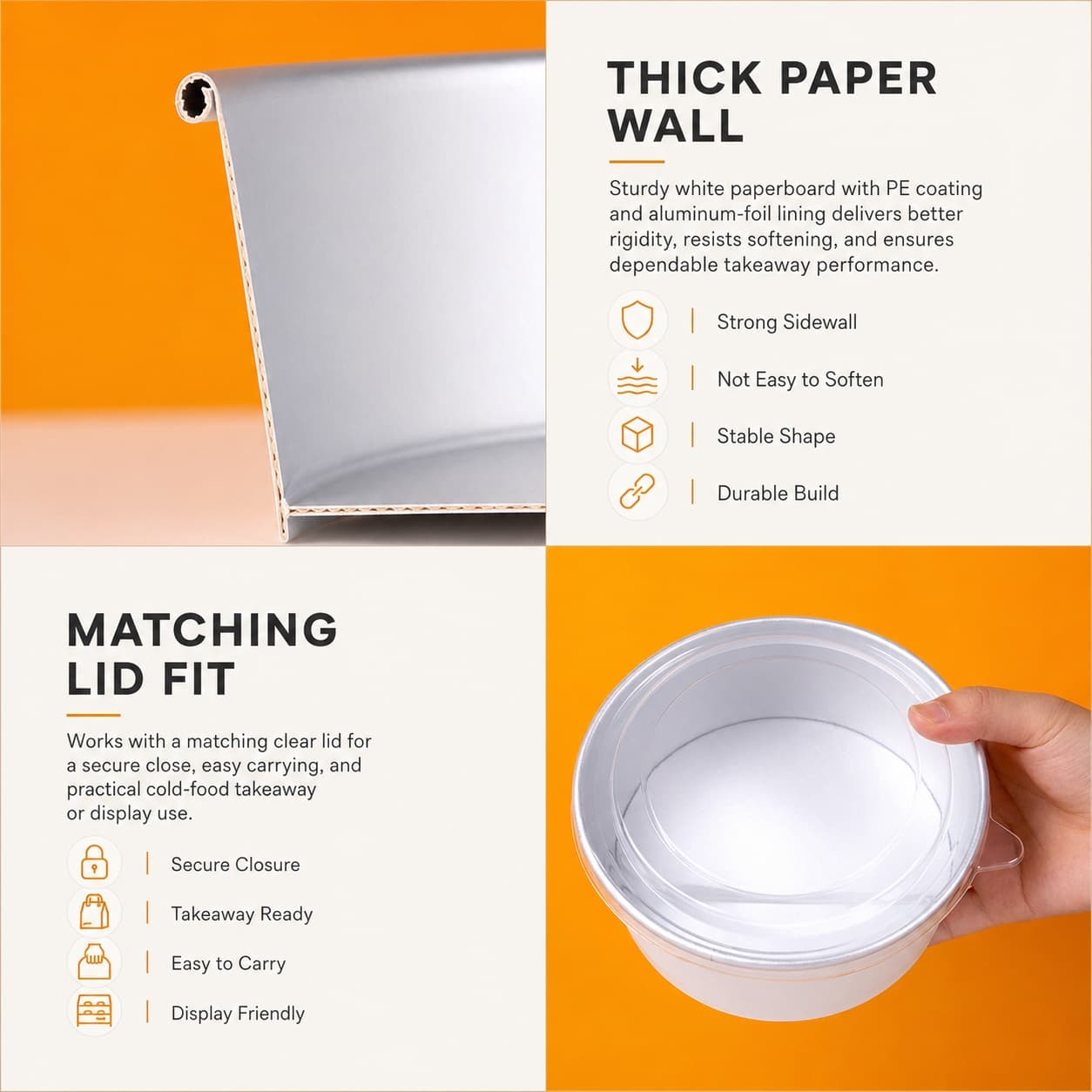
重要なポイント: The useful recycling question is not whether paper or aluminum can be recycled individually. It is whether the complete paper-aluminum laminate can be processed efficiently through the intended recycling route.
The same principle applies to Bioleader® aluminum foil-lined paper salad bowls. The outer product may look predominantly paper-based, but the inner foil and coating system still affect how the finished packaging behaves after disposal.
Are Aluminum Foil-Lined Paper Bowls Technically Recyclable?
They can be technically recyclable when the finished structure is compatible with an appropriate paper-recycling process, but that conclusion needs more than a material description.
Cepi’s Paper and Board Recyclability Laboratory Test Method reproduces important stages of a conventional recycling mill, including pulping, coarse and fine screening, and sheet formation. The 4evergreen Recyclability Evaluation Protocol uses this type of testing to determine whether a fiber-based package is compatible with conventional or more specialised recycling processes.
One useful engineering metric is Total Screening Yield (TSY). In the 2026 4evergreen Circularity by Design guidance, packaging evaluated for a conventional paper-mill process should achieve at least 80% TSY to continue through the conventional-process assessment. If screening rejects push TSY below 80%, the Technical Recyclability Score becomes negative for that route.
4evergreen therefore uses 80% paper content as the minimum starting point for packaging designed according to its conventional-mill design tables. The guidance also notes that many composite paper packages containing approximately 80%–95% paper are already processed in conventional mills in Europe, provided that their complete design remains compatible with the process.
Do not confuse two different 80% figures: 4evergreen’s 80% paper-content design threshold and 80% Total Screening Yield relate to the paper-recycling pathway. They are not the same thing as the PPWR Grade B threshold discussed later in this article.
Packaging with lower paper content is not automatically unrecyclable. It may require a specialised fiber-recycling process instead of a conventional paper mill. Structure, disintegration, screening rejects, adhesive behaviour and recovered-fiber quality remain important.
Technically Recyclable, Accepted for Recycling and Recycled in Practice
The word “recyclable” can describe very different conditions. For a composite food bowl, buyers should separate at least three questions.
| 質問 | 意味 | 証明されないこと |
|---|---|---|
| Is it technically recyclable? | The finished structure can be processed under a defined recycling process and test methodology. | It does not prove that local collection systems accept it. |
| Is it accepted for recycling? | A specific collection or waste-management program accepts the packaging format. | It does not prove that all collected units are successfully recycled. |
| Is it recycled in practice? | The package is collected, sorted, processed and converted into usable secondary material through a functioning system. | It does not mean the same result occurs in every country or municipality. |
This distinction is examined more broadly in Bioleader®’s guide 「技術的にリサイクル可能」と「実際にリサイクルされている」はなぜ同じではないのか“. Foil-lined paper bowls are a useful example because they combine a valuable fiber fraction with materials that must be separated or managed during reprocessing.
Why Paper Content Alone Does Not Determine Recyclability
High paper content can improve compatibility with a fiber-recycling process, but it is not enough by itself. Two packages with the same nominal paper percentage can produce different recycling results if one disintegrates cleanly while the other creates excessive screening rejects, adhesive contamination or visual impurities.
For that reason, professional recyclability evaluation also looks at variables such as total screening yield, coarse and fine rejects, sheet adhesion, visual impurities and dissolved or colloidal substances.
The aluminum layer should not automatically be treated as a recycling failure. Its presence changes the structure from a simpler paper package into a multi-material package whose non-fiber fraction has to be separated and managed. A specialised process may handle a structure that is unsuitable for a conventional paper mill.
Used foodservice packaging adds another variable. Soup, oil, dressing, curry and other food residue can affect collection and mill acceptance even when a clean laboratory specimen performs satisfactorily.
Material claim vs packaging claim: “Paper and aluminum are recyclable materials” describes raw materials. “This finished foil-lined bowl is recyclable in this market” is a stronger system-level claim that should be supported by the finished structure and the intended recycling route.
What Does the EU PPWR Mean for Foil-Lined Paper Bowls?
Regulation (EU) 2025/40 on packaging and packaging waste, commonly referred to as the 包装・包装廃棄物規則(PPWR), has applied from 12 August 2026.
Annex II recognises composite packaging of which the majority is paper/cardboard as a distinct packaging category. The regulation therefore does not require buyers to pretend that a foil-lined paper bowl is ordinary uncoated paper packaging simply because paperboard forms most of its structure.
Article 6 introduces a harmonised recyclability framework based first on design for recycling (DfR) and later on whether packaging is 大規模にリサイクルされる.
| PPWR Recyclability Grade | Weighted Recyclability Performance | Regulatory Meaning |
|---|---|---|
| A級 | ≥ 95% | Highest recyclability performance grade under the PPWR Annex II framework. |
| Grade B | ≥ 80% | Meets the second recyclability performance level. |
| Grade C | ≥ 70% | Technically recyclable under the framework but insufficient for market placement from 2038, subject to applicable provisions and exemptions. |
| Technically non-recyclable | < 70% | Falls below the PPWR recyclability performance threshold. |
These percentages are not raw-material ratios. A bowl containing 95% paper by weight does not automatically become PPWR Grade A, and a package containing 10% aluminum or polymer does not automatically become Grade C. PPWR grades will be calculated according to the applicable design-for-recycling criteria, weighting methodology and packaging-category rules established under Article 6.
The practical design direction is still clear: unnecessary non-fiber material should be minimised where food performance allows, and components should be selected so that they interfere as little as possible with collection, sorting and material recycling. But suppliers should not advertise an unsupported future PPWR Grade A, B or C simply by subtracting foil and coating weight from the paper percentage.
Buyers comparing other structures can review Bioleader®’s wider 紙製スープボウルシリーズ, where barrier systems and lid configurations vary according to hot-food, takeaway and delivery requirements.
What Happens in a Real Recycling System?
A technically compatible foil-lined bowl still has to pass several real-world gates after use.
- 回収: the local recycling program must accept the packaging format.
- 分別: the bowl must reach the appropriate fiber or composite-packaging stream.
- Repulping and screening: usable fibers need to separate from foil, coatings, adhesives and other rejects.
- Recovered-fiber quality: the accepted fiber must be suitable for producing secondary paper or board.
- Non-fiber management: foil, polymers and other residues need an appropriate recovery or treatment route.
- 最終市場: the recovered material needs a practical downstream application.
This is why a structure that can be recycled by one mill may still be excluded from another municipality’s collection system. Recycling infrastructure is not globally uniform.
The same issue explains why broad claims such as “100% recyclable” need caution. Bioleader® discusses environmental-claim verification in its guide to greenwashing in sustainable food packaging. For a multi-material bowl, the evidence should match the complete product and the market in which the claim will appear.
What Should Buyers Check Before Making a Recyclability Claim?
Buyer Recyclability Checklist
- Confirm the complete layer structure. Request the paperboard grade, liner, coating and bonding specification for the exact SKU.
- Request the material weight breakdown. Paper percentage is useful when determining the appropriate fiber-recycling pathway.
- Do not rely only on paper percentage. Ask whether finished-product repulpability or recyclability data is available.
- Identify the intended recycling process. Conventional paper mills and specialised fiber-recycling mills do not have identical acceptance conditions.
- Check the destination market. Collection instructions and recycler acceptance can differ between countries and municipalities.
- Evaluate the lid separately. PP, PET and paper lids may enter different recycling pathways from the bowl body.
- Verify the wording used on artwork. The claim should not imply universal recycling when the evidence applies only to a defined system or market.
B2B Specification Support
Need the exact paper grade, laminate structure or material-weight information for a foil-lined bowl project? Bioleader® can provide the relevant product Technical Data Sheet (TDS), available food-contact and compliance documentation, and SKU specifications for buyer review. Where recyclability is a project requirement, buyers should also ask what finished-product recyclability or repulpability evidence is available for the proposed structure.
Request the Bioleader® aluminum foil-lined paper bowl TDS and available compliance documentation before finalising packaging claims or artwork.
This specification-first approach also applies across the broader 紙製サラダボウルシリーズ. A standard coated bowl, a foil-lined bowl and a paper bowl paired with a plastic lid can have very different end-of-life pathways even when all three appear paper-based to the consumer.
Recyclability Should Not Be Separated From Food Performance
Removing a functional barrier may simplify the material structure, but that change only makes commercial sense if the new package can still contain the intended food safely and reliably. Soup, oily curry, wet noodles and long delivery times place much greater demands on a bowl than dry snacks or short-service cold foods.
Bioleader® has separately compared foil-lined paper, conventional kraft paper and thin-wall PP systems in a controlled takeaway container heat-retention test. That test answers a performance question rather than a recyclability question, but buyers need both when selecting a commercial packaging system.
Manufacturer Insight: Start With the Food, Then Define the End-of-Life Route
For a packaging manufacturer, the useful question is not whether aluminum foil-lined paper bowls are simply “recyclable” or “non-recyclable.” The better specification defines the food, filling temperature, oil and moisture exposure, holding time, lid requirement, destination market and intended environmental claim.
If conventional paper-stream recycling is a priority, paper content, screening yield and compatibility with a conventional mill become important design variables. If the required barrier structure cannot meet that route, the buyer should evaluate whether a specialised recycling process is realistically available in the target market rather than forcing an unsupported paper-recycling claim.
So, Are Aluminum Foil-Lined Paper Bowls Recyclable?
They can be recyclable, but the answer belongs to the finished packaging system rather than to paper or aluminum individually.
For conventional paper recycling, current 4evergreen guidance gives buyers a useful technical reference point: packaging designed for that route generally starts from at least 80% paper content and must still demonstrate acceptable screening yield and other recycling-performance parameters.
Under the EU PPWR, the question becomes even more structured. Grade A, B and C are based on weighted design-for-recycling performance, not simply on paper percentage. From a procurement perspective, the safest approach is to obtain the SKU-level material structure, identify the intended recycling pathway and verify the destination-market infrastructure before printing a recyclability claim.
FAQ: Aluminum Foil-Lined Paper Bowl Recycling
アルミ箔ライニング紙ボウルはリサイクル可能ですか?
完成した紙とアルミニウムの構造が適切なリサイクルプロセスに対応していれば、技術的にはリサイクル可能となり得ます。ただし、それによってすべての地域でリサイクル可能になるわけではありません。地域の回収体制、選別、製紙工場の対応能力、食品による汚染、そしてラミネート全体の設計が、そのボウルが実際にリサイクルされるかどうかに影響します。.
紙ボウルがリサイクル可能であるためには、少なくとも80%の紙を含む必要がありますか?
すべてのリサイクル工程で対応しているわけではありません。現在の4evergreenのガイダンスでは、従来の製紙工場向けリサイクル表に基づいて設計された包装について、少なくとも80%の紙含有率を出発点としています。これを下回る包装は、専用の繊維リサイクルルートが必要になる場合があります。紙の含有率だけではリサイクル可能性は判断できません。スクリーニング歩留まりや回収繊維の品質も重要だからです。.
アルミ箔が使われていると、紙製ボウルは自動的にリサイクル不可能になるのでしょうか?
いいえ。アルミ箔が付いているからといって、紙ボウルが自動的にリサイクル不可能になるわけではありません。アルミ箔、コーティング、接着層からなる複合素材構造となり、リサイクル時にこれらの層を分離または適切に処理する必要があります。設計によっては、従来の紙リサイクル工程に対応できる場合もあれば、専用の処理が必要な場合、あるいは該当するリサイクル性評価を満たさない場合もあります。.
Does 95% paper content mean a bowl is PPWR Grade A?
No. PPWR Grade A requires a recyclability performance of at least 95% under the applicable design-for-recycling assessment. That percentage is a regulatory performance result, not simply the percentage of paper in the package. Final grading depends on the methodology and category-specific design-for-recycling criteria established under the PPWR.
Can foil-lined paper bowls go in the paper recycling bin?
Only where the local collection system accepts that packaging format. Technical recyclability does not automatically determine household or commercial bin instructions. Buyers and foodservice operators should follow the disposal guidance of the market where the packaging is actually used.
What documents should B2B buyers request from a supplier?
Request the Technical Data Sheet, exact material structure, paper grade, coating and liner specification, material weight breakdown and relevant food-contact documentation. If recyclability is part of the purchasing specification, buyers should also ask whether finished-product repulpability or recyclability test data is available for the exact SKU and intended recycling pathway.
参考文献
- European Union. Regulation (EU) 2025/40 on packaging and packaging waste. See Article 6 and Annex II for design-for-recycling requirements, composite packaging categories and recyclability performance grades.
- 4evergreen Alliance. Circularity by Design, Version 4, February 2026. Guidance covering paper-content thresholds, conventional and specialised recycling processes, and design recommendations for fiber-based packaging.
- 4evergreen Alliance. Fibre-Based Packaging Recyclability Evaluation Protocol, Version 1. Framework for evaluating technical recyclability in conventional and specialised recycling processes.
- Confederation of European Paper Industries (Cepi). Paper and Board – Recyclability Laboratory Test Method, Part I: Recycling Mill with Conventional Process, Version 3, February 2025.